Tag: Prime Minister Imran Khan

  • Police brutality, again

    Pakistan is no stranger to incidents of police brutality but there are events that leave the entire nation shell-shocked.

    Five officials of Islamabad Police’s Counter-Terrorism Department (CTD) were arrested after they gunned down a 21-year-old boy, Usama Satti, in cold blood near Srinagar Highway, G-10 sector in the federal capital.

    This incident has led the nation to question why ours is a trigger-happy police force.

    Earlier today, Senate’s Human Rights Committee Chairperson Senator Mustafa Nawaz Khokhar tweeted, “Heart goes out to the family of young Usama. Can’t imagine what his parents and loved ones must be going through. Although judicial inquiry has been ordered, will take it up in HR committee too. Use of deadly assault weapons should b the last resort. Fatal error of judgement.”

    Social media trends asking for justice for Satti as well as arresting Interior Minister Sheikh Rasheed started trending following the young man’s brutal killing.

    In a report published by Human Rights Watch (HRW) in 2016 on police in Pakistan, the rights group noted that successive Pakistani governments have for decades failed to reform an under-resourced and under-equipped police force or hold abusive police to account. 

    Two years ago in January 2019, police officials killed several members of the same family in Sahiwal town on suspicion of terrorism. At that time, Prime Minister (PM) Imran Khan not just condemned the killings but he also promised police reforms so as to avoid torture and extrajudicial killings.

    An anti-terrorism court acquitted all six personnel of the CTD who were allegedly involved in the Sahiwal incident. The Punjab government did challenge the acquittal but such is the state of justice in this country that an encounter in broad daylight in front of young children could not garner any justice for the victims’ family.

    Two years ago in January 2019, police officials killed several members of the same family in Sahiwal town on suspicion of terrorism. At that time, Prime Minister Imran Khan not just condemned the killings but he also promised police reforms so as to avoid torture and extrajudicial killings. An anti-terrorism court acquitted all six personnel of the CTD police who were allegedly involved in the Sahiwal incident. The Punjab government did challenge the acquittal but such is the state of justice in this country that an encounter in broad daylight in front of young children could not garner any justice for the victims’ family.

    Police reforms were one of the key promises made by PM Imran and his party, the ruling Pakistan Tehreek-e-Insaf (PTI), when they came to power in 2018. Unfortunately, we have not seen any substantive move towards the same. It is important now more than ever that the government starts walking the talk because such incidents occur due to lack of accountability. We cannot continue to live in fear of a trigger-happy police force that can kill at will without any consequences.

    After police reforms in Khyber Pakhtunkhwa (KP) by the PTI government during its last tenure, we had high hopes that the PTI’s federal government would emulate the KP Police Act, 2017 in other provinces where it is in power, especially Punjab. We hope that the government would now do so at an urgent basis. 
  • Nothing wrong with U-turns if they don’t ‘compromise ideology’: PM

    Nothing wrong with U-turns if they don’t ‘compromise ideology’: PM

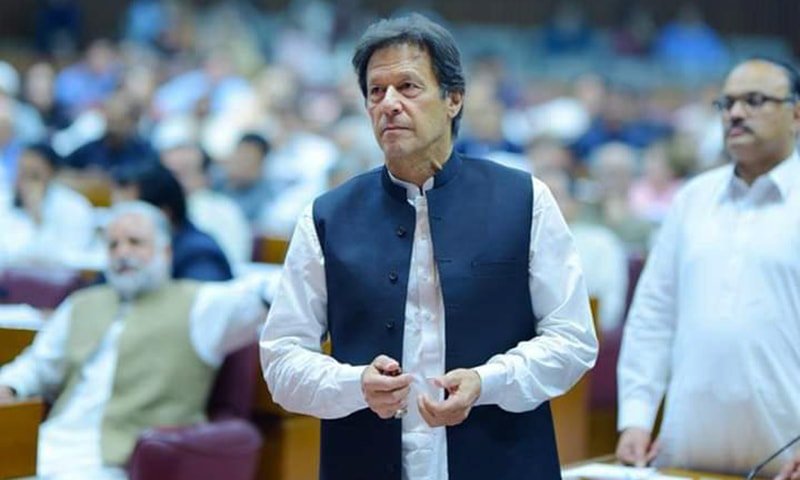
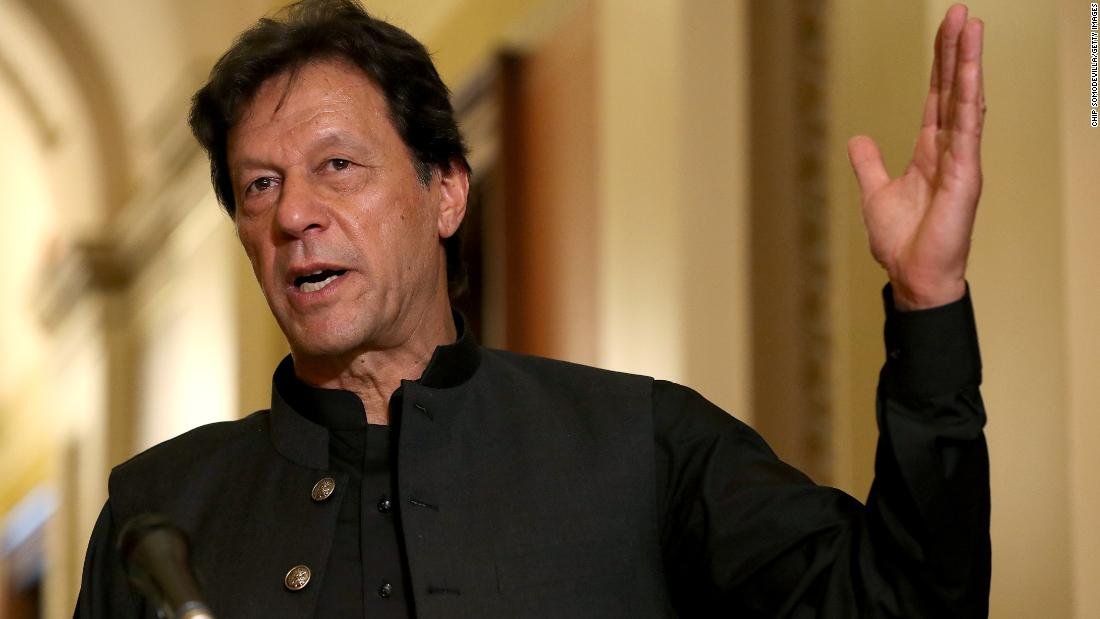
    Prime Minister Imran Khan has defended his U-turns once again, saying that going back on one’s words is fine as long as it doesn’t compromise “ideology”.

    This is not the first time Imran has tried to defend the actions that saw him walk away from his promises. In 2018, he had said: “A leader who does not take ‘U-turns’ [in the best interests of the nation] is not a ‘real leader’.”

    APP, the state-run news agency, reported the PM as saying that the idea of making “compromises to reach the ultimate goal was never bad until one compromised the ideology”. “I will never make a compromise on an NRO. The U-turn is when you give up your goal,” he remarked.

    In an interview with Dunya News on Friday, the PM also talked about his statement wherein he had said that he was not prepared to run the country. “My statement that I was not prepared was completely misunderstood,” he said, adding: “I have never made any excuses that I was not prepared.”

    According to the premier, only a “fool would not know about the problems of the country”. The PM said the two years have passed with great “difficulty” but now things are looking better. “Good times are soon to come.” “People will decide about my performance after five years [and] God willing, Pakistan will soon have great times.”

    Speaking about economy, Imran said expenditure is on the rise as opposed to the income. “Reducing expenditure at home can become a pain,” he said, adding that half of tax revenue is spent on debt servicing.

    The current government has paid back $20 billion worth of loans over the past two years and the current account deficit has also been in positive for the past five months, he added.

    The remittances and exports have increased as well, the PM said, referring to a boost in the textile industry.

  • ‘Kids half Imran’s age giving him sleepless nights’

    ‘Kids half Imran’s age giving him sleepless nights’

    Recalling that Prime Minister (PM) Imran Khan had dismissed her and Pakistan People’s Party (PPP) chief Bilawal Bhutto-Zardari as “kids”, Maryam Nawaz of the Pakistan Muslim League-Nawaz (PML-N) has said that the same are now giving the premier “sleepless nights”.

    “These kids are half your age but they are turning you around their little finger [and] have given you sleepless nights,” she said as leaders of the 11-party opposition alliance Pakistan Democratic Movement (PDM) on Sunday gathered in Larkana on the occasion of the late ex-PM Benazir Bhutto’s 13th death anniversary for another power show as part of its anti-government protests.

    According to Dawn, Maryam once again hit out at the government over inflation and allegedly hiding behind the establishment, telling PM Imran he was not fighting the PDM but the entire population of Pakistan.

    “Your war is not with PDM but with the 220 million people of Pakistan whom you have struck like lightning,” she said while addressing the premier, adding that the people had “won” this war.

    Maryam said when Bilawal was unable to attend the PDM rally in Mardan, PM Imran was “jumping around with elation” believing there had been a rift within the opposition. She alleged he will say the same about today’s rally which Jamiat Ulema-e-Islam-Fazl (JUI-F) chief Maulana Fazlur Rehman did not attend.

    She alleged that whenever these “kids” called him out, Prime Minister Imran hid behind his “elders” and asked them to rescue him.

    “These kids’ biggest qualification is that the people of Pakistan are standing with them,” she said, adding that the premier’s alleged dream of creating a rift within the PDM “will never be fulfilled”.

    The PML-N leader paid tribute to Benazir’s struggle for democracy, recalling that the Charter of Democracy signed by her father Nawaz Sharif and Benazir “wasn’t just a few pieces of paper; this was a decision for turning the course of Pakistan’s political history that I, Bilawal and all of Pakistan’s political leadership will take forward and advance”.

    She said when the PPP government was formed in 2008, many elements wanted it to be brought down but Nawaz “crushed that suggestion even within his own party” and favoured allowing the government to complete its tenure.

    “When political parties started completing their terms, some forces to whom ‘divide and rule’ suited started getting restless. Then we saw [former ISI chief Lt Gen Ahmed Shuja] Pasha set up a party by collecting political trash named the Pakistan Tehreek-i-Insaf, and that party was then used in dharnas and conspiracies against your elected government,” Maryam alleged.

    She said while politicians were given death sentences and faced character assassinations, those who committed much severer offences such as “breaking the country and the Constitution, losing Siachen and the Kashmir cause, violating one’s oath to interfere in politics, having political rivals killed, and committing corruption worth billions” were not held accountable.

    “But remember, ideology cannot be hanged or exiled,” she added.

    Accusing former military ruler retired Gen Pervez Musharraf of being “the murderer of the Constitution and of Benazir Bhutto”, she said no one even talked about bringing him back to the country.

    “The court that sentenced Musharraf to death [in the high treason case] was hanged itself,” Maryam alleged.

    She said although Musharraf could not return to the country, the “brave decision” of the judge who led the bench that handed guilty verdict to him, late Peshawar High Court chief justice Waqar Ahmad Seth, to uphold the Constitution “will not only be remembered by the Pakistani people but also kept alive”.

    Maryam also thanked the people of Sindh for their hospitality and Bilawal and his family members for welcoming her early in the morning at their residence in Naudero.

    Earlier, Bilawal also delivered a fiery speech wherein he criticised the government and its policies among accusing it of rising to power with the support of the security establishment.

  • Middle East Monitor apologises for report on Zulfi Bukhari; Israel confirms ‘no ties with Pakistan’

    Middle East Monitor apologises for report on Zulfi Bukhari; Israel confirms ‘no ties with Pakistan’

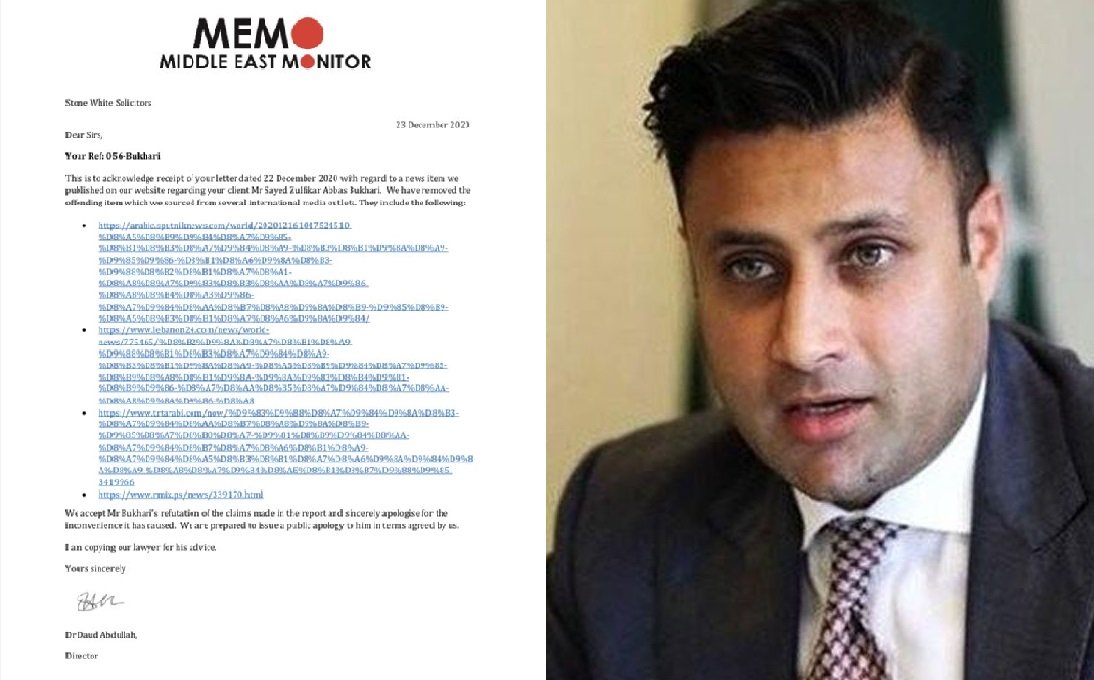
    Not-for-profit press monitoring organisation Middle East Monitor has apologised for a report claiming that Prime Minister (PM) Imran Khan’s aide Zulfi Bukhari visited Israel, whereas a minister in Tel Aviv has also clarified that the country in Asia that could soon normalise relations with his country is not Pakistan.

    As per the details, Bukhari, who is the premier’s special assistant on overseas Pakistanis, tweeted some documents, including a letter by the news media outlet wherein it had categorically acknowledged the reporting error and apologised.

    “We have removed the offending item,” the letter read, saying that it had been sourced from several foreign media outlets.

    “We accept Mr Bukhari’s refutation of the claims made in the report and sincerely apologise for the inconvenience it has caused,” concluded the letter dated December 23.

    The development was followed by an Israeli cabinet minister also confirming that there was a fifth Muslim-majority country in Asia that was likely to soon normalise relations with Tel Aviv, but it was not Islamabad.

    Speaking to the Israeli news outlet Ynet TV, Regional Cooperation Minister Ofir Akunis acknowledged that there is a potential for two more countries to normalise relations with Israel. He predicted that “there will be an American announcement about another country that is going public with the normalisation of relations with Israel and, in essence, with the infrastructure for an accord — a peace accord”.

    One of those countries is reportedly in the Gulf, but he ruled out Saudi Arabia, therefore leaving many to believe it could be Oman. The other country is further to the east of Israel towards Asia, and is a “Muslim country that is not small”.

    Okif dismissed the possibility of it being Pakistan, however, which many have suspected following PM Imran Khan admitting that “friendly” nations had been pressuring Islamabad to establish diplomatic relations with Tel Aviv.

    Those “friendly” nations are thought to be Saudi Arabia and the United Arab Emirates (UAE), particularly after Foreign Minister Shah Mahmood Qureshi told the UAE earlier this week that the country “will not and cannot establish a relationship with Israel until a concrete and permanent solution to the Palestine issue is found”.

    The attributes described by Okif leave Afghanistan, Indonesia, Malaysia and Bangladesh as the only remaining Muslim-majority countries that are “not small” and do not already have open ties with Israel.

  • ‘Pakistan’s governance system has become corrupt’

    The governance system in Pakistan has become corrupt, Islamabad High Court (IHC) Chief Justice Athar Minallah said Thursday.

    He expressed the belief that people do not even have access to “cheap and speedy justice.”

    According to Geo, he was hearing cases against the rising number of crime in Islamabad, obstacles in the delivery of justice, issues pertaining to naval farms and housing societies.

    Adviser to the Prime Minister on Accountability and Interior Mirza Shahzad Akbar also appeared before the court.

    Pointing out the flaws in the justice system, Justice Minallah said district courts, which are meant to deal with the problems of the common man, had never been anyone’s priority.

    In response, the PM’s adviser said he has already briefed Prime Minister Imran Khan regarding the matter.”

    You are the adviser on accountability, so I suggest you go to the accountability courts yourself and examine the conditions there,” Justice Minallah said.

    “The judges in those courts do not even have the staff for dictation. There is a lot of work pressure on those courts, but there is an acute dearth of staff.”

    The chief justice added that the Supreme Court of Pakistan has repeatedly stressed courts to hear cases on a daily basis, adding that judges are “ready to work day and night if the executives cooperate with them.”

    “You should visit the accountability courts and brief the prime minister about the situation,” Justice Minallah told Akbar.

    Responding to the judge’s remarks, Akbar said he has been appearing in the same courts for quite some time, adding that the situation in courts did not worsen overnight and it took 40 years of neglect to reach the current stage.

    “Advisers do not have executive authority, we can only provide suggestions,” Akbar said. “We will do whatever we can to improve the conditions of special courts.”

  • Pakistan, IMF and our economic future

    Pakistan, IMF and our economic future

    Pakistan is looking to resume the IMF’s $6 billion programme to bring in some much-needed foreign exchange. The programme was earlier suspended due to the government’s unwillingness to increase power tariffs and bring in a mini-budget. The negotiations for programme resumption were further delayed due to COVID-19 but IMF came to the government’s rescue with $1.4 billion emergency financing, which helped the country sail through tough times.

    But now we are back to square one, and it’s time to take some hard decisions.

    Reportedly, IMF is expecting Pakistan to significantly increase electricity prices, bring in additional revenue measures and introduce a few legal amendments. Pakistan was expecting an IMF mission in December to negotiate the conditions, but it seems that IMF is expecting some solid prior actions by the government, before it plans a review mission.

    There is no doubt that an electricity price increase is inevitable to reduce the mounting circular debt, and new tax measures are critical to help the government reach the ambitious Rs4.9 trillion revenue target. But the government is worried on two counts: not only will these measures be unpopular and further strengthen the opposition’s narrative around inflation but will also make a dent in government’s efforts to stimulate the economy. The prime minister has already given a nod to the electricity price increase; however, it is not clear if this increase is enough and how soon the government will be able to pass this on to consumers.

    However, irrespective of whether the government ends up taking these unpopular yet necessary measures or if the IMF ends up showing some flexibility, it remains to be seen if we can keep on relying on these ad hoc measures, pushing electricity tariffs up for the paying consumers and squeezing the existing taxpayers to meet the ever-increasing targets.

    Pakistan has availed 21 IMF programmes over the past 60 years; however, these programmes failed to bring in any sustainable improvement in Pakistan’s worsening conditions. Pakistan’s repeated boom-bust episodes are now a characterising feature of its economy, where sprouts of growth are inevitably followed by prolonged slumps.

    All political governments start in the midst of a balance-of-payment crisis, necessitating going for an IMF programme. IMF brings in foreign exchange to avoid a default but also fiscal and monetary tightening, which slows down growth. As soon as the IMF goes away, the country takes no time in coming back to its expansionary fiscal and monetary policies, owing to political reasons and mostly to win the next election. This in turn increases the demand for imports, increasing the trade deficit, and the country is pushed into yet another balance-of-payments crisis and the cycle starts all over again.

    But every time, Pakistan’s economic indicators sink a bit further than the previous episode. It is clear that we are on an unsustainable economic trajectory, but our political shortsightedness prevents us from seeing what’s written on the wall.

    What can break this vicious cycle? The answer is actually not that difficult. What we need is a serious dose of structural reforms, where we expand the tax net, do away with the exemptions enjoyed by powerful lobbies, control power thefts and line losses, stop the bleeding by state-owned enterprises, rationalise the ever-growing subsidies and strengthen and diversify our exports base. But these reforms require paying high political costs and compromising on short-term gains for the longer-term future.

    IMF is also no stranger to these solutions. Almost all recent IMF programmes have stressed these reform areas, but every time they end up being content on short-term corrective measures rather than the so-called structural benchmarks.

    A research paper by Harvard Kennedy School in 2015 highlighted that IMF ironically adopts a serial lending pattern. More than one-fourth of IMF member countries were part of an IMF programme for fifty percent of the duration since they became a member. Another 37 per cent have been on IMF programmes for 40 per cent of the time or more. This makes it quite evident that Pakistan, like many other developing economies, has ended up being addicted to this repeated dose of IMF money, without ever fixing the underlying problems.

    Recent months, however, have shown some positive signs, with the government mulling over restructuring plans for SOEs like Pakistan Steel Mills and PIA, announcing ambitious and futuristic power sector reforms, re-negotiating contracts with Independent Power Producers (IPPs), stimulating export industries, and even taking stock of the massive subsidy stock.

    The market-based exchange rate regime adopted by the government has already put in place an auto-corrective measure, whereby any significant current account imbalance will lead to currency devaluation, making imports expensive, reducing demand and narrowing the trade deficit.  However, the government needs to follow through on its plans and build further on this groundwork.

    These measures will undoubtedly be hard to put in place, but sooner or later someone has to go this road. If the present government pushes through on these reforms, it can help the country break out of this vicious cycle and can create a name for itself in Pakistan’s economic history. If not, we’ll be knocking on IMF’s doors yet again in another 4-5 years, but in a much worse condition.

  • Naya Pakistan: PM appoints former Silicon Valley, IBM executive as special tech zones chief

    Naya Pakistan: PM appoints former Silicon Valley, IBM executive as special tech zones chief

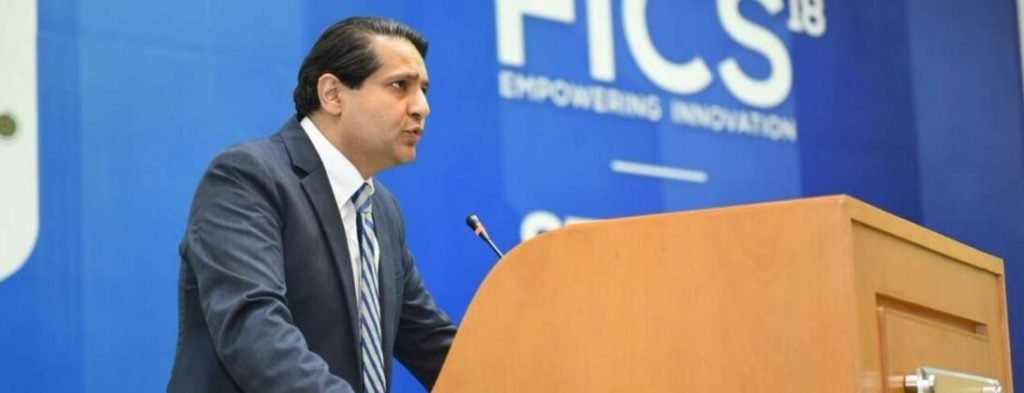
    Prime Minister (PM) Imran Khan has appointed Amer Ahmed Hashmi as chairperson for the Special Technology Zones Authority (STZA).

    According to the ordinance passed on Dec 2 for the establishment of Special Technology Zones Authority, the new authority will focus on the growth of scientific and technological ecosystem in the country, primarily by fostering the development of technology zones and high-tech industrial parks, thereby contributing to the acceleration of the evolution of the national system of innovation.

    Headquartered in Islamabad, the federal body will help promote the global competitiveness of the domestic technology sector, as well as provide institutional and legislative support to attract foreign direct investments in the high-tech sector.

    Amer Ahmed Hashmi

    The prime minister would serve as the president of the Board of Governors of the STZ Authority.

    As a global strategist, IT executive, and entrepreneur, Amer Hashmi possesses diverse global experience in organisational leadership with companies like IBM and MCI Systemhouse. He was the founding CEO of Si3 – Pakistan’s pioneering technology outsourcing firm that helped stimulate IT systems integration in public and private organizations in Pakistan. His work has been featured in Forbes Asia, Businessweek & Financial Times UK.

    Hashmi spent the last 10 years building a knowledge ecosystem in his capacity as advisor and chief strategy officer at National University of Sciences & Technology (NUST).

    He was also the chairman of executive committee of NUST Science & Technology Park and founding president of the Global Think Tank Network (GTTN).

    Hashmi is a graduate of York University, Toronto, and has been trained in several technical and specialised programmes, including executive leadership on ‘Innovation for Economic Development’ from Harvard’s Kennedy School of government.

  • PM Imran prays for Maulana Tariq Jamil’s speedy recovery

    Prime Minister Imran Khan has extended his prayers and best wishes to Maulana Tariq Jamil after he tested positive for COVID-19. The renowned religious scholar has been admitted to the hospital on his doctor’s advise.

    “Praying for Maulana Tariq Jamil’s speedy and full recovery from the COVID-19”, wrote PM Khan on social media.

    Maulana Tariq Jamil on Sunday had announced that he has tested positive for coronavirus.

    “For the past few days, I have been feeling unwell. On getting tested for COVID, it came positive,” he shared on social media. “I have been admitted to the hospital on the advice of doctors, special prayers are requested.”

    Read more – Maulana Tariq Jamil apologises to nation for controversial remarks against women

    Meanwhile, Senator Faisal Javed Khan has also extended his best wishes to Maulana Tariq.

  • Dividing the divided

    “The ruling party’s most recent act of issuing a list of news media talk-show anchors, dubbing them pro-corruption, drives a deeper wedge into a polarised nation.”

    It is no secret that the truth of national integration of the Islamic Republic of Pakistan is not just bitter but severely inconvenient. The fine line that separates diversity and differences among this nation has blurred so many times that it has almost permanently been reduced to a smudge. From the barracks to the parliament, sermons and edicts from atop the mosque minarets, political jargons from atop the containers and trucks, to the unending layers of multiple identities — divisions are the Achilles’ heel of this society.

    Issuing a list of journalists, dubbing them against the interests of the state, vilifying them publicly was like shooting a nuke at this Achilles heel. Driving a wedge at the very source of information of the nation, the media, is creating the deepest division imaginable so far. In the history of deleted tweets in this country, these two might have very long lasting effects.

    A ruling political party being unaware of this landmine or apathetic to the consequences of triggering it can potentially prove to be catastrophic.

    73 years of age, sick, weak and drained it stood on shaky feet, running out of natural body resources, vitals dimming, surviving on one shot of steroids after another, scars of surgical interventions spread across the map of its skin and a plethora of side-effects from past treatments racking its existence. It had almost forgotten the number of doctors that had taken a shot at it, sometimes even without its total consent. Almost every one of those taxing prognosis left it more vulnerable and feeble. All of them focused on treating the symptoms and not the disease, worsening the illness.

    It was almost as if they knew, but never disclosed that it was plagued by the uncanny Autoimmune Disease – an ailment in which the organs of its own body were at constant war with each other. It was almost as if they were intentionally not treating the disease because ending its ailment would end years of profiteering from its misery, and yet they all claimed they did everything to serve its interest. Or maybe decades of varying drugs had blurred its ability to separate those who sought to save it from those who added to its agony.

    The story of Pakistan is difficult to pen down because it is hard to indisputably identify the heroes and the villains. Pakistanis to this day are even conflicted over autocratic dictatorships being good or bad. This is a country where coups were celebrated, even if by a significant minority. Its very inception on the basis of a presumed uniformity of a religion so deeply divided across sectarian lines was unsteady. The ethnic, cultural, political and ideological differences at its core, though dormant at the time, were highly flammable. While these divisions stayed buried under the unanimous rejected of Hindu subjugation, the fault lines under the surface started growing into visible cracks once liberated from the common enemy. This is why, ever since, the integration and unity of this nation has always been a function of hatred, fear and anger against a common enemy, rather than collective growth, pride and prosperity.

    However, in times when an aggravated threat of a common enemy does not exist, Pakistan’s autoimmune disease starts tearing her apart and eating the core of the country hollow. For all these reasons, and more, the worst thing that can happen to this already fragmented and disunited country is fuelling more divisions.

    From its campaign leading to the 2018 elections, PTI and its patron in chief Imran Khan has been extremely careless, if not intentionally exploitative, of this ability of the Pakistani polity. He went further than the usual practice of demonising and defiling his political rivals and berated their voters and supporters as dumb donkeys following their leaders mindlessly like zombies. At his massive public meetings he openly vilified news organisations that disagreed with him. The rants inadvertently led to mob attacks on news media offices and at times on journalists.

    The ruling party’s most recent act of issuing a list of news media talk-show anchors, dubbing them pro-corruption, incites targeted and aggravated hatred against these journalists. But more importantly still, it drives a deeper wedge into a polarised nation. It impacts not just PTI supporters but the supporters of its political rivals as well. With the history of Pakistan and its behavior in view, this action will have consequences far more long-lasting than being perceived.

    This list discourages openness to differing views and perspectives. It freezes the ability to question and challenge one’s hardened positions and clan-vote mentality. It encourages the dangerous practice of sticking to narratives that only feed people’s confirmation biases. It magnifies and glorifies selective perception. But more than anything else, it breeds generations of an ill-informed polity, with an ‘us-versus-them’ mindset for its own countrymen, incapacitated to vote a credible person into power, adding to the long list of bad doctors that would worsen this ailing country’s autoimmune disease and feed off its ailing semi-conscious body.

  • Five Pakistani dramas PM Khan should watch

    Five Pakistani dramas PM Khan should watch

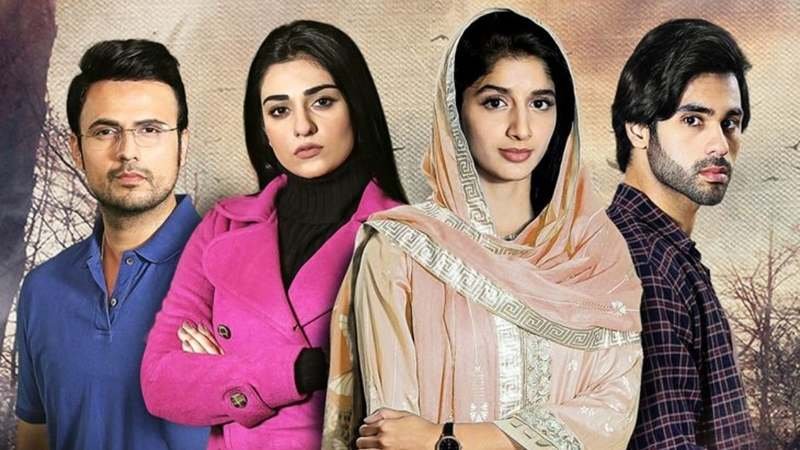
    Ever since he assumed office, Prime Minister Imran Khan has given us plenty of recommendations on drama serials and books – the most prominent being Turkish drama series Diriliş: Ertuğrul and Elif Shafak’s The Forty Rules of Love. Earlier this week, PM Khan recommended the youth to watch another Turkish show on Sufism Yunus Emre: Aşkin Yolculuğu, which is also being aired on PTV in Urdu.

    While we love the fact that the PM takes out time to recommend stuff to the youth, we decided to turn the tables and recommend him a few recent (in the past two years) Pakistani drama serials which are worth watching. Check out our suggestions below:

    Sabaat

    While Hum TV’s Sabaat in its essence is a family drama exploring familial relations and dynamics, its presentation was very refreshing, in particular Anaya and Hassan’s storyline. The drama highlighted the importance of having a healthy, loving relationship with your children and gave out a strong message on the importance of empowering women and daughters and gave viewers a new heroine after Zindagi Gulzar Hai‘s Kashf. It also showed how ego, money and misunderstandings can ruin relationships and your life. All these themes are the ones which PM Khan has time and time again urged our drama writers to show on television.

    Read more – ‘Sabaat’ manages to tie up loose ends in a rushed finale

    Alif

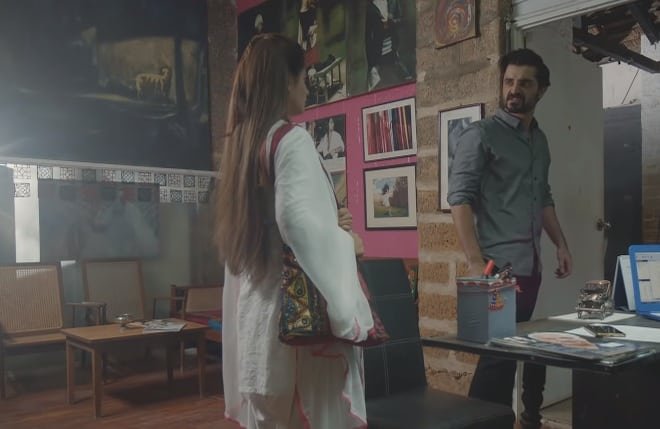
    Starring PM Imran’s BFF Hamza Ali Abbasi and Sajal Aly in the lead, Alif, written by Umera Ahmed and directed by Haseeb Hasan focuses on the spiritual journeys of two individuals Qalb-e-Momin (Hamza) and Momina Sultan (Sajal), who despite coming from completely different backgrounds help each other find peace in righteousness. Alif was a brilliant example of good storytelling and sensitive direction. Moreso, the entire cast of the drama including Hamza, Sajal, Ahsan Khan, Manzar Sehbai and Kubra Khan gave strong and solid performances. It is pertinent to add here that Hamza in several interviews has shared that his life reflects what is shown in the drama.

    Suno Chanda Season 1

    Perhaps one of the most-loved dramas in the country, Suno Chanda (Season 1) is chaotic, fun and will leave you with a warm feeling. The show which ran through Ramadan and had everyone hooked is about a household in which the children of two brothers get married just before the family’s patriach passes away. Directed by Aehsun Talish and written by Saima Akram Chaudhry, Suno Chanda is a comedy drama done just right. From the performances to the witty dialogues to the direction, everything about this drama was brilliant. The show gave us some memorable characters and there was bound to be one person in the cast you could relate too.

    Out of the list, if there is one drama the prime minister should be watching, it should be Suno Chanda. Will also give him some much-needed respite from the day-to-day political tensions.

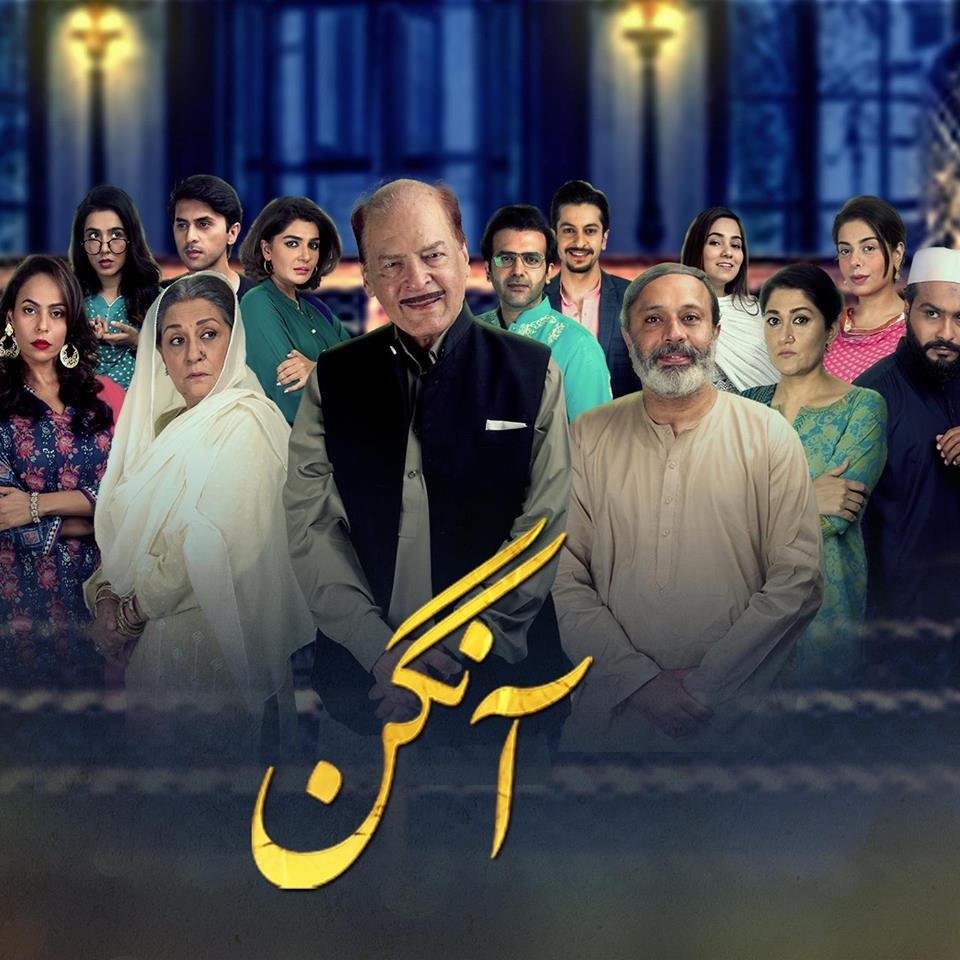
    Aangan

    Yet another multi-starrer drama starring some big dramas of the drama industry, Aangan brought back and romanticised living in joint family systems while at the same time highlighting the issues that come with it. The drama very delicately and tactfully challenged societal norms while keeping viewers engaged and hooked. Aangan is without a doubt one of Faiza Iftikhar’s finest works. I am pretty sure Khan sahab is going to love this one. It is everything he wants to promote through television and dramas.

    Sammi

    Perhaps the darkest drama on this list, Mawra Hocane and Adnan Siddiqui’s Sammi sheds light on the custom of vani (or exchange brides) and how women are forced to continuously bear children in the quest for a son. It is gritty and makes you uncomfortable but that is because you know that this is exactly what happens to women in this country. The drama has been sensitively written by Noor ul Huda Shah and directed by Saifee Hassan.

    Is there any other drama you would recommend PM Imran to watch? Let us know in the comments below.