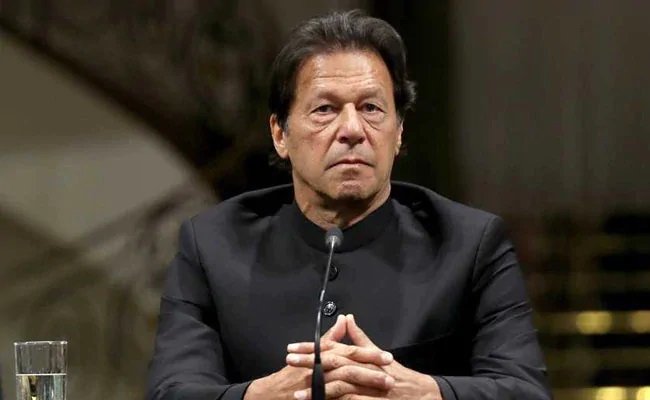
Tag: Prime Minister Imran Khan

  • Projection: August likely to be the worst month for Pakistan with one million coronavirus cases

    Projection: August likely to be the worst month for Pakistan with one million coronavirus cases

    The effects of poorly managed or no lockdowns at all are raising their ugly heads as Pakistanis has reached the 14th position in the global ranking of countries most affected by the new coronavirus — COVID-19 — with 165,062 cases, while it now ranks 6th among nations with the most number of active cases around the globe, as per Worldometers.

    The World Health Organization (WHO) earlier this year warned that South Asia could become yet another new epicenter of the pandemic, however, despite the warning and rapidly increasing number of coronavirus cases, Prime Minister (PM) Imran Khan has only announced the imposition of “smart lockdowns” with only certain areas in worst-hit cities being put under restrictions.

    The decision was taken keeping in view the consequent struggles of the poor, whom the government believes might not be able to survive a complete lockdown and its effects on the already deteriorating economic conditions.

    While experts, including Dr Attaur Rahman of PM’s task force, believe the government has already failed to deal with the pandemic and is grossly under-reporting both COVID-19 fatalities and infections, the virus is yet to peak — by the end of July or August –, data suggests.

    An analysis by The Current showed that before lockdown restrictions were eased in Pakistan ahead of Eidul Fitr, the highest number of confirmed coronavirus cases stood at 24,648 during the first week of May. The figure then crawled up to 122,574 by June 11, while the number of coronavirus cases as of this moment stands past 165,000 with thousands of cases being reported every day despite a low testing capacity.

    It is estimated that the actual number of infections is very high with Lahore alone having more than 2 million cases by now.

    Pakistan has experienced its largest month-wise jump since the pandemic began, with 69,910 cases being reported between May 6 to June 6. Earlier, 3,858 COVID-19 cases were recorded between March 6 and April 6 while 20,209 were reported between April 6 to May 6.
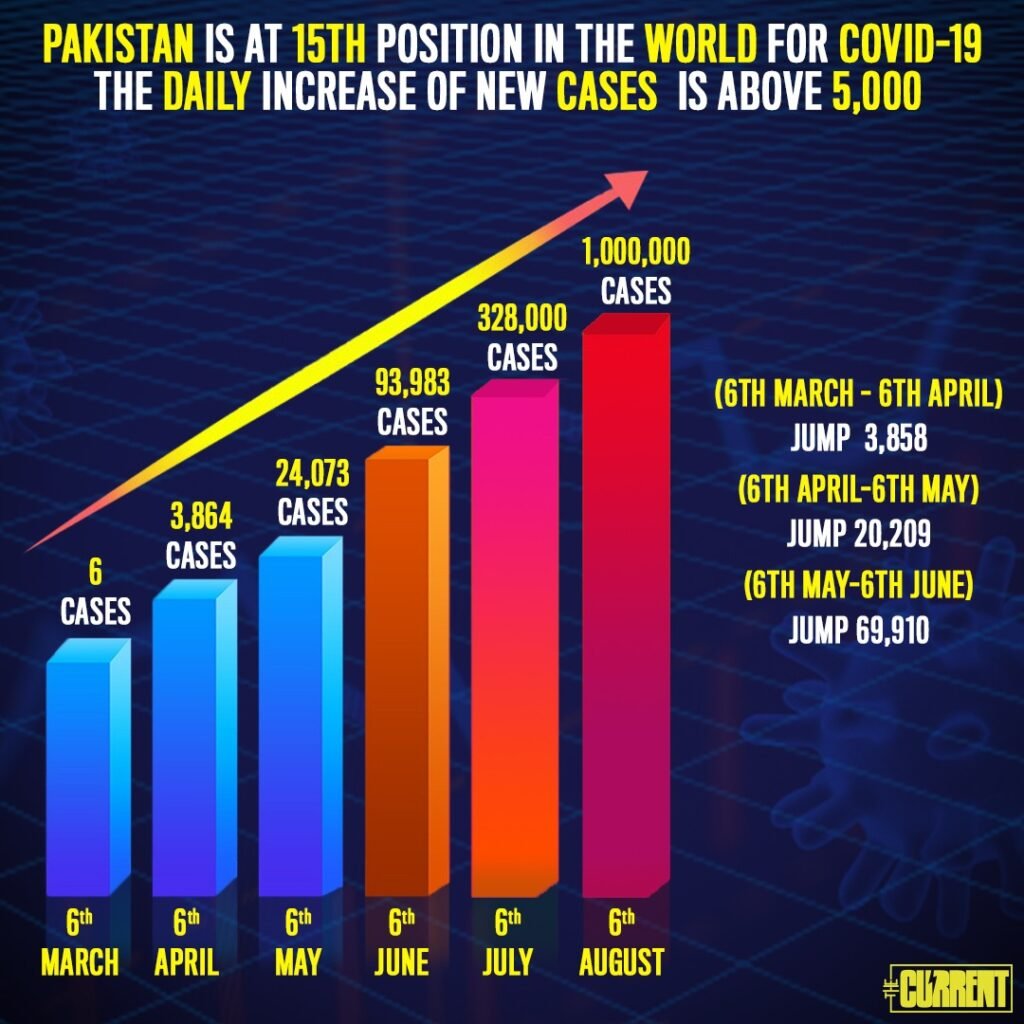
    According to projections, the figure is likely to reach a million by August 6 if strict lockdowns aren’t imposed and social distancing guidelines are not followed.

    A comparison with the best and worst managed lockdowns from across the globe also puts things into perspective.

    Country Outcome
      New Zealand
    Prime Minister Jacinda Ardern announced a strict lockdown on March 25 when 100 people had tested positive and no deaths had been reported.   After a 76-day lockdown, New Zealand lifted all restrictions, declaring the country ‘corona free’ but borders remain closed. No new case for more than two weeks has been reported in the country except three suspected ones.
    Wuhan
    The capital of Hubei province of China was the origin of the deadly virus, where 11 million residents were locked up at their homes since January. After an effective 77-day lockdown, Hubei reports zero COVID-19 infections and the country has reported zero coronavirus deaths since January.        

    On the other hand:

    Country Outcome
    India
    On March 25, India imposed a countrywide lockdown that was called a curfew by PM Narendra Modi. The development had come when 519 confirmed cases and 10 deaths had been reported across India.   A bit over two months later, with India easing lockdowns and shopping malls, restaurants as well as temples being re-opened, it has become the country with 4th highest number of coronavirus cases in the world.
    Iran
    Iran shut schools, postponed events and discouraged travel since the country reported its first COVID-19 death in February. Despite these measures, the number of deaths and infections continued to grow until a countrywide lockdown was imposed in March.   With the lockdown being eased from mid-April to May 26 when everything was reopened, including shopping malls, parks, religious shrines, restaurants and historical sites, the number of deaths has jumped to nearly 10,000 with over 200,000 infections.

    By the time this report was filed, Sindh topped the chart with most infections in Pakistan (62,269), with Punjab trailing behind at 61,678, Khyber Pakhtunkhwa (KP) at 20,182, Islamabad at 9,941, Balochistan 8,998 and Gilgit-Baltistan and Azad Jammu Kashmir (AJK) at 1,225 and 769 infections, respectively.
  • SC dismisses presidential reference against Justice Qazi Faez Isa

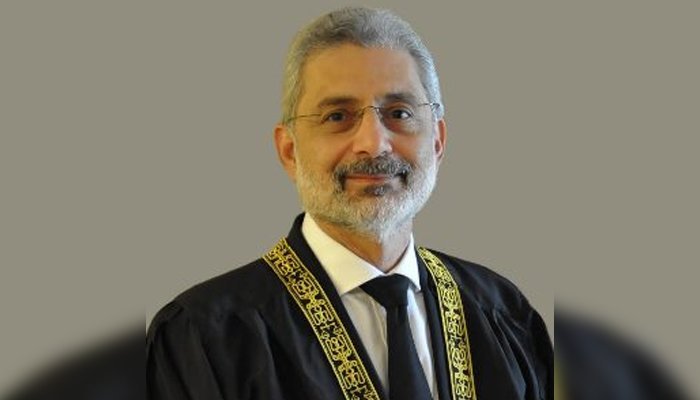
    SC dismisses presidential reference against Justice Qazi Faez Isa

    The Supreme Court (SC) on Friday dismissed the Pakistan Tehreek-e-Insaf (PTI) government’s presidential reference against Justice Qazi Faez Isa of the top court, announcing its short verdict on the petition challenging the reference in the Supreme Judicial Council (SJC).

    A ten-member larger bench of the apex court headed by Justice Umar Ata Bandial and comprising Justice Maqbool Baqar, Justice Manzoor Ahmad Malik, Justice Faisal Arab, Justice Mazhar Alam Khan Miankhel, Justice Munib Akhtar, Justice Sajjad Ali Shah, Justice Syed Mansoor Ali Shah, Justice Yahya Afridi and Justice Qazi Muhammad Amin Ahmed heard the case, reserving the verdict before it was announced after 4 pm.

    The case was wrapped up after Justice Isa’s spouse on Thursday provided the money trail pertaining to her foreign properties and the Federal Board of Revenue (FBR) provided its input on the matter.

    The petitioner’s lawyer, Munir A Malik, concluded his arguments in court by saying that the federation had “gotten on the wrong bus” in the case.

    The top court judge’s wife, Zarina Carrera Khoso, submitted the money trail of her three properties in the United Kingdom (UK) to a full bench of the SC via video link in an assets concealment and alleged misconduct case against her husband.

    The SJC had initiated the proceedings against Justice Isa on allegations that he purchased three properties in London in the name of his wife and children between 2011 and 2015 but did not allegedly disclose them in wealth returns declared in Pakistan.

    Justice Isa had told the apex court on Wednesday that his wife wanted to appear before the SC bench to explain the sources of her UK properties.

    Subsequently, following the top court’s approval she testified that all the money was transferred from Pakistan to UK through her two foreign accounts.

    “Properties in Karachi were sold out and two bank accounts — one in British pounds and the other in US dollars — were opened in a private bank to transfer the money.

    “From 2003-2013, a total of £700,000 was transferred through these two foreign accounts in the Standard Chartered Bank’s Karachi branch,” she added.

    Khoso clarified that she was a Spanish citizen and that she had used her passport to purchase the properties in London. She added that when her husband was a lawyer, she would get a five-year visa.

    However, the Pakistani authorities had issued a one-year visa after 2018 only to create hurdles.

    Justice Isa’s wife explained that since she was born in Spain and her father’s and mother’s names, respectively, were Khoso and Carrera, her name on her birth certificate and passport is Zarina Carrera Khoso.

    After she got married to Justice Isa back in 1983, however, the Pakistani government registered her name on her CNIC as Zarina Isa.

    In her statement, the judge’s wife said her tax returns were filed after advice from Rehan Naqvi, her solicitor, and that she owned a house in Clifton, as well as a plot in Shah Latif Town. She has also received agricultural land from her father, which is now in her name.

    Khoso said she was advised that according to the law, tax returns were not filed on agricultural land. All of her taxes were filed after consultations with Naqvi, she added, noting that the last tax return she had filed was over Rs7.6 million.

    Later, Justice Maqbool Baqar reportedly remarked that what was going on in the country in the name of accountability would also be looked into. He said destruction [of institutions] was underway in the country in the name of accountability and they would also write that in the verdict.

    Justice Maqbool Baqar asked if the SJC could review the performance of the president, to which the federation’s lawyer, Farogh Naseem, said that the council had the authority to review anyone’s performance.

    NOT SURE ABOUT THE CASE? DON’T WORRY, WE HAVE YOU COVERED:

    Justice Qazi Faez Isa is an SC justice who took oath as a judge of the top court in September 2014. He is scheduled to become the chief justice of Pakistan (CJP) in August 2023 for thirteen months.

    His landmark cases include the Faizabad Sit-in judgment in 2019, the Quetta Massacre Commission in 2016 — when he headed an inquiry commission to find out what happened when a suicide attack in August 2016 killed 74 people — and the Memogate Commission in 2012, a case where an alleged memo was delivered to an American official at the behest of former ambassador to the United States (US), Husain Haqqani, in May 2012.

    In May 2019, media started reporting that references were being filed against SC judges Reports became so rampant that Justice Isa approached President Arif Alvi, complaining that information being leaked to the media amounted to character assassination, which would hinder his right to a fair trial. He also asked the president if a reference was being filed against him by the president in the SJC.

    There was no reply by the president and soon, a notice was sent to the federal government by the SJC that a reference was being filed against him and another judge, accusing them of concealing assets.

    Justice Isa then wrote another letter, in which he said that he could’ve handled the inquiry against him and his family but it seemed that the independence of the judiciary was being undermined and that a judge had to preserve and protect the constitution as he had sworn to do.

    He then asked the SC that a full bench be constituted, a plea that was accepted by then CJP Asif Saeed Khosa, and after a months-long trial, a full bench of the apex court on Friday dismissed the petition against him.

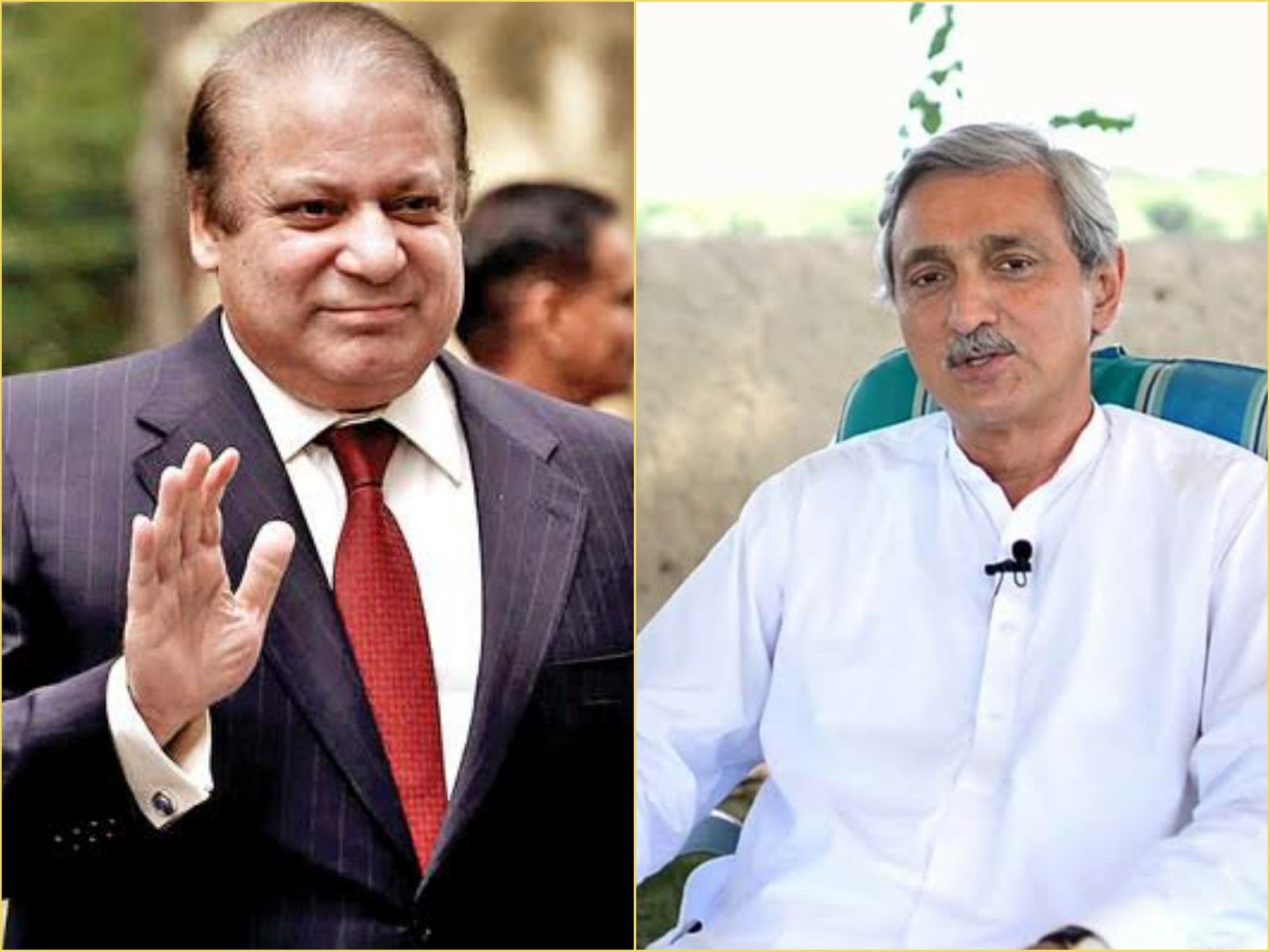
  • Tareen meets Nawaz in London while not on talking terms with Imran?

    Tareen meets Nawaz in London while not on talking terms with Imran?

    Pakistan Tehreek-e-Insaf (PTI) senior leader Jahangir Khan Tareen on Thursday said he has neither met Pakistan Muslim League-Nawaz (PML-N) supremo Nawaz Sharif nor did he wish to and that the media cell of the former premier’s party was spreading fake news.

    In an audio statement, Tareen — whose relationship with the PTI seems to have fallen apart — said “our struggle has been against them”, referring to the PML-N.

    “I have neither met Nawaz Sharif nor do I wish to [meet him],” he said.

    “I am not an opportunistic politician to go to them [Nawaz Sharif and the PML-N] just because I have developed differences with Imran Khan,” he said of the premier.

    “I am a principled politician, I tried my best with the PTI,” he added, noting that if there were any problems, it was not his fault. “I am just sitting separately; whatever is acceptable to God will happen.”

    Meanwhile, reports quoted senior leaders of the PML-N as confirming that there had been no meeting between Nawaz and Tareen, that they had neither approached Tareen for such a meeting nor do they plan to do so.

    ‘NOT ON TALKING TERMS WITH IMRAN’:

    The claims rebutted by Tareen had come amid reports that Prime Minister (PM) Imran Khan and his former friend and leading PTI stalwart Tareen were no longer on talking terms as the latter ponders his political future from his Newbury farmhouse just outside of London.

    According to The News, PM Imran has not spoken to Tareen, the former secretary general of PTI and its main sponsor and patron, in several weeks and their relationship of warmth and trust at this point of time is non-existent.

    Tareen jetted off to London two weeks ago in a chartered plane and said he was travelling for medical treatment. He didn’t respond to requests for interview and has stayed quiet but sources close to him have shared details of Tareen’s state of mind and his stance.

    Tareen is not happy with how his colleagues have treated him and believes that he was shed off like dead weight by the very people who used to fawn upon him.

    Another source close to Tareen said that people around Imran and some bureaucrats had become insecure of him as he advised Imran to reduce the role of bureaucracy to improve governance. The source said that Tareen has made more contributions for the growth of PTI than all others put together but none of this was counted when it came to his alleged involvement in the sugar crisis.

    The former powerhouse of PTI is of the view, according to the source, that the premier didn’t come to his aide as he has been surrounded by a coterie of bureaucrats who have been feeding him false information.

    The sources in government said that PM Imran is neutral viz a viz Sugar Commission Inquiry and will not interfere to save or persecute anyone. They added that the PM will not give favours to anyone.

    As Tareen left Pakistan, speculations emerged that he had left to save himself before the start of government’s punitive action on the findings of the report of Sugar Inquiry Commission that implicated PTI leader and other leading political figures and businessmen in sugar scam.

    Tareen has denied all speculations but it has been claimed, including in the National Assembly, that Tareen thought it was best to be out of Pakistan for sometime and that the PTI govt provided him a passage to fly out while keeping accused opposition figures on the Exit Control List (ECL).

    Tareen, however, says that he will return to Pakistan once his treatment is completed but has not given any timeframe and many believe that he is in important discussions about the events that will unfold when he is back in Pakistan.

  • Govt is grossly under-reporting coronavirus deaths and infections: PM’s task force head

    Govt is grossly under-reporting coronavirus deaths and infections: PM’s task force head

    Pakistan is understating its rate of infections and the death toll from the coronavirus, the head of a government task force has said as the country becomes a hotspot for the pandemic in South Asia, Bloomberg reported.

    “The actual numbers will be two to three times more than what the government is reporting,” Dr Attaur Rahman, chairman of Prime Minister (PM) Imran Khan’s task force on science and technology, said and added that a large number of cases weren’t being reported because of low testing and as reasons other than respiratory failure weren’t being counted in deaths.

    WATCH VIDEO:

    Pakistan’s coronavirus cases have increased manifold since the government eased a lockdown in the second week of May after a partial shutdown of about two months. PM Imran has said he is allowing some businesses to open as he fears people will die of poverty and hunger instead of the virus. Alarmed by the rising number of cases, the authorities have again started shutting down residential localities in 20 key cities including the federal capital and Lahore.

    Pakistan is the second most infected nation in Asia after India with over 150,000 cases and about 3,000 deaths. The fatality rate of 2% is less than half of the 5% global average.

    Random testing in Pakistan’s second-largest city, Lahore, by the health department of Punjab in May showed that at least 6 per cent of all tests came back positive for COVID-19 while in some areas the percentage was as high as 14 per cent, Voice of America reported.

    Based on the city’s population and the sampling data, the health department working group, comprised of epidemiologists, public health specialists, applied economists, statisticians and public policy specialists, calculated the number of cases in Lahore to be 670,800 on May 15.

    The rate at which the infection was spreading alarmed those involved.

    “Our calculations said the numbers were doubling every two weeks,” said Dr Waheeduzzaman Tariq, a senior virologist who was part of the group and sits on multiple government committees dealing with the coronavirus pandemic.

    According to those numbers, on June 15, the figure should be approximately 2.7 million infected people in Lahore alone.

  • PTI lawmakers from Sindh urge Imran to improve ties with PPP govt

    PTI lawmakers from Sindh urge Imran to improve ties with PPP govt

    Lawmakers of the Sindh Assembly belonging to the Pakistan Tehreek-e-Insaf (PTI) have urged Prime Minister (PM) Imran Khan to strengthen relations between the Centre and the provincial government led by the Pakistan People’s Party (PPP) so that they are able to resolve public issues in their respective constituencies more efficiently.

    The premier met the MPAs at the Governor House during his two-day visit to the province.

    The delegation praised the premier’s suggestions in the new finance bill and decisions that were taken by the government to curb the spread of coronavirus. They also commended the PM on reaching out to the poor segment of the society through the Ehsaas Programme.

    “Public service is the first mission of the PTI government,” PM Imran said, urging the PTI lawmakers to be more proactive in resolving public issues.

    Sindh Governor Imran Ismail, Minister for Maritime Affairs Syed Ali Zaidi and Special Assistant Dr Sania Nishtar were also present in the meeting.

    Among the MPAs were Omar Amari, Dr Syed Imran Ali Shah, Arsalan Taj Hussain, Bilal Ahmed, Syed Firdous Shamim Naqvi, Haleem Adil Sheikh, Jamaluddin Siddiqui and others.

    The Grand Democratic Alliance (GDA) delegation was also present during the meeting.

    According to reports, the delegation demanded Sindh’s share in the NFC award and discussed the privatisation of steel mills and eradication of locusts from agricultural fields in the province.

    The GDA delegation included Sardar Abdul Hakim, Dr Arbab Ghulam Rahim, Arif Mustafa Khan Jatoi and Irfanullah Marwat.

  • 1997: When Tariq Aziz defeated Imran Khan by a margin of over 45,000 votes

    1997: When Tariq Aziz defeated Imran Khan by a margin of over 45,000 votes

    Veteran actor and television host Tariq Aziz passed away in Lahore on Wednesday.

    He was 84 years old and was admitted to a private hospital last night after he fell critically ill. The cause of his death, however, has not yet been ascertained.

    Born in 1936 in British India, Aziz received his early education in Jalandhar (now in India) before starting his career at Radio Pakistan in Lahore. When state-owned Pakistan Television (PTV) started its broadcast in 1964 from Lahore, he became the first male news announcer of the country.

    In 1974, Aziz started the first-of-its-type game show, Neelam Ghar, from PTV. The show went on to register unprecedented heights. It was later rebranded as Tariq Aziz Show in 1996 before finally renamed Bazm-e-Tariq Aziz in 2006.

    Aziz also tried his luck in movies. He starred in Insaniyat (1967) alongside Waheed Murad and Zeba, following which he played a leading role in Haar Gaya Insaan.

    He received the Pride of Performance award in 1992 for his services.

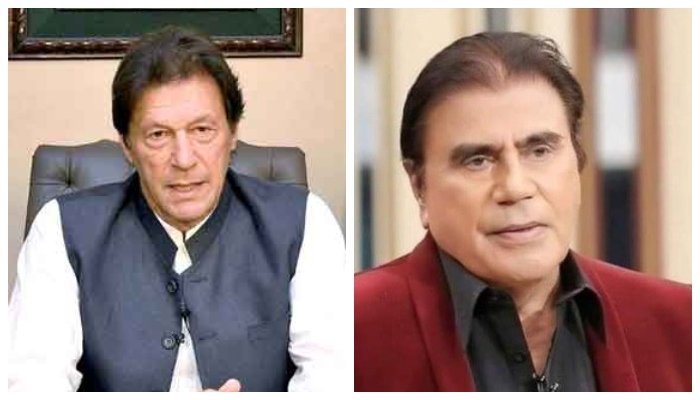
    TARIQ AZIZ VS IMRAN KHAN:

    Unprecedented fame as a radio and television personality was, however, not it for Aziz who also went on to contest general elections in the 90s.

    He was active in student politics during his college days and had joined the Pakistan People’s Party (PPP) in 1970. In those days, Aziz was called a “firebrand socialist” known for charging up crowds with revolutionary slogans at Zulfikar Ali Bhutto’s rallies. However, later he parted his ways and went back to the entertainment world. In 1996, he joined the Pakistan Muslim League-Nawaz (PML-N) and was later elected member of the National Assembly from Lahore.

    Imran Khan, after founding Pakistan Tehreek-e-Insaf (PTI) in 1996 fielded himself from multiple seats in the 1997 general elections.

    Only from Lahore, Imran contested from NA-94 and NA-95 seats where he suffered defeats at the hands of Tariq Aziz and then PML-N president Nawaz Sharif, respectively.

    He received 4,595 votes against Aziz’s 50,227, paving way for Aziz’s election to the Lower House.

    Aziz was also one of the political activists who were charged with attacking the Supreme Court of Pakistan building in 1997.

  • PTI caught off-guard as allied BNP-M quits coalition govt

    PTI caught off-guard as allied BNP-M quits coalition govt

    The Pakistan Tehreek-e-Insaf (PTI) government appeared to be caught off-guard as the Balochistan National Party-Mengal (BNP-M), one of the eight political parties who either support the federal government or are a part of the ruling coalition, on Wednesday announced to end its alliance with the Imran Khan government.

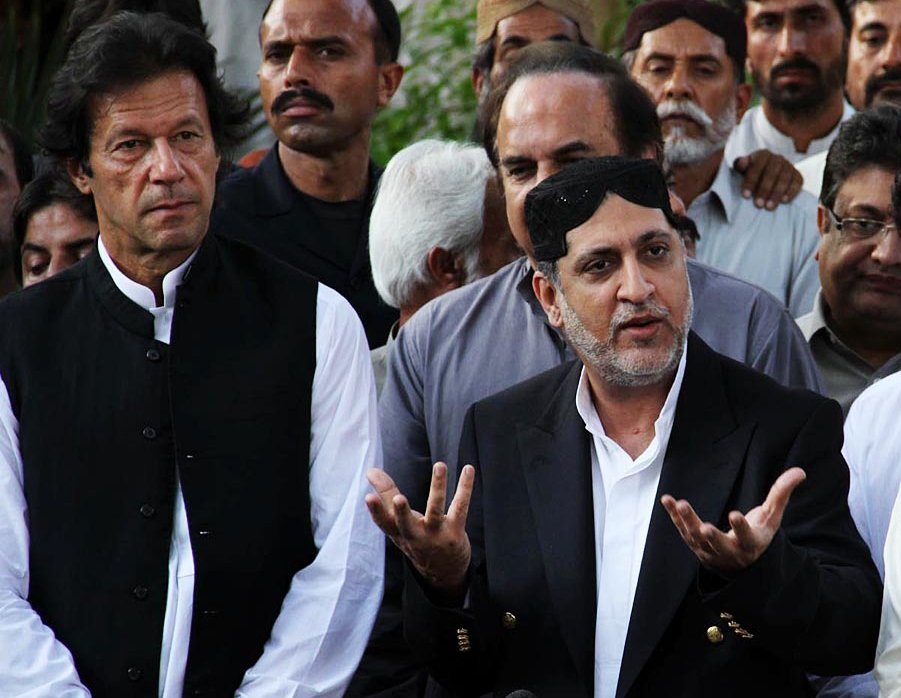
    Speaking on the floor of the National Assembly (NA) during a session, party President Sardar Akhtar Mengal officially announced that his party was separating itself from the government. “We will stay in parliament and will keep talking about issues,” he said.

    The two parties had signed a six-point memorandum of understanding (MoU) in August 2018 for an alliance in centre. The six points included recovery of missing persons, implementation of the National Action Plan (NAP), implementation of six per cent quota for Balochistan in the federal government, immediate repatriation of Afghan refugees and the construction of dams in the province to resolve the acute water crisis.

    Mengal reminded the House that his party had two agreements with the ruling party, adding that it was the Imran Khan-led party which had come to him for an alliance, not the BNP-M which went to Bani Gala — the personal residence of PM Imran.

    “The first agreement was done on August 8, 2018 and signed by Shah Mahmood Qureshi, Jahangir Tareen and Yar Muhammad Rind,” recalled Mengal. 

    He added that his party had demanded that the missing persons issue be resolved and the National Action Plan be implemented in letter and spirit in the agreement.

    “Can someone tell us if there was anything unconstitutional in both these demands? Why were they not implemented?” asked the lawmaker from Balochistan. 

    He regretted that the ruling party’s mindset was “the same one running in the country since 1948”.

    “We waited for two years for the implementation of the agreement; we are ready to [wait] further, but start something,” appealed the nationalist leader. 

    He added that if the government wishes to take his province along, then they should implement their agreements with BNP-M.

    While highlighting his grievances in the assembly, the lawmaker stated that the foundations for the road from Chaman to Karachi were laid in 1973, and it has killed 4,500 in road accidents. He added that instead of giving them a six-lane road, the government gave them only a two-lane road.

    The BNP-M leader also claimed that “no one can find justice in this country” and that “justice is being sold”. 

    While hitting out at the government, he noted that Pakistan Steel Mills were being privatised and thousands were being unemployed.

    “The disappointing thing is that no one here is ready to listen to their [the laid off workers’] demands,” said Mengal. He added that if the demands could not be met, then they should at least be noted.

    “It has become a tradition here that the last government is held responsible for everything,” said Mengal.

    The alliance with the PTI was only in the centre, while the BNP-M’s alliance with the Jamiat Ulemae Islam-Fazl (JUI-F) in Balochis­tan continues at the provincial level.

    The coalition government has been struggling over “broken promises” for quite some time now as the Pakistan Muslim League (PML) and the Muttahida Qaumi Movement-Pakistan (MQM-P) also do not seem much satisfied with the ruling PTI’s performance.

    Wednesday’s development and its consequences could spell trouble for PM Imran who was elected as the leader of the house with a thin majority.

  • Pakistan mourns as Tariq Aziz passes away

    Pakistan mourns as Tariq Aziz passes away

    The passing of Pakistan’s renowned TV/radio host, film actor and politician Tariq Aziz has left an irreplaceable void in the country and Pakistanis, including Prime Minister Imran Khan, mourned his death and remembered him and his work.

    According to Radio Pakistan, Aziz passed away due to cardiac arrest in Lahore on Wednesday. He was 84. ARY reported that the veteran host did not have any underlying ailments or conditions. He had been isolating at home ever since the coronavirus outbreak. Quoting his wife, the reporter said that a while before his death Aziz said he felt cold and put his head on his wife’s shoulder for some relief. He passed away soon after.

    Read more – Legendary Pakistani actress Sabiha Khanum passes away at 85

    In a condolence message, the Prime Minister Imran Khan said that Aziz was “an icon in his time and a pioneer of our TV game shows”.

    President Arif Alvi said that “a chapter closes with the sad demise of Tariq Aziz”.

    Meanwhile, from celebrities and politicians to sportsmen and journalists, everyone fondly remembered the legend and his iconic presence on the screen.

    https://www.instagram.com/p/CBh4hApDDZr/

    Born in 1936 in Jalandhar, Aziz began his professional career from Radio Pakistan Lahore and was one of the most recognisable voices on the radio. Later, he joined PTV, where he not only became the state-owned television’s first announcer, he also became popular for his work on PTV’s Quiz Show Neelam Ghar, first aired in 1974. The show was later renamed the Tariq Aziz Show and also known as Bazm-e-Tariq Aziz.

    Aziz’s unique hosting skills on Neelam Ghar made him a household name in Pakistan over the past four decades in the country.

    https://www.instagram.com/p/CBh5kIDhdoV/

    Other than that, Aziz was also a poet and a film actor – he was part of several films over the course of his career. He also featured in the super hit musical Salgira (1969), which went on to win two Nigar Awards that year.

    Aziz was also a member of the National Assembly of Pakistan between 1997 and 1999.

    He was awarded Pride of Performance Award by the President of Pakistan in 1992 for his services to the nation.

    May his soul rest in peace.

  • Justice Qazi Faez Isa strikes back with ‘Imran, others’ properties in UK’

    Justice Qazi Faez Isa strikes back with ‘Imran, others’ properties in UK’

    Supreme Court’s (SC) Justice Qazi Faez Isa, who is facing a presidential reference for not disclosing his family’s assets, on Tuesday put the federal government in a tight spot before a full bench of the apex court by pointing out key leaders of the ruling party who also owned properties in the United Kingdom (UK), including Prime Minister (PM) Imran Khan and his special assistant on accountability, Shahzad Akbar.

    As a 10-judge full court, headed by Justice Umar Ata Bandial, continued hearing the petitions against the reference, Justice Isa in a written statement informed the bench that PM Imran owned six properties, Akbar (five), Special Assistant to the PM on Overseas Pakistanis Zulfiqar Bukhari (seven) and Special Assistant to Prime Minister (SAPM) on Youth Affairs Usman Dar have three to his name.

    Former federal information minister Firdous Ashiq Awan and Pakistan Tehreek-e-Insaf (PTI) stalwart Jahangir Tareen each owned a property there as well. In addition, the judge submitted before the court that former military ruler Gen (r) Pervez Musharraf owned two properties in the UK.

    Justice Isa submitted the statement in response to SAPM Akbar telling the court that he did not receive any salary or benefit as the head of the Asset Recovery Unit (ARU).

    “Taking a cue from what is stated to have transpired in the case of the petitioner’s family, the search engine 192.com was used to search a few known public figures,” the statement read.

    The judge clarified that he was “not saying or suggesting, let alone allege” that the people he had identified had illegally acquired any property in the UK in violation of the income tax, the foreign exchange and/or money laundering laws.

    “Before an allegation of non-compliance with income tax law is made, the Federal Board of Revenue must check its records [of these individuals] and consider how much taxable income was declared and income-tax paid and whether they had non-taxable income, such as from agricultural land, which the Constitution exempts from payment of income tax.”

    Justice Isa further stated that before making an allegation with regard to the illegal transfer of money abroad, the State Bank “must check to determine whether the said individuals had foreign exchange accounts and whether through these accounts money was remitted abroad, to exclude the possibility of it sent to the UK through Hawala, Hundi or by any other illegal means”.

  • ‘Alvi, Imran ready to face consequences if SC quashes reference against Justice Isa’

    ‘Alvi, Imran ready to face consequences if SC quashes reference against Justice Isa’

    The government’s counsel has told the Supreme Court (SC) that the President Arif Alvi and Prime Minister (PM) Imran Khan were ready to face the consequences if the presidential reference against SC’s Justice Qazi Faez Isa was quashed.

    Dr Farogh Naseem, former law minister and currently the government’s counsel in the case against Justice Isa, submitted before members of the 10-judge full court that it appeared as if the top government functionaries were on trial and not the judge who has yet to explain the source of income for his family members’ properties.

    “We are ready to face consequences,” said Dr Naseem, adding that the consequences would be across the board.

    Earlier, Justice Syed Mansoor Ali Shah had observed that the government is also accountable if the reference is not maintainable.

    “There should be consequences if the reference is quashed based on malice,” noted another judge, Justice Maqbool Baqar.

    Meanwhile, chief judge of the full court, Justice Umar Ata Bandial observed that no bar association has ever complained about Justice Isa being dishonest. None of the government’s allegations prove dishonesty of Justice Isa, he remarked.

    READ: Law minister resigns again; this time to represent govt in Faez Isa case

    The federal counsel maintained that a judge is the most powerful person in society, and therefore, he argued, we must have confidence that the judge is free of controversy. The independence of the judiciary comes through integrity, and there should be good public perception of the judge, added Dr Naseem.

    At this, Justice Shah inquired whether the counsel admits that this is a case pertaining to independence of the judiciary.

    Justice Shah further asked the federal counsel whether a husband could seek his wife’s tax records from the Federal Board of Revenue. To this, Dr Naseem replied that he would have to ask the relevant officials.

    Under which law can the Supreme Judicial Council (SJC) ask a judge to disclose details of his wife’s properties, inquired Justice Shah. He observed that the public perception of a judge can also be destroyed on social media.

    At this, Dr Naseem said that fake news could not destroy public perception but if a judge is unable to explain the source of his family members’ properties than it would influence his reputation before the public.

    Justice Bandial told the federal counsel that instead of relaying a violation of Section 116 of the Income Tax law his main focus is on the issuance of the show cause notice to Justice Isa by the SJC.

    READ: New top lawyer excuses himself from fighting Justice Faez Isa case for PTI govt

    With regards to the show cause notice, Justice Maqbool Baqar noted that if the basis of the reference was illegal then all of the proceedings would be quashed.

    Referring to various SC judgements, Dr Naseem said that the office of a judge came under the definition of public office and it is mandatory for a public servant that their family members’ lifestyle is not beyond the ostensible source of income. He maintained that his case was about the source of income.

    The bench asked Dr Naseem yet again as to why the government did not question Justice Isa’s wife about her source of income for the properties in question. If the wife purchased these properties through inherited income, would the judge be liable to reply, asked Justice Shah.

    In the same vein, Justice Yahya Afridi asked whether all judges should be asked about their family members’ tax concerns by the SJC or by tax authorities. To this Dr Naseem said that disciplinary proceedings against a judge could only be initiated by the SJC.