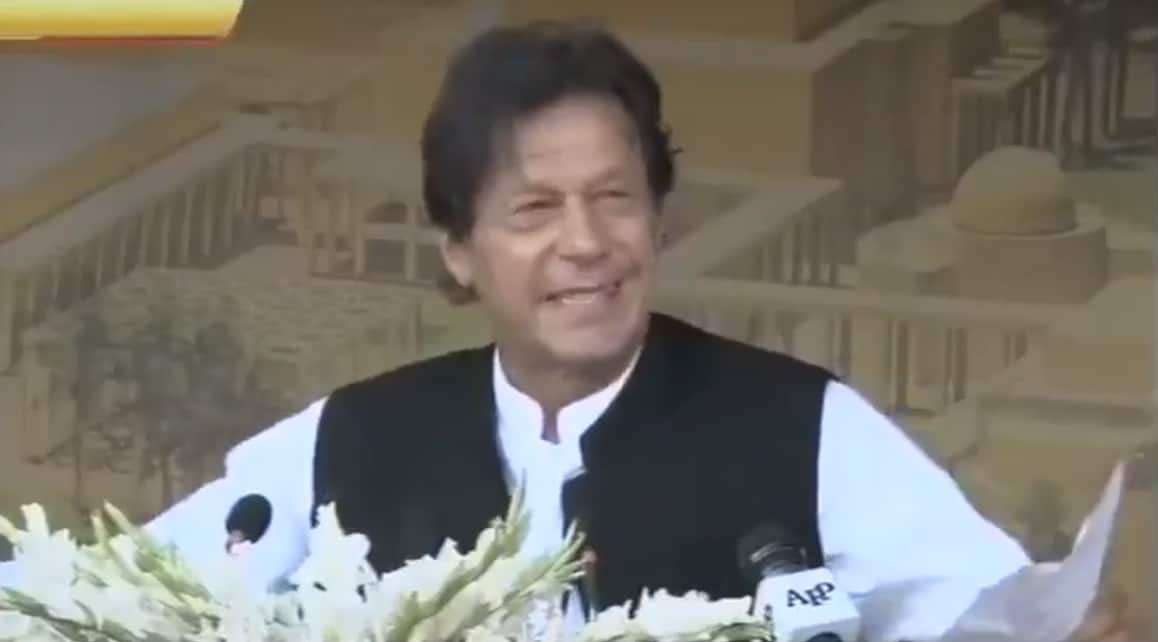
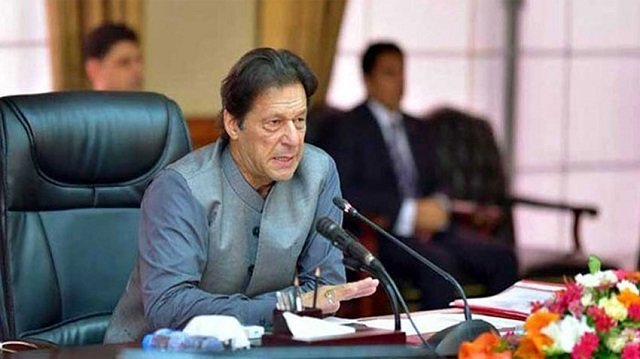
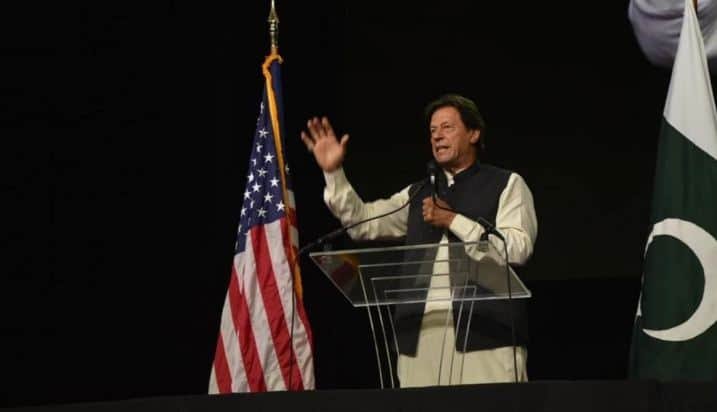
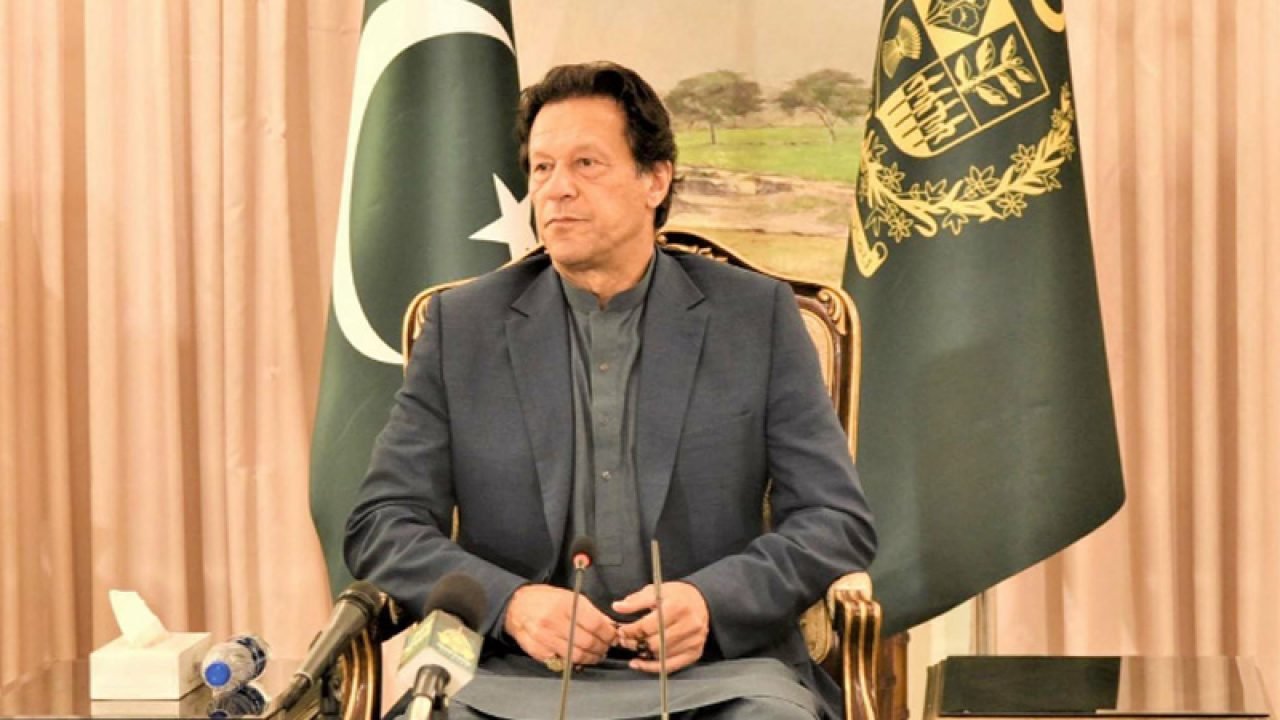
Prime Minister Imran Khan has called out Bollywood for spreading vulgarity and adopting the ‘worst of Hollywood’.
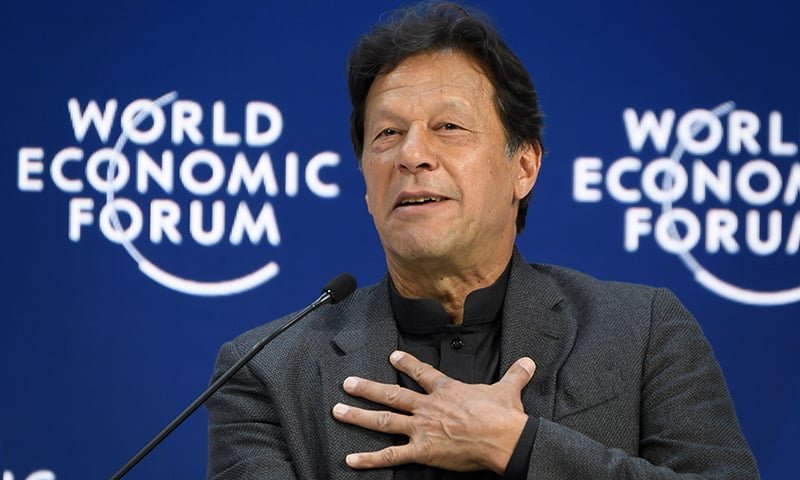
In a recent media meet, PM Khan discussed why he requested PTV to air the superhit Turkish series Diriliş: Ertuğrul with Urdu dubbing.
“The show has depicted the culture of Islam,” said PM Imran. “I want our youth to know that we also have a culture which has romance and other interesting elements.”
The premier then called out Bollywood for promoting vulgarity.
“I say this with a heavy heart but thirty to forty years ago, you would have never seen such vulgarity in Bollywood. There is so much trash. Bollywood has adopted the worst of Hollywood.”
“This is affecting our society and youth negatively. Drug culture is emerging, sex crimes are increasing because of such promotion of vulgarity. This is the reason I wanted the series to be aired so that the youth understand that there are other cultures as well.”
“It is important to note that when vulgarity increases in a society, the family system goes down”, remarked the prime minister.
Prime Minister Imran Khan shares his views over PTV telecast of famous Turkish drama serial Diriliş: Ertuğrul; it will make our youth learn about Islamic history and ethics pic.twitter.com/pymAPbJFLr
Turkish historical fiction series Diriliş: Ertuğrul, popularly referred to as the Turkish Game of Thrones, has begun to air on PTV Home with Urdu dubbing for the local audiences. PTV obtained the exclusive rights for dubbing and screening it in Pakistan.
Dear PTV viewers, the PTV management would like to thank you for the most encouraging feedback for #ErtugrulUrduPTV Episode 1, and for making it the TopTrend on Twitter Pakistan!
Set in 13th century Anatolia, before the establishment of the Ottoman Empire Diriliş: Ertuğrul illustrates the struggle of Ertugrul Gazi, the father of Osman I – the founder of the Ottoman dynasty.
Since its premiere on state-run Turkish TV channel TRT 1 in November 2014, the serial has been telecasted in 60 countries and has a huge fan following across the world.
The federal government has launched ‘Yaran-e-Watan’ to allow overseas Pakistani health professionals to support the country’s efforts to help fight the coronavirus pandemic.
Taking to Twitter on Saturday, PM Imran said that Pakistani health professionals are on the frontline in the fight against COVID-19 across the world and they want to help the government to combat COVID19 in Pakistan.
“We have launched YaranWatan initiative for our overseas health professionals who can now register to volunteer their services,” he wrote.
Pakistani health professionals are on the frontline in the fight against #COVID19 across the world. They also want to help us combat COVID19 in Pak. We have launched @YaranWatan iniitiative for our overseas health professionals who can now register to volunteer their services. pic.twitter.com/O0MkyDMNDs
Special Assistant to Prime Minister (SAPM) on Health Dr Zafar Mirza said, the initiative has been launched in collaboration with the Ministry of National Health Services, Regulations and Coordination, the Ministry of Overseas Pakistanis and Human Resource Development with support from the Pakistani diaspora health organisations.
He said the platform will help utilise the full potential of the diaspora community, including medical doctors, nurses, pharmacists, administrators, health economists, public health professionals and other professionals, in developing Pakistan’s health sector.
— National Information Technology Board (NITB) (@NationalITBoard) April 24, 2020
Meanwhile Tania Aidrus also encouraged doctors, both local and overseas, to offer their services to the country.
For doctors who are overseas you can sign up at https://t.co/O9uVecEAuC and have your credentials verified.
The telehealth service will go live as soon as we have enough doctors who are set up on the system and ready to be connected to patients.@NTCPakistan@EoceanEm
After Edhi Foundation head Faisal Edhi tested positive for the new coronavirus less than a week following his meeting with Prime Minister (PM) Imran Khan, who, however, has tested negative for the same, concerns have been raised over another health risk that the premier may be facing as an employee of Coronavirus Care Hospital of Pakistan Red Crescent Society (PRCS) in Rawalpindi tested positive for COVID-19 the same day Imran visited the facility.
As per the details, Khaleeq Abbasi, who works at the Logistics Department, had been deputed at the hospital to take care of the logistics and was also involved in logistics provision for PM Imran’s visit along with other staff.
“Abbasi was not feeling well for quite a few days. He tested for coronavirus on Monday which came positive on Wednesday,” reports quoted an official as saying.
“After testing positive, Abbasi has been directed by the PRCS management to self-isolate,” they said, adding that as a follow-up measure, the management had also isolated the entire logistics department and sent samples of all of the department’s employees among a number of other persons for testing.
According to a press statement issued by PM House, the premier during his visit was briefed in detail by PRCS Chairman Abrarul Haq on the measures taken by the organisation in the wake of the situation arising out of the COVID-19 outbreak and the facilities at the hospital.
A video doing rounds over the internet also showed PM Imran and his delegation at the facility without any specific protective measures.
Minister for Railways Sheikh Rasheed Ahmad, PM’s special assistants Dr Sania Nishtar, Dr Zafar Mirza and Member National Assembly (MNA) Amir Mehmood Kiyani were among those who accompanied Imran.
PRCS spokesperson Rehal Ali has confirmed that an employee named Khaleeq Abbasi tested positive for COVID-19 the same day the premier visited the hospital. “Actually, Abbasi’s test sample had been sent on Monday and the confirmation came on Wednesday,” said the spokesperson, adding that Abbasi and all other staff members had been isolated at their homes as a safety measure.
“We have tracked back around 10 people who had been in contact with Abbasi and isolated them at their homes. Their samples have also been taken and sent for tests,” he said, adding that all measures identified by the National Institute of Health (NIH) were being followed at the hospital as well as the national headquarters of the PRCS.
Prominent preacher Maulana Tariq Jamil’s statements from Prime Minister (PM) Imran Khan’s Ehsaas Telethon to raise money for the government’s coronavirus relief fund on Thursday have received mixed reactions, which were followed by the religious scholar also apologising as he drew the ire of several netizens, including senior journalists and rights activists, who called him out for “targetting women” and calling media personalities “liars”.
“I apologise if someone has misconstrued my words. It was not a sweeping statement and I was referring to certain journalists when I said they lie,” Jamil said while appearing on a private media outlet’s show hosted senior journalist Javed Chaudhry, who was seen making the religious scholar realise that his words had not been very well-received by many.
WATCH VIDEO:
https://www.youtube.com/watch?v=IE6KhNlpK7A
Earlier, he was also called out by senior journalist and analyst Hamid Mir and his colleague Murtaza Ali Shah.
ایک زمانے میں مولانا طارق جمیل کی آخری امید نواز شریف ہوا کرتے تھے پھر وقت بدلا اور امید بھی بدل گئی https://t.co/T77upk1iuy
Molana Tariq Jameel used to praise Nawaz Sharif in the same way he’s today praising PM Imran Khan; he has condemned the whole media but the media didnt have the opportunity to defend itself but TJ shud explain who justified lying on media, says @HamidMirPAK on @geonews_urdu
Other than speaking against “certain journalists”, Maulana had on Thursday also blamed “immodest women” for causing the coronavirus pandemic in Pakistan.
According to reports, he advised people to abstain from vices like indecency, lying, fraud and illegal means of earning a livelihood, adding that pre-Islamic nations were annihilated because they transgressed the limits set by God.
He went on to call some women “behaiya [immodest]” and talked about the indecency and mixing up of genders and leading the youth astray. In one particular sentence, he expressed remorse over women dancing. He, however, did not clarify his stance further.
He then concluded the transmission with a special prayer asking God to end the pandemic coronavirus and save entire humanity.
Here’s what Twitterati had to say:
“Mulana Tariq Jameel” blessing for Pakistan Exactly explain the ground reality. To build a great Empire or Nation it requires the guidance of scholars. inshaAllah Imran Khan will make Pakistan a great nation under the guidance of scholars.#PMIKEhsasTelethon#tariqjamilpic.twitter.com/G56n6G39Qc
I just want to apologise to all my followers for that sleeveless kurta I wore once. I really didn’t know it would cause a global pandemic. #tariqjamil#COVID19
Pakistani media made Tariq Jameel a hero and celebrity, gave him his status that he enjoys today. Live on all channels today, he declared all Pakistani media as ‘liars’. Good going.
#tariqjamil ‘s comments about immoral women & corona sum up the thinking of most clergy in Pakistan and dare I say, the Prime Minister himself & most of his party & followers.
The question is: if we women brought this azaab upon us why is the virus affecting more men than women?
— Benazir Jatoi #FreePalestine (@BenazirJatoi) April 24, 2020
The Human Rights Commission of Pakistan (HRCP) has also condemned Jamil’s remarks.
HRCP is appalled at Maulana #TariqJamil‘s recent statement inexplicably correlating women’s ‘modesty’ to the #Covid19 pandemic. Such blatant objectification is unacceptable and, when aired on public television, only compounds the misogyny entrenched in society.
— Human Rights Commission of Pakistan (@HRCP87) April 24, 2020
Meanwhile, “#TariqJamil” continues to trend on Twitter in Pakistan.
The country’s current account deficit (CAD) — a trade measurement that says a country imported more goods, services, and capital than it exported — decreased to $2.78 billion during the first nine months of the Fiscal Year (FY) 2020, a decline of 73 per cent as compared to the $10.284 billion CAD recorded in the corresponding period last year, data released by the State Bank of Pakistan (SBP) has revealed.
The CAD for March stood at $6 million, as against $823 million recorded in March last year, and $198 million recorded in February 2020, Profit reported.
Most of this was driven by the decline in imports, which fell 19.3 per cent year-on-year to $4.118 billion in March. Exports of goods also fell 10.8 per cent year-on-year to $2.037 billion in March.
Additionally, there was a 9.2 per cent rise in the inflow of workers’ remittances, which were recorded at $1.734 billion.
The trade deficit in total balance of goods and services was recorded at $2.368 billion in March, an improvement over the deficit recorded in February ($1.969 billion).
During the July-March FY20 period, the total deficit in goods and services balance stood at $17.1 billion, a decline of 30.8pc from the deficit of $24.7 billion recorded in the corresponding period of last year.
Prime Minister Imran Khan will collect donations from the public for the PM’s Corona Relief Fund while appearing on different channels today at 4 pm.
According to PTI Senator Faisal Javed, a large number of philanthropists and humanitarians would be part of the telethon. The donations would be made to an account in the Karachi branch of the National Bank of Pakistan (NBP).
He announced that religious scholar, Maulana Tariq Jameel will also be a part of the telethon today.
مولانا طارق جمیل صاحب آج ہونے والی پرائمنسٹر احساس ٹیلیتھون میں دعا کرائینگے انشاءاللہ – آپ سبکو شرکت کی دعوت دیتے ہیں آج شام 4 بجے PST آپکی ٹیلیویژن سکرین پر -اس تاریخی ٹیلیتھون میں شرکت کریں اور دل کھول کر عطیات کریں – اللہ سب کا حامی و ناصر ہو آمین#PMIKEhsasTelethonpic.twitter.com/AOvnoZi1y6
Earlier, the senator has tweeted that every citizen can also contribute towards Prime Minister’s COVID Relief Fund by sending a text message “Fund” at 6677.
You can SMS “Fund” at 6677 and contribute Rs. 20 per SMS towards Prime Minister’s Covid Relief Fund. Contribute as much as you can as it will reach those who are in need. Together we can and together we must. #PMFundForCovid19pic.twitter.com/D0PXI0d0Vk
PM Imran had announced the relief fund on April 1 to fight the pandemic in the country.
“Prime Minister’s COVID-19 Pandemic Relief Fund-2020 has been set up to help us fight this pandemic. I want everyone to donate towards this fund which will be used to take care of all those who have been made destitute by the lockdown,” the premier said on Twitter.
PM Imran asked the citizens to send their tax-deductible donation to account number 4162 786 786 set up at the main branch of National Bank of Pakistan in Karachi.
The PM had said money from the fund will be used to buy essential items for their families.
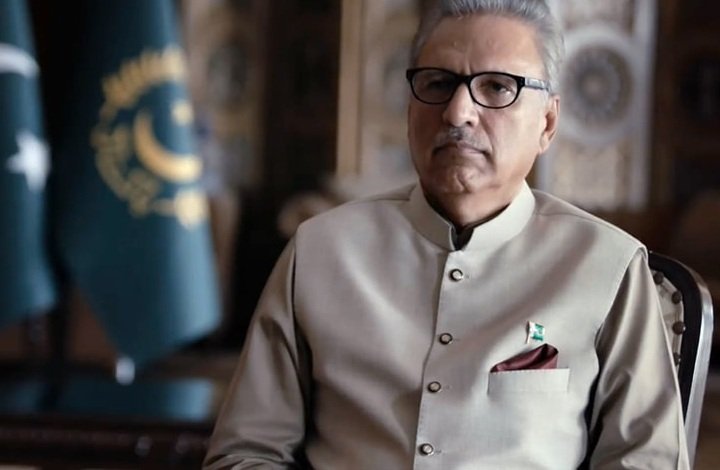
In a rather insensitive statement, President Dr Arif Alvi, while speaking of the damning investigation report regarding independent power producers (IPPs), has said the way mafias looted the country was “not rape but gang-rape”.
The federal cabinet on Tuesday decided to make public the investigation report on deals that allowed IPPs to earn illegal profits worth billions of rupees and also gave the nod to the formation of an inquiry commission to further probe into the matter.
The decision came two days after the president and Prime Minister (PM) Imran Khan reportedly discussed the report.
“I first read the executive summary of the 300-page [IPPs] report. I discussed it with the PM a day before we met [on Monday]. My exact words were… forgive me for what I am about to say and let’s not forget how the report doesn’t yet include the opinion of all stakeholders… but my exact words to the premier were that the country has not only been raped but gang-raped by mafias,” he said in a conversation with senior journalist and analyst Hamid Mir.
WATCH VIDEO:
WHAT DOES THE REPORT SAY?
A nine-member committee headed by former chairman of the Securities and Exchange Commission of Pakistan Mohammad Ali was formed last year to investigate reasons behind the high cost of electricity, especially in connection with IPPs.
According to the report prepared by the committee, deals were signed at the expense of interests of the consumers and the government. The national exchequer suffered a loss of over Rs4 trillion in the last 13 years because of circular debt and subsidies being given to power producers.
The report further disclosed that 16 IPPs invested around Rs51.80 billion and earned over Rs415 billion in profits – having dividends taken out in excess of 310 billion — in a period ranging from two to four years.
“Pakistan has regionally the highest power tariffs consequently raising the cost of manufacturing,” read a summary of the report. “This has been one of the prime reasons for loss of competitiveness of our industry and the stagnation of our exports,” it read.
It was noted that the profits generated by most of these IPPs were 18.26 times than their investment and the dividends taken out were 22 times higher.
Six companies earned an annual return on equity (ROE) between 60% and 79%. Four of them earned an ROE of 40%.
The report further revealed that 13 residual fuel oil- and gas-based plants in the last eight to nine years of their operations earned profits of Rs203 billion against their combined investment of Rs57.81 billion.
Excess payments of 6.33 billion to four bagasse-based plants were also identified.
“Coal companies with government connivance obtained a tariff which is more than 50% higher than the market rate leading to an annual over payment of $477 million per annum or $14.5 billion over the life of these projects,” the report read.
“Thermal IPPs set under the 2002 Power Policy and Nepra [National Electric Power Regulatory Authority] tariff determination were entitled to a 15% rate of ROE on a cost plus basis. However, the projects set up under this policy have been posting returns in dollar terms in excess of 50%. This could only have been possible if the tariff setting process of Nepra was compromised.”
It was noted that the Quaid-e-Azam Solar Park was instrumental in getting a very high upfront tariff for solar power approved at US cents 14 levelised and 18 cents for first 10 years through influence peddling and corruption.
The solar tariff in India at that time was between 7-8 cents with similar cost structure, while a much higher upfront tariff and capital cost allowed by Nepra, causing a massive loss to the country.
“The first project in the Quaid-e-Azam Solar Park established by the Punjab government involved a kickback of approximately $50 million,” the document read.
The committee found that private companies had provided false oil statistics to secure better tariffs.
Malpractices by IPPs with respect to project setting up costs, actual fuel use being less than the invoices submitted to Nepra, kickbacks in commission on fuel were also identified.
The report suggested that the power tariffs could be cut down by Rs3 per unit by adopting three measures: converting the payment to IPPs from dollar to rupee, switching from “take-or-pay” to “take-and-pay” option, and reducing capacity payments.
Special Assistant to the Prime Minister (SAPM) on Information and Broadcasting Dr Firdous Ashiq Awan has announced the federal cabinet’s decision to send chloroquine tablets — an anti-malarial medicine that some studies found has a strong antiviral effect on COVID-19 — to “friendly nations” to help them in their time of need.
Addressing a press conference after the weekly cabinet meeting, she said that one million chloroquine tablets will be sent to Saudi Arabia and the United States each, 500,000 to Turkey and Italy each, five million to the United Kingdom, 700,000 to Kazakhstan and 300,000 to Qatar.
Firdous revealed that leaders of some countries had called Prime Minister Imran Khan and expressed a desire to import the tablets from Pakistan following some encouraging results in treating the coronavirus.
“Pakistan has always been asking these countries for something or the other. So, for the sake of humanity and to improve Pakistan’s credibility and face value, this is a good chance to help them in this time of need,” she said.
She also said that Pakistan had some 40 million tablets in stock and possessed the raw material to make even more.
Prime Minister (PM) Imran Khan will undergo the test for the new coronavirus after Edhi Foundation Chairperson Faisal Edhi, who had met the premier last week, tested positive for COVID-19 earlier in the day.
According to the PM’s focal person on coronavirus, Dr Faisal Sultan, the premier has been advised to get himself tested as a precautionary measure after Edhi tested positive days after meeting him to donate Rs10 million to the government’s virus relief fund.
وزیر اعظم عمران خان سے فیصل ایدھی کی ملاقات
ایدھی فاونڈیشن کی طرف سے ایک کروڑ روپے کا چیک وزیراعظم کورونا ریلیف فنڈ کے لیے وزیر اعظم کو پیش کیا۔ pic.twitter.com/8FuqDOqmD5
Edhi is in Islamabad at the moment and had insisted on being tested since he had been on the ground working with patients. His family will also undergo a test for the virus.
Edhi had traveled to Lahore and then to Islamabad, where he had met the premier and donated a Rs10 million check on behalf of his organisation, Geo reported.
According to his son Saad Edhi, everyone who had come in contact with him will be tested for the virus, while the social worker remains in isolation and constant contact with his doctor.
Edhi says he had started experiencing severe headache and fever on April 16.
Meanwhile, the host and crew of a TV show, where Edhi had made an appearance last week, has already taken the tests and advised to stay at home till results arrive.
‘PAKISTAN AN INDEPENDENT NATION, CAN’T STOP WORSHIPPERS’:
Separately, the premier said the government “will take action” if safety precautions agreed upon by ulema were not followed.
He said that Pakistan was an “independent nation” and it could not force worshippers to not pray in mosques.
“The war for coronavirus is being fought by the entire country. It will not differentiate between the rich and the poor. It can happen to anyone,” he said, adding that ulema had signed a 20-point agreement with President Arif Alvi, under which mosques will be reopened with special measures in place. He, however, urged people to pray at home.
“I would urge my Pakistanis to stay at home and pray,” he said. “Other Muslim countries have urged their citizens to do the same. But if you have to go to mosques, keep this in mind. You will have to obey these conditions,” he added.
The premier said if people did not follow the safety precautions and cases surged in mosques during Ramzan, the government will have no other option but to take back its decision. “The government will shut mosques if safety precautions are not followed and this was mentioned in the agreement.”
Oil prices have turned negative for the first time in history, dipping by 305 per cent as storage space is filling up, discouraging buyers as weak economic data from Germany and Japan cast doubt on when fuel consumption will recover.
The crash in oil prices on Monday was as disrupting as the pandemic, with the United States (US) oil prices plummeting to a range between $1-2 per barrel. The Brent oil prices also hovered around $22-25 per barrel, the lowest in 22 years. The glut created by the price war between Saudi Arabia and Russia was compounded by the extremely low oil demand in most developed economies.
Traders have fled from the expiring contract in a frenzy as barely any buyers are willing to take delivery of oil barrels because there is no place to put the crude, creating a global supply glut as billions of people stay home to slow the spread of COVID-19.
But what does it mean for countries like Pakistan?
Crash in oil prices is an opportunity for Pakistan because even after passing 50 per cent of the decline on to consumers, the government can make up for revenue fall. Qatari gas will be cheaper than domestic gas.
Pakistan was in the midst of its worst economic crisis before the coronavirus attack and was finding it hard to finance its huge oil bill as the crude oil was hovering in the range of $55-60 per barrel.
After the pandemic, the demand for crude started declining sharply, and it ranged for a long time between $30-40 per barrel in March. Its price started declining sharply in the last 10 days with US oil showing more volatility than Brent Oil that is mainly consumed in Asia.
With the US oil prices declining to $2, Brent price logically should not be more than $10 which means a price of $12 per barrel. At the moment, Brent Oil is still priced at $22 per barrel but if the buyers started buying from the US this price would not hold.
This low oil price has vindicated former Prime Minister (PM) Shahid Khaqan Abbasi’s inking of an agreement with Qatar for buying Liquefied Natural Gas (LNG) at 13 per cent of the Brent Oil price. At current Brent Oil rates, Pakistan will be buying LNG from Qatar at $2.6-2.8 per mmbt.
At this rate, it would be feasible for the state to procure gas from Qatar at a price even lower than our local gas, reports say.
Qatar is bound under agreement to provide this gas as Pakistan is bound to lift a certain quantity of cargo from Qatar whether we needed it in the domestic market or not.
If the opportunity is made use of, it could lower gas tariff for all industries much below the price that the government is charging from exporting industries after paying huge subsidy and the cost of electricity from gas-run power plants would also decline appreciably.
All this can result in the government making up for massive revenue losses.