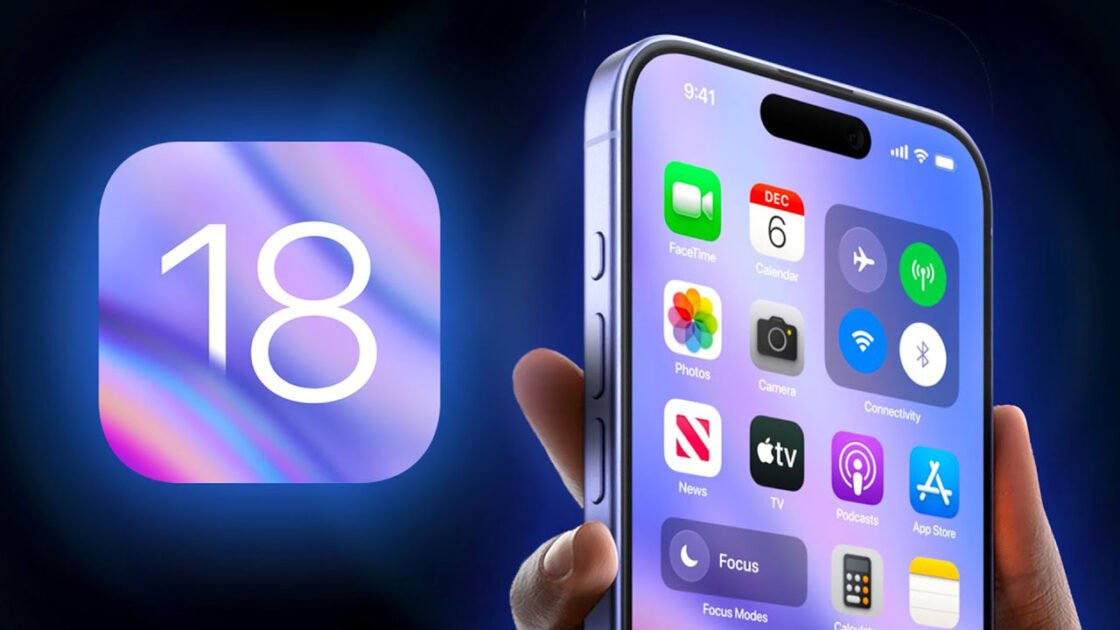
The upcoming iOS 18 is anticipated to introduce a new security feature that allows users to lock individual apps, according to several sources familiar with the development.
This feature is set to provide users with the ability to lock native iPhone apps such as Mail, Messages, Notes, Phone, Photos, Safari, and Settings, among others, thereby offering an additional layer of privacy and security.
To unlock a locked app, users will need to authenticate via Face ID, and it is expected that Touch ID or an iPhone’s passcode will also be compatible with this feature.
It remains unconfirmed whether this functionality will extend to third-party apps from the App Store.
Currently, Apple permits certain content to be secured behind Face ID, Touch ID, or a passcode, such as notes in the Notes app and photos in the “Recently Deleted” and “Hidden” albums within the Photos app.
The upcoming iOS 18 feature will expand this capability, allowing for entire apps to be locked, even when the iPhone itself is unlocked.
iPhone users have previously resorted to using Screen Time or Shortcuts to lock apps, but these methods will become obsolete with the new iOS 18 functionality.
Apple is set to unveil iOS 18 during its WWDC keynote on Monday. The initial iOS 18 beta is expected to be available to Apple Developer Program members immediately following the keynote, with a public release anticipated in September.
In a bid to fortify the safety and security of digital banking experiences, banks in Pakistan have recently implemented a crucial update, removing customers’ account balance information from SMS alerts.
This proactive move aims to safeguard users’ privacy and protect their sensitive financial details.
Previously, users would receive SMS alerts from their banks, displaying their account balance whenever they made transactions or received funds from other accounts. However, this service has now been discontinued, prompting mixed reactions from the public.
While some Pakistanis express reservations about this security update, it is essential to understand that the decision was made to enhance user privacy. To access their account balance conveniently, customers can now log into their respective bank’s mobile application.
The update aligns with the recommendations of the State Bank of Pakistan (SBP), as outlined in the central bank’s BPRD Circular No. 04 of 2023. This security enhancement has been uniformly implemented across the entire banking industry in Pakistan.
The move comes in response to the rising trend of fraud and mobile banking scams, necessitating measures to protect account privacy, especially in public spaces.
With SMS notifications often visible on lock screens, the removal of account balances adds an extra layer of security, ensuring sensitive financial information remains confidential.
The State Bank of Pakistan (SBP) has consistently advised banks and microfinance banks (MFBs) to implement appropriate controls and remedial measures to enhance the security of digital banking products and services. As the digital landscape continues to evolve rapidly, these measures become crucial in mitigating the risk of fraudulent activities.
The adoption of digitization has significantly transformed the financial landscape, allowing banks and MFBs to cater to the growing needs of customers.
However, the State Bank of Pakistan emphasises the importance of supplementing digitization with necessary controls to effectively counter the risk of fraudulent activities and maintain the integrity of digital banking products and services.
Farid Town police in Sahiwal have arrested the manager and assistant manager of a wedding marquee at 96/6-R village, for reportedly installing hidden cameras in the bridal dressing room.
Complainant Muhammad Arshad from 94/6-R village had booked his daughter’s wedding at Grand Imperial Marriage Hall on September 1, 2023.
DAWN has reported that the man said that when his daughter went into the dressing room to change, she and her mother heard voices through the walls.
Arshad’s wife informed him about it after which, along with his son Ali Akbar and cousin Tariq Hussain, he went to the adjacent room only to find a video recording setup connected with the camera capturing the activities of the bridal room.
A man pointed a gun at them, while the manager and his assistant escaped the premises. He called the police on 15 helpline after which the manager and his assistant, Umer Iqbal and Javed Munir, were arrested.
A case (FIR No 1495/23) has been registered against both the suspects and their accomplice who had pointed a pistol at the complainant, under sections 292 and 506/B of the PPC on the complaint of Arshad.
Arshad has demanded that the district police officer conduct an investigation, and recover all the videos made by the suspects because they might have or could use it to blackmail and exploit women.
While we love the fact that Pakistani celebrities are respected and valued by their fans-especially cricket stars- it’s important to remember that it doesn’t mean fans are allowed to invade anyone’s privacy. Former cricket captain Shahid Afridi addressed this issue as a guest on Vasay Chaudhry’s show ‘Gup Shab’ where he opened up about his distaste for fans who have crossed boundaries and invaded the privacy of his family. Boom Boom Afridi said he finds it unpleasant that fans make videos of him and his family when they go out.
But, Shahid said, it was disappointing to watch his family’s privacy further invaded when they were in Makkah for Umrah, sharing that it was disrespectful even for the people claiming to be a fan of the cricket player.
“When you’re going for your Umrah or Hajj with your family, your privacy is completely breached over,” Shahid noted.
“My wife does pardah. During Tawaaf, I have snatched phones from several people who were making videos. Even though I apologised to them afterwards, I have asked several times to stop making videos during that moment.”
The topic of fans crossing their limits and invading the privacy of celebrities, especially when they’re with their family members, is not new.
Cricket player Imam ul Haq spoke on Daniyal Sheikh’s podcast about an occasion when he was at a restaurant with his family. A few people shouted ‘parchi’ at him. This bullying has gone to the point that his family members no longer attend his matches, in fear of being heckled by the attendants.
“They really want to come and watch me play, but I’m just scared- this is the first time I’m talking about this. But when I’m standing on the boundary, I don’t want my mother to listen to the taunt ‘parchi’ in the stadium. If I was batting and I was out, it wouldn’t matter if I had played better before or not, while going back I would hear taunts of ‘parchi’.”
Previously, actress Romaisa Khan slammed nurses who approached the ‘John’ actress for photos when she was in tears and praying for her mother’s recovery in the ICU, an act she recalled as “insensitive” in a detailed post on Threads.
“Some people are so insensitive,” lamented the ‘John’ actress on her Threads account. “I know we are public figures but not public properties, so it’s unethical that my mom is in the ICU screaming in pain almost fighting for her life and where I am crying and praying outside and nurses literally making videos and asking for a selfie.”
So please remember that while it is natural to have immense respect for a public figure’s talent and skills, fans should also remember to respect the privacy. Celebrities are only in the public spotlight as a job, and it doesn’t give any fan the right to treat their entire existence as a public affair.
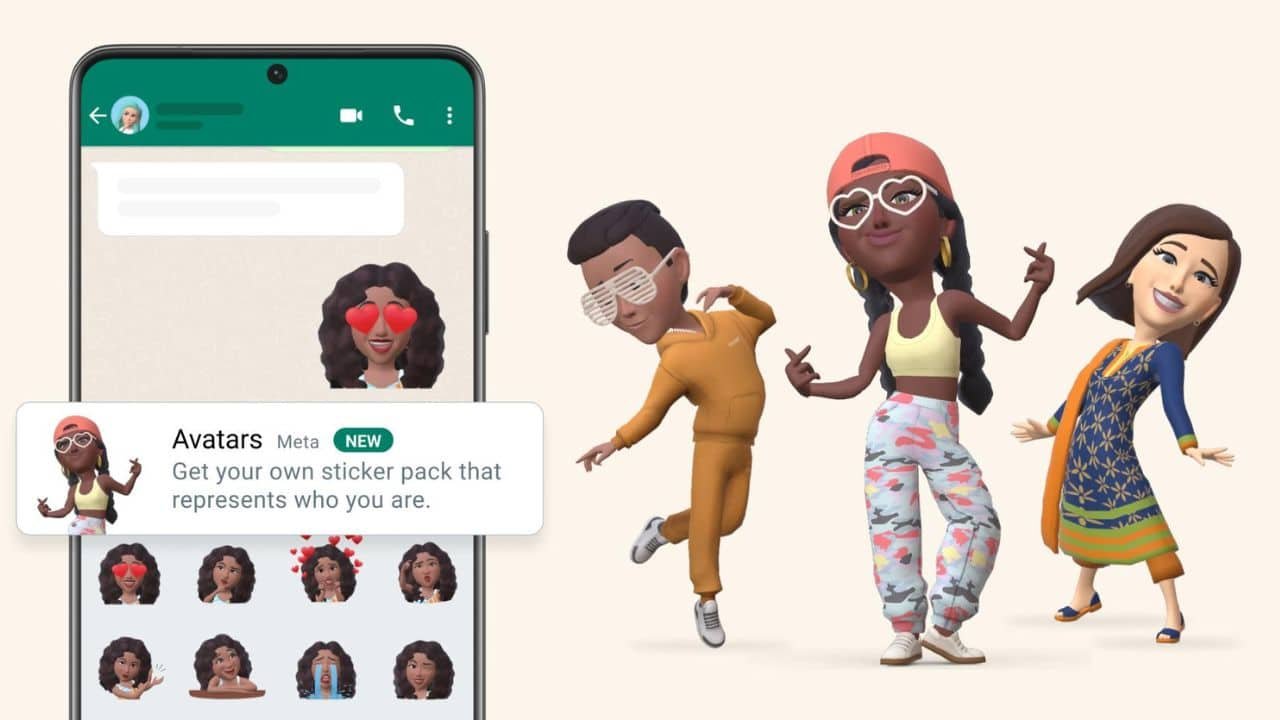
Meta’s messaging application, WhatsApp, is reportedly gearing up to introduce animated avatars for video calls. This anticipated feature, reminiscent of Apple’s Memoji, has been in development since the previous year.
According to WABetaInfo, an independent source for real-time WhatsApp updates, the Messenger app has now unveiled the capability to use animated avatars during video calls in its latest Android beta version 2.23.19.14.
WhatsApp is actively informing its users about this innovation through a pop-up notification. This notification provides the option to “utilise your avatar during calls,” offering the choice to either “switch to avatar” or defer the decision with a “not now” button.
To employ this new video call avatar feature, users must select the “Switch to avatar” option. This function will replicate their facial movements and expressions in real-time through the use of an avatar character. Importantly, users retain the flexibility to disable this feature at any time through the settings, allowing them to reveal their true selves. Crucially, the introduction of the avatar feature will not compromise WhatsApp’s end-to-end encryption, ensuring the preservation of user safety and privacy.
It’s worth noting that some data usage will be necessary to enhance the Avatar experience on the app. Additionally, WhatsApp is actively developing avatars for status updates, although there is no official information regarding their release at this time.
PC Magazine has reported that X, previously known as Twitter, will soon require its Blue users to provide a selfie and a copy of a government-issued identification.
This is a part of the verification process that will be handled by an Israeli company AU10TIX software which will store the provided information for up to 30 days.
According to X, data collected from a user’s profile will be used “for the purpose of safety and security, including preventing impersonation”.
X users have expressed their concerns with data collection due to previous instances of data breach. Others are unhappy about the software’s links with Israeli intelligence.
Al-Jazeera reports that AU10TIX has helped create the identity verification systems for airports and border controls in the 1980s and 90s and then ventured into “digital spaces” in 2002 as the internet grew. The company now deals with renowned digital platforms like Uber, PayPal and Google.
The purpose of the new verification process is to further strengthen security against impersonation and fraud.
Previously, Musk imposed a subscription fee on verified Twitter users in November 2022. This was extended to accounts with a verified phone number and active subscription to an “eligible Twitter Blue plan”.
This year, in April, Twitter removed legacy verification programmes as well as legacy verified checkmarks. This prompted a fear of impersonation and spreading of information.
This was followed by gold and grey check marks indicating verified organization and government- affiliated accounts, respectively.
WhatsApp, the messaging app owned by Meta, has introduced two new updates for its Android and iOS users. These updates offer enhanced privacy and control over incoming calls, as well as improved options for protecting user information.
One of the updates is the “Silence Unknown Callers” feature, which automatically screens out unwanted calls from unknown or suspicious numbers. It helps users avoid spam, scams, and calls from people they don’t know. Instead of ringing on the phone, these calls will be listed in the call log, allowing users to check them later in case they are from important contacts. To enable this feature, users can go to their WhatsApp account privacy settings and select the “Silence Unknown Callers” option in the calls section.
The second update is the “Privacy Checkup” feature, which assists users in navigating and configuring important privacy settings. By taking users through a step-by-step process, it helps them understand and choose the appropriate level of protection for their messages, calls, and personal information. By accessing the Privacy settings and selecting “Start checkup,” users can explore various privacy options and strengthen the security of their WhatsApp account.
WhatsApp has taken innovative measures to spread awareness about these updates on a global scale. Emphasising the significance of secure communication, the app encourages users to connect with friends and family through private messaging, where they can freely express themselves. These updates aim to provide a safer and more private experience for WhatsApp users.
Future Chief Justice of Pakistan (CJP) Justice Qazi Faez Isa adjourned the hearing of a commission to investigate the audio leaks which allegedly involved senior judges and their families a day after CJP Umar Ata Bandial’s order to stop all proceedings.
However, during the hearing today, Justice Isa, who was heading the commission, raised questions on the decision handed out yesterday.
Commenting on one of the key issues raised in the petitions filed in the SC yesterday, the judge observed that privacy always belongs to the home.
“One cannot peep into someone’s house; however, there are CCTV cameras on the streets, are they also against privacy?” he asked.
He said that the commission was doing nothing that would be considered a breach of anyone’s privacy.
Defending the commission, he said it should, at least, be determined who was releasing the audios and whether they were real or not.
He further said that there is talk of giving money to a judge in an audio leak, but the investigation has been stopped.
“It is written in the oath that I will perform my duties according to the constitution and law,” he said.
“This inquiry commission has been formed under a law — the Commission of Inquiry Act,” he further remarked, adding that people have to do certain things in life that they do not like.
Further adding that the judges have to conduct such “painful investigations”, he said: “If this commission was not allowed under oath, I would have excused myself.”
After this, Pakistan Muslim League-Nawaz (PML-N) Senior Vice President Maryam Nawaz attacked CJP Bandial for stopping the investigation of the audio leaks. It is pertinent to mention that one of the many audio leaks allegedly features Bandial’s mother-in-law talking to a Pakistan Tehreek-e-Insaf member’s wife.
“Bandial deserves to be punished for making a mockery of the law and making a spectacle of the judiciary to save his family”, Maryam said in a tweet.
چیف جسٹس کا کمیشن کو کام کرنے سے روک دینا ہی ان کے گناہگار ہونے کا ثبوت اور اعتراف ہے۔ انصاف کی سب سے بڑی کرسی پر براجمان شخص اپنے عہدے کو احتساب سے بچنے کے لیے بے دریغ استعمال کر رہا ہے۔ اگر آپ اور آپ کی ساس کا دامن صاف ہے تو کیا آپ کو قانون کا سامنا نہیں کرنا چاہیے ؟ یا چیف…
— Maryam Nawaz Sharif (@MaryamNSharif) May 27, 2023
Feroze Khan has issued a public apology to the ten celebrities whose personal information was leaked to the internet when he posted their personal phone numbers and home addresses on Twitter in a screenshot.
Khan had written in a statement: “As an actor, I know the importance of privacy and value it the most. I never intended that anyone’s peace be disturbed. If any one of my colleagues had to go through any inconvenience I’m deeply sorry for that.”
Actor Muneeb Butt and his wife, Aiman, along with her sister Minal, were among the celebrities whose private info was leaked, but yesterday Butt shared a picture of him and Khan together, and revealed that they had settled their differences and decided to drop the charges against the “Habs” actor.
His statement read:
“..To give us pain and mental distress wasn’t FK’s intention it was a mistake I announce to drop all of the charges.”
Butt had previously filed a stalking report with the cyber crime department against Khan for leaking his and his family’s personal information.
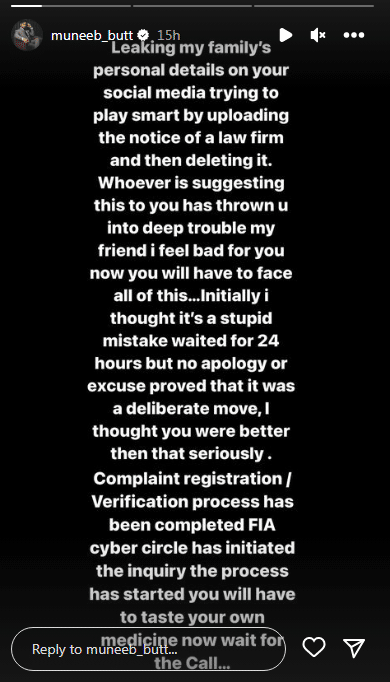
“Whoever is suggesting this to you has thrown you into deep trouble my friend I feel bad for you now you will have to face all of this… Initially I thought it’s a stupid mistake waited for 24 hours but no apology or excuse proved that it was a deliberate move, I thought you were better than that seriously. Complaint registration/ verification process has been completed FIA cyber circle has intiated the inquiry. The process has started, you will have to taste your own medicine now wait for the call,” he had written.
Celebrities like Yasir Hussain had slammed Khan for being ‘stupid’ for first beating up his wife, and then leaking his number to the world.
Actor Sarwat Gilani had shared a screenshot on her Instagram page of the numerous phone calls she had received since her number was leaked by Khan, and publicly announced that she was suing him along with the other celebrities.
Gilani had written: “It is bizarre and despicable that private information, including phone numbers, of various famous individuals has been publicly shared on the absurd pretext of issuing legal notice to them by @ferozekhan Not only are such actions clearly illegal but also demonstrates the total lack of maturity to handle matters in a civilized way.”
Will Cathcart, the head of WhatsApp, has stated that the company will not comply with the proposed online safety bill in the United Kingdom (UK), which aims to ban end-to-end encryption. Cathcart made these remarks during a visit to the UK, where he will meet with legislators to discuss the government’s internet regulation flagship policy. He further described the bill as the most concerning piece of legislation being discussed in the western world.
Cathcart explained that users worldwide demand security, and 98 per cent of WhatsApp’s users are outside the UK. Therefore, it would be an odd choice for the company to lower the product’s security in a way that would affect the majority of its users. He added that end-to-end encryption is essential in messaging services to prevent anyone other than the communication recipients from decrypting it. WhatsApp cannot read messages sent over its service and cannot comply with law enforcement requests to hand over messages or actively monitor communications for child protection or anti-terrorism purposes.
Cathcart noted that the online safety bill is an expansion of the UK government’s power to demand the removal of encryption, and it poses a grey area in the legislation. He called for similar language to be inserted into the UK bill as in the EU’s digital markets act, which explicitly defends end-to-end encryption for messaging services.
Furthermore, under the proposed bill, the UK government or Ofcom could require WhatsApp to apply content moderation policies that would be impossible to comply with without removing end-to-end encryption. If WhatsApp refused to comply, it could face fines of up to 4 per cent of its parent company Meta’s annual turnover, or it would have to withdraw entirely from the UK market.
Cathcart argued that large communities that use end-to-end encryption, such as WhatsApp’s “communities” offering, which allows group chats of over 1,000 users to be grouped together, have slim chances of causing trouble. He suggested that one person reporting any serious issues would suffice, making it easy for investigators to gain access.
The online safety bill is expected to return to parliament in the summer, giving Ofcom significant new powers as the internet regulator and enabling it to require effective content moderation under the penalty of large fines. WhatsApp has never received a legal demand to remove encryption from the UK government, according to Cathcart.