Tag: professors

  • College teachers in Khyber Pakhtunkhwa getting salaries without taking classes, reveals report

    College teachers in Khyber Pakhtunkhwa getting salaries without taking classes, reveals report

    Around 200 teachers of the higher education department posted at different government degree colleges in Khyber Pakhtunkhwa are getting salaries without taking classes as they have been posted irrationally and in the wrong positions, reports Mohammad Ashafaq for Dawn.

    Along with the 200, another 679 teachers in government colleges were not meeting the required credit hours, as per official documents. Against the department’s policy of two credit hours, these teachers have only one credit hour.

    Specified workload for teachers

    The higher education department has specified a workload of each teacher that is 12 credit hours in a week while relaxation has been made of three credit hours for the faculty assigned other duties including coordinator, controller, examiners and chief proctors in the respective colleges.

    Burden on rest of the teachers

    The posting and transfers of teachers has shifted the burden to the remaining 808 teachers serving in different colleges, who are forced to attend additional classes in their respective institutes due to shortage of staff.

    A breakdown of teachers not taking classes

    The data shows that six professors in BPS-20 posted in different colleges, 33 associate professors in BPS-19, 61 assistant professors in BPS-18 and 85 lecturers in BPS-17 are not attending classes.

    The teachers, who attend half of their classes, include 31 professors in BPS-20, 195 associate professors in BPS-19, 163 assistant professors in BPS-18 and 285 lecturers in BPS-17.

    The teachers, who are overburdened and attend additional classes beyond their capacity, include 16 professors in BPS-20, 84 associate professors in BPS-19, 238 assistant professors in BPS-18 and 270 lecturers in BPS-17.


    The truth about irrationality of posting

    Sources told Dawn that the minister and secretaries of higher education were responsible for irrationality in the transfer of teachers.

    “For instance, if there is a vacant seat for Urdu teacher in BPS-19 in a government college, which is located in urban area or important city like Peshawar, HED orders posting of a mathematics teacher there in the same grade,” they added.

    However, after posting on the wrong position, the mathematics teacher couldn’t teach Urdu because in colleges only a teacher specialised in subject could teach the same subject. “Wrong posting can be managed at school level but it is not possible in higher education institutions,” they added.

    Sources said that teachers were using their contacts with the high authorities to get posting on wrong positions. They added that such teachers were unable to teach in colleges.

    They said that principals of government degree colleges had also reservations over wrong postings as it caused academic losses to students.

  • KP launches AI-based attendance system for schools

    KP launches AI-based attendance system for schools

    Due to an upsurge in complaints about teachers’ absences, Khyber Pakhtunkhwa (KP) has deployed artificial intelligence (AI)-based video systems in schools to monitor students’ and teachers’ live attendance.

    According to Zarif-ul-Mani, MD of the Elementary Schools Education Foundation (ESEF), the AI-based attendance system in the foundation schools would uphold the standard of instruction and improve student performance.

    He also described how the School Management Information System (SMIS) works to guarantee quality, accountability, and a simple transfer of scholarship cash to partners.

    He also commended the ESEF’s e-governance division for reviving this project, which had been mismanaged in the past.

    Additionally, the project would reduce dropout rates while guaranteeing that professors are present and that classes start on schedule.

    Prior to that, the government of Sindh made the decision to take strong action against teachers who were getting their wages while staying at home and neglecting their jobs.

    The provincial education agency reportedly stopped more than 2,000 “ghost teachers” being paid across the province.

    According to Express Tribune, Akbar Laghari, the education secretary for Sindh, said in a statement on the choice that they have filed a letter to the AG for Sindh asking him to cease paying the wages of 2,019 ghost teachers.

    He added that the department would fire the “ghost teachers” and would do everything it took to ensure that teachers showed up for work.

  • Federal Govt teachers demand pay raise, promotion

    Federal Govt teachers demand pay raise, promotion

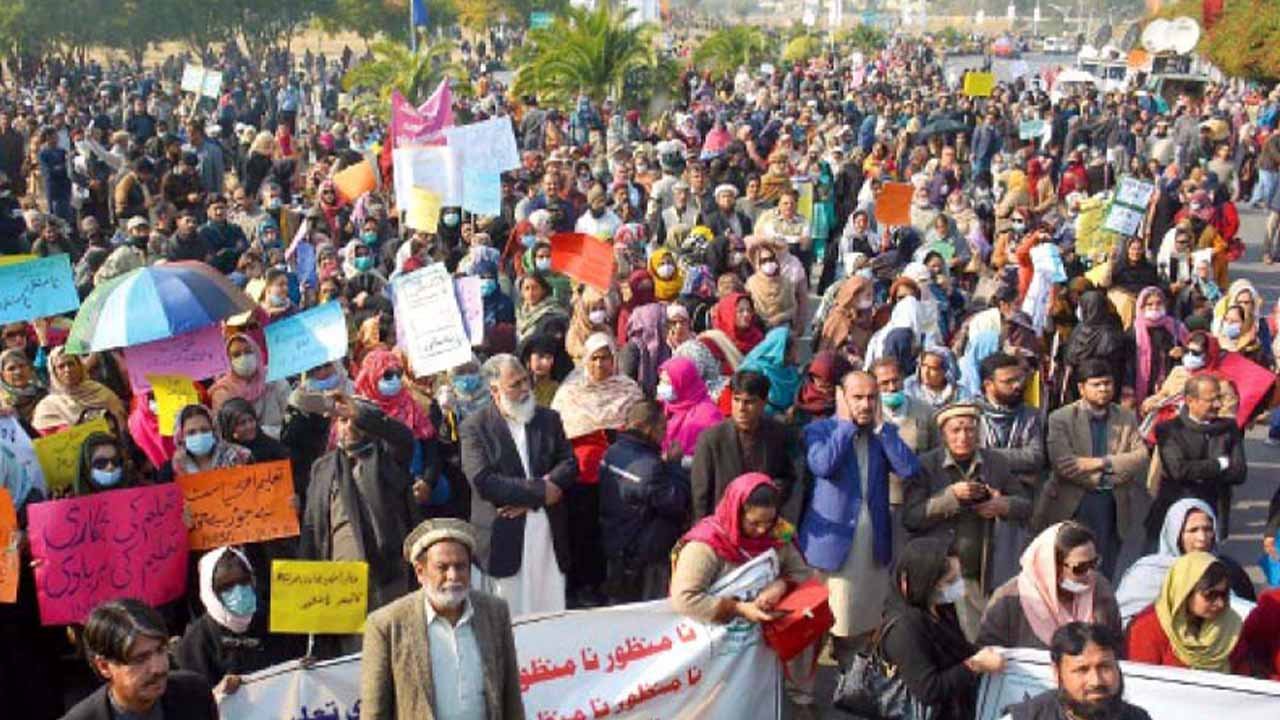
    Federal government employees have warned to hold another sit-in in the federal capital if their demands for salary increments and promotions are not met by May 23.

    They voiced the statement during a rally in front of Parliament House organised by the All-Government Employees Grand Alliance (AGEGA), where a significant number of teachers showed up, responding to the Federal Government College Teachers Association’s call (FGCTA).

    Dr Nazir Ahmed Bhutta, the FGCTA’s General Secretary, urged the government to fulfill its promise made last year in February.

    As per the agreement, all perks or allowances should be combined with basic salaries, employees should be given timely promotion and raise, including pay and pension adjustments should be implemented to minimise wage discrepancy.

    Professor Tahir Bhatti, president of the FGCTA (local unit of H-9 College), demanded the return of the Saturday weekly off for government employees who, he claimed, couldn’t afford to work six days a week due to a large increase in fuel prices in recent months.

    To preserve electricity, he believes the government should proclaim Saturday as a holiday.

    Professor Farhan Azam, senior vice-president of the FGCTA, noted that the remuneration of employees in different departments differed significantly, causing resentment among lesser-paid staff of the same grade. He proposed that professionals of the same status should have the same pay and privileges.

    Rehman Bajwa, AGEGA’s chief coordinator, cautioned that if the employees’ demands were not met by May 23, they would take to the streets after speaking with their management.