Tag: PSO

  • Profit plunge: Pakistan Refinery Limited records Rs1.24 billion loss

    Profit plunge: Pakistan Refinery Limited records Rs1.24 billion loss

    Pakistan Refinery Limited (PRL), a subsidiary of Pakistan State Oil Company Limited (PSO), faced a significant loss of Rs1.24 billion in the third quarter ending March 31, 2024, primarily due to reduced revenue and escalating costs.

    This marks a stark contrast to the same quarter in the previous fiscal year, when PRL posted a profit of Rs1.77 billion.

    The financial setback was announced through a notice to the Pakistan Stock Exchange (PSX) on Wednesday following a meeting of PRL’s board of directors on April 23. In light of the loss, the board recommended no dividend distribution.

    According to the report, the loss per share (LPS) for the quarter was Rs1.97, a notable decline from earnings per share (EPS) of Rs2.81 in the same period last year (SPLY).

    This financial downturn was driven by a 17 per cent drop in revenue from contracts, which fell to Rs49.45 billion in 3QFY24 from Rs59.55 billion in SPLY. As a result, PRL recorded a gross loss of Rs559.1 million, a significant shift from a gross profit of Rs4.46 billion in SPLY.

    The company’s ‘other income’ rose dramatically, up over 95 per cent to Rs1.12 billion in 3QFY24 compared to Rs574.32 million in SPLY.

    Despite this increase in other income, the company’s operating expenses soared by more than 240 per cent, reaching Rs1.69 billion in the third quarter, compared to Rs495.52 million in SPLY.

    Consequently, PRL reported an operating loss of Rs1.13 billion, a sharp reversal from an operating profit of Rs4.54 billion in the same period last year.

    The loss before tax (PBT) from refinery operations in 3QFY24 was Rs2.11 billion, a considerable drop from a profit of Rs2.65 billion in SPLY.

    However, despite the quarterly loss, PRL’s performance over the first nine months of the fiscal year remains positive, with a profit of Rs5.27 billion—more than double the Rs2.53 billion earned in the same period last year.

    Pakistan Refinery Limited was established in 1960 and has a current capacity of approximately 50,000 barrels of crude oil per day.

    It produces various petroleum products, including furnace oil, high-speed diesel, kerosene oil, jet fuel, and motor gasoline.

    Despite the recent downturn, the company’s operational capacity and product range remain robust.
  • Tariff hike of Rs1.72 per unit approved for K-Electric consumers 

    Tariff hike of Rs1.72 per unit approved for K-Electric consumers 

    The Economic Coordination Committee (ECC) has granted approval for quarterly tariff adjustments of Rs1.72 per unit for K-Electric, alongside government guarantees of Rs100 billion for Pakistan State Oil (PSO) and a Rs20 billion credit facility for Punjab’s Green Cooperative Initiative. 

    The ECC session, presided over by Federal Minister for Finance Dr Shamshad Akhtar and attended by other federal ministers and senior officials, addressed various summaries submitted by ministries such as Interior, Maritime Affairs, Energy (Power Division), Energy (Petroleum Division), Poverty Alleviation and Social Safety, and Defence. 

    The decision to adjust the tariff for K-Electric was reached after careful consideration of a summary presented by the Ministry of Energy regarding “Uniform Quarterly Tariff Adjustments for K-Electric Consumers on a par with XWDISCOs 2nd and 3rd Quarterly FY 2023.” 

    Following in-depth discussions, the ECC concluded that the tariff rationalisation through adjustments for K-Electric, aligning with the uniform Quarterly Tariff Adjustment (QTA) guidelines already issued to NEPRA, will be applicable to the consumption of July, August, and September 2023.  

    According to The News, these adjustments are set to be recovered from K-Electric consumers in December 2023, January 2024, and February 2024, respectively. 

  • Why was Shahid Khaqan Abbasi barred from flying abroad?

    Why was Shahid Khaqan Abbasi barred from flying abroad?

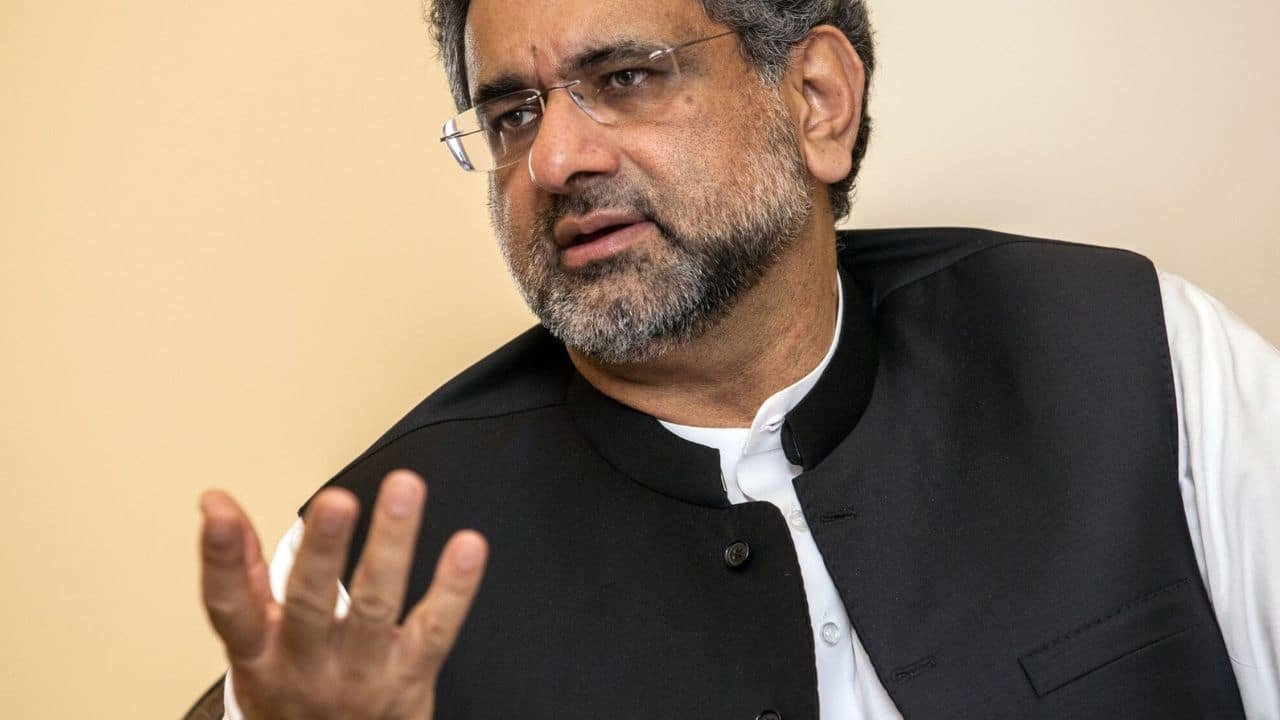
    Former Pakistani Prime Minister Shahid Khaqan Abbasi faced a brief hiccup on Friday when he was initially stopped from flying abroad due to his name being on the no-fly list, as per Shahzad Ali of Samaa.

    However, after clarification, he was allowed to proceed with his travel plans to China.

    Mr. Abbasi and his wife were at Islamabad Airport to catch a flight to China when immigration authorities informed him that he was on the stop list based on orders of the Sindh court.

    Consequently, he was told he couldn’t continue his journey and had to return from the airport lounge.

    Eventually, the issue was resolved, and he was permitted to travel.

    When reached for comment, Mr. Abbasi denied any disruption and stated that he had already departed for China.

    Despite attempts to contact the Federal Investigation Agency (FIA) immigration authorities for clarification, no response was received.

    Earlier last month, Shahid Khaqan Abbasi’s son Abdullah Khaqan Abbasi was prevented from leaving the nation at the Islamabad airport by immigration officials.

    On a foreign carrier, flight EK-613, Abdullah Khaqan Abbasi was scheduled to travel for Dubai.

    Due to the fact that Abdullah’s name was on the National Accountability Bureau’s (NAB) stop list, the FIA immigration officers stopped him.

    Earlier, Shahid Khaqan Abbasi’s bail had been extended by the Sindh High Court in a case related to an unauthorized appointment at Pakistan State Oil (PSO).

    The court also ordered that Abbasi’s name and those of the other defendants be added to the Exit Control List (ECL).

    The case involved allegations against Abbasi, Arshad Mirza, Imranul Haque, and Yakoob Babar, with the former petroleum secretary also being present during the court hearing.

  • Petrol price increased to historic high of Rs305.36 per litre

    Petrol price increased to historic high of Rs305.36 per litre

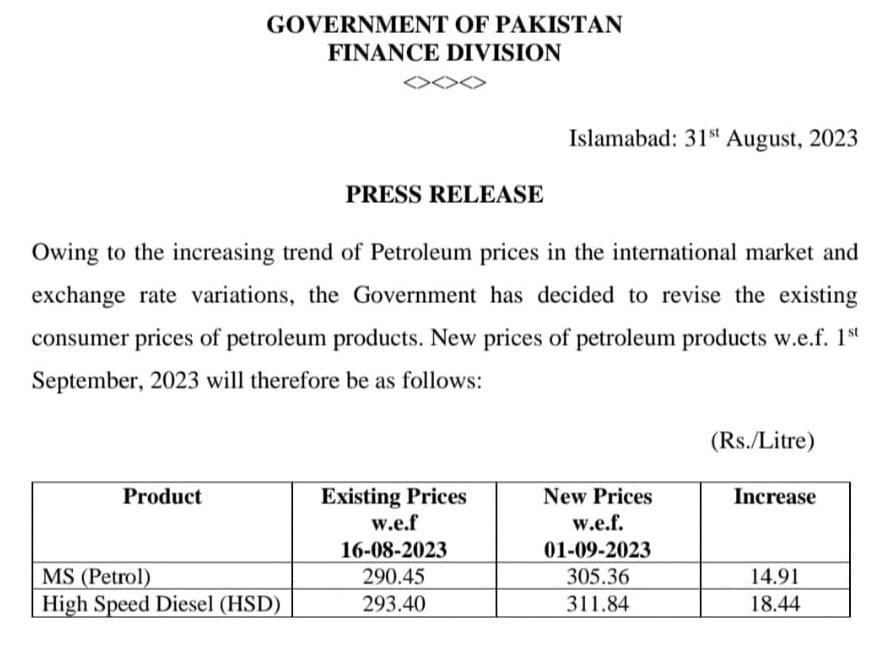
    For the first time in Pakistan’s history, the price of petrol has crossed the Rs300 mark due to a recent hike of Rs14.91. This brings the new petrol price to Rs305.36 per litre. The diesel price has also increased by Rs18.44, now at Rs311.84 per litre.

    The government has attributed these revisions to the upward trajectory of global petroleum prices and the consequential fluctuations in exchange rates.

    A statement issued by the finance ministry highlights that due to the escalating trend of petroleum prices in the international market and the subsequent shifts in exchange rates, the Government has opted to recalibrate the prevailing consumer prices of petroleum products.

    In the days ahead, the effects of these significantly heightened petrol and diesel prices will become evident. These price fluctuations are poised to have a substantial impact on individuals who rely on personal vehicles, such as bikes and cars, as well as those who depend on public transportation services.

  • Pakistan moves closer to finalising oil deal with Russia as team arrives in Karachi

    Pakistan has taken a step forward in its efforts to secure a loan deal with Russia, as a delegation has arrived in Karachi to finalise a crude oil deal with Pakistan State Oil (PSO). However, the Energy Ministry has not yet revealed the payment method or the discount rate for the crude oil prices, keeping it confidential for now.

    Technical teams from the Operational Services Centre held talks with the PSO team last month, but progress was not made on the constitution of a Special Purpose Vehicle responsible for importing crude and making payments. The Russian delegation is now in Pakistan to finalise the government-to-government agreement, including the mode of payment. Pakistan wants to pay in rupee, while Russia is asking for payment in China’s Yuan or Ruble. Once the deal is done, Pakistan will place an order with Russia for crude oil purchase.

    According to sources, the Russian ship will arrive in mid-May, and the current Brent price in the international market is $85.16 per barrel, while Russian oil is available at $47-48 per barrel. The State Bank of Pakistan (SBP) is asking local banks to open letters of credit for importing Russian oil, but they are hesitant to do so mainly because of the G7 countries’ regulations of following the price cap of $60 per barrel or below it and making payments under Society for Worldwide Interbank Financial Telecommunications (SWIFT) arrangement.

    PSO has never imported crude oil before, and refineries have been importing crude under long-term agreements from ADNOC and Saudi Aramco. However, in the case of Russian crude, refineries will not be involved in the import, but it will be an SPV with representatives from PSO and PSC. Pakistan may get Russian crude price with a discount close to $50 per barrel, $10 per barrel below the cap price imposed by G7 countries on Russian oil in the wake of the war on Ukraine.

    One of the top officials in the coalition government suggests that the decision to import Russian crude under the government-to-government agreement at a 30 per cent discount may not provide the required relief as shipping and refining costs will erode the maximum discount. Additionally, Pakistan refineries will only be able to extract 10 per cent MS out of Ural crude and 50 per cent furnace oil.

    The government needs to conduct a commercial analysis to determine if importing Russian oil will benefit Pakistan’s economy and to what extent. Industrial sources suggest that the government should evaluate the economic benefits of importing Russian oil carefully.

  • National Refinery halts fuel supply to Pakistan State Oil over unpaid dues

    The National Refinery Limited (NRL) has decided to suspend the supply of fuel to Pakistan State Oil (PSO) due to the state-owned oil marketing company’s failure to make payments to the refinery.

    PSO has encountered a severe financial crisis, leading to outstanding payments owed to various sectors as a result of the supply of petroleum products.

    The amount owed to NRL by PSO is currently Rs3.469 billion. NRL has conveyed its decision to stop the supply of fuel to PSO in writing, according to a report by a national daily.

    Notably, PSO has recently stopped making payments to refineries, including those that supply diesel, gasoline, aviation fuel, furnace oil, and other petroleum products to the state-owned company.

    As per the company’s receivables, Sui Northern Gas Pipelines Limited (SNGPL) is the largest defaulter of PSO, with an outstanding amount of Rs492.102 billion as of March 8, 2023. In response, the Economic Coordination Committee of the cabinet has authorized a sovereign guarantee of Rs50 billion in favor of SNGPL for commercial borrowing on an immediate basis to meet PSO’s liquidity requirement.

    The power sector remains a significant source of difficulty for the state-owned oil marketing company, with outstanding payments of Rs178 billion, followed by Pakistan International Airlines (PIA) and the government of Pakistan, both of which owe PSO Rs92.5 billion. The total receivables, which have risen to Rs762.653 billion, include the most critical payment of Rs124.666 billion in late payment surcharge (LPS).

  • PSO reportedly planning to buy Telenor to expand its business beyond oil

    PSO reportedly planning to buy Telenor to expand its business beyond oil

    Pakistan State Oil (PSO) is reportedly conducting due diligence on the Pakistani operations of a Norwegian telecommunications operator, in response to Telenor’s plans to sell its Pakistani operations valued at around $1 billion. Pending regulatory approval, PSO has expressed interest in acquiring Telenor Pakistan and Easypaisa, following the completion of bidding documentation and due diligence.

    Easypaisa, a leading mobile wallet, mobile payments, and branchless banking services provider, boasts a significant customer base of nine million monthly active users. Launched in 2009 as a money transfer service through Unstructured Supplementary Service Data (USSD) channels, Easypaisa introduced a mobile app in 2016, offering a broad range of financial transactions. Telenor Microfinance Bank owns Easypaisa, and jointly, Telenor Group most recently launched a debit card on January 17, 2023.

    According to Mettis Global, Telenor Pakistan’s decision to exit the market stems from heavy taxation on the telecommunications industry and the policies of the Pakistani Telecommunication Authority (PTA), which have significantly reduced its revenues. Although Telenor Pakistan has faced operational losses for the past three years, there is no certainty that discussions regarding the sale of its Pakistani operations will result in a transaction.

    For PSO, the potential acquisition of Telenor’s operations in Pakistan aligns with its efforts to expand its business beyond traditional oil and gas. If successful, the acquisition could enable PSO to diversify its revenue streams and leverage Pakistan’s growing digital payments market.

  • Pakistan has ample fuel stocks available: PSO denies reports of petrol, diesel shortage

    Pakistan State Oil (PSO) on Friday denied all the rumours about the shortage of fuel reserves and said that there is ample stock of petroleum products in the country.

    The Ministry of Energy and Oil & Gas Regulatory Authority (OGRA), according to the PSO spokesman, is keeping an eye on the general situation regarding product availability by other oil marketing companies to ensure that the nation’s supply chain is maintained smoothly.

    He claimed that PSO would continue to supply the nation with petroleum products on an uninterrupted basis, that there is enough gasoline and diesel in the country, and that 80,000MT and 90,000MT, respectively, of each have arrived at Karachi Port.

    According to the OGRA spokesperson, local oil marketing firms and refineries are also working to meet the demand for petroleum products.

    The Oil Companies Advisory Council (OCAC) requested last week that the federal government step in right away to guarantee the prompt issuing of lines of credit to import petroleum products in order to prevent a fuel scarcity in the nation.

    On behalf of oil marketing companies (OMCs) and refineries, the OCAC sent a letter outlining the difficulties resulting from the opening of letters of credit (LCs) for the import of petroleum products being delayed.

    There haven’t been many oil shipment cancellations as a result of the LCs being closed.

    Mogas, High-Speed Diesel (HSD), and 650,000 MT of crude oil must all be imported into Pakistan on a monthly basis for a total cost of about $1.3 billion.

  • Petrol price may go down by Rs9.63 per litre for the next fortnight

    The price of petrol is expected to decrease by Rs9.63 per litre for the next two weeks, while diesel prices are anticipated to increase.

    According to reports, the Oil and Gas Regulatory Authority (OGRA) has advised lowering gasoline prices for the final fifteen days of the current month, September.

    However, a final decision about increased petroleum pricing would only be made after receiving Prime Minister Shehbaz Sharif’s approval.

    For the specified period, the cost of diesel is probably going to go up by Rs3.04 per litre, bringing the price from Rs247.26 per litre to Rs250.30.

    The federal government announced an increase in the price of gasoline and diesel for the first two weeks of September on August 31.

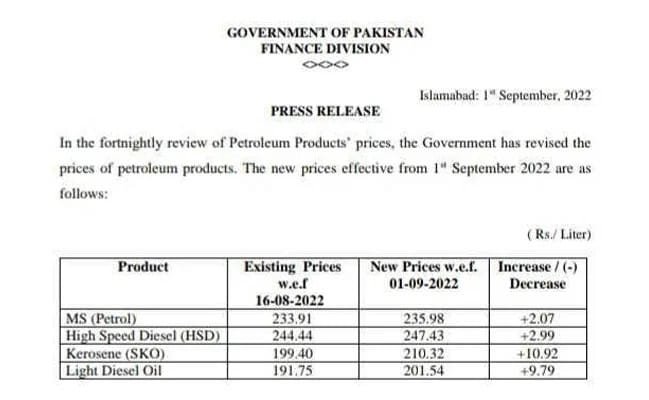
    The price of gasoline increased by Rs2.07 to reach Rs235.98 per litre, while the price of high-speed diesel increased by Rs2.99 to reach Rs247.43.

    According to Express Tribune, various strategies have reportedly been used by the government and OGRA to maintain low petroleum prices in order to avert political reaction.

  • Govt raises petrol price by Rs2.07 to Rs235.98 per litre

    Govt raises petrol price by Rs2.07 to Rs235.98 per litre

    The price of petrol was raised by the government on Wednesday by Rs2.07 per litre, making it Rs235.98 for the upcoming two weeks.

    Additionally, it announced a hike in the costs of kerosene oil by Rs9.79 per litre to Rs201.54, high-speed diesel by Rs2.99 per litre to Rs247.43, and light diesel oil by Rs10.92 per litre to Rs210.32.

    Contrary to what the market anticipated, the decision to raise gasoline prices, even more, was finally made. In the first half of September 2022, the market anticipated a price drop of up to Rs 20 per litre for the two main petroleum products—petrol and high-speed diesel.

    Expectations were sparked by a decline in the average exchange rate for the purchase of Pakistan State Oil (PSO), which fell from Rs227 in the first half of August to Rs217 in the next15 days.

    Similar to this, the premium paid on gasoline and HSD in the first half of August had decreased from $17 and $8.5 per barrel, respectively.