Tag: PSX

  • Pakistan continues to face liquidity crunch despite IMF programme’s revival

    Pakistan continues to face liquidity crunch despite IMF programme’s revival

    Even though the International Monetary Fund (IMF) programme has resumed after a seven-month hiatus, Pakistan continues to struggle with a major dollar liquidity crunch as the catastrophic floods have exacerbated the macroeconomic conditions.

    According to Geo, since many politicians and economists advocated for Pakistan to ask the IMF for a Rapid Financing Instrument (RFI) or Natural Calamity Response-related Funding Facility, the Pakistani government has not yet submitted a new request in anticipation of the Washington-based international lender’s unenthusiastic response.

    After being put on hold in February 2022 by the previous PTI-led government’s provision of unfunded fuel and energy subsidies, the IMF project under $6.5 billion was restarted in late August.

    Since then, there has been pressure on Pakistan’s currency; nevertheless, the recent devastating floods have hurt the economy, contrary to what experts had anticipated would happen with the restart of the IMF programme.

    The rupee has dropped 9 per cent against the US dollar in recent days due to intense pressure on the currency rate.

    According to reports, the issue has gotten worse as demand for imports has multiplied and there are not enough dollars in the country. Pakistan’s macroeconomic risks are not going away without greater dollar inflows.

    The early estimates of damages have now increased to almost $18 billion as a result of the severe flooding, with Pakistan’s agriculture industry taking the biggest hit.

    The worst agricultural performance will put pressure on rising import demand for commodities, and if Pakistan cannot attract the appropriate levels of dollar inflows, food shortages may occur in the ongoing financial year.

    In contrast to the projected aim of 3.9 per cent for the current fiscal year 2022–2023, the agriculture growth could remain zero or perhaps turn negative.
  • Intraday trade: PKR resumes downward spiral against US dollar, falls to Rs223

    Intraday trade: PKR resumes downward spiral against US dollar, falls to Rs223

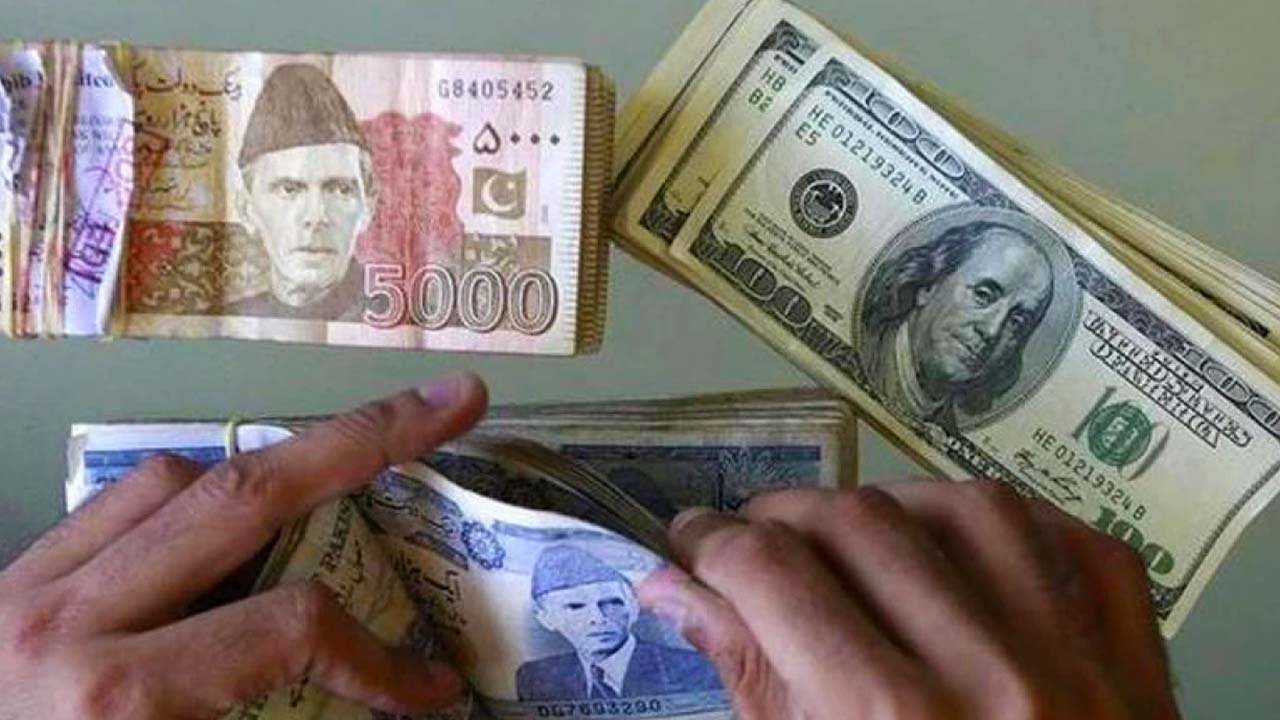
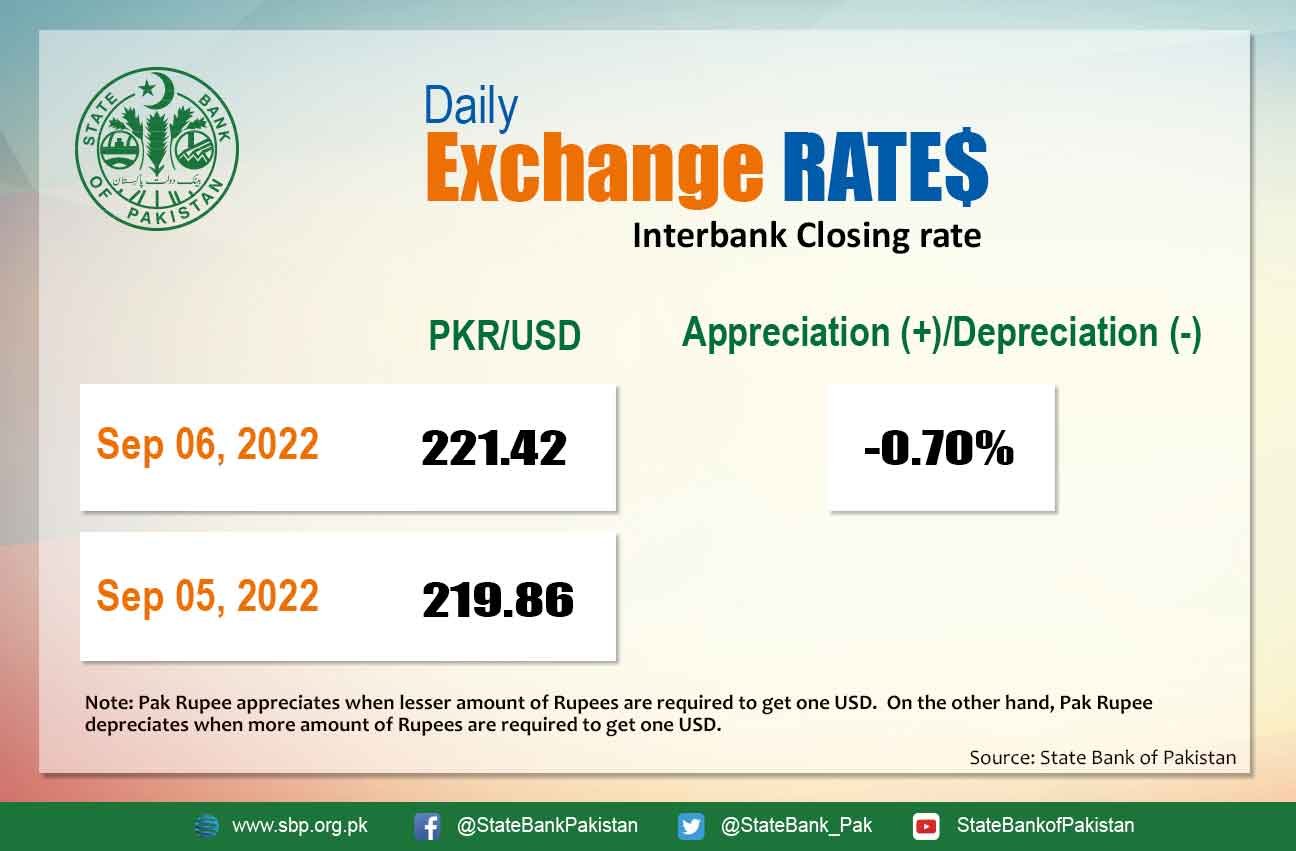
    The Pakistani rupee was trading between Rs222-223 on Wednesday as losses against the US dollar persisted in the early hours of trading.

    During intra-day trading, the rupee was quoted at Rs222.49 at roughly 10:30 am, depreciating by Rs1.07 or 0.48 per cent against the US dollar.

    The local unit lost for the third session in a row on Tuesday, falling down Rs1.56 or 0.7 per cent against the dollar to close at Rs221.42.

    According to analysts, the government’s decision to let the duty-free import of edible commodities to promote food security after floods severely damaged the nation’s agriculture sector has led to a spike in demand for dollars on the local market.

    However, the dollar is also strengthening globally. On Wednesday, after U.S. economic data supported the notion that the Federal Reserve will continue with policy tightening, it reached fresh highs against the yen and the Australian and New Zealand dollars.

    The US dollar index, which compares the value of the dollar to six important rival currencies, increased 0.08 per cent to Rs110.43, remaining close to the 20-year high set on Tuesday of Rs110.57.

    On Wednesday, oil prices, a major factor in determining currency parity, fell more than $1 to their lowest level since before Russia invaded Ukraine as COVID-19 restrictions in the world’s top crude importer China and anticipation of further interest rate increases stoked concerns about a global economic slowdown and a decline in fuel demand.

  • Video: Pakistani soldiers play Sidhu Moose Wala’s songs, Indian soldiers dance their hearts out

    Video: Pakistani soldiers play Sidhu Moose Wala’s songs, Indian soldiers dance their hearts out

    Indian singer-politician Sidhu Moose Wala passed away on May 29th this year. He was shot dead in his which had a connection with his famous song, 295 that he created for his enemies. Canada-based gangster Goldy Brar has taken responsibility for his murder, and Lawrence Bishnoi and others are involved. Now his father Balkaur Singh claims his ‘brothers’ turned out to be his enemies.

    A lot has happened ever since Sidhu passed away. A statue has been erected at his cremation site in Mansa and his father inaugurated it. He broke down and even expressed how hard it was to see his son in that form at the age of just 28. Police continue their investigation and several linked to the case have been arrested.

    The Punjabi rapper was very famous for his songs and now those same songs are now bringing cheer across the Indian-Pakistan border. The popularity of his songs is not just restricted to India but his magic also spreads worldwide, and now it has managed to make the two boundaries (India and Pakistan border) bond.

    Recently, Indian IPS officer HGS Dhaliwal shared a heartwarming video on Twitter. In the video, Indian Army personnel are seen grooving to Sidhu Moose Wala’s Bambiha Bole, which was being played on speakers by Pakistani soldiers across the border.

    The IPS officer captioned his post, “Sidhu’s songs playing across the border! bridging the divide!”

    The sight of it was indeed delightful to see!

  • Pakistani rupee loses Rs2.01 against dollar to close at Rs216.66

    Pakistani rupee loses Rs2.01 against dollar to close at Rs216.66

    On Monday, the Pakistani rupee (PKR) remained under pressure to start the week, falling Rs2.01, or 0.93 per cent, versus the US dollar in the interbank market.

    The local currency dropped from Friday’s closing rate of Rs214.65 to Monday’s closing rate of Rs216.66 per dollar, according to the State Bank of Pakistan.

    The dollar fluctuated between Rs213-214 during the previous week. It ended at Rs214.65 on Friday after ending at Rs213.98 on Monday. Last week, the rupee lost 0.31 per cent of its value against the dollar.

    The KSE 100-index of the Pakistan Stock Exchange (PSX), on the other hand, experienced a bearish trend on Monday, shedding 443.99 points, or 1.03 per cent, and finishing at 42,826.66 points as opposed to 43,270.65 points on the last working day.

    When compared to the previous trading day, when 306,208,580 shares were traded, a total of 194,667,559 shares were traded on Monday (today). The price of the shares was Rs5.331 billion as opposed to Rs6.393 billion on Friday.

  • PSX surpasses 43,000-mark as IMF tranche inches closer

    PSX surpasses 43,000-mark as IMF tranche inches closer

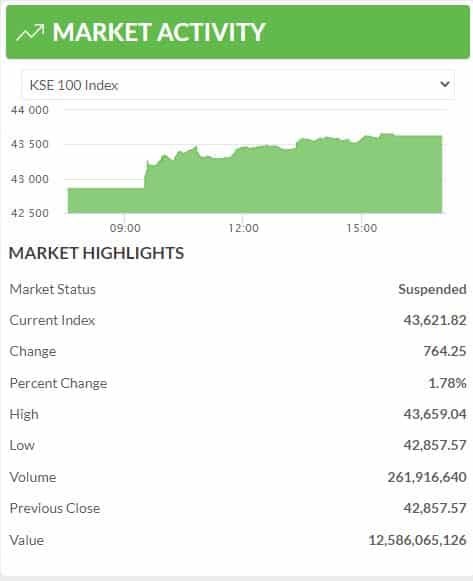
    As trading began on Monday, the Pakistan Stock Exchange (PSX) resumed its upward trend, rising more than 700 points to cross the 43,000-mark.

    The benchmark KSE-100 index gained 764.25 points, or 1.78 per cent, from its previous finish of 42,857.57.

    PSX – August 15, 2022

    The benchmark KSE-100 index increased by 731.54 points, or 1.71 per cent, by 2:13 pm to reach 43,589.11 points, according to the PSX website.

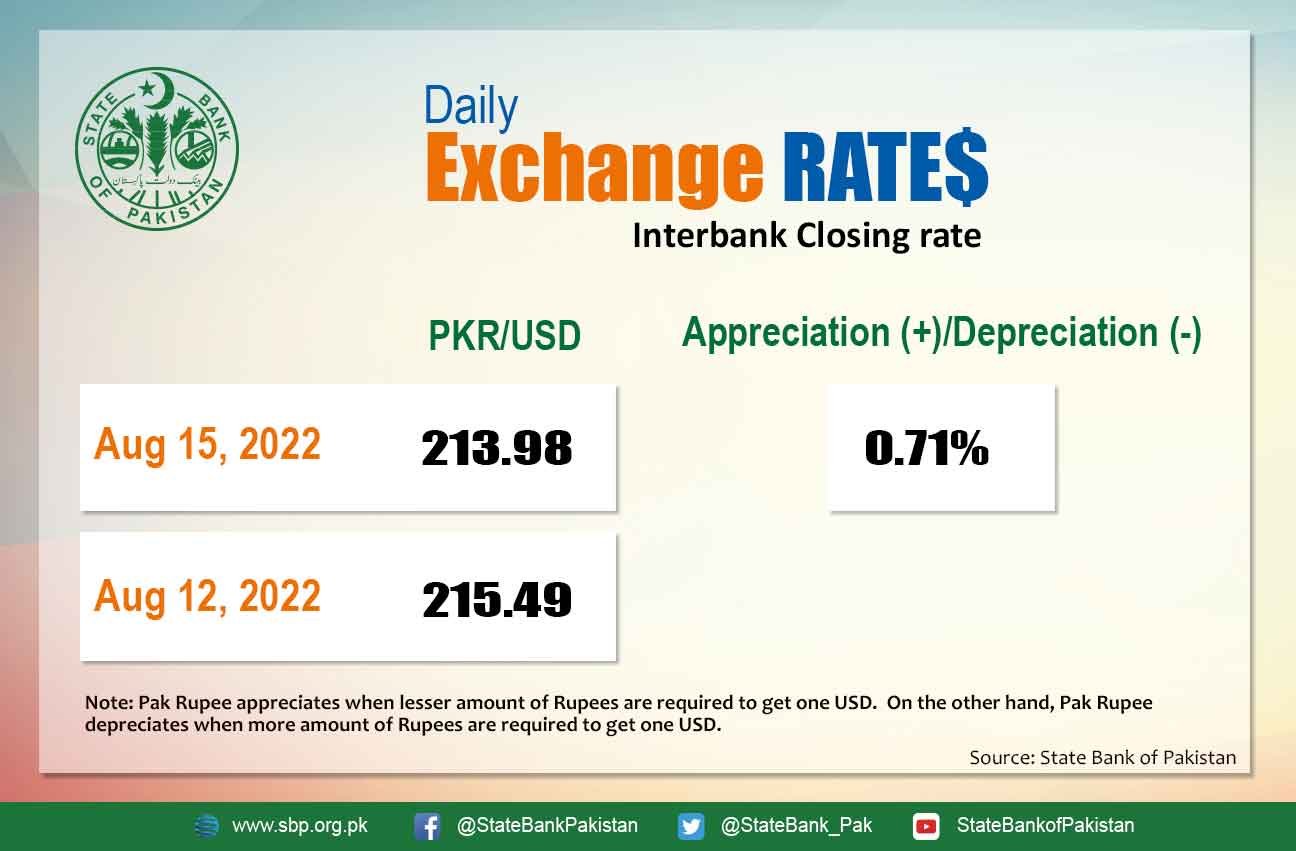
    Additionally strengthening by Rs1.51, the Pakistani rupee (PKR) ended the day at Rs213.98. Since last week, the local currency has been steadily rising against the US dollar.

    Rupee latest closing -August 15, 2022

    The IMF’s letter of intent and Saudi Arabia’s pledge of more support were among the good developments over the weekend that contributed to the index’s strong start.

    The rupee’s robust rebound and the IMF tranche anticipated at the end of this month can be credited for the upward trend.

  • SBP’s foreign exchange reserves dropped to $7.83 billion

    SBP’s foreign exchange reserves dropped to $7.83 billion

    Owing to debt payments, the State Bank of Pakistan’s (SBP) foreign exchange reserves fell to $7.83 billion as of August 5 from $8.385 billion in the last week.

    It is worth noting that this is the lowest level in over three years, according to figures released by the SBP.

    Pakistan’s overall foreign exchange reserves were $27.067 billion as of August 2021 but fell to $13.561 billion as of August 5, 2022.

    The most recent figures on the country’s foreign exchange holdings came when the reserves were quickly running out due to a $6 billion IMF programme that was stalled and the country was experiencing a lack of external funding.

    Due to debt payments and a lack of external finance, the central bank’s foreign reserves decreased by $555 million or 6.6 per cent every week.

    To reach $13.561 billion, Pakistan’s total liquid foreign reserves decreased by $648 million, or 4.6 per cent, and its commercial banks’ holdings fell by $5.730 billion, or 1.6 per cent.

    The SBP’s reserves are sufficient to cover imports for just over a month, according to The News. The reverse decline was brought on by paying off foreign debt.

    According to the central bank, debt repayments may slow down over the following three weeks of this month.

    On the other hand, the Pakistani rupee continued its upward trend against the US dollar for the ninth day, adding Rs3.38 to trade at Rs215.50 in intraday trade on Friday. The KSE-100 index likewise witnessed an increase of 386 points.

  • Pakistani rupee continues to recover, PSX witnesses bullish trend

    Pakistani rupee continues to recover, PSX witnesses bullish trend

    The dollar was trading at Rs223 on Thursday, as the Pakistani rupee (PKR) increased by Rs5.79 in interbank trade to extend its winning streak versus the dollar to five days.

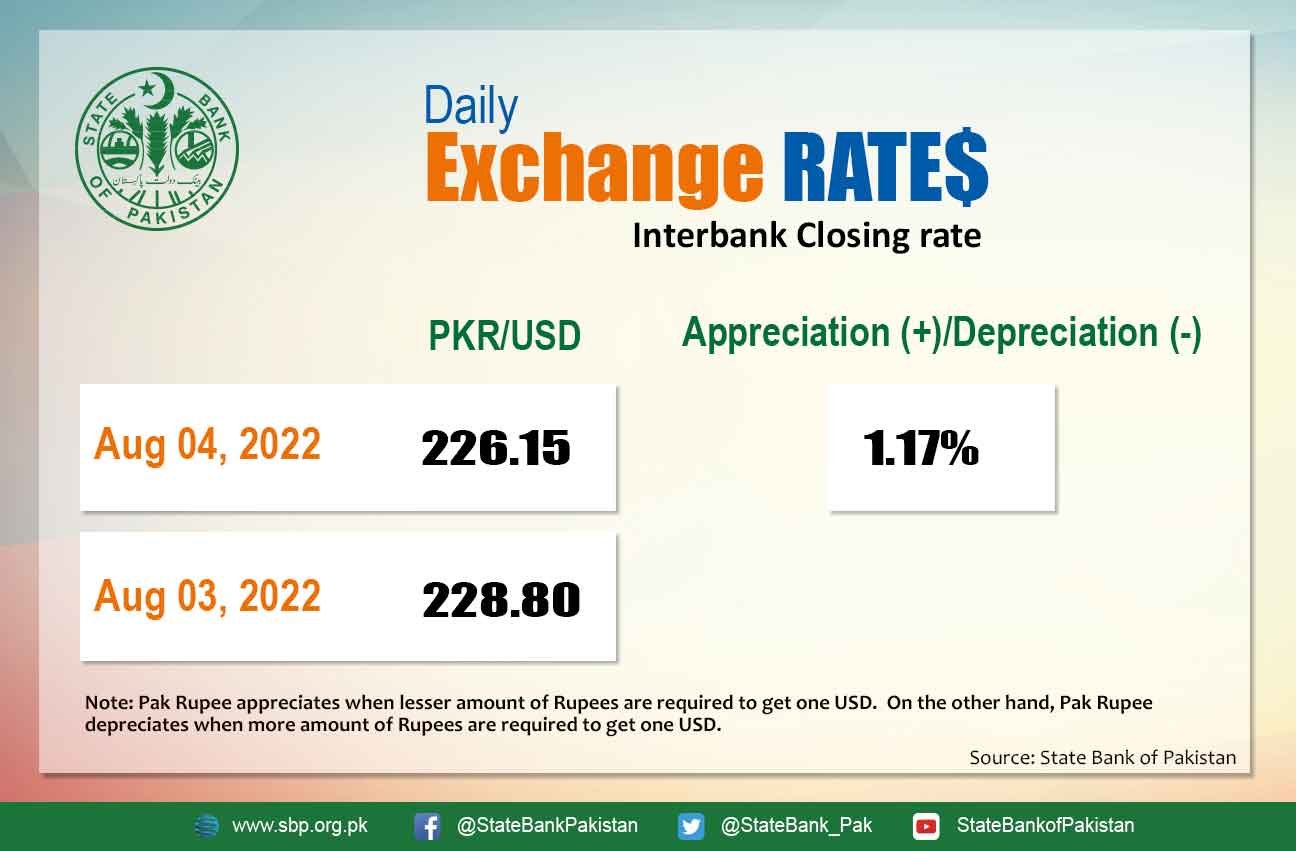
    The Pakistani rupee increased against the US dollar for the fifth day in a row, rising Rs2.65 to close at Rs226.15.

    US dollar to Pakistani rupee rate – 4 August 2022

    As the market opened on a good note and remained optimistic with heavy volumes in nearly all sectors for a while, the benchmark KSE-100 likewise rose up to 500 points before 12:00 pm. However, as of 1:40 pm, the market fell by 290 points.

    On Wednesday, the rupee gained the most against foreign currencies in a single day, ending the day at Rs228.80. The dollar’s decline versus the rupee reached its biggest level since November 2, 1998, when it dropped by Rs5.10.

    The local currency is strengthening as a result of increased export inflows and reduced import expenditures, with optimism that the cash-strapped nation was getting closer to winning an IMF bailout bolstering confidence.

    A board meeting is provisionally scheduled for late August after sufficient finance assurances are secured, according to a statement released on Tuesday by Esther Perez Ruiz, the IMF’s Resident Representative for Pakistan.

    Read more: Pakistan rupee appreciates Rs9.58 against US dollar, closes at Rs228.8

    The dollar may devalue between Rs180 and Rs190 against the Pakistani rupee if the IMF releases the $1.2 billion tranche in August, according to Malik Bostan, chairman of the Exchange Companies Association of Pakistan (ECAP).

  • Bitcoin falls to lowest since January after stock market

    Bitcoin falls to lowest since January after stock market

    Bitcoin on Monday, May 9 fell to its lowest level since January 2022, as falling equity markets weighed on cryptocurrencies, which are now trading in line with riskier assets like tech stocks.

    In early trade, bitcoin fell as low as $33,266 to test the January low of $32,951. If it drops below that level, it will be at its lowest since July of 2021. The price then settled at roughly $33,500, down 1.4 per cent.

    A Singapore-based crypto platform, Stack Funds said that everything in crypto is still classified as a risk asset, and most cryptocurrencies are pummelling in the same way that the Nasdaq has been.

    The Nasdaq, which is heavily weighted in technology, plummeted 1.5 per cent last week and is down 22 per cent year to date, as persistent inflation forces the US Federal Reserve to raise rates despite slowing GDP.

    On Monday morning Nasdaq futures were down another 0.8 per cent.

    Other factors in bitcoin’s weekend slide were the crypto market’s notoriously low liquidity on weekends, as well as short-lived fears that an algorithmic stablecoin dubbed Terra (UST) could lose its stability against the US dollar.

    Read more: Pakistan’s foreign currency reserves down by $328 million

    The crypto world is keeping a close eye on UST because of its unique method of maintaining a 1:1 dollar peg, as well as its founders’ aspirations to construct a $10 billion bitcoin reserve to support the stablecoin, implying that UST volatility might potentially leak over into the bitcoin markets.

    On Monday, Ethereum, the world’s second-largest cryptocurrency, plummeted to $2,421, its lowest level since late February.

  • Pakistan’s foreign exchange reserves dropped by $115 million

    Pakistan’s foreign exchange reserves dropped by $115 million

    Pakistan’s liquid foreign reserves were depleted by $115 million in the week ending April 30, 2022, a 0.7 per cent drop from the previous week.

    According to the SBP weekly report unveiled on Friday, Pakistan’s total liquid foreign exchange reserves declined by $115 million (-0.7 per cent) to $16.553 billion on April 30, 2022, from $16.668 billion the previous week.

    Due to external debt payments, the SBP reserves fell by $59 million to $10.499 billion (-0.6 per cent) from $10.558 billion a week earlier.

    Read more: Dr Murtaza Syed assumes charge as the new Governor State Bank of Pakistan

    Furthermore, commercial banks’ net foreign reserves stood at $6.05 billion, down $56 million (-0.9 per cent) on a weekly basis.

  • Pakistan’s cotton fabric trade climbed by 28.23 per cent

    Pakistan’s cotton fabric trade climbed by 28.23 per cent

    In the first eight months of the fiscal year 2021-22, Pakistan’s textile and garment exports grew to $1.65 billion. The Pakistan Bureau of Statistics (PBS) estimates that the textile and apparel sector brought in $12.607 billion this time, compared to $ 9.999 billion in exports from July to February 2020-21.

    Knitwear exports surged by 33.86 per cent to $3.302 billion on a year-over-year (YoY) basis, while non-knit readymade clothes trade increased by 25.11 per cent to $2.516 billion. Additionally, cotton yarn exports increased by 34.40 per cent to $815.375 million, up from $606.690 million the previous year.

    Cotton fabric trade climbed by 28.23 per cent in 2022, reaching $1.584 billion in value. Also, over the eight months of 2021-22, the distribution of bed clothing jumped by 20.34 per cent.

    The industry has engaged in synthetic fiber imports, which increased by 31.65 per cent from July to February 2021-22, and the cost of artificial silk yarn soared by $ 569.256 million.

    Consequently, the value of textile machinery in Pakistan has climbed dramatically over the last eight months, reaching $577.249 million.

    Read more: SBP determined to curb inflation, improve foreign exchange reserves

    For those unaware, Pakistan’s textile sector has the capacity to generate $30 billion in annual revenue. The country’s leaders and economic experts should assess the existing economic situation and devise an effective economic strategy to boost textile exports.

    To summarise, the industry has tremendous potential and can significantly contribute to the country’s economic success by providing job opportunities. Which could help the country’s GDP and GNP grow even more.