Tag: PTI government

  • Pakistan performs poorly, scores 30/100 on freedom of expression report

    Pakistan performs poorly, scores 30/100 on freedom of expression report

    Pakistan has performed poorly with respect to legal and practical protections for the right to freedom of expression of its citizens during 2020, according to a new assessment report published by Media Matters for Democracy.

    The Pakistan Freedom of Expression Report 2020 was launched through a webinar on Wednesday.

    Speaking at the report launch, European Union (EU) Ambassador to Pakistan Androulla Kaminara said the report provides a comprehensive analysis of the state of freedom of expression in Pakistan and highlights some concerning trends.

    “Freedom of Expression is enshrined in the European Charter of Fundamental Rights. It is also one of the important aspects of Pakistan’s GSP plus commitment to upholding the international Human Rights Conventions and a key priority in the Strategic Engagement Plan between EU and Pakistan.”

    “As this report confirms, the situation of journalists and documentation of threats they face through attacks, intimidation and harassment is particularly concerning. Disinformation is another area of concern, and one, which the European Union is working to address both at home and abroad. Misleading or false information can put lives in danger. It is crucial to resolutely counter disinformation with transparent, timely and fact-based communication and thus reinforce the resilience of societies,” she said.

    The report documents the situation of freedom of expression in Pakistan with a new index based on six dimensions namely the legal environment, press freedom, digital expression, pluralism, the socioeconomic and political situation.

    Pakistan scored low on all six dimensions to provide an overall score of only 30 points out of a total of 100 points on the assessment index. This cumulative score fell in the range of “poor” protections for freedom of expression in the country.

    The report found that during the year 2020 Pakistan’s media and Internet regulatory authorities continued to exert arbitrary legal and regulatory restrictions on speech and online content, by ordering bans, suspensions, and advisories against social media apps, entertainment content, and news discussions of social and political issues.

    Journalists remained vulnerable to physical, legal, and digital threats in the absence of long-awaited legislation on journalists’ safety, according to the study.

    The report found that at least eight individuals connected with the media were killed, at least 36 journalists were attacked in the line of duty, 10 were arrested, and as many as 23 instances of arbitrary detentions in connection with news reporting and online expression were recorded across Pakistan during the year.

    Women journalists were especially targeted with coordinated online attacks as they reported on political issues and the government’s pandemic response.

    The report noted that the coronavirus pandemic intensified the challenges to freedom of expression and access to information in Pakistan.

    Internet users were consistently exposed to disinformation while journalists reporting on the pandemic faced physical safety risks and restrictions on access to information sources, and many young citizens without Internet services found themselves abandoned as education systems shifted online, according to the report.
  • ‘FIA was told to file FIRs against Jahangir Tareen, son on WhatsApp,’ senior journalist claims

    The Federal Investigation Agency (FIA) has booked estranged Pakistan Tehreek-e-Insaf (PTI) leader Jahangir Tareen and his son, Ali Tareen, for fraud and money laundering after it was told to do so by someone over WhatsApp, senior journalist and analyst Arif Hameed Bhatti has claimed.

    According to Bhatti, he possesses details of who sent the WhatsApp message, at what time and when did the other person respond to that message.

    “Even the language used in the draft is not that of the investigation officer,” he said, further saying that the case was registered back on March 22 but the news was leaked over a week later.

    Bhatti’s claims came after Tareens, who are rumoured to be at odds with Prime Minister (PM) Imran Khan over probe into their alleged involvement in the sugar crisis, were booked by the FIA.

    According to the FIRs dated March 22, two separate cases were registered under sections 406 (criminal breach of trust), 420 (cheating of public shareholders) and 109 of the Pakistan Penal Code (PPC), read with sections 3/4 of the Anti Money Laundering Act.

    Responding to the development, Tareen lashed out at the FIA and said the accusations against him and his family were “totally fabricated”.

    One of the complaints states that Tareen fraudulently misappropriated shareholder’s money after his company — JDW group — transferred Rs3.14 billion to an associated private company identified as Farooqi Pulp Private Limited (FPML). The FIR stated that the private company is owned by his sons and close relatives.

    “The transfers, especially after FY 2011-2012, were patently fraudulent investments which ultimately translated into personal gains for the family members of the JDW CEO,” the FIR said.

    According to Dawn, it said that during this period, Tareen, his son and other family members purchased cash (US$) from the open market in Lahore in a “structured manner”.

    “Subsequently, in 2016, Ali Khan Tareen remitted approximately US$7.4 Million to the United Kingdom for purchasing properties (to be investigated in detail during the course of investigation) which makes them liable for Anti-Money Laundering investigation,” it said.

    The FIA stated that Tareen, his son, son-in-law Waleed Akbar Faruki and Shahid Akbar Faruki beneficially controlled FPML and personally benefitted from this scheme.

    In the second FIR, the investigation agency said “voluminous withdrawals amounting to at least Rs2.2 billion were fraudulently and dishonestly made through a trusted cash rider.” It noted that Amir Waris, employed as a cashier at JDW’s Corporate Head Office, deposited large amounts into the personal and business accounts of Tareen and his family members.

    “This modus operandi of cash-based misappropriation and money laundering was employed to break the onwards money trail of deposits into personal and business accounts of the accused Tareen and family,” it said.

    It also stated that Rana Nasim Ahmed, JDW CEO, was also given large amounts from the company’s accounts to the tune of Rs600 million. “He claims these humungous amounts as salary, bonuses and ‘gentlemanly-agreed’ benefits.”

  • State Bank clears air surrounding forthcoming legislation; no, it won’t bankrupt Pakistan

    State Bank clears air surrounding forthcoming legislation; no, it won’t bankrupt Pakistan

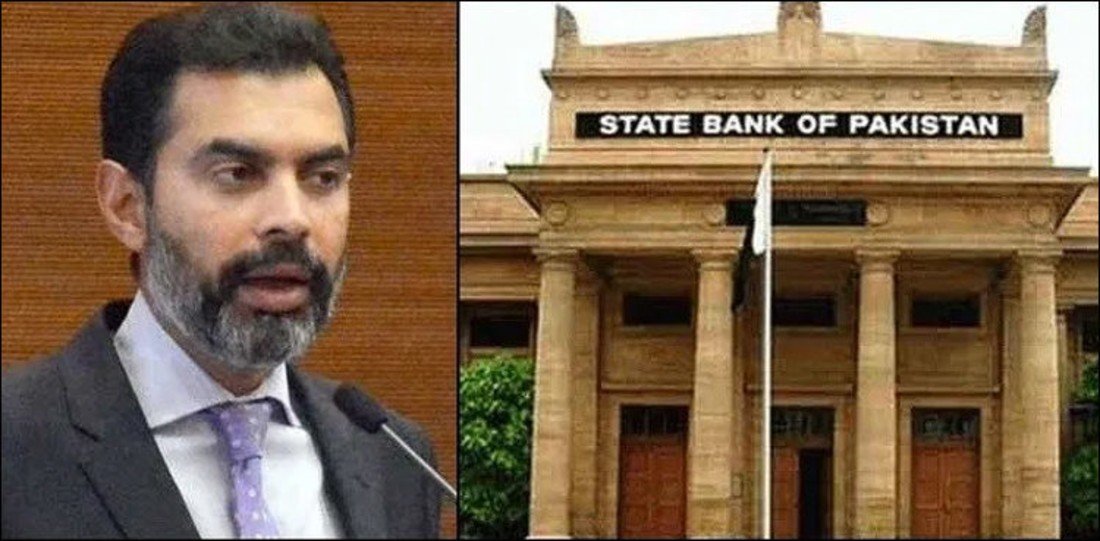
    Deputy governor of the State Bank of Pakistan (SBP) Dr Murtaza Syed has clarified that repayment of loans isn’t a priority on the list of objectives the central bank plans to achieve if it is granted autonomy under forthcoming legislation.

    He was responding to The Current’s query during a meeting of SBP bigwigs, including Governor Dr Reza Baqir, with digital broadcasters amid widespread rumours about a future with an autonomous central bank in Pakistan.

    Besides opposition members, renowned Economist Dr Kaiser Bengali had earlier warned that “the SBP ordinance, which is likely to be introduced soon, is anti-national and could lead to no accountability of central bank officials besides ultimately resulting in the collapse of the country”.

    “Our objectives are controlling inflation, ensuring financial stability and promoting the government’s policies of development and growth,” he said.

    Earlier, SBP Governor Baqir also clarified the air surrounding what he said was not an ordinance but a bill to be presented before the parliament for discussion.

    He said that it wasn’t the first time that amendments to the SBP Act will be discussed.

    “The SBP Act was previously amended in 1994, 1997, 2012 and 2015. Changing the Act does not mean that it cannot be changed again and the parliament has the power to withdraw amendments to the SBP Act,” the SBP governor said.

    However, he added, that clarity in the bill to avoid any sort of troubles in the future was important.

    “The aim of the proposed law is to limit interference in the operations of the SBP. In turn, the bank will be asked what it did to achieve its objectives. Accountability would not be possible if the goals remain unclear. Excess currency printing and lending to the government causes inflation. With the amendments to the Act, this will not be allowed to happen.”

    He said that discipline would have to be exercised to end borrowing, adding that it was easier to ask the SBP to print more money instead of raising taxes.

    “Relying on the SBP does not solve the government’s problems. In the last year and a half, the government has not taken any loan from the SBP. A country that repays loans by printing notes witnesses increased inflation,” he reiterated.

    The SBP governor said that in the past, governments had repeatedly printed excess money, the effects of which are still seen today. The current inflation is not due to monetary policy, but because of administrative shortcomings.

    “If the current government had made the SBP print more money, inflation would have been even higher.”

    Addressing concerns that under the new law authorities won’t be able to hold SBP officials accountable, Dr Murtaza clarified the only difference would be that anti-graft bodies would require permission from the bank’s board beforehand to proceed on allegations.

    He also vowed that the bank would ensure complete transparency in any such instance, which he maintained was also a common practice across the globe.

    SBP members, including Dr Inayat Hussain and Abid Qamar, as well as Information Ministry officials were also present during the session.

  • VIDEO: PTI’s Gandapur spotted letting minor kid drive his car

    Pakistan Tehreek-e-Insaf (PTI) leader and Federal Minister for Kashmir Affairs (AJK) & Gilgit-Baltistan (GB) Ali Amin Gandapur has been spotted letting a minor kid drive a car.

    A video tweeted by senior journalist Mansoor Ali Khan showed at least two other people accompanying Gandapur as the fourth individual in the car, the kid, cruised off the road at an unknown location.

    “Ali Amin Gandapur letting a kid drive the car,” he wrote along with a dig at ruling PTI’s loyalists.

    While there has been no official reaction to the video, amid criticism, a netizen has quoted Gandpur as asking why would the video bother anyone.

    “Just spoke to Ali Amin Gandapur and this is what he had to say: ‘Why does it bother anyone when it is my land, my son and my car?’,” he claimed.

    Later, Gandapur tweeted the same:

    Although Gandapur is not new to controversy, it merits a mention that number of incidents of underage kids driving in Pakistan have recently shot up.

    Earlier, a viral video showed a five-year-old boy standing behind the wheel of a black Toyota Land Cruiser V8.

    According to Dunya News, the boy was cruising through Bosan, one of the busiest roads in Multan “to go and buy ice cream”.

    Despite putting his own and others’ lives at risk, he was pardoned by the police upon his father’s assurances.

  • PDM at war

    PDM at war

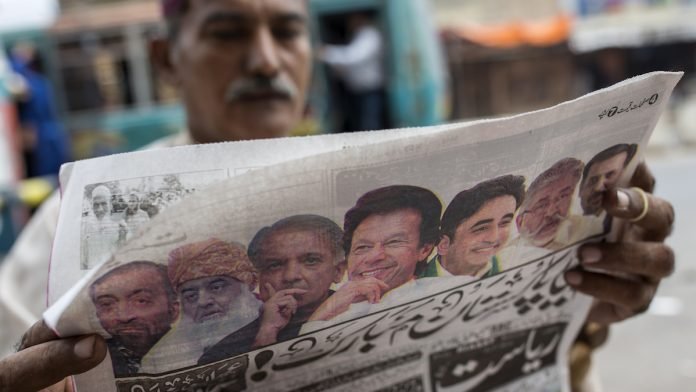
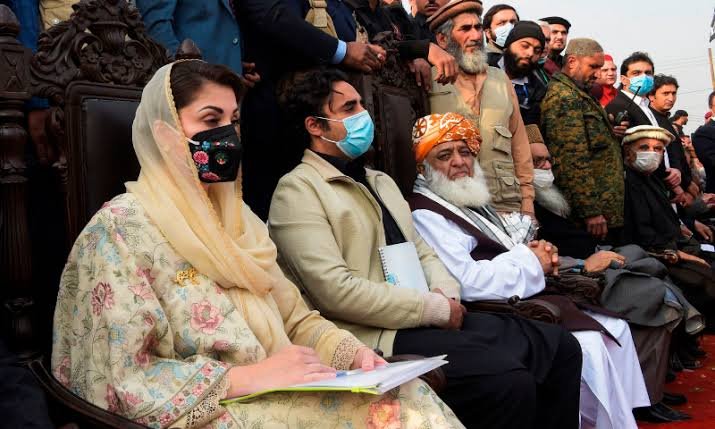
    The Pakistan Democratic Movement (PDM) is at war with itself, it seems. The opposition alliance that was formed last year as an anti-government alliance now seems to be fighting a battle within its ranks.

    The two largest parties — Pakistan Muslim League-Nawaz (PML-N) and the Pakistan People’s Party (PPP) — have had a falling out of sorts in recent weeks.

    While we saw over the months since the formation of the PDM that the PML-N leadership took a rather strong stand on the establishment meddling in politics, the PPP was being cautious when it came to naming anyone directly. The strategies of both parties also seemed to be different, which is understandable given the fact that PDM is a mix of different parties with different ideologies. But one of their common goals was to get rid of the government.

    There were of course differences in strategies as to how to do it: the PML-N and Maulana Fazlur Rehman believed in resignations but the PPP believes that it should be done within the democratic framework while remaining in the system. It is understandable that the PPP would not want to resign given that it is the only Opposition party that is in power in a province. It has more at stake in parliamentary system at the moment than other parties of PDM.

    These issues have now come back in public again after the recent PDM meeting where former president Asif Zardari asked former premier Nawaz Sharif to return to Pakistan when the issue of resignations from assemblies was proposed once again by the latter. What ensued was a public war of words. From a tweet by Maryam Nawaz warning PM Imran to be wary of a ‘substitute’ being fostered, to Bilawal Bhutto saying he will not respond to a PML-N vice president’s statement and his party VP could respond.

    Then Bhutto-Zardari said a family from Lahore has a track record of being selected, quite obviously taking a jibe at the Sharifs. Things escalated even faster when the PPP went against the consensus decision of PDM on the Leader of the Opposition in Senate being from the PML-N. First they said they do not agree on the name of Azam Nazeem Tarar as he is defending two police officers accused in Benazir Bhutto’s assassination case, who have been accused of negligence after her murder.

    The PML-N says that if the PPP could have a deputy PM who was directly nominated in BB’s letter, then why would they have an issue with Tarar’s name who is not defending any murderers. The PPP’s Yousaf Raza Gilani recently became the Leader of Opposition in Senate after securing votes from the government’s ally, BAP. Apart from the ANP and Jamaat-e-Islami, the rest of the Opposition parties supported Tarar in Senate.

    Now it remains to be seen whether the PDM decides that PPP will remain part of the Opposition alliance or not. The government, it seems, is having fun at the PPP’s expense. However, it is important that instead of this infighting, the Opposition parties should sit with the government and work on electoral reforms, accountability reforms, judicial reforms, among other things. Every democratic government must complete its tenure and bring about reforms.

    It is high time that the PDM stop thinking about a change in government and think long term so that it can benefit the system. Any elections without proper reforms would lead to finger-pointing by those who lose. It is important that all parties put aside their differences for the greater good of democracy.

  • New pro-IMF State Bank law would leave country bankrupt, lead to Pakistan’s collapse: prominent economist

    Renowned economist Dr Kaiser Bengali has warned that the State Bank of Pakistan (SBP) Ordinance, which is likely to be introduced soon, is anti-national and could lead to no accountability of central bank officials besides ultimately resulting “in the collapse of the country”.

    Speaking to a private media outlet, he said that the law would leave the federal government and subsequently the state paralysed.

    “There would be no money to pay salaries because the top priority would be paying back loans for which new loans will be sought,” Dr Bengali said.

    To a query by host Asma Shirazi, he said the law had no parallel in the modern world, however, a similar one dating back to the Ottoman Era played a key role in the downfall of the House of Osman.

    “They didn’t have any money to fight wars or deal with the rebellion after handing control of all the money to the central bank.”

    “This would dissolve Pakistan because there won’t even be enough money to pay the police,” Dr Bengali maintained, adding that it was a bleak picture.

    “The opposition alliance should put its other demands on hold and work towards stopping this legislation,” he concluded. The same was stated by him in a tweet as well.

    Earlier, Pakistan Muslim League-N (PML-N) Secretary General Ahsan Iqbal also claimed the government was enacting such a law which would hand over the State Bank of Pakistan’s (SBP) control to the International Monetary Fund (IMF) and other international financial institutions.

    Addressing a press conference, he said that with the new legislation, the SBP would not be accountable to the parliament, the prime minister or any institution of the country and it would only be answerable to the international institutions.

    He said National Accountability Bureau (NAB), Federal Investigation Agency (FIA) or any other institution would not be able to ask the SBP governor and other officials for any corruption.

    “If the prime minister of Pakistan can appear before NAB, then why can’t the SBP governor?” Ahsan said adding it was only to mortgage Pakistan’s economy with the international institutions.

  • Gill dismisses report claiming he is ‘earning billions by importing COVID-19 vaccine’

    Prime Minister (PM) Imran Khan’s aide on political communication, Dr Shahbaz Gill, has rubbished reports claiming that he is earning hefty profits by importing vaccine for COVID-19.

    “Some people are making false claims that I have imported coronavirus vaccine. This news is fake. I have nothing to do with it,” he tweeted, urging people to stop spreading it.

    The government has now allowed Gill’s company to import Russian vaccine with a profit of Rs7,000 on each dose, the report had alleged.

    It went on to claim that Gill’s company had ordered 200,000 Sputnik-V vaccines in the first consignment, keeping a net profit of Rs1.40 billion — with Rs8,500 for every Rs1,550 dose — in one consignment and that too with the permission of the government.

    In another tweet, Gill said the fake WhatsApp forward regarding him cracked him up.

    The news and its dismissal comes days after the government capped the maximum retail price of Russian and Chinese coronavirus vaccine injections imported by the private sector.

    The government has fixed the maximum sale price of Sputnik-V vaccine at Rs8,449 for two doses and China’s Convidecia at Rs4,225 per injection, showed the summary of the National Health Services and Regulations Ministry.

  • Kubra Khan hits back at media outlet for misreporting her comments

    Kubra Khan has hit back at a local media news outlet for misreporting her comments about un-following Prime Minister Imran Khan on Twitter. Khan, in an interview, had shared that she unfollowed PM Khan (and Hamza Ali Abbasi) on Twitter because she didn’t want any political updates.

    Read more – ‘Masterstroke’: Celebrities, cricketers jubilant over PM Imran’s Vote of Confidence

    Sharing the misreported news on Twitter, Kubra said: “I am and will always one of the biggest supporters of [PM] Imran Khan.”

    “I don’t need to follow him on “social media” to show my support,” said the actor further, adding: “But thanks for adding the negative connotation?”

    Earlier, during the 2018 General Elections, Kubra had said that if she had the option to vote, “it would be no other than PTI.”

    Meanwhile Kubra follows only four people on Twitter: Vasay Chaudhry, Gohar Rasheed, Iqrar ul Hassan Syed and Fahad Mustafa.

  • Twitter blunder: PTI dates Lahore Resolution (1940) as a 1947 event in Pakistan Day post

    Twitter blunder: PTI dates Lahore Resolution (1940) as a 1947 event in Pakistan Day post

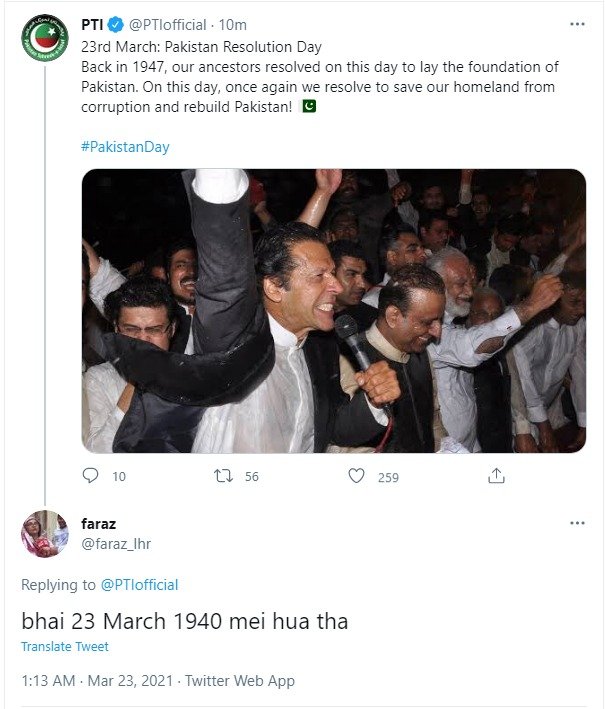
    In yet another Twitter blunder from political quarters, the official Twitter handle of the ruling Pakistan Tehreek-e-Insaf (PTI) on Monday-Tuesday midnight mistakenly dated the Lahore Resolution of 1940 as a 1947 event, which was passed seven years before actual independence.

    “23rd March: Pakistan Resolution Day Back in 1947, our ancestors resolved on this day to lay the foundation of Pakistan. On this day, once again we resolve to save our homeland from corruption and rebuild Pakistan!” read a tweet that was deleted after netizens pointed out the blunder.

    Here’s the new tweet:

    LAHORE RESOLUTION:

    The Lahore Resolution was a formal political statement of declaration of independence of Pakistan adopted by the All-India Muslim League on the occasion of its three-day general session in Lahore from March 22–24, 1940.

    The resolution called for independent states as seen by this statement:

    That geographically contiguous units are demarcated regions which should be constituted, with such territorial readjustments as may be necessary that the areas in which the Muslims are numerically in a majority as in the North Western and Eastern Zones of (British) India should be grouped to constitute ‘independent states’ in which the constituent units should be autonomous and sovereign.

    Today marks 81 years since its adoption that was followed by creation of Pakistan seven years later in 1947.

  • HR ministry directs Lahore university to re-admit expelled students

    The Ministry of Human Rights (MoHR) has directed the University of Lahore to re-admit the expelled students, saying that the university “overreacted” on the matter.

    According to a report in Dawn, MoHR Parliamentary Secretary Lal Chand Malhi wrote a letter to the University of Lahore’s vice-chancellor, requesting him to re-admit the expelled students. The letter was reportedly written on March 16.

    The letter said that the university administration expelled the students without giving them the chance to explain themselves and that the university “overreacted” on the matter.

    Terming the university’s action as “moral policing,” the ministry said: “Both the girl and the boy did not commit such a heinous crime for which they were punished “severely and expelled from the university. This would destroy their career and future education opportunities.”

    “This kind of freedom[proposing] is outlined in Article 16 of the Universal Declaration of Human Rights to which Pakistan is party and also under the UN Covenant on Civil and Political Rights,” read the letter further.

    Background

    The University of Lahore expelled two students for publicly expressing their love and proposing on university grounds. In a video that went viral on social media, a girl could be seen getting down on one knee and asking her partner to marry him with a bouquet of roses. The proposal ended with the two hugging each other.

    According to a notification, dated March 12, the two students were expelled for “[being] involved in gross misconduct and violation of university rules and were called to appear before the special disciplinary committee [but] failed to appear.”

    Public Reaction

    The expulsion of the students in Lahore over a public proposal has created an uproar on social media with users criticising the university administration for the shallow-minded approach. Prominent personalities who criticised the university for its decision included Federal Minister Fawad Chaudhry, PPP’s Sharmila Faruqi, Shehzad Roy, Yasir Hussain and Shaniera Akram.