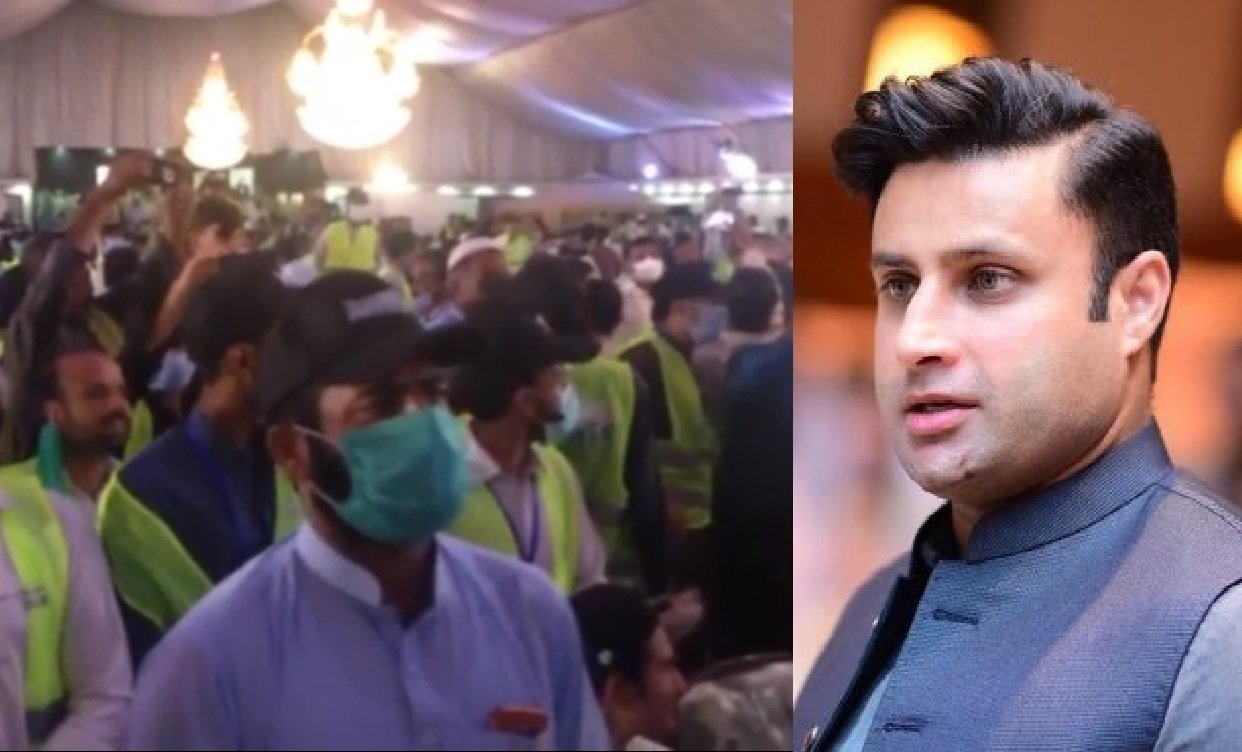
A protest led by members of Prime Minister (PM) Imran Khan’s Tiger Force on Saturday disrupted Special Assistant to the PM (PM) for Overseas Pakistanis Zulfi Bukhari’s speech as disgruntled workers raised slogans against him as well as the ruling party’s leadership, reportedly forcing Bukhari to leave the rostrum.
The premier’s Corona Relief Tiger Force is part of an ambitious multi-pronged strategy by the Pakistan Tehreek-e-Insaf (PTI) government to impose movement restrictions and shut down industries while also ensuring that Pakistan’s poorest citizens — many of whom rely on daily wages to survive — continue to receive adequate supplies of food and other essentials.
Hundreds of thousands of volunteers from across the country, who signed up for the force, are reportedly discharging their duties as the country continues to fight the COVID-19 pandemic.
While Saturday’s event organised in Attock seemed to be in violation of social distancing among other government guidelines to curb the spread of the virus, things took an uglier turn as soon as Bukhari took the floor to address the gathering.
According to reports, the volunteers raised slogans against Bukhari as well as other leaders of the ruling PTI in protest against the force’s focal person, namely Qadri Ahmed, “not being invited to the ceremony despite working hard for over a month”.
اٹک میں وزیر اعظم کے معاون خصوصی زلفی بخاری کی سربراہی میں ہونے والی ٹائیگر فورس کی تقریب بد نظمی کا شکار زلفی بخاری کو تقریر روکنے پڑھ گئی ٹائیگر فورس کے ایک گروپ نے اپنے علاقائی صدر کو نہ بلانے پر احتجاج کیا زلفی بخاری مردہ باد کے نعرے @sayedzbukhari@ImranKhanPTI@ArfaSays_pic.twitter.com/PmH2NKZkyg
The volunteers were then seen leaving the venue, raising slogans in Ahmed’s favour.
WATCH VIDEO:
A member of Bukhari’s staff, however, denied media reports and said that no one left the stage as it was “only a two to four-minute issue between [Adviser to PM on Climate Change] Malik Amin Aslam and the local president.
“Bukhari ended up completing his speech,” they said.
PTI Punjab lawmaker Syed Yawer Abbas Bukhari among other local leaders were also present on the occasion.
“Imran Khan’s recent Freudian slip reveals a lot.”
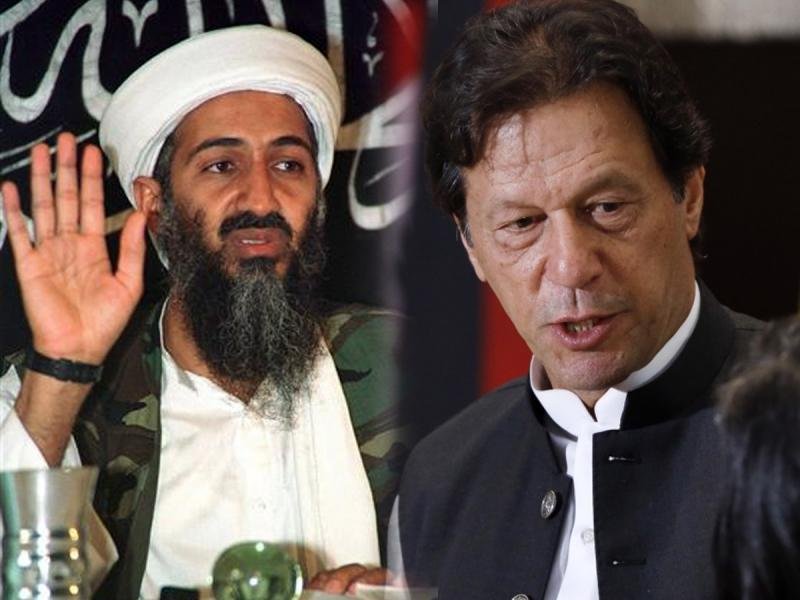
Two interesting things happened recently in the chaotic drama that is Pakistani politics: one is that the prime minister (PM) actually deigned to show up in the parliament, and the second is that he referred to al-Qaeda founder Osama bin Laden as a “shaheed [martyr]” during his speech on the floor of the National Assembly.
Imran Khan, speaking in the context of his usual “the world has mistreated Pakistan” narrative, referred to the Abottabad raid saying, “One thing that happened was that the Americans came and killed Osama Bin Laden in Abbottabad… martyred him” — or in Urdu, “Abbottabad may aa kr maar diya… shaheed kar diya.” People picked up on this quickly and social media erupted in astonishment and dismay.
This was then followed by the very amusing attempts of IK apologists to clarify what “he actually meant”. One of his advisors attempted to fudge the facts by tweeting that the PM “twice used the word ‘killed’ for OBL” and that all the ensuing hoo-ha was actually a conspiracy “with clear attempt to make his remarks controversial unnecessarily”.
But the fact is that his remark is controversial. His slip of tongue reflects possibly his true political leanings and seems to be the logical continuation of the position he has taken on various issues over the years.
“He [Imran] is the man who despite (or maybe because of ) his elitist Lahori upbringing and western education, has always taken very right-wing and regressive political positions.”
He is the man who tried to portray the Taliban to western media as “misunderstood freedom fighters”, who was in favour of “negotiating” with militants, and who advocated for them being allowed to open an office — as if to suggest that they were a serious political group rather than a group of armed religious extremists responsible for the bloody attacks and bombings that resulted in the killing of thousands of Pakistanis (civilians, uniformed personnel, school children, teachers).
He is also the man who despite (or maybe because of ) his elitist Lahori upbringing and western education, has always taken very right-wing and regressive political positions. After his return to Pakistan, he became something of a born-again Muslim and also something of a born-again Pashtun, and his closest political allies over the decades have been right-wing and religious parties.
Apart from official spokespersons trying to clarify and defend the PM’s choice of words, there were also several others, including some non-official ones like the TV news anchor who describes himself on Twitter not as a ‘columnist’ but as a ‘prominent columnist.’ This gentleman tweeted repeatedly in defence of the great leader and he came out with a few gems about the leader’s slip of tongue, even bringing puja, idols and Modi into the conversation! He also remarked that “the discussion was not about OBL” but about how IK’s government “has improved communication and engagement with the US & the world”.
The way the Pakistan Tehreek-e-Insaf (PTI) government has reacted to this matter, illustrates both the way that it functions as well as the way in which Imran himself conducts his politics. For one thing, IK does not seem to believe in any sort of political dialogue of any kind of engagement that might lead to consensus.
“‘I am right’ could easily be his motto in life (inching even further towards the far right). You can call this either immense self-belief or insufferable arrogance…”
His approach seems to be that when he talks, everybody else should listen. His speeches are a mixture of pseudo-Islamic nationalism and political self-righteousness, peppered with abuse for opposition members. His contempt for parliament is evinced by his poor attendance record as well as the fact that he has not bothered to do any legislative work in parliament or do anything on any committees or in any other way be part of the community of parliamentarians. But when he talks, people should listen, and people who disagree with him are wrong.
“I am right” could easily be his motto in life (inching even further towards the far right). You can call this either immense self-belief or insufferable arrogance — but the problem with this tendency is that it is often an impediment in the process of learning and developing. Which raises the question that: after 22 years in the field has Imran Khan evolved politically? Will he ever be able to?
The answer to this question is unclear but it is a sad fact that a man who so many Pakistanis wished so well because he was a national cricket hero (and eye candy) has become a divisive, rude and arrogant leader. He has some good ideas generally perhaps and also has the persistence to keep going, but the “I am right” mantra will only get you so far in life.
With Prime Minister (PM) Imran Khan approving a Rs25 hike in petrol price, yet another tweet from the past has come back to haunt the ruling Pakistan Tehreek-e-Insaf (PTI).
The premier on Friday approved a summary of recommendations to increase the prices of petroleum products “in view of the rising oil prices trend in the global market”, with a notification issued to announce the new rates.
The notification stated that the new petrol prices would come into effect immediately.
Petrol prices, according to the recommendation, were to be bumped up Rs25.58 per litre. Similarly, the per-litre prices of high-speed diesel (HSD), kerosene oil, and light diesel were recommended to be increased Rs21.31, Rs23.50, and Rs17.84, respectively.
The new per-litre prices of petrol, HSD, kerosene oil, and light diesel, therefore, would respectively be Rs100.10, Rs101.46, Rs59.06, and Rs55.98.
With the hike drawing a strong reaction from the general public as people expressed frustration over the development that could result in yet another inflation bomb amid the coronavirus outbreak, some took to Twitter to retweet a statement by the premier from back when he sat in the parliament on opposition benches.
Absolutely shameful how the govt has dropped a petrol bomb on the poor nation at the start of 2018. Instead of undertaking tax reforms and cracking down on money laundering, the govt continues to burden the masses – this time with a big increase in petroleum products’ prices.
“Absolutely shameful how the govt has dropped a petrol bomb on the poor nation at the start of 2018. Instead of undertaking tax reforms and cracking down on money laundering, the govt continues to burden the masses — this time with a big increase in petroleum products’ prices,” the tweet read.
Petrol should be sold at Rs 58 per litre, demands @ImranKhanPTI
“Petrol should be sold at Rs58 per litre, demands @ImranKhanPTI [sic],” another tweet from 2015 by PTI’s official handle read.
This isn’t the first time an old tweet has come back to bite the PTI government.
While the same tweets were used to criticise the government after a fuel prices hike in July 2019, a separate tweet from August 2014 read, “All over the world, just on an incident of railway accidents, minister resigns. This is real democracy, says Imran Khan [sic].”
All over the world, just on an incident of railway accidents, minister resigns. This is real democracy, says Imran Khan
It had started making rounds last month after the tragic train accident in Sadiqabad, which claimed over 20 lives.
Prior to this, as PM Imran reached China amid Tehreek-e-Labbaik Pakistan’s (TLP) nationwide protests last year, a 2012 tweet of his, went viral. In the tweet, he had criticised the then premier for traveling abroad as the country “burned”.
Karachi to Gilgit Pak is burning & rulers least bothered. Instead they are travelling abroad or boasting of invisible “achievements”!
It was aimed at criticising former prime minister Yousaf Raza Gillani, who had traveled to China for the Boao Forum while violence linked to sectarian, ethnic and political tensions continued in different parts of the country.
Federal Minister for Industries and Production Hammad Azhar has said that the government is confident of achieving the tax collection target of Rs4,960 billion set in the 2020-21 federal budget through Federal Board Revenue (FBR).
Concluding discussion on the Finance Bill 2020-21 in the National Assembly, the minister on the floor of the House pointed out that the present government inherited a weak economy, but due to its concerted efforts, the government succeeded in stabilising it.
He said that all the international financial institutions are praising Pakistan government’s performance on economic front.
Hammad said that presenting a tax free budget while enhancing allocations for development shows the true leadership of Prime Minister Imran Khan. He said the government is trying to minimize the impact of Covid-19 on the economy by pursuing a prudent strategy.
The minister categorically stated that the federal government has not withheld any funds of the provinces under the National Finance Commission (NFC). He said that the recommendations of the Senate for the Finance Bill 2020-21 would be given due consideration.
Earlier, the National Assembly approved 96 demands for grants pertaining to different ministries, divisions and departments for the next fiscal year.
Presented by Minister for Industries and Production Hammad Azhar, these demands were related to Climate Change, Commerce Division, Communications Division, Pakistan Post, Defense Division, Survey of Pakistan, Economic Affairs Division, Power Division, Petroleum Division, Geological Survey of Pakistan, Foreign Affairs Division, Housing and Works Division, Human Rights Division, Information and Broadcasting Division, Information Technology and Telecommunication, Inter Provincial Coordination, Kashmir Affairs and Gilgit-Baltistan Division, Law and Justice Division, Federal Shariat Court, Council of Islamic Ideology, National Accountability Bureau, District Judiciary Islamabad Capital Territory, Maritime Affairs, Narcotics Control, National Assembly, The Senate, Overseas Pakistanis and Human Resource Development Division, Parliamentary Affairs Division, Planning Development and Special Initiatives Division, CPEC Authority, Privatization Division, Religious Affairs and Inter Faith Harmony Division, Science and Technology Division, States and Frontier Regions and Water Resources.
No cut motions were moved on these demands for grants.
Prime Minister (PM) Imran Khan’s words have yet again landed him in crosshairs of the general public as well as opposition leaders, who are training guns at him for calling notorious terrorist and al-Qaeda chief Osama bin Laden a “martyr”.
Making a rare appearance in the National Assembly (NA), Imran on Thursday took the floor and among other things, elaborated how Pakistan had been humiliated despite having sacrificed lives in the war against terrorism.
“The way we helped America in the war on terror and the humiliation that my country had to face. I don’t think there has ever been any other country that supported war on terror and had to face criticism from them. If they are not successful in Afghanistan, Pakistan is held responsible for that too,” he said.
The premier went on to add that the United States (US) “martyred” bin Laden in Abbottabad.
“Pakistanis were deeply embarrassed when Americans killed Osama bin Laden in Abbottabad. Shaheed kar diya [was martyred]. But what happened after that? The entire world hurled abuses at us. Our ally [the US] entered our country and killed someone without even telling us. It was a big humiliation,” he said before going on to describe the drone attacks as the second set of incidents that embarrassed the country.
Osama bin Laden was killed in a military operation by US Navy Seals in 2011 in Abbottabad — a few kilometres away from the Pakistan Military Academy (PMA) — and ended a nearly 10-year search for bin Laden, following his role in the 9/11 attacks on the US.
“Whose side are you on? The head of al-Qaeda, a terrorist organisation, who died in Abbottabad or the 70 to 80 thousand Pakistani civilians and military men who laid down their lives in the war on terror?” Pakistan Muslim League-Nawaz (PML-N) leader and former Sindh governor Muhammad Zubair said while reacting to Imran’s statement.
He, however, wasn’t the only one the premier’s speech attracted a strong reaction from. Here’s what Twitterati have to say:
PM Imran Khan says #OsamaBinLaden was “martyred”. It’s not surprising that he considers OBL a “martyr”, but it validates why many have been calling him Taliban Khan. He sympathises with radical jihadists and is carrying forward the legacy of Gen Zia… pic.twitter.com/cfkVitk80S
PM Imran Khan’s statement in National Assembly, calling OBL a ‘martyr’ (Shaheed) should be a wake up call for those deluding themselves that a ‘changed’ Khan is a partner against terrorism in #Pakistan@State_SCA
Why would the PM refer to OBL as a shaheed on the floor of parliament? If it was a slip of tongue, he should clarify this without delay to avoid further international embarrassment. Else this may be his personal opinion but can’t be our policy position as a responsible state.
Addressing the NA, he reminded the premier that Osama bin Laden was responsible for instability in the region, especially Pakistan, and was nothing but a terrorist.
Federal Minister for Science and Technology Fawad Chaudhry has said that politics is not for the “weak-hearted” and vowed not to resign for as long as he has the confidence of Prime Minister (PM) Imran Khan.
“I will stay on as a minister till I have the trust of Prime Minister Imran Khan. There is no question of resigning on someone else’s wish,” Fawad tweeted Thursday, referring to Punjab Information Minister Fayazul Hasan Chohan, who had asked the federal minister to step down following the former’s claims pertaining to rifts among the ruling Pakistan Tehreek-e-Insaf (PTI).
اس وقت تک وزیر رہوں گا جب تک وزیر اعظم کا اعتماد حاصل ہے، کسی اور کی خواہش پر استعفیࣿ دینے کا سوال ہی پیدا نہیں ہوتا، سیاست کمزور دل حضرات کا کھیل نہیں ۔۔۔
In an interview from earlier this week, Fawad had claimed that the PTI failed to bring “tabdeeli” [change] due to the in-fighting between Asad Umar, Jahangir Tareen and Shah Mahmood Qureshi after the formation of its government, which was followed by the ouster of the political class from PM Imran’s core team.
“This political vacuum was then filled by new and non-elected people who did not have anything to do with politics,” the minister had said while also making other explosive revelations that did not sit well with many.
With Fawad drawing criticism from his colleagues for also disclosing that the premier had warned his ministers to perform within six months, many reportedly approached PM Imran, urging him to take action against the science and technology minister.
It was followed by the PM telling his cabinet members to maintain unity within the party. Addressing a presser after a meeting of the federal cabinet chaired by PM Imran, Federal Minister for Information and Broadcasting Shibli Faraz said that Fawad’s interview with the Voice of America came under discussion during the cabinet meeting.
“Fawad Chaudhry’s interview was discussed in the cabinet [meeting] and the prime minister said we should maintain unity within the party,” Faraz said.
During the cabinet meeting, the information minister said that the prime minister has instructed the ministers and party leaders not to talk about things that “affect” the party or the government.
According to reports, the premier has now also held separate meetings with federal ministers. Those who held meetings with Imran included Minister for Water Resources Faisal Vawda, Foreign Minister Shah Mahmood Qureshi and Minister for Planning, Development & Special Initiatives Asad Umar.
During the meetings, the PM discussed the disorder and heat during the federal cabinet meeting.
On the occasion, Umar and Qureshi apprised the premier on their respective positions and offered explanations.
Umar reportedly raised before PM Imran the issue of Fawad’s statements, to which the premier directed his cabinet members to exercise caution and maintain unity.
Vawda, on the other hand, openly criticised policies of Umar, Adviser to PM on Commerce and Investment Abdul Razak Dawood as well as Special Assistant to PM on Petroleum Division Nadeem Babar. He also reportedly accused some people of “conspiring from within the cabinet”.
“There is a game being played here and we cannot sit silent,” he said, adding that people thought that they had become the prime minister.
Amid statements from other government members regarding coronavirus cracking netizens up, it has emerged that Pakistan Tehreek-e-Insaf (PTI) lawmaker Riaz Fatyana thinks eating locusts, an infestation of which is threatening food security in Pakistan among other South Asian nations as well as in Africa, the Arabian Peninsula and South America, could end the COVID-19 pandemic.
“It is said that eating locusts can lead to the eradication of coronavirus,” reports quoted the senior PTI MNA as saying.
ٹڈیوں کےبارے میں کہا جاتا ہے کہ اس کوکھانےسےکورونا ختم ہوسکتا ہے،ریاض فتیانہ
The 2019-20 locust infestation is an outbreak of desert locusts which is the worst in 70 years in Kenya and the worst in 25 years in Pakistan, India, Ethiopia and Somalia.
The outbreak began with heavy rains in 2018 in the Arabian Peninsula in spring 2019, swarms spread from these areas, and by June 2019, the locusts spread north to Pakistan, India, Iran and south to East Africa, particularly the Horn of Africa. By the end of 2019, there were swarms also in Ethiopia, Eritrea, Somalia, Kenya, Saudi Arabia, Yemen, Egypt and Oman.
By June 2020, another swam appeared in South America, affecting Paraguay and Argentina while as of April 2020, efforts to control the locusts were being hampered by ongoing restrictions in travel and shipping due to the COVID-19 pandemic.
According to reports, around 37 per cent area of Pakistan is more vulnerable to the attack. This includes 60 per cent area of Balochistan, 25 per cent area of Sindh and 15 per cent area of Punjab.
“If the desert locust is not contained, Punjab and Sindh may become summer breeding zone of the pest,” said a report submitted to the Supreme Court (SC) by Punjab government through Additional Advocate General Chaudhry Faisal Hussain earlier this month.
It said desert locust appeared in Punjab’s Cholistan area in July last year. In November last year, locust swarms started migration toward Balochistan and South Punjab.
Prime Minister (PM) Imran Khan has told his cabinet members to maintain unity within the party, a day after Federal Science and Technology Minister Fawad Chaudhry said in an interview that the Pakistan Tehreek-e-Insaf (PTI) was failing to bring promised change due to a lack of political leadership amid rifts among leaders such as Jahangir Khan Tareen, Planning Minister Asad Umar and Foreign Minister Shah Mahmood Qureshi.
Addressing a presser after a meeting of the federal cabinet chaired by PM Imran, Federal Minister for Information and Broadcasting Shibli Faraz said that Fawad’s interview with the Voice of America came under discussion during the cabinet meeting.
“Fawad Chaudhry’s interview was discussed in the cabinet [meeting] and the prime minister said we should maintain unity within the party,” Faraz said.
In the interview, Fawad had said there were rifts among Tareen, Umar and Foreign Minister Shah Mahmood Qureshi, which hurt the party and forced the PTI’s “political class” to part ways.
“As soon as the PTI government was formed, quarrels among Qureshi, Umar and Tareen began. Tareen used his influence to get Umar removed from the cabinet and later Umar got Tareen out,” Fawad had said.
During the cabinet meeting, the information minister said that the premier has instructed the ministers and party leaders not to talk about things that “affect” the party or the government.
Faraz also spoke about a recent interview of Climate Change Minister Zartaj Gul in which she said that Covid-19 means that the virus has 19 points that can be applied to any country based on its respective immunity levels.
Her remarks were widely shared on social media and she was criticised for not knowing that Covid-19 is actually an acronym for the coronavirus.
“It was a slip of the tongue and people make mistakes,” the information minister said, referring to Gul’s remarks. “It should not have happened and I completely agree with you.”
The information minister said that Gul is an “outstanding” minister “who is doing great work”.
“We should ignore the mistakes because people make mistakes,” Faraz added.
Federal Minister for Science and Technology Fawad Chaudhry has made some explosive revelations by claiming that the Pakistan Tehreek-e-Insaf (PTI) failed to bring “tabdeeli” [change] due to the in-fighting between Asad Umar, Jahangir Tareen and Shah Mahmood Qureshi after the formation of its government, which was followed by the ouster of the political class from Prime Minister (PM) Imran Khan’s core team.
“This political vacuum was then filled by new and non-elected people who did not have anything to do with politics,” the minister said in an interview with VOA Urdu.
Talking to senior journalist Suhail Warraich, Fawad revealed that Tareen was responsible for Asad Umar losing his Finance Ministry portfolio. When asked why was there so much in-fighting among PTI ranks, he said when Umar was the Finance Minister, Tareen got him fired.
“Now when Umar got back in the government, he got rid of Tareen. Qureshi and Tareen also had meetings but things didn’t work out between the two.”
He maintained that party groupings were a norm but PTI’s internal fighting between top leaders led to their replacement by bureaucrats, which compromised PM’s reform agenda.
Fawad added that the PTI government was now just another government as its agenda of carrying out police and judicial among other reforms now faced an uncertain future.
CIVILIAN SUPREMACY AND OPPOSITION:
To another question, he said that people say there should be civilian supremacy and the military’s role in politics should be curtailed, but they should also take a look at the parliament and provincial lawmakers. “How can there be civilian supremacy under such leadership?” Ultimately, this is about human resources, he added.
Criticising the opposition for having a limited vision due to dynastic politics, he also questioned why PM Imran had not developed any new and capable leadership.
“We can understand why Nawaz Sharif and Benazir Bhutto put weak people in important positions because their vision was to transfer leadership to their own children. Imran doesn’t have this problem. He should have placed the best at powerful positions but somehow, he was advised by someone to place weak people in powerful positions so that they can be dictated. This only damaged Imran. He is far bigger than what he looks like right now.”
ALL-POWERFUL TECHNOCRATS:
When asked how bureaucrats and special advisors to the PM were all-powerful without any resistance from the political class, he said that most people worked with the status quo. “If you can’t balance politics and governance, then it is a problem. PM Imran knows this… he recently warned his cabinet that we have five and a half months to improve our performance, otherwise time will run out for us.” He added that they didn’t have a political or governance-reform team.
PRESIDENTIAL FORM OF GOVT?
Fawad said that in a parliamentary form of government, experts are brought in to consult in the decision-making process but decision-making has to be done by elected politicians. “This is the basic difference between parliamentary democracy and a presidential system.”
When asked if the country was now moving towards a presidential form of government, he said that the appointment of so many advisors or special assistants, and elected people not being invited to participate in key decision-making, put a question mark on parliamentary form of government. “Imran Khan’s failure is not the failure of an individual; the entire nation’s hopes are pinned on his success. If the military and other state institutions are supporting the PM, it is because there are no other political options.”
He also said that while parliamentary form of government was not the most competent, it was still the most powerful. “Ideas cannot be implemented without a good team and human resource.”
It is not the first time Fawad Chaudhry has criticised the PTI government for favouring non-elected or weak people in key positions. Last year following a major cabinet reshuffle that led to Asad Umar losing his ministry while Fawad Chaudhry and several others were given new portfolios, Chaudhry lamented in an interview that at times, important decisions were taken “and we don’t even know”.
While explaining the ongoing COVID-19 pandemic, Minister of State for Climate Change Zartaj Gul, in a talk show, said that COVID-19 means that the coronavirus has 19 points that can be applied to any country based on the immunity levels of the people.
https://www.instagram.com/p/CBq1pYBp0TU/
Feb2020, WHO announced an official name COVID-19 for novel coronavirus outbreak In COVID-19 CO’ stands for ‘corona VI’ for ‘virus D’ for disease and 19 for 2019(year it emerged) But according to highly educated minister, 19 stands for whatever points, any country wanna adopt pic.twitter.com/50ELJ0YPKl
Meanwhile, Zartaj was unfazed by the criticism and said that such trolling does not bother her.
روزانہ ٹی وی پر گھنٹوں بات کرتی ہوں، پرچی کے بغیر۔
کہنا چاہتی تھی کہ وباء کا اثر، شدت مختلف ممالک میں مختلف ہیں۔
چند لمحوں کی خطاء پر یوں ماتم کناں ہونے کی بجائے اپنی جماعتوں کے حشر نشر پر توجہ دیں تو شائد ان کے حق میں بہتر ہو۔ تنقید سے نہیں گھبراتی، اور مظبوط ہوتی ہوں۔