Tag: PTI government

  • SC dismisses presidential reference against Justice Qazi Faez Isa

    SC dismisses presidential reference against Justice Qazi Faez Isa

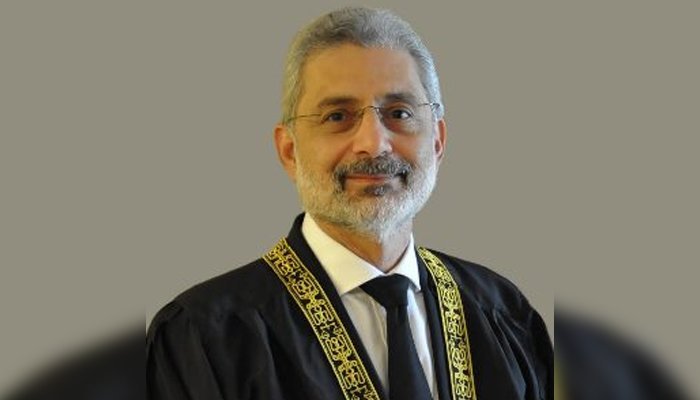
    The Supreme Court (SC) on Friday dismissed the Pakistan Tehreek-e-Insaf (PTI) government’s presidential reference against Justice Qazi Faez Isa of the top court, announcing its short verdict on the petition challenging the reference in the Supreme Judicial Council (SJC).

    A ten-member larger bench of the apex court headed by Justice Umar Ata Bandial and comprising Justice Maqbool Baqar, Justice Manzoor Ahmad Malik, Justice Faisal Arab, Justice Mazhar Alam Khan Miankhel, Justice Munib Akhtar, Justice Sajjad Ali Shah, Justice Syed Mansoor Ali Shah, Justice Yahya Afridi and Justice Qazi Muhammad Amin Ahmed heard the case, reserving the verdict before it was announced after 4 pm.

    The case was wrapped up after Justice Isa’s spouse on Thursday provided the money trail pertaining to her foreign properties and the Federal Board of Revenue (FBR) provided its input on the matter.

    The petitioner’s lawyer, Munir A Malik, concluded his arguments in court by saying that the federation had “gotten on the wrong bus” in the case.

    The top court judge’s wife, Zarina Carrera Khoso, submitted the money trail of her three properties in the United Kingdom (UK) to a full bench of the SC via video link in an assets concealment and alleged misconduct case against her husband.

    The SJC had initiated the proceedings against Justice Isa on allegations that he purchased three properties in London in the name of his wife and children between 2011 and 2015 but did not allegedly disclose them in wealth returns declared in Pakistan.

    Justice Isa had told the apex court on Wednesday that his wife wanted to appear before the SC bench to explain the sources of her UK properties.

    Subsequently, following the top court’s approval she testified that all the money was transferred from Pakistan to UK through her two foreign accounts.

    “Properties in Karachi were sold out and two bank accounts — one in British pounds and the other in US dollars — were opened in a private bank to transfer the money.

    “From 2003-2013, a total of £700,000 was transferred through these two foreign accounts in the Standard Chartered Bank’s Karachi branch,” she added.

    Khoso clarified that she was a Spanish citizen and that she had used her passport to purchase the properties in London. She added that when her husband was a lawyer, she would get a five-year visa.

    However, the Pakistani authorities had issued a one-year visa after 2018 only to create hurdles.

    Justice Isa’s wife explained that since she was born in Spain and her father’s and mother’s names, respectively, were Khoso and Carrera, her name on her birth certificate and passport is Zarina Carrera Khoso.

    After she got married to Justice Isa back in 1983, however, the Pakistani government registered her name on her CNIC as Zarina Isa.

    In her statement, the judge’s wife said her tax returns were filed after advice from Rehan Naqvi, her solicitor, and that she owned a house in Clifton, as well as a plot in Shah Latif Town. She has also received agricultural land from her father, which is now in her name.

    Khoso said she was advised that according to the law, tax returns were not filed on agricultural land. All of her taxes were filed after consultations with Naqvi, she added, noting that the last tax return she had filed was over Rs7.6 million.

    Later, Justice Maqbool Baqar reportedly remarked that what was going on in the country in the name of accountability would also be looked into. He said destruction [of institutions] was underway in the country in the name of accountability and they would also write that in the verdict.

    Justice Maqbool Baqar asked if the SJC could review the performance of the president, to which the federation’s lawyer, Farogh Naseem, said that the council had the authority to review anyone’s performance.

    NOT SURE ABOUT THE CASE? DON’T WORRY, WE HAVE YOU COVERED:

    Justice Qazi Faez Isa is an SC justice who took oath as a judge of the top court in September 2014. He is scheduled to become the chief justice of Pakistan (CJP) in August 2023 for thirteen months.

    His landmark cases include the Faizabad Sit-in judgment in 2019, the Quetta Massacre Commission in 2016 — when he headed an inquiry commission to find out what happened when a suicide attack in August 2016 killed 74 people — and the Memogate Commission in 2012, a case where an alleged memo was delivered to an American official at the behest of former ambassador to the United States (US), Husain Haqqani, in May 2012.

    In May 2019, media started reporting that references were being filed against SC judges Reports became so rampant that Justice Isa approached President Arif Alvi, complaining that information being leaked to the media amounted to character assassination, which would hinder his right to a fair trial. He also asked the president if a reference was being filed against him by the president in the SJC.

    There was no reply by the president and soon, a notice was sent to the federal government by the SJC that a reference was being filed against him and another judge, accusing them of concealing assets.

    Justice Isa then wrote another letter, in which he said that he could’ve handled the inquiry against him and his family but it seemed that the independence of the judiciary was being undermined and that a judge had to preserve and protect the constitution as he had sworn to do.

    He then asked the SC that a full bench be constituted, a plea that was accepted by then CJP Asif Saeed Khosa, and after a months-long trial, a full bench of the apex court on Friday dismissed the petition against him.
  • Govt is grossly under-reporting coronavirus deaths and infections: PM’s task force head

    Govt is grossly under-reporting coronavirus deaths and infections: PM’s task force head

    Pakistan is understating its rate of infections and the death toll from the coronavirus, the head of a government task force has said as the country becomes a hotspot for the pandemic in South Asia, Bloomberg reported.

    “The actual numbers will be two to three times more than what the government is reporting,” Dr Attaur Rahman, chairman of Prime Minister (PM) Imran Khan’s task force on science and technology, said and added that a large number of cases weren’t being reported because of low testing and as reasons other than respiratory failure weren’t being counted in deaths.

    WATCH VIDEO:

    Pakistan’s coronavirus cases have increased manifold since the government eased a lockdown in the second week of May after a partial shutdown of about two months. PM Imran has said he is allowing some businesses to open as he fears people will die of poverty and hunger instead of the virus. Alarmed by the rising number of cases, the authorities have again started shutting down residential localities in 20 key cities including the federal capital and Lahore.

    Pakistan is the second most infected nation in Asia after India with over 150,000 cases and about 3,000 deaths. The fatality rate of 2% is less than half of the 5% global average.

    Random testing in Pakistan’s second-largest city, Lahore, by the health department of Punjab in May showed that at least 6 per cent of all tests came back positive for COVID-19 while in some areas the percentage was as high as 14 per cent, Voice of America reported.

    Based on the city’s population and the sampling data, the health department working group, comprised of epidemiologists, public health specialists, applied economists, statisticians and public policy specialists, calculated the number of cases in Lahore to be 670,800 on May 15.

    The rate at which the infection was spreading alarmed those involved.

    “Our calculations said the numbers were doubling every two weeks,” said Dr Waheeduzzaman Tariq, a senior virologist who was part of the group and sits on multiple government committees dealing with the coronavirus pandemic.

    According to those numbers, on June 15, the figure should be approximately 2.7 million infected people in Lahore alone.

  • PTI lawmakers from Sindh urge Imran to improve ties with PPP govt

    PTI lawmakers from Sindh urge Imran to improve ties with PPP govt

    Lawmakers of the Sindh Assembly belonging to the Pakistan Tehreek-e-Insaf (PTI) have urged Prime Minister (PM) Imran Khan to strengthen relations between the Centre and the provincial government led by the Pakistan People’s Party (PPP) so that they are able to resolve public issues in their respective constituencies more efficiently.

    The premier met the MPAs at the Governor House during his two-day visit to the province.

    The delegation praised the premier’s suggestions in the new finance bill and decisions that were taken by the government to curb the spread of coronavirus. They also commended the PM on reaching out to the poor segment of the society through the Ehsaas Programme.

    “Public service is the first mission of the PTI government,” PM Imran said, urging the PTI lawmakers to be more proactive in resolving public issues.

    Sindh Governor Imran Ismail, Minister for Maritime Affairs Syed Ali Zaidi and Special Assistant Dr Sania Nishtar were also present in the meeting.

    Among the MPAs were Omar Amari, Dr Syed Imran Ali Shah, Arsalan Taj Hussain, Bilal Ahmed, Syed Firdous Shamim Naqvi, Haleem Adil Sheikh, Jamaluddin Siddiqui and others.

    The Grand Democratic Alliance (GDA) delegation was also present during the meeting.

    According to reports, the delegation demanded Sindh’s share in the NFC award and discussed the privatisation of steel mills and eradication of locusts from agricultural fields in the province.

    The GDA delegation included Sardar Abdul Hakim, Dr Arbab Ghulam Rahim, Arif Mustafa Khan Jatoi and Irfanullah Marwat.

  • PTI caught off-guard as allied BNP-M quits coalition govt

    PTI caught off-guard as allied BNP-M quits coalition govt

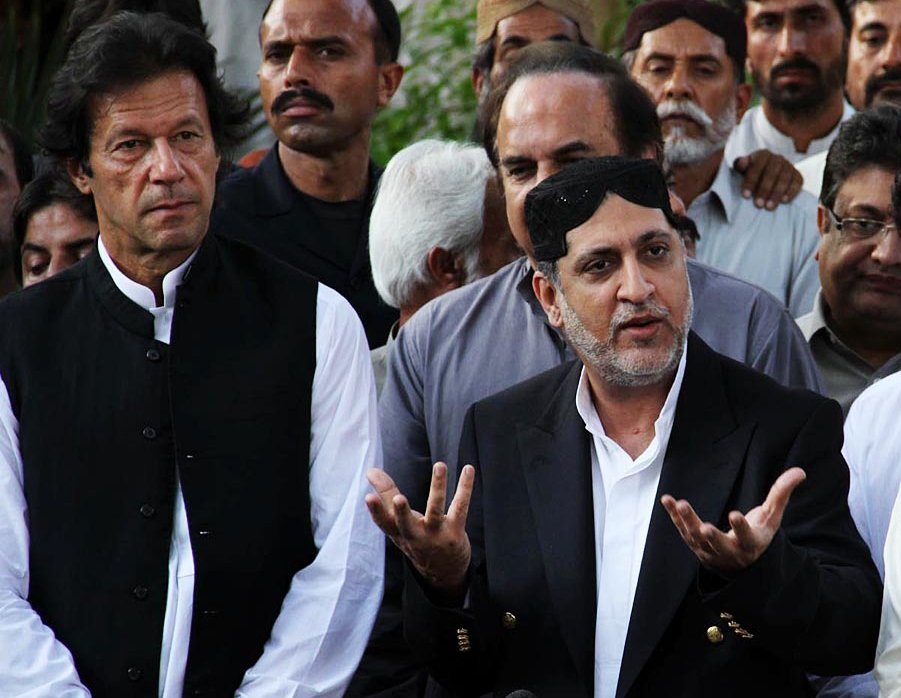
    The Pakistan Tehreek-e-Insaf (PTI) government appeared to be caught off-guard as the Balochistan National Party-Mengal (BNP-M), one of the eight political parties who either support the federal government or are a part of the ruling coalition, on Wednesday announced to end its alliance with the Imran Khan government.

    Speaking on the floor of the National Assembly (NA) during a session, party President Sardar Akhtar Mengal officially announced that his party was separating itself from the government. “We will stay in parliament and will keep talking about issues,” he said.

    The two parties had signed a six-point memorandum of understanding (MoU) in August 2018 for an alliance in centre. The six points included recovery of missing persons, implementation of the National Action Plan (NAP), implementation of six per cent quota for Balochistan in the federal government, immediate repatriation of Afghan refugees and the construction of dams in the province to resolve the acute water crisis.

    Mengal reminded the House that his party had two agreements with the ruling party, adding that it was the Imran Khan-led party which had come to him for an alliance, not the BNP-M which went to Bani Gala — the personal residence of PM Imran.

    “The first agreement was done on August 8, 2018 and signed by Shah Mahmood Qureshi, Jahangir Tareen and Yar Muhammad Rind,” recalled Mengal. 

    He added that his party had demanded that the missing persons issue be resolved and the National Action Plan be implemented in letter and spirit in the agreement.

    “Can someone tell us if there was anything unconstitutional in both these demands? Why were they not implemented?” asked the lawmaker from Balochistan. 

    He regretted that the ruling party’s mindset was “the same one running in the country since 1948”.

    “We waited for two years for the implementation of the agreement; we are ready to [wait] further, but start something,” appealed the nationalist leader. 

    He added that if the government wishes to take his province along, then they should implement their agreements with BNP-M.

    While highlighting his grievances in the assembly, the lawmaker stated that the foundations for the road from Chaman to Karachi were laid in 1973, and it has killed 4,500 in road accidents. He added that instead of giving them a six-lane road, the government gave them only a two-lane road.

    The BNP-M leader also claimed that “no one can find justice in this country” and that “justice is being sold”. 

    While hitting out at the government, he noted that Pakistan Steel Mills were being privatised and thousands were being unemployed.

    “The disappointing thing is that no one here is ready to listen to their [the laid off workers’] demands,” said Mengal. He added that if the demands could not be met, then they should at least be noted.

    “It has become a tradition here that the last government is held responsible for everything,” said Mengal.

    The alliance with the PTI was only in the centre, while the BNP-M’s alliance with the Jamiat Ulemae Islam-Fazl (JUI-F) in Balochis­tan continues at the provincial level.

    The coalition government has been struggling over “broken promises” for quite some time now as the Pakistan Muslim League (PML) and the Muttahida Qaumi Movement-Pakistan (MQM-P) also do not seem much satisfied with the ruling PTI’s performance.

    Wednesday’s development and its consequences could spell trouble for PM Imran who was elected as the leader of the house with a thin majority.

  • PTI MPA removed from Punjab information body after ‘leaked calls discussing PM, his wife, others’

    PTI MPA removed from Punjab information body after ‘leaked calls discussing PM, his wife, others’

    Pakistan Tehreek-e-Insaf (PTI) MPA Uzma Kardar, who had earlier made headlines for her mention in Reham Khan’s notorious book, was on Monday removed from an information body of the Punjab government hours after she was allegedly heard discussing Prime Minister (PM) Imran Khan, First Lady Bushra Bibi, Punjab Chief Minister (CM) Usman Buzdar, Defence Minister Pervaiz Khattak among others in a series of leaked phone calls.

    According to a notification issued by Punjab Information Minister Fayazul Hasan Chohan, Kardar was removed from the provincial government’s Media Strategy Committee. No reason was, however, given in the notification, a copy of which is available with The Current.

    The sacking comes hours after journalist Mansoor Ali Khan said a call recording of someone from the present government could surface very soon and become very embarrassing for the PTI government.

    It was followed by audio clips doing rounds over the internet.

    While Kardar could allegedly be heard discussing PM Imran and the first lady in one recording, she allegedly made outrageous claims regarding Buzdar, Khattak, Punjab Child Protection Bureau Chairperson Sarah Ahmad, “dirty politics” inside the PTI, Punjab Info Minister Fayazul Hasan Chohan and PTI’s allied Pakistan Muslim League (PML), in other leaked audio clips.

    The Current does not endorse any of the recordings or other content available when the above-embedded links are accessed but is committed to keeping our followers aware of whatever is going on.

    While the PTI lawmaker was not available for a comment, the audio has drawn mixed reactions as many question the motive behind the leaks.

    Among others, Mansoor has also questioned who recorded the phone calls and why.

    Meanwhile, reports claim that legal action will also soon be initiated against the PTI lawmaker.

  • FIA acquits Imran’s health aide Dr Zafar Mirza in masks smuggling case

    FIA acquits Imran’s health aide Dr Zafar Mirza in masks smuggling case

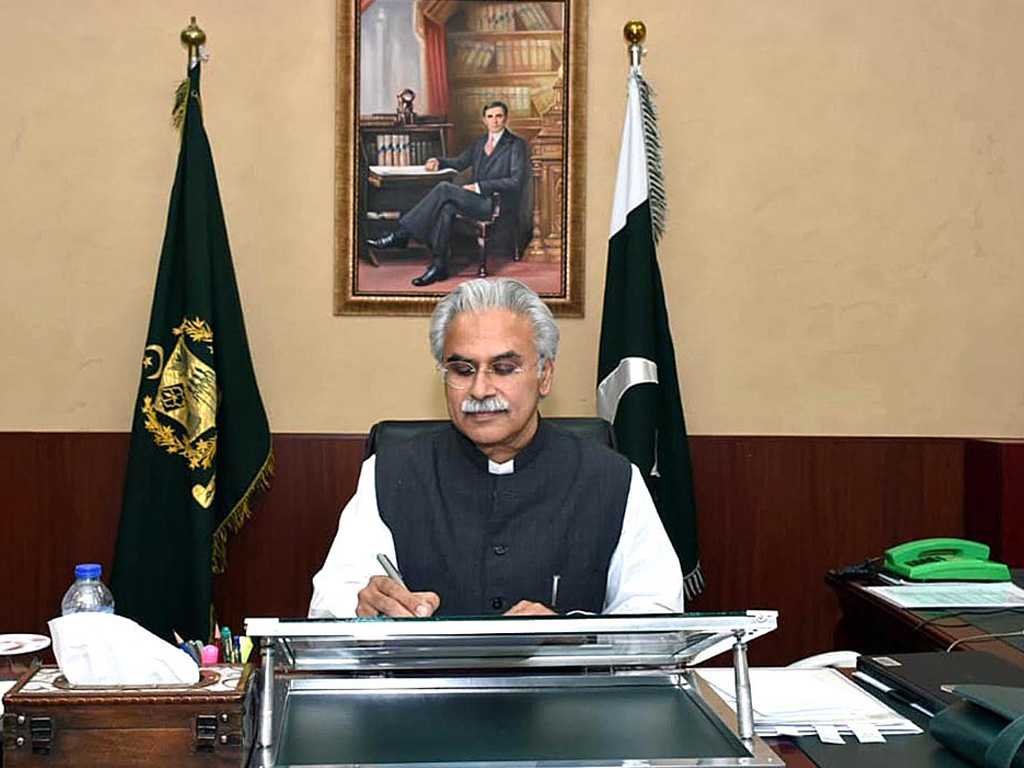
    The Federal Investigation Agency (FIA) has acquitted Special Assistant to Prime Minister (SAPM) on Health Dr Zafar Mirza after probing his alleged involvement in the smuggling of protective masks amid COVID-19 pandemic.

    According to FIA sources, no allegation was proved against Dr Mirza as the petitioner failed to provide evidence of his allegations during the agency’s investigation into the export of 20 million masks to China.

    Sources said that according to FIA’s report, no collusion was proved in issuance of permit for export of the masks and the Drug Regulatory Authority of Pakistan (DRAP) allowed the export under rules and regulations.

    It may be noted that the complaint in this regard was registered by Young Pharmacists’ Association (YPA) Secretary General Dr Furqan Ibrahim with the PM’s Complaint Cell.

    According to the complainant, 20 million masks were smuggled out of Pakistan allegedly by the SAPM in collusion with DRAP Deputy Director Ghazanfar Ali Khan.

    Meanwhile, the National Accountability Bureau (NAB) has also decided to launch an inquiry into the allegations against Dr Mirza.

  • Selective lockdown

    Selective lockdown

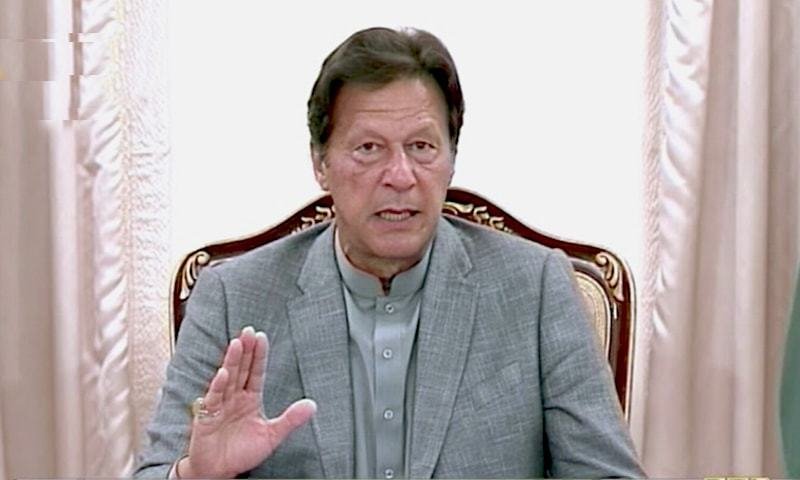
    Prime Minister (PM) Imran Khan has reiterated that there will not be another lockdown. “It is tantamount to shutting down the entire economy to contain the spread of coronavirus. My views have been quite clear on this from the first day.”

    He said that Pakistan is not like Singapore or New Zealand or Taiwan with smaller populations and is also not a rich country to afford a lockdown. PM Imran said smart lockdown will be imposed after identifying hotspots and blamed the people of Pakistan for not following SOPs.

    Pakistan’s coronavirus cases are more than 141,000 while deaths are 2,647. The number of cases keeps rising rapidly each day, which hospitals seem unable to deal with. Oxygen cylinders are unavailable in most cities or are available at exorbitant prices while prices of oximeters, medicines and other supplies have also shot up. Pakistan’s health sector will not be able to deal with such a huge crisis in the coming days.

    “I have been saying this repetitively that you must take precautions… I am disappointed to see that our people have been very careless,” said PM Imran who had once likened COVID-19 to flu.

    He said that masks are now mandatory and both the administration and volunteers of the Tiger Force will ensure this.

    It is easy for the government to ask people to follow the SOPs and take precautions while not taking responsibility for its policy failure. When lockdown was first imposed in the country, it should have been extremely strict followed by aggressive testing. Lockdown should not have been lifted for Eid when cases were on the rise. The government not just lifted the lockdown but also kept downplaying the virus despite warnings from health workers and senior doctors. No wonder then that people are not taking coronavirus seriously. It is the government’s responsibility to implement rules; people all over the world are not responsible unless rules and laws are strictly implemented. The government should consider temporary lockdown in cities where administration finds it difficult to control the spread of coronavirus, increase the number of tests, create more awareness by telling people how serious this virus is.

    Countries that locked down early and strictly have been able to return to normal much faster and are open to a large extent. In Pakistan, we have been busy in comparisons or criticism of other countries’ strategies while no effective policy has been in place here.

    Reports indicated that the Punjab government was considering imposing a strict two-week lockdown in Lahore at the recommendation of the World Health Organization (WHO) due to the rising number of cases but PM Imran rejected the proposal.

    Selective lockdown is not a solution because its implementation will be extremely difficult. It seems as if the government has adopted the policy of ‘to each his/her own’ when it comes to dealing with the coronavirus. Let’s not forget that countries that have gone down this road have not been able to save their economy either. We should act before it is too late.

  • ‘Unrealistic and meaningless’: Economists react to PTI govt’s second federal budget

    ‘Unrealistic and meaningless’: Economists react to PTI govt’s second federal budget

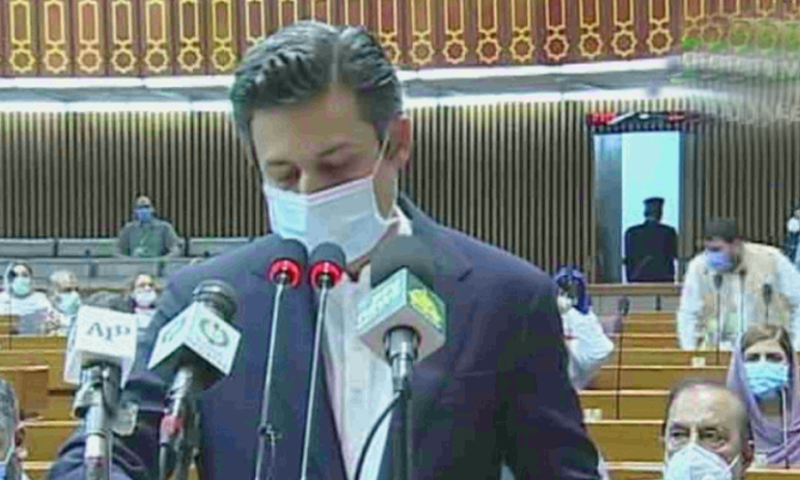
    The Pakistan Tehreek-e-Insaf (PTI) government has unveiled a Rs7.13 trillion budget for the upcoming fiscal year, which was presented before the parliament by Industries Minister Hammad Azhar amid opposition members’ protest against the same for being “anti-people”.

    But while the budget, which Prime Minister (PM) Imran Khan’s team claims will bring relief to the masses in coronavirus times, is drawing mixed reactions from political leaders and the general public, what do economists have to say about it?

    MUZZAMMIL ASLAM:

    “Given the GDP [gross domestic product] projections (2.1%) for next year, it is apparent that the government has failed to provide impetus to the economy. This has highlighted resource constraints the current government is facing. The government is basically relying on the stimulus of 1.2 trillion it provided during COVID-19 and is now consolidating its finances due to [the] IMF [International Monetary Fund] programme.”

    YOUSUF NAZAR:

    “Budget making has been reduced to a meaningless annual ritual given the overall dismal performance in meeting the targets, a performance which had little to do with the pandemic. Given that Pakistan’s economy is contracting for the first time in history, I had hoped that the government will come up with a plan to revive growth. A big near term risk to growth is the locust attack. I don’t see anything in the budget to help the agriculture sector face this threat. On a broader note, the government seems lost and overwhelmed by the economic contraction. I don’t see how it succeed in meeting the revenue target through privatisation when the business confidence is so low and the premier appears to be, honestly, clueless about we need to do to reform the economy, reset spending priorities and revive confidence in the government.”

    FARHAN BOKHARI:

    “It is an unrealistic budget that is based on an unrealistic tax collection target. The budget should have included a bold plan to cut losses in public sector companies and an equally bold plan for tackling losses in the energy sector. Pakistan additionally needs an emergency plan to raise agricultural productivity as agriculture is the only sector of the economy that has recorded some growth. Such big moves require a national political consensus which is missing as the premier refuses to talk to other mainstream political leaders.”

    According to Hammad Azhar, the Federal Board of Revenue (FBR) revenue target for next year has been kept at Rs4.95 trillion, while defence allocations amount to around Rs1.3 trillion.

    READ: Twitter loses it over Rs1.29 trillion budget for defence, Rs83.63 billion for education

    The federal development programme has been budgeted at Rs650 billion to support growth prospects.

    The budget for fiscal year (FY) 2020-21 comes at a time when the country is battling the COVID-19 pandemic that has served a severe blow to the economy. According to reports, it has been formulated considering the impact of the virus and to give relief to the citizens, as part of which no new taxes have been imposed.

    Check out the budget document here.

  • Twitter loses it over Rs1.29 trillion budget for defence, Rs83.63 billion for education

    With the Pakistan Tehreek-e-Insaf (PTI) government unveiling its second budget in the National Assembly (NA) on Friday, Twitterati are losing it over nearly Rs1.3 trillion being allocated for defence against not even Rs84 billion for education in the Rs7.13 trillion budget for fiscal year (FY) 2020-21.

    One trillion equals 1,000 billion.

    DEFENCE BUDGET:

    According to Dawn, the government has proposed Rs1.29 trillion defence allocation for the next fiscal year, representing an 11.8 per cent increase over the original allocation for the outgoing year. Federal Minister for Industries Hammad Azhar, while presenting the budget in the National Assembly, said that defence and internal security have been given adequate attention in the budget.

    The military had last year forgone a major hike because of the economic challenges then facing the country and settled for a raise of 4.74 per cent, but by the end of the year, it had overshot the allocation by 6.33 per cent.

    The original allocation for last year was Rs1.15 trillion, but according to revised figures presented before the lower house of parliament, about Rs1.23 trillion had been spent. It has now virtually become a norm for actual defence spending incurred in a year to be higher than the original allocation.

    EDUCATION BUDGET:

    Meanwhile, the government has earmarked Rs83.363 billion for Education Affairs and Services against the revised allocation of Rs81.253 billion for the current fiscal year, showing an increase of around 2.5 per cent. The country’s public expenditure on education as a percentage to gross domestic product (GDP) is estimated at 2.3 per cent in the fiscal year 2019-20, which, according to reports, is the lowest in the region.

    An amount worth Rs70.741 billion has been allocated for Tertiary Education Affairs and Services in budget 2020-21, which is 84.9 per cent of the total allocation under this head, while Rs2.931 billion have been earmarked for pre-Primary & Primary Education Affairs, Rs7.344 billion for Secondary Education Affairs & Services and Rs1.237 billion for administration.

    Since the federal government only finances higher education after the 18th Amendment when education as a subject was devolved to provinces, the government has increased the budgetary allocation for the higher education sector from Rs59 billion in 2019-20 to Rs64 billion for the next fiscal year. According to the budget documents, Rs29.470 billion have been earmarked for the Higher Education Commission (HEC) under the Public Sector Development Programm (PSDP) for 2020-21.

    TWITTER REACTS:

    With the nearly 1447.62 per cent difference between the spending on defence and education not sitting well with many, here’s how Twitterati are reacting:

    Some also highlighted how the government had allocated only Rs70 billion for combating the coronavirus and other disasters at a time when dozens were losing their lives to the virus across the country every day.

    What do you think of Budget 2020? Let The Current know in the comments.

    You can go through the budget document here.

  • 10 million Pakistanis to fall below poverty line

    10 million Pakistanis to fall below poverty line

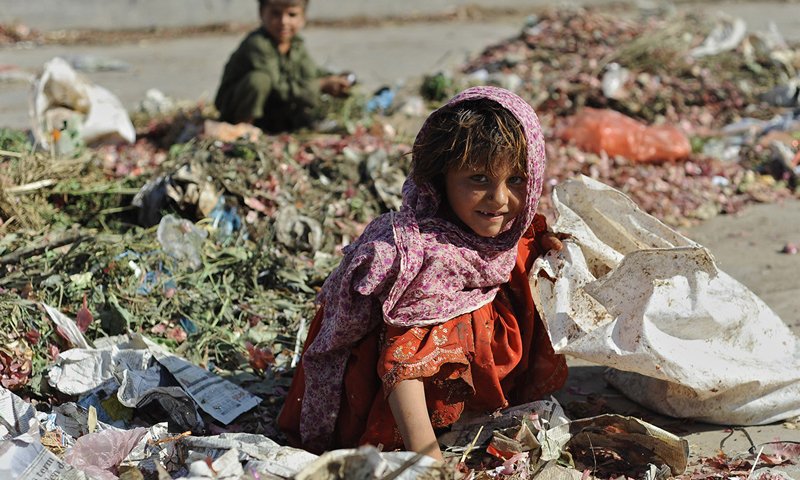
    At least 10 million more Pakistanis will drop below the poverty line because of the toll of the COVID-19 pandemic, the government’s new economic survey estimates.

    Around one in four Pakistanis are currently too poor to meet basic needs, but the figure is predicted to rise closer to 30 per cent of the world’s sixth most populous nation.

    “The COVID-19 outbreak is expected to have a negative impact on Pakistan’s economy, and the number of people living below the poverty line may rise from the existing figure of 50 to 60 million,” the survey says.

    The government’s annual Economic Survey also warned that the economy would contract for the first time in 68 years.

    “The country’s provisional gross domestic product (GDP) growth rate will likely contract 0.4 per cent instead of growing 3.3 per cent as previously forecast,” Adviser to Prime Minister (PM) on Finance Abdul Hafeez Shaikh told a news conference.

    The adviser said the International Monetary Fund (IMF) and World Bank (WB) were making bleaker assumptions keeping in view the severity and duration of the coronavirus pandemic. “In my view, we will have a better estimation when this year ends on June 30.”

    He highlighted the government’s swift and decisive policy actions since the start of the current fiscal year, including resource mobilisation, completion of the IMF programme, austerity measures and monetary policies helping stabilise the economy.

    The adviser stated that these measures helped the economy to reverse large external and internal imbalances. He said that significant improvement in external accounts was made as the current account and trade deficit witnessed a substantial contraction.

    “Foreign reserves steadily improved. There was an increase in foreign direct investment (FDI). The credit rating profile also improved. Fiscal performance remained strong during the first three quarters of the outgoing fiscal year, on the back of consolidation efforts and targeted reforms.”

    “To mitigate the socio-economic impact of the pandemic, the government announced a stimulus package of Rs1.24 trillion and offered further relief measures through the State Bank of Pakistan (SBP). The policy rate was also cut by 5.25pc to 8.0pc,” he said, adding that monetary and fiscal policy interventions had been made to restore economic activity in this difficult time and to reduce negative effects on poverty and unemployment.