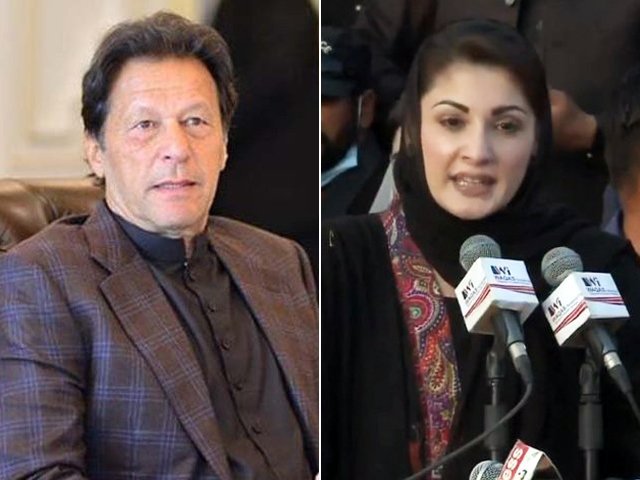
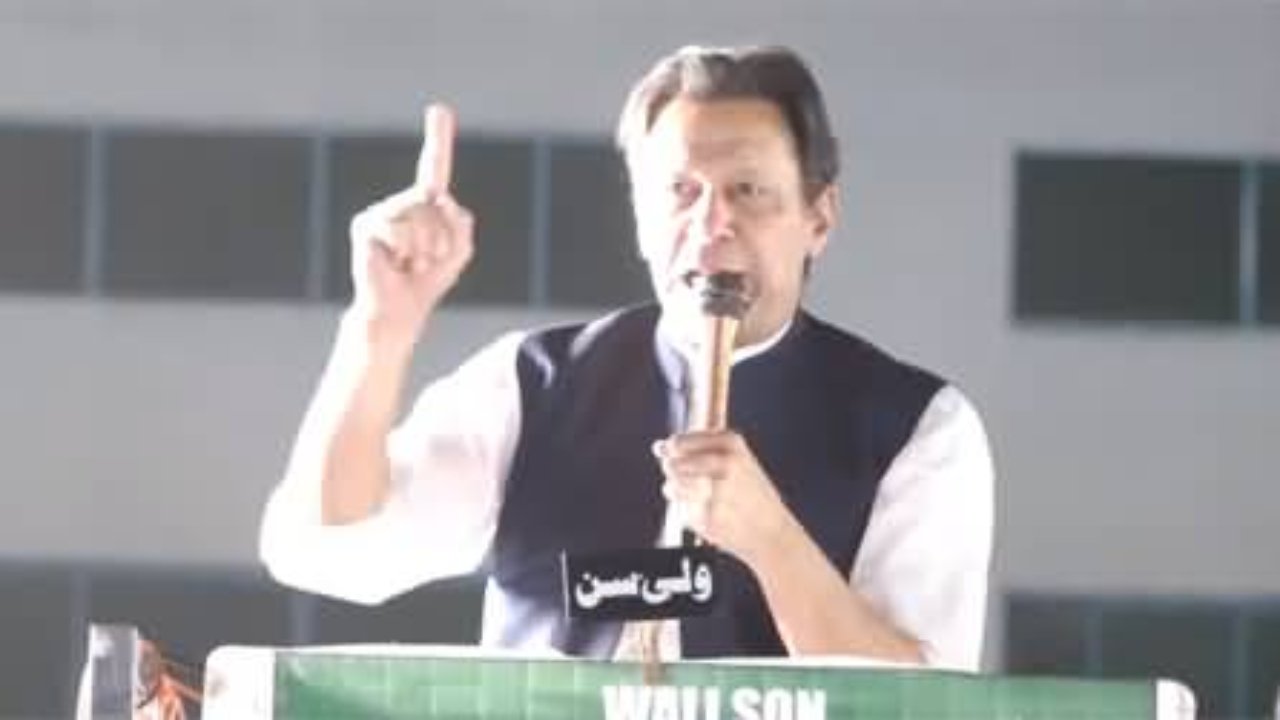
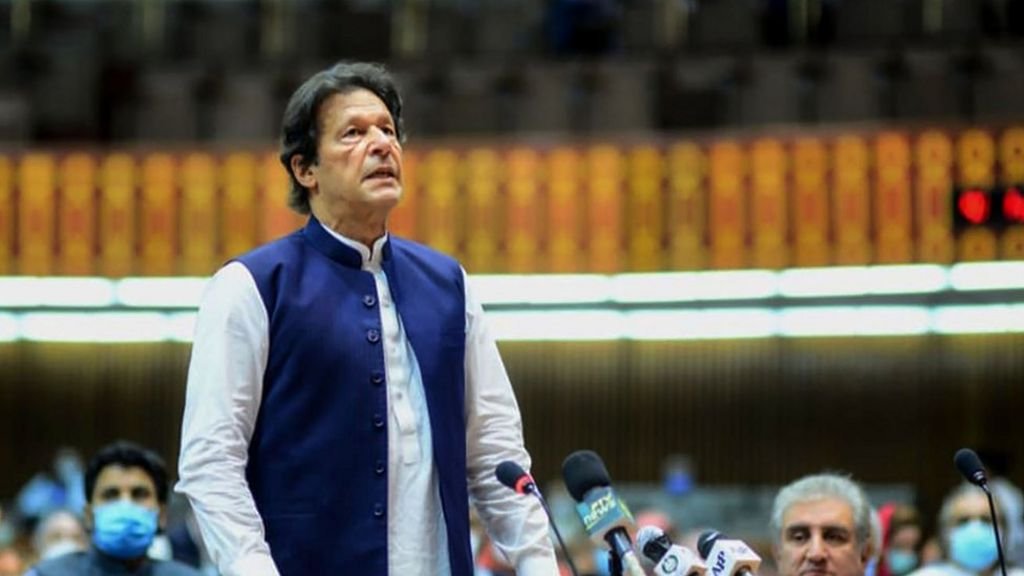
Pakistan Tehreek-e-Insaf (PTI) chairman Imran Khan on Wednesday in his jalsa in Gujranwala criticised Pakistan Muslim League-Nawaz (PML-N) Vice President Maryam Nawaz.
Khan said, “Once a woman from the American Embassy came to [Pakistan], Maryam called her at her house, opened the door of her car, and brought her inside. The way she was walking besides the American lady, the only thing left was for Maryam to lie down and tell the lady to pass over her so that her shoes don’t get dirty.”
ایک مرتبہ امریکی ایمبیسی سے خاتون آئی مریم نواز نے اسے اپنے گھر بلایا ، اس کی گاڑی کا دروازہ کھولا ، صرف ایک ہی کسر باقی رہ گئی تھی کہ مریم لیٹ جاتیں اور ان خاتون سے کہتی کہ میرے اوپر سے گزر کر جائیں تاکہ آپ کے جوتے گندے نہ ہوجائیں، عمران خان#GeoNewspic.twitter.com/hRmjzPu20x
— Maryam Nawaz Sharif (@MaryamNSharif) May 18, 2022
Khan was talking about United States (US) Charge d’ Affaires Angela Aggeler, who visited Jati Umrah on October 14, 2021. On her arrival, she was received by Maryam Nawaz.
The PTI chairman hit at Prime Minister (PM) Shehbaz Sharif as well and said, “Shehbaz Sharif you have worked really hard. You have polished many boots. Whoever came from the American Embassy you used to polish their boots.”
Berating the Sharif brothers, Khan said: “Shehbaz Sharif is asking what to do after becoming the prime minister. He said that inflation is rising and foreign exchange is tumbling. The two brothers (Shehbaz and Nawaz Sharif) are now trapped and they are wondering what to do.”
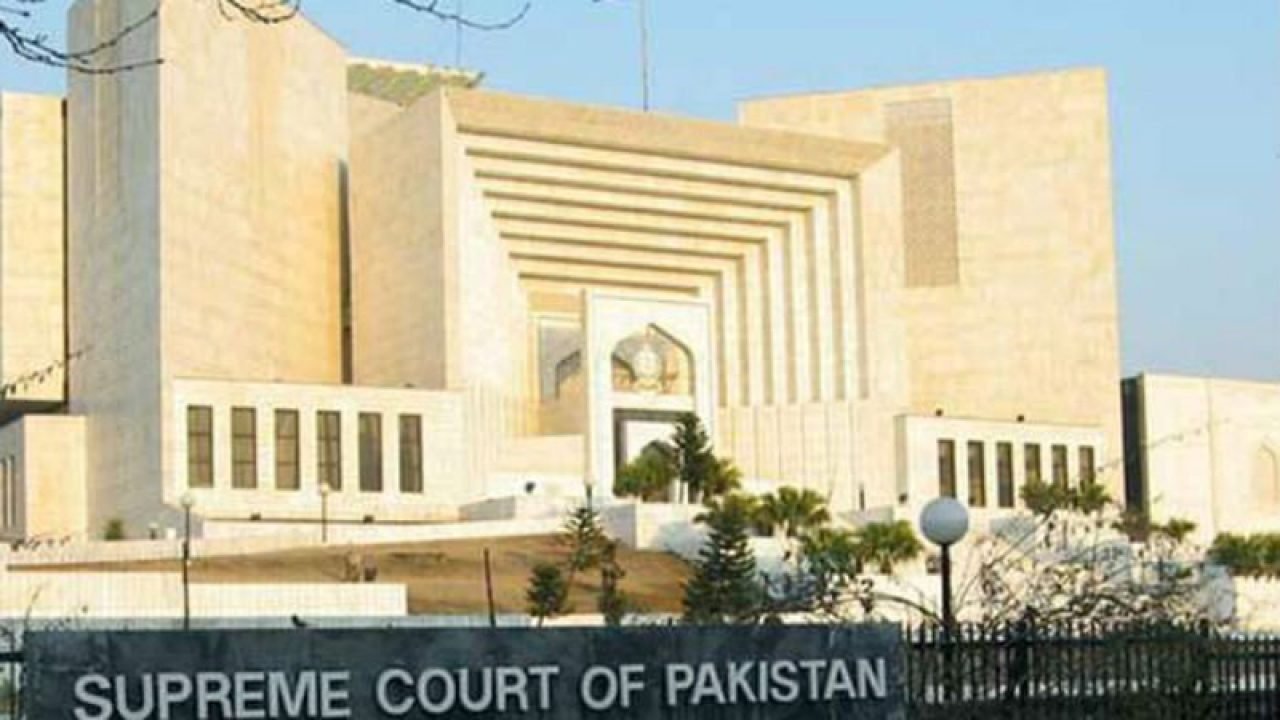
The Supreme Court (SC) on Tuesday in its decision on a presidential reference seeking interpretation of Article 63-A of the Constitution, which is related to the status of defecting lawmakers, said the votes of defecting lawmakers will not be counted.
Chief Justice of Pakistan (CJP) Umar Ata Bandial, Justice Ijazul Ahsan, and Justice Munib Akhtar gave the majority verdict while Justice Mazhar Alam Khan Miankhel and Justice Jamal Khan Mandokhail were the dissenting judges.
Question 1: Should Article 63-A have a limited or a broad, purpose-oriented interpretation?
The short-order said that the first question was related to the proper approach to be taken for the interpretation and application of Article 63-A.
“In our view, this provision cannot be read and applied in isolation and in a manner as though it is aloof from, or indifferent to, whatever else is provided in the Constitution,” the verdict stated.
It said that Article 63-A was an “expression in the Constitution itself of certain aspects of the fundamental rights that inhere in political parties under clause (2) of Article 17,” adding that the two provisions were “intertwined”.
“Defections rightly stand condemned as a cancer afflicting the body politic. They cannot be countenanced,” the order said, adding that 63-A must be interpreted in a “purposive and robust manner”.
“The pith and substance of Article 63-A are to enforce the fundamental right of political parties under Article 17 […] It must therefore be interpreted and applied in a broad manner, consistent with fundamental rights,” the verdict said.
Question 2: Will the defecting members’ vote be counted, given equal weightage?
Giving its stance on the second question, the verdict said that the vote of any member of a parliamentary party in a house “that is cast contrary to any direction issued by the latter in terms of para (b) of clause (1) of Article 63-A cannot be counted and must be disregarded, and this is so regardless of whether the party head, subsequent to such vote, proceeds to take, or refrains from taking, an action that would result in a declaration of defection.”
Question 3: Will the defectors be disqualified for life?
“While it is for parliament to enact such legislation, it must be said that it is high time that such a law is placed on the statute book. If such legislation is enacted it should not amount to a mere slap on the wrist but must be a robust and proportionate response to the evil that it is designed to thwart and eradicate,” the order stated.
Question 4: Measures that can be taken to prevent defection, floor crossing, and vote-buying
On the question of the measures that can be taken to curb vote-buying, the verdict refrained from giving an opinion on the fourth question, submitted by the president was returned by the court as it was “stated in terms” that were “vague, and too broad and general”.
What is Article 63-A?
Article 63(A) of the Constitution of Pakistan deals with the defection of parliamentarians.
According to the Article, a lawmaker can be disqualified on the grounds of defection if they vote or abstain from voting in the House contrary to any direction issued by the parliamentary party to which they belong.
However, this is restricted to three instances where they have to follow the party’s directions:
Election of the prime minister or chief minister;
Vote of confidence or a vote of no-confidence;
Money bill or a Constitution (amendment) bill.
Per the Article, the head of the party is required to present a written declaration that the MNA concerned has defected.
However, prior to presenting the declaration, the head of the party will have to give the MNA concerned a chance to explain the reasons for defection.
Following that, the party chief will then forward the written declaration to the speaker, who would, in turn, hand it over to the chief election commissioner (CEC).
The CEC will have 30 days at its disposal to confirm the declaration. Once confirmed, the MNA concerned will no longer be a member of the House and their “seat shall become vacant”.
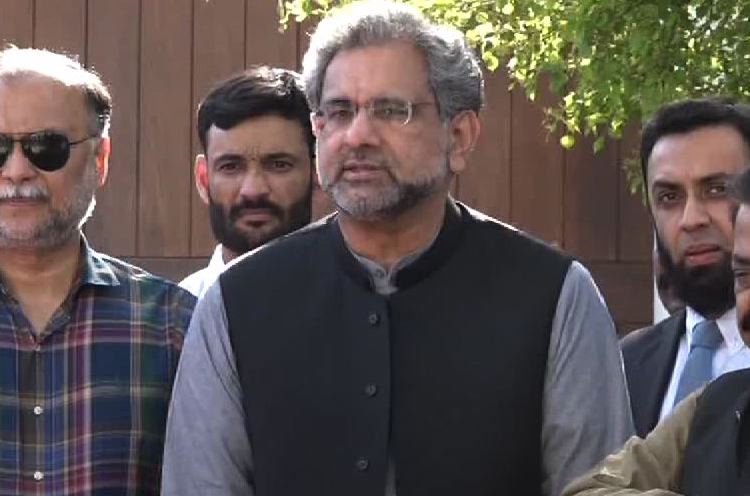
Pakistan Muslim League-Nawaz (PML-N) leader and former Prime Minister (PM) Shahid Khaqan Abbasi has said that dissolving assemblies is not the solution to the current economic crisis in the country.
Speaking outside the National Accountability Bureau (NAB) office in Islamabad, he said, “The government is working hard to get the situation under control” and urged that political parties should sit together to derive a solution.
Khaqan said that the decisions need the support of institutions and the people because Pakistan is everyone’s responsibility.
“Our country has always had unconstitutional intervention in politics. That intervention also plays a role in getting us where we are today,” he added.
“This destruction started four years ago when the PTI government came to power,” he claimed. “Today, Imran Khan is the sole person responsible for the economic turmoil in Pakistan. You cannot expect a government to immediately fix things that he spoiled.”
The PML-N leader’s statement has come when the dollar rate is at its peak. This spell of the dollar’s persistent rise against the rupee began last week.
Earlier, it was reported that government would either dissolve the assemblies or increase the petrol prices in the upcoming days.
It was said that if the government does not increase the fuel prices Pakistan may face a much worse situation than what is happening in Sri Lanka.
Pakistan Tehreek-e-Insaf (PTI) Chairman and Former Prime Minister (PM) Imran Khan said that he has recorded a video, in which he has mentioned each and every character behind the “conspiracy” against his government, and if something happens to him, it will be released.
Addressing a rally in Sialkot on Saturday, Khan claimed that his life is in danger and a “conspiracy” is being hatched to take his life. According to him, the video is stored in a “safe place.”
“I have recorded this video as I don’t consider what I do as politics, this is jihad to me,” the PTI chairman added.
The former PM said, through this video, he will expose everyone who went “against the country’s interest. He urged people to come out against the current government and support PTI and if they do not do this, the “public will have no future”.
Khan praised the judiciary and said they took a good initiative by taking a suo motu on the night of the no-confidence vote and opened the gates of the courts.
The PTI chairman told the judiciary that Rs24 billion corruption cases were filed against the current PM Shehbaz Sharif, Chief Minister (CM) Hamza Shahbaz, and his brother, Suleman Shahbaz.
He said that the former Federal Investigation Agency (FIA) director Dr Rizwan, was bold enough to continue investigating corruption cases against the “Sharif mafia”.
Reacting to a police crackdown at the party’s venue, Khan said that when PTI was in power, it did not stop the then-Opposition from holding long marches, rallies, or sit-ins.
On Saturday, police got the PTI’s rally venue vacated after they tried to hold a public meeting at the CTI ground, a property belonging to the Christian community, without their consent. However, the party changed the venue to the public VIP Ground in Sialkot.
Khan claimed that his party has always remained peaceful, but warned Interior Minister Rana Sanaullah and the government, that if they resort to violence, then they would “not get any place to hide”.
Pakistan Tehreek-e-Insaf’s (PTI) leader Usman Dar and other party members were arrested on Saturday after a police crackdown at the party’s rally venue in Sialkot.
Dar shared a video on Twitter, saying he was speaking from a “prison van”. Others could also be seen with him.
Dar said, “We will bear imprisonment but remain loyal to our leader Imran Khan. And listen closely, we will come out of the jails and again hold a rally in Sialkot. Our leader will again come to Sialkot. And under the leadership of Imran Khan, we will bury this imported government, these puppets of America forever.”
Earlier, in the day police launched a crackdown on PTI’s activists and got the rally venue vacated after they tried to hold a public meeting at the CTI ground, a property belonging to the Christian community, without their consent. However, now the party has changed the venue to the public VIP Ground in Sialkot.
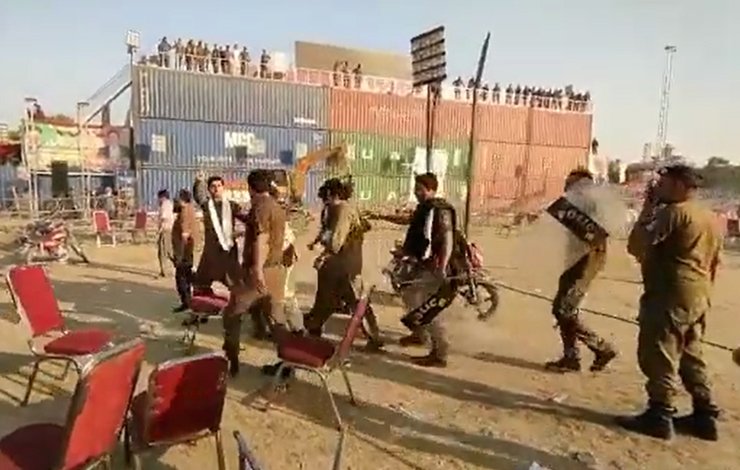
The Christian community lodged a protest as PTI had not taken prior permission from them for the rally. When the police arrived to stop the arrangements, many PTI workers showed resistance, however police baton-charged and used tear gas to disperse PTI workers.
Sialkot District Police Officer (DPO) Hasan Iqbal, who was present at the site, told reporters, “As you know we are right now standing on a ground that belongs to the Christian community. They had filed a writ [petition] in the high court, asking that no political rally be held on the grounds.”
He added that the “political party’s leaders” sought permission to hold the rally but the Christian community refused. “Then we came here and told them that we can help you with regards to an alternative venue. What has happened after that is there for you to see,” he added.
In a video, Iqbal can be heard talking to PTI members. He said, “No one is stopping you. This land is private. You didn’t take permission from them. Your party talks about rule of law. Does the law allow you to do a jalsa on this land without the Christian community’s consent?”
“We have been trying to tell your this for two days. Try to understand it”, he added.
Brilliant response by Sialkot DPO. Calm, composed, soft but firm.
Following the situation, former Prime Minister (PM) Imran Khan claimed, “What imported govt did in Sialkot against our leadership & workers is outrageous, but not unexpected. This bunch of criminals out on bail and their convict mafia boss in London have always used fascist tactics against opponents when they are in power.”
In a press conference, Shafqat Mehmood, Ejaz Chaudhry, and Firdous Ashiq Awan blamed Defence Minister Khawaja Asif for the police action and urged the administration to release PTI leaders who have been arrested.
Official documents revealed that several members of Pakistan Tehreek-e-federal Insaf’s cabinet enjoyed gains in their fortunes during their term in parliament and as ministers, despite being elected on pledges of fighting corruption.
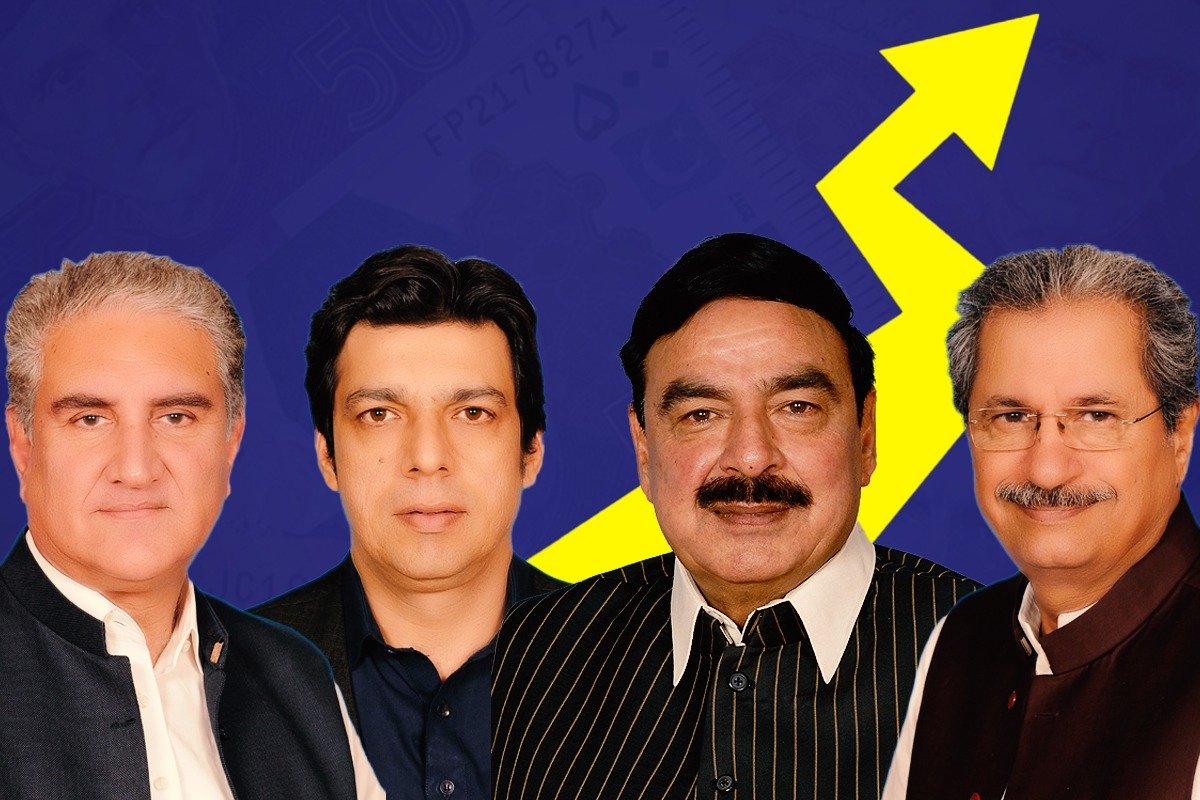
According toSAMAA TV, Shah Mehmood Qureshi and Sheikh Rasheed Ahmad, Omar Ayub Khan, Azam Khan Swati, Khusro Bakhtiar, Faisal Vawda, Shafqat Mehmood, Fehmida Mirza, Zubaida Jalal, Mahboob Sultan, and Tariq Cheema are among the listed former ministers.
Since select ministers received notices to explain their excessive wealth, the majority blamed weak wealth and asset declaration regulations, which did not contribute to increases in the valuation of assets overtime or the amalgamation of entities.
An inquiry into assets spontaneously declared before the Election Commission of Pakistan (ECP) and Pakistan’s tax authorities — primarily the Federal Board of Revenue (FBR) — by cabinet members who worked under former Prime Minister Imran Khan disclosed that plenty of of them saw a tremendous upsurge in their riches, with growth proportions primarily in the triple digits.
As per the official record, the ECP sent notices to at least six former ministers while they were still in government in 2019 and 2020, requesting them to clarify their wealth-related issues.
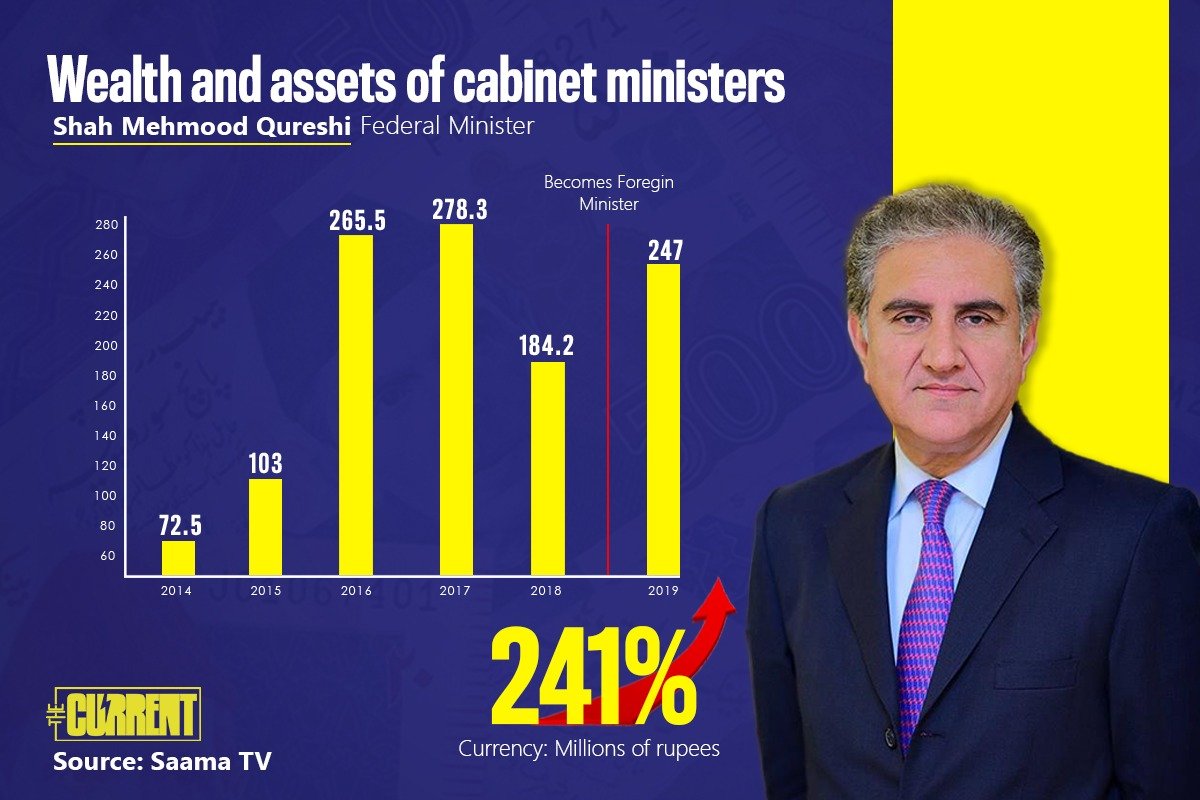
From 2014 to 2019, former foreign minister Shah Mahmood Qureshi, who has been a staple of the parliament for more than a decade and served twice in the federal cabinet in two different governments, had a 241 per cent growth in his wealth.
He and his wife held assets worth only Rs72.5 million in 2014, according to asset declarations he submitted to the ECP and the FBR. In the following three years, his assets nearly quadrupled, reaching Rs278.3 million, a 283.86 per cent increase over his wealth in 2014. Qureshi’s fortune dropped dramatically to Rs184.2 million in 2018, the year he returned to the Treasury benches, albeit with a new party, the PTI. However, while in power, it soon increased to Rs247.1 million in 2019, a rise of 240.82 per cent since 2014.
When questioned, Qureshi recounted how the worth of his assets had evolved over the years.
“The reason for the increase in assets was that during 2015-16, my wife received her share from the sale of property situated in Lahore, which had been gifted by her mother, and shares from sale proceeds of inherited property worth Rs169.6 million and Rs22.6 million,” he claimed. In October 2017, duplicates of sale deeds were handed to the ECP, according to the former minister.
“The ECP raised this observation too,” he said regarding the increase in his wealth, adding, “I and my dependent family members are all filers with the FBR”.
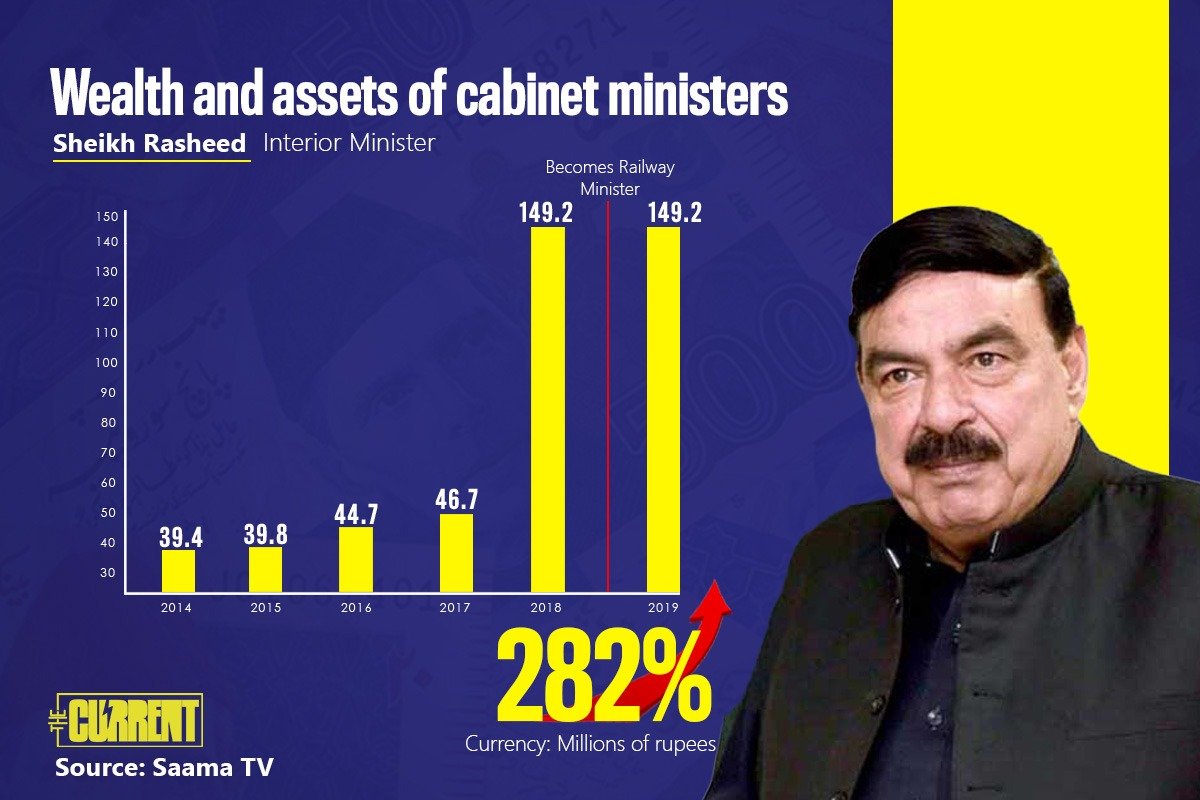
Sheikh Rashid, the former interior minister, watched his fortune increase by nearly 278.68 per cent between 2014 and 2019.
The financial disclosures for 2014 revealed that he only had Rs39.4 million in assets. Earnings climbed by Rs0.4 million to Rs39.8 million. His holdings steadily expanded over the next two years, reaching Rs44.7 million in 2016 and Rs46.7 million in 2017.
Conversely, in 2018, the time he was elected to power, his assets boosted by Rs100 million to Rs149.2 million. In 2019, there was no movement in reported assets. After inquired why his assets had suddenly changed, Rashid said that the discrepancy was due to an advance payment he had obtained for reselling a portion of land in 2018.
“I received Rs100 million as advance after making a deal of land to be sold last year, [2021],” he said, adding, “There is no such increase in my assets”. The former interior minister stated that the rise in his declarations submitted with the FBR and the ECP had been properly disclosed.
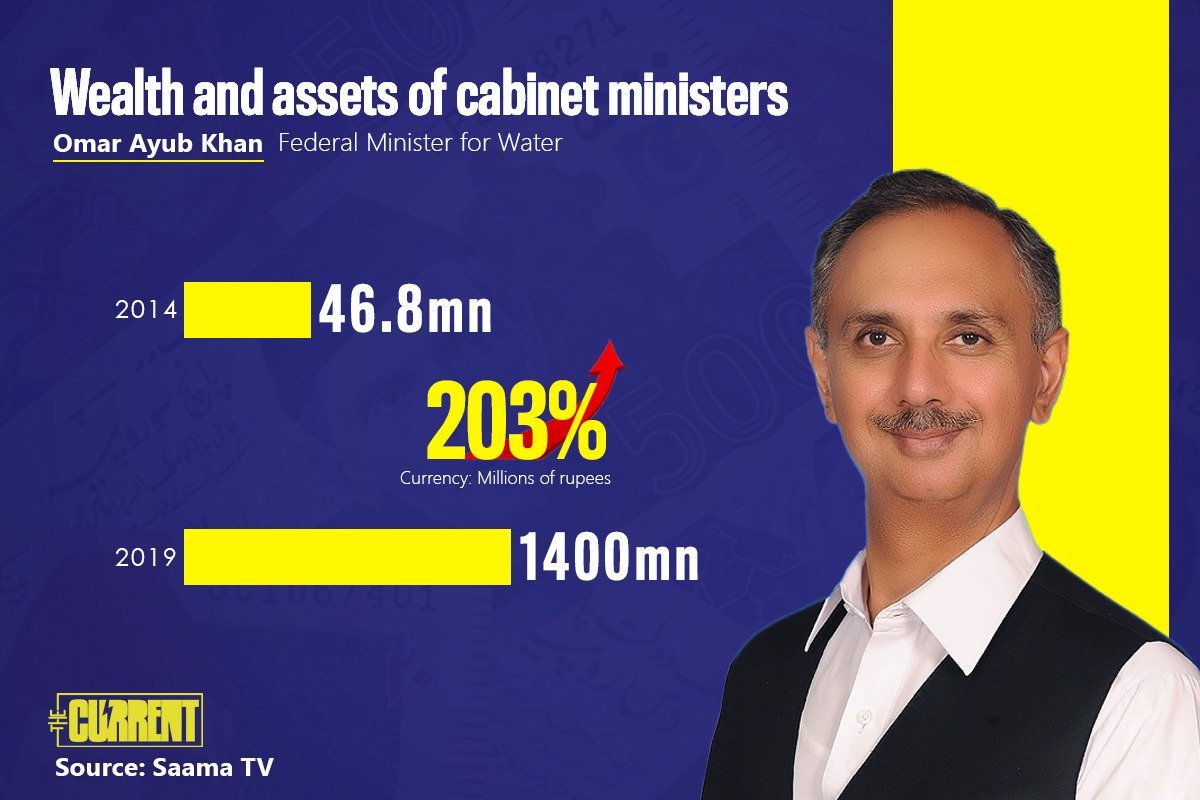
Between 2014 and 2019, the fortune of former federal minister of water Omar Ayub and his wife jumped by 203 per cent.
As per Ayub’s filings to the ECP and FBR in 2014, he and his wife held assets worth Rs461.8 million. This comprised Rs132 million in assets held by his wife and Rs329 million in assets owned by the minister. This value had risen to Rs1.4 billion by 2019. Surprisingly, while his wife’s holdings increased slightly to Rs201 million, Ayub’s assets increased to Rs1.2 billion. Each has debts worth only Rs26.3 million, according to the disclosures.
As a result, the ECP expressed concerns about Ayub’s and his family’s unexpected surge in wealth.
“It was explained to the ECP in 2019 that it [increase in wealth] is because of group formation having no cash involvement,” Ayub said, confirming that the top poll body had issued him a notice on this subject. Ayub claimed that he owned shares in Nova Synpac Ltd. and NovaGene Pharmaceuticals Ltd., which increased in value by approximately Rs1.071 billion.
“My assets have decreased (excluding this group formation) since I took an oath as a minister because I resigned from my group,” he claimed, adding that the increase was due to the consolidation of all of his businesses under the group.
“This cannot be reflected in a declaration, which is always a reflection of statements submitted to the FBR and there cannot be any difference [between them] otherwise it would have been challenged there,” he explained.
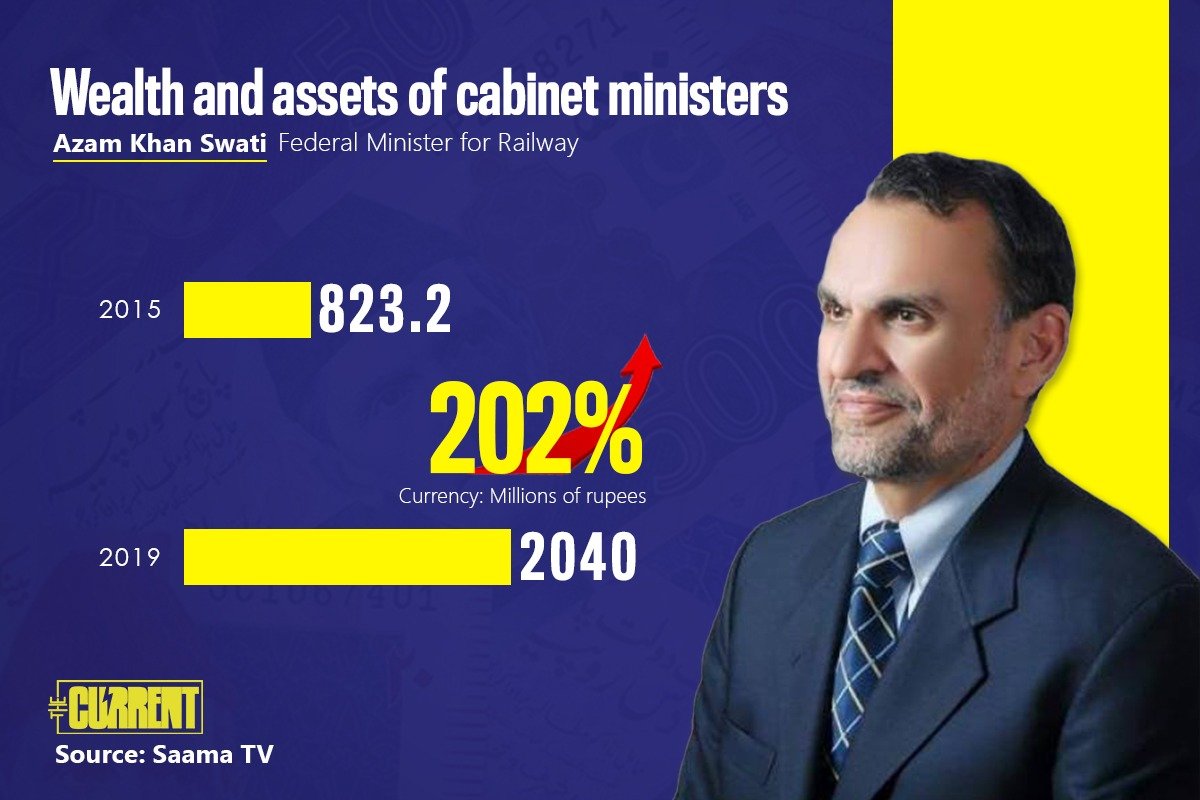
Azam Swati, the former federal railways minister, saw his fortune grow by 202 per cent from Rs823.2 million in 2015 to about Rs2.04 billion in 2019. He reported that his liabilities increased from Rs417 million in 2015 to Rs811 million in 2019.
“[Your] figures are wrong due to incomplete information being furnished before ECP by members and cabinet members owing to faulty legal requirements mentioned in ECP Act 2017,” he explained.
He further said that his situation was slightly unusual. “In Pakistan, I have no income and no business.” I am confident that our FBR wealth statement [filed] will be compared to ECP in 2019 [asset declarations],” he remarked, worried that the statistics may contain a few errors.
“ECP has no efficiency and capability to audit assets and liabilities,” he disclosed, adding, “We were making mistakes filing combined [wife and husband together]”.
“Now we have corrected the mistake and filed separately because the wife is not dependent,” Swati told SAMAA TV.
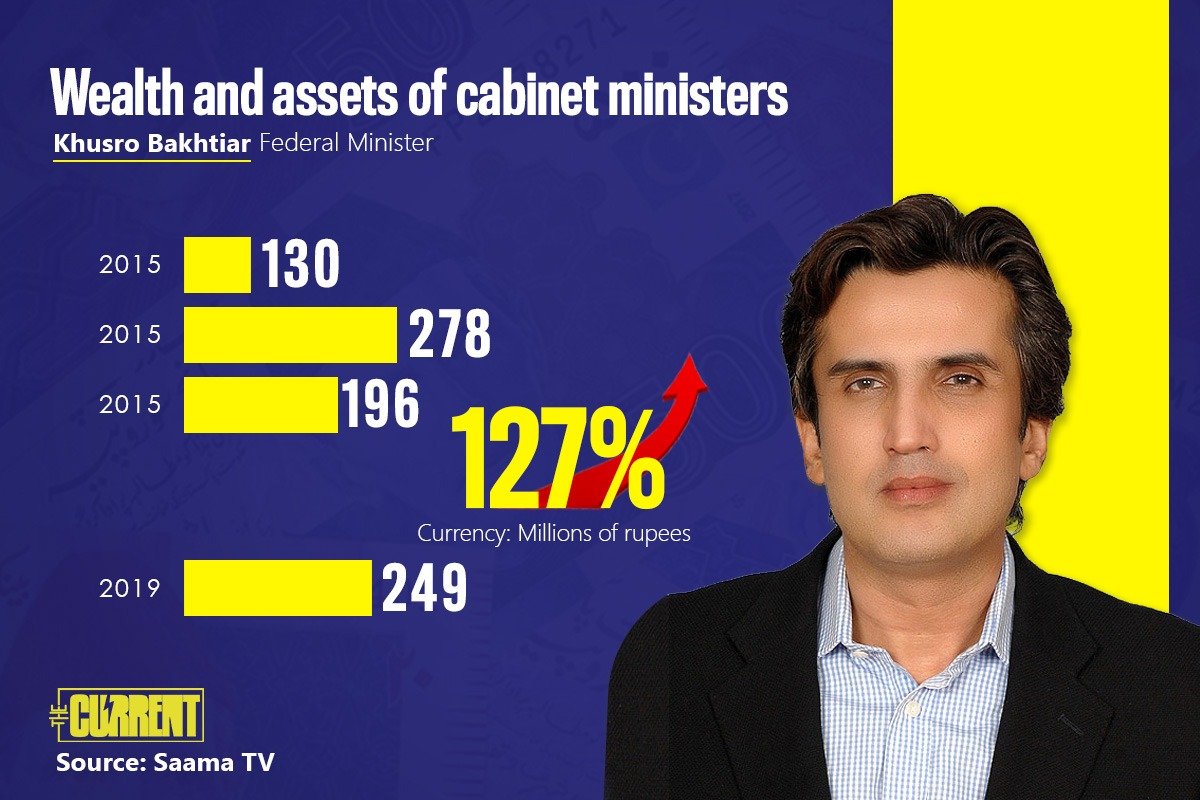
Khusro Bakhtiar, the former federal commerce minister, saw his fortune rise by 127.8% from Rs109.3 million in 2013 to Rs249 million in 2019. In 2014, he had assets of Rs130 million, which more than doubled to Rs278 million in 2015, shrank to just Rs196 million in 2016, and then surged again in the next three years.
“Increase in assets were mainly comprised of [various] sources during the year 2014 to 2019,” he told SAMAA TV, detailing that these sources included savings from agricultural income, proceeds from the sale of land worth Rs40 million, other sources which contributed Rs20 million.
Bakhtiar also claimed that he actually paid Rs27.5 million in agricultural taxes from 2017 to 2020, and that he owed Rs60 million in 2016.
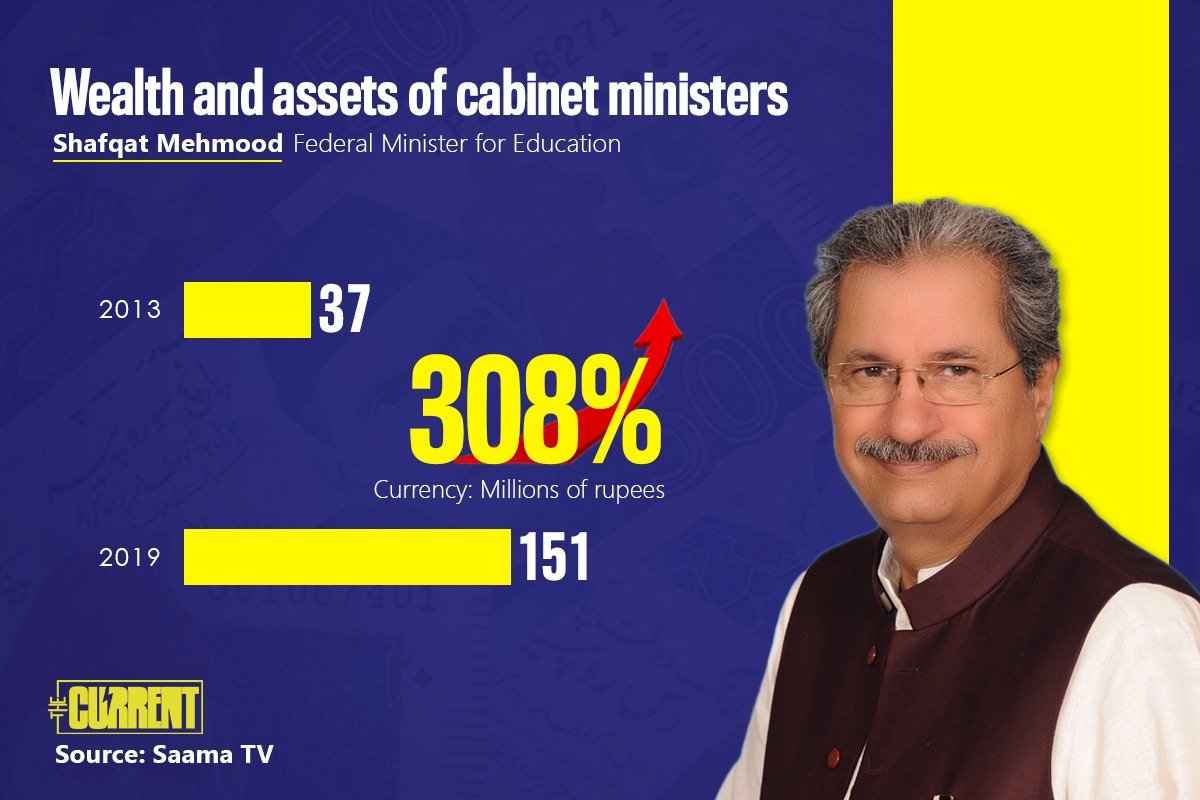
Former federal minister for education Shafqat Mahmood and his family had a 308 per cent growth in asset valuation between 2013 and 2019, making them one of the most successful federal ministers in terms of percentage increases. According to Mehmood’s filings, his and his family’s assets were valued at just Rs37 million in 2013, but had grown to Rs151 million by 2019.
“My assets have not changed since 2013 onwards,” Mehmood asserted, explaining “The change that you see is the cost re-evaluation from purchase price to market price”. The ex-minister further said that he has 360 kanals of hereditary land, a few more plots, and automobiles that he never assessed.
“There will, of course, be some variation regarding bank accounts. There will also be a slight difference in detail offered to FBR and ECP with regards to bank accounts,” he maintained. He went on to say that in his previous disclosure, he had combined the amounts in all of his bank accounts to present a single total.
“My wife is a distinct taxpayer because she works, but I have included her assets as well”, he explained.
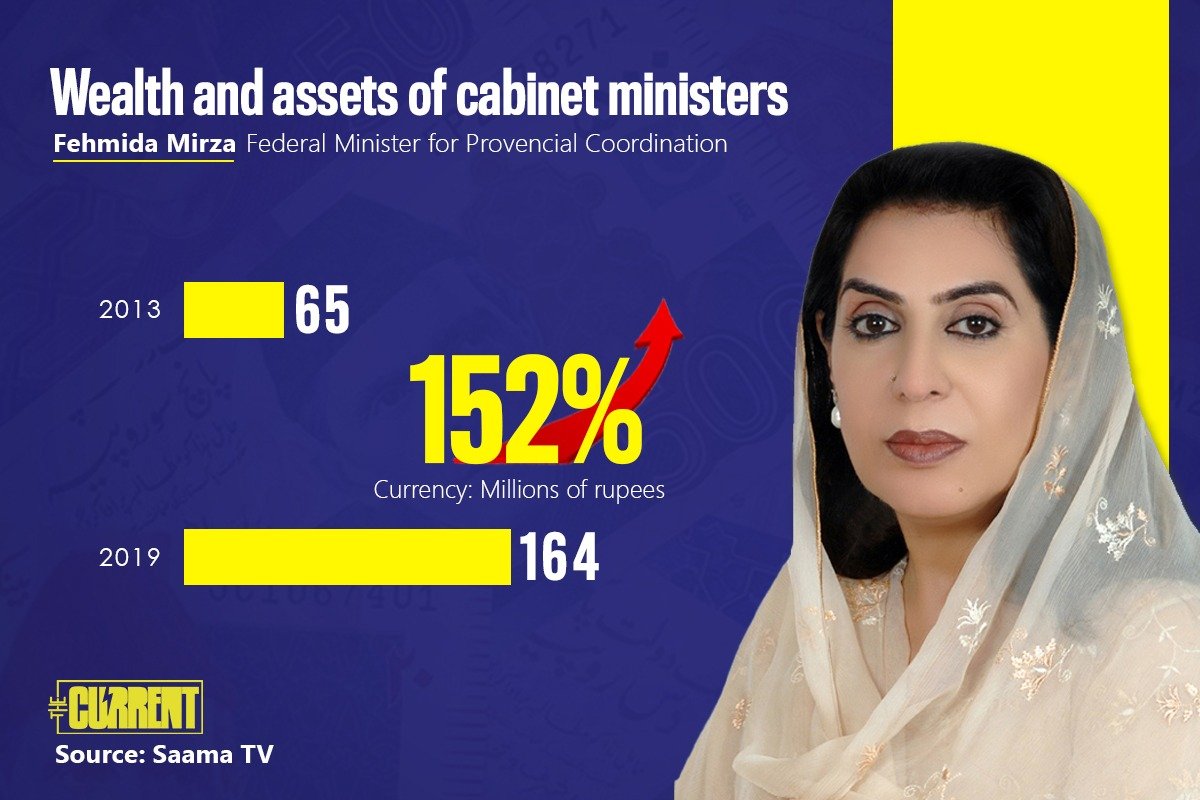
Fehmida Mirza, the former federal minister for interprovincial coordination, had a similar scenario, with her net worth rising from Rs65 million in 2013 to Rs164 million in 2019.
“I did not see any rise in my assets and wealth at all,” she told SAMAA TV. She did, although, reveal that she had sold some property in Pakistan in order to purchase a home in the United Kingdom.
“This new increase in my assets has already been declared with the FBR and the ECP,” she stated.
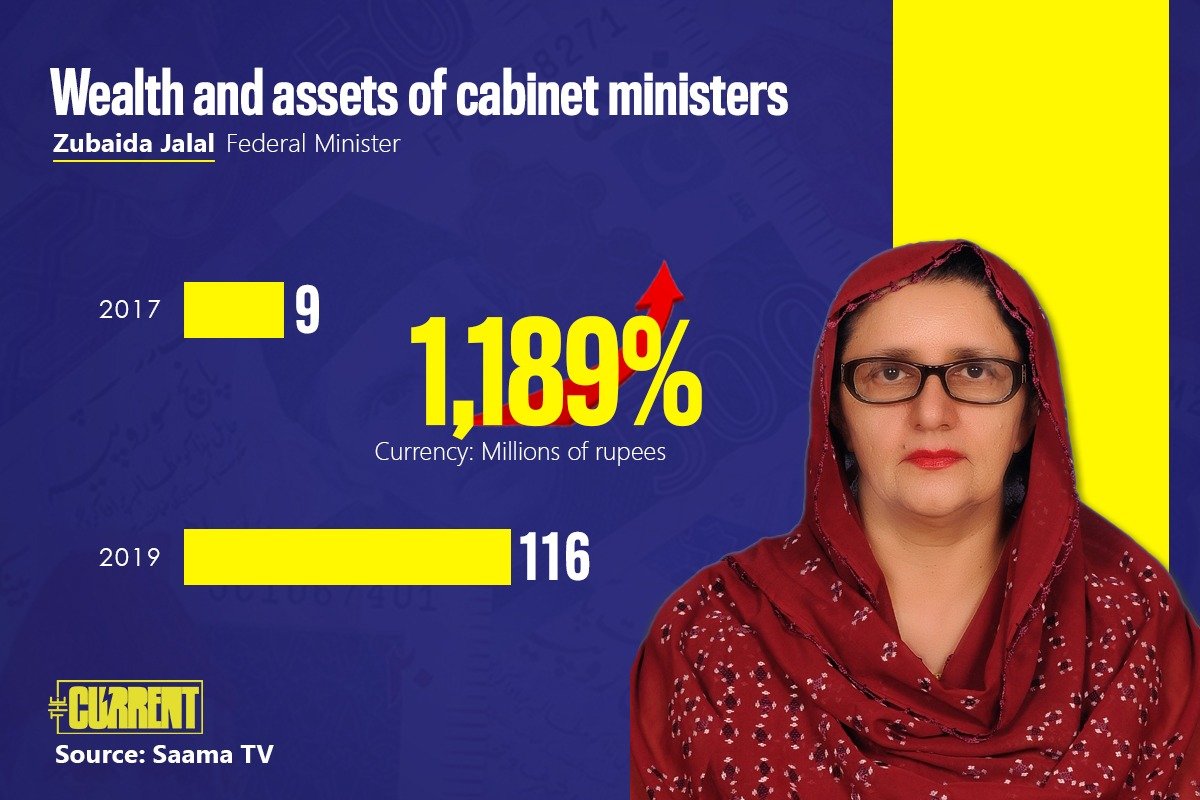
Contrary to the PTI’s cabinet’s millionaire members, one of the “weakest” members of the federal cabinet, former federal minister Zubaida Jalal and her husband, had a 1,189 per cent growth in their fortune in a short period of time. Their riches increased from Rs9 million to Rs116 million in 2019.
Jalal, on the other hand, described the quick spike in wealth as the outcome of changes in declaration requirements.
“There is no big difference in my assets’ declaration” she asserted while speaking to SAMAA TV. The value of immovable assets was not mentioned in data provided in past elections, she said, noting that the ECP declaration requirements changed over time.
“[We are] required to mention values of assets in the asset declaration for this time,” she stated. She explained that the variations in asset values were attributable to market forces working on enterprises.
“Ups and downs will keep happening [in mining operations and business],” she said, as she reminded that her husband owns the National Coal Mining Company since the 1960s.
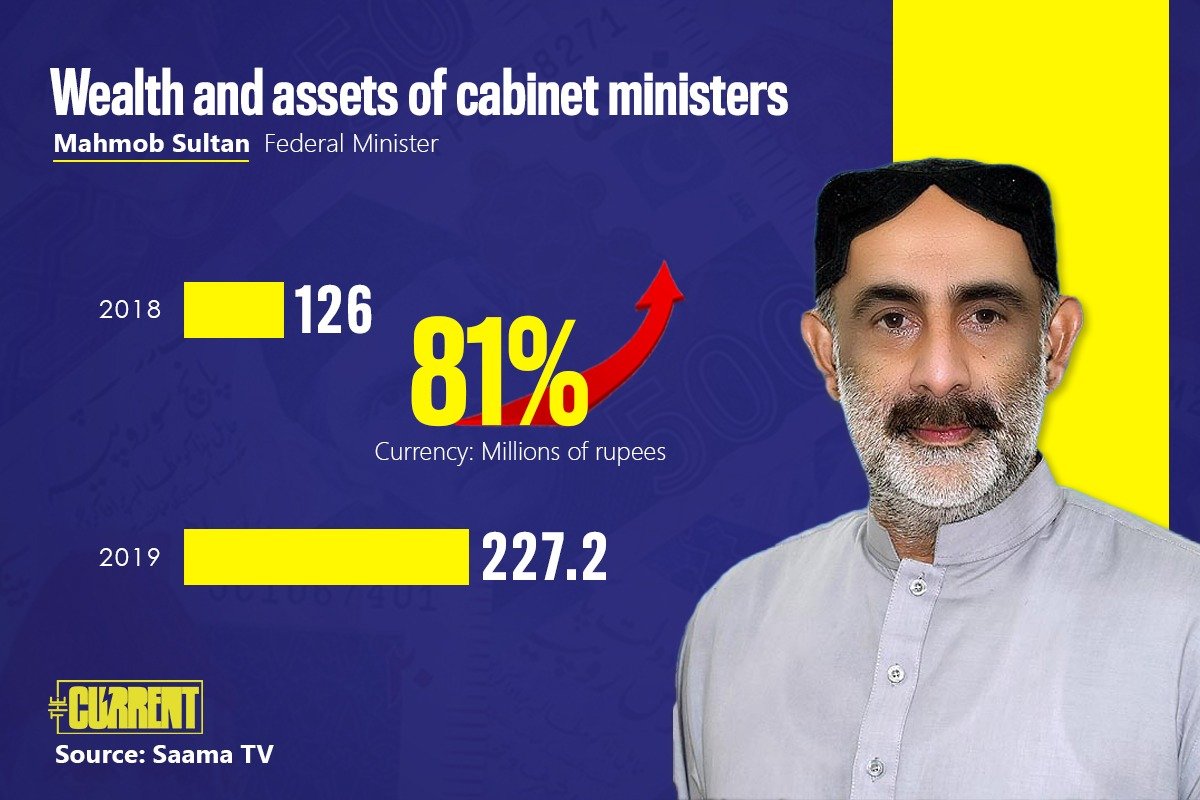
Former state minister Mahboob Sultan was one among the ministers who saw only double-digit asset growth. Only 81 per cent of his assets increased from Rs126 million in 2018 to Rs227.2 million in 2019. It’s worth noting, however, that his growth of nearly Rs100 million occurred while he was in the cabinet of ministers.
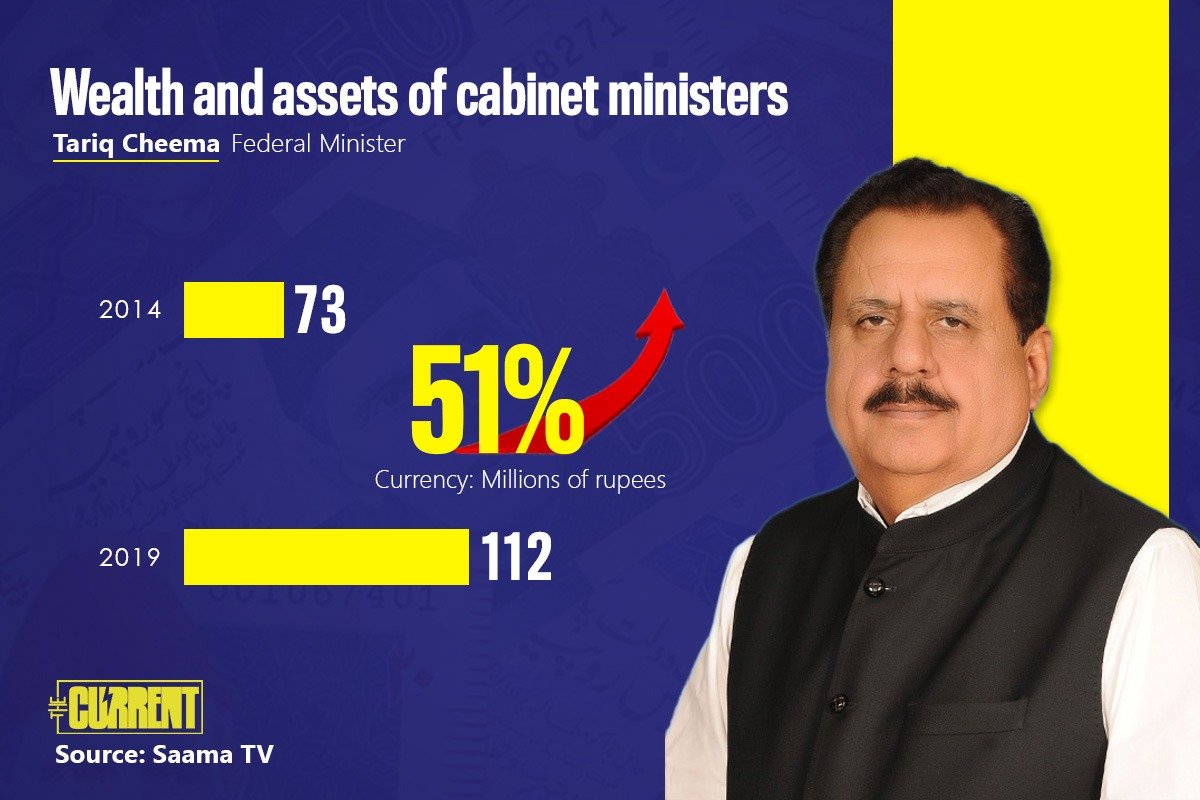
Tariq Cheema, the former federal minister for housing and infrastructure, showed the smallest growth in his wealth, going from Rs73 million in 2014 to Rs112 million in 2019. He did not, however, assess the value of his inherited assets and report them to the electoral or tax authorities.
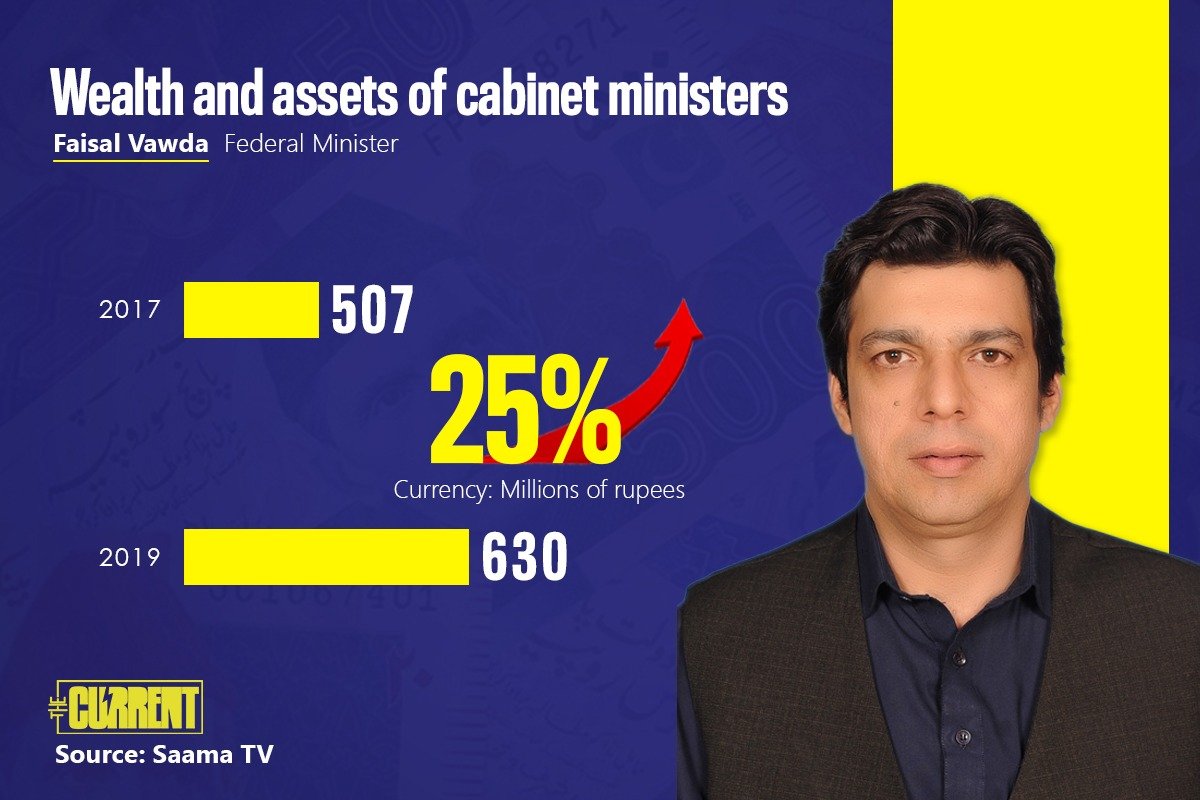
Former federal minister Faisal Vawda and his family witnessed their fortune increase by 25 per cent from Rs507 million in 2017 to Rs630 million in 2019. He was among the most controversial cabinet ministers who were eventually dismissed by the ECP.
Despite multiple requests from SAMAA TV, neither Sultan, Cheema, Vawda, nor an ECP official have commented on inquiries regarding their wealth.
Pakistan Tehreek-e-Insaf (PTI) leader Shahbaz Gill’s wife Izza Asad Rasool is reportedly found to be owing around Rs18.6 million to the Commission on Science and Technology for Sustainable Development in the South (COMSATS) University of Islamabad.
According to Geo News‘ reporter Azaz Syed, a show-cause notice has been sent to Rasool in this regard. The university has demanded the payment of official expenses worth $99,000 and Rs86,000, spent on account of Rasool’s tuition fees, her living allowance and airfare.
ایک نمبر کا جھوٹا۔۔
1- کامسیٹس یونیورسٹی کے مطابق شہباز گل کی بیوی اگست 2011 میں سرکاری خرچ پر ڈگری کرنے امریکہ گئی
2- ڈگری 2016 میں ختم ہونا تھی مگرشہباز گل کی بیوی 11 سال بعد بھی یونیورسٹی واپس نا آئی۔
According to the notice, Rasool went to the United States (US) in 2011 to pursue an MS leading to PhD studies in the field of Labour and Industrial Relations at the University of Illinois at Urbana-Champaign (UIUC). She was supposed to complete her studies by 2016 and come back to the country but she didn’t. She has been living there since she left for the US.
Moreover, the notice stated that Rasool could not complete her studies by the due date and she was also irregular in submitting her academic progress reports.
It is pertinent to mention that at the time when Rasool left for her studies, she was not married to Gill who is an employee of the same American university.
COMSATS has warned Rasool to respond to the notice within 15 days or they will initiate legal and administrative action against her.
As per the media outlet, GIll has allegedly been using his influence to threaten COMSATS’ administration in order to avoid action against his wife.
Responding to the news, Gill termed the news as false. He said that her wife’s PhD is still going on and she will be back as soon as her degree finishes.
“There is a campaign going on against me and this news is also a part of it. I know who is doing it”, he claimed.
آج جیو ٹی وی نے ایک اور جھوٹی خبر میری فیملی کے بارے دی۔
1- سٹودنٹ کو میرٹ بیس سکالرشپ ہماری حکومت سے پہلے ملا
2- ابھی بھی Phd کی تعلیم جاری ہے جو کہ یونیورسٹی سے کنفرم کی جا سکتی ہے۔ کامسیٹس کے پاس تمام انفارمیشن موجود ہے
3-اگلے سال PhD ختم ہوتے ہی پاکستان واپسی ہو جائے گی
Mr Shahbaz Gill , We would request you to respond officially upon below . It’s your responsibility as this amount is not your wife’s HALAL earning. Hope you understand that you and your so called leader was always quoting Rayasat Madina. Speak up now ….. https://t.co/rfLMNtjRio
— Ashfaq Ahmad Chaudhry (@AshfaqAhmadCha7) May 12, 2022
A key member of Pakistan Tehreek-e-Insaf (PTI) Jahangir Khan Tareen (JKT) Group, Awn Chaudhry has been appointed as an adviser on sports and tourism to Prime Minister (PM) Shehbaz Sharif.
President Arif Alvi approved the appointment of Chaudhry on the advice of PM Shehbaz.
It has been reported that the newly-elected Punjab Chief Minister (CM) Hamza Shehbaz has also decided to accommodate the JKT group in the provincial cabinet.
CM Hamza recently met with Jahangir Tareen, who is back in Lahore from London. Tareen congratulated Hamza Shahbaz on being elected as CM.
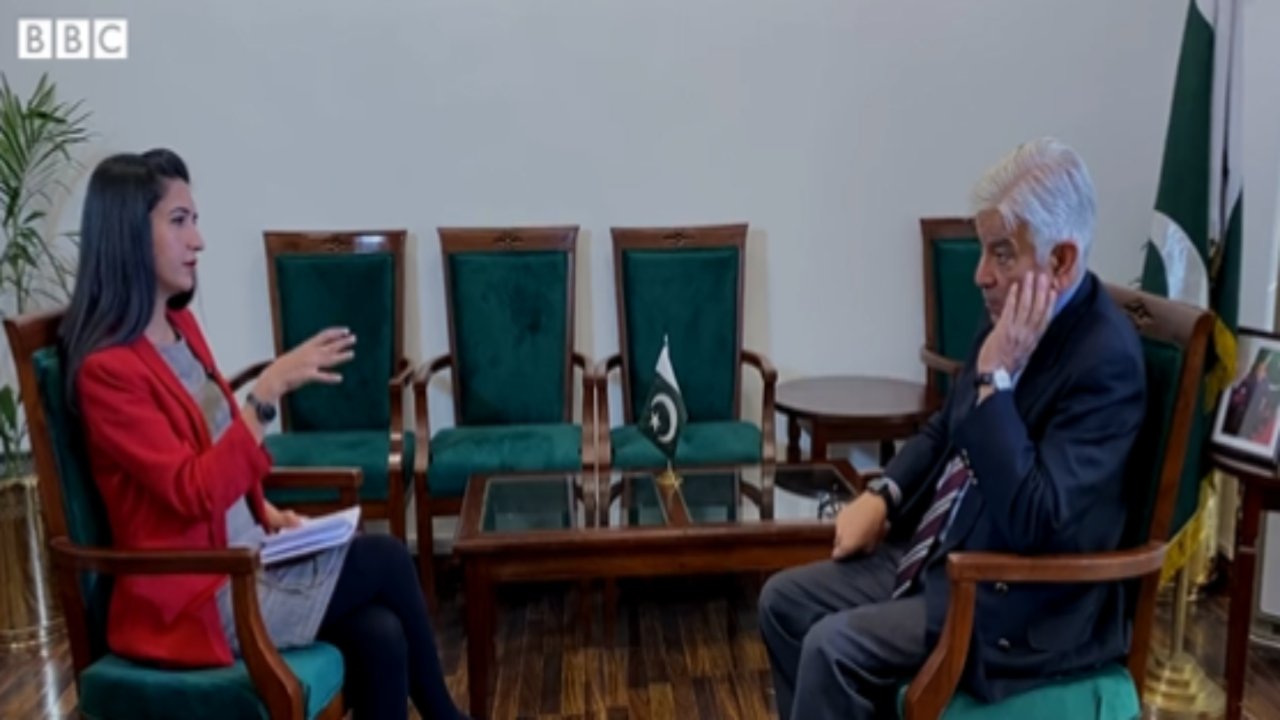
The newly-appointed Defence Minister Khawaja Asif, who is currently in London, hinted at early elections by saying, “It is possible that we [government] hold elections before the [new] Chief of Army Staff (COAS)’s appointment [which is in November]”
In an interview with BBC Urdu, the federal minister added, “It is also possible that the [current] caretaker government is gone by then and the new government is in power before November.”
About the extension of the current COAS General Qamar Javed Bajwa, Asif stated Bajwa had already clarified that he does not want his tenure to be extended. He said the government welcomed his announcement.
It is pertinent to mention that Bajwa’s three-year tenure will come to an end on November 29 this year. He was given an extension by the former government in 2019.
‘If Lt Gen Faiz Hameed’s name is on seniority list, can consider him for the post’: Khawaja Asif
Upon asking whether Pakistan Muslim League-Nawaz (PML-N) considers Lt Gen Faiz Hameed’s name for the post of COAS, Asif disclosed if his [Faiz] name is on the seniority list, it will definitely be considered.
“If the defence minister brings the names of five officers to the prime minister, and the army recommends Lt Gen Faiz Hameed’s name as well, then I don’t think the defence ministry or the Prime Minister (PM) have the space left to say anything”, he said while adding that “all names on the list will be considered.”
When asked about previous PML-N’s claims that Hameed, was behind former PM Nawaz Sharif’s ouster, Asif said it was unfortunate that the party’s politics were “dragged into this or red lines were mixed in our past experiences”.
The army should not become a topic of discussion in the public domain, he said, adding that “they say names should not be taken at the party level.”
Asif said he believed the process for appointing COAS should be “institutionalised” similar to the judiciary.
“This process should 100 per cent be based on merit. This is a big and very important issue”, he was quoted saying by BBC.
There are several reports that suggest that former PM Imran Khan wanted Lt Gen Faiz Hameed to take over the post of COAS.
‘Imran Khan wanted to bring an army chief of his choice’: Khawaja Asif
During the interview, the minister claimed that former PM Imran Khan wanted to bring an army chief of his choice from the list of names recommended to him by the army.
About Imran Khan’s anti-establishment statements, he termed them “shameful”, called Khan “paranoid” and said: “He wants to stay in power and for institutions to provide him with crutches.”
Moreover, Asif alleged that the establishment had brought Imran as an alternative to traditional politicians. “The establishment thought he [Imran Khan] is new to politics and will bring “freshness” to the politics of Pakistan,” he said.
‘Imran Khan didn’t interfere in army’s internal matter’: Fawad Chaudhry
While reacting to Asif’s recent interview, former Information Minister and PTI leader Fawad Chaudhry clarified that from day one former PM Imran Khan didn’t interfere in the army’s matters.
“We have also hoped that the sector [army] remains strong”, he said while adding that Khan and Bajwa always shared a respectful relationship and both of them agreed to each other’s suggestions.
About Khan’s preference for COAS, Chaudhry said, “If Asif thinks that way, it is his personal opinion.”
Moreover, the PTI leader hailed the revelations made by Asif. Chaudhry said that there are some people in PML-N who wants early elections and understand this government can’t continue like this.
Speaker National Assembly (NA) Raja Pervez Ashraf on Tuesday said that former Prime Minister Imran Khan is still a member of the National Assembly, adding that he is yet to resign, reports Geo News.
The speaker has sent letters to Pakistan Tehreek-e-Insaf (PTI) members in order to confirm their resignations.
It was further reported that PTI has decided not to appear before the Speaker National Assembly to confirm their resignations. It is also being reported that the PTI fears that more than two dozen members may refuse to confirm in front of the speaker.
Geo News further reports that if Khan is arrested, protests would be held across the country and important highways would be blocked.