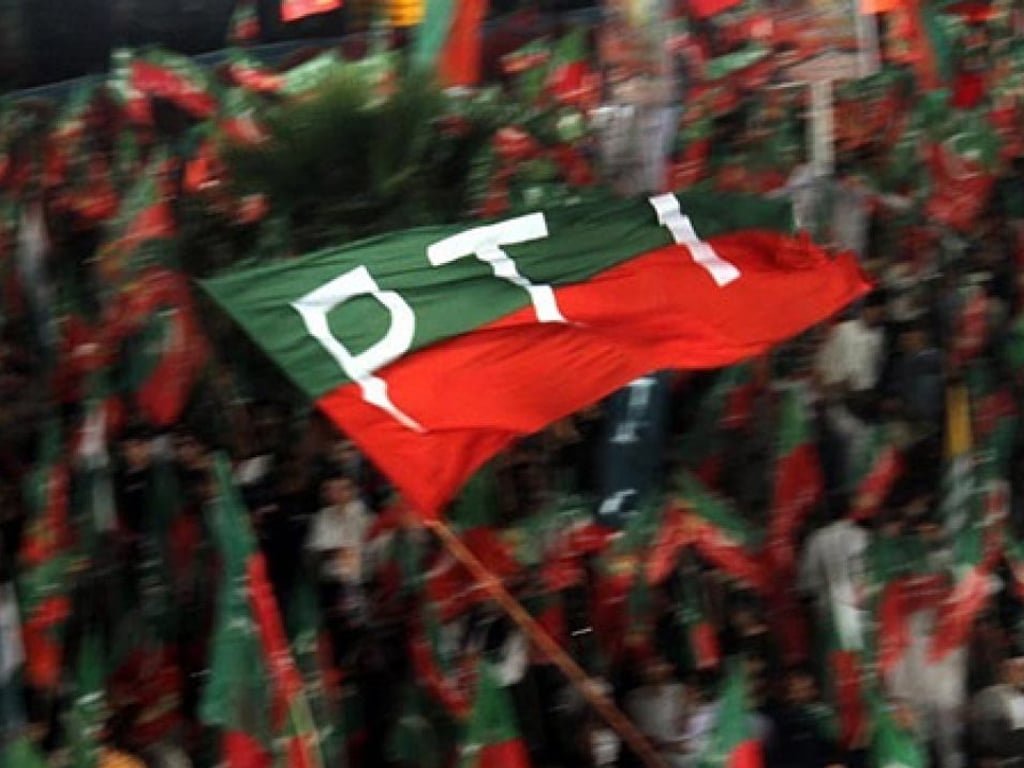
Tag: PTI

  • PTI reacts to report on false claims of ministers and govt officials

    PTI reacts to report on false claims of ministers and govt officials

    Journalist Benazir Shah’s exclusive report featured on Geo News highlighted the misleading claims of Pakistan Tehreek-e-Insaf’s (PTI) numerous ministers and government officials.

    Since the PTI came to power in 2018, its lawmakers and officials have made the most of ‘fake news’ and used it to discredit journalists, media organisations, and the party’s opponents.

    “The offending language is often used to distort the truth and to undermine journalism, which aims to keep the powerful in check. When in reality those handing out the label of ‘fake news’ have occasionally stumbled themselves, especially when communicating with the public. A large number of ministers and government officials from the ruling party have fallen for false and misleading claims. In some instances, clarifications are issued, but in others, no corrections have been made to date,” read the report.

    September 2021: Minister of State Ali Muhammad Khan claims that Quaid-e-Azam went to jail

    Claim: Minister of State, Ali Muhammad Khan while speaking on 92 News programme, ‘Hard Talk Pakistan with Moeed Pirzada’ said, “We made the country. In 1947, my grandfather, Muhammad Wakeel Khan, went jail with Quaid-e-Azam.”

    Truth: There is no claim to the fact that the founder of Pakistan was ever arrested.

    August 2021: The ministry of information released a report, which incorrectly flag pro-state tweets as ‘anti-state’

    Claim: A report was released by the Digital Media Wing (DMW) of the Ministry of Information and Broadcasting titled, ‘Anti-State Trends: Deep Analytics Report’. It was deeply misleading and based on assumptions instead of facts.

    “The purpose of this report was to ascertain factual data and to analyse social media trends that were anti-state, Data was collected after analysing Pakistan Twitter Panel from June 2019- August 2021. Those hashtags were marked for data collection where the content of tweets was planned and propagated through a network to spread anti-state trends,” General Manager of the Digital Media Wing (DMW), Imran Ghazali told The Current.

    Truth: The report seemed to declare all the users in the report as anti-state until one prominent journalist reached out to the government and they eventually added the disclaimer after the report was published.

    June 2020: Minister of State Zartaj Gul claimed that ‘Covid-19’ actually has 19-points, hence the name

    Claim: Minister of State for Climate Change, Zartaj Gul, while speaking on PTV said that Covid-19 actually has 19 points, which can be applied to any country to combat coronavirus.

    Truth: Covid-19 is actually a short form for Coronavirus disease.

    June 2020: Prime Minister Imran Khan misquotes Allama Iqbal 

    Claim: In a tweet, Prime Minister (PM) Imran Khan shared an image, which had poetry written on it along with Allama Iqbal’s picture, and wrote, “This poem by Iqbal reflects how I try to lead my life. I urge our youth to understand and absorb the poem of the great Iqbal and I guarantee them that it will release their great God-given potential that we all possess as His greatest creation Ashraf ul Mukhluqat.”

    Truth: PM Khan later tweeted, “I stand corrected – this is not Allama Iqbal’s poem but the message conveyed is what I have stood by and tried to follow.”

    May 2020: Minister Murad Saeed insists the governor of New York wants to follow Pakistan’s model of contact tracing

    Claim: Minister for Communication Murad Saeed, while addressing the National Assembly, said that the governor of New York wanted to follow Pakistan’s model of contact tracing after PM Khan gave the concept of smart lockdown.

    Truth: As per the report published on Geo, not a single briefing of the governor was found stating the claim made by the minister.

    September 2019: Minister of Human Rights Shireen Mazari shares incorrect video

    Claim: Minister of Human Rights Shireen Mazari shared an incorrect video on Twitter and wrote, “Indian occupation forces can’t even bare to see fruit trees live in IOJK – lest the Muslim Kashmiris eat the fruit. Such is the barbarism of the Rogue Modi Govt’s fascist hate-filled mindset. #Kashmir”

    Truth: The video shared was from Himachal Pradesh, 2018 when India, after a court order against illegal forest encroachment, ordered the trees to be chopped.

    May 2019: Minister Fawad Chaudhry claims that the Hubble telescope was sent into space by Suparco

    Claim: Fawad Chaudhry while speaking on Geo News programme, Naya Pakistan said that the Hubble telescope was sent into space by Suparco, the national space agency of Pakistan.

    Truth: Hubble was deployed by NASA.

    However, the ruling party reacted to the report.

  • Ushna, Zarnish and Amanat defend Abrar-ul-Haq for his remarks on young mothers

    Ushna, Zarnish and Amanat defend Abrar-ul-Haq for his remarks on young mothers

    Prominent celebrities have extended their support to Abrar-ul-Haq after Nadia Hussain bashed him for his recent statement on young mothers.

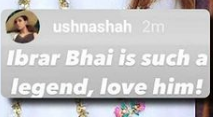
    Ushna Shah took to Instagram and said: “Abrar bhai is such a legend, love him!”

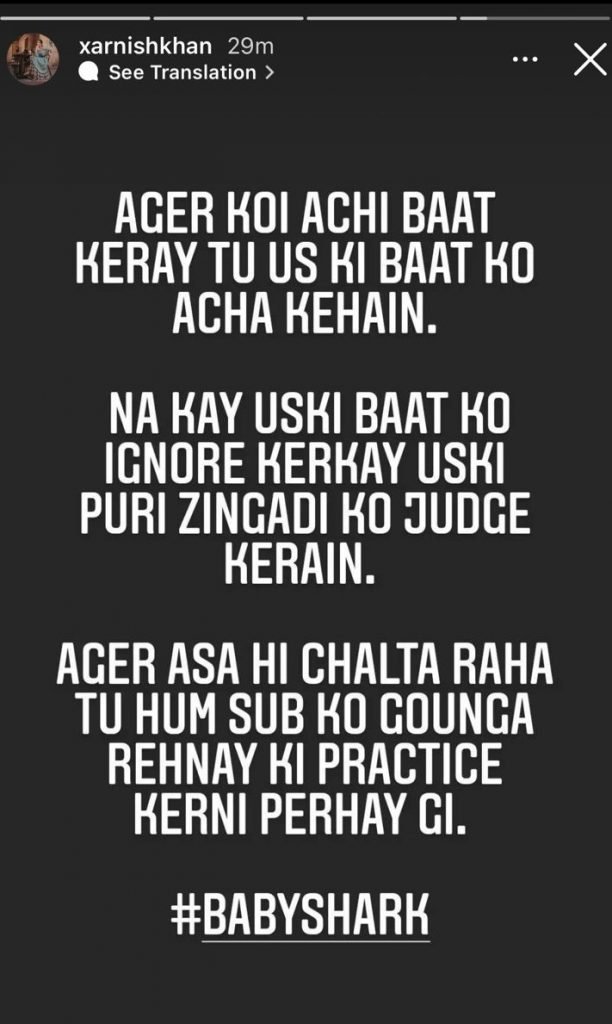
    While Zarnish said if someone says the right thing, it should be appreciated. She said that we should not judge someone’s personal life.

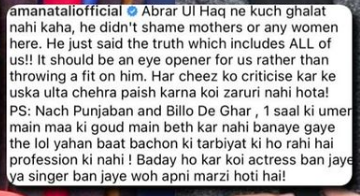
    The Tera Zikar singer, Amanat Ali also shared his opinion on the matter.

    Earlier this week, the singer-turned politician Abrar-ul-Haq criticised young mothers for giving gadgets to children and ignoring their nurturing while singing Baby Shark at a convention to mark Pakistan Tehreek-e-Insaf’s (PTI) three years performance.

    Model-turned actor Nadia Hussain called out the Nach Punjaban singer for his comments on modern day mothers.

  • Pakistan on UK Red List because of Nawaz Sharif, says PTI’s Ali Nawaz Awan

    Pakistan on UK Red List because of Nawaz Sharif, says PTI’s Ali Nawaz Awan

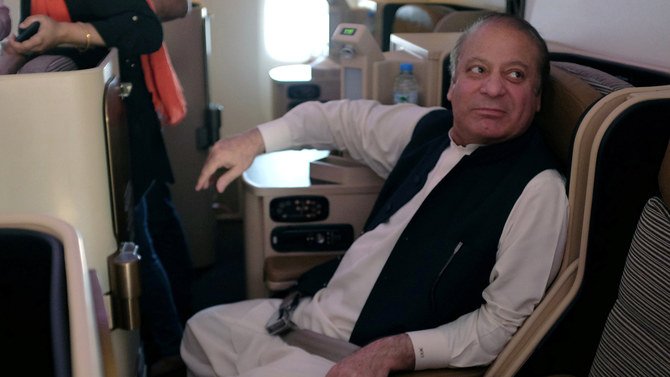
    Speaking to anchorperson Gharidah Farooqi on ‘G For Gharidah’, Prime Minister Imran Khan’s Special Assistant on Capital Development Authority (CDA), Ali Nawaz Awan, said: “Pakistan is on United Kingdom’s (UK) Red List because of Pakistan Muslim League-Nawaz’s (PML-N) leader Nawaz Sharif.”

    Awan said that despite providing all the data and information required by the UK, Pakistan suffered due to Nawaz.

    Awan said that the government was very hopeful that Pakistan would be taken to the amber list but then thrice elected former prime minister Nawaz Sharif attached his fake medical reports along with his extended stay application. Hence the UK decided that if a three-time prime minister can lie, they cannot trust Pakistan and have thus kept us on hold.

    Awan’s argument left the panel laughing. Anchorperson Gharida Farooqi asked Awan as to what connection did the former prime minister’s health have with Pakistan staying on the Red List.

    Awan stressed again that the UK is looking at the fake reports submitted by Nawaz Sharif.

  • PM Khan briefs nation on three years of Naya Pakistan

    PM Khan briefs nation on three years of Naya Pakistan

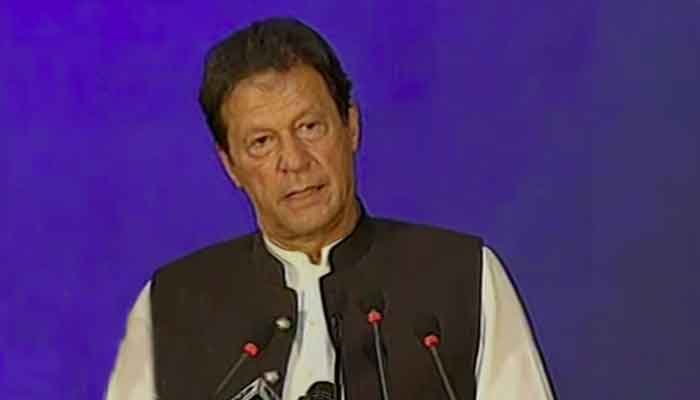
    Prime Minister Imran Khan on Thursday presented a charter of his party’s performance so far at the Jinnah Convention Centre in Islamabad.

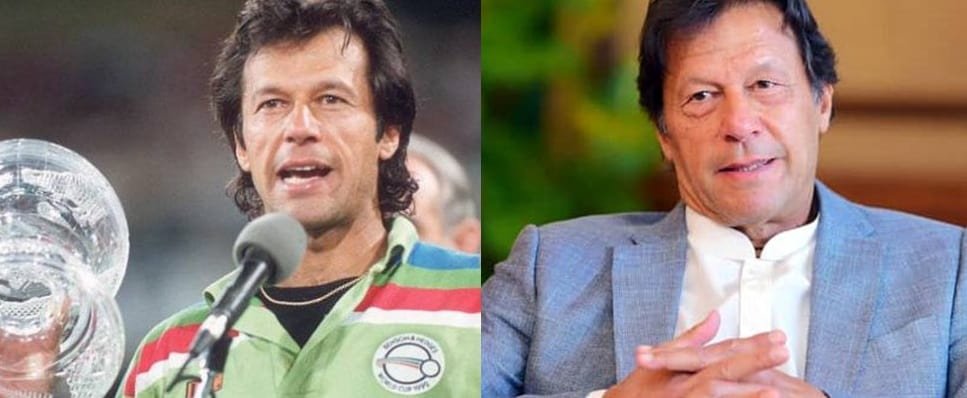
    Talking about his career as a cricketer, PM Khan explained how his life as a sportsman, “where there are standing ovations one moment and curses the next”, prepared him for a life of struggles.

    “Until you go through struggles, you cannot do anything big,” the prime minister said. “No leader became big with a shortcut. Quaid-e-Azam was a big leader. He struggled in his life and people will always remember him [for that].”

    Mentioning Pakistan’s clash with India in the aftermath of the Pulwama incident, PM Khan thanked the army for effortlessly protecting the people of Pakistan.

    “I appreciate our army and air force. As they (Indian fighter jets) came into our territory and launched an offensive, we realised the [power] of our army,” said the premier.

    The premier blamed a “mafia” for defaming state institutions. “I also criticised the army in the past,” he said. “Judiciary and army also make mistakes but it doesn’t mean we should [expect] them to topple the democratic government.”

    “We know the Indian lobby is trying hard to defame Pakistan Army. They are implying that the Taliban won because of Pakistan Army.”

    “The NCOC (National Command and Operation Center) team comprising Asad Umar and Dr Faisal [Sultan] took great decisions and we survived the worst of Covid.”

    “In our tenure, Punjab’s anti-corruption has recovered Rs450bn so far,” he claimed. “NAB (National Accountability Bureau), in its 18 years before we came to power, had recovered Rs290bn and in the last three years, they recovered Rs519bn. All hue and cry are because of this reason.”

    The premier reminded his audience of the efforts made to “empower women” in rural areas and stressed the need to educate women, adding that “this is what we are trying to do”.

    “We are also working on inheritance laws to ensure women get their due share in the property,” he added.

  • PTI presents three years’ performance charter

    PTI presents three years’ performance charter

    Pakistan Tehreek-e-Insaf (PTI) released the party’s performance since it came into power three years ago. The party under its manifesto of ‘Justice, humanity, and selflessness’ claims to have served the people of Pakistan.

    Diplomacy:

    From prioritising economic diplomacy to highlighting Kashmir’s cause on all international forums, Pakistan witnessed an increase in its global and regional relevance in the past three years.

    PTI in its past three years has been countering Islamophobia. The party has been a long-term facilitator of the peace process in Afghanistan.

    The party claims to be aggressively active in exposing the Hindutva Agenda.

    Ehsaas programme:

    The Ehsaas programme has emerged as the largest social protection programme in history by benefiting almost half of the country’s population. ‘Ehsaas Emergency Cash’ has been declared as the third largest social protection programme in the world.

    The World Bank has listed the Ehsaas Emergency Cash programme among the top four social protection interventions globally in terms of the number of people covered. The programme distributed cash among 15 million underprivileged families after they suffered financially due to Covid-19 related lockdowns.

    Education:

    As per PTI’s claims, the government has done revolutionary initiatives for the education sector.

    A uniform education system has been introduced in the country under the Prime Minister’s auspices. The Single National Curriculum (SNC) has been approved and made functional in the country for students from Grade 1 through 5. One system of Education for all, in terms of curriculum, medium of instruction, and a common platform of assessment so that all children have fair and equal opportunities when it comes to receiving a high-quality education.

    Climate Change:

    In the climate change battle, Pakistan has emerged as an inspiration to the world over the course of the last three years. Pakistan has devised peculiar strategies to deal with environmental challenges.

    Under the supervision of the Ministry of Climate Change, the PTI government has been devoted to protecting the environment. From working on ‘Pakistan Clean Air Program’ to ‘Sustainable Forest Management’, PTI praised itself for the work it has done in this department.

    Pakistan launched a number of initiatives including a landmark “10-Billion Tree Tsunami” project that earned global acclaim.

    Reformation:

    Completing its three years in power, PTI claims to have done tremendous work for the restoration of green belts of ICT, Anti-Encroachment Drive, enhanced capacity of Panah Gahs, online token tax payment, and claim that they are some of the major achievements of the Interior Ministry.

    Digital Pakistan:

    Taking credit for the digital transformation of state media project, initiated by the Ministry of Information & Broadcasting, in view of the vision of Prime Minister Imran Khan for a Digital Pakistan, PTI states to have done landmark work towards the digitalisation and modernisation of state media.

    Electoral reforms:

    Electoral reforms, electronic voting, and the voting process for overseas Pakistanis have been major projects spearheaded by PTI. The party has successfully launched electronic voting to aid the process of having smooth and transparent elections.

    To promote transparency and prevent fraud in the elections, the government has developed a model of the electronic voting machine and submitted it for testing.

    The government states that it has done historic work to address the problems of overseas Pakistanis.

    Covid-19:

    Shining through its three years, PTI’s Ministry of Science and Technology helped manufacturing of agricultural and police drones, locally manufactured ventilators, PPAs, sanitisers, diagnostic kits, and biomedical equipment for Covid-19 protection.

    National Command and Operation Centre (NCOC) led by Federal Planning Minister Asad Umar did a commendable job combating the deadly virus. Covid-19 exposed the terrible state of the health sector but NCOC managed to prop up systems on a war-footing to cope with the emergency.

  • Three-year report card: PTI’s quest to achieve Naya Pakistan

    Three-year report card: PTI’s quest to achieve Naya Pakistan

    As Pakistan Tehreek-e-Insaf (PTI) goes into its third year of being in power, it becomes imperative to review its scorecard and what they have accomplished so far.

    Prime Minister Imran Khan was voted into power based upon the idea of building a ‘Naya Pakistan’. The voters were inspired by a movement that calls for a more equitable approach to governance, particularly one built around the principles of Riyasat-e-Madina.

    Prior to being elected, PTI promised to carry out extensive reforms pertinent to the state’s welfare should they manage to establish a government.

    Governance:

    The PTI government struggled to define its vision and manifest it into an actionable policy based on clear ideas and directives. The party witnessed a continuous shuffle in its cabinet members and lawmakers, sometimes blaming these frequent reshuffles on lackluster performance and incompetence. Every reshuffle saw the party falling into instability which further weakened the overall party narrative of change and transparency.

    Despite having a majority, PTI failed to execute a much-needed face-lift at a provincial level. One of the ruling party’s promises before forming the government was to “spearhead the creation of a South Punjab province on administrative lines”, which is still a work in progress.

    “We want to make Karachi the urban jewel of Pakistan,” the PTI stated in its manifesto. But despite their promises, several projects have yet to be completed.

    PTI aimed to depoliticise the police by building upon Khyber Pakhtunkhwa’s successful police reform model, which was to be replicated nationally. In their own words, the PTI manifesto acknowledges that the police in Pakistan are ill-equipped, poorly trained, deeply politicised, and chronically corrupt. However, very little has been done to enforce the depoliticisation of law enforcement agencies in order to circumvent these deeply entrenched issues.

    Reforming the civil service through transparent and merit-based recruitment with regional representation was another one of the party’s ambitious objectives. Civil service reform also included performance-based promotions and compulsory training at all requisite levels, providing equal opportunities for career advancement. Work is still underway when it comes to reforming the civil service as well.

    Economy:

    Under PTI governance in its first year, the economic growth rate of the country was 5.5 percent, which proceeded to drop to 1.9 percent. During the party’s second year in power, the country witnessed negative growth due to Covid-19. Pakistan’s debt grew from Rs24 trillion to Rs38 trillion in three years.

    From a deficit of $8.56 billion in the calendar year 2019, the current account balance swung into a surplus of $245 million in 2020. But in the first three months of 2021 it swung back to a deficit of $274m, and then registered a further deficit of $188m in April and $632m in May.

    Health:

    A motion to change the name of Benazir Income Support Programme (BISP) faced resistance from the Opposition and was later abandoned. The party instead placed it under the umbrella of Ehsaas — the PTI’s flagship social safety programme.

    The World Bank has listed the Ehsaas Emergency Cash programme among the top four social protection interventions globally in terms of the number of people covered. The programme distributed cash among 15 million underprivileged families after they suffered financially due to Covid-19 related lockdowns.

    Prime Minister Imran Khan’s federal government expanded the Sehat Sahulat Programme on a nationwide scale.

    Over the past three years, the government has announced the extension of health care coverage to journalists, Islamabad police, the transgender community, overseas labourers, and people with disabilities.

    Covid-19:

    National Command and Operation Centre (NCOC) led by Federal Planning Minister Asad Umar did a commendable job combating the deadly virus. COVID-19 exposed the terrible state of the health sector but NCOC managed to prop up systems on a war-footing to cope with the emergency.

    Education:

    Prime Minister Imran Khan said that his focus will be centered on improving public sector education, including madrassas. He also discussed providing young persons with loans to cultivate and promote entrepreneurship.

    A uniform education system will be introduced in the country next year under the Prime Minister’s auspices. The Single National Curriculum (SNC) has been approved and made functional in the country for students from Grade 1 through 5. One system of Education for all, in terms of curriculum, medium of instruction, and a common platform of assessment so that all children have fair and equal opportunities when it comes to receiving a high-quality education.

    In May 2019, the Ministry for Federal Education started the registration process for madrassas in the country. In October of the same year, the Directorate General of Religious Education (DGRE) was set up.

    The party had promised to provide stipends for female secondary school students and to prioritize the upgrade and establishment of schools for girls.

    The Kamyab Jawan Programme (KJP) was launched in October 2019. It is a small-and-medium-enterprise lending scheme, aimed at stimulating job creation and economic empowerment for young persons.

    Furthermore, the Hunarmand Jawan programme is another PTI initiative that aims to promote economic emancipation amongst young people through high-quality training.

    Accountability:

    Prime Minister Imran Khan has been categorically saying that his government would not interfere with the process of accountability and that “every corrupt individual” would have to face justice irrespective of their status or party.

    The National Accountability Bureau (NAB) has seemingly been the most active throughout PTI’s tenure. The anti-graft body had recovered 484 billion PKR over a span of two years from 2018 to 2020. On the contrary, previous governments had managed to recover a mere 290 billion PKR from 1999 to 2017.

    However, the Supreme Court has criticised NAB for “selectively applying its law on individuals” and said that there is a widespread perception of the NAB laws “being employed as a tool for oppression and victimisation of political opponents by those in power”.

    Freedom of speech:

    The PTI government has been determined to control the media through new laws, which will eventually span electronic, print, and digital media platforms.

    Pakistan has recently been criticized both internally and externally for the issues surrounding freedom of speech within its borders.

    Pakistan ranks at 142 on the Reporters Without Borders (RSF) Press Freedom Index. According to the Pakistan Press Freedom Foundation’s report, Pakistan has witnessed the murders of 72 journalists since 2002. Most of these cases remain unsolved.

    Pakistan Media Development Authority (PMDA) has been described in the Ordinance as “an independent, efficient, effective and transparent authority, which will regulate all forms of media, including digital media”.

    Under the Ordinance, print and digital media organisations will also need a license to operate in the country.

    Media bodies and organisations have vehemently opposed the PMDA and criticised it.

    Electoral Reforms:

    PTI has worked towards electoral reforms with great vigor, stating that electronic voting is the only way to ensure transparency and prevent rigging.

    Electoral reforms, electronic voting, and the voting process for overseas Pakistanis have been major projects spearheaded by PTI. The party has successfully launched electronic voting to aid the process of having smooth and transparent elections.

    On June 10th, the National Assembly passed the Elections (Second Amendment) Bill which pertains to fair, free, and transparent elections through a more contemporary approach to technology.

    PTI sees overseas Pakistanis as an asset to the country and has worked to involve them in the election process.

  • Digital Media Wing Report: misleading and not at all ‘Deep Analytics’

    Digital Media Wing Report: misleading and not at all ‘Deep Analytics’

    A report released by the Digital Media Wing (DMW) of the Ministry of Information and Broadcasting titled, ‘Anti-State Trends: Deep Analytics Report’ is deeply misleading and based on assumptions instead of facts, The Current has discovered after analysing the report.

    Glaring errors and almost comical additions, the report makes a correlation between analysing hashtags on Twitter to determine if someone is anti-state and is responsible for starting trends against Pakistan.

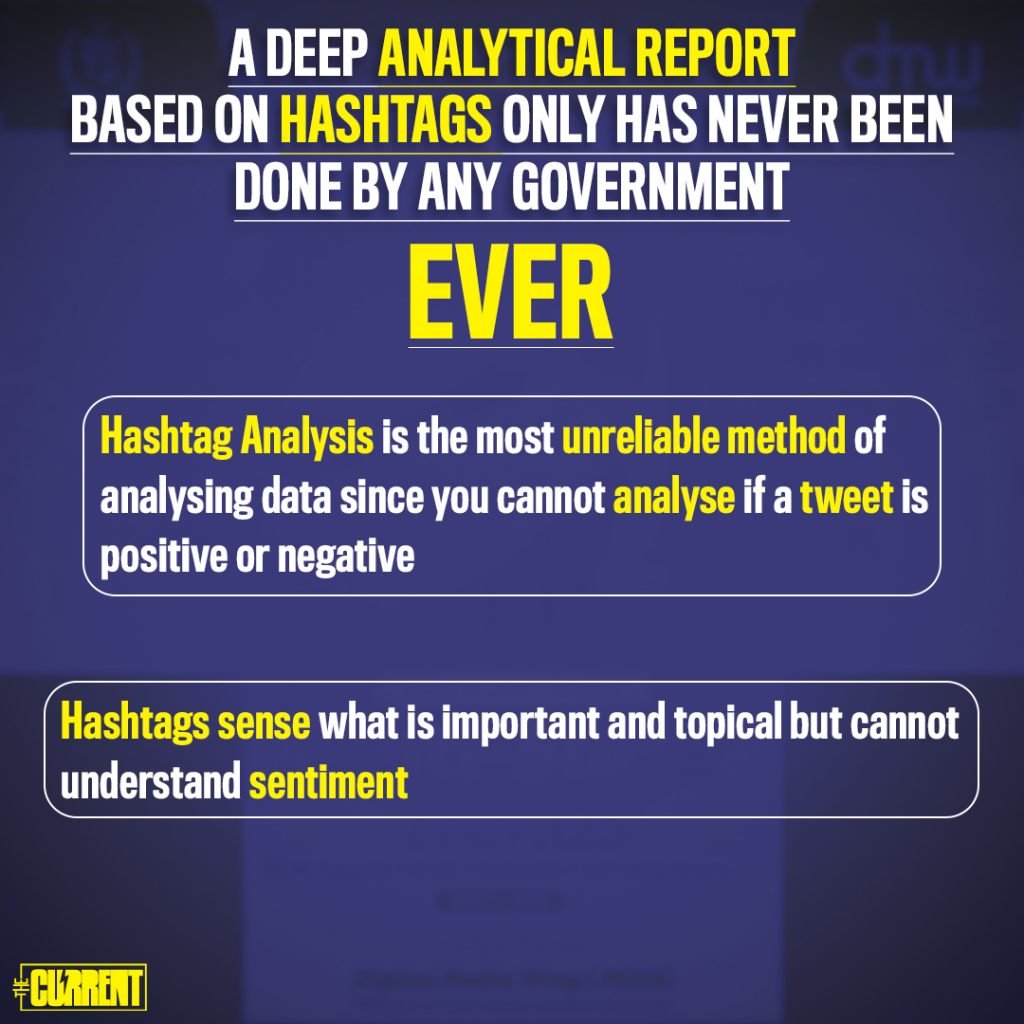
    Before analysing the report, The Current researched and spoke with analysts who are well-versed with digital analysis. There is no record of any report on hashtag analysis to determine trends at a government level in any country at any time. Pakistan is the only country that has created a report based on hashtag analysis. Worldwide, hashtag analysis is considered to be deeply unreliable since it cannot understand what is written in the tweet – it is just able to see what is being discussed.

    WHAT IS THE REPORT?

    The report is a compilation of hashtags that created trends that the government deems anti-state. The report shows information collected about hashtag trends and then lists pages of screenshots that show different Twitter handles sharing tweets that have the ‘anti-state’ hashtag. They do not differentiate between users and also label ‘influencers’ – people with a following who have tweeted or retweeted/replied to the hashtag.

    In effect, the report seems to declare all the users in the report as anti-state, until one prominent journalist got them to add a disclaimer last night.

    HOW WAS THE INFORMATION COLLECTED?

    Since the whole report is based on hashtag analysis, it will be considered to be unreliable data collection and cannot be considering as a legitimate report in any institution.

    When The Current reached out to General Manager of the Digital Media Wing (DMW), Imran Ghazali, he responded to the question of faulty analysis of hashtags by saying, “The purpose of this report was to ascertain factual data and to analyze social media trends that were anti-state, Data was collected after analysing Pakistan Twitter Panel from June 2019- August 2021. Those hashtags were marked for data collection where the content of tweets were planned and propagated through a network to spread anti-state trends.”

    According to a source in the government, the information used is public. “Publicly released data is accurate. It’s no rocket science, anybody with a credit card can get this data. Hence made public.”

    From The Current’s analysis, the data was collected by using a web application called, ‘Tweeps Map’, which is open to the public.

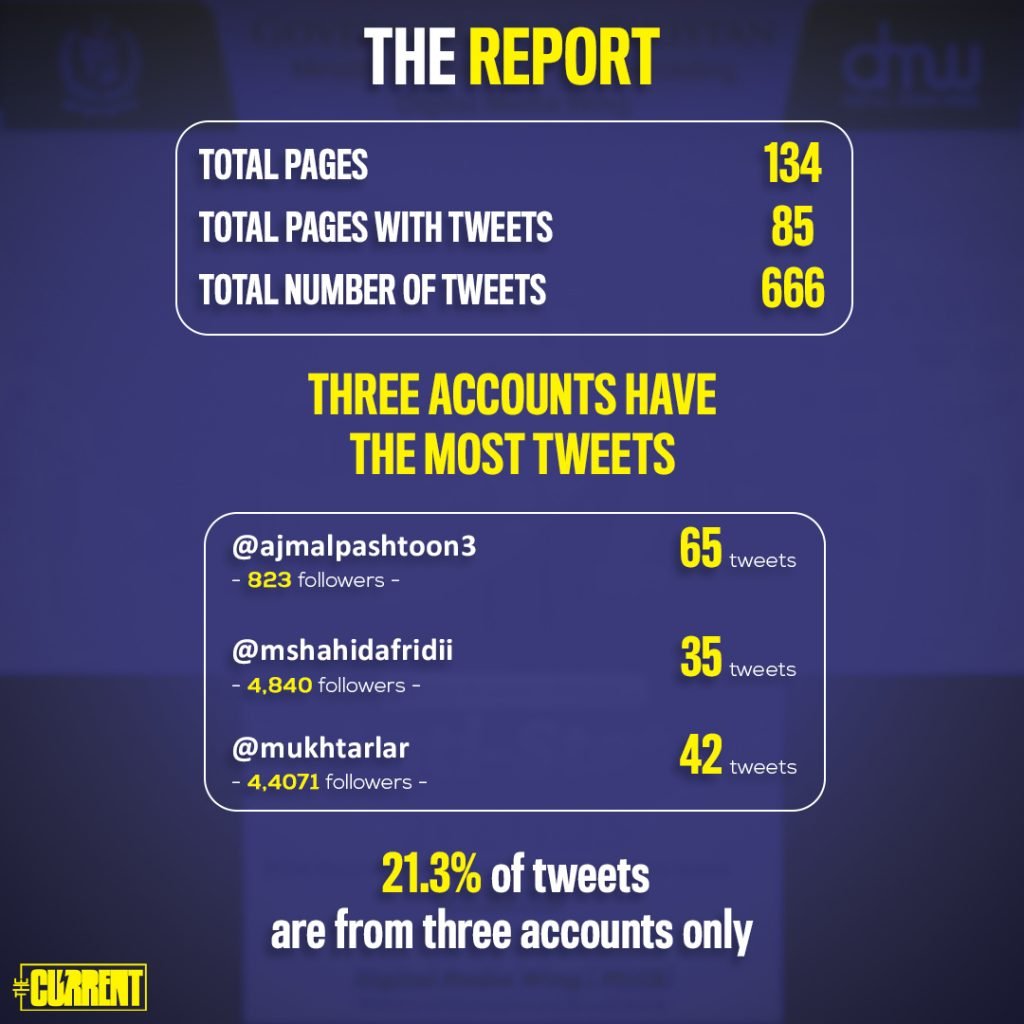
    From our findings, the 134-page report has 85 pages that have screenshots of tweets, which means that 63.4 per cent of the report is based on screenshots of people who are using a certain hashtag that the government has identified as being anti-state. The number of tweets that are in these 85 pages amount to 666 tweets out of which 142 tweets are from three accounts, which means that 21.3 per cent of the tweets used in this study came from three people.

    After further analysis of the three accounts, The Current discovered that all three accounts had a combined following of less than 11,000.

    TheCurrent Analysis on report of  Anti State Tweets as per the Digital Media Wing of the Ministry of Information

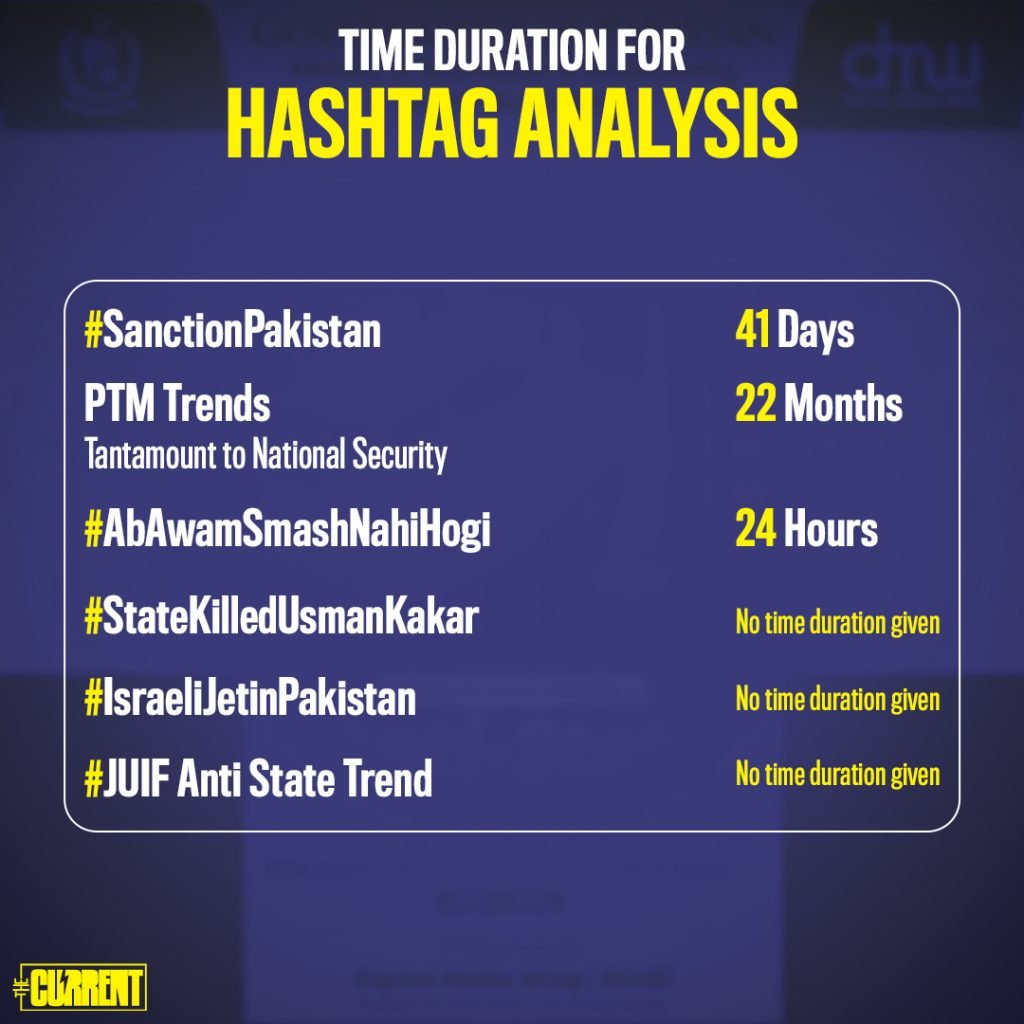
    We discovered that the hashtag #SanctionPakistan was ‘analysed’ for 41 days, Pakhtun Tahafuz Movement (PTM) hashtags were clubbed together as “PTM Trends Tantamount to National Security” (the report doesn’t list which hashtags were used within this topic) and were ‘analysed’ for 22 months, #AbAwamSmashNahiHogi was ‘analysed’ for one day, and #StateKilledUsmanKakar, #IsraeliJetinPakistan, ‘JUIF Anti State Trend’, was ‘analysed’ but no time duration is given.

    TheCurrent Analysis on report of  Anti State Tweets as per the Digital Media Wing of the Ministry of Information

    WHY AND WHEN WAS THE ‘DISCLAIMER’ ADDED?

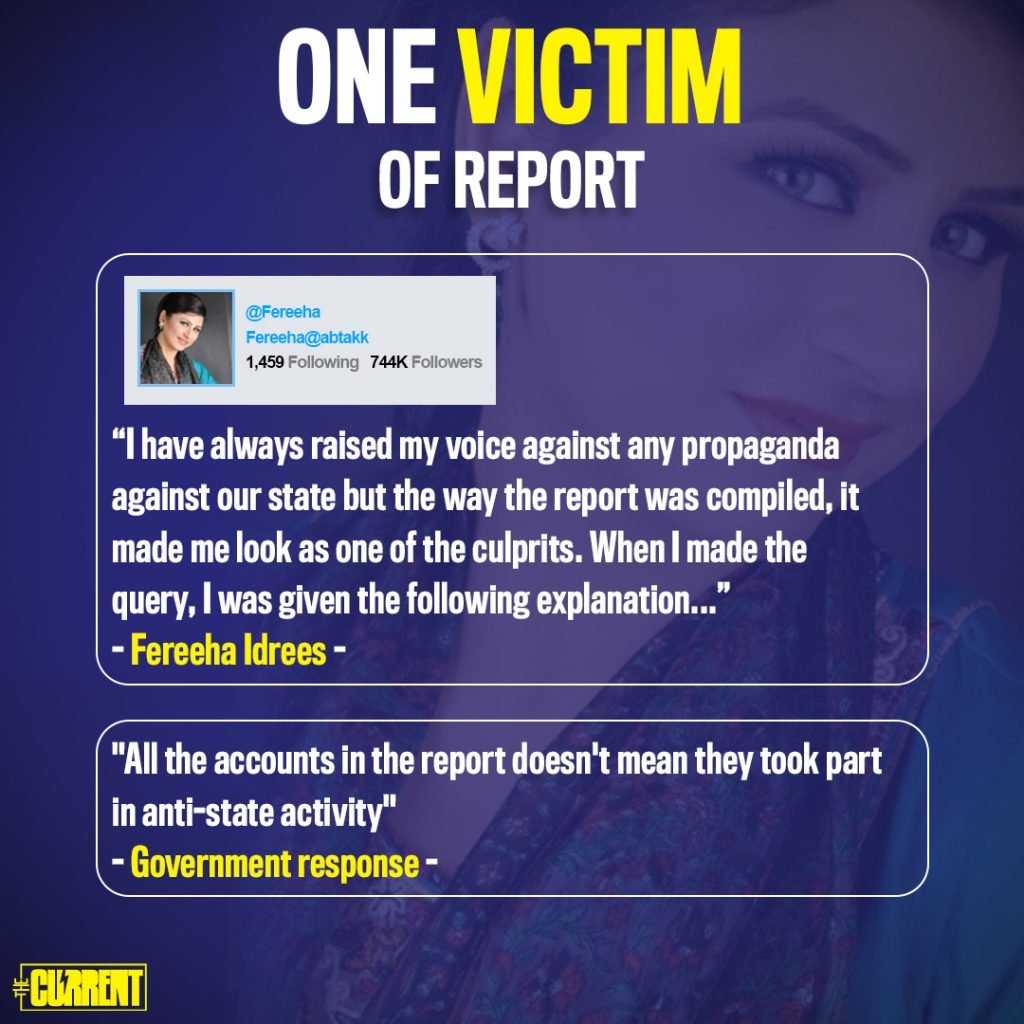
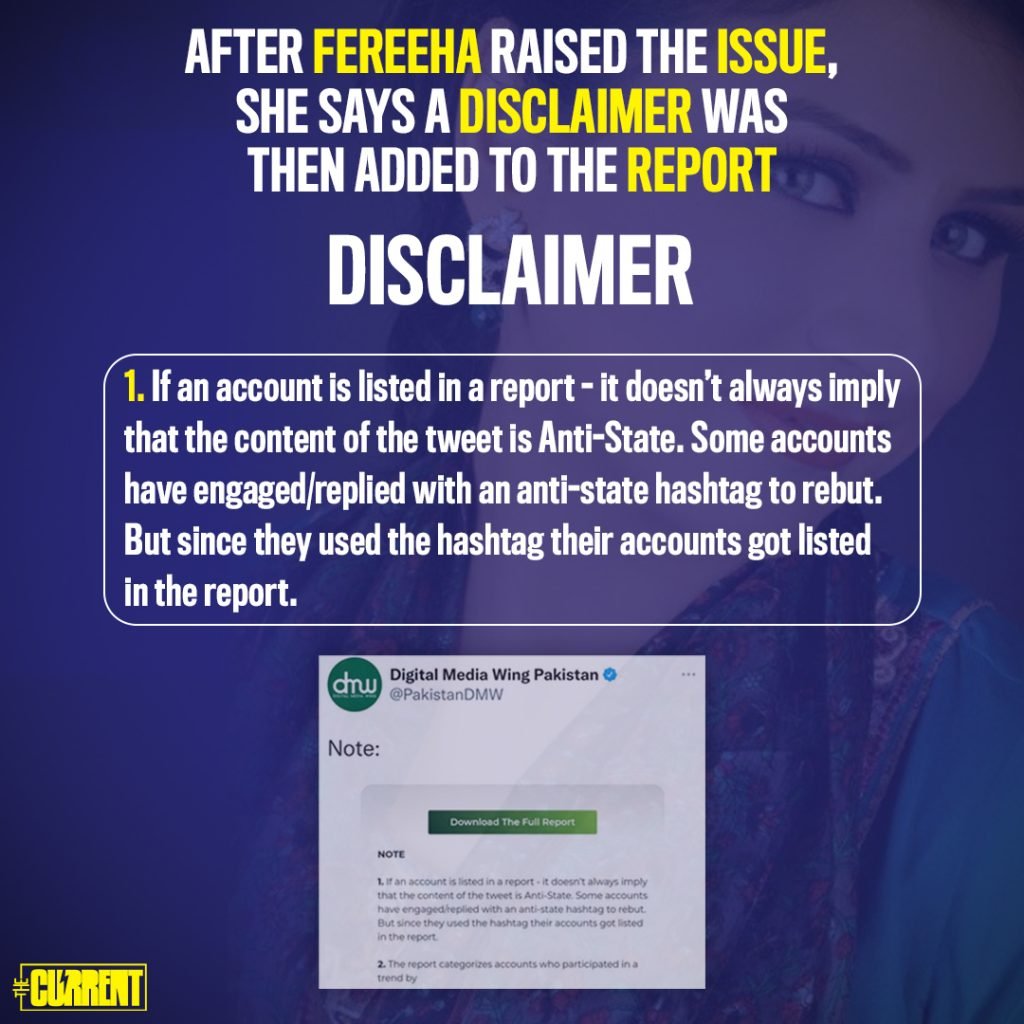
    The report was released Wednesday evening around 5:30PM and a few hours later a disclaimer was added to the report. According to journalist Fereeha Idrees, the disclaimer was added after she raised the issue with the DMW for being highlighted in the report as a ‘replies with the most followers’ account.

    “I have always raised my voice against any propaganda against our state but the way the report was compiled, it made me look as one of the culprits and suddenly social media was rife with messages calling me anti-state,” Fereeha told The Current, “When I made the query, I was given the following explanation.”

    TheCurrent Analysis on report of  Anti State Tweets as per the Digital Media Wing of the Ministry of Information

    The explanation given to Fereeha by the DMW stated, “All the accounts in the report doesn’t mean they took part in the anti-state activity…It shows the whole journey of the trends/hashtags, so in this case Fareeha Idrees replied/rebutted on the Israeli related trend and that’s why it mentions ‘Replies with most mentions’ in the report.”

    After the DMW response, Fereeha demanded that they add a disclaimer to the report. A disclaimer was added which stated, “If an account is listed in a report – it doesn’t always imply that the content of the tweet is Anti-State. Some accounts have engaged/replied with an anti-state hashtag to rebut. But since they used the hashtag their accounts got listed in the report.”

    Digital Media Wing of the Ministry of Information - Anti State Tweets

    Imran Ghazali admitted to adding the disclaimer after Fereeha raised an objection about the fairness of the report.

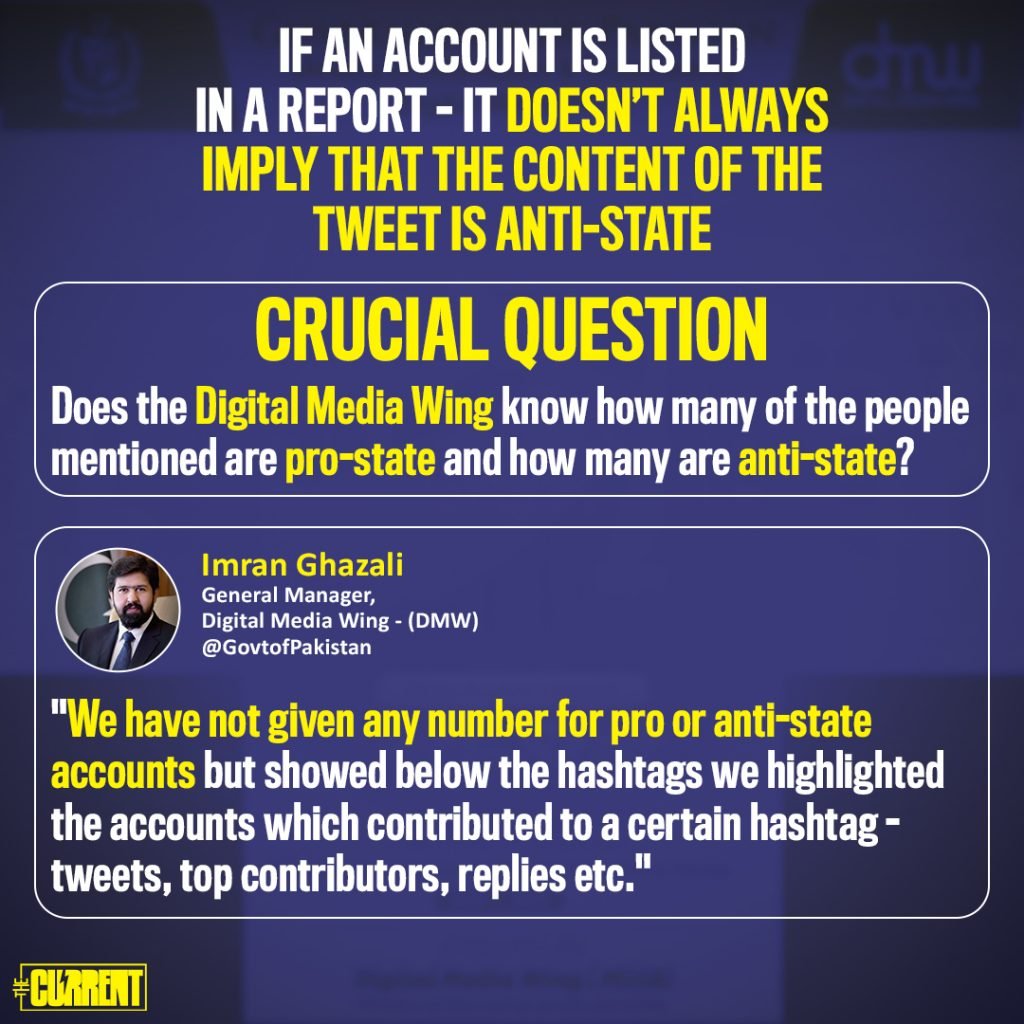
    The Current asked Ghazali about how they have divided the report to show which people mentioned were anti-state and which ones were considered pro-state. Ghazali refused to directly answer the question and stated, “We have not given any number for pro-state or anti-state accounts but showed below the hashtags we highlighted the accounts which contributed to a certain hashtag – tweets, top contributors, replies etc.”

    When we pressed him to answer the question about how the people selected were separated into anti-state and pro-state, he said, “If an account is listed in a report – it doesn’t always imply that the content of the tweet is Anti-State. Some accounts have engaged/replied with an anti-state hashtag to rebut. But since they used the hashtag their accounts got listed in the report.”

    The implication of his answers show that the report does not – and cannot- differentiate people’s points of view on a tweet, which means that someone who has posted a ‘pro-state’ tweet condemning the hashtag will also be added into the list of someone who is considered anti-state.

    WAS THE GOVERNMENT ALLOWED TO USE THE APP ‘TWEEPSMAP’?

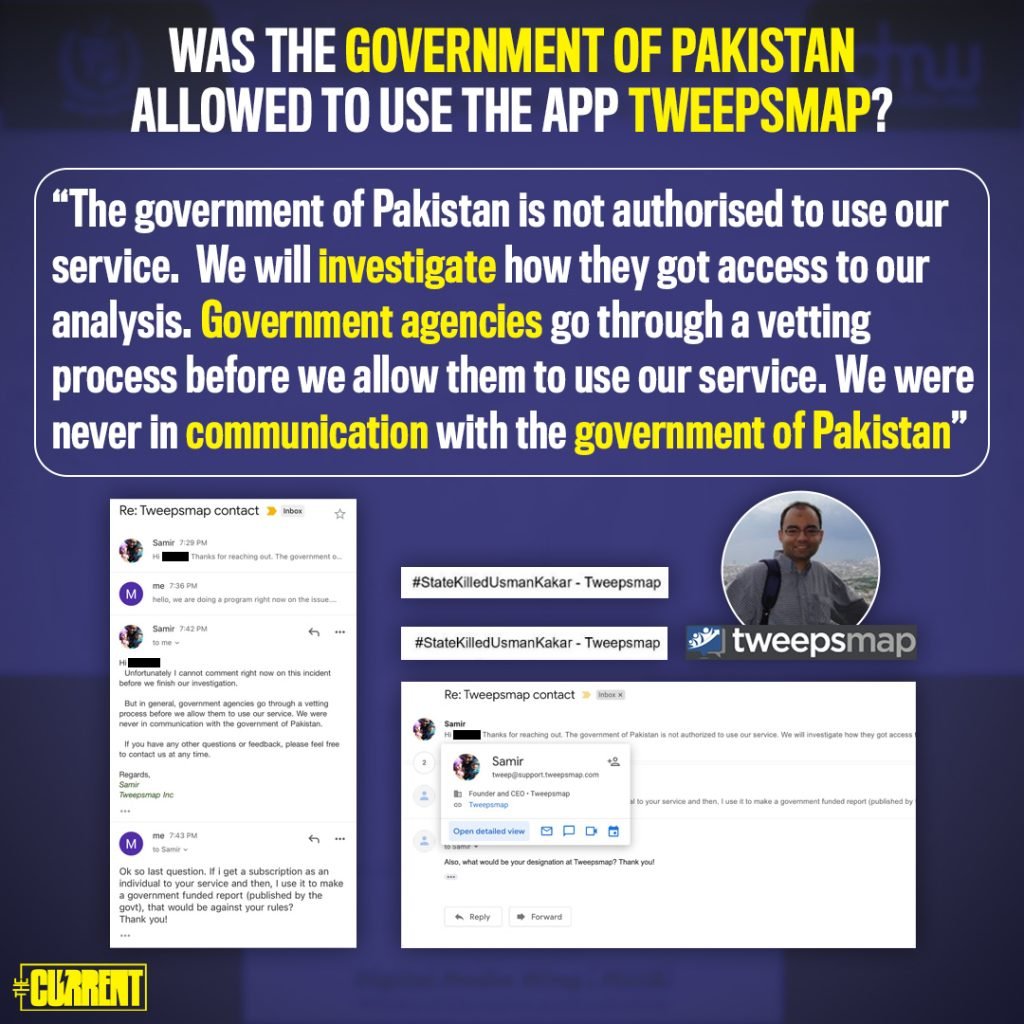
    The Current reached out to TweepsMap, which was the primary analysis app used by the government for this report. The maps and information all have the Tweepsmap link on the maps and all charts in the report. We asked the CEO of TweepsMap Samir Al-Battran if they considered the analysis of the report to be authentic since it used their app service. Samir told us, “The government of Pakistan is not authorised to use our service.  ​We will investigate how they got access to our analysis and get back to you on this.”

    Digital Media Wing of the Ministry of Information - Anti State Tweets

    We asked him for further details, asking if an individual used their service for analysis for a government funded report, would that be against their rules, to which Samir replied and said, “…Government agencies go through a vetting process before we allow them to use our service. ​We were never in communication with the government of Pakistan…Yes, [using the app without informing us what it is for] would be a misrepresentation and is definitely against our rules.”

    The Current asked Ghazali if they used the application and if they had authorisation to which he said, “We used different tools/APIs including our internal tools to analyse data”. We asked him since TweepsMap is the only one that is being listed in the report, if they had gotten a subscription for the government of Pakistan to which we got no response.

    WHAT ELSE IS IN THE REPORT?

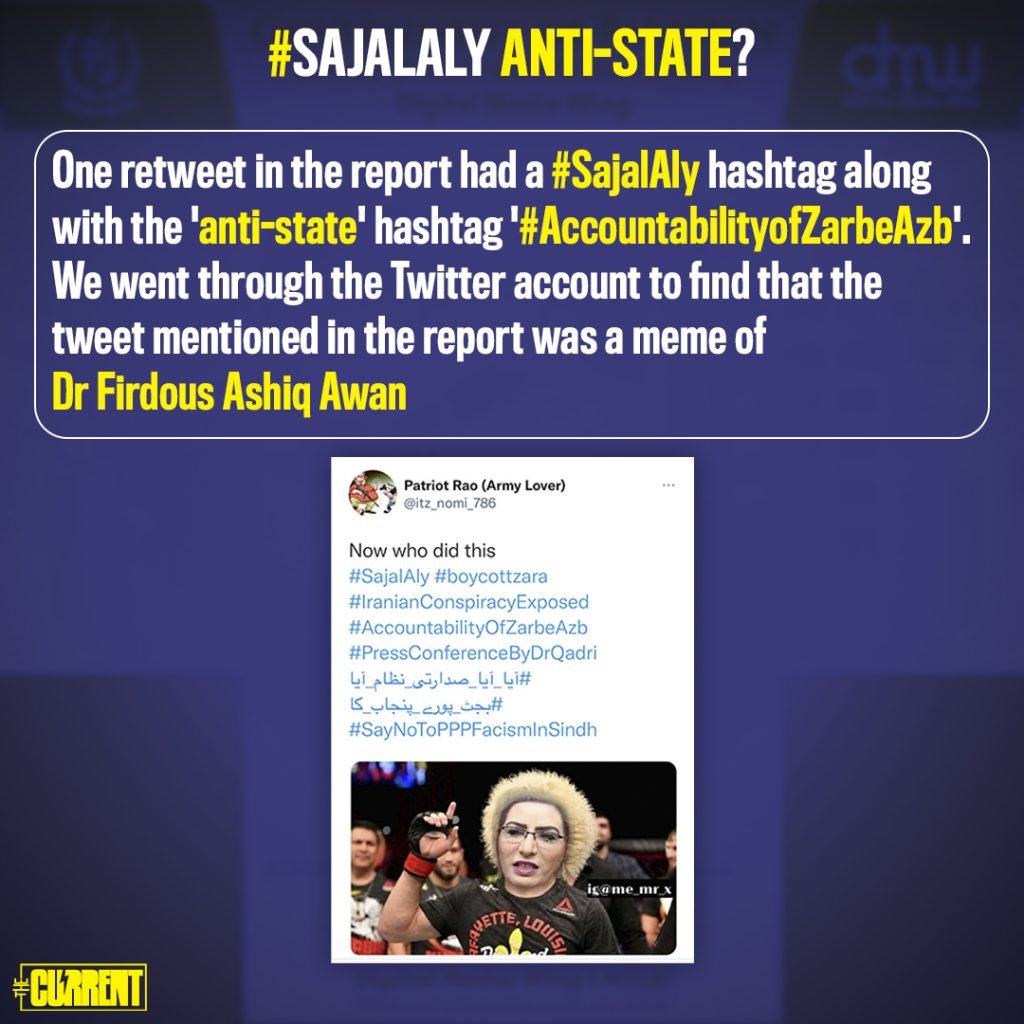
    We analysed the tweets used in the 85 screenshots present in the report and found some comical discrepancies. One retweet had the #SajalAly hashtag along with the ‘anti-state’ hashtag ‘#AccountabilityofZarbeAzb’. We went through the Twitter account to find that the tweet mentioned in the report was a meme of Dr Firdous Ashiq Awan.

    Digital Media Wing of the Ministry of Information

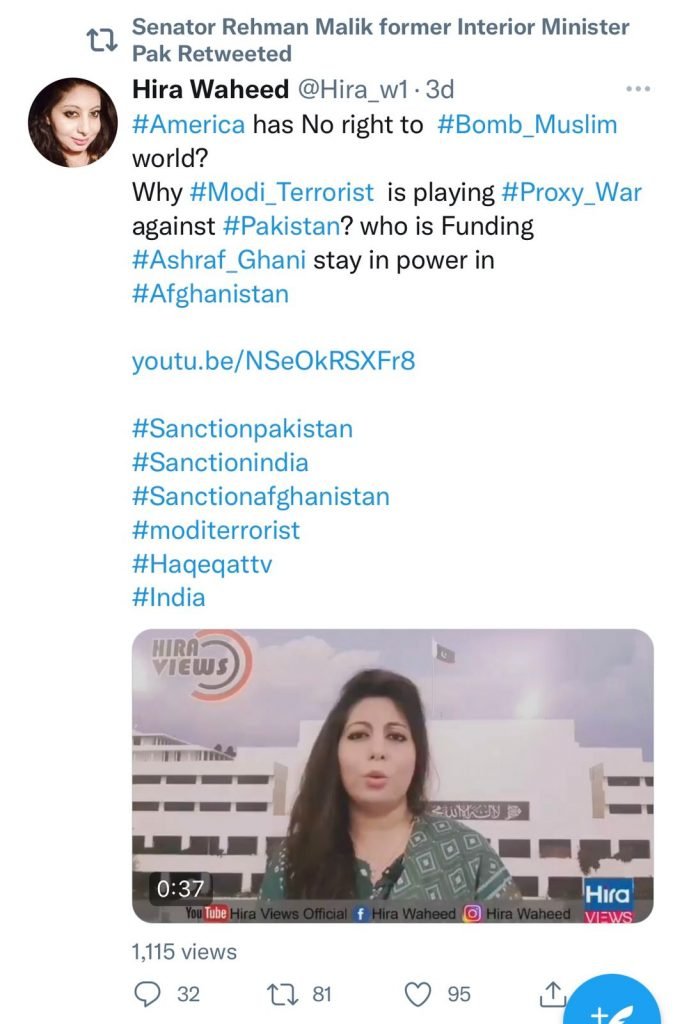
    A tweet by former Interior Minister Rehman Malik is included in the #SanctionPakistan list in which he is criticising Indian Prime Minister Narendra Modi and the US.

    The tweet Rehman Malik retweeted

    The report also includes references to “a group of Wikipedia Admins most of whom are based in India,” giving state level credibility to an online encyclopedia that can be edited by anyone. With glaring spelling mistakes and analysis based on unauthorised data, the summary of the Digital Media Wing Deep Analysis report has been summed up by one senior data analyst based in Singapore, “That just goes to show… they don’t understand how it works.”

  • PML-N changes stance, no longer opposes the Anti-Rape Ordinance

    PML-N changes stance, no longer opposes the Anti-Rape Ordinance

    The Pakistan Muslim League-Nawaz (PML-N) moved a resolution in the National Assembly today for the disapproval of the Anti-Rape (Investigation and Trial) Ordinance, 2020. According to an official document by the National Assembly Secretariat, members from the Opposition party were to move against the Anti-Rape Ordinance.

    However, the PML-N has withdrawn its resolution against the Anti-Rape Ordinance.

    PML-N’s Secretary Parliamentary Affairs Shaza Fatima Khawaja told The Current that there were several Ordinances that were passed by the Pakistan Tehreek-e-Insaf (PTI) government. The PML-N has a considered stance to oppose any legislation that is brought through Ordinances, which is why the PML-N prepared resolutions for dissolution for all of them because they were not going through proper legislative procedures. “This became one of them by mistake,” says Shaza. The PML-N has now withdrawn its resolution for disapproval of the Anti-Rape (Investigation and Trial) Ordinance, 2020.

    Shaza added that the PML-N would like the government to bring this legislation to parliament as concerns were also raised by the Women’s Action Forum (WAF) and the Women’s Lawyers’ Association (WLA) about the Anti-Rape Ordinance.

    “PML-N stands for women’s rights and would want a pro-women law that can also be implemented without any bureaucratic or other hurdles.” Shahza Khawaja said that despite strong opposition from PTI and other parties, the PML-N has been able to pass progressive and pro-women legislation, including the Anti-Rape Laws 2016, Anti-Honour Killing Bill, as well as Protection of Women against Violence Bill in Punjab.

    In response to a tweet, Shaza Khawaja tweeted that the PML-N unequivocally stands with women’s rights in every sense of the word.

    Twitterati reacted to PML-N’s withdrawing the resolution.

    Farieha Aziz tweeted, “Bills will be detrimental, not beneficial if passed in their current form. Must not be passed as they are.”

    Lawyer Reema Omer tweeted, “It was bizarre – even if well-intentioned – to make such radical reform in criminal law through ordinances anyway. The focus now must be on the anti-rape bills, which have some serious problems.”

  • ‘The gun is already placed on their head’: Hamid Mir on being  banned by Geo

    ‘The gun is already placed on their head’: Hamid Mir on being banned by Geo

    In an interview with Stephen Sackur on BBC HARDtalk, senior journalist Hamid Mir talked about why he was banned on Geo News, press freedom, censorship under Prime Minister Imran Khan, attacks on journalists, and how he is worried for his own safety in Pakistan.

    Disappointment on being off-air

    Stephen Sackur questioned Hamid Mir as to how disappointed he was with his employers [Geo News] and the Jang group who did not stand by him. Sackur also questioned how Mir felt that he had lost his voice and platform as a journalist because he was suspended from his channel.

    Mir said he was certainly disappointed but did understand the circumstances under which the decision was taken place.

    “Mir Shakil ur Rehman was arrested last year and he remained in the detention of the National Accountability Bureau (NAB) for more than seven months for a three-decade-old case, which was not a very big case. And I think that he was arrested, he was detained, just because of the freedom he was trying to give us. He got bail from the Supreme Court but his name was placed on the Exit Control List. He cannot leave Pakistan. He is already being held at gunpoint. So, my employers, the gun is already at their head. So when they were asked to ban Hamid Mir, they banned me. So I can understand their problem,” replied Mir.

    Imran Khan is a helpless Prime Minister

    The BBC host asked Mir that in the past he had a friendly relationship with PM Imran Khan so did he ever think that PM Imran personally wanted to see him taken off-air.

    Hamid replied, “It’s a very difficult question for me to respond [to], but I will try to very honestly. Imran Khan stood by me in 2007 when I was banned by General Pervez Musharraf, and yes at that time he was the biggest supporter of media freedom in Pakistan. Yes, I provided him a lot of space on my TV shows because he was in the Opposition, and you can say that I was friendly with him when he was in the Opposition. But when he became PM, I started raising questions. I even met him personally, and I asked him that your government should provide more space to the media because you are the biggest beneficiary of media freedom.”

    “One of my interviews with the former president, Asif Ali Zardari, was banned on my show, on my TV channel and some other Opposition leaders were also banned on different TV channels. So we started criticising Imran Khan and so I think he was not happy with my criticism.

    “The second part of your question is very important. I think that Imran Khan is not directly responsible for imposing a ban on me. And I don’t think he wants me to be off-air. But like past prime ministers, he is not a very powerful prime minister and I think he is helpless and he can’t help me,” said Mir.

    Concerned about my personal security

    Sackur questioned Mir if he feared the toxic environment in Pakistan and how concerned was he about his personal safety in the country after two assassination attempts on him. Mir answered, “Yes, I am very concerned about my personal security for a long time. I asked my family to leave Pakistan and my family left, my daughter and wife have already left. I was also approached by some people who suggested I leave Pakistan. But I decided not to leave.”

    Ready to face imprisonment

    The HARDtalk host asked Hamid Mir if he was ready to face imprisonment for the accusations against him, to which Mir responded, ” Yes, and I am ready to face life imprisonment because if they will be able to convict me at least the whole world will come to know what is going on in Pakistan. The whole world is already aware of what is going on in Pakistan because I am a living example of censorship in Pakistan. Everybody knows what happened to Hamid Mir and why he is banned and everybody knows the names of the people which I have not mentioned, everybody knows who was responsible for imposing a ban on me.”

    “The common Pakistanis are very wise, they are very clever. They know each and everything about what’s going on. But you see, there is no rule of law in Pakistan. And we only want justice, we want that the rule of law should be established in Pakistan. And if a journalist is asking questions, don’t try to silence his voice,” added Mir.

    State of media freedom in Pakistan

    Stephen Sackur questioned Mir whether there was a climate of fear in Pakistan when it comes to journalists or journalism.

    “Yes, definitely, there is a climate of fear in Pakistan. A lot of young journalists, they are very disappointed and look at the state of media freedom in Pakistan. When Mr Imran Khan became prime minister in 2018 Pakistan was ranked at 139 on the World Press Freedom Index. Today, in 2021, when I am talking to you, it is 145. So Pakistan lost six points in the last three years,” said Mir.

    He further added, “According to the International Federation of Journalists, Pakistan is one of the five most dangerous countries for journalists in the whole world. This is not good for Pakistan, for its reputation and credibility in the international community. And yes, there is a climate of fear in Pakistan because Pakistani journalists think journalism is becoming very difficult in this country and this government of Imran Khan [is] now planning some more anti-media laws which is not acceptable to us.”

    Rule of law only solution in Pakistan

    Commenting on the grave danger to democracy in Pakistan, Hamid Mir said, “I think that the rule of law is the solution to all of our problems. That’s why we want a general democracy in Pakistan because the founder of Pakistan, Muhammad Ali Jinnah was a democrat and I am a follower of his.”

    “And all those people who are trying to snatch media freedom from us are enemies of Pakistan and are enemies of Muhammad Ali Jinnah,” said Mir.

  • ‘Nigeria chota ghareeb sa mulk’, Twitterati reacts to Faisal Vawda’s comment

    ‘Nigeria chota ghareeb sa mulk’, Twitterati reacts to Faisal Vawda’s comment

    Pakistan Tehreek-e-Insaf (PTI) leader Faisal Vawda, on live television, called Nigeria a ‘chota ghareeb sa mulk’ [a small poor country].

    Twitterati immediately started drawing comparisons between Pakistan and Nigeria, trying to school the senator with facts.

    A Twitter user wrote, “Imagine the embarrassment for the Foreign Office (FO) if the Nigerian Ambassador lodges a formal protest with them tomorrow.”

    https://twitter.com/BuffetKh0r/status/1423321667292602369

    Sports journalist Faizan Lakhani reacted to the comments by posting a video of Prime Minister Imran Khan face-palming himself.

    Journalist Shiraz Hassan wrote, “I don’t know in what context he said that but we know that Nigeria has already won two medals in #Tokyo2020 – both by women athletes.”

    Another Twitter user wrote, “Pakistan 2020 GDP: $263.6B, Nigeria 2020 GDP: $432B. How Mr. Vawda came to the conclusion that Nigeria is ‘small and poor’ really escapes me.”