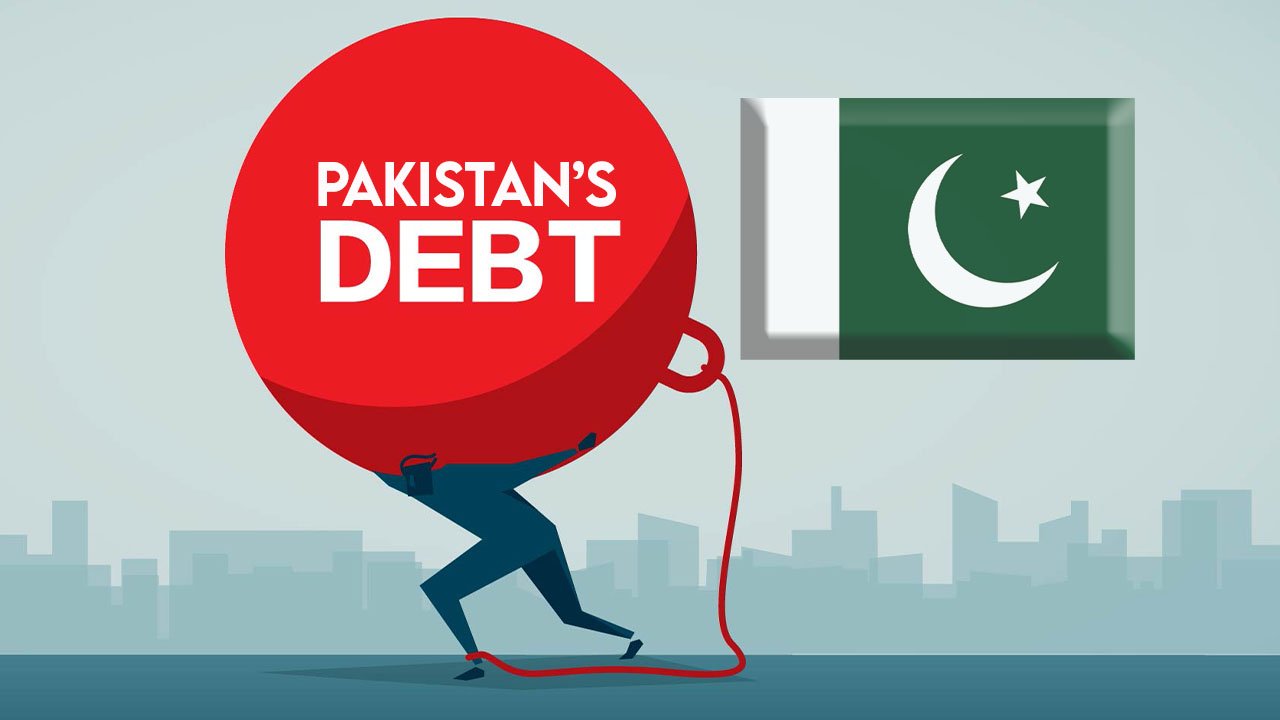
In a span of just 15 months, the Pakistan Democratic Movement (PDM) government has significantly added Rs18.5 trillion to the country’s public debt, a striking amount surpassing the debt accumulation of its rival, the Pakistan Tehreek-e-Insaf (PTI), during its three-and-a-half-year tenure.
Between March 2022 and the close of the 2022–23 fiscal year, the gross public debt surged from Rs44.4 trillion to Rs62.9 trillion. This rapid increase of 41.7 per cent in just 15 months occurred without a well-defined strategy to curb it. As a result, the federal government’s debt, for which the finance ministry bears direct responsibility, escalated to Rs60.8 trillion by June 2023. The debt bulletin, published on a recent Wednesday, indicates an addition of Rs18 trillion during the PDM government’s one year and three months in power.
As per a report in the Express Tribune by Shehbaz Rana, this unsustainable surge in public debt is mainly ascribed to unregulated spending, insufficient revenue collection from areas such as real estate, services, and agriculture, alongside the diminishing value of the Pakistani rupee in comparison to the US dollar.
It’s worth noting that the government under Imran Khan added Rs18.1 trillion to the public debt over a span of 44 months, a threshold that the current administration led by Shehbaz Sharif managed to surpass in just 15 months. However, it’s important to mention that the debt figure for July has yet to be compiled by the State Bank of Pakistan.
This trend becomes even more significant when we consider that the combined debt addition by the Pakistan Peoples Party (PPP) and the Pakistan Muslim League-Nawaz (PML-N) from 2008 to 2018 was Rs18 trillion. Another Rs18 trillion was added from August 2018 to March 2022 during Imran Khan’s government, and now the PDM government has contributed an additional Rs18.5 trillion in a remarkably brief period of 15 months.
Comparatively, from September 1, 2018, to the end of March 2022, the PTI government, on average, increased the public debt by Rs14.5 billion per day, more than double the average daily increase of Rs5.6 billion during the PML-N period. The PDM government has further escalated this daily addition to an average of Rs41 billion.
By the time the PTI government’s term concluded, the total public debt amounted to Rs44.4 trillion, equivalent to 83.5 per cent of the gross domestic product (GDP) before the economy’s rebasing. Following the rebasing process, there was a 15 per cent reduction in public debt relative to GDP but no reduction in absolute terms.
At present, the public debt constitutes 74.3 per cent of the GDP. Steep currency depreciation has also contributed to the federal government’s debt. Over the past 15 months, the total domestic debt of the federal government surged to Rs38.8 trillion, an addition of Rs10.8 trillion (or 38 per cent). When Imran Khan left office, the domestic debt stood at Rs28 trillion.
Alarmingly, the external debt of the federal government surged by 48 per cent to Rs22 trillion within just 15 months, with a net increase of Rs7.1 trillion attributed largely to currency depreciation. By the end of March 2022, the external debt, excluding IMF liabilities, was Rs14.9 trillion.
External debt constitutes roughly 36 per cent of the total debt, and fluctuations in the exchange rate have a significant impact on debt even without borrowing additional funds. In a span of 15 months, the rupee-dollar parity plummeted from Rs183.5 to Rs286.4, a decline of Rs103 or 56 per cent. This substantial and rapid depreciation has also contributed to inflation.
On a recent Wednesday, the rupee slid further to Rs295. An immediate outcome of this mounting debt is a considerable rise in the cost of debt servicing. It is projected that debt servicing will exceed Rs5.8 trillion by the end of the last fiscal year.
As a result of reckless borrowing, Pakistan’s total debt and liabilities have surged to Rs77.1 trillion, equivalent to 91.1 per cent of the national economy’s size. This ratio is deemed unsustainable for a developing nation like Pakistan.
During the past four years of the IMF programme, Pakistan struggled to enhance the Federal Board of Revenue’s (FBR) tax-to-GDP ratio, despite it being a priority for both the IMF and the World Bank.
This raises concerns about the effectiveness of obtaining foreign loans for the sake of tax reform. Moreover, there has been a lack of serious efforts to control expenditures. The Shehbaz Sharif government, like its predecessors, continued to allocate funds to projects and initiatives that fall under provincial jurisdiction as per the constitution.