Tag: punishment

  • Two People To Be Publicly Executed In Eastern Afghanistan

    Two People To Be Publicly Executed In Eastern Afghanistan

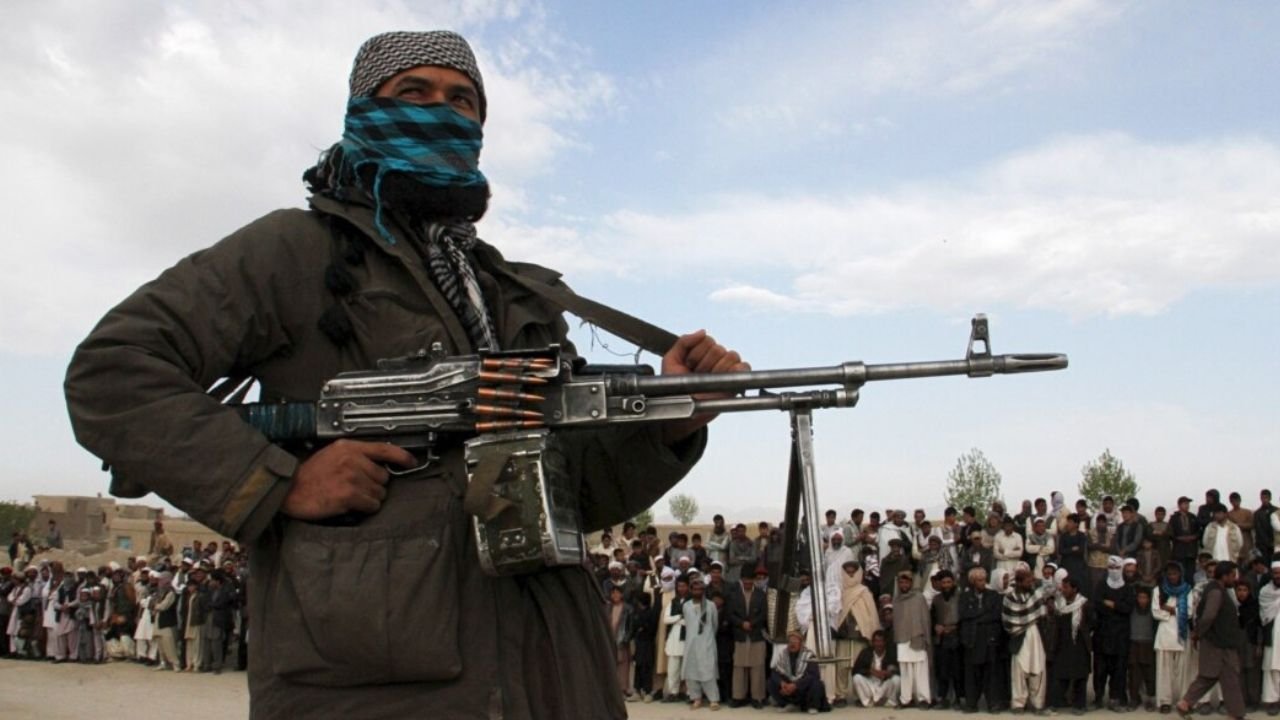
    Two people were due to be publicly executed in a football stadium in eastern Afghanistan on Thursday, provincial officials said, in the third and fourth death penalties carried out since the Taliban returned to power.

    The Ghazni province information and culture department said in a public notice that the execution was a qisas punishment — equating to “an eye-for-an-eye” — but did not initially provide details on the prisoners or their crimes.

    Although public executions were common during the Taliban’s first rule from 1996 to 2001, they have only carried out two others since surging back to power in August 2021. Both were for the crime of murder.

    There have been regular public floggings for other crimes, however, including theft, adultery and alcohol consumption.

    Taliban Supreme Leader Hibatullah Akhundzada last year ordered judges to fully implement all aspects of sharia — including qisas punishment.

    The last execution was carried out in June 2023, when a convicted murderer was shot dead in the grounds of a mosque in Laghman province in front of some 2,000 people.

  • Ban against corporal punishment enforced in Islamabad

    On Thursday, the federal government of Pakistan introduced rules to enforce the ‘Prohibition of Corporal Punishment Act, 2021’ throughout the capital city and territories, banning corporal punishment in public and private schools.

    According to Dawn, the law was passed three years ago, however the rules were updated a couple of months ago and the act was finally launched on Thursday.

    According to the act, teachers who are found guilty of inflicting violence on students will be punished through major penalities like compulsory retirement, dismissal from service or demotion to a lower post. Minor penalties include withholding promotion for a specific period or increment or financial advancement in accordance with the rules or orders pertaining to the service or post.

    The law states:

    “The child has the right to be shown respect for his personality and individuality and shall not be made subject to corporal punishment or any other humiliating or degrading treatment.”

    Speaking at the launch at the Islamabad Model College for Girls in F-10/2, the Minister of Federal Education Rana Tanveer Hussain praised the act as a shift towards fostering a culture of non-violence and empowering the rights of children:

    “Let us work together to implement these rules effectively and create an environment where every child feels safe and nurtured.”

    Convener of the Parliamentary Caucus on Child Rights and Parliamentary Secretary Law and Justice, Mehnaz Akber Aziz, who was also present at the ceremony, discussed the significance of the rules towards improving the lives of children:

    “The launch of the Prohibition of Corporal Punishment Rules is a testament to our commitment to ensuring children’s well-being and upholding their rights. These rules will provide clear guidelines and enforce strict measures to eradicate corporal punishment from educational institutions and child-related settings throughout Islamabad. I hope this will also incentivise the currently 2.4 million out-of-school children to head to schools.”

    United Nations International Children’s Fund (UNICEF) Representative Abdullah A. Fadil spoke on why corporal punishment must be outlawed in Pakistan:

    “Corporal punishment can inflict immediate pain and suffering, and sadly may also cause irrevocable damage that can last a lifetime. We need to act now and put all our weight behind this act so that all children in Pakistan are able to learn and grow in a safe environment and are protected in a society which respects and upholds their rights and dignity.”
  • Malala not only an excellent example for the women of Pakistan but also for the world: CM Punjab

    Malala not only an excellent example for the women of Pakistan but also for the world: CM Punjab

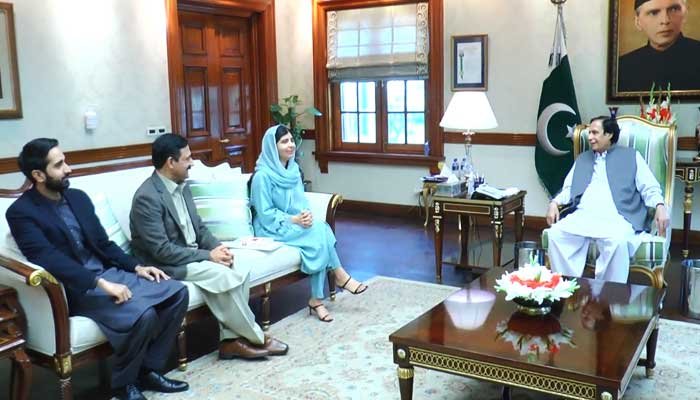
    Nobel laureate Malala Yousafzai on Wednesday met with Chief Minister (CM) Punjab Chaudhry Parvez Elahi to discuss the promotion of education and especially girls’ education in Punjab along with the STEAM programme.

    Yousfzai also discussed the issue of corporal punishment in schools and religious seminaries.

    CM Punjab has assured Malala that his government will pass a bill against corporal punishment this month. “We will implement the law on giving physical punishment and this law will be passed from the Punjab Assembly during the current month,” he said.

    In addition, CM Elahi ordered recruitment of 10,000 teachers in STEAM and ordered the secretary of the school education department to call a meeting to discuss the release of a budget of Rs165 million for STEAM education.

    CM Punjab while lauding Malala’s effort to promote education said, “Malala Yousafzai is not only an excellent example for the women of Pakistan but also for the world. She confronted terrorism and extremism for the sake of getting education.”

    He also praised the Malala Fund for “striving to constitute such a society where every female can attain education and become a leader in future.”

  • Social media hater? You could go to prison for seven years

    Social media hater? You could go to prison for seven years

    The federal cabinet has approved an amendment seeking seven-year imprisonment for those who spread hateful content on social media.

    Under the amendment, the Federal Investigation Agency (FIA) has been authorised to take action against such people. The final approval of the amendment will be taken by Parliament.

    However, Federal Interior Minister Rana Sanaullah decided to consult journalists and other stakeholders on the amendment. The minister said that if the amendment leads to restrictions on people’s freedom of expression, then the government will withdraw the bill

    The interior minister also stressed that if the bill is against the freedom of expression then “we won’t pass it”.

    Sanaullah said people’s private lives are being affected due to social media which is a “serious matter”.

    He further added that the issue is an important one, therefore, the government is hoping that the amendments will not create hurdles in the way of people’s right to freedom of expression.

    Earlier this year, during Pakistan Tehreek-e-Insaf (PTI) tenure, President Arif Alvi approved an ordinance of a similar nature proposing amendments to the Prevention of Electronic Crimes Act, (PECA) 2016. It proposed a five-year sentence for criticising state institutions, including the Pakistan Army and judiciary on electronic media

    At the time, Islamabad High Court (IHC) declared the ordinance “unconstitutional” and directed the federal government to probe abuse of the law and submit a report. The law also faced backlash from the media fraternity.

  • Husband escapes severe punishment for second marriage

    The Lahore High Court (LHC) dismissed the sentence of a husband who got married for the second time without his first wife’s permission, ARY News reported

    According to details, Justice Amjad Rafique of the LHC heard the petition against the sentence of Muzaffar Nawaz, a man who got married in secret.

    The court, while ruling on the petition, cancelled the verdict and hearing of the magistrate’s sentence.

    The LHC ruled that only the Family Court has the authority to hear the case under Muslim Family Law Ordinance, not a Magistrate.

    Read More: Newly-wed bride asks groom to bring water, runs away with cash, jewellery

    Muzaffar Nawaz was convicted of marrying Sitara Jabeen without the permission of his first wife Ishrat Rasool; a magistrate sentenced Muzaffar Nawaz to three months imprisonment and was charged with a fine of Rs 500,000 on the complaint of his first wife.

    The Sessions Court later dismissed the appeal against the magistrate’s decision

  • Woman pours boiling water on husband for berating son

    Woman pours boiling water on husband for berating son

    A woman in Egypt poured boiling water on her husband allegedly for ill-treating their son.

    As per reports, the 43-year-old man was rushed to a nearby hospital with burns sustained in different parts of the body allegedly due to the woman’s attack.

    The husband who is a mechanic accused his 32-year-old wife of throwing boiling water at him from a teapot in their house because he had berated their son for playing late outdoors.

    Read More: Ukrainian army defends decision to make female soldiers march in high heels

    The woman confessed to the crime after she was arrested by the police.

    She said it was in reaction of her husband’s physical punishment to their son. Local prosecutions has ordered an inquiry into the incident.