Tag: ram mandir

  • Indian court allows Hindus to pray inside disputed mosque

    Indian court allows Hindus to pray inside disputed mosque

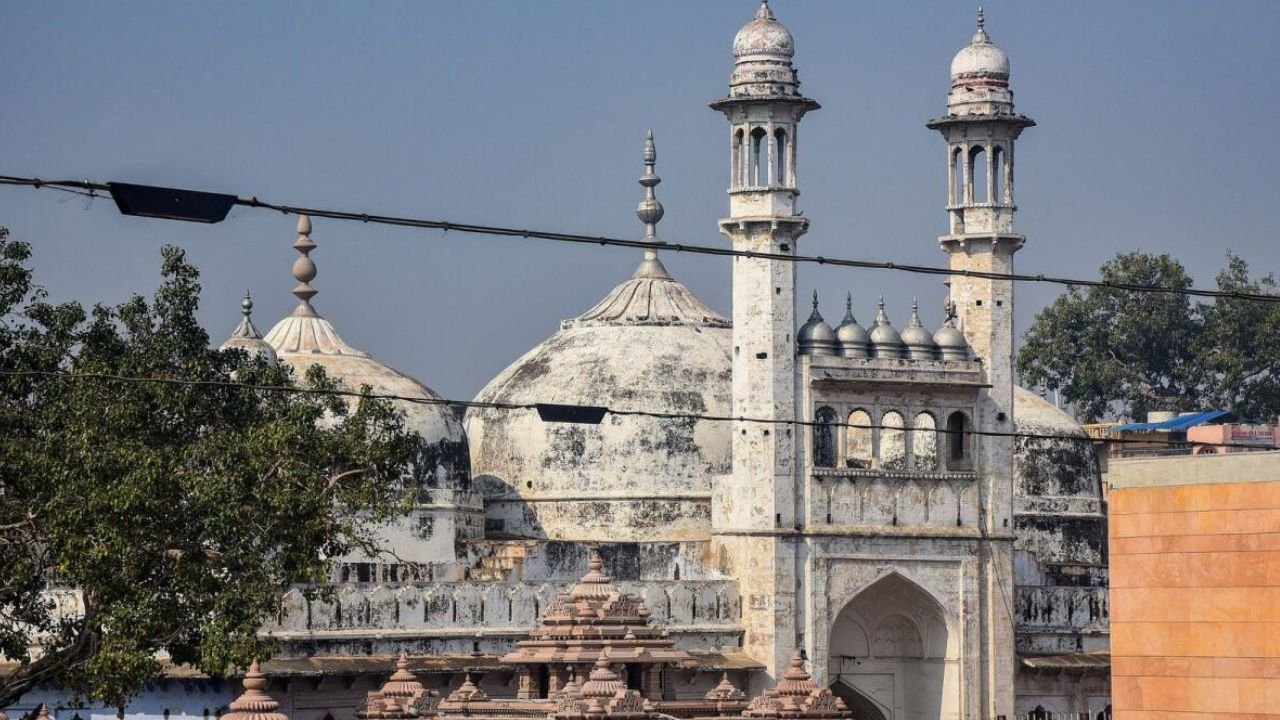
    An Indian court weighed in on one of the country’s most sensitive religious disputes Wednesday by permitting Hindu worshippers to pray inside a mosque in the city of Varanasi.

    The Gyanvapi mosque is one of several Islamic houses of worship that Hindu activists, backed by Prime Minister Narendra Modi’s party, have sought for decades to reclaim for their religion.

    It was built in the 17th century by the Mughal empire in a city where Hindu faithful from across the country cremate their loved ones by the Ganges river.

    The court in Varanasi ruled that Hindu worshippers — who believe the mosque replaced a destroyed temple to the deity Shiva — could pray in the building’s basement.

    Its verdict ordered district authorities to “make proper arrangements within the next seven days” to facilitate worshippers.

    The decision is the latest in a long-running legal saga over Gyanvapi’s future.

    This month, India’s official archaeological agency said a survey of the site appeared to corroborate the belief that it was originally home to a temple, according to local news reports.

    Emboldened right-wing Hindu groups have laid claim to several Muslim sites of worship they say were built atop ancient temples during Mughal rule.

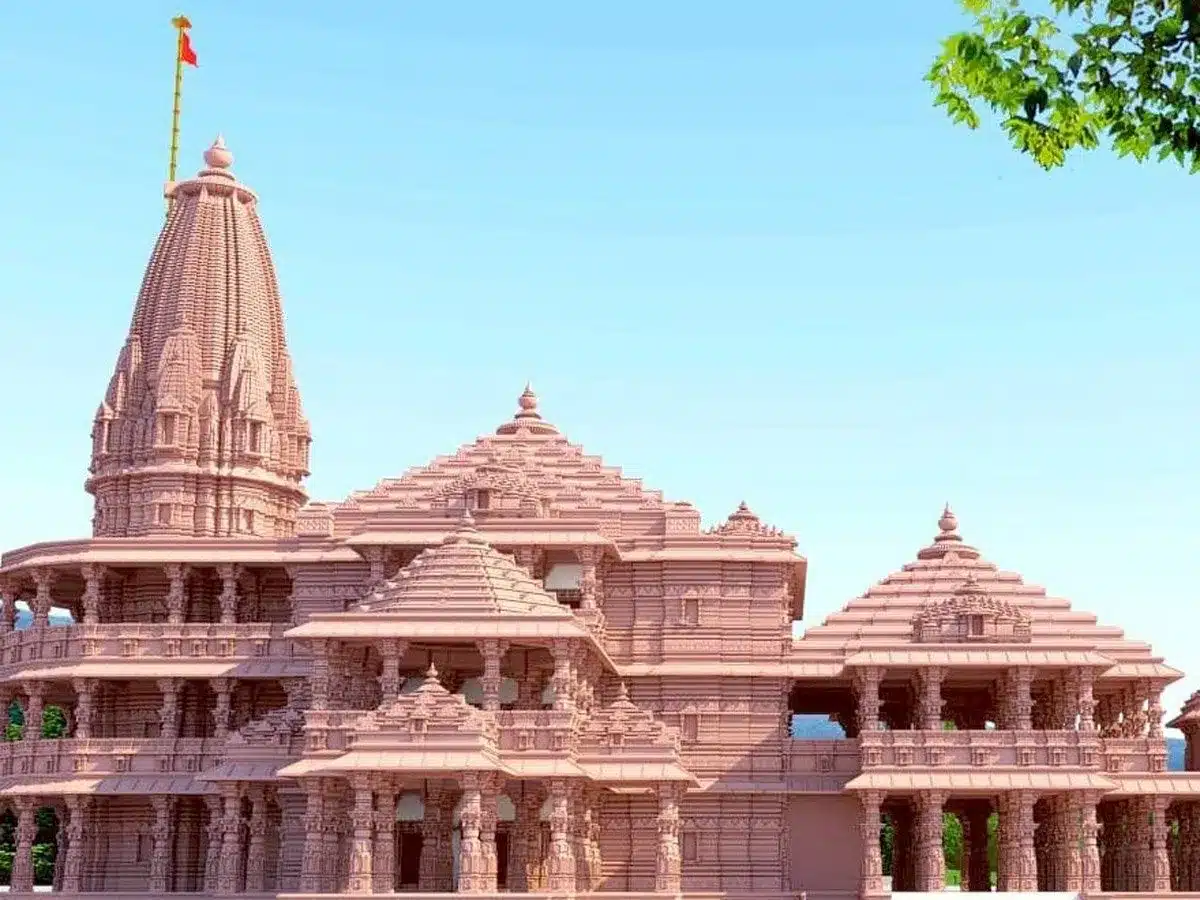
    Last week, Modi presided over a grand inauguration ceremony in the nearby city of Ayodhya for a Hindu temple built on grounds once home to the centuries-old Babri mosque.

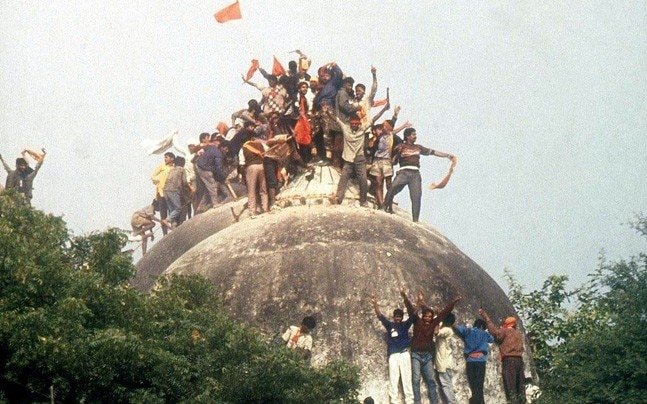
    Hindu zealots had torn down that mosque in 1992 in a campaign spearheaded by members of Modi’s party, sparking sectarian riots that killed 2,000 people nationwide, most of them Muslims.

    The decades-long court battle that ensued over the future of the Babri site ended in 2019 when India’s top court permitted the construction of a temple to the deity Ram, who according to Hindu scripture was born in the city.

    Members of Modi’s party routinely refer to India’s history of Muslim rule under the Mughal emperors as a time of “slavery”.

    The prime minister described last week’s opening of the temple as “the advent of a new era”.

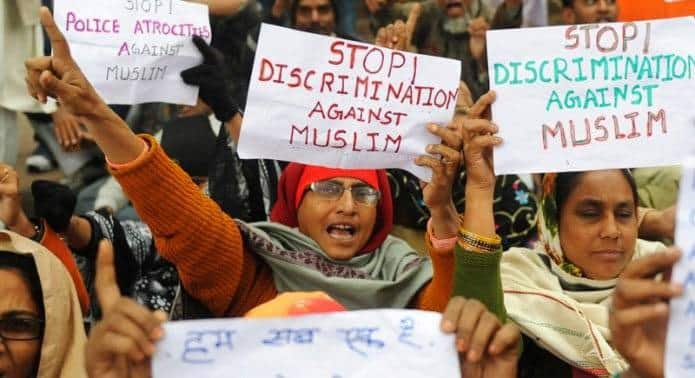
    Calls for India to enshrine Hindu supremacy have rapidly grown louder since Modi took office in 2014, making its roughly 210-million-strong Muslim minority increasingly anxious about their future.
  • India continues becoming unsafe for Muslims as Ram Mandir consecration emboldens extremists

    India continues becoming unsafe for Muslims as Ram Mandir consecration emboldens extremists

    A number of violent incidents have been reported in at least six states after the consecration of Ram Temple in Ayodhya, India.

    A report published by the Indian outlet The Quint says that from a graveyard in Bihar to a mosque in Telangana, India saw multiple attacks and violent incidents on 22 January. The incidents were of varying scales, ranging from sandals allegedly thrown inside a mosque and a shop being burnt in Telangana to a graveyard set on fire in Bihar, to violent skirmishes in different parts of Maharashtra.

    In the capital of Uttar Pradesh, Lucknow, a video of a hateful song being played in Narhi, Hazratganj, surfaced on social media. The song was allegedly played by a procession celebrating the consecration of Ram Temple.

    Journalist Rana Ayyub shared the video with a caption stating, “Trigger warning for abusive, misogynistic language. Do listen to this song. To go to a Muslim locality and celebrate Ram Mandir’s inauguration with this song. And you still think this is about faith? Is this how you want to raise your kids? Is this the culture you want to normalise? Why send your kids to Ivy League, why give them quality education, let them be a part of this crass revelry.”

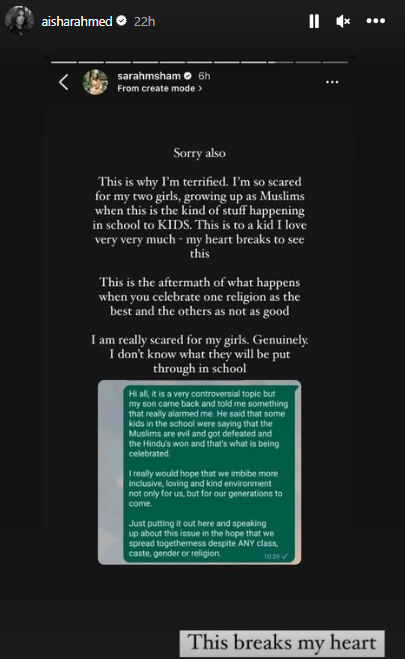
    Famous Indian actor Aisha Ahmed, popular for her roles in web-series ‘Adulting’, shared her experience via an Instagram story of Sarah Sham, the influencer and wife of Indian Tennis player, Mustafa Ghouse who shared her heartbreaking experience of getting a message from a fellow parent about their kid being harassed in school for being Muslim.

    Sarah said it had taken a lot of effort to share her experience of feeling like a second-grade citizen in her country. She went on to explain that the persecution has exacerbated after the establishment of Ram Mandir.

    Indian publication The Wire posted two days ago that activist and journalist Umar Khalid’s bail plea got adjourned yet again. He has been detained since September 2020. Commenting upon this, Professor of Peace Studies at Uppsala University Dr. Ashok Swain said, “If you are a Muslim in India, you have no one, I repeat no one to save you from the wrath of Modi!”

    He even shared a video of a Hindu supremacist mob attacking Muslims and their properties in Mumbai, screaming “Jai Sri Ram”.

    Extremist Hindus in Pune University beat up students of the Film and Television Institute of India for putting up banners that read “Remember Babri, death of constitution.”

    Mob beating or lynching Muslims in India has become a frequent sight in India lately.

    One of the Khans of Bollywood, Aamir Khan, once slammed fellow countrymen for their growing intolerance. He later redeemed himself to the extremists by praising Prime Minister Narendra Modi.

    Yusra Hussain, a freelance journalist from Lucknow told Al-Jazeera, “After Ayodhya, there might be a snowballing effect on other disputed places like Mathura and Kashi,”.

    Mathura and Varanasi – Modi’s parliamentary constituency also known locally as Kashi – are also home to historic mosques that the prime minister’s Bharatiya Janata Party (BJP) and its Hindu majoritarian allies say were built on demolished temples.

  • Inauguration of Ram Mandir- Modi’s Hindutva in full force

    Inauguration of Ram Mandir- Modi’s Hindutva in full force

    Ram Mandir in India is being inaugurated today (Monday) by Prime Minister Narendra Modi with state-sponsored fanfare.

    “This will be our Vatican City, the holiest site for Hindus across the world,” said Sharad Sharma, spokesperson for Vishva Hindu Parishad (VHP), a rightwing Hindu group, and member of the Hindu trust building the temple. “After 500 years of Hindu oppression, Lord Ram will finally be returned to Ayodhya,” The Guardian cites him as saying.

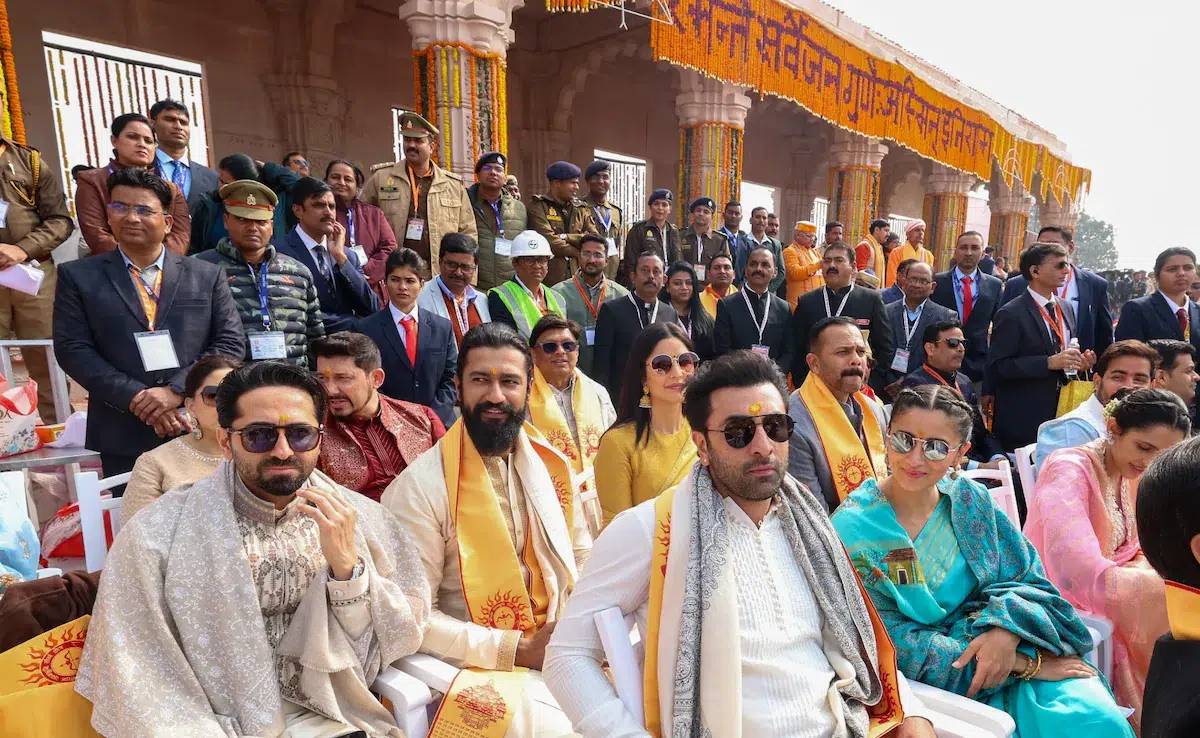
    Considering the importance the event holds, the ceremony is going to be attended by a huge number of Bollywood celebrities, cricketers, politicians and leading businessmen of the country. A newly commissioned airport in Ayodhya is also in the works. Security has been tightened, while the fear of violence has prompted Muslim residents of Ayodhya to send their children and women to relatives in neighbouring towns.

    Bollywood celebrities at the inauguration of Ram Mandir

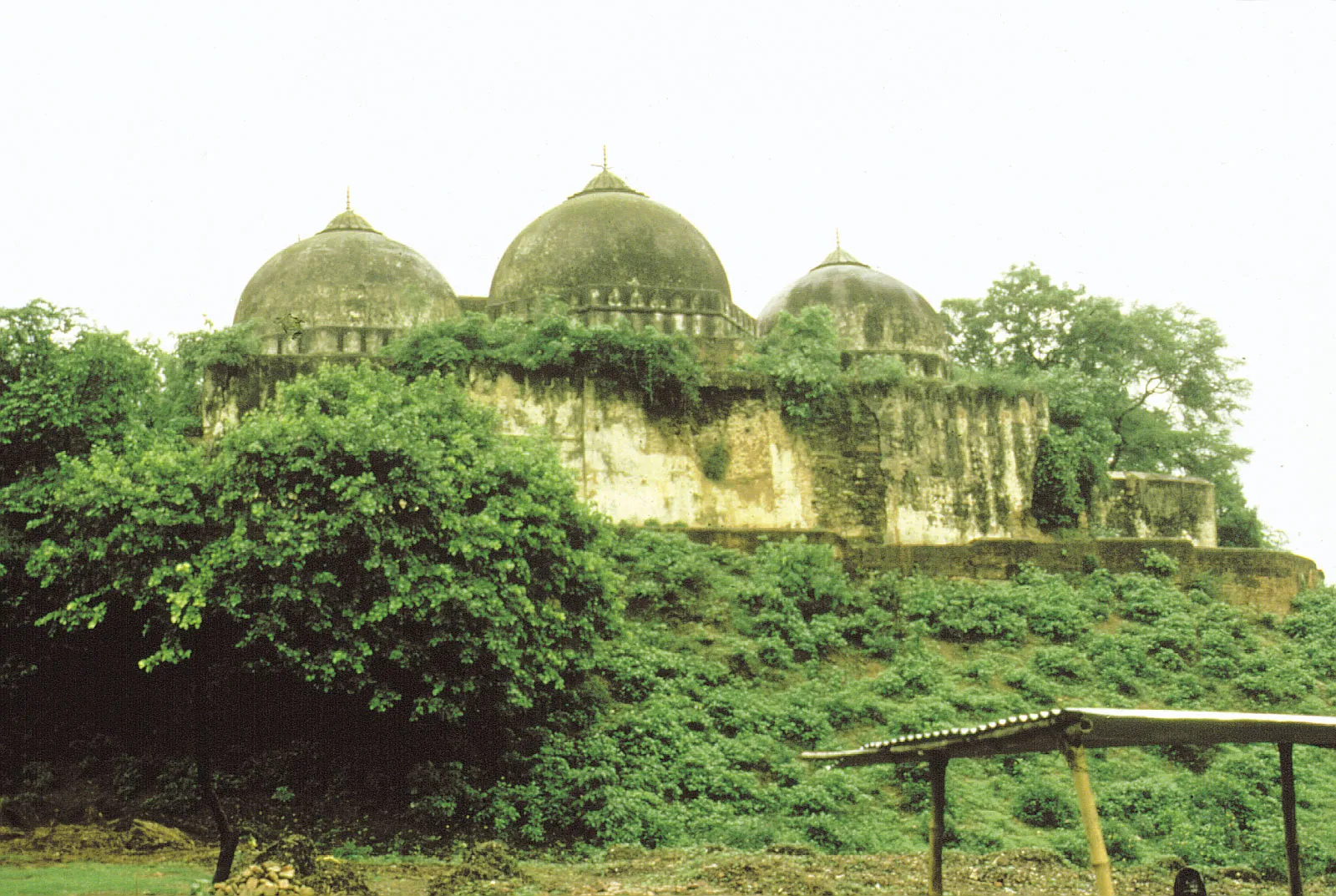
    The temple is a reminder of the very inception of this controversy built on the ruins of 16th-century Babri Masjid. It was demolished by a Hindutva-infused right-wing mob in 1992 after decades of disputes. The riots that happened following the demolition killed more than three thousand Muslims.

    The mosque was built in 1527 by Mughal Emperor Babur and was a rare surviving example of the architecture of the early Mughal Empire, which ruled India from 16th to 19th centuries. Muslims worshipped in the mosque for more than 300 years.

    Summarising the history of the site, Dr. Audrey Truschke wrote in Time: “In the 1850s, when India was largely under British colonial rule, the first signs of trouble arose as the Babri Masjid emerged as a key site of Hindu nationalist attempts to rectify perceived historical wrongs by Muslims, an idea inherited from British colonialists. Hindus claimed that Lord Ram, a major god and mythological hero, had been born at the very spot on which the mosque stood. Competing claims of Ram’s birthplace were once attached to many sites in Ayodhya, but the Babri Masjid drew particular fervor because it was a mosque. Some imagined further historical wrongs associated with the Babri Masjid, including claiming that the mosque was built after Babur’s general destroyed a Hindu temple at that location. None of these claims stand up to historical scrutiny. But in the 1980s, Hindu nationalist groups began tapping into these claims to argue that the mosque needed to be destroyed to clear the way for a new Hindu temple, declaring Mandir wahi banayenge (‘The temple will be built right there!’). After years of agitation, their efforts resulted in an explosion of Islamophobic violence on December 6, 1992, when a Hindu mob numbering at least 75,000 descended on Ayodhya and dismantled the Babri Masjid, brick-by-brick.

    Modi’s BJP benefitted from the situation and came to power in 2014. After the second victory in BJP in 2019, India’s Supreme Court—laden with judges affiliated with BJP- the court called the mosque’s destruction ‘an egregious violation of the rule of law,’ but nonetheless ruled that a Hindu temple could be built on the mosque’s ruins.”

    Modi laid the foundation stone at a groundbreaking ceremony in August 2020.

    Posed as a divine moment this is interpreted as a political gimmick by The Guardian because general elections are going to be held in April in India and by invoking the religious sentiments of the 80 per cent majority of the country, Modi is seeking a third term in power. Prime Minister Modi has also declared that God had chosen him as an instrument to be “representative of all Indians” and he had begun 11 days of “strict vows and sacrifice” to prepare for the event.

    Even though many Indians have given in to the political gimmickry, most are reminded that this Vatican City is nothing but a monument built after demolishing Babri Masjid by force with the help of brute majority.

    Dr. Audrey posted, “Today is a dark day for India”. She was then hugely criticised by Hindu extremists over her tweet and the article she shared.

    A Twitter user commented that this is the win of Jinnah’s two-nation theory.

    Pratesh from India shared a clip from ANI where a teacher was teaching dance steps on bhajans in schools to celebrate the inauguration. He commented, “Now what happened to no religion in school? Was it only applicable for hijab?”

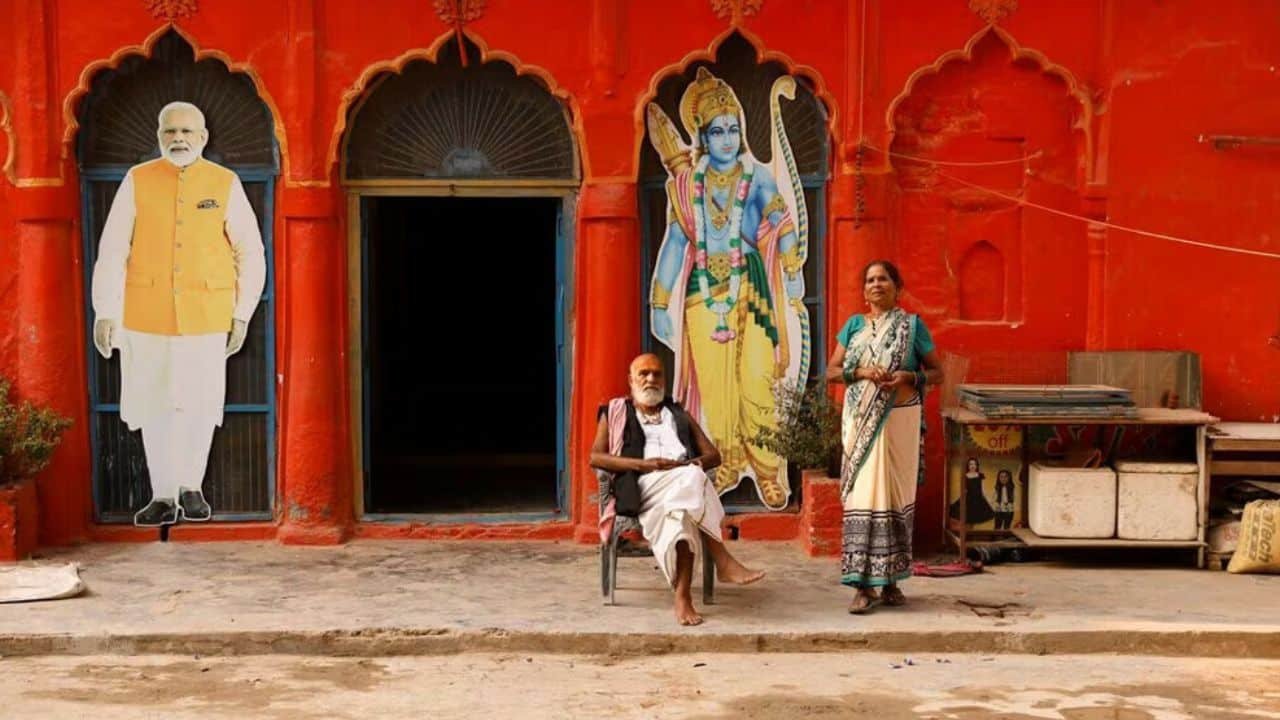
    Someone sarcastically trolled Narendra Modi’s poster by writing, “Very hard to say at this point whose temple is being inaugurated.”

    A user named Sabah counted the Bollywood actors that are attending the event just to appease the government.

    Writer and Educationist Raju Parulekar lamented the state of India has lost its secular spirit in a tweet.

    The most viral is that of a kid schooling the government that a Mandir can’t educate and enable people only a school can.

  • India celebrates minority rights day as Ram Mandir set to open in place of Babri Masjid next year

    India celebrates minority rights day as Ram Mandir set to open in place of Babri Masjid next year

    Every year on December 18 Minority Rights Day is celebrated in India but this year, the country topped the list of atrocities on minorities.

    In the Northern Indian city of Ayodhya, once marred by communal rights because of Babri Mosque, Ram Mandir is about to be inaugurated on January 22. The establishment of Ram Mandir is a long overdue promise of the ruling Bharatiya Janta Party (BJP) and Prime Minister Narendra Modi.

    Ayodhya is expecting about 4.5 million tourists a month – more than Ayodhya’s entire population of three million – once the first stage of Ram Mandir opens in the upcoming days.

    Ayodhya made international headlines in 1992 when a Hindu mob razed Babri mosque – where the Mandir will stand – saying it had been built on the site of an earlier Hindu temple.

    The incident spurred nationwide riots that left 2,000 people dead, most of them Muslims.

    After decades of legal wrangling, India’s Supreme Court in 2019 awarded the site to Hindu groups for the temple.

    While the $180 million temple project in Uttar Pradesh is funded by donations, the state government – controlled by PM Modi’s Hindu nationalist BJP- is pulling out all the stops.

    In a Reuters report cited by the Business Recorder where they interviewed people from the locality of the temple, Hindus expressed excitement for the launch because this will attract business for them. Muslims, on the other hand, fear being marginalized further.

    The Supreme Court also said authorities must allocate the Uttar Pradesh Sunni Central Waqf Board, which advocates for Muslim rights, “suitable” land at a “prominent” place to build a new mosque.

    The board was issued land 15 miles from the temple, just next to the city border.

    That effectively means Muslims are excluded from the development boom-brought by the temple-downtown, said Azam Qadri, president of Ayodhya district committee of the board.

    “Everyone is focused on the temple. There should have been a focus on promoting mosques too,” Qadri said.

    Muslims still don’t have wide acceptance in the city and even if the community tried to build hotels, Hindu religious tourists might not visit, he added.

    It’s not just Muslims, other minorities in India are suffering as well. On April 21, 2022, 50 thousand houses of Muslims were demolished in the state of Hyderabad, and in 2023, 400 incidents of violence against Christians were reported in 23 states of India. On August 25, Indian extremists killed hundreds of Christians and burned 600 villages in the Kandhamal district of Orissa, reports Samaa News.

    Sikh riots intensified after the assassination of Indira Gandhi in 1984, in which around 17,000 Sikhs were killed. Farmers remain protesting across Punjab but the government did not pay any heed to their demands.

    As per DW, 60,000 crimes against Dalit Hindus were reported. On average, an incident of violence against a Dalit occurred every 10 minutes in 2012.
    National Crime Bureau said that over 250,000 hate crimes against lower castes were reported in the last 5 years while as per the report US Institute on Religious Affairs, there have been systematic attacks on Muslims, Christians, and Dalits in India.

    The head of the U.S. Commission on Religious Freedom said that religious freedom in India has suffered a sharp decline under the Modi regime.
    Since 2020, the US Commission on Religious Affairs has included India in the list of countries of concern, and human rights organizations have declared India as a dangerous country for minorities.