Tag: Ramadan

  • Palestinian Muslims mark sad and tense ‘holiest Ramadan night’ in Jerusalem

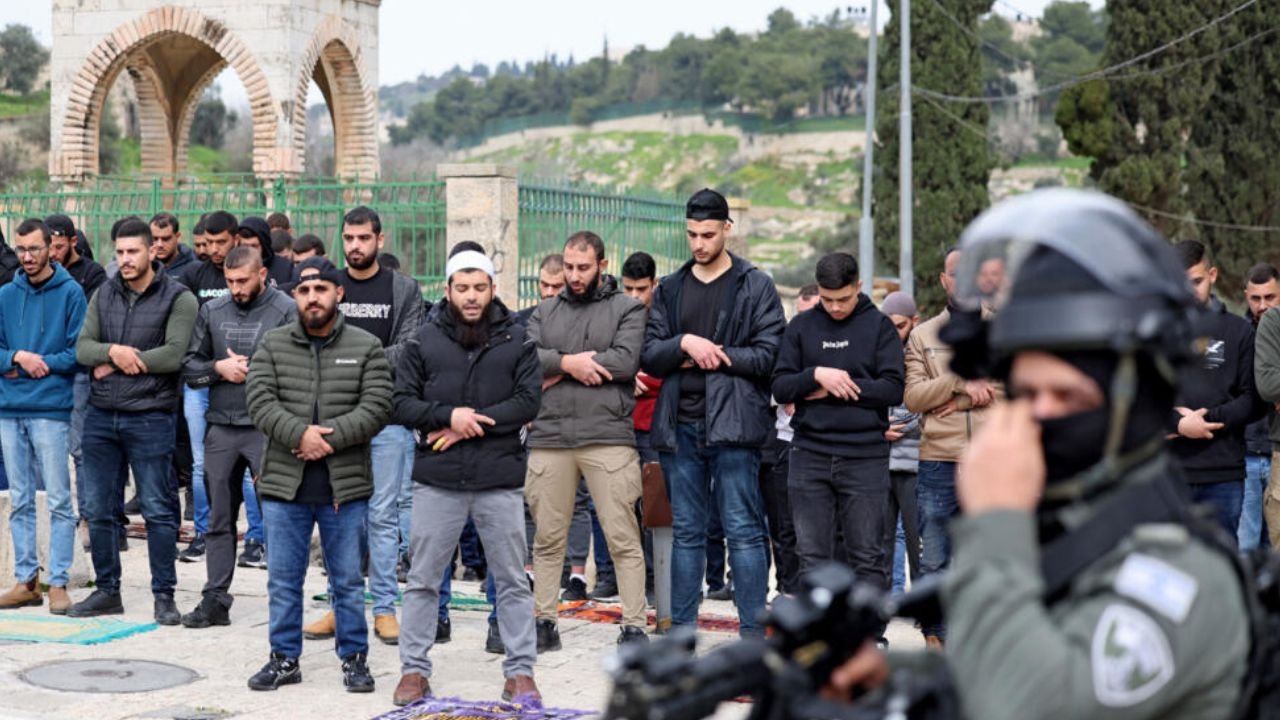
    Palestinian Muslims marked a tense and sombre last Friday of Ramadan in Jerusalem as Israeli police controlling the entrance to the Al-Aqsa mosque – the third holiest site in Islam – attacked worshippers.

    Some 120,000 people descended on the shrine, which dominates the Old City, officials said, with grand mufti Muhammad Ahmad Hussein urging the faithful to brave the heavy police presence because of the war in Gaza.

    Adli al-Agha, 53, from Jerusalem, told AFP that many people “had to flee dawn prayers” after Israeli police deployed a mini-drone spraying tear gas to disperse people chanting “Glory to God”.

    “In our soul and our blood, we sacrifice for you Al-Aqsa,” worshippers declared, according to Agha.

    Police said they arrested eight people for inciting terrorism.

    Yasser Basha, from Tulkarem in the Israeli-occupied West Bank, said police were restricting entrance to the mosque to the old and the very young. Only men over 55 and women over 50 were being allowed inside, he said.

    “If it wasn’t for the war, things would have been much easier,” he added.

    Friday also marks Laylat al-Qadr (“The Night of Destiny”), the spiritual climax of the Muslim holy month, which commemorates the moment the archangel Gabriel first appeared to Prophet Mohammed and began revealing the Koran.

    It is the night when Muslims believe their prayers are most likely to be granted, a festive moment while children stay up late and shops stay open till the small hours.

    But many Palestinians are not in the mood to celebrate and are praying for an end to the war in Gaza after almost six months of bloodshed.

    Sameeha Al Qadi, 55, who had come from near Bethlehem, said Jerusalem “is sad and has lost its light — we all feel what is going on in Gaza. We can’t escape it for a minute.”

    This year there are few Ramadan decorations or lights in the Holy City, with Palestinians instead having a bitter coffee and a date — traditionally to mark mourning — on Tuesdays and Wednesdays, when feasts are usually held.

    “There is sweet nothing about the feast this year. People are not celebrating,” said Sabah, 54, some of whose relatives have been killed in Gaza.

    “Everything is bitter in my mouth. It is so painful at this time which is all about family.”

    Easter was similarly subdued last weekend for Palestinian Christians.

    Adnan Jafar, 60, a sweet maker in the Old City, said usually in Ramadan his shop is at its busiest.

    “But I have never had a Ramadan like this. And we all know why. (Gaza) is not just affecting us, it is affecting the whole world.”

    Israeli genocide in Gaza has killed at least 33,091 people since October 7, mostly women and children, according to the territory’s health ministry.


  • ‘Bloody’ Ramzan Friday as Gaza strike kills 36 relatives

    ‘Bloody’ Ramzan Friday as Gaza strike kills 36 relatives

    Palestinian Territories: Displaced by Israeli bombardment, the Tabatibi family gathered in central Gaza to eat together during the first Friday night of Ramzan, a scene that soon turned into a bloodbath.

    An air strike hit the building where they were staying as women prepared the pre-fasting meal, killing 36 members of the family, survivors told AFP on Saturday.

    The health ministry in Gaza, which provided the same death toll, blamed Israel for the strike in Nuseirat, while the Israeli military said it was looking into the incident.

    “This is my mother, this is my father, this is my aunt, and these are my brothers,” 19-year-old Mohammed Al-Tabatibi, whose left hand was injured in the strike, said through tears at the Al-Aqsa Martyrs Hospital in nearby Deir Al-Balah.

    “They bombed the house while we were in it. My mother and my aunt were preparing the suhoor food. They were all martyred.”

    He spoke as bodies were spread out in the hospital courtyard, then stacked on a truck to be driven to a cemetery.

    Because there were not enough body bags, some of the dead — including at least two children — were wrapped in white cloth stained with blood, AFPTV footage showed.

    The first Friday of Ramzan, the Muslim fasting month which began on Monday, passed peacefully in Israeli-annexed east Jerusalem, despite concerns about tensions at the sacred Al-Aqsa Mosque compound.

    But it was a different story in Gaza.

    The strike in Nuseirat was one of 60 “deadly air strikes” reported overnight by the press office of the government, from Gaza City in the north to Rafah in the south.

    “This is a bloody night, a very bloody night,” said Salama Maarouf of the media office.

    Israel’s retaliatory military campaign has killed at least 31,553 people in Gaza since October 7, mostly women and children, according to the health ministry.

    In Rafah, where the majority of Gaza’s 2.4 million people have sought refuge, more bloodshed is feared after Israeli Prime Minister Benjamin Netanyahu’s office said on Friday he had approved plans for a military operation there.

    Yet even before any such operation begins, air strikes continue, including one early Saturday that witnesses said killed Issa Duhair, the muezzin of a mosque, along with his two sons.

    Mahmoud Duhair, a 41-year-old relative who lives nearby, described the muezzin as “a good man” who, as usual, dutifully performed the call to prayer before dawn on Saturday, then went to eat with his family “when his house was struck.”

    Back in Nuseirat, in central Gaza, Yussef Tabatibi said the true toll of the strike that killed 36 members of his family could rise.

    “Some of the martyrs we are unable to retrieve. We lack equipment, bulldozers, machinery, or anything else, ” he told AFP, his hands and sweatshirt covered with dust from trying to clear rubble.

    “We retrieve them only with our hands. We brought shovels and hammers, but to no avail. Look at the extent of the destruction.”

  • 22 flights cancelled as passengers decrease in Ramzan

    22 flights cancelled as passengers decrease in Ramzan

    Due to operational issues of various airlines, 22 flights across the country including eight domestic flights of Quetta have been cancelled today.

    According to PIA spokesperson, as reported by Geo news, the flights had to be cancelled due to not meeting the minimum load of the required number of passengers.

    Aviation reported that today alone, PIA cancelled six flights from Karachi, Islamabad and Lahore to Quetta. PK 310, 311 from Karachi, PK 322, 323 from Lahore and PK from Islamabad to Quetta. K 325, 326 will not be operated today.

    PIA’s Karachi-Gwadar PK-503, 504 flights have also been cancelled.

    Five flights from Karachi to Islamabad, three flights between Karachi to Lahore, two flights of PIA from Islamabad to Sukkur have been cancelled.

  • SNGPL to provide uninterrupted gas supply during Sahr and Iftar in Ramadan

    SNGPL to provide uninterrupted gas supply during Sahr and Iftar in Ramadan

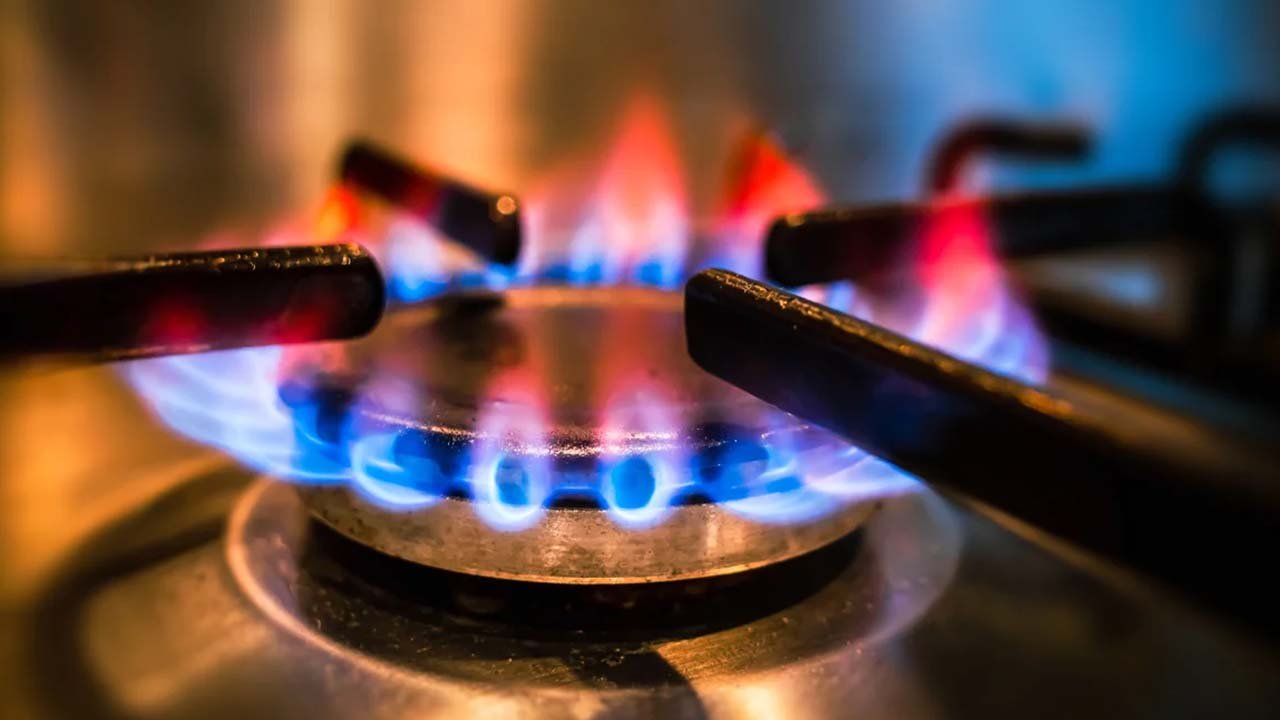
    Sui Northern Gas Pipelines Limited (SNGPL) has affirmed its commitment to providing uninterrupted gas supply during the holy month of Ramadan, specifically catering to the Sahr and Iftar periods. The decision comes as a proactive measure to facilitate consumers adhering to their religious practices.

    According to a spokesperson from Sui Northern, the gas supply will remain constant from 2:30 am to 8 am for Sahr (pre-dawn meal) and from 3 pm to 10 pm for Iftar (breaking of the fast). This move is aimed at ensuring a seamless gas service for consumers at crucial times during Ramadan.

    In addressing potential gas pressure issues, Sui Northern Gas has formed monitoring teams and established control rooms. These initiatives are designed to swiftly resolve any challenges that may arise, emphasising the company’s dedication to a reliable gas supply throughout the holy month.

    Consumers experiencing gas pressure or supply problems are encouraged to contact the dedicated helpline at 1199.

  • Israel says to allow worshippers access to Al-Aqsa in Ramzan as in ‘previous years’

    Israel says to allow worshippers access to Al-Aqsa in Ramzan as in ‘previous years’

    Israel will allow as many Muslim worshippers to access Al-Aqsa mosque in Jerusalem during the first week of Ramzan as in previous years, the prime minister’s office said Tuesday.

    “In the first week of Ramzan, worshippers will be allowed to enter the Temple Mount, in similar numbers to those in previous years,” the statement said, using the Jewish term for the site.

    “Every week there will be a situation assessment in terms of security and safety and a decision will be made accordingly,” it added.

    Every year, tens of thousands of Muslim worshippers perform Ramzan prayers at the Al-Aqsa mosque.

    Ramzan comes this year as Israel wages a genocide in the Gaza Strip in a disproportionate response to Hamas in Israel on October 7.

    Israel has been assessing how to address worship in Jerusalem during Ramzan, the Islamic fasting month due to start on March 10 or 11, depending on the lunar calendar.

    Israel’s far-right National Security Minister Itamar Ben Gvir had recently said that Palestinian residents of the West Bank “should not be allowed” entry to Jerusalem to pray during Ramzan.

    “We cannot take risks,” he said, adding: “We cannot have women and children hostage in Gaza and allow celebrations for Hamas on the Temple Mount.”

    Ben Gvir leads a hard-right party advocating Jewish control of the compound.

    Days later, the United States called on Israel to allow Muslims to worship at Al-Aqsa.

    “It’s not just a matter of granting people religious freedom that they deserve… it’s also a matter that directly is important to Israel’s security,” State Department spokesman Matthew Miller said.

    “It is not in Israel’s security interest to inflame tensions in the West Bank or in the broader region.”

    Hamas has called for a mass movement on Al-Aqsa for the start of Ramzan.

    “Ramzan is sacred to Muslims; its sanctity will be upheld this year, as it is every year,” the Israeli government statement said after Prime Minister Benjamin Netanyahu held a meeting of all security agencies on Tuesday.

  • Biden hopes for ceasefire in Gaza by next week, lasting through Ramadan

    Biden hopes for ceasefire in Gaza by next week, lasting through Ramadan

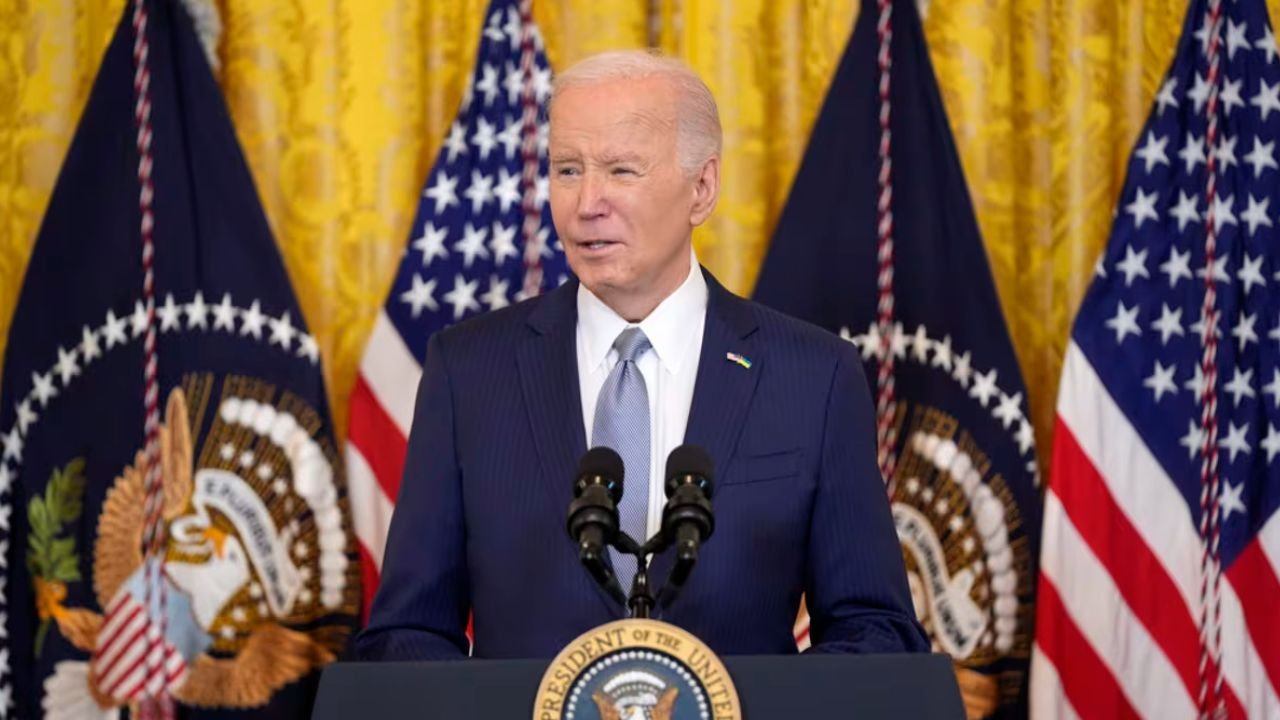
    US President Joe Biden said Monday he hoped a ceasefire in Gaza could start by the beginning of next week, adding that Israel was ready to halt operations during the Muslim month of Ramadan as part of any deal.

    Amid a spiraling humanitarian crisis in the Palestinian territory, representatives from Egypt, Qatar, the United States, France and others have acted as go-betweens for Israel and Hamas, seeking a halt to the fighting and the release of Israeli hostages held in Gaza.

    Asked during an election campaign trip to New York when such an agreement might start, Biden replied: “I hope by the end of the weekend.”

    “My national security advisor tells me that we’re close, we’re close, we’re not done yet. My hope is by next Monday we’ll have a ceasefire,” Biden told reporters.

    Biden, 81, gave more details of what a deal could look like when he spoke on the issue in an interview with late-night US television show host Seth Meyers.

    “There is a path forward, with difficulty,” he told Meyers when asked about how to end the conflict.

    Mediators have been hoping to get a deal in place before the start of the Muslim holy month of Ramadan in about two weeks.

    “Ramadan’s coming up and there’s been an agreement by the Israelis that they would not engage in activities during Ramadan as well, in order to give us time to get all the hostages out,” Biden said.

    Biden has previously spoken of a six-week ceasefire.

    ‘Temporary ceasefire’

    The US president said such a deal “gives us time to begin to move in directions that a lot of Arab countries are prepared to move” in terms of normalizing relations with Israel.

    “I think that if we get that temporary ceasefire, we’re going to be able to move in a direction where we can change the dynamic,” he said.

    Biden has firmly supported Israel despite the soaring death toll in its offensive in Gaza following the Hamas attacks on Israel on October 7.

    But he has been increasing pressure on Israeli Prime Minister Benjamin Netanyahu to limit civilian casualties, particularly in Israel’s planned offensive in Rafah.

    Israel had “made a commitment” to evacuate significant parts of Rafah before they “go and take out the remainder of Hamas,” Biden added.

    But overall Biden warned that the “only way Israel ultimately survives” was to reach a deal that gives “peace and security for Israelis and Palestinians.”

    Amid mounting tensions with Netanyahu, Biden told Meyers that if Israel continued with its “incredibly conservative government they have… they’re going to lose support from around the world.”

    Biden’s comments come after his National Security Advisor Jake Sullivan said Sunday that representatives from several parties — although not Gaza’s rulers Hamas — met in Paris over the weekend and reached an understanding about the “basic contours” of a temporary ceasefire.

    Israel’s military campaign has killed at least 29,782 people in Gaza since October 7, mostly women and children, according to the ministry.

    dk/ssy

    © Agence France-Presse

  • Rising petrol prices and rupee devaluation push inflation to 47.23% in Pakistan ahead of Eid

    Rising petrol prices and rupee devaluation push inflation to 47.23% in Pakistan ahead of Eid

    According to data released by the Pakistan Bureau of Statistics (PBS), a steep increase in the prices of essential food items such as chicken and petrol has pushed weekly inflation to 47.23 per cent year-on-year for the week ending on April 19. Inflation has risen 0.51 per cent week-on-week, compared to a 0.60 per cent decrease in the previous week.

    The rising inflation has been attributed to the increase in sensitive price indicators such as LPG, potatoes, petrol, tea, gur, matchbox, bread, chicken, bananas, broken basmati rice, and rice irri-6/9. However, a major decrease was observed in the prices of tomatoes, onions, garlic, sugar, wheat flour, mustard oil, cigarettes, and pulse gram.

    For the week under review, the SPI (Sensitive Price Index) was recorded at 251.83 points, against 250.56 points registered last week and 171.05 points recorded during the week ended April 21, 2022. Fahad Rauf, head of research at Ismail Iqbal Securities, said that SPI experienced an increase mainly driven by a 4 per cent and 2 per cent increase in the prices of petrol and chicken, respectively.

    During the week, the government raised petrol prices by Rs10 per litre, bringing the new price to Rs282 per litre, due to the impact of rising international oil prices and rupee devaluation. Chicken prices have also risen mainly due to increased seasonal demand in Ramadan and the arrival of Eid.

    Prices of commodities have risen significantly over the last year on account of devaluation as well as the massive floods that devastated food crops across most of the fertile plains of the country. Different weights are assigned to various commodities in the SPI basket, and prices of commodities have risen on a year-on-year basis. The PBS compiles the SPI by collecting prices of 51 essential items from 50 markets in 17 cities of the country.

    During the week under review, out of 51 items, prices of 29 (56.86 per cent) items increased, eight (15.69 per cent) items decreased, and prices of 14 (27.45 per cent) items remained unchanged. The PBS data attributed the year-on-year rise in SPI to the jump in the prices of goods such as cigarettes, wheat flour, gas charges for Q1, tea, diesel, potatoes, bananas, eggs, petrol, broken basmati rice, rice irri-6/9, pulse moong, and plain bread. However, a decrease was observed in the prices of tomatoes and chilli powder.

  • Inflation hits Pakistanis hard as they prepare for Eid-ul-Fitr festivities

    Inflation hits Pakistanis hard as they prepare for Eid-ul-Fitr festivities

    Eid-ul-Fitr is an important religious holiday celebrated by Muslims around the world, marking the end of the holy month of Ramadan.

    During Ramadan, Muslims fast from dawn until sunset and abstain from food, drink, and vices like gossip and lying. It is a period of self-reflection and a reminder to be charitable to the less fortunate.

    Observed first day of Shawwal, the tenth month of the Islamic calendar, Eid-ul-Fitr is a time for Muslims to come together with family and friends to offer prayers, exchange gifts, and share meals. It is also a way for Muslims to show their gratitude to Allah for giving them the strength to fast and to seek forgiveness for any sins committed during the year.

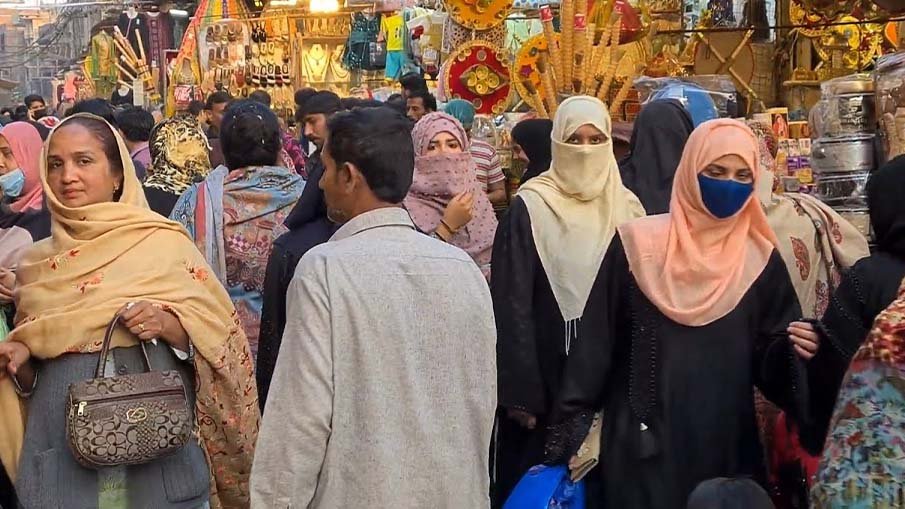
    However, in Pakistan, small shops and businesses are struggling to make ends meet during this year’s Eid-ul-Fitr celebrations. The high levels of inflation, which have hit their highest levels in decades, have left many businesses unable to make enough money to cover their monthly expenses, including rent and utility bills.

    For many small shops and businesses in Pakistan, the last days of Ramadan or before Eid-ul-Fitr used to be a guaranteed earner—a big-spending week that could match the take from the rest of the year. However, this year, many worry they will not even make enough to pay for their monthly expenses.

    A tailor in Canal Bank, Lahore, stated that each year, he was fully booked and had so many orders that he couldn’t take orders after the middle of the month of Ramzan. However, this year, he said, “For the first time, we are accepting orders in the last week of Ramzan as there is not much work.”

    Tailors in Lahore who used to charge Rs1,500 are now charging Rs2,500 or Rs2,200. Even well-known brands or shops are charging more, which is leaving consumers with no option but to go for cheap ready-made clothes or clothes that are available on sale.

    The South Asian country of more than 220 million people saw year-on-year inflation hit 35.4 per cent in March. Food prices surged more than 47 per cent in 12 months, with transport costs rising by 55 per cent.

    Pakistan is deeply in debt and needs to introduce tough reforms to unlock a tranche of a $6.5 billion bailout from the International Monetary Fund in order to avoid default. The economy has been wrecked by years of financial mismanagement and political instability—a situation exacerbated by a global energy crisis and devastating floods that left a third of the country under water last year.

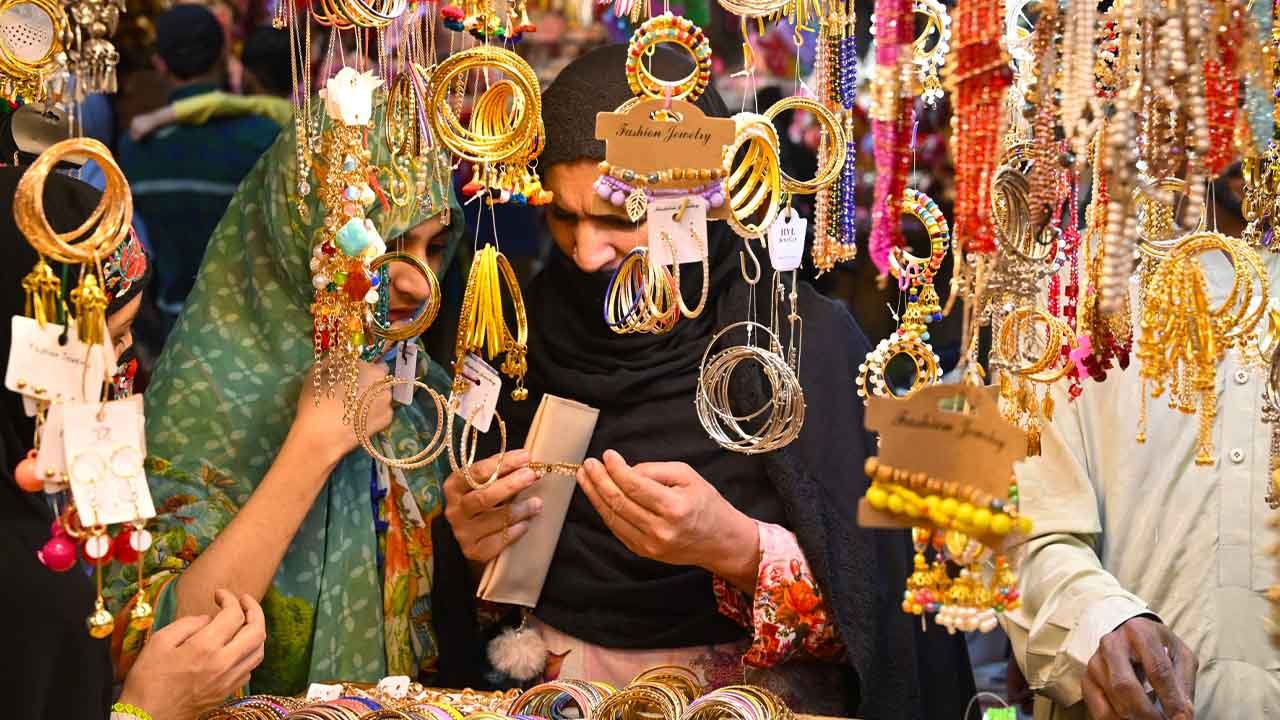
    An artificial jewelry shop owner in Anarkali, Lahore, Zaryab, said, “There is a significant difference between last year’s sales and this year’s. People come to our stall, see 3-4 necklaces or bangles, ask the price, and then leave.”

    The high inflation has significantly reduced the purchasing power of Pakistanis, and people are mostly focusing on fulfilling their essential needs. Noman Khan, an electrical engineer at ACE Pakistan, stated that this Eid, he has not been able to buy clothes for himself as he had to buy clothes for his two kids and wife. He added that “From artificial jewelry to kids’ clothes, everything is so expensive this year that I have no option but to wear old clothes. Although, I made sure that my kids and wife at least get what they want to wear this Eid.”

    In conclusion, the struggle for small businesses in Pakistan during Eid-ul-Fitr celebrations is a stark reminder of the country’s economic challenges. While many Pakistanis are still managing to celebrate the holiday, the high levels of inflation have made it difficult for many to enjoy the festivities.

  • Gold price hits new record high of Rs218,300 per tola as Pakistani rupee crashes

    Gold price hits new record high of Rs218,300 per tola as Pakistani rupee crashes

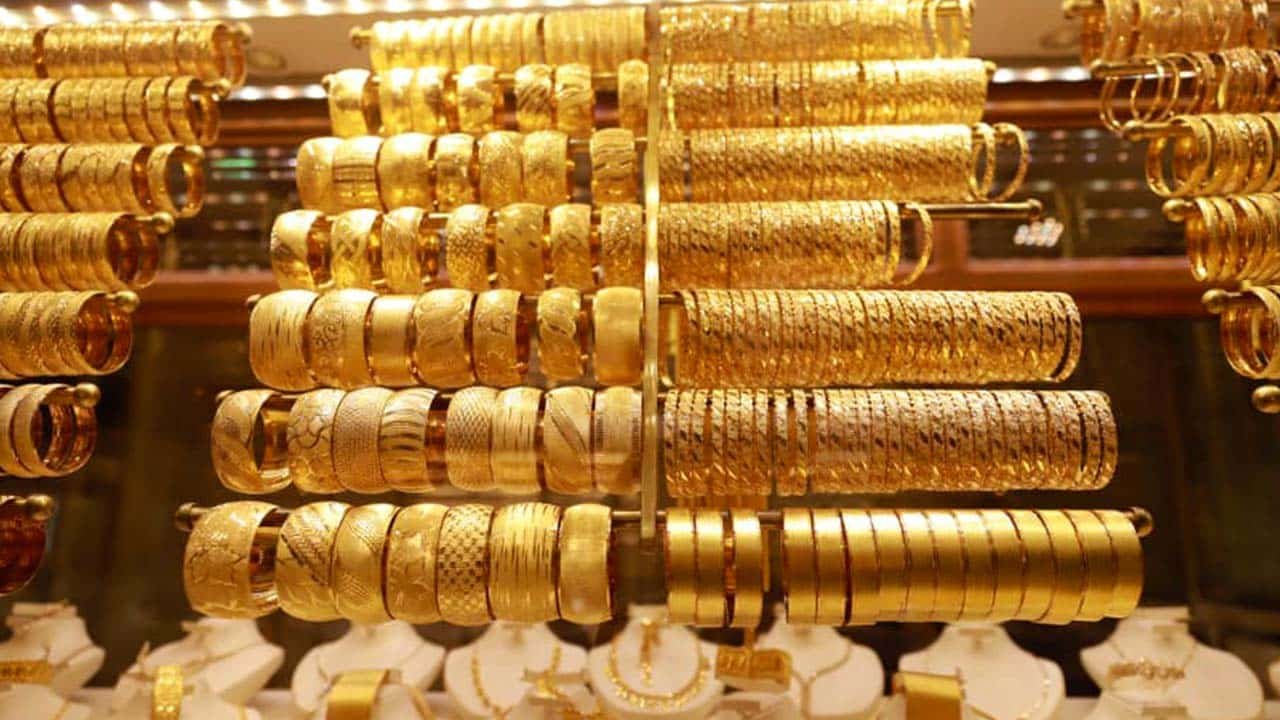
    The price of gold in Pakistan has surged to an all-time high, surpassing the Rs218,000 mark, as the country’s local currency slumped to a historic low against the US dollar. The All-Pakistan Sarafa Gems and Jewellers Association (APSGJA) has released data showing that the price of gold (24 carats) rose by Rs600 per tola and Rs514 per 10 grammes, settling at Rs218,300 and Rs187,157, respectively.

    The rise in the price of the yellow metal was in line with the movement of the rupee, which fell Rs1.34 or 0.46 per cent to Rs288.43 against the US dollar in the interbank market, and an increase in weekly inflation. Weekly inflation rose 0.92 per cent week-on-week and 44.49 per cent year-on-year during the seven-day period ending on April 6, as the prices of sugar and chicken surged due to Ramadan and likely hoarding.

    Gold is often seen as a hedge against inflation and its value increases as the purchasing power of the dollar declines, as well as due to seasonal demand during the holy month of Ramadan. During the week, investors’ attention shifted towards the precious metal as economic tensions continue to rise amid the International Monetary Fund (IMF) reviewing external financing commitments from friendly countries before it releases bailout funds. According to Geo, the delay in the revival of the programme has had a negative impact on the currency market, which in turn is bolstering demand for gold.

    The APSGJA also mentioned that the price of gold in Pakistan is Rs5,000 per tola “undercost” as compared to the Dubai market, indicating that the Pakistani gold market is currently cheaper than the global market.

    Meanwhile, silver prices in the domestic market have also surged to historic highs, with an increase of Rs40 per tola and Rs34.30 per 10 grams, settling at Rs2,520 and Rs2,160.5, respectively. In the international market, the price of gold dropped by $1 per ounce, settling at $2,001.

  • Gold price soars to an all-time high of Rs217,700 per tola amid economic tensions

    Gold price soars to an all-time high of Rs217,700 per tola amid economic tensions

    The price of gold has soared to an all-time high following a significant slump in the rupee against the dollar, with the country struggling to secure external financing. The data released by the All-Pakistan Sarafa Gems and Jewellers Association (APSGJA) shows that the price of gold (24 carats) has spiked by Rs3,100 per tola and Rs2,656 per 10 grammes, settling at Rs217,700 and Rs186,643 respectively.

    The gold rush is in line with the movement of the rupee, which has fallen 2.44 or 0.85 per cent against the US dollar in the interbank market, and an increase in weekly inflation. Inflation has shot up 0.92 per cent week-on-week and 44.49 per cent year-on-year during the seven-day period that ended on April 6th. Prices of sugar and chicken have surged due to Ramzan, and hoarding has caused a likely uptick in inflation.

    Gold is often seen as a hedge against inflation, increasing in value as the purchasing power of the dollar declines. Plus, it’s the season of Ramzan, which brings with it a surge in demand for the precious metal. Investors’ attention has shifted towards gold as economic tensions continue to rise, with the International Monetary Fund (IMF) reviewing external financing commitments from friendly countries before it releases bailout funds. The delay in the revival of the program has negatively impacted the currency market, which is boosting demand for gold.

    The APSGJA also noted that the price of gold in Pakistan is Rs5,000 per tola “undercost” compared to the Dubai market. Thus, the Pakistani gold market is cheaper than the global market. Meanwhile, silver prices in the domestic market have also jumped to historic highs, increasing by Rs30 per tola and Rs25.72 per 10 grams to settle at Rs2,480 and Rs2,126.20, respectively.

    In the international market, the price of gold dropped $6 per ounce, settling at $2,002. Nevertheless, gold’s rise in Pakistan is set to bring a lot of excitement to the local market.