According to the Punjab Police, the main suspect is under interrogation, while a search is underway to find the other suspects.
Moreover, the police have confirmed that the rape survivor underwent medical examination and a DNA sample is being taken, adding that the action has been initiated to arrest the other suspects.
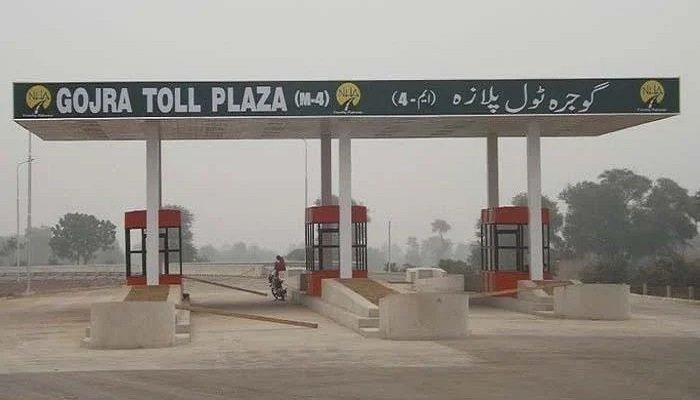
The suspects lured the young woman from Toba Tek Singh on the pretext of offering her a job.
In the First Information Report (FIR), the survivor’s paternal aunt said that her 18-year-old niece received a message on her mobile phone for a job interview in Gojra.
Her aunt said that upon reaching the place, the suspects put the survivor into a car, raped her on the motorway, and fled after throwing her at the Faisalabad Interchange.
Pakistan has been plagued by episodes of rape and abuse over the years that it has now become common to the extent that people have started normalising such acts.
Back in 2002, Mukhtaran Mai’s gang-rape was one of the most horrifying gang-rape incidents that were reported.
Another major incident that took place in 2014 was the Layyah gang-rape case, where a 20-year-old girl after being gang-raped, was found hanging from a tree. Such inhumane incidents haven’t stopped even now.
Two men stole her money and the jewellery she had on her. They then raped her in front of her two children in a nearby field and escaped.
The incident sparked national outrage but what happened next? Before the arrest of the two culprits, questions like “Why was she out on the motorway so late without a brother or husband? Why didn’t she check her gas tank before leaving the house? And if she had to travel, why didn’t she take the more public GT Road route?” were asked because, sadly, in our country ‘getting raped’ is the woman’s fault. Apparently, a woman gets raped because ‘she was driving alone, on the wrong road, at the wrong time, in the wrong place’.
Later, the motorway rapists were sentenced to death but rape cases continued to rise in Pakistan.
On October 12, 2020, our team started counting rape cases on a daily basis from 13 different sources, which included these newspapers: Dawn, The News, The Express Tribune, The Nation, Pakistan Today, Daily Times, Nawa-e-Waqt, Daily Jang. And from these websites: ARY News, Geo News Samaa News Dunya News Aaj News.
It is to be noted that the given stats only include the reported incidents, not the ones that go unreported.
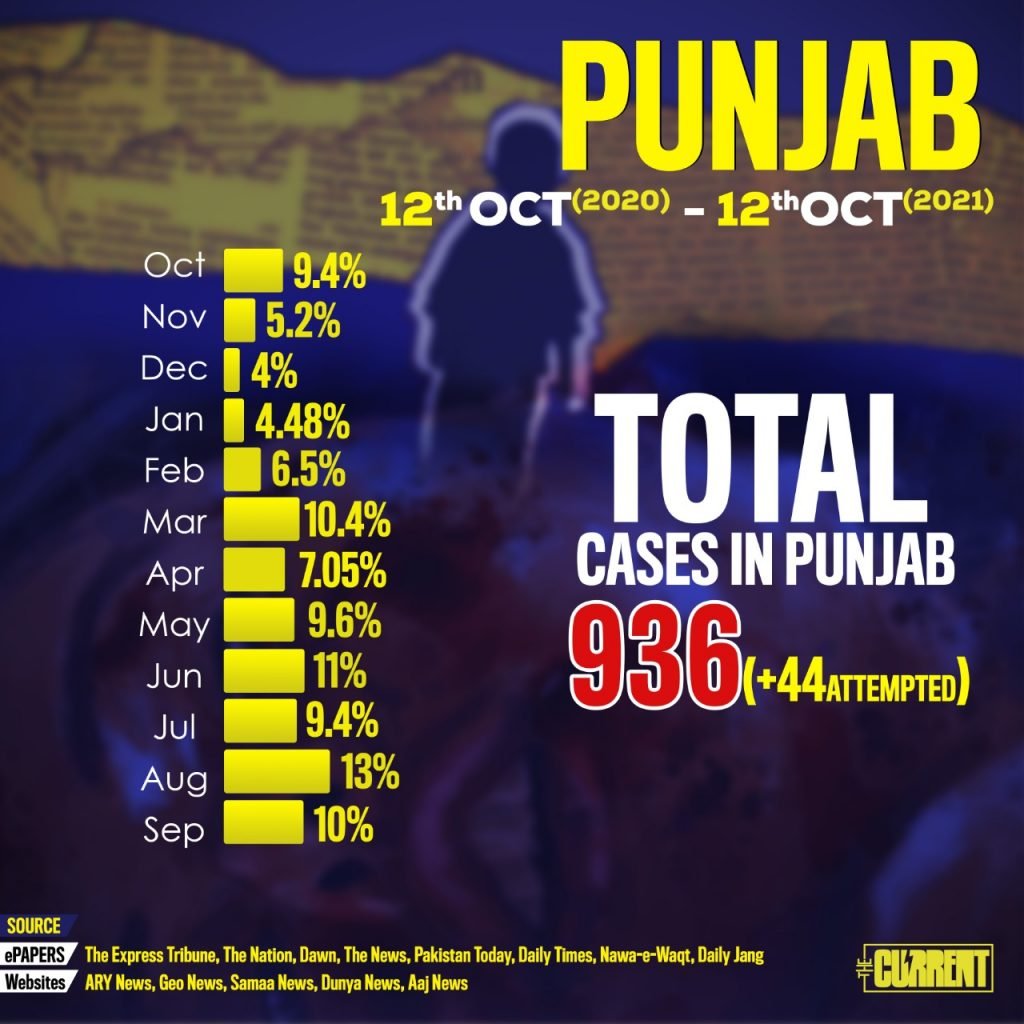
During the process, we have included reported rape cases of girls, boys, women, men and transgenders. Moreover, we have divided the rape cases province-wise, according to which Punjab till date has the highest number of rape cases, i.e. 936 rape cases and 44 attempted incidents.
It has been a year since we have started posting our rape template daily to analyse the record of reported rape cases. We have collected the data of the entire year (October 12, 2020 to October 12, 2021) and prepared slides of reported cases of each month provinces-wise.
Provinces Categorisation:
Sindh
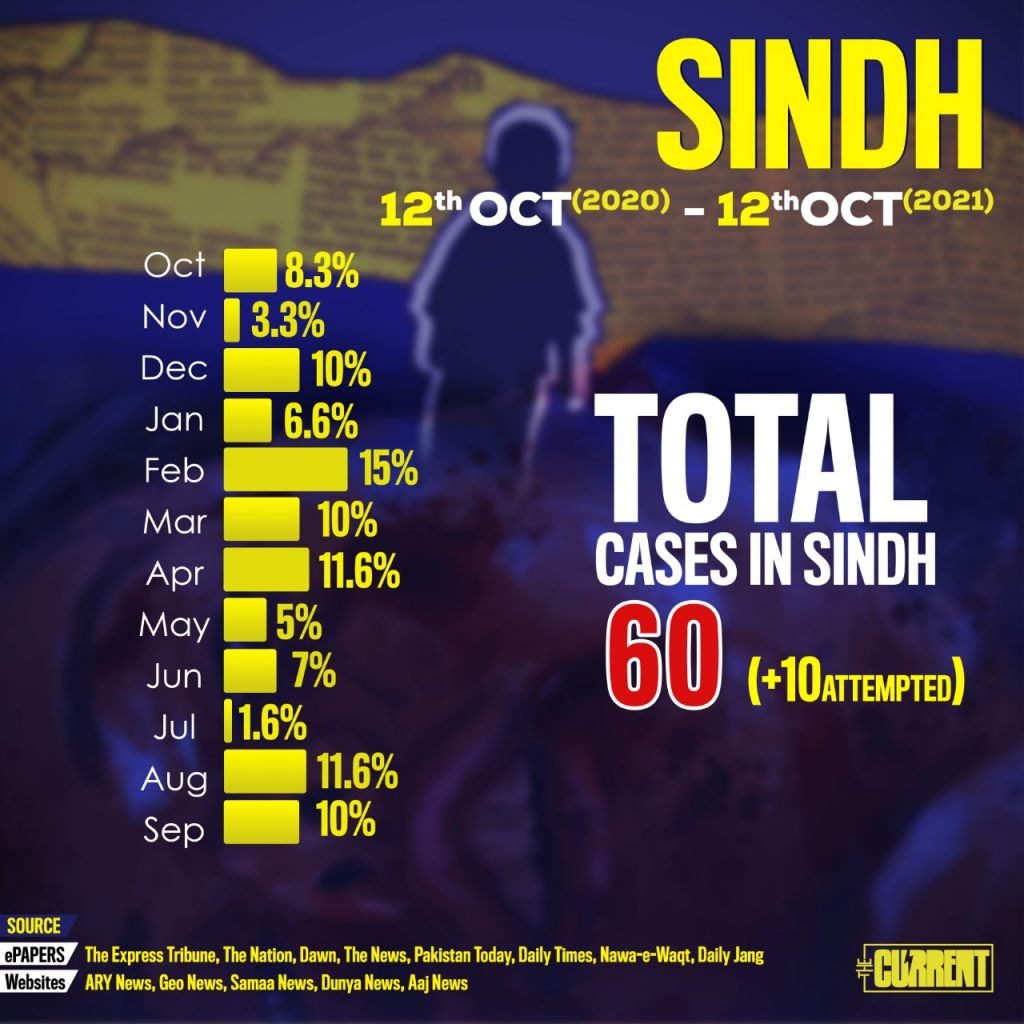
Till date, Sindh has recorded a total of 60 reported rape cases in which 10 are attempted incidents. 11.6 per cent of cases were reported in the month of April and August as per the graph.
Punjab
Punjab has recorded a total of 936 reported rape cases in which 44 are attempted incidents until now. 13 per cent of cases were reported in August.
Islamabad
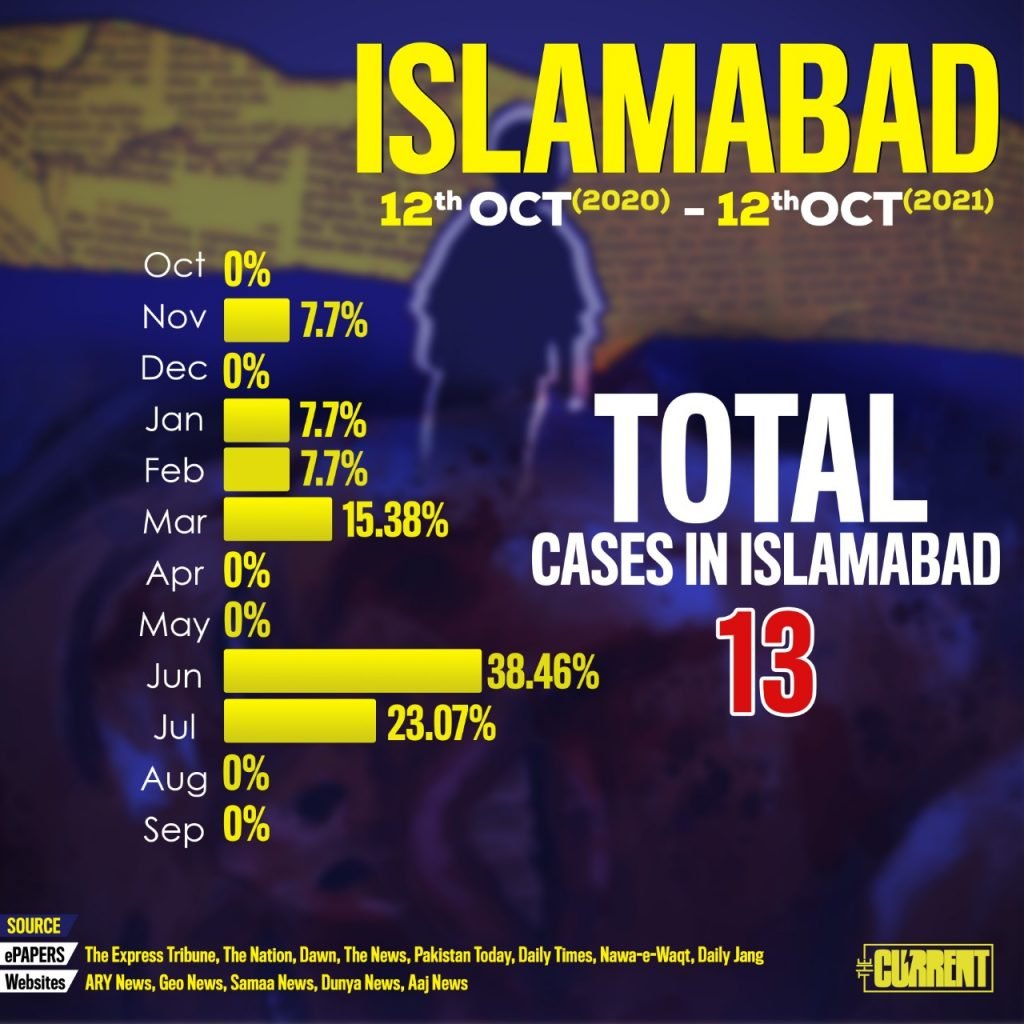
The capital has recorded a total of 13 reported rape cases which no attempted cases until now. The reported cases are relatively low as compared to other provinces’ data. However, 38.46 per cent of rape cases were reported in June this year.
Balochistan
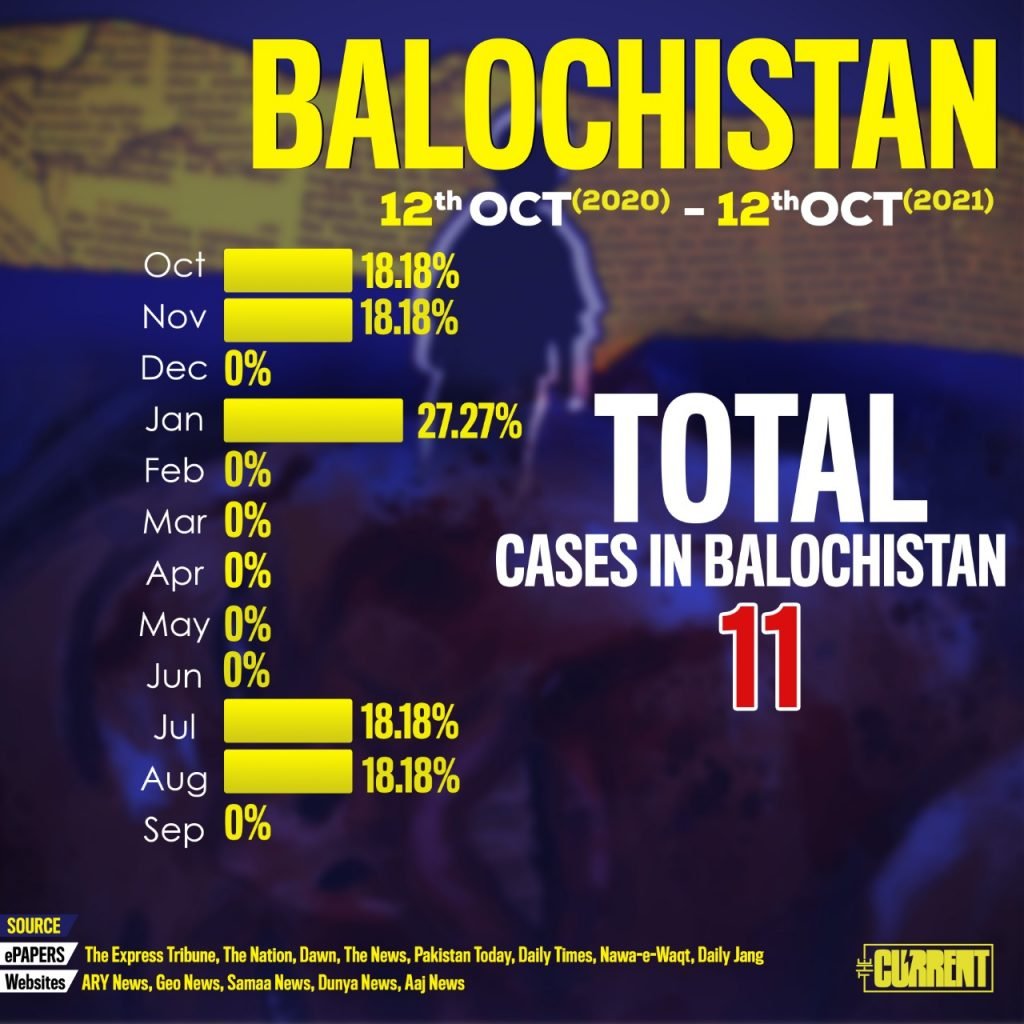
Balochistan has reported a total of 11 reported rape cases. Most of the months show zero reported rape cases, according to the graph.
KPK
Khyber Pakhtunkhwa (KPK) has reported a total of 20 reported rape cases of which 2 were attempted incidents. The numbers throughout the months are quite the same.
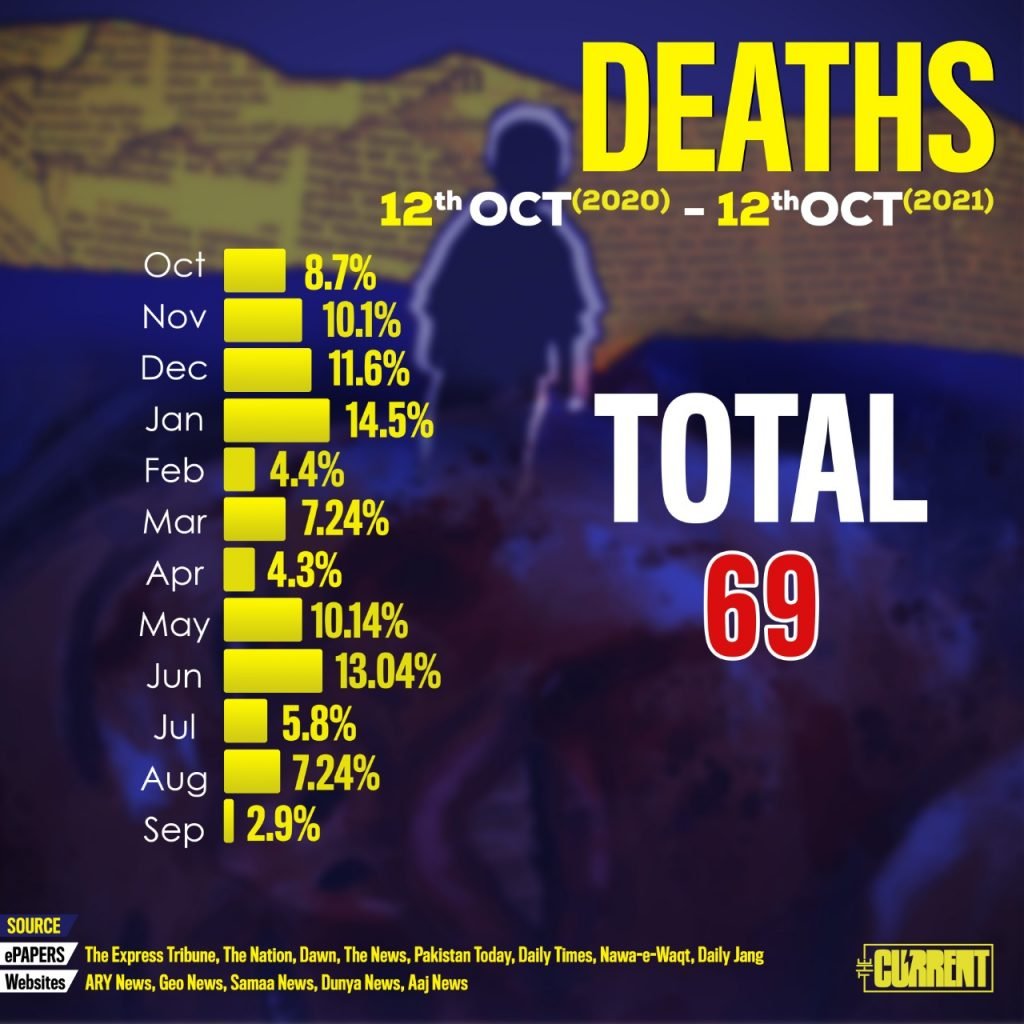
Deaths (province-wise)
As per the graph, the death rate was high in the month of January i.e.14.5 per cent.
Numbers of the recorded cases after the highlighted incidents of 2021
After the following incidents, we noticed an increase in the reporting of rape cases.
Mufti Aziz-ur-Rehman: sexual assault case
On June 17, police registered a criminal complaint against Mufti Aziz after a male student accused him of sexual abuse. In the aftermath of a viral graphic video that showed Mufti engaging in sexual intercourse with the male student, who was the victim, the action was taken against Mufti Aziz. After the incident, we noticed an increase of 10.7 per cent in the reporting of rape cases in the month of June.
Usman Mirza’s sexual assault on a couple
Usman Mirza was arrested on July 7. He was seen torturing and assaulting a couple. He was also seen stripping naked a woman in the video. The video sparked outrage across Pakistan. After the petrifying incident, an increase of 9 per cent was observed in the reporting of rape cases in the month of July.
Noor Mukadam’s murder case
On July 20, Noor Mukadam, daughter of former Pakistani diplomat Shaukat Mukadam, was raped, beheaded and murdered, in a posh neighbourhood of Islamabad in July. Noor’s murder led to nationwide protests. After her murder, as per the reported cases we have monitored, there was an increase of 12.6 per cent in the month of August.
There are many more cases that are still unreported due to various reasons.
According to The News, official statistics obtained from the Police, Law, and Justice Commission of Pakistan, Human Rights Commission of Pakistan, Women’s Foundation, and provincial welfare agencies in 2020 revealed that there are at least 11 rape cases reported in Pakistan every day with over 22,000 rape cases reported to the police across the country in the last six years.
The Senate Standing Committee on Law and Justice, chaired by Senator Syed Ali Zafar, on Wednesday approved the Anti-Rape (Investigation and Trail) Bill, 2021 stipulating the formation of special courts to hear rape cases.
The National Assembly passed the bill on June 10 after that it was moved by Law Minister Dr Farogh Naseem on June 15. It will now be tabled in the Senate for approval, as perDAWN.
The Senate standing committee for Law & Justice passed the Anti-rape(investigation & trial) Bill. A great win for women across Law Minister @Farogh_NaseemPK & PM @ImranKhanPTI are the real force behind this. Credit to members of opposition members for a constructive role.
The provision of the virginity test has been removed.
If one is proven guilty, they could face a death sentence, life imprisonment, or undergo chemical castration.
Investigation officials could also face a penalty if they tried to mislead case proceedings in any capacity.
The suspects will be provided facilities to prove their innocence.
Instead of retired ones, serving judges will be appointed to the special courts.
Opposition reaction
PPP’s Mustafa Nawaz Khokhar suggested that the parliament must monitor the performance of special courts means that the legislature could make changes to the law if issues continue to transpire.
His party mate Raza Rabbani said he didn’t believe that constitution of special courts was required for hearing rape cases.
Furthermore, Azam Nazeer Tarar of the PML-N said similar courts were also established in the past, but they didn’t very helpful.
Prior to this last year after the motorway incident, President Arif Alvi approved the anti-rape ordinance and had said that special courts would be established throughout the country for speedy trials of sexual assault suspects. The courts would have to wrap up the cases within four months.
Cases like Noor Mukadam’s makes us wonder: what happened to the murderers and rapist of the major violence against women cases in Pakistan? We follow up on seven major cases in Pakistan.
Motorway Gang Rape Case- 2020
In September 2020, a woman was gang-raped at gunpoint in Lahore’s Gujjarpura area in the presence of her children after her car ran out of fuel. She was waiting for help on the Lahore-Sialkot Motorway (M-11).
What happened to the rapists?
An anti-terrorism court (ATC) in March 2021 awarded a death sentence to prime accused and co-accused – Abid Malhi and Shafqat Ali – in the motorway gang-rape case. The court also awarded life imprisonment to both convicts under the charges of abduction and 14-years imprisonment to each accused under the charges of robbery. They are currently serving their sentences in prison.
Zainab Ansari-2018
Zainab, who was only six years old, was raped and killed in Kasur. Her body was found in a rubbish dump.
What happened to the convict?
Imran Ali, 24, was convicted over the death of Zainab was sentenced to death was hanged in October 2018.
Khadija Siddiqi-2016
A law student, Shah Hussain, stabbed his class fellow, Khadija Siddiqi, 23 times in Lahore in May 2016.
What happened to the convict?
Shah Hussain was sentenced to jail for five years but he was released from jail on July 17 2021 without completing his five-year jail term. He got a 1.5-year remission for “good character and blood donation”.
Kainat Soomro-2007
In 2007, a 13-year-old schoolgirl, Kainat Soomro, was kidnapped and gang-raped for four days in her native village of Mehar in Sindh. After she spoke out against her rapists, the village elders decided that she should be killed for bringing dishonour to her family.
What happened to the convict?
Her parents rejected the decision; her brother was subsequently killed and her sister was divorced. She lost the court case against her rapists. The court ruled that the accused were innocent, stating that there was no corroborative evidence available on record. All four men accused of Kainat’s rape were hence acquitted.
Dr Shazia Khalid-2005
In January 2005, Dr Shazia Khalid, an employee of a state-owned natural gas firm, was raped in Sui (Balochistan). She was working at the company’s hospital for the past 18 months while living alone in heavily guarded government-provided accommodation.
What happened to the convict?
The rapist of Dr Shazia Khalid, Captain Hammad, was declared innocent by Former Army Chief and Dictator Pervez Musharraf and no inquiry report on the subject was made public.
Mukhtaran Bibi-2002
Mukhtar Mai was gang-raped by order of her tribal council as punishment for her younger brother’s alleged relationship with a woman from another clan.
What happened to the convicts?
In August 2002, an anti-terrorism court sentenced six out of the 14 accused persons to death. Four of them were sentenced for rape, while the other two were convicted as being members of the village council. Eight others were released.
In 2005, the Lahore High Court acquitted five, and subsequently released, of the six convicts while one person’s death penalty was converted to life imprisonment. Mai challenged the decision in the Supreme Court, but her appeal was rejected in 2011.
Farhana (Veena)- 1991
November 1991: Farhana, known as a friend of Benazir Bhutto, was assaulted, raped, and tortured for 12 hours at gunpoint by five men. What happened?
A court case was filed against Irfanullah Khan Marwat for being behind the rape. No evidence was found against Marwat. After Marwat’s acquittal, Farhana moved out of Pakistan.
Police booked five men for allegedly raping and killing a goat in Okara on Tuesday.
According to the police, five men unchained a labourer’s goat and took it with them to a nearby compound. The suspects sexually assaulted the animal, tortured and killed it.
As per reports, locals saw the suspects escaping after committing the crime.
The owner of the goat registered a complaint with the police. Police registered a case against the five suspects.
Azhar Hussain, a local of Satghara police station, had his goat tied in front of his house which was untied by Naeem and his four partners. The suspects took the goat to a nearby compound where they tortured and raped it.
The goat was taken to a livestock hospital by the police. The medical report showed that the goat was raped before it was killed. Police have started a search operation to arrest the suspects.
DPO Faisal Shehzad took notice of the incident and ordered Satghara SHO Javed Khan to detain the culprits as soon as possible. SHO Javed Khan said the suspects will be arrested soon.
Residents of the area demanded from the police to strictly punish the culprits for the heinous crime.
A 30-year-old woman, who was allegedly raped and later stabbed in front of her 14-month-old son, passed away after struggling for her life in the District Headquarters (DHQ) Hospital on Sunday.
As per reports, the victim’s son Gulfam was also stabbed at the crime scene. He also passed away.
Police filed a case against the suspect under relevant sections of the law involving rape/murder and a search operation has been launched to arrest him.
On Saturday at around 12:30 pm, the victim, her son, brother, and uncle Mohammad Ramzan reached Chak Beli Bazaar for begging in the area.
In the FIR, the victim’s brother stated that they met a man (suspect). His sister already knew him and he offered to take her and her son to Mohra village.
The complainant said that he was worried when his sister and her son did not return after a long time. He started looking for them and found them lying injured in the Mohra area.
The victim told her brother that she was sexually assaulted by the suspect. The suspect also tried to kill her by stabbing her in the neck with a knife, which left her seriously injured. She said the suspect also stabbed her son and fled away.
The complainant said he and his uncle were taking the injured mother and son to a nearby hospital in Rawalpindi, but Gulfam died on the way. The body of the 14-month-old boy was handed over to his relatives after postmortem on Saturday. The mother who was struggling for her life in the emergency ward of DHQ Hospital and breathed her last on Sunday.
Initial postmortem report shows that the woman’s neck injuries were the cause of her death whereas forensic analysis was being carried out to determine if she was raped.
The investigating officer said the victim originally belonged to Vehari and was unable to record her statement due to her critical injuries.
After the incident came to light, Station House Officer Mohammad Asif, SI Yasir Mehmood, who is investigating the incident, and other senior police officers reached the spot and collected evidence and other relevant information.
Police have arrested the suspect identified as Wajid Ali on Tuesday.
Recently, a session court in Karachi has sentenced a man to 14 years in jail after he was found guilty of raping his eight-year-old daughter three years ago, reports Zubair Ashraf for The News.
On March 7, 2019, the rapist Shahid’s wife, a young maid, was at work. Her three children came back home from their school in the evening. Their father, Shahid, was at home to greet them. He sent his two younger sons to play outside and raped his daughter at his house.
The victim told her mother when she returned home from the work. The mother after finding the truth fought with Shahid but he denied the allegations. The mother with her daughter went to Jinnah Postgraduate Medical Centre (JPMC) for the medical examination.
The medical reports showed that the girl was subjected to vaginal and anal intercourse. The police took a week to register an FIR against Shahid on the complaint of his wife.
An investigation was started and the officials questioned the accused and the complainant collected swabs for DNA and chemical analysis and held the clothes of the victim.
After the investigation, the police charged-sheeted the husband for rape and unnatural offence. When the suspect was charged, he did not confess alleging his wife of infidelity. He said that he was falsely accused in the case by his wife because he had caught her cheating on him with another man in their house.
A lawyer, Asiya Munir represented Zakiya and Gulshan in the case. Speaking to The News, she said, “First of all, nobody in our society tends to believe incest cases, not even the judges. They think that these all are made-up stories. In this hostile and harassing environment, proving your case becomes a tremendously difficult job.” The worst part of it, she added, was standing to the leering looks and shameful questions during the arguments in the courtroom.
“I have seen these mother and daughter sitting together like glued in a corner of the courtroom getting humiliated by staffers and taunted by the defence lawyers,” Asiya said, explaining the reason behind her request for an in-camera hearing to record the statement of the victim.
The examination-in-chief of the victim took place inside the chamber of the judge. Except for the victim, judge, and complainant’s and defence lawyers, no one was there in the room.
After the victim stated what had happened, the defence lawyer was allowed to cross-examine her. “You [the victim] are lying because your mother has told you to,” the lawyer representing her father asked her. She responded, “My mother has not taught me to lie.”
“Your mother had an affair with someone,” the lawyer asked another question. Her attorney objected to it but the victim said, “No, my mother cleans the washrooms of others for us. She is not lying nor am I.”
The defence lawyer questions before the judge were: In the case of rape, why is there no violence mark or injury found on the victim? Why was the FIR filed a week later? Why were the clothes of the victim handed to the police 19 days after the incident? Why didn’t the complainant get a letter from the concerned police station before going to the JPMC? The complainant is having an extramarital affair and the person should also be summoned by the court.
In the judgment issued on July 17, the East Additional District and Sessions Judge, Javed Ahmed Phulpoto, observed that as far as the allegation of the affair was concerned, the accused had not been able to produce even his own relatives to support his stance. The judge termed this allegation an attempt by the accused “to malign the complainant and gain sympathy from society to get away from his crime.”
The judge remarked that the absence of torture marks was not enough proof to suggest that the crime did not take place.
“The statement of the victim is straightforward and [she] narrated the entire incident in a very innocent and natural manner and the defence failed to establish that there was any exaggeration in her statement,” the judge observed, adding that the victim’s, the complainant’s and the investigators’ testimonies were not questionable and so was the medical proof which showed the offence on the accused.
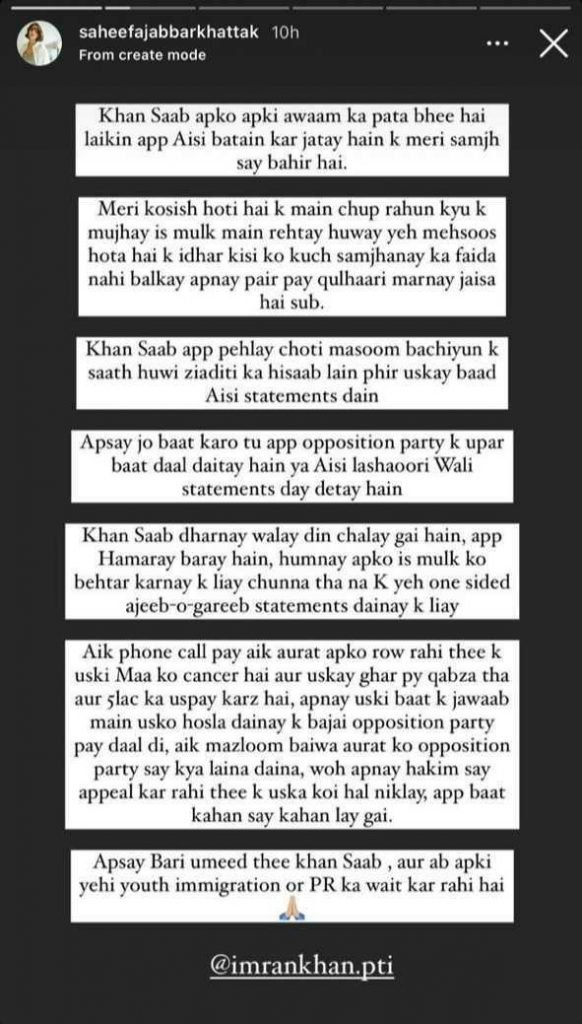
Saheefa Jabbar Khattak has expressed her disappointment with Prime Minister Imran Khan’s statement regarding women’s attire and potential rape threat.
Taking to her Instagram story, Saheefa said Pakistanis had chosen Khan as PM to solve the problems and not for giving irrelevant statements.
“We have chosen you to make our country better and not for giving irrelevant statements,” Saheefa called out. “Firstly, do justice with teenage girls who were sexually abused and then give such statements,” the actor stressed.
“Every time, you [PM Khan] start blaming the opposition. Kindly, do not do that, people want you to solve their problems and not just blaming the opposition,” she added.
The Boom Boom rendition singer Meesha has also tweeted on PM’s statement.
“To matlab bachay bhi aurton ke kapron kee wajah se rape ho rahay hain?”, tweeted Shafi.
To matlab bachay bhi aurton ke kapron kee wajah se rape ho rahay hain?
Maria Wasti recently gave an interview in which she spoke on a wide range of topics, from politics to the entertainment industry.
“I would like to say to Prime Minister Imran Khan Ghabrana Nahi Hai [not to be scared],” said the actress, appearing as a guest at the show Jashan-e-Cricket.
Without mentioning it directly, she spoke about the recent controversy triggered by the prime minister’s comments on women’s dressing and the rise in cases of sexual abuse and rape.
“The PM should weigh his words before speaking on international forums,” she said.
An FIR (first information report) was recently registered against Mufti Aziz-ur-Rehman of Lahore’s Jamia Manzoorul Islamia over charges of unnatural offenses (sodomy) and criminal intimidation. Mufti Aziz-ur-Rehman’s video went viral on social media in which he can be seen sexually assaulting one of his students.
The young student taped the incident on video to prove how he was being raped on a regular basis by the mufti and the madrassa administration refused to believe him when he complained about the sexual abuse. The student, who is in hiding because he has been receiving death threats from Mufti Aziz and his sons, said this had been going on for more than three years. In the disturbing video of sexual assault, the student later says that he is contemplating suicide. Mufti Aziz and his sons are on the run and have not yet been arrested.
Mufti Aziz has been expelled from the seminary and his title of a religious scholar has been stripped off by the Wafaq-ul-Madaris. When the disturbing video did the rounds on social media, only then was the matter highlighted and action taken against Mufti Aziz. The young student was able to record a video of this heinous crime but what about those students and young children who are unable to record such incidents? This is not just about seminaries but schools and other places in the country. As per Sahil, an NGO that works on child protection and child sexual abuse, 2,960 cases of child abuse were reported across Pakistan in 2020. This is just the tip of the iceberg as many cases of child abuse and sexual assaults and rape are either never reported, or the survivors’ and victims’ are blackmailed, their families pressurised. In some cases, reports indicate that the police are bribed or such cases are settled out of court even though this is not legally allowed.
We saw extreme outrage over Nobel Laureate Malala Yousafzai’s innocent remarks about marriage in a recent interview. The matter was even discussed in the Khyber Pakhtunkhwa Assembly and she was asked to clarify her comments. Where is this indignation now in the case of Mufti Aziz? Why are we not outraged that a young boy was repeatedly raped by his teacher? Why are we not talking about how such cases are overlooked most of the time and how our society reacts to fake videos of Aurat March versus a legit video of sexual abuse? Even with the evidence out in public, we saw some sickening remarks of how the ‘act’ was ‘consensual’ because the student did not ‘resist’ it. Such insinuations are extremely disturbing because the student has made it quite clear in his statement how he was forced to go through this abuse because of the power dynamics against his will. Why don’t we believe victims and survivors of sexual abuse? This is a sad reflection of how we behave as a society. We need to change this and believe the survivors of abuse. We also need to start teaching our children about good touch and bad touch. It is imperative that we make our children safe from predators.
National Assembly’s Standing Committee on Law and Justice has approved chemical castration, which falls in the Criminal Law bill.
As per the Criminal Law Bill 2020, if the accused commits the crime again after serving a life sentence, he will be sentenced to chemical castration.
Under this law, special court, anti-rape crises cell, and special committee would be set up to hear rape cases and registered complaints.
Geo news reported that under the Criminal Amendment Bill 2021, a rapist who commits the crime again will be chemically castrated.
In November 2020, the federal cabinet had approved a law that proposed chemical castration as a punishment for convicted rapists.
Prime Minister Imran Khan had previously said the government will not tolerate any lax attitude in the implementation of anti-rape laws and added that the safety of all citizens was the utmost priority of the government.
The premier said the legislation will be clear and transparent with strict enforcement. He said the rape survivors will be able to register complaints without fear, adding that the government will protect their identity.
Regarding chemical castration, Pakistan People’s Party’s (PPP) Nafisa Shah said it is inhuman under the law. The law for awarding death punishment and life imprisonment to rapists already exist, she added.