Tag: raw material costs

  • Pak Suzuki hikes prices, Cultus AGS now priced above Rs4.5 million

    Pak Suzuki hikes prices, Cultus AGS now priced above Rs4.5 million

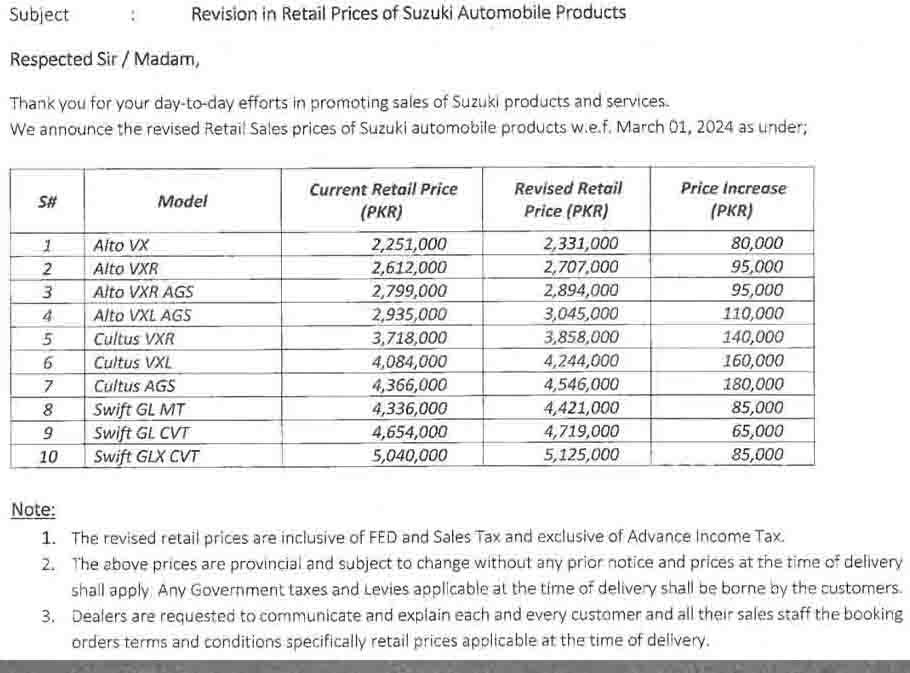
    In response to inflationary pressures and rising overhead costs, Pak Suzuki has announced a significant hike in car prices, impacting models across the range.

    The adjustments, ranging from Rs80,000 to Rs180,000, are set to take effect on March 1, 2024.

    Shafiq Ahmed Shaikh, Head of Corporate Affairs at Pak Suzuki, explained the rationale behind the decision, citing factors such as inflation, increased overhead expenses, higher international raw material and accessory costs, and elevated shipment and freight charges.

    The latest adjustments mean that the top-of-the-line model, Alto VXL AGS, will now be available at Rs3.045 million, reflecting a price increase of Rs110,000.

    However, the most significant surge is observed in the Cultus AGS, with its new price set at Rs4.546 million, following an increase of Rs180,000.

    This move by Pak Suzuki aims to navigate the challenges posed by the current economic landscape, ensuring the sustainability of operations amid various cost escalations.

    Customers will experience the impact of these changes as they come into effect, marking a new pricing structure for Suzuki vehicles in Pakistan.

    Here are the new prices for all Suzuki cars:

  • Public health concerns mount as essential drug prices increase

    Public health concerns mount as essential drug prices increase

    The interim government announced on Wednesday a price adjustment affecting 146 essential drugs, aligning with the decision made by the federal cabinet on February 1, 2024.

    The Ministry of National Health Services and Regulations issued a notification invoking its authority under Section 36 of the Drug Act 1976, stating that all drugs and biological substances not included in the National Essential Medicines List are exempt from Section 12 of the act in the public interest.

    This decision stems from a federal cabinet meeting chaired by interim Prime Minister Anwaar ul Haq Kakar on February 1, 2024. The move, categorised under hardship, was endorsed based on the recommendation of the National Health Services Ministry. The ministry highlighted the escalating costs of raw materials for drug manufacturing in the global market.

    Officials from the National Health Services Ministry and the Drug Regulatory Authority of Pakistan (DRAP) informed the cabinet that citizens could report medicine unavailability through the pharmaceutical industry regulator’s online portal.

    Primarily targeting vital medications like those for cancer treatment, vaccines, and antibiotics, the decision, communicated through a drug price hike notification, was based on a proposal from the Drug Regulatory Authority, suggesting price increases for 262 medicines. However, the government opted to implement adjustments for 146 medicines crucial to saving lives.

    According to Brecorder, among the medicines listed for price increments, pharmaceutical companies are tasked with adjusting the prices of 116 medications.

    Significantly, the government will now oversee the prices of 464 medicines included in the National Essential Medicines List, ensuring the accessibility of critical medications to the public.

    The government’s decision to deregulate drug prices grants pharmaceutical companies autonomy to adjust prices independently, marking a significant shift in pharmaceutical pricing governance that may reshape the healthcare industry’s landscape.

    As stakeholders assess the implications, concerns regarding affordability and access to life-saving medications emerge. While the government seeks to balance the viability of pharmaceutical companies with public health interests, the consequences of these adjustments warrant scrutiny and debate.

    However, following the cabinet’s approval of the price increase, a shortage of essential drugs was observed in both the wholesale and retail markets. Drug distributors and retailers attribute this to manufacturers awaiting formal notification from the Health Ministry regarding the price increase before releasing supplies to the market.

    This practice has resulted in significant patient suffering, as Mohammad Samiullah Awan, a drug retailer, highlights. While the notification’s issuance may ensure medicine availability, it further burdens already financially strained consumers grappling with price hikes.
  • Pak Suzuki suffers worst sales decline, sells less than 1,000 cars in February

    Pak Suzuki suffers worst sales decline, sells less than 1,000 cars in February

    Recent reports indicate that Pak Suzuki Motors has experienced a significant decline in sales due to production issues. The company has recorded its worst sales performance in history, mainly because of a shortage of production parts and rising raw material costs.

    Reports reveal that Pak Suzuki sold fewer than 1,000 units in February, marking its worst performance since the country’s COVID-19 lockdowns in April 2020 when production and sales came to a halt. In January, the automaker sold 2,940 vehicles, a significant 74 per cent decrease in monthly sales. This was attributed to the poor sales of the Suzuki Alto, which declined from 6,898 units in December 2022 to 44 units in January 2023.

    The official figures from the Pakistan Automotive Manufacturers Association (PAMA) are yet to arrive, but the total units sold in February are expected to range from the high tens to low hundreds.

    Despite being among the highest-selling automobile brands in the country, Pak Suzuki’s recent sales decline has left it struggling to maintain its position in the fiercely competitive industry. The drop in Suzuki sales is attributed to production part issues, which have caused difficulty in obtaining necessary auto parts due to major supply chain issues caused by the pandemic. As a result, the company has faced a shortage of raw materials and production parts.

    Global inflation has further exacerbated the problem, leading to a rise in the prices of raw materials and an increase in the car prices. This inflation has further contributed to a drop in sales as it has become difficult for the company to access all the required materials.