Tag: repayment

  • Pakistan’s debt burden increases by Rs86.28 billion within seven days

    Pakistan’s debt burden increases by Rs86.28 billion within seven days

    In the week ending January 12, the government of Pakistan increased its debt burden by Rs86.28 billion, bringing the total net borrowing for the ongoing fiscal year 2024 to Rs2.57 trillion, as per the latest estimates from the State Bank of Pakistan (SBP).

    The government’s borrowings fall into three main categories: budgetary support, commodity operations, and others.

    The breakdown of the weekly net borrowing reveals that Rs87.7 billion was allocated for budgetary support, while Rs1.37 billion went towards retiring commodity operations.

    Additionally, Rs48.4 million was used for other purposes during the week.

    Cumulatively, this brings the borrowing figures for the fiscal year 2024 to Rs2.77 trillion for budgetary support, Rs193.72 billion for retiring commodity operations, and Rs1.1 billion for other purposes.

    The primary sources of financing for budgetary support are the State Bank of Pakistan and the Scheduled Banks. In the ongoing fiscal year, the government has repaid a net sum of Rs1.05 trillion to the central bank.

    The Federal Government accounted for Rs954.56 billion of this repayment, while the Provincial Government, AJK Government, and GB Government contributed Rs77.73 billion, Rs11.17 billion, and Rs2.05 billion, respectively.

    On the other hand, scheduled banks have extended a net total of Rs3.81 trillion in loans. The Federal Government borrowed Rs3.9 trillion, while the Provincial Government repaid Rs90.41 billion during this period.
  • SBP-held foreign exchange reserves dropped to 9-year low of $4.34 billion

    SBP-held foreign exchange reserves dropped to 9-year low of $4.34 billion

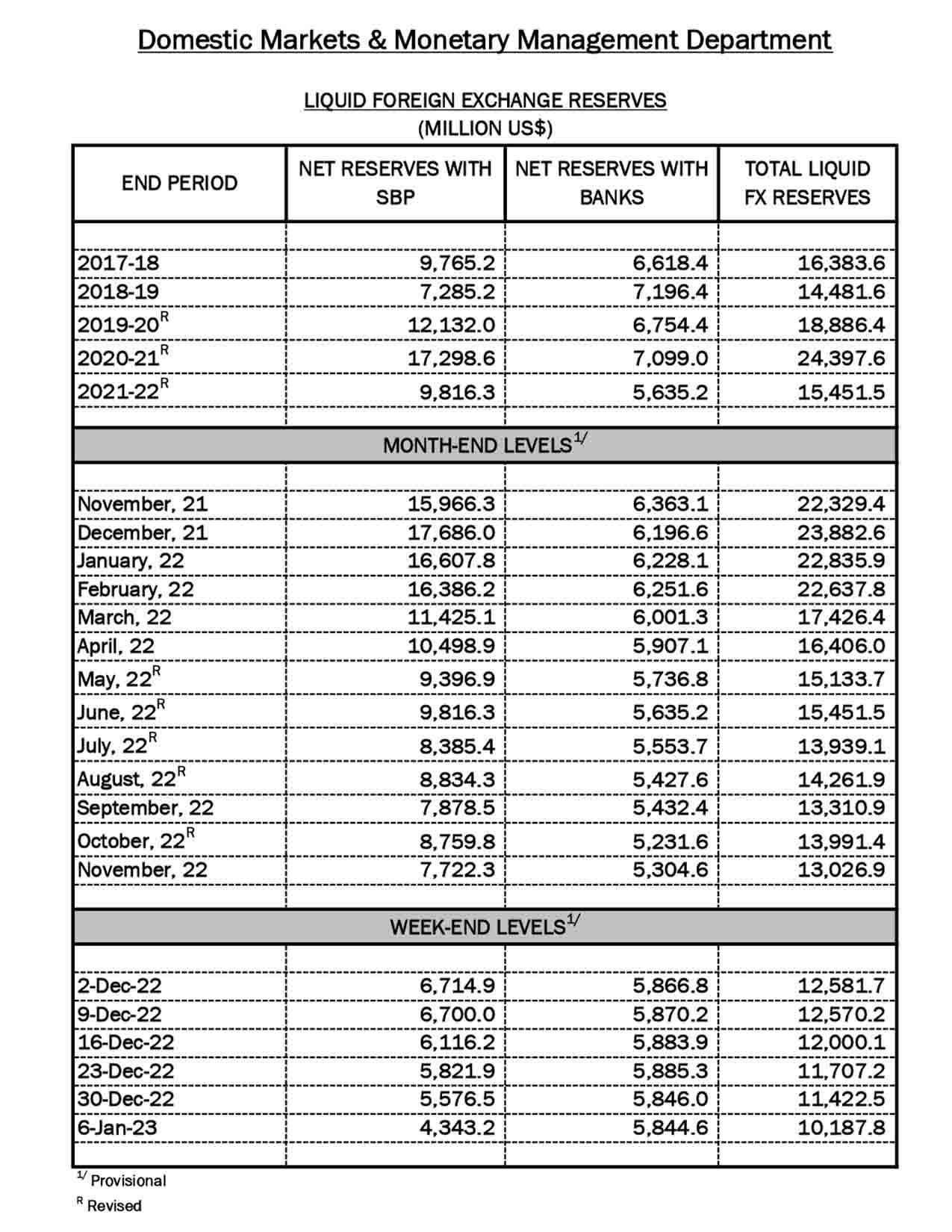
    The State Bank of Pakistan’s (SBP) foreign exchange reserves fell to $4.34 billion, its lowest level since February 2014, due to a lack of dollar inflows from the International Monetary Fund (IMF) or friendly nations.

    The SBP disclosed on Thursday that due to the repayment of external debt, its reserves fell by $1.23 billion during the week ended January 6.

    The country has been experiencing a severe dollar shortage, which is having a negative impact on the capacity to import even food and industrial raw supplies. The country doesn’t have enough dollars, according to the most recent status of foreign exchange reserves, to pay for even one month’s worth of routine imports.

    Data showed that commercial banks held $5.84 billion in net foreign currency reserves, while the overall amount of liquid foreign exchange reserves was $10.18 billion.

    Ever since the beginning of 2022–2023, reserves have been rapidly decreasing. In the upcoming months, analysts predict rising inflation and limited industrial output as manufacturing is constrained by the scarcity of imported raw materials.

    According to Geo, United Arab Emirates (UAE) will roll over the existing loan of $2 billion and give an additional $1 billion loan, which should stabilise the reserve position in the coming days.

    As the government strives to reduce imports amid a dollar shortage, the reserves, which fell to their lowest level since February 2014, would now only provide import coverage of 0.82 month.

  • Pakistan is committed to completing IMF programme while meeting debt repayments on time: Ishaq Dar

    Pakistan is committed to completing IMF programme while meeting debt repayments on time: Ishaq Dar

    Pakistan is committed to completing the International Monetary Fund (IMF) programme while meeting external debt repayments on time, Finance Minister Ishaq Dar said on Tuesday during a meeting with the ambassador of its top bilateral lender, China.

    The country is in desperate need of external financing as the IMF’s review for the disbursement of its next tranche of funding has been on hold since September, according to Reuters.

    Ishaq Dar, the finance minister, stated last week on local television that the IMF was “behaving abnormally” by not finishing the ninth review even though all targets had been met.

    “The Finance Minister … apprised the Chinese Ambassador that the Government remains committed to completing the IMF program while meeting all external debt repayments on time,” the finance ministry said in a statement.

    The IMF programme is “back on track,” according to a separate statement released by the finance ministry on Tuesday, and preparations for the ninth review were well underway.

    An Extended Fund Facility (EFF) bailout for Pakistan in 2019 included a $6 billion bailout that was later increased by $1 billion.

    Dar said that Pakistan’s government has a “realistic plan” for handling the costs associated with rehabilitating the areas damaged by devastating flooding a few months ago during his meeting with the Chinese Ambassador. Official estimates place the cost of flood damage at $40 billion.

    Pakistan is dealing with a balance of payments issue and a growing current account deficit. Dar announced last week that a $3 billion loan from a friendly nation will be used to bolster Pakistan’s foreign reserves, which have fallen to $7.5 billion.

    According to the finance ministry, the government has implemented austerity measures to cut non-essential spending and has prioritised energy conservation to lower its import expenses.

  • Pakistan gets temporary relief of $3.68 billion from G-20 countries

    Pakistan gets temporary relief of $3.68 billion from G-20 countries

    The Ministry of Economic Affairs stated that the Government of Pakistan and the French Republic on Monday signed an agreement as part of the G20 Debt Service Suspension Initiative (DSSI).

    The government signed a DSSI, which amounted to the suspension of loans totaling $107 million under the G20 DSSI framework, according to a statement made in this regard by the ministry, according to Profit.

    This sum, which was initially due between July and December 2021, will now be paid back over a six-year period (plus a one-year grace period) in semi-annual installments, according to the statement.

    Federal Secretary for Economic Affairs Division Mian Asad Hayaud Din and French Ambassador to Pakistan Nicolas Galey signed the agreement today in Islamabad.

    Agreements for the revocation of $261 million between the government and the French Republic have already been signed.

    The ministry mentioned that the G20 DSSI has provided the fiscal space required to address the immediate health and financial demands of the Islamic Republic of Pakistan as a result of the support given by Pakistan’s development partners.

    According to the ministry, $3,688 million in debt has been suspended and rescheduled overall under the DSSI framework, which covers the period from May 2020 to December 2021.

    Pakistan has so far reached 93 agreements and signed them with 21 bilateral creditors for the restructuring of its liabilities under the G20 DSSI framework, totaling a delay of nearly $3,150 million.

    The above-mentioned agreements have been signed, bringing the total to $3,257 million. The G20 DSSI’s remaining agreements are currently the subject of negotiations.