Tag: rupee

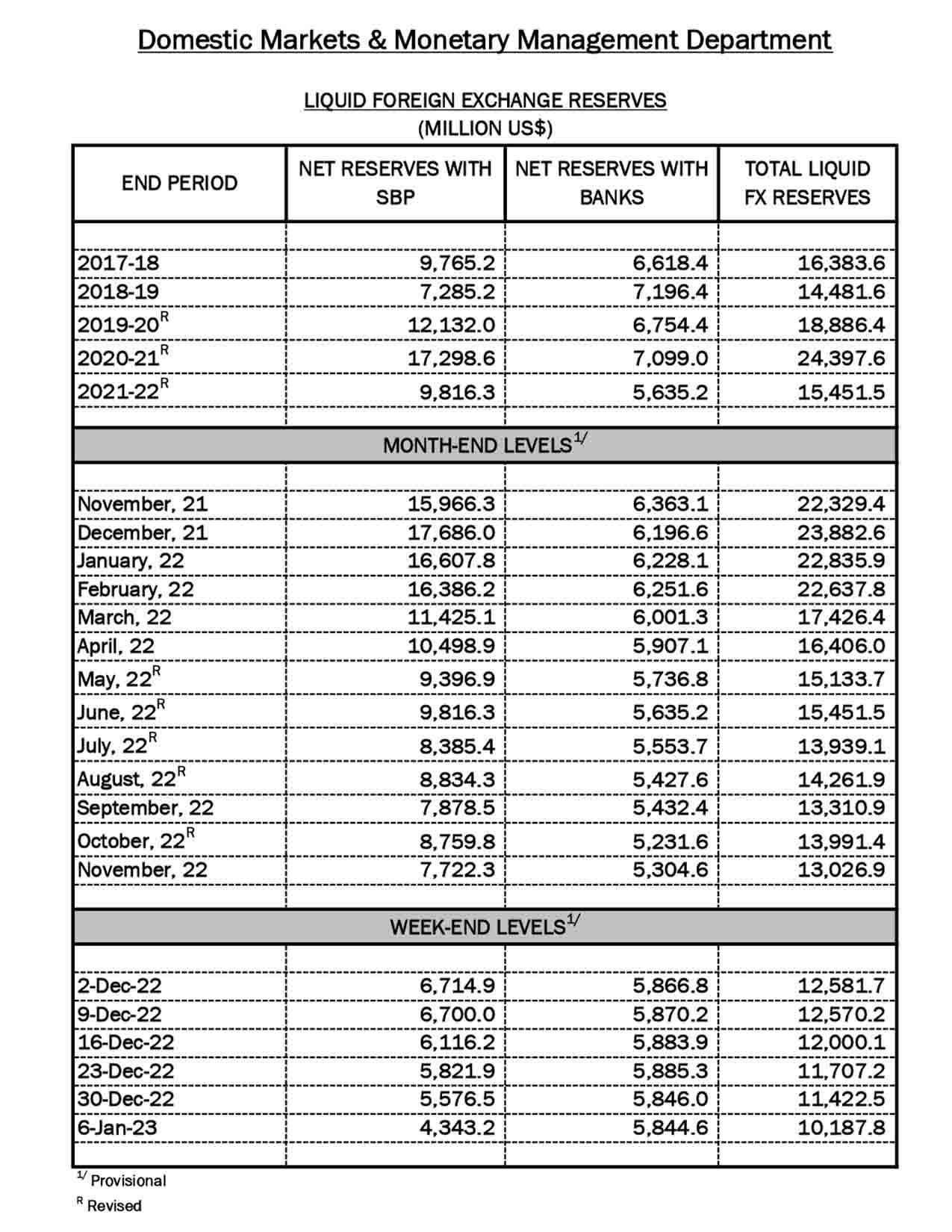
  • SBP-held foreign exchange reserves dropped to 9-year low of $4.34 billion

    SBP-held foreign exchange reserves dropped to 9-year low of $4.34 billion

    The State Bank of Pakistan’s (SBP) foreign exchange reserves fell to $4.34 billion, its lowest level since February 2014, due to a lack of dollar inflows from the International Monetary Fund (IMF) or friendly nations.

    The SBP disclosed on Thursday that due to the repayment of external debt, its reserves fell by $1.23 billion during the week ended January 6.

    The country has been experiencing a severe dollar shortage, which is having a negative impact on the capacity to import even food and industrial raw supplies. The country doesn’t have enough dollars, according to the most recent status of foreign exchange reserves, to pay for even one month’s worth of routine imports.

    Data showed that commercial banks held $5.84 billion in net foreign currency reserves, while the overall amount of liquid foreign exchange reserves was $10.18 billion.

    Ever since the beginning of 2022–2023, reserves have been rapidly decreasing. In the upcoming months, analysts predict rising inflation and limited industrial output as manufacturing is constrained by the scarcity of imported raw materials.

    According to Geo, United Arab Emirates (UAE) will roll over the existing loan of $2 billion and give an additional $1 billion loan, which should stabilise the reserve position in the coming days.

    As the government strives to reduce imports amid a dollar shortage, the reserves, which fell to their lowest level since February 2014, would now only provide import coverage of 0.82 month.

  • Pakistan stocks lose more than 1,400 points due to political uncertainty

    Pakistan stocks lose more than 1,400 points due to political uncertainty

    Political unrest caused significant selling pressure on the Pakistan Stock Exchange (PSX), which saw the benchmark KSE-100 Index lose more than 1,400 points on Tuesday during trading.

    The KSE-100 Index was down 1,432.25 points, or 3.5 per cent, at 39,538.57 around 3 o’clock, below the 40,000-mark, according to the PSX website.

    Investors were under pressure to sell their shares across the board due to Pakistan’s escalating political unpredictability and economic uncertainties.

    For a while now, there has been pressure on the market. Just last week, the benchmark KSE-100 Index dropped nearly 550 points due to domestic and global events, and the PSX experienced intense selling pressure. On Friday, it increased to close higher, but this week started off negatively once more.

    Experts claim that market pressure is resulting from the Pakistan Tehreek-e-(PTI) Insaf’s announcement that it will dissolve the Punjab and Khyber Pakhtunkhwa assemblies, according to Brecorder.

    In particular, the pressure has intensified since Monday’s event.

    A worsening economic crisis is accompanied by louder political clamour as foreign exchange reserves drop to dangerously low levels and negotiations with the International Monetary Fund (IMF) keep getting postponed.

    Analysts have also stated that although the World Bank’s approval of $1.692 billion for flood relief efforts in Sindh should have had a positive effect, political commotion is also obscuring this good news.

    Pakistan’s stock market is expected to remain under pressure till Friday until clarity is achieved on the political front.

  • Pakistani rupee depreciates for the 5th day in a row, settles at Rs222.67

    Pakistani rupee depreciates for the 5th day in a row, settles at Rs222.67

    The Pakistani rupee (PKR) lost 0.12 per cent on Thursday in the inter-bank market, continuing its downward trend against the US dollar.

    The rupee dropped by Rs0.26 and ended the day at Rs222.67. The rupee has decreased by Rs1.25, or 0.56 per cent, over the last five trading sessions.

    PKR continued to lose value against the US dollar on Wednesday, falling Rs0.50 (0.22 per cent) to settle at Rs222.41.

    In a significant breakthrough on Wednesday, the State Bank of Pakistan (SBP) promised the Standing Committee on Finance of the National Assembly that action would be taken against banks by the end of the month for allegedly overcharging importers when establishing Letters of Credit.

    The SBP informed the banks in person about the practise and counselled them to rationalise the margins they were charging customers, according to information provided to the committee.

    Additionally, Pakistan’s external debt and liabilities reduced by $3.282 billion from $130.196 billion as of June 30, 2022, to $126.914 billion at the end of September 2022.

    The dollar recovered globally on Thursday as strong US retail data challenged the recent narrative that inflation is declining and US interest rates do not need to increase significantly more.

    The US reported overnight that retail sales increased 1.3 per cent in October, exceeding economists’ expectations of 1.0 per cent, a positive sign but one that dashed expectations for a pause in rate increases.

    The dollar index, which compares the value of the dollar to six important peers, increased 0.18 per cent to 106.46.

    A key indicator of currency parity, oil prices fell on Thursday due to easing geopolitical tensions and worries about Chinese demand, though signs of tighter supply, such as lower US inventories, provided support.

  • Pakistani rupee reverses losses against greenback

    Pakistani rupee reverses losses against greenback

    After strengthening against the US dollar on Monday, the Pakistani rupee started the new week positively.

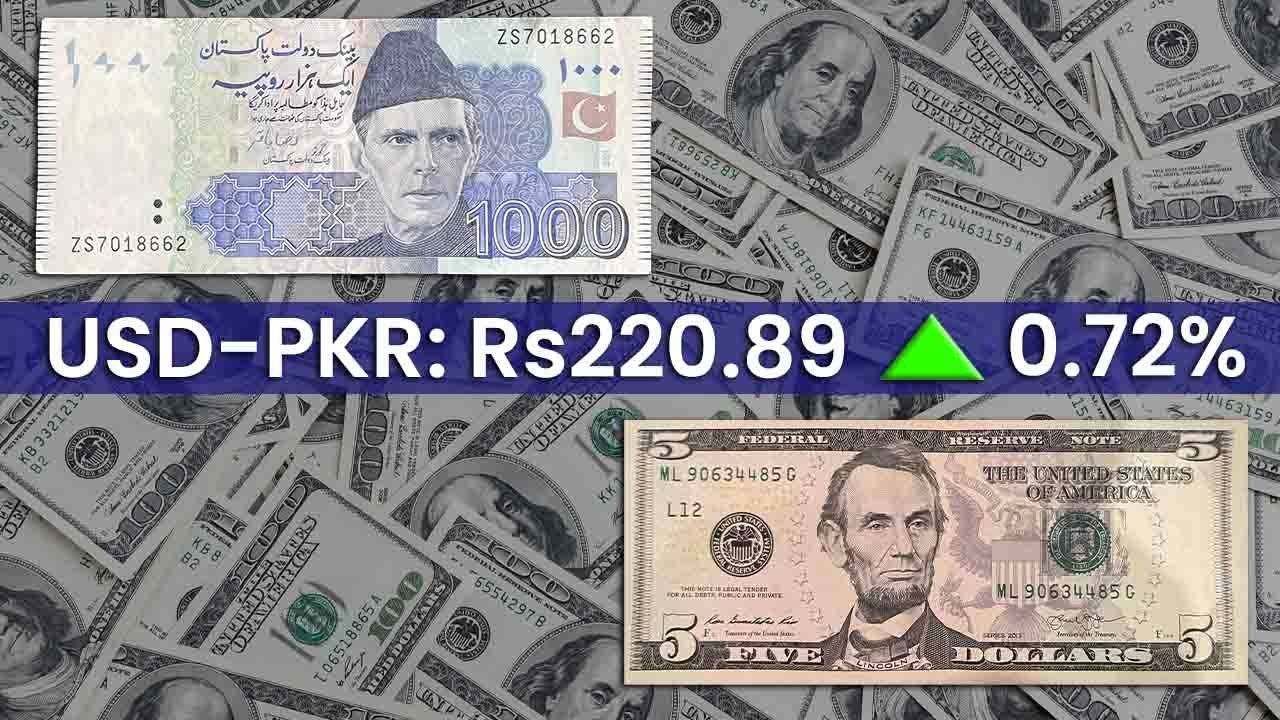
    Discussions between Finance Minister Ishaq Dar and State Bank of Pakistan (SBP) employees and currency traders had positive effects as the local currency increased by Rs1.59, or 0.72 per cent, versus the dollar.

    In the interbank market, the rupee was able to settle at Rs220.89, according to the SBP.

    The rupee last week dropped 0.93 per cent versus the dollar, trading at Rs222.47. Analysts predicted that this week will see range-bound trading in the local currency.

    Earlier, Ishaq Dar issued a warning last week saying that anyone detected manipulating the currency rate will face harsh punishment.

    Dar said that the rupee’s true worth in relation to the dollar is less than Rs200. He predicted that the rupee will soon strengthen against the dollar and gave a warning to those who were speculating in and hoarding foreign cash.

    Furthermore, the price of Brent oil fell by 0.65 per cent to $95.15 per barrel on Monday, while the price of US West Texas Intermediate (WTI) fell by 0.83 per cent to $87.17 per barrel. With advances of 7.7 per cent and 9.3 per cent so far in October, respectively, Brent and WTI are on course to post their first monthly gains since May.

    Europe, which is anticipated to experience a recession this winter, poses a threat to global oil consumption. The European Central Bank’s policymakers are also continuing with their plans to raise interest rates, despite the fact that doing so might plunge the region into recession and stoke political unrest.

  • Rupee resumes downward trend against US dollar

    Rupee resumes downward trend against US dollar

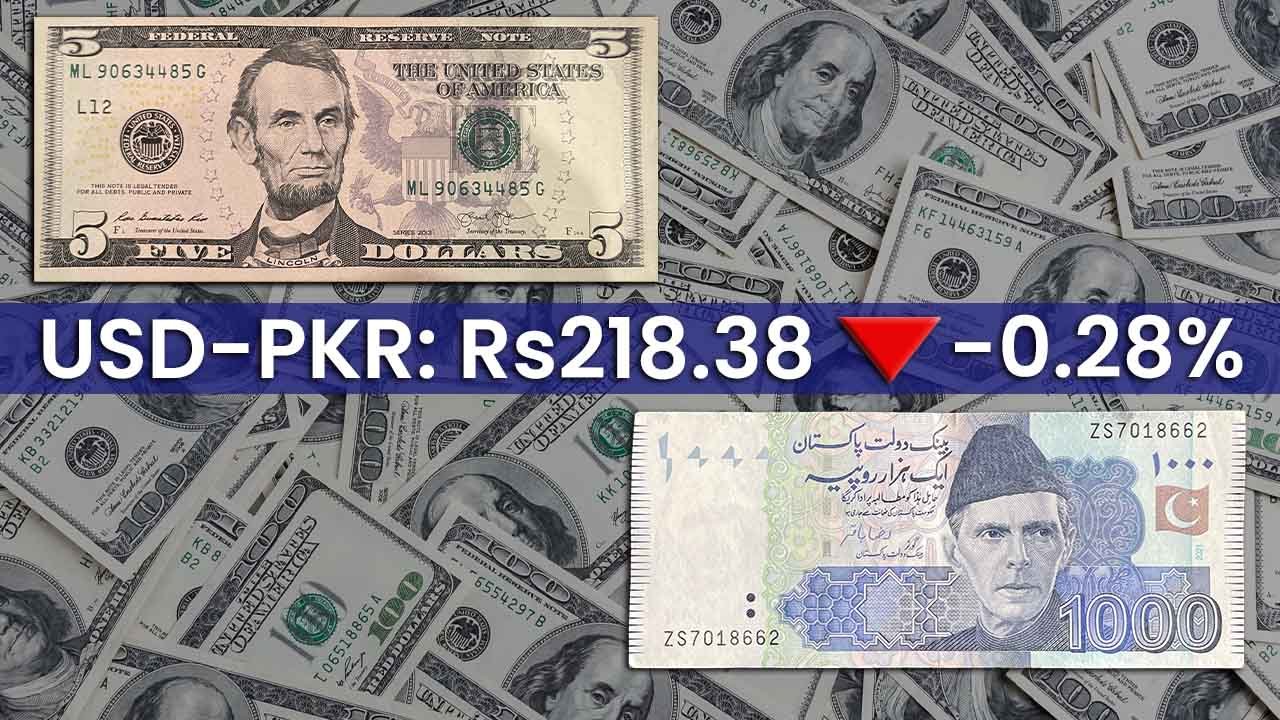
    Pakistani rupee suffered a marginal loss of Rs0.50 against the US dollar in the interbank market, extending its losses for a second straight session.

    State Bank of Pakistan (SBP) reports that the local currency lost Rs0.50 against the dollar in the interbank market and ended the day at Rs218.38.

    The Forex Association of Pakistan (FAP) said that banks were trading US dollars for Rs218.78 at the time. The exchange rate for the dollar in the open market was between Rs220 and Rs222.

    This is the second time, the rupee has registered a loss in its value after Federal Finance Minister Ishaq Dar’s return to office. The local currency appreciated by almost Rs22, or 10.1 per cent, against the greenback in the last 13 sessions.

    Earlier, Federal Minister For Finance and Revenue Ishaq Dar vowed to bring back Pakistani rupee at its original value which is less than 200 against US dollar. “I can genuinely prove that dollar’s actual value is below Rs200,” he added.

  • Pakistani rupee becomes best performing currency after recording impressive gains

    Pakistani rupee becomes best performing currency after recording impressive gains

    The unpredictable Pakistani rupee, which made the highest rise of 3.9 per cent over five working days to Rs219.92 against the dollar on anticipation of sizable inflows of foreign cash, was dubbed the “world’s best-performing currency” in the week that concluded on Friday.

    According to analysts monitoring currency movements, the rupee proved to be the best-performing currency throughout the week.

    Friday marked the rupee’s 11th straight successful working day since the current finance minister, Ishaq Dar, announced his return to Pakistan by ending a five-year self-exile last month, according to the Express Tribune.

    Clearly, Dar continued his previous strategy of defending the rupee from the assault of the US currency after assuming power. He thought the rupee was undervalued at its all-time low of roughly Rs240 to the dollar in July and suspected commercial banks of manipulating the rupee’s value to advance their own interests.

    In a swift move, Pakistani officials notified Moody’s that during recent meetings with multilateral creditors, the government had received an additional funding commitment of more than $2.5 billion from the Asian Development Bank.

    This was done while strongly responding to Moody’s downgrading Pakistan’s credit rating to Caa1. The World Bank has also committed to providing an additional $1.3 billion in finance for infrastructure improvement and other projects during the current fiscal year.

  • Pakistani rupee inching towards all-time low once again

    Pakistani rupee inching towards all-time low once again

    In the first hours of trade on Tuesday, the Pakistani rupee (PKR) fluctuated between Rs238 and Rs239 as it lost value versus the US dollar in the interbank market.

    During intra-day trade at roughly 10:20 am, the rupee was quoted at Rs237.99, a devaluation of Rs0.08 or 0.03 per cent versus the greenback.

    In the interbank market on Monday, the local currency fell for the 12th straight session to end at Rs237.91 as pressure on the currency increased due to the expectation of a higher import bill and the globally strong dollar.

    The PKR has continued to lose value after receiving the IMF tranche of $1.2 billion at the beginning of September and has not yet seen a positive session this month.

    According to experts, the country’s borrowing requirements would rise in the wake of the devastating flash floods, which will also boost the cost of imports. As floods destroy standing crops in Sindh and lower Punjab, the country’s borrowing requirements may rise further in the near future.

  • IMF report exposes incorrect PTI policies that led to rupee’s devaluation

    IMF report exposes incorrect PTI policies that led to rupee’s devaluation

    The International Monetary Fund (IMF) has issued its country report for Pakistan, exposing erroneous policies implemented by the PTI administration that, according to the Fund, undermined the country’s currency reserves and led to the rupee’s devaluation.

    The study also discloses what the present administration, led by the PML-N, has promised the international lender, according to Samaa.

    The study does not identify any political party, but it does mention rising GDP, which the PTI has said is the outcome of its policies. Pakistan’s GDP increased by 6 per cent in fiscal year 2021-22 (FY22), which ended less than three months after Imran Khan was overthrown by parliament in early April.

    According to experts, the increase in GDP was driven by unsustainable expansion, which resulted in economic overheating. The IMF study comes to the same conclusion.

    According to the Fund, GDP growth in FY22 was “driven by permissive fiscal policy and a delayed monetary reaction to inflationary pressures.”

    These factors, together with worldwide food and fuel price shocks, resulted in a major worsening of the external situation, including an unsustainable current account deficit, a considerable decrease in reserves, and a significant devaluation of the rupee.

    The PTI administration failed to respond to the worldwide commodity price increase, and its policies caused the rupee to depreciate and currency reserves to dwindle, according to the international lender.

    Pakistan is at a crossroads in its economic development. Internal demand reached unsustainable levels as a result of a challenging external environment paired with procyclical domestic measures. According to the IMF, the resulting economic overheating resulted in high fiscal and external deficits in FY22, contributed to increasing inflation, and destroyed reserve buffers.

    The PTI administration broke its pledges quickly after collecting roughly $1 billion from the IMF. Following the completion of the sixth evaluation, programme implementation worsened. In the midst of a volatile political scene, planned fiscal adjustment was reversed, and some significant EFF agreements were honoured, as per the report.

    According to the report, the present administration has informed the Fund that it would reimpose the general sales tax (GST) on petroleum products and will not provide any fuel subsidies.

    The current administration will not declare a tax amnesty unless Parliament first approves it. It will also simplify the sales tax on services throughout the country. Currently, different provincial territories apply varying rates of sales tax on services.

    The Fund takes notice of the actions implemented by the PML-N administration to re-establish the IMF programme, including a budget based on a basic surplus, a rise in interest rates, and the elimination of fuel subsidies.

    The IMF has advised the government to maintain a market-based currency rate, enhance tax income, and strengthen foreign reserves. The IMF also said that the lending programmes entail exceptional risks even after policy adjustments.
  • Honda reduces car prices to pass on the forex impact

    Honda reduces car prices to pass on the forex impact

    Honda Atlas Cars Limited (HACL) has reduced the prices of its entire lineup, like its rival Toyota.

    According to a notification from the automaker, the latest price reduction is an outcome of the Pakistani rupee’s strengthening versus the US dollar, and the company wants to pass on the forex impact to its “valued” customers.

    Here are the new prices of Honda cars in Pakistan, effective from August 17:

    Model  Old invoice New price Decrease
    City Manual 1.2L Rs4,049,000 Rs3,769,000 Rs280,000
    City CVT 1.2L Rs4,199,000 Rs3,899,000 Rs300,000
    City CVT 1.5L Rs4,439,000 Rs4,139,000 Rs300,000
    City Aspire Manual 1.5L Rs4,609,000 Rs4,299,000 Rs310,000
    City Aspire CVT 1.5L Rs4,799,000 Rs4,479,000 Rs320,000
    BR-V CVT S Rs5,299,000 Rs4,939,000 Rs360,000
    Civic 1.5L M CVT Rs6,799,000 Rs6,349,000 Rs450,000
    Civic 1.5L Oriel M CVT Rs7,099,000 Rs6,599,000 Rs500,000
    Civic RS 1.5L LL CVT Rs8,099,000 Rs7,549,000 Rs550,000
    Honda Cars Latest Price List – August 2022

    Despite the most recent drop, the ‘cheapest’ Honda car still costs more than Rs3.7 million, making it out of reach for low-income individuals.

  • Gold price drops by Rs8,600 per tola as rupee strengthens

    Gold price drops by Rs8,600 per tola as rupee strengthens

    The price of 24 karat gold decreased by Rs8,600 per tola and Rs7,373 per 10 grams to settle at Rs145,300 and Rs124,571, respectively, in the local market, according to figures released on Wednesday by All Sindh Sarafa and Jewellers Association (ASSJA).

    The latest decrease was in accordance with what the traders anticipated that the market would correct itself after achieving fresh heights in earlier sessions.

    On July 28, the price of a tola of gold rose to an all-time high of Rs162,500.

    The local currency made a significant comeback against the US dollar, rising by nearly Rs9 or 4 per cent, which diminished the shine of the precious metal.

    In the last three sessions, the price of gold has fallen by a total of Rs14,300 per tola, from Monday to Wednesday.

    Read more: Pakistan rupee appreciates Rs9.58 against US dollar, closes at Rs228.8

    Compared to Dubai, the price of gold in Pakistan is Rs2,000 per tola less.

    Bullion prices also fell $14 per ounce to close at $1,766 on the global market.