Tag: sales tax

  • FBR establishes new section to investigate corrupt tax officials

    In order to ensure the prompt resolution of all disciplinary cases and inquiries against tax employees engaged in corruption and dishonest activities in field formations, the Federal Board of Revenue (FBR) established a new Section on Friday called “Discipline/Inquiries.”

    A new Section with the nomenclature “Discipline/Inquiries” is hereby created in the Admn/HR Wing, FBR (HQ), Islamabad with immediate effect in order to ensure proper follow-up of all disciplinary cases/inquiries of officers (BS-16 and above) of FBR (HQ) and IR field formations with a view to ensuring timely disposal of such cases, according to an office order issued by the FBR on Friday.

    According to Brecoder, a secretary or second secretary who works for the specified Section will be in charge and reporting to the Chief (HRM-IR), FBR.

    The FBR has also been ordered by Prime Minister Shehbaz Sharif to fully abide by the guidelines of the Civil Servants (Efficiency and Discipline) Rules, 2020 when taking disciplinary action and conducting investigations against dishonest tax officers.

    The FBR chairman has directed the Revenue Division/FBR to rigorously adhere to the following instructions in all disciplinary processes and inquiries launched against the officers, in accordance with the directives of the prime minister:

    The Civil Servants (Efficiency & Discipline) Rules, 2020, Rule 10 read with Rule 12 shall govern how the chosen inquiry officer would conduct the inquiry processes. The same must be finished within sixty (60) days of the date the inquiry order was issued, or within any further time the authority may provide.

    All Directors General, Chief Commissioners, Chief Collectors, Commissioners, and Collectors of FBR shall keep the relevant case record in safe custody while forwarding the recommendation to begin disciplinary proceedings against any officer(s) or official in order to ensure safe custody of the record in an inquiry.

    In accordance with the guidelines outlined in Rule 8 of the Civil Servants (Efficiency and Discipline) Rules, 2020, all heads of field offices shall also see to it that pertinent records of the case and other related documents are timely provided to the inquiry officer or the inquiry committee, as the case may be, through the designated departmental representative (DR). This must be done within seven days of the date of the inquiry order.
  • FBR collects highest-ever tax of Rs6 trillion in FY22

    FBR collects highest-ever tax of Rs6 trillion in FY22

    The Federal Board of Revenue (FBR) achieved a significant feat by collecting a record Rs6,000 billion in revenue during the previous fiscal year 2021–2022.

    The FBR reported that during the current fiscal year, it collected Rs2,205 billion in income tax, Rs2,773 billion in sales tax, and Rs1,007 billion in customs duty. The organisation in charge of collecting taxes also released Rs305 billion in refunds during that time.

    According to former finance minister Shaukat Tarin, the government of Imran Khan’s policies and the country’s economic growth allowed FBR to meet its revenue goals.

    Tarin insisted that the government should continue enforcing the prior administration’s tax laws. According to Tarin, the government shouldn’t impose additional taxes on the current taxpayers. Heavy taxes shouldn’t be imposed on the economy’s productive sectors, he continued.

    The government has given the general public significant tax breaks on a number of necessities, but the FBR claims that these tax breaks haven’t prevented revenue collection from continuing on an unprecedented and constant growth trajectory. Sales tax on all POL products has been eliminated for the first time in the nation’s history, costing the FBR Rs45 billion per month.

    In order to maximise revenue potential through digitization, transparency, and taxpayer facilitation, the FBR has implemented a number of novel interventions at both the policy and operational levels. In addition to ensuring transparency, facilitating taxpayers, and making business easier, this has led to a steady increase in revenue collection.

  • Punjab’s ePay system collects over Rs90 billion tax revenue through 17 million transactions

    Punjab’s ePay system collects over Rs90 billion tax revenue through 17 million transactions

    Since its launch in October 2019, e-Pay Punjab, an online payment solution developed by the Punjab Information Technology Board (PITB) and the Punjab Finance Department, has collected over Rs90 billion in tax revenue through 17 million transactions.

    As per details released by the PITB on Friday, e-Pay Punjab has collected a total of Rs57 billion in sales tax, Rs11.5 billion in token tax, Rs9 billion in property tax, Rs4 billion in traffic challans, and Rs440 million in vehicle transfers.

    It’s worth noting that e-Pay Punjab now accepts online payments for 23 taxes and levies from ten different departments. Its 1-Link network integration with the State Bank of Pakistan (SBP) and all scheduled banks makes it a secure and dependable payment channel.

    The e-Pay Punjab application, which has over 1 million downloads, generates a unique PSID number that is accepted by banks across Pakistan through their various channels, including Internet and Mobile Banking, ATMs, and physical branch visits.

    It is also a secure, smart, and fast online payment option for the annual Token Tax. Vehicle owners can use e-Pay Punjab to pay their Token Tax from the comfort of their own homes.

    The app’s primary objective is to make it convenient for the government to gather revenue in the form of taxes through a simple solution. With Pakistan’s first digital tax aggregator, the app demonstrates how Pakistan and its government are rapidly integrating financial technology (fintech) into their processes.

  • Here are the latest income tax rates and slabs for salaried class

    Here are the latest income tax rates and slabs for salaried class

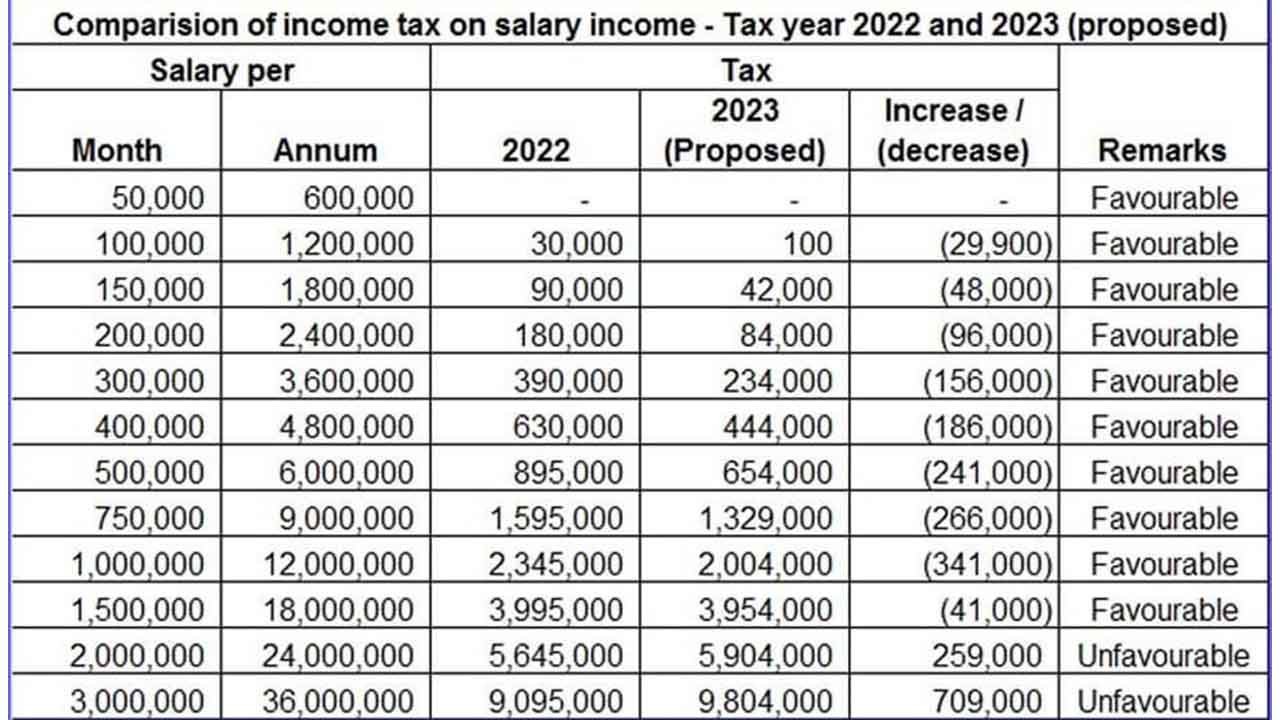
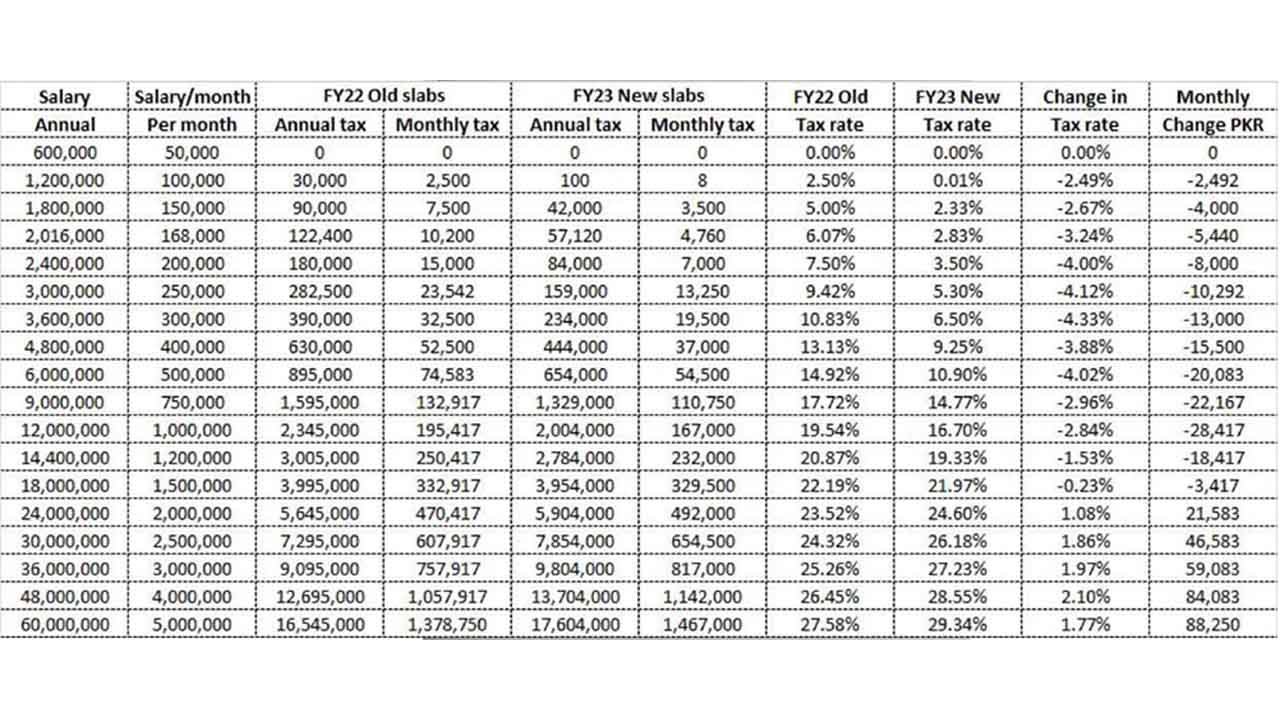
    In the budget for fiscal year 2022-23, the government has exempted those earning up to Rs100,000 per month from paying income tax, up from Rs50,000 last year.

    For the salaried income group, the latest budget is a mishmash as the government reduced tax rates and the number of slabs while eliminating available credit through the omission of deductible allowance for profit on debt and tax credit for investment in shares, health insurance, and pension funds.

    Moreover, the government has released a revamped list of income tax brackets for salaried employees. There were previously 12 slabs, which have now been shrunk to seven.

    Here are the new slabs:

    1. For annual incomes less than Rs600,000 (below Rs50,000 per month)
    2. For a yearly income of Rs600,000-Rs1.2 million (Rs50,000 to Rs100,00 per month).
    3. For annual earnings of Rs1.2m-2.4m (Rs100,000 to Rs200,000 per month)
    4. For annual earnings of Rs2.4m-3.6m (Rs200,000 to Rs300,000 per month)
    5. For earnings of Rs3.6m-6m (Rs300,000 to Rs500,000 per month)
    6. For annual earnings of Rs6m-12m (Rs500,000 to Rs10,00,000 per month)

    For annual earnings of more than $12 million (more than $100,000 per month), income tax is not to be levied on people earning between 0 and Rs600,000 per year (where income from salary exceeds 75 per cent of taxable income). A nominal amount of Rs100 will be subtracted per year from those earning between Rs600,000 and Rs1.2 million.

    Employees getting paid more than Rs1.2 million but less than Rs2.4 million per year will be levied 7 per cent of the amount that exceeds Rs1,200,000 in the third slab.

    An employee getting paid Rs1,400,000 per year will be levied 7 per cent of Rs200,000 (Rs1,400,000 minus Rs1,200,000 since that is the amount exceeding Rs1,200,000).

    As per the latest budget resolution, the government recommended an income tax rate of 20 per cent on small business earnings, 42 per cent on banking, and 29 per cent on related companies.

  • PANAH suggests tobacco taxes be raised even higher

    PANAH suggests tobacco taxes be raised even higher

    Pakistan National Heart Association (PANAH) has proposed that the government increase tariffs on unnecessary and harmful tobacco products. Increased tobacco-related levies will lessen diseases and healthcare expenses while also helping to generate tax revenue.

    Sanaullah Ghumman, PANAH’s General Secretary, announced this at a news conference held by the Pakistan National Heart Association on Wednesday at a local hotel.

    Smoking, according to Sanaullah Ghumman, is not healthy for human health in any aspect, and it is the first step toward addiction. Health experts and civil society groups have also urged the Prime Minister to increase tobacco goods taxes.

    A significant number of health experts and civil society representatives attended the event. Tobacco kills 8 million people worldwide each year, according to a global study, and more than 1.5 million individuals in Pakistan lose their lives each year owing to smoking.

    On World Food Safety Day, PANAH proposed that tariffs on sugary drinks be increased as well, as these beverages are harmful to children and cause a variety of health problems.

    Sanaullah Ghumman spoke at the event, urging a 30 per cent rise in tobacco product taxes to protect minors from tobacco usage.

    “This will be a win-win situation for us,” he continued, “since it will lower the health burden while also dramatically increasing revenue”. PANAH, he claimed, had been educating the public about a variety of dangerous diseases, including heart disease and its causes, for 39 years.

  • Direct taxes target predicted at Rs2,560 billion for FY 22-23

    In an attempt to meet the Federal Board of Revenue’s (FBR) revenue collection target of Rs7,255 billion for the upcoming fiscal year, the direct taxes target has been predicted at Rs2,560 billion, up from Rs2,182 billion in 2021-22.

    According to Brecorder, the indirect taxes (net) estimates were predicted at Rs4,695 billion in the macroeconomic framework for 2022-23. Direct taxes forecasts included income tax and withholding taxes, whereas indirect taxes projections included sales tax, customs duty, and Federal Excise Duty (FED).

    The indirect tax goal for 2022-23 has been set at Rs4,695 billion, up from Rs3,647 billion in 2021-22, representing a Rs1,048 billion rise. The indirect tax revenue for the fiscal year 2021-22 was Rs3,440 billion.

    The entire collection of indirect taxes in 2020-21 was Rs3,008.2 billion. Direct taxes are expected to reach Rs2,560 billion in the next fiscal year, up from Rs2,182 billion in 2021-22, a Rs378 billion increase.

    Read more: PM Shehbaz directs to eliminate taxes on raw materials used by export industries

    During the first 11 months of the current fiscal, the FBR collected roughly Rs1.9 trillion in direct taxes. In the fiscal year 2020-21, direct tax collections totalled Rs1,726.0 billion. Withholding taxes account for 72 per cent of the total direct tax collection.

  • Pakistan records 13.8 per cent inflation in May

    Pakistan records 13.8 per cent inflation in May

    The latest data provided by the Pakistan Bureau of Statistics (PBS) on June 1, inflation continued to rise in May 2022, with the Consumer Price Index (CPI)-based reading coming in at 13.8 per cent year on year, up from 13.4 per cent the previous month and 10.9 per cent in May 2021.

    In May 2022, inflation climbed by 0.44 per cent month over month, compared to 1.6 per cent the previous month and 0.1 per cent in May 2021. This brings average inflation in 11MFY22 to 11.29 per cent year over year, up from 8.83 per cent in 11MFY21.

    Rising prices have emerged as a major source of concern for the economy of the South Asian country, which is grappling with dwindling foreign exchange reserves and a growing import bill.

    The State Bank of Pakistan (SBP) hiked the main interest rate by 150 basis points to 13.75 per cent last month in an attempt to combat economic headwinds.

    The existing administration, on the other hand, has indicated that it will partially remove subsidies by raising petroleum product tariffs by Rs30 per liter, a move that is projected to raise inflation.

    As per a report from Brecorder, on a month-on-month basis, Inflation in Urban areas increased by 0.3 per cent in May 2022 as compared to an increase of 1.6per cent in the previous month and increase of 0.2per cent in May 2021.

    In the meantime, CPI inflation in urban areas grew 12.4 per cent year over year in May 2022, compared to 12.2 per cent the previous month and 10.8 per cent in May 2021.

    It climbed by 0.3 per cent month over month in May 2022, compared to a 1.6 per cent increase the previous month and a 0.2 per cent increase in May 2021.

    In rural areas, CPI inflation climbed by 15.9per cent year over year in May 2022, compared to 15.1 per cent the previous month and 10.9 per cent in May 2021. It climbed by 0.6 per cent month over month in May 2022, compared to an increase of 1.6 per cent the previous month and a fall of -0.03 per cent in May 2021.

    In May 2022, the SPI inflation grew by 14.1 per cent year over year, compared to 14.2 per cent a month earlier and 19.7 per cent in May 2021. On a month-over-month basis, it climbed by 0.6 per cent in May 2022, compared to 1.5 per cent a month earlier and 0.8 per cent in May 2021.

  • CNG prices pushed to Rs140 per kg for sales tax collection

    CNG prices pushed to Rs140 per kg for sales tax collection

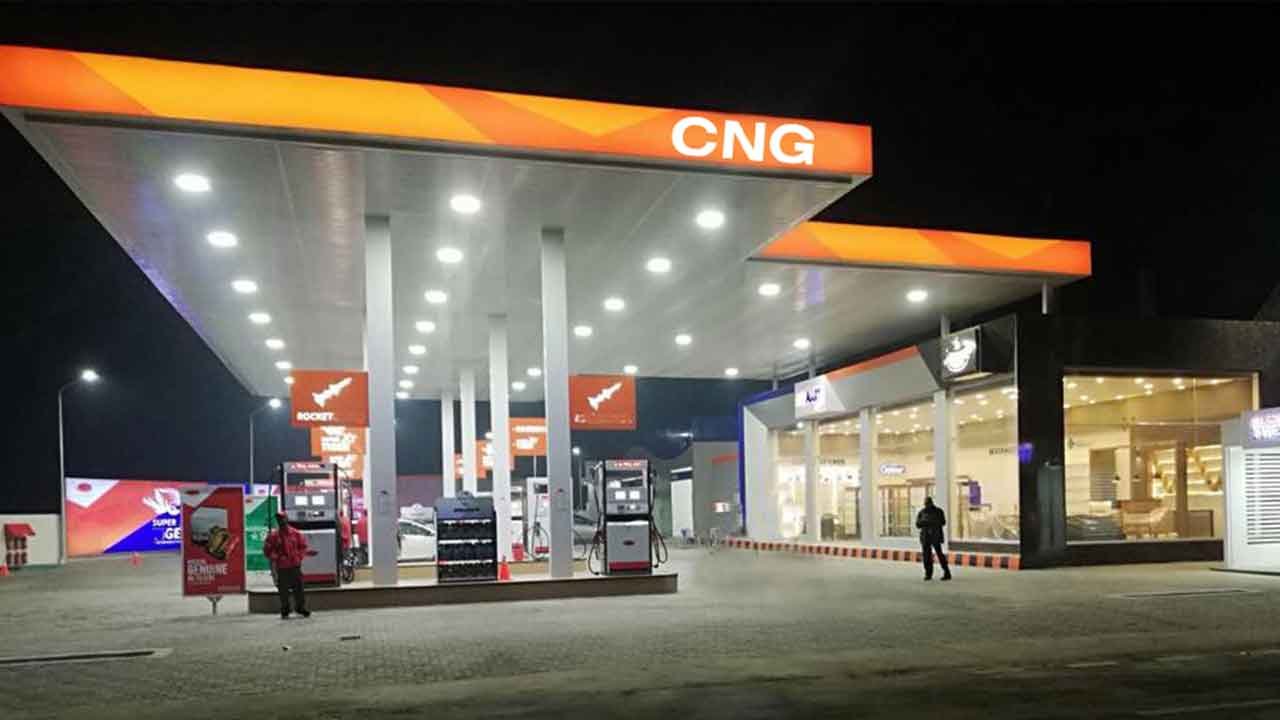
    The Federal Board of Revenue (FBR) has raised the sales tax rate on compressed natural gas (CNG) supplies to customers.

    On Tuesday, the FBR published S.R.O. 587(I)/2022 to replace S.R.O. 39(I)/2022, which was issued on January 8, 2022. It has amended the value of compressed natural gas (CNG) supply to consumers in order to charge sales tax from CNG stations.

    It has set the value of supply to CNG customers in order for gas generation and distribution businesses to charge sales tax from CNG stations.

    CNG rates

    The price of CNG in Region-I, which includes Khyber Pakhtunkhwa, Balochistan, and Potohar, has been raised from Rs134.57 per kg to Rs140 per kg (Rawalpindi, Islamabad, and Gujar Khan).

    Read more: Pakistani Rupee crashes to a record low against US dollar 

    Moreover, the cost of CNG has been raised from Rs128.11 per kg to Rs135 per kg in Region-II, which covers Sindh and Punjab except for the Potohar region.

  • PM Shehbaz rejects OGRA’s proposal, petrol price to remain unchanged till April 30

    PM Shehbaz rejects OGRA’s proposal, petrol price to remain unchanged till April 30

    Pakistan’s new Prime Minister (PM) Shehbaz Sharif on Friday dismissed the proposal from the Oil and Gas Regulatory Authority (OGRA) to raise the price of petroleum products for the fortnight. The recent decision is aimed at providing relief to the public affected by inflation.

    It is worth noting that the present government’s choice to maintain the same prices will oblige it to provide another substantial subsidy till the end of April 2022.

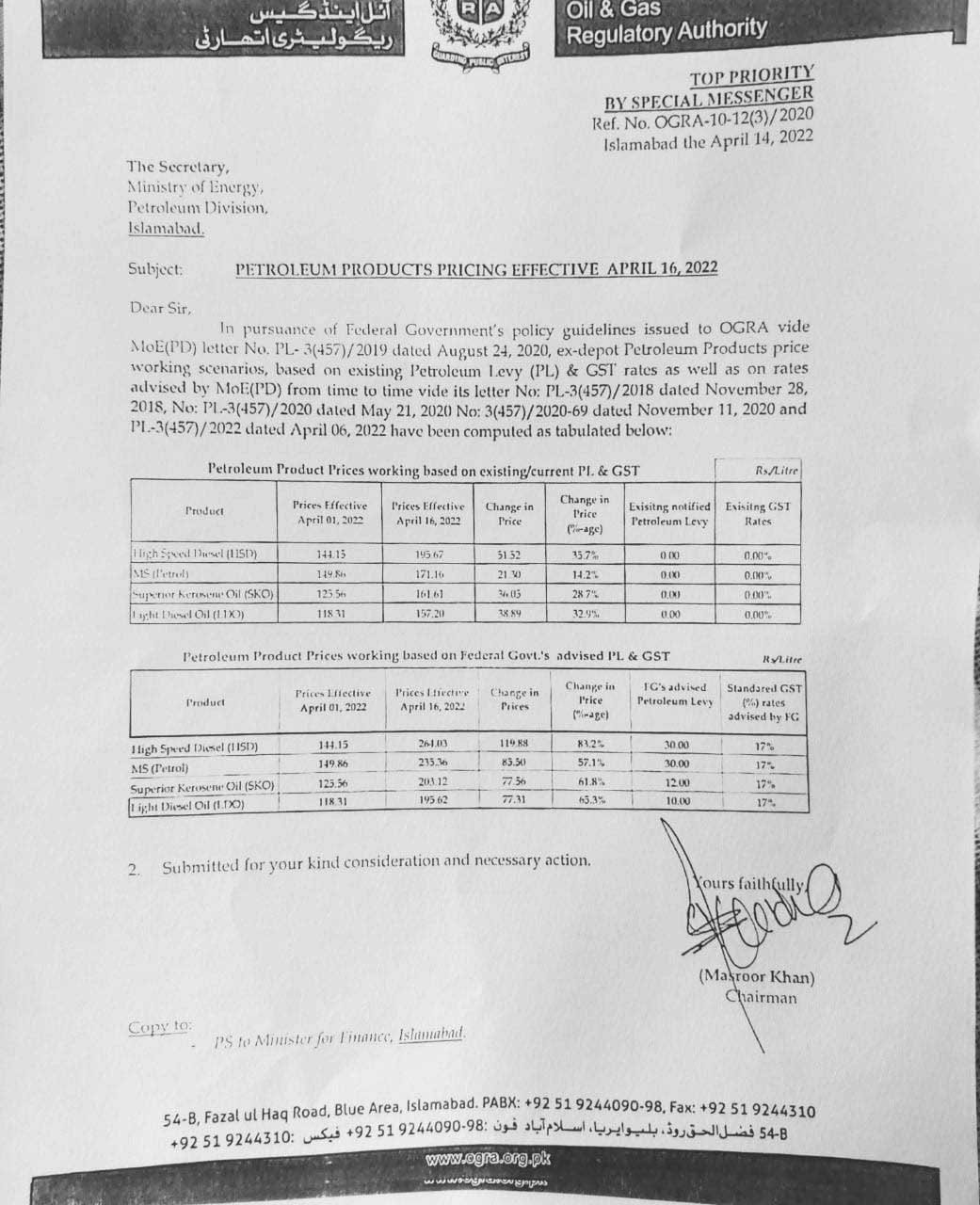
    Earlier, OGRA suggested to the Finance Division that the price of petrol be increased by Rs21.50 and that of diesel be hiked by Rs51.30 in view of the current petroleum levy and general sales tax (GST).

    Read more: Massive hike of Rs83.5 for petrol, Rs119 for diesel proposed by OGRA

    The authority also proposed a hike of Rs83.50 per liter of petrol and Rs119.88 per liter of diesel considering the federal government’s recommended petroleum levy of Rs30 and 17 per cent GST, as per the official statement.

  • FBR records 29.1% growth during July 2021 to March 2022, despite providing ‘massive tax relief’

    The provisional revenue collection data for the months of July 2021 to March 2022 of the current financial year 2021-22 have been announced by the Federal Board of Revenue (FBR).

    The net collection was Rs575 billion for the month of March 2022, up 20.5 per cent from Rs477 billion in March 2021.

    Conversely, the gross revenues, rose by 28.9 per cent in the current financial year, from Rs3,577 billion in July 2020 to March 2021 to Rs4,611 billion in July 2021 to March 2022. Furthermore, the amount of reimbursements granted in March 2022 was Rs31.9 billion, compared to Rs26.3 billion in March 2021, showing a 21.3 per cent upsurge.

    Then again, refunds of Rs229 billion were paid from July 2021 to March 2022, a 25 per cent increase over the Rs183 billion paid the previous year.

    Read more: Petrol, Diesel prices to remain unchanged till April 15

    It is worth noting that the continuous remarkable growth in revenue collection has been achieved despite the government providing ‘massive tax relief’ to the general public on a variety of vital commodities.

    For the first time in Pakistan’s history, the sales tax on all petroleum products was abolished, costing the FBR Rs45 billion in the past month.