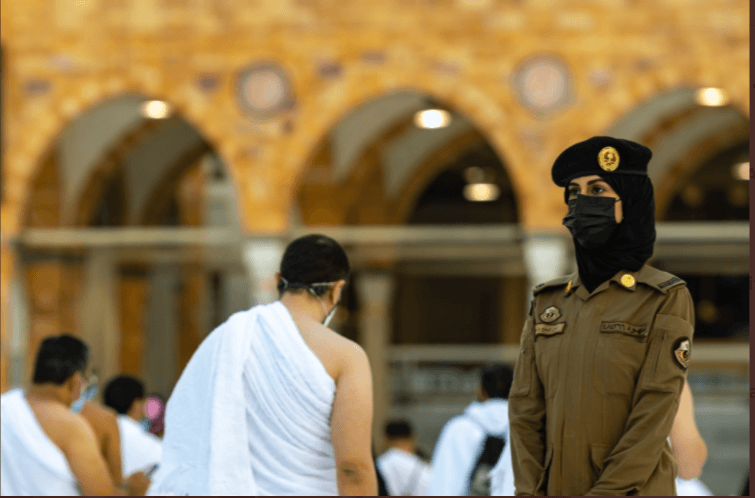
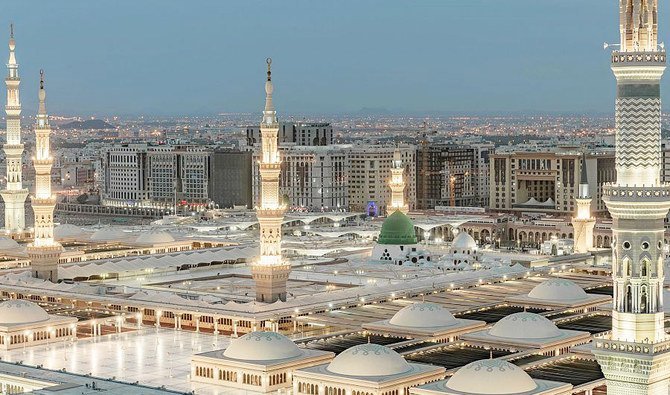
The Saudi Ministry of Interior has introduced historic reforms, appointing female security officers for the first time at the Grand Mosque.
Pictures shared by the ministry show the women guards in security uniforms taking care of the safety of worshippers and pilgrims while ensuring all precautionary measures were being complied with.
“From the field, security of Hajj and Umrah,” wrote the Ministry in the caption.
Saudi Arabia’s recent move to allow women to climb the ranks in its internal security forces is one of the new reforms endorsed by Crown Prince Mohammed Bin Salman bin Abdulaziz to advance women’s rights in the country.
Under his Vision 2030 initiative, Saudi women will be provided with several opportunities to participate in various disciplines and in roles previously allowed only to men.
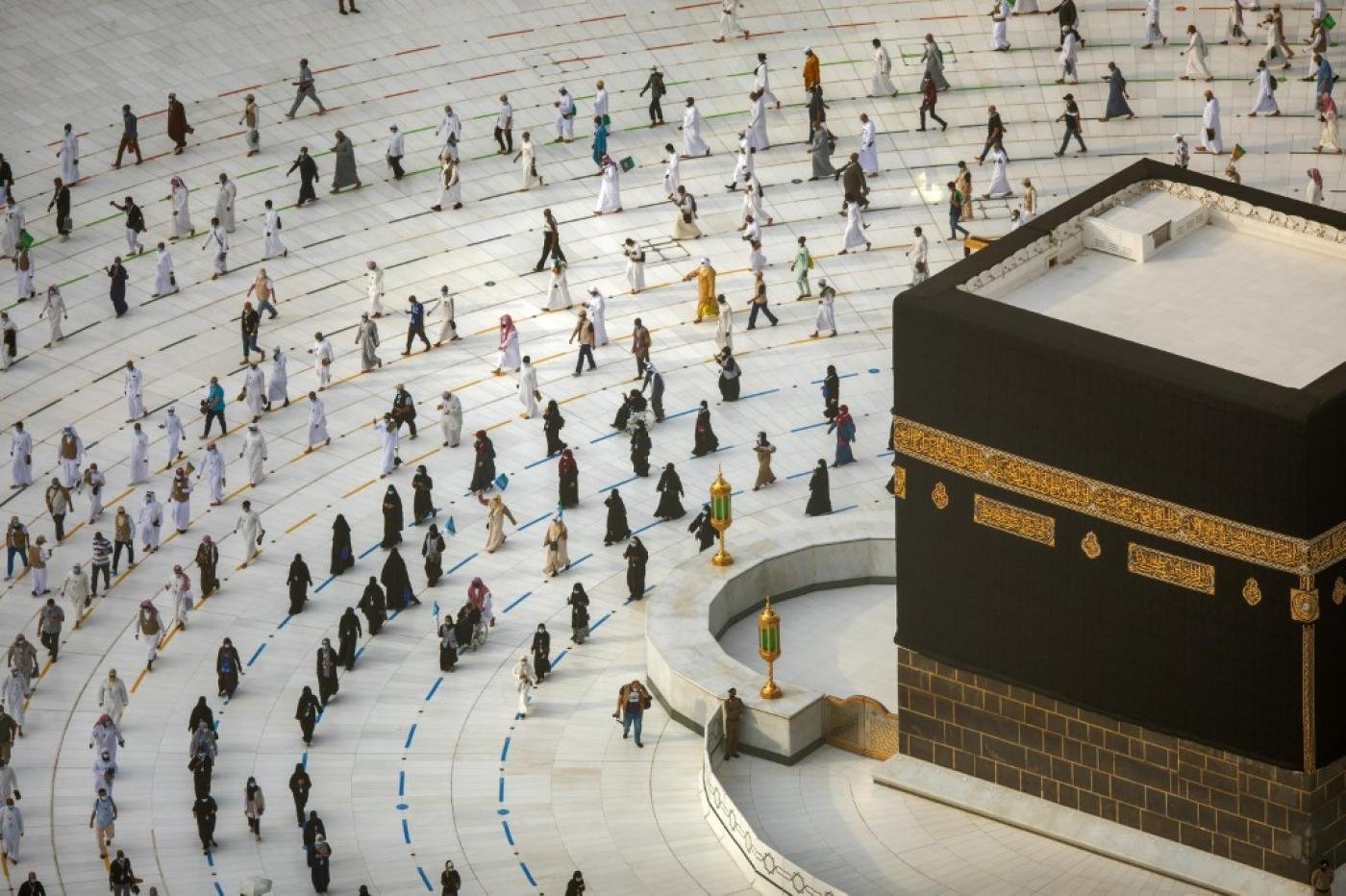
Saudi Arabia has announced that only people immunised against COVID-19 will be allowed to perform the year-round Umrah pilgrimage during the month of Ramzan.
Al Jazeera, quoting the Saudi press agency, reported: “Immune persons who [have] received two doses of the COVID-19 vaccine/immune person after 14 days of receiving the first dose of the COVID-19 vaccine / immune person who has recovered from the infection will [only] be allowed to perform Umrah.”
It further said that “Umrah permits and visit permits for the Grand Mosque and the Prophet’s Mosque in Madinah will increase operational capacity during the month of Ramadan, which begins next week.”
The holy sites, which draw millions of pilgrims every year, are a key revenue earner for Saudi Arabia, which hopes to welcome 30 million pilgrims to the Kingdom annually by 2030.
A woman in Saudi Arabia has been fined 50,000 Saudi Riyals for miscounseling her friend and advising her to leave her husband and find a better one.
According to details, the husband will get the money while the woman has promised that she will not advise any married woman, regardless of her intentions, according to court records. Lawyers have described the court ruling as a unique judicial precedent.
The defendant’s friend’s husband filed a case against the woman for trying to destroy his marriage and wanted compensation for the stress he suffered because of this.
He stated in his complaint that the defendant badly counselled his wife and urged her not to listen to him, saying: “My wife’s friend incited my disobedience, by giving her advice that harmed our marital relationship.”
“She used to tell my wife ‘You should find someone better for yourself. Show him who’s the boss. Don’t let them push you around’,” he added.
On the other hand, the defendant said she wanted nothing but the best for her friend.
The court advised the partners to determine what advice they should take seriously and what to ignore, because “friends may ruin a relationship by giving bad advice out of jealousy”.
Saudi Arabia’s Ministry of Health has said that only people who have been vaccinated against COVID-19 will be allowed to attend Hajj this year.
“The COVID-19 vaccine is mandatory for those willing to come to Hajj and will be one of the main conditions [for receiving a permit],” read a statement signed by the Minister of Health.
In 2020, the Kingdom reduced the number of pilgrims to around 1,000 to avoid the spread of the coronavirus barring Muslims from around the world from the rite for the first time in modern times.
In the same notification, Saudi Minister of Health Dr Tawfiq al-Rabiah said the government must be prepared to “secure the manpower required to operate the health facilities in Mecca and Medina”.
These facilities will be stationed at entry points for pilgrims, he said, in addition to a formation of a vaccination committee for pilgrims within Saudi Arabia.
“We have noted that the Saudi government termed Jamal Khashoggi’s murder as an ‘abhorrent crime’ and a ‘flagrant violation of the Kingdom’s laws and values’,” the Ministry of Foreign Affairs said in a statement after public release of the US Administration’s declassified intelligence report, containing its “assessment” on the killing of Khashoggi.
The Saudi government has further underlined that it took all possible measures within its legal system to ensure that the individuals responsible were properly investigated, convicted and sentenced and that justice was served, the Pakistani statement maintained.
“Pakistan recognises Saudi efforts in this regard and expresses solidarity with the Kingdom of Saudi Arabia,” said the press release.
It added that Pakistan underscores adherence to the rule of law, respect for national sovereignty, and protection and promotion of human rights by all states, in accordance with their respective constitutional frameworks and international obligations.
Anchor Usama Ghazi, among other journalists with a presence on YouTube, has claimed that Saudi Arabia is desperate to improve ties with Pakistan as it needs to get closer to the new Biden administration in the United States (US); however, it seems that the civil and military leadership in Pakistan may have moved on.
Islamabad recently returned $1 billion to Riyadh as the second instalment of a $3 billion soft loan, as the country reached out to Beijing for a commercial loan to help it offset pressure to repay the last $1 billion in January.
“Now that Pakistan will no longer be under Saudi pressure but the Kingdom will be fearing missing out on a lot under a new US government; it is trying to improve relations with Pakistan that have suffered blows over the past few months,” Ghazi said in a YouTube video, citing Saudi Crown Prince Mohammed bin Salman’s closeness with former US president Donald Trump as a major reason.
He went on to claim that a new world was being formed with Pakistan, China, Russia, Turkey and even Iran if Biden’s US removes Trump-imposed sanctions on the country.
WATCH VIDEO:
“Saudi Arabia is regretting not outrightly supporting Pakistan on the Kashmir issue against India and seeking back the loan […] but now the ball is in Pakistan’s court,” he said and added that leadership in Pakistan was no longer under any burden. “They have appointed Bilal Akbar as the new envoy [to Saudi Arabia] and Gen (r) Raheel Sharif is already there.”
While the journalist also mentioned the under-construction Iran–Pakistan gas pipeline and what impact would it have in the new world, it is relevant to note that Ghazi is not the only one to have come forward with such claims regarding alleged Saudi desperation for better ties with Pakistan.
Senior journalist Irshad Bhatti had earlier claimed that the Saudi government has refused to let former convicted PM Nawaz Sharif, leading to speculations if it was an attempt to appease the Pakistani government.
The holy city of Madina has been acknowledged as the world’s healthiest cities by the World Health Organisation (WHO).
As per reports, the holy city is believed to be the first city having a population of more than 2 million to be recognised under the organization’s healthy cities program.
The city’s integrated program included a strategic partnership with Taibah University to record government requirements on an electronic platform for the organisation’s review.
It gained the authorization after WHO team said that it complies with the global standards required to be included in the list of the world’s healthiest cities.
Meeting goals set by the Madinah Region Strategy Project and the launch of a “Humanising Cities” program were included in the criteria of the accreditation.
A total of 22 government, community, charity, and volunteer agencies helped prepare for the WHO accreditation.
As per the world health organisation, “a healthy city is one that is continually creating and improving the physical and social environment for its citizens”.
It also works on expanding those community resources which enable people to mutually support each other in performing all the functions of life and developing to their maximum potential.
Footballing star Cristiano Ronaldo has reportedly rejected a $6 million-a-year (Rs96 crores-a-year or Rs8 crores-a-month) offer to be the face of Saudi Arabian tourism.
But the Middle Eastern country has not given up hope of attracting a world-class footballer to help them out, with Lionel Messi in their sights.
According to The Telegraph, the deal on offer is understood to include the player making visits to the Kingdom and his image being used in all promotional material. But the 35-year-old Juventus striker has decided to “pass” on the offer.
Concerns have been raised over Saudi Arabia’s human rights record as the country tries to attract world-class sport to its shores. Sports and entertainment have formed part of Saudi Arabia’s Vision 2030 strategy to diversify the economy and improve its international reputation.
However, groups such as Amnesty International have long campaigned against what it says is the Kingdom’s use of such connections to distract from its human rights violations.
Meanwhile, Messi’s views on the deal are not yet known.
Representatives of both Ronaldo and Messi, however, have refused to discuss the matter when approached by The Telegraph.
Saudi Arabia staged the Spanish Super Cup in Jeddah in 2020, with Messi’s Barcelona competing for the trophy alongside Real Madrid, Atletico Madrid and Valencia.
In October, a coalition of human rights groups called for a boycott of the first Ladies European Tour golf event being held in Saudi Arabia over concerns it would be used to “sportswash” Riyadh’s record on women’s rights.
Also last year, Amnesty cautioned against Saudi Arabia’s Public Investment Fund’s attempted takeover of Newcastle United FC of the English Premier League.
The takeover ultimately failed after several months of waiting to pass the league’s owners and directors test.
Amnesty International has also raised concerns over this year’s Saudi Formula One race planned for Jeddah.
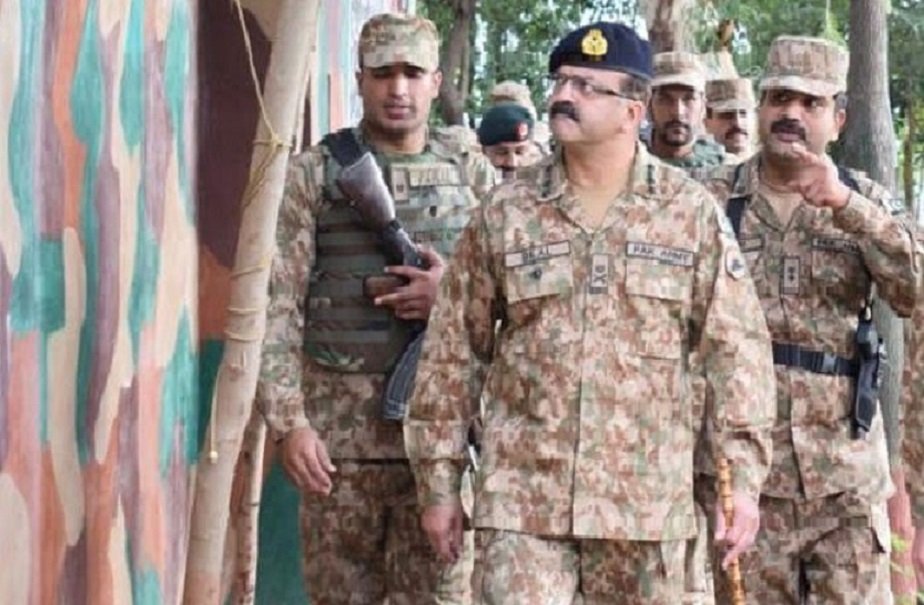
The Ministry of Foreign Affairs has appointed Lt Gen (r) Bilal Akbar as Pakistan’s ambassador to Saudi Arabia, removing Raja Ali Ejaz, a career diplomat.
The outgoing Ejaz, who was on his first ambassadorial posting, had been given the assignment around two years ago.
The latest change has brought Islamabad at par with Riyadh in one term that now both countries have envoys with a military background in each other’s capitals.
The Saudi ambassador in Pakistan Nawaf bin Saeed Al-Maliki was from the Royal Saudi Navy and retired as Rear Admiral. He had been appointed as the defence attaché of the Saudi mission in Islamabad and later elevated as the ambassador here four years ago.
The sudden shuffling by Pakistan is being seen as significant amid reportedly weakening bilateral ties at a time when India’s relationship with the Kingdom is improving.
Amid the present scenario, key task of Lt Gen (r) Bilal Akbar, who retired as Pakistan Ordnance Factories chairman, would be saving the ties from further deterioration.
The former three-star rank lieutenant general also served as X Corps Rawalpindi commander, chief of general staff (CGS) at GHQ, Pakistan Rangers Sindh director general and the general officer commanding (GOC) of the 11th Infantry Division Lahore.
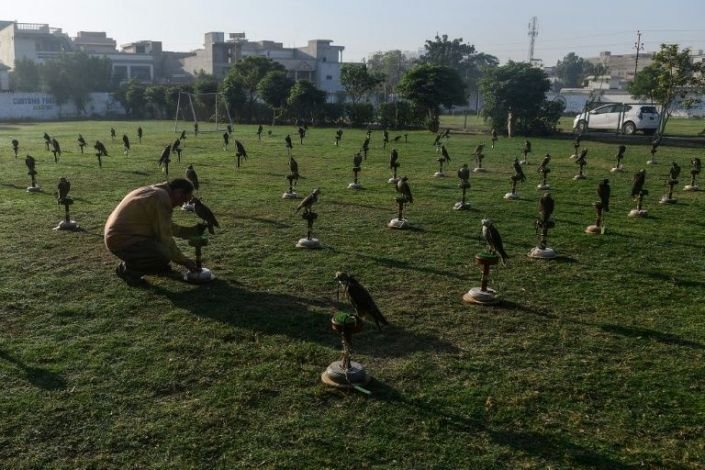
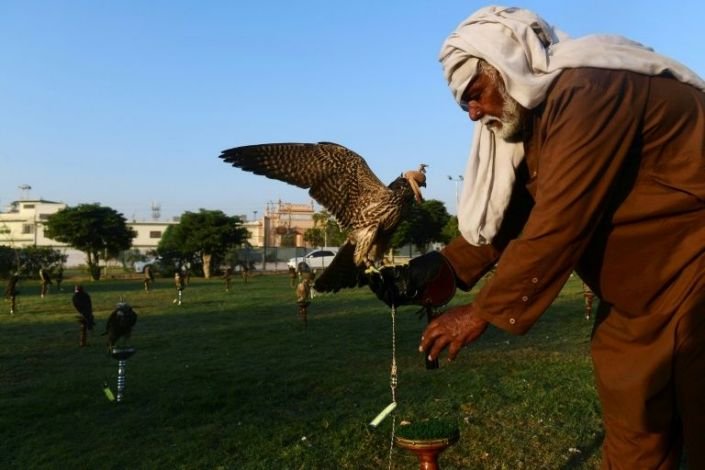
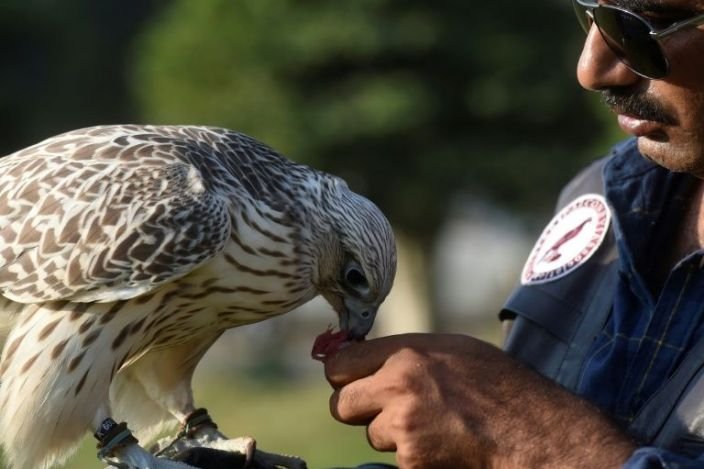
Since learning to capture birds as a teen, Muhammad Rafiq has amassed a small fortune in Pakistan trapping and trafficking falcons — including some endangered species — for wealthy Gulf Arabs.
A single falcon can fetch up to tens of thousands of dollars on the black market, which allowed Rafiq to renovate his family home.
“Every season, dealers come from Karachi and leave their contacts with us, and we call them back if we catch something,” said the 32-year-old, from a nearby coastal village.
He recently trapped a peregrine falcon on a one-week hunting mission.
“I desperately needed money,” he told AFP. “And God has listened to me.”
For years, Pakistan has stood at the nexus of the falcon trade, both as a source of the birds of prey, and then as a destination to hunt with them.
Falcon poaching is officially banned, but demand for the birds is rising, according to the World Wildlife Fund in Pakistan.
It estimates that up to 700 falcons were illegally smuggled out of the country last year alone, often by organised criminal networks.
Their destination is normally Gulf countries, where falconry is a treasured tradition.
Owners treat the birds “like their own children”, said Margit Muller, the director of Abu Dhabi’s falcon hospital, which treats 11,000 falcons annually, a number that has more than doubled in the past 10 years.
One conservationist told AFP an Arab falconer usually owns around five to six hundred birds, most of which will be captured in the wild in Pakistan or Mongolia.
Wild birds are prized over those bred in captivity because they are believed to be better hunters, though there is no evidence to support those claims.
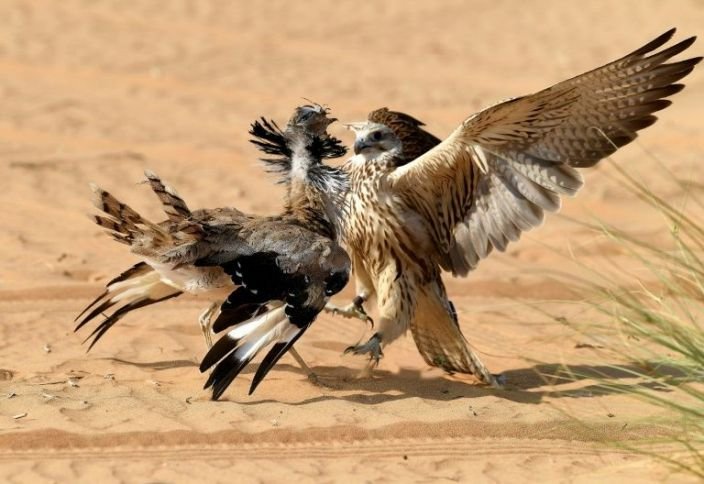
Every winter, lavish hunting parties from the Gulf flock to Pakistan’s sprawling deserts, where they are given permits to use their falcons to hunt the houbara bustards, a migratory bird wrongly prized as an aphrodisiac and classified as vulnerable by conservationists.
These excursions have cast a spotlight on the deep ties between Pakistan and its allies in the Gulf. For decades, the Gulf states have propped up Islamabad’s ramshackle finances with generous loans, with one of the expectations being that they can continue to use Pakistan as a hunting playground.
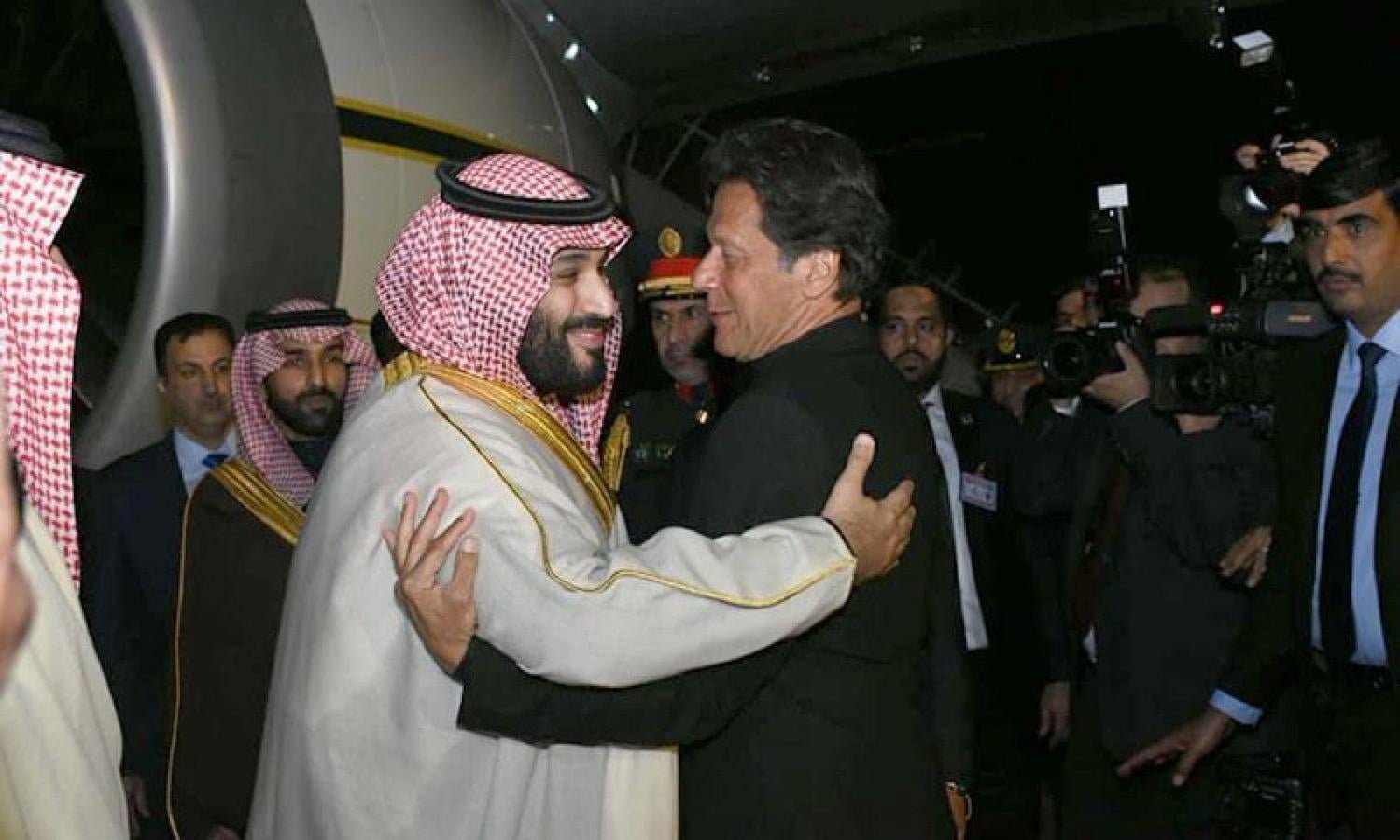
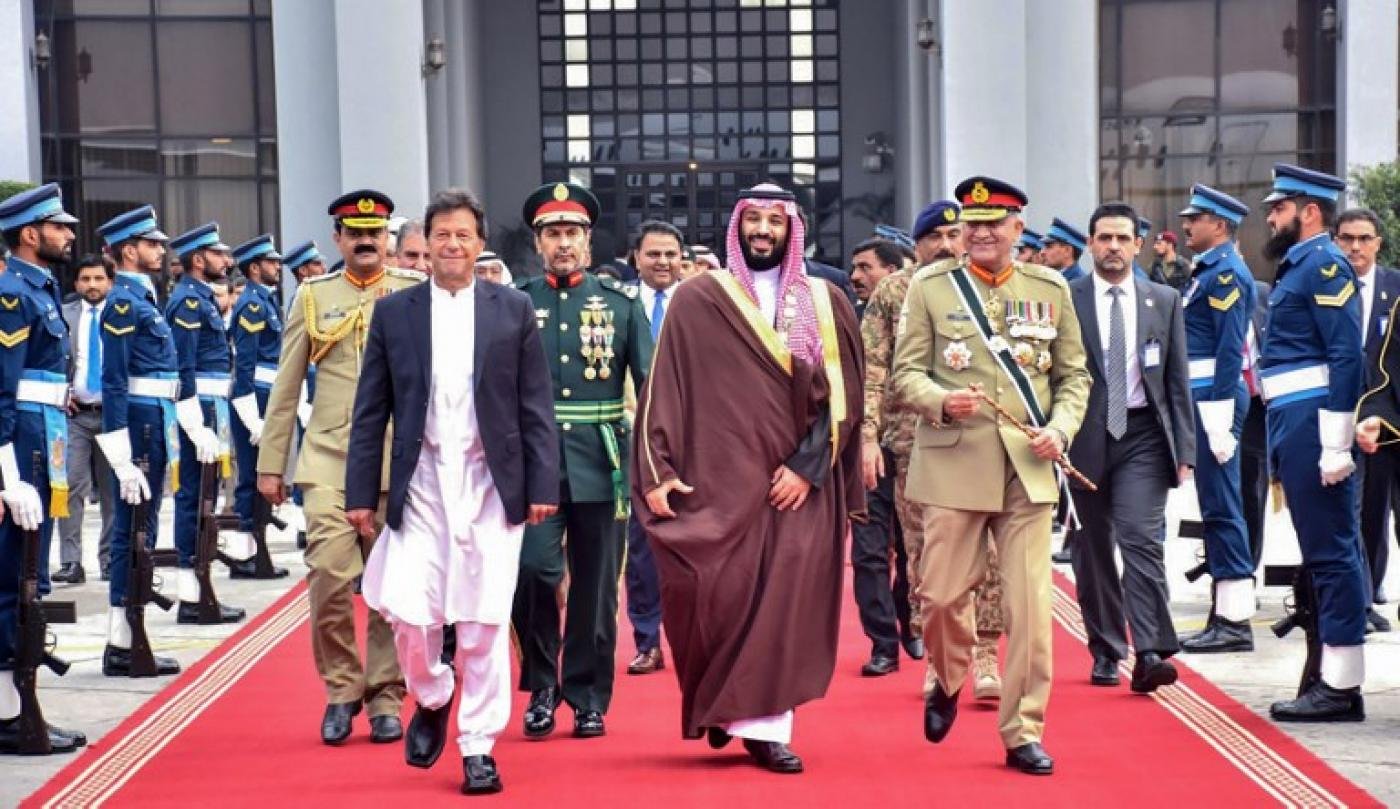
Saudi Crown Prince Mohammed bin Salman and two other royals were granted permission to catch bustards by Prime Minister Imran Khan’s government in December last year, a soft diplomacy tactic that Khan had openly disagreed with when he was in the opposition.
The government also presents falcons as gifts to world leaders.
“Our officials are working like pimps for the Arabs,” a government official requesting anonymity told AFP.
A brief ban on the bustard hunts was overturned in 2016 by the Supreme Court, but conservationists are now pushing for the export of falcons to be regulated in an ongoing case at the Islamabad High Court.
Every year, falcons escape the harsh Siberian winter and fly thousands of miles to warmer regions, including southern Pakistan.
During the migratory season, wildlife traffickers descend on villages along the Arabian Sea coastline, offering fishermen cash to briefly abandon their boats and try their hand at poaching.
“We pay them in advance, send food to their families and if they catch a bird that is precious, we happily give them motorbikes,” said one trafficker who spoke to AFP on the condition of anonymity.
A range of tactics can be employed — sticky liquids, net traps or, most commonly, using smaller birds as bait.
Poachers especially target the peregrine falcon, whose populations remain stable — but also the saker, which is endangered.
Bob Dalton, a veteran falcon conservationist, helped oversee the rehabilitation of dozens of falcons seized by Pakistani authorities in October, with officials estimating the cache to be worth well over $1 million.
“The illegal trade is growing, there is more money being spent, more pursuit from the Gulf,” he told AFP.
“With the exception of one or two species, most falcon populations are in decline or on the point of being unstable.”
With ongoing efforts to curtail rampant poaching failing, some officials in Pakistan have suggested regulating the falcon trapping market, inspired by a scheme involving another rare native species, the markhor — an elusive mountain goat with striking twisted horns found in Pakistan’s mountainous north.
Every year, foreigners shell out tens of thousands of dollars for a handful of trophy hunting permits, providing a financial incentive for communities to prevent poaching. Naeem Ashraf Raja, the director of the biodiversity at the ministry of climate change, said markhor numbers have rebounded as a result of this controversial conservation method.
With hunting parties set to descend on Pakistan again over the next few months, Kamran Khan Yousafzai, the president of Pakistan’s Falconry Association, said the country desperately needs to implement a sustainable wildlife programme.
“Arab falconers can’t resist coming to Pakistan. They have been coming to these hunting grounds for generations, and unless they face any real problems, they are not going to search for new destinations.”