Tag: save

  • Climate crises drove 27 million children into hunger in 2022

    Climate crises drove 27 million children into hunger in 2022

    Extreme weather events in countries vulnerable to climate change drove more than 27 million children into hunger last year, Save the Children said on Tuesday.

    The figure represented a sharp 135 percent increase over 2021, the UK-based charity said in an analysis ahead of the COP28 climate summit opening in Dubai on Thursday.

    It said children made up nearly half the 57 million people pushed into crisis levels of acute food insecurity or worse across 12 countries because of extreme weather in 2022, according to data from the IPC hunger monitoring system.

    Out of the 12, countries in the Horn of Africa were most affected, with Ethiopia and Somalia accounting for about half of the 27 million children facing hunger, Save said.

    “As climate-related weather events become more frequent and severe, we will see more drastic consequences on children’s lives,” Save’s CEO Inger Ashing said in a statement.

    The charity called on leaders meeting at COP28 in Dubai to take action on the climate crisis by recognising children as “key agents of change” but more broadly to address other causes of food insecurity such as conflict and weak health systems.

    Save highlighted the situation in Somalia, which is considered one of the most vulnerable countries to climate change, locked in a vicious cycle of drought and floods.

    It said the recent torrential rains and flooding that have engulfed many parts of the country had displaced about 650,000 people, about half of them children.

    Elsewhere, Save noted that two million children in Pakistan remained acutely malnourished after floods that swamped a third of the country last year.

    Across the planet, Save estimated that 774 million children -– or one third of the global child population — are living with the dual impacts of poverty and high climate risk.

    In a report issued last week, Save said that more than 17.6 million children will be born into hunger this year, one-fifth more than a decade ago.

  • Renowned Washington Post faced extreme backlash for cartoon dehumanising Palestinian children, deleted later

    Renowned Washington Post faced extreme backlash for cartoon dehumanising Palestinian children, deleted later

    Washington Post was slammed on the internet on Wednesday for a racist cartoon dehumanising the Palestinians. Right now the number of Gazans killed in Israeli airstrikes has reached 10,000. The cartoon has since been deleted, while Post has put out an editorial note.

    The offensive drawing shows a crudely drawn Arabic man labeled Hamas with three children and a woman tied around him with ropes.

    “This is the kind of anti-Palestinian racism that they think is acceptable for publication,” slammed Palestinian poet Remi Kanazi.

    Palestinian journalist Ahmed Eldin re-shared the post to point out how the racism Palestinians are enduring in the Western media is similar to how the Jews were drawn as evil with physical features that compared them to rats or cockroaches.

    “Before the Holocaust, Jews were portrayed as irrational and evil, with physical features that made them appear akin to cockroaches and rats. These images dehumanized Jews to justify their mass extermination. Now, the Western press is doing the same to Palestinians. The source of this obscene and offensive piece of propaganda masquerading as a “political cartoon” by Michael Pramirez is not a lesser-known publication, but rather the widely recognized

    @washingtonpost. Regardless of the validity of the claims regarding Hamas using human shields, the notion that thousands of children being killed can be justified or deemed acceptable as collateral damage is absolutely unacceptable. The dehumanization of Palestinians, which serves as a pretext to permit and rationalize their mass killing, is a disturbing trend that seems to have no boundaries within American discussions and debates.”

    ‘What’s more troubling than this racist depiction,” Palestinian-American poet Mohammad El-Kurd wrote. “Is that the Washington Post thinks it’s OK to kill civilians if, hypothetically, ‘terrorists’ hid behind them. Even if the “human-shields” myth was true, only those who kill civilians are responsible for the act of killing.”

    Columnist and writer Fatima Bhutto tweeted her outrage:

    “This cartoon is so anti-Muslim, so racist it boggles the mind that any newspaper could print it. Beyond which, Israel has murdered over 4,000 children- do you have absolutely no shame depicting Palestinian children in this manner? What a disgrace.”

    The Washington Post opinion editor David Shipley published an apology for the cartoon on their website and took it down:

    “A cartoon we published by Michael Ramirez on the war in Gaza, a cartoon whose publication I approved, was seen by many readers as racist. This was not my intent. I saw the drawing as a caricature of a specific individual, the Hamas spokesperson who celebrated the attacks on unarmed civilians in Israel. However, the reaction to the image convinced me that I had missed something profound, and divisive, and I regret that. Our section is aimed at finding commonalities, understanding the bonds that hold us together, even in the darkest times.”

  • Dubai-based Pakistani awarded 50,000 dirhams for saving pregnant cat

    Atif Mehmood, a Pakistani salesman based in Dubai, saved a  pregnant cat stuck on the second-floor balcony of a residential building in Deira, the commercial hub of Dubai.

    Atif, along with a Moroccan and an Indian man, spread a bedsheet and caught the cat after it jumped from the second floor.

    The video shows the three men holding up the bedsheet for the cat, who initially hesitates, but then jumps into it and is saved.

    Viewed over 1.1 million times, the video caught the eye of the ruler of Dubai who took to Twitter and asked people to help identify the “unsung heroes” so he could thank them.

    “I got a call from the police and someone asked me, ‘Did you save a cat?’,” Mehmood told Arab News. “I got scared and said yes, I did, and then they asked me to visit the police station.”

    Read More: Diner leaves $10,000 tip to reward employees’ services

    He said he entered the police station to cheers and applause. Three days later, he was told he had been awarded AED50,000 (Rs 2,172,833) by the Dubai government.

    “I did not believe it at first,” he said, “but it has become a reality.”

    Mehmood, who is single, has already spent most of the reward money to buy a car for his father and help out his brother. He now plans to use the rest of the cash to try to set up a business in Dubai

  • Australian man punches 10-feet great white shark to save wife’s life

    Australian man punches 10-feet great white shark to save wife’s life

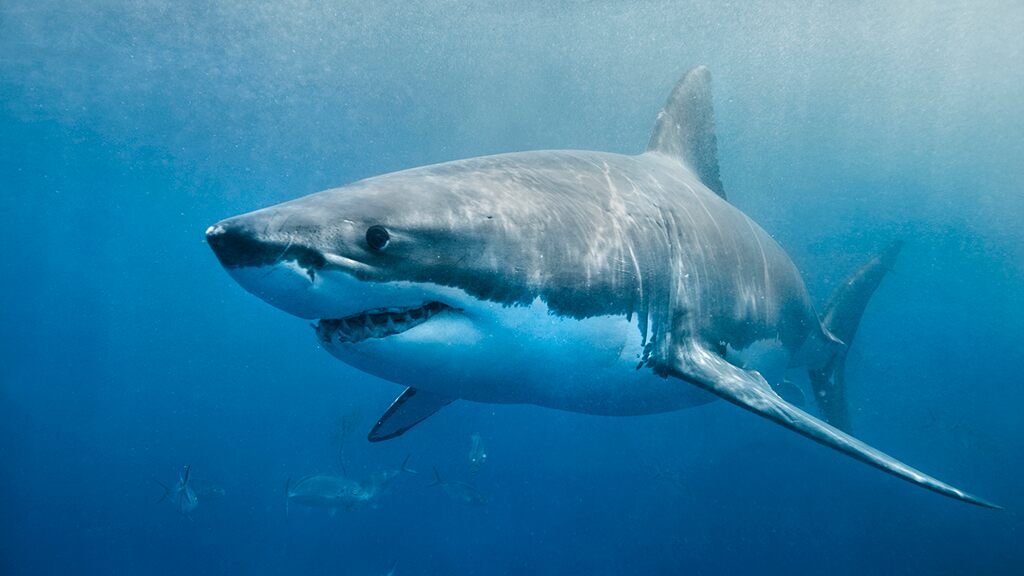
    An Australian surfer repeatedly punched a 10-feet long white shark that had bit his wife until it released his wife’s leg.

    According to details, the couple was surfing at a beach near Port Macquarie on Saturday morning when the woman was bitten twice by the shark and her right leg got injured.

    “Her companion was forced to punch the fish until it let go,” police said in the statement.

    Paramedics gave the 35-year-old first-aid at the beach and then she was airlifted to a major hospital for surgery.

    One witness who was surfing nearby when the attack occurred called the man a “hero” for taking on what appeared to be a great white shark up to three meters (10 feet) long.
    “He started laying into the shark because it wouldn’t let go,” Jed Toohey told the Daily Telegraph. “He saved her life… He was really incredible.”

    The woman’s husband, Mark Rapley, said that “I did what anyone would have done at that moment”.

    Australia has one of the world’s highest incidences of shark attacks and there have been five fatal ones in the country so far this year.

    Just last month, a shark pulled a 10-year-old boy from a fishing boat off Tasmania. He survived after his father jumped in the water to save him.

  • How to save on your electricity bill?

    How to save on your electricity bill?

    The ever-increasing inflation has disturbed our budget to no extent. And considering its the summers, the electricity bill has practically sky-rocketed just like the mercury making it a feat to pay.

    Here are four ways you can save on your electricity bill.

    Save on your appliances

    Electronic devices consume energy even when they are not in use but plugged in. Unplug every electrical device that’s not needed. Moreover, fit LED lights instead of traditional bulbs as they use less energy and last longer than bulbs. Bulbs also produce more heat and make your home warmer.

    Save on your AC

    Set the air-conditioning unit to “Auto” rather than the “On” mode, as this will regulate room temperature more effectively.

    Don’t keep your AC’s temperature lower than 24 degrees celsius. Each degree cooler can represent the equivalent of a nine percent savings on cooling costs.

    Ensure your air-conditioners are well maintained by regularly getting them checked from a good maintenance company. It is important to ensure that air filters are clean, refrigerant levels are maintained and electrical connections are working properly. If they’re not checked everyday issues have the potential to cause bigger problems which will eventually contribute to your expenses.

    Save when
    doing laundry   

    Around 90% of a washing machine’s energy is used to heat the water, so washing your clothes at 30-40C will help keep your electricity bill less. Another tip is don’t start the machine until you have a full load.

    Use less
    energy during peak hours

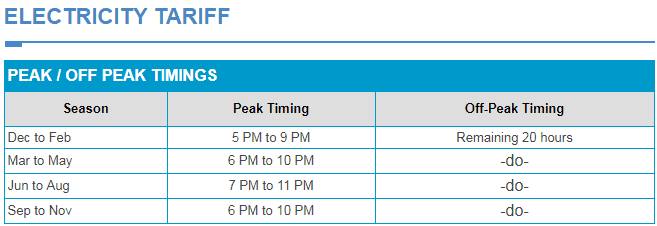
    According to LESCO and K-electric, these are the peak and off-peak hours so try to use less energy during these hours.

    LESCO Peak and Off-Peak Hours
    K-Electric Peak and Off-Peak Hours