Tag: sexism

  • Maya Ali’s favourite scene from ‘Yunhi’ is a replay of sexist ‘beti ka ghar na raha’

    It’s Friday, Mercury has stopped going in retrograde and everything is going back to normal, except for Pakistani dramas, which will keep scraping the bottom of the barrel to search for sexist content.

    It’s hilarious and yet quite terrifying how dedicated Pakistani dramas are to not provide what their audiences actually want: progressive storylines that recognise women as equals, rather than as props. But what currently popular trending dramas like ‘Yunhi’ prove, the best way to get ratings and to keep eyes glued to screens is to keep peddling the same sexist tropes over and over again and proclaim it as the standard content everyone should watch.

    ‘Yunhi’ began trending on social media this week when the actor playing the female lead on the show, Maya Ali, shared a clip from the latest episode. In it, her character is having an emotional, heart-to-heart with her father (played by fashion designer Deepak Perwani). Judged on performance alone, the scene is definitely tearjerking. However, we made the mistake of unmuting the video and heard the female character discuss how tragic it is for her to leave her father and how happy she is that her mother isn’t alive to see her wedding day.

    We should clarify here that Maya’s character is not heading off to war or to a distant land, but is actually getting married and leaving for her new home.

    Exactly what magical powers does a yellow mayun joraa hold, we want to ask Deepak Perwani, because of which a woman suddenly becomes a shadow of her past self and leaves behind her old family and friends? Does signing a marriage pact suddenly mean that over night, no woman can come back to her old home, and is now just the wife of the man that she has married?

    And most importantly, how is this supposedly tear jerking scene suppose to sit well in a country where women are taught that once they are married, they can never freely visit their families nor can they wear what they want or go where they want? They are not even allowed to escape domestic abuse.

    The message that Maya Ali likes, is once more, a terrifying reminder that for Pakistani families, marriages are basically equivalent to exiling women from their parents’ homes. And that for parents, including the dead mother who Maya is glad isn’t alive to watch her get married, the sole emotional and fundamentally important moment is their daughter getting married, nothing else.

    If these drama creators need any advice to show a rukhsati that actually makes the audience sob, take notes from ‘Kuch Ankahi’. That drama serial included a wedding scene where the phupoo (aunt) passionately defended women’s right to include protective clauses in the nikkahnama, and prove that women do not become strangers to their own families once they get married. They are still individuals with a personality, and definitely more than just the wives of the men they are getting married to.
    https://twitter.com/sunflowermochii/status/1637183811300601858?s=20
  • Twitter users troll Salman Khan for calling for censorship against vulgarity, nudity

    Bollywood superstar Salman Khan came under fire on Twitter after he spoke about digital platforms normalizing nudity and vulgar topics, asking that they should be subjected to censorship.

    “I really think there should be censorship on the medium (OTT). All this… vulgarity, nudity, swearing needs to stop. Kids as young as 15 or 16 can access it. Would you like it if your young daughter watches it? I just think the content on OTT needs to be checked. The cleaner the content, the better it will be. It will also have better viewership.”

    According to The Hindustan Times, the ‘Kisi Ka Bhai Kisi Ki Jaan ‘ actor spoke out against actors who perform nude scenes on television and expose themselves on screen, suggesting that this should not be acceptable in India, because it could also lead to security problems:

    “You have done it all – love making, kissing and exposing in scenes. And when you enter your building, your watchman has also watched your work. I just don’t think that is right for security reasons. We don’t need to do that… You don’t need to cross the boundary. We live in India. It was way too much before, finally, it has been curbed. Now, people have started working on a lot of good and decent content.”

    Khan’s comments led to a revolt against him on social media, with users bringing up the problematic things the actor has said and done in the past, pointing out the irony in him speaking out against vulgarity, yet refusing to address his own problematic behavior.

    Twitter users shared how the 57 year old has consistently played hero to women 20 years younger than him, as currently the female lead of his upcoming film ‘Kisi Ka Bhai Kisi Ki Jaan’, Pooja Hedge, is 32 years old.

    Other users pointed out Khan’s history of making problematic comments, especially when in 2016, he drew outcry over saying his schedule was so hectic that he felt like a ‘raped woman’.

    Many also pointed out how Khan has a history of being abusive to his partners. Former girlfriend Somy Ali shared details of domestic violence she suffered during their eight year relationship. Other people also recalled how Bollywood superstar Aishwarya Rai Bachchan suffered from domestic abuse from the actor during the time they were together.

  • ‘Sexist’: NADRA slammed for declaring men head of family

    ‘Sexist’: NADRA slammed for declaring men head of family

    Twitter users have slammed a sexist policy authorized by The National Database and Registration Authority (NADRA) after a user shared a screenshot of the message she received from the government organization that informed her that the husband was designated as the head of the household.

    The user went on to criticize NADRA as she had not nominated her husband as the head of the household, per the message stated.

    https://twitter.com/yougoglencocco/status/1640997625821380608?s=20

    The user further went on to question how this policy would become a threat for women trying to escape abusive marriages, because their private information is being sent to their spouses without their consent.

    Other women also slammed NADRA for refusing to recognize female agency, and pointed out how this policy alienates single parent households, especially with women who had escaped abusive relationships.

    Sharing their experiences of being turned away from offices while applying for their CNIC card, female tweeps blamed the policy that demands that a male guardian verify themselves as the head of their household.

    NADRA responded to the tweet by sharing that this policy was designed to guard family data from unauthorized access, because of which they had decided to inform the family head about procedures related to family data.

    “It is one of the security features to guard family data from unauthorised access. In order to maintain the integrity of family data, @NadraPak informs every family head about any processing through which someone becomes part of his family.”

    This tweet was bashed by Twitter users are regressive for refusing to recognize women as the head of their households, as activist and researcher Ammar Rashid tweeted that the government body should not have violated the privacy of women by leaking their data this way.

    “Maybe @NadraPak should try to institute measures to confirm identities that don’t openly violate the constitutional right to privacy of adult female citizens? Other countries seem to be managing data security just fine without such archaic rules.”

    Another user said: “A married woman is usually above the age of 18 and that makes her legally a citizen. She must have access to her OWN security features without having man govern her changes to the card.”

    https://twitter.com/dcfaiqalethal/status/1641077646548148227?s=20

    The Chairman of NADRA, Tariq Malik addressed the controversy in a tweet on Thursday, sharing that the policy did not discriminate against women from becoming the head of the household, and shared statistics that showed more women were nominated for this position than men.

    @NadraPak policy of declaring head of family is not gender specific. See thru lens of #realdata 28 million citizens declared their mother, 291,039 declared their sisters, 116,800 men declared their wife as head of family. And, 3.69 million females who are self head of family.”

    Malik further went on to reveal that the backlash to this policy has encouraged the department to reform it in order to prevent discrimination of any kind:

    “Declaring head of family is self reported event. I have directed our Public Engagement Department to sit down with social scientists and subject matter experts to bring reform in policies and SoPs. Suggestions welcomed. We have revamped quite a few since a year.”

  • Yashma Gill debunks the ‘gold digger stereotype’, encourages women to be financially independent

    Yashma Gill debunks the ‘gold digger stereotype’, encourages women to be financially independent

    Yashma Gill was a guest on the Nadir Ali podcast, a clip of which has gone viral, where she passionately spoke out against the misogynist stereotype that women are gold-diggers.

    Ali said that in our society today, a man’s ugliness is considered his empty pocket:

    “Regardless of whether he is good-looking or not, he looks awful without having money. He is told to go and earn money.”

    Gill corrected this statement by pointing out that that many women in successful, happy marriages are earning more than their husbands so this stereotype that women are only in love with money isn’t true:

    “I will not give any names, but around us there are a lot of examples where a woman is more successful than her husband, and they had love marriages…Regardless of these people belonging to my field or not..I don’t like the stigma attached to women that we are gold diggers.”

    Ali brought up a sexist stereotype about women gaining financial independence and abandoning men:

    “When a man earns, he hands over everything he has to the woman. Whereas when a woman begins earning she decides to abandon her man.”

    Gill counteracted this statement by pointing out that financial independence only helps women become more confident within themselves, and doesn’t translate into not wanting a companion anymore.

    “People are confusing this with when a woman becomes financially independent, she is no longer helpless,” stressed the ‘Pyaar Kay Sadqay’ actor. “She can stand up for herself. She can remind her parents that she is no longer a burden on them so doesn’t need to be married off. She can even provide for her children…So I think that independence for women and girls can give them strength and power, not the fact that they don’t need a man. Everyone needs companionship.”

    Gill then gave the example of Hazrat Adam (S.A.W) and Hazrat Havva (S.A.W), to prove that every human being was meant to have a companion:

    “Take the example of Hazrat Adam (S.A.W) and Hazrat Havva (S.A.W), this is a natural thing that evcryone needs companionship. But there must be compatibility, respect and a lot of other things.”

    Listen to her complete interview here:

    Gill shared the viral clip on her Instagram stories to address the misunderstanding that might rise in case audience is assuming that Ali was being sexist, to which the actor had written that the host was respectful and well mannered:

    “So just to clear the air, the respectable host only meant to ask my opinion on what is a common misconception in society. Nowhere did he agree with it himself or said that it is something that he believes in. It was just one of the many things that he discussed with me – “discussed” not imposed, argued or debated. Therefore let’s not get him wrong and frame him in ways he doesn’t deserve because he was nothing but extremely kind and respectful towards me that I was honestly in awe of his nature. A true gentleman.”

  • ‘Jahil’: Celebrities, activists slam Senator Afnan Ullah Khan for horrifying remarks about Mahira Khan, Anwar Maqsood

    Yesterday, a clip from a session named An Evening With Mahira Khan went viral on social media, featuring Anwar Maqsood. The renowned writer made a disparaging comment about two female Pakistan Muslim League -Nawaz (PML-N) leaders, Maryam Aurangzeb and Maryam Nawaz.

    In the clip, Khan was seen asking about two women who are fighting and shouting with each other, to which Maqsood responded that these women are Maryam Nawaz and Maryam Aurangzeb,

    “I am restricted from talking about politics, I can’t say anything about anyone. Hopefully the situation will get better soon. What you said about poisoning, abusing each other so I gave an example, it is also happening in real life. Also both are actors, not character actors.”

    This comment was rightfully criticized because of how it chose to directly target the female politicians through the same misogynist stereotypes Khan was condemning in her session. Twitter users also slammed Khan for her selective morality, urging the actor to reflect on the feminist morals she is presenting because repeatedly calling out misogynist slurs used to put down women, but in the same breath applauding this way of publicly targeting female politicians and humiliating them? Baffling.

    https://twitter.com/Bubbleskhanum/status/1637942268773519367?s=20

    “I don’t expect anything good from him, because he is a man, but it’s so baffling to see Mahira Khan applauding over this incitement of misogyny and sexism, she literally made a brand by capitalizing over feminism, but is not consious about how harmful this is for Pakistani women,” one user wrote.

    This is the proper manner of responding to an opinion you disagree with, by pointing out mistakes and urging the other person to reflect and correct themselves. Because after all, celebrities have a public platform through which they can influence other people to follow their actions.

    What is the most vile, awful way to counteract? By using abelist, abusive language and making personal remarks like the way Senator Afnan Ullah Khan did on Twitter

    “Mahira Khan has mental health problems and Anwar Maqsood has become a drunkard at this stage of life. Both of them are shameless characters and the public should condemn them for it. There are books written about Mahira Khan’s character, and she is known for even flattering Indian actors for the sake of money and Anwar Maqsood is filled with hatred at this point of his life,” wrote the PML-N senator on Twitter.

    To condemn a misogynist remark is the right of any politician, but to go even lower and make personal, completely distorted and abusive comments about someone is completely not acceptable.

    Targetting Khan and Maqsood with such awful comments from the politician whose party is currently ruling the country proves how deep misogyny runs in this country. Celebrities like Atiqa Odho and Farhan Saeed openly condemned these comments for showcasing Dr Ullah Khan’s misogynist state of mind.

    Farhan Saeed retweeted this comment and condemned the way free speech in Pakistan has been suppressed

    “This is the mentality that doesn’t let #Pakistan grow , this is what they do when someone just gives an opinion or has a political preference . They get personal so people stop giving their opinion . Senator ? Zuban jahilon wali,” he wrote.

    Odho shared a picture of both Khan and Maqsood on her Instagram account and in the caption she condemned the PML-N politician for using such foul language against two “hard working and committed people.”

    She wrote: “#AnwerMaqsood a living legend and mentor and #MahiraKhan our beloved star. Both shine where ever they go and leave others way behind. Shameful when anyone dares to say anything against such hard working and committed people as these are national treasurers. PMLN should expel the senator who behaved so poorly from their party at once to teach him a lesson and show their sincerity towards our iconic soft image ambassadors. Such acts must not go unnoticed as these are not political people and as citizens have a right to an opinion within a true democracy. Hope action is taken and a public apology is given by #PMLN !”

    Actor and writer Mira Sethi tweeted that these remarks are ‘utterly shameful’.

    https://twitter.com/sethimirajee/status/1638106602828865539?s=20

    Actor Iffat Omar, who is critical of Imran Khan, also condemned the tweet and tagged Maryam Nawaz, urging her to take action against the senator.

    The twitter account of Aurat March called out the Senate of Pakistan to teach their politicians to refrain from using such abusive, sexist language against their critics, especially when it is a woman involved.

  • ‘Mera Jism Meri Marzi is more than just being about clothes’: Amna Ilyas

    Actor Amna Ilyas was a guest on “The Talk Talk Show’ where she opened up about being a feminist, and clarified the misinformation around the Aurat March slogan ‘Mera Jism Meri Marzi’.

    When the placcard was raised at the 2018 Aurat March, it caused outrage after many right-wing critics said that the chant supports promiscuity and challenges family values in Pakistan. Many religious clerics had used the placard as justification to call ‘Aurat March’ un-Islamic and accused it of promoting a Western agenda in Pakistan.

    Many feminist activists have defended the slogan for protecting women’s bodily autonomy, and now Ilyas has also done the same, as she explained that the slogan ‘Mera Jism Meri Marzi’ was more than about clothes, it’s about protecting the rights of women:

    “It’s about having body autonomy rights and consent. It’s about harassment, domestic violence, and concepts like, ‘No one has the right to touch me without my consent, even if I’m married to you’.”

    Ilyas went on to debunk the stereotype associated with feminism that women who support this ideology are promoting vulgarity, when in reality the ideology supports the rights of women to have the same opportunities as men:

    “Whenever I talk about feminism, people always object by saying ‘Oh, Amna is bold, of course, she will spread vulgarity as she’s from the industry, she wants all our daughters to be like her’. No, I don’t want that, I only do what I want to for myself.”

    “When we speak of equal rights, it’s about having the same opportunities to thrive in my career as the man beside me. If you’re a father of four children who excel in your profession, why can’t I do the same? Honestly, it’s not about whether you’re getting permission to wear jeans or not. What we truly need, is the space to work in a cerebral capacity,” she explained.

    Watch the complete interview here:

  • Don’t tell our women what needs to be done

    Don’t tell our women what needs to be done

    Women political participation is a fundamental prerequisite for gender equality and genuine democracy. It facilitates women’s direct engagement in public decision-making and is a means of ensuring better accountability to women. But here in Pakistan, women in politics are seen as a threat to the fragile egos of some male politicians.

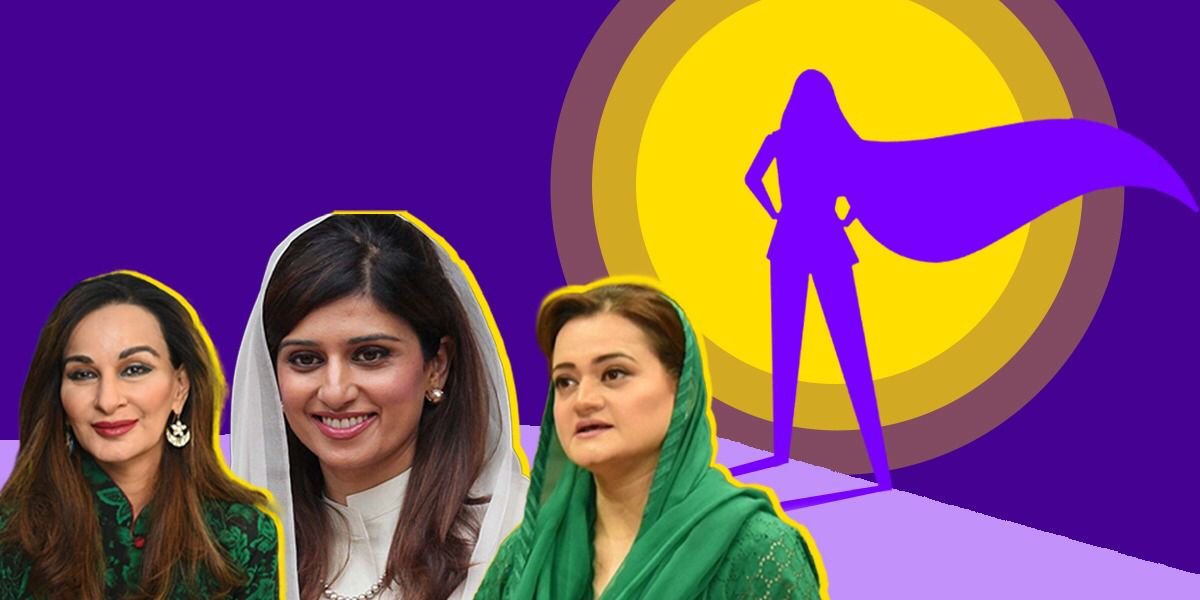
    When we talk about women’s political participation, it is easy for us to imagine the empty seats around the decision-making table, and a little more difficult to picture the many obstacles and challenges women face to get into those seats. When the same empty seats are filled by women, they somehow become a threat and danger. Recently, Jamaat-e-Islami’s (JI) MNA Abdul Akbar Chitrali criticised State Minister for Foreign Affairs Hina Rabbani Khar on her recent visit to Afghanistan. Chitrali said that he was not against any female minister, but he believed that the government should have included some tribal elders in the Khar-led delegation that visited Afghanistan. In response to his sexist statement, women Members of the National Assembly (MNAs) from treasury benches extended their support for Khar. Minister for Climate Change Senator Sherry Rehman said, “This debate on gender difference has ended in the entire world, as to who is a man and who a woman. People are known for their performance and merit and not for their gender. Our women are excelling internationally and continuing to do so.” Information Minister Marriyum Aurangzeb also spoke up, asking that all parliamentarians, especially the men, should encourage and acknowledge the competency of women ministers appointed on merit.“Hina represented Pakistan in Afghanistan. This is a moment of pride for the entire nation,” she said, rebuffing Chitrali’s objections.

    It is not the first time that we have seen sexism in parliament. Chairman Senate Sadiq Sanjrani called Sherry Rehman the “Senate’s dadi (grandmother)” when he asked a house member to keep the questions specific so that Sherry Rehman can answer the questions. “I would advise you to only ask specific questions so that Sherry Rehman, who is the dadi of this House, can give you the right answers,” Sanjrani said, adding that members should keep the environment of the House calm.

    This month we saw PTI leader Fawad Chaudhry advising Information Marriyum Aurangzeb and Sherry Rehman to quit politics and open a beauty parlour instead.

    The question remains: what are the male politicians so frightened of? Politicians need to learn that there is a a fine line between criticism and misogyny remarks. Our politicians and men in general of Pakistan need to do better. Women of Pakistan are fierce, resolute and hardworking — be it in any field of the world. They are trendsetters and opinion makers. They shall and will not be stopped.

  • Alia Bhatt is annoyed with sexism in Bollywood, speaks her heart out

    Alia Bhatt is annoyed with sexism in Bollywood, speaks her heart out

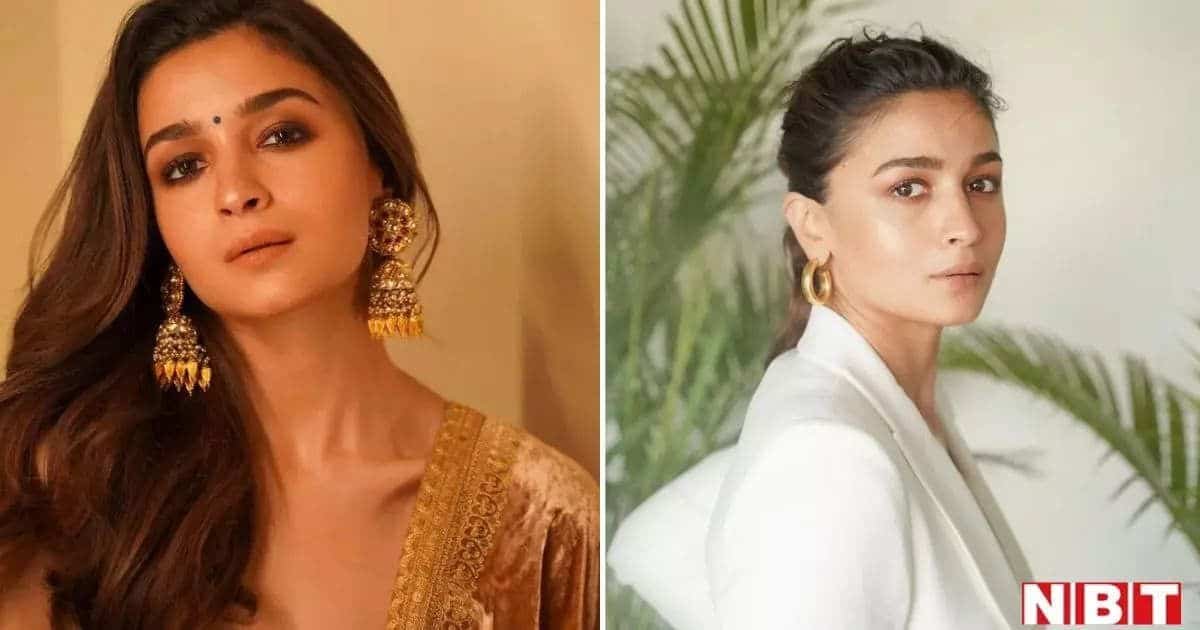
    Bollywood actor Alia Bhatt recently discussed in an interview how she has occasionally encountered casual misogyny and has heard sexist remarks in Bollywood.

    The Raazi star claimed that she did not recognise the sexism in such remarks early in her, however now such sexist remarks irritates her.

    When asked if she had faced casual sexism in Bollywood like fellow women producers and actors, the Student Of The Year actor replied, “I think from time to time I have faced that– casual sexism. Many times I would not notice it. When I think back now because I am so much more aware of it, it just makes so much sense as ‘oh my god that was such a sexist comment, or that I was basically a subject of extreme misogyny in that moment. That’s why now I am so much more sensitive. Sometimes my friends go like ‘what’s wrong with you, why have you become so aggressive?’”

    The actress said, ‘But it is not about her, people say don’t be so sensitive, you are being so sensitive, have you had periods.’ I say, ‘I am not getting sensitive and even if I am on my period, then what? You were also born because of this because women have periods.’

    She added, “I get very angry when people say these random things. Things like ‘Your bra shouldn’t be on the bed, hide your bra. Hey, why hide it? It’s clothes, you’re shining your underwear, so I’m not saying anything. It’s not that all this happened to me but I understand how you as a woman should hide a lot of things.”

    She further mentioned, “But it’s not about that, just random things like ‘don’t be so sensitive, you’re being so sensitive, are you PMSing. To hell with you, I am not being sensitive, and even if I am PMSing so the hell what? You were born because women were PMSing. It gets me so annoying when people say these random things. It’s just casual.”

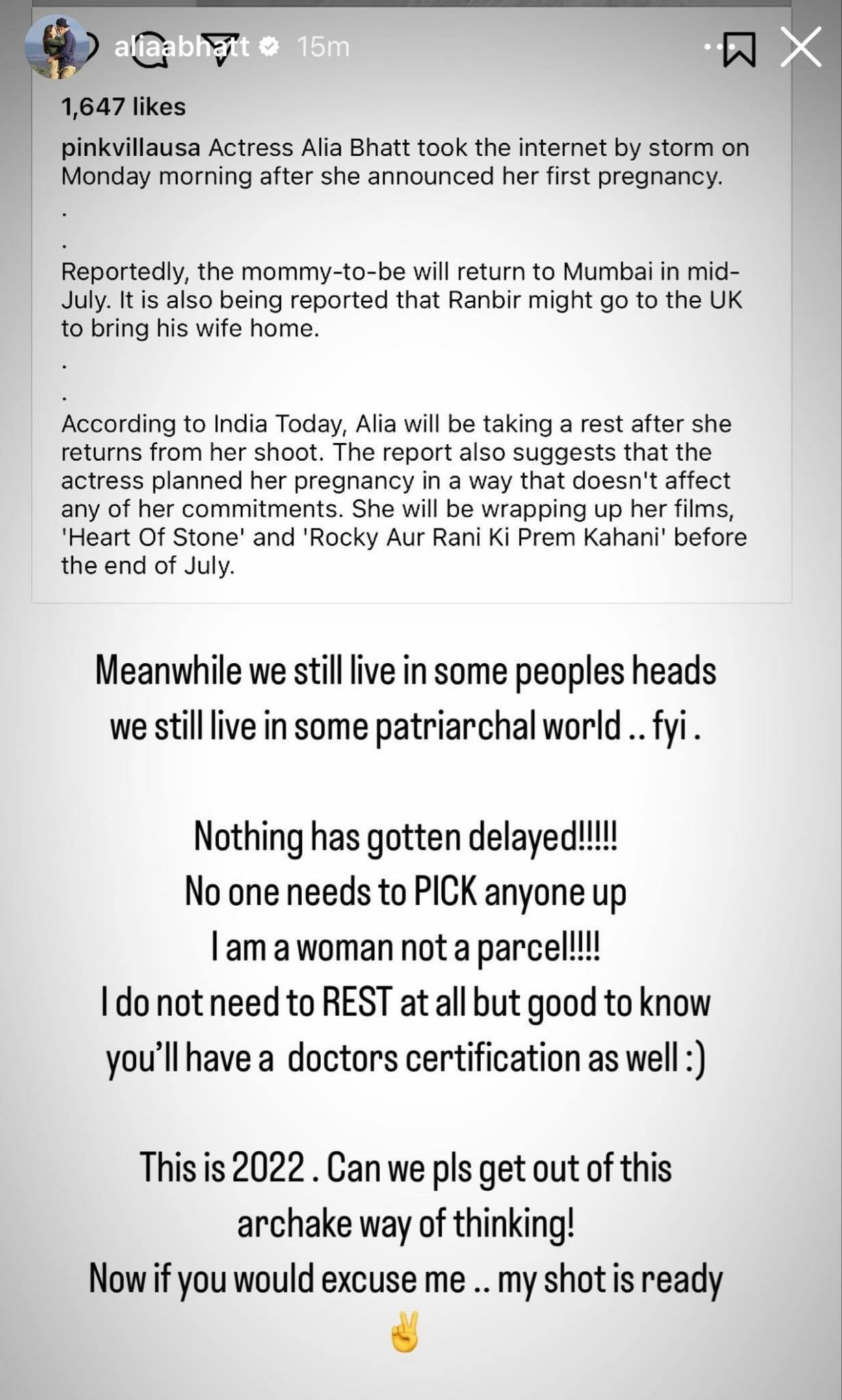
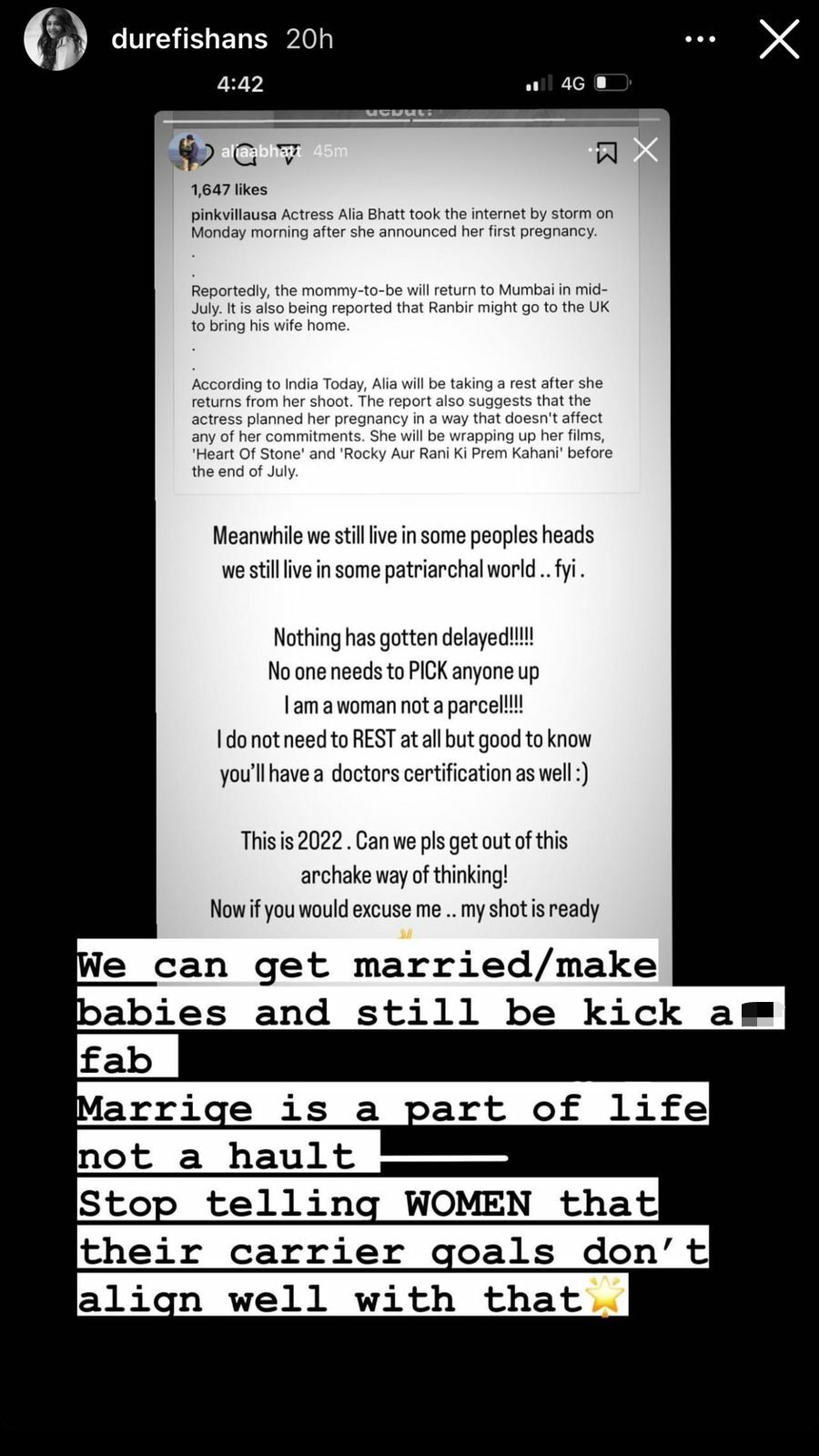
    Earlier this year Alia took to her Instagram stories to share a screenshot of a post by Pinkvilla that claimed the Gangubai Kathiawadi star would return to Mumbai, India in mid-July and that her husband Ranbir Kapoor would especially fly to the UK to bring his wife back home as she is pregnant and needs care.

    The post also read that Bhatt will be taking a rest after she returns from her shoot, suggesting that the diva had planned her pregnancy in a way that doesn’t affect her shoot schedule. The post concluded that Bhatt would be wrapping up her films Heart of Stone and Rocky Aur Rani Ki Prem Kahani before the end of July.

    Alia captioned her post while re-sharing that in some “peoples heads we still live in some patriarchal world” and confirmed that nothing has been delayed. “No one needs to PICK anyone up. I am a woman, not a parcel!!!! I do not need to REST at all but good to know you’ll have a doctor’s certification as well.”

    She emphasized that this is 2022 and requested that people could get out of the “archaic” way of thinking. “Now if you would excuse me.. my shot is ready,” she concluded suggesting that she won’t be “resting” at home.

    Multiple Pakistani actresses have extended their support to Bhatt with heartwarming posts.

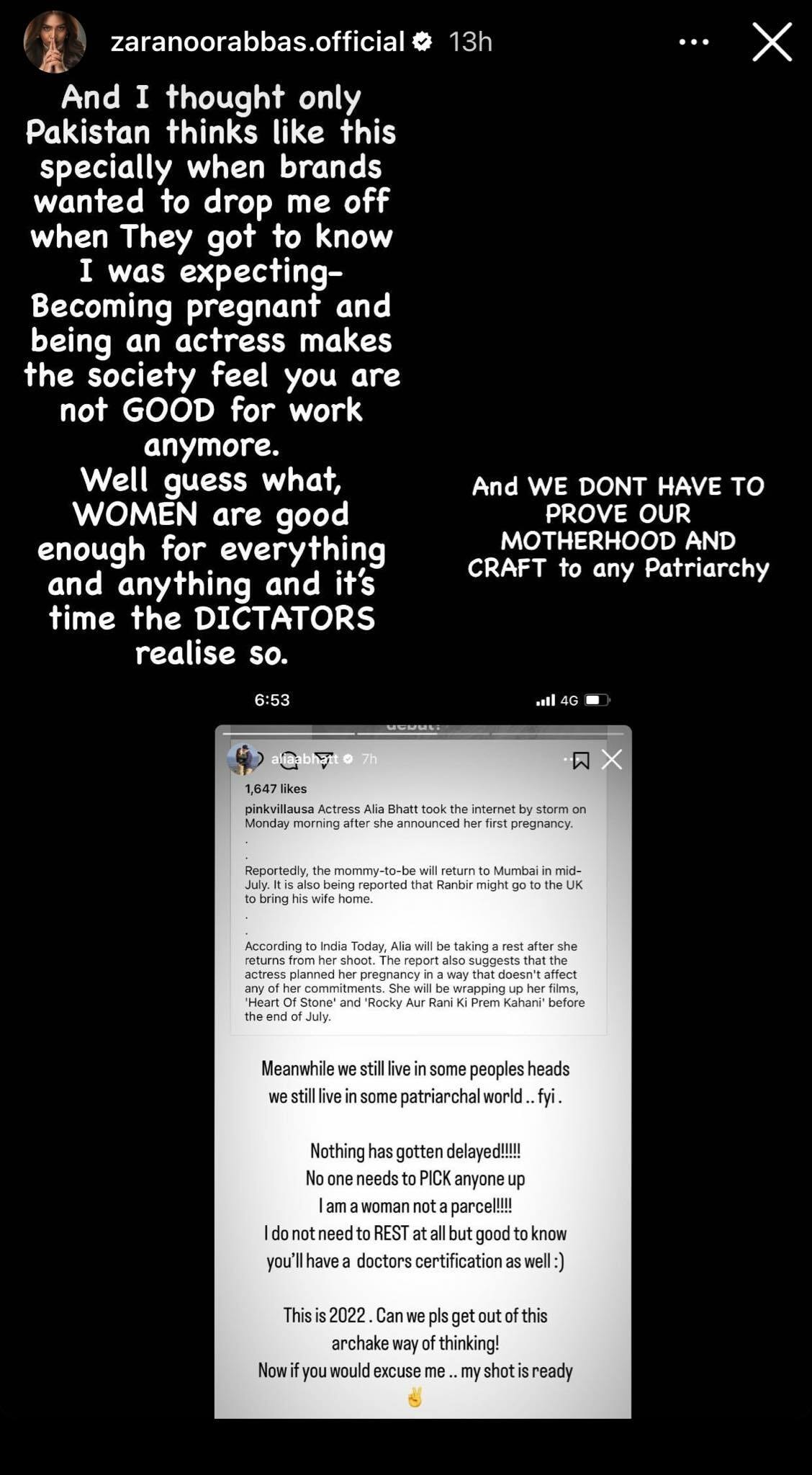
    Pakistani actors Zara Noor Abbas and Durefishan Saleem lent support to the Bollywood star and took to their Instagram stories to write that women don’t have to prove anything.

    Zara wrote that she thought this happens only in Pakistan, recounting how brands wanted to drop her after finding out that she was expecting.

    “Becoming pregnant and being an actress makes the society feel you are not good for work anymore. Well guess what, WOMEN are good enough for everything and anything and it’s time the dictators realise so. We don’t have to prove our motherhood and craft to any patriarchy,” penned the Zebaish star.

    Kesi Teri Khudgarzi diva Dur-e-Fishan Saleem also shared Alia’s Instagram story to her own and wrote, “We can get married/make babies and still be kick a** fab. Marriage is a part of life not a [halt].” She also said people need to stop telling women that their career goals don’t align well with that.

    Meanwhile, on the work front, Alia is all set for the release of her maiden production film, Darlings, which is scheduled to release on August 5, 2022, on Netflix.

  • ‘Arrest, sexism, political victimisation’: Keep women out of your politics

    ‘Arrest, sexism, political victimisation’: Keep women out of your politics

    Politics in Pakistan hits a new low every day. This past week, the nation witnessed two incidents that again prove how women in politics are seen as soft targets to settle political scores. Be it misogyny, sexist remarks targeted harassment or political victimisation — we have seen how women face the brunt of most of these attacks.

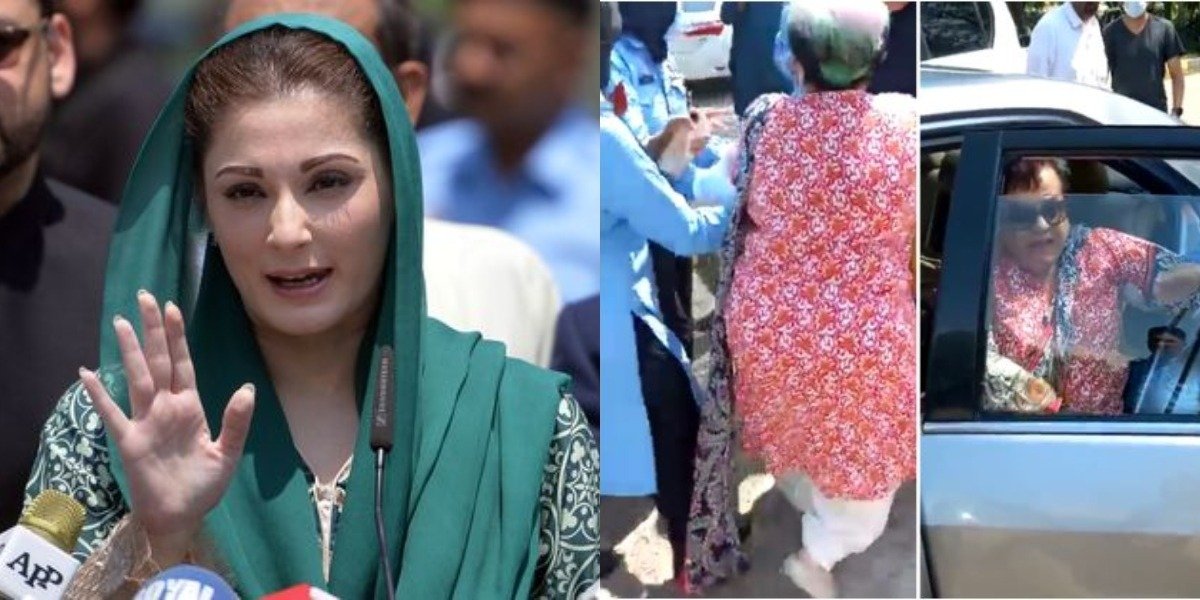
    Case one: Former Prime Minister Imran Khan passed sexist and controversial remarks about Maryam Nawaz at a political rally in Multan on Friday. Khan said: “I was sent the video of Maryam’s speech in which she took my name so many times with such jazba and junoon that I want to tell her to be careful, your husband might get upset at you taking my name so often.” Khan’s misogynistic remarks about his political rival were uncalled for, and not what was expected from a national leader. One would have thought that a man who is almost 70-year-old, whose first wife has had to deal with perpetual harassment to this date, whose second wife faces a plethora of abuse on a regular basis, and whose current wife has not been spared either, would spare women. Yet he made these comments about Maryam Nawaz while addressing thousands of people looking to him as the future of the country. What message is being sent to our younger generation? That it is okay to sexualise women, that it is okay to mainstream misogyny? Where will it stop is what one wonders.

    Case two: Punjab’s anti-corruption department took former human rights minister Shireen Mazari into custody in Islamabad yesterday. A video clip shows female police officers manhandling Mazari after she refused to step out of her car. The way that she was harassed and manhandled and the timing make it look like a clear case of political victimisation.

    Pakistan at the moment is facing a national crisis. The new coalition government is finding it hard to stay afloat, the country needs a financial boost from the International Monetary Fund (IMF) to survive economically. Serious decisions are to be made for the betterment of the country but what are the male politicians doing instead? Demeaning, silencing, and mocking strong women to put them down. Arresting Mazari because she is a vocal critic while demeaning Maryam because she is giving a tough time to her opponents.

    One can criticise anyone’s politics but in the case of women politicians, resorting to personal attacks is unwarranted. Mazari has faced such attacks from the likes of Khawaja Asif and others. Maryam was threatened with violence by Gandapur during the previous government.

    No one is above the law but abuse of power can never be condoned, regardless of who it targets or from where it emanates. Khan must apologise for his remarks about Maryam Nawaz. Such misogyny needs to stop against women. The government has released Mazari but she has been arbitrarily arrested because of the whims of a few men. It is high time that men keep women out of their politics. They cannot scare women into quitting.

  • School restricts female students to wear ponytails because they ‘excite men’ in Japan

    School restricts female students to wear ponytails because they ‘excite men’ in Japan

    As per Motoki Sugiyama, a former middle school teacher in Japan’s school, administrators told him that girls must not wear a ponytail because exposing the nape of their necks could “sexually excite” male students.

    While referring to how most schools require girls to wear white undergarments so that they won’t show through their uniforms, Sugiyama said, “They’re worried boys will look at girls, which is similar to the reasoning behind upholding a white-only underwear colour rule.”

    “I’ve always criticized these rules, but because there’s such a lack of criticism and it’s become so normalized, students have no choice but to accept them,” he added.

    Sugiyama has taught at five different schools in Shizuoka prefecture, some 90 miles southwest of Tokyo, over the course of 11 years, all of which prohibited ponytails.