Kamran Shahid, the anchor of On the Front on Dunya News, filmed a highly anticipated interview at his ancestral ‘Haveli’, airing it on Wednesday night.
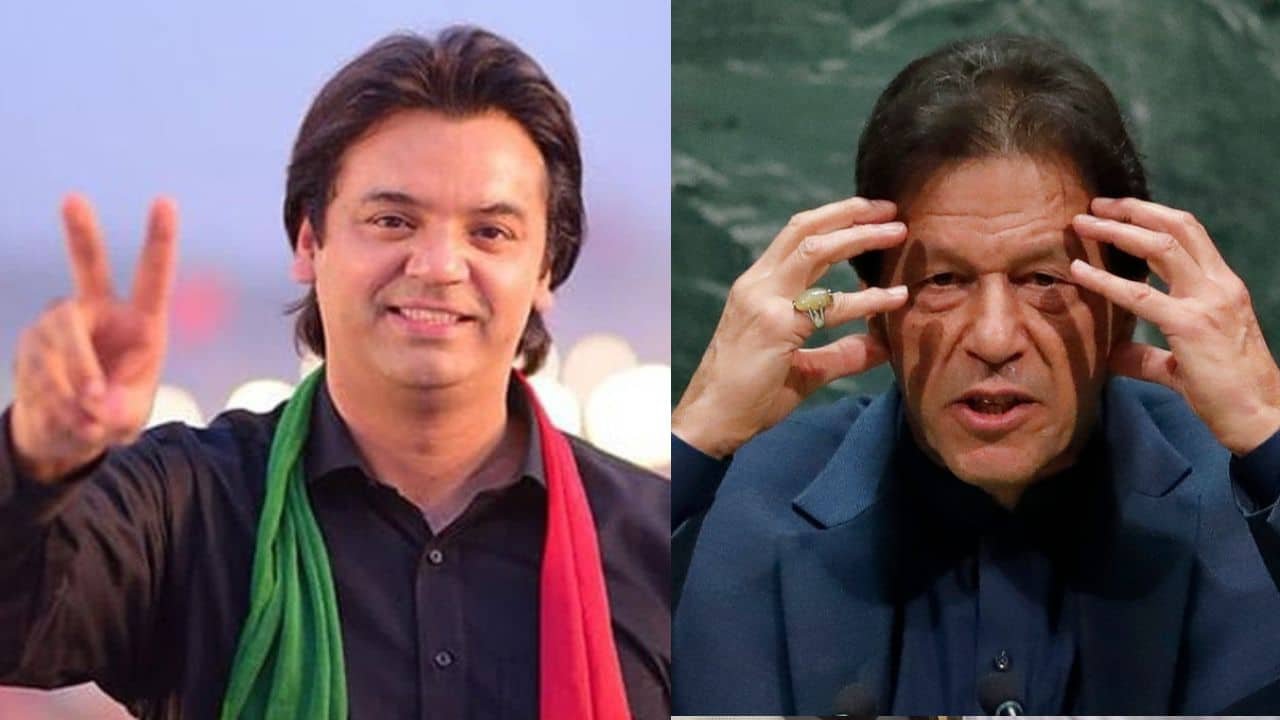
Usman Dar, one of the stalwarts of Pakistan Tehreek-e-Insaf (PTI) and the former head of PTI’s Tiger Force, an organization comprising young volunteers, appeared on the show to talk about who was the mastermind behind the May 9 riots. On the said day, after PTI Chairman Imran Khan was arrested from Islamabad High Court, protests broke out throughout the country, leading to armed clashes between them and law enforcement agencies. Jinnah House in Lahore, GHQ building in Rawalpindi, airbases and other state installations, along with monuments honouring martyred military men, Askari Tower, Military Library, residences of the armed forces officers, army selection center, petrol pumps, were attacked or set ablaze.
Dar reappeared in public after 147 days to announce on the show that not only was he leaving PTI but also bidding farewell to politics forever. Dar started off by mentioning that he had been missing his passionate arguments with Kamran Shahid on his programs, moving on to say he joined PTI because he genuinely believed that Imran Khan was a leader who could provide a platform for “clean politics.”
Dar termed the aftermath of May 9 for PTI workers an “earthquake”, stating that the day did not unfold incidentally but happened after a significant build-up. After the PTI government was removed, there were two types of mindsets in the party, Dar revealed. Murad Saeed, Azam Swati, and Hammad Azhar were the ones who believed in the politics of collision while Asad Umar, Omar Ayub, Ali Muhammad Khan, Shafqat Mahmood, and Dar himself believed in the politics of reconciliation.
“Those who believed in the collision were convinced that this confrontation would generate results. Unfortunately, Imran Khan supported that group more. He is anyways more of a leading from the front type, and he likes front liners,” said Dar, unveiling what went on in Zaman Park, where Imran Khan was bunkered down.
He further stated that the beliefs of the collision group prevailed more within the party and Imran Khan supported this policy. He also explained how workers from Punjab and KPK were called on and off to Lahore to provide Imran Khan with a ‘human shield’ to avoid arrest. Duties, timing, and days were divided among leaders and workers to stop something as “unique” as Imran Khan’s arrest.
Dar stated that workers had a feeling that they had to save Imran Khan at all costs. Imran Khan was supporting the anti-state narrative that was being developed among workers. “Imran Khan started with General Bajwa and then on to [Chief of Army Staff] Asim Munir. I believe any Army Chief would leave, like today General Asim Munir is there instead of General Bajwa but the institution remains there,” he said.
He also explained that the long march organised by PTI in November 2022 was to oppose General Asim Munir’s appointment. “I think Imran Khan had some information from within the institution that probably the long march would hinder the appointment of General Asim Munir,” Dar said, confirming what many political pundits had suspected since long.
Dar also said that he’ll appear in court to state all this under oath if he has to.
After May 9, the lives of PTI workers have changed entirely and their families are suffering, the Sialkot based Dar observed. Finally, he said he is disappointed in Imran Khan.
Pakistan Tehreek-e-Insaf (PTI) leaders lashed out at Pakistan Muslim League-Quaid (PML-Q) chief Chaudhry Shujaat Hussain for directing his Members of Provincial Assembly (MPAs) to vote for Hamza Shehbaz instead of his cousin and party leader Chaudhry Pervaiz Elahi in the run-off election for the Punjab chief minister.
PTI leader Fawad Chaudhry said that Shujaat’s ability to make decisions is “limited due to his illness”, adding that his thumb impressions “were taken on a blank paper”.
Talking to journalists, Chaudhry also took a jibe at Deputy Speaker Punjab Assembly Dost Mazari, and said that Mazari stole the people’s mandate, adding that he violated the Constitution.
He said that now the PTI has approached Supreme Court (SC) in this regard.
About Zardari, Fawad said that Pakistan cannot bear the brunt of the “politics of Zardari”.
Apart from Fawad, other PTI leaders also lashed out following yesterday’s defeat.
Talking to Twitter, PTI leader Shafqat Mahmood termed Mazari’s ruling as “shameful denial of peoples verdict”.
What a farce! Deputy Speaker rules against the constitution. It Clearly says direction to be issued by parliamentary party. Even the candidate Pervaiz Elahie asked to vote against himself. Shameful denial of peoples verdict and the fundamental law of the land
Meanwhile, Hammad Azhar said that Chaudhry Shujaat is the most dislikable figure among the masses.
پاکستانیوں کی سب سے ناپسندیدہ شخصیت کافی عرصے سے زرداری رہا ہے۔ پچھلے تین ماہ میں رانا ثناء اور زرداری کا پہلی پوزیشن کے لئے مقابلہ سخت رہا۔ آج چوہدری شجاعت نے ایک ہی دن میں دونوں کو پیچھے چھوڑ دیا ہے۔ حاصل ان تینوں کو کچھ بھی نہیں ہونا اور آخر میں عوام ہی جیتے گی۔
Shah Mahmood Qureshi was of the view that yesterday’s incident is “equivalent to suppressing the voice of the people”.
پنجاب اسمبلی میں جو آج ہوا سراسر مضحکہ خیز ہے لیکن اس کرپٹ حکومت سے اور کیا امید کی جا سکتی ہے جو اقتدار کے لئے کسی بھی حد تک جاسکتی ھے چاہے اس کا مطلب عوام کو نقصان ہی کیوں نہ ہو۔ یہ فیصلہ خلافِ آئین اور عوام کی آواز کو دبانے کے مترادف ہے۔ ہم انصاف کے لیے سپریم کورٹ جا رہے ہیں
— Shah Mahmood Qureshi (@SMQureshiPTI) July 22, 2022
It is pertinent to mention that Elahi had the support of 10 PML-Q MPAs apart from PTI. However, a day before the CM Punjab election, a meeting took place between Shujaat and Pakistan People’s Party (PPP) co-chairman Asif Ali Zardari, which turned the tables in Hamza’s favour. On the day of the election, Shujaat directed his MPAs to vote in favour of Hamza.
However, the lawmakers cast votes in favour of Elahi but Mazari dismissed their votes.
Pakistan Tehreek-e-Insaf (PTI) leader and the former Federal Minister for Education Shafqat Mahmood resigned from his post as the party’s Punjab President on Friday because of health-related issues.
In a tweet, Mahmood wrote: “It was an honour and privilege to serve as President PTI Punjab and I thank chairman Imran Khan for the opportunity. It is time for change due to my surgery and convalescence. I congratulate the new President and will serve the party in whatever capacity assigned.”
It was an honour and privilege to serve as President PTI Punjab and I thank Chairman Imran Khan for the opportunity. It is time for change due to my surgery and convalescence. I congratulate the new President and will serve the party in whatever capacity assigned
According to Geo News, Vice-President Shah Mehmood Qureshi will look after the PTI Punjab President post. However, the names of Ejaz Chaudhry and Mian Mehmood ur Rasheed are under consideration for the post.
After the PTI’s Azadi March, Shafqat Mahmood remained hospitalised and underwent surgery.
It is pertinent to mention that PTI Punjab leadership remained under extreme criticism as they were unable to put up a solid power show in Islamabad.
The news has come forward at a time when PTI has a real test ahead, in which it will have to fight the Pakistan Muslim League-Nawaz (PML-N) for 20 vacant seats of the Punjab Assembly (PA).
Official documents revealed that several members of Pakistan Tehreek-e-federal Insaf’s cabinet enjoyed gains in their fortunes during their term in parliament and as ministers, despite being elected on pledges of fighting corruption.
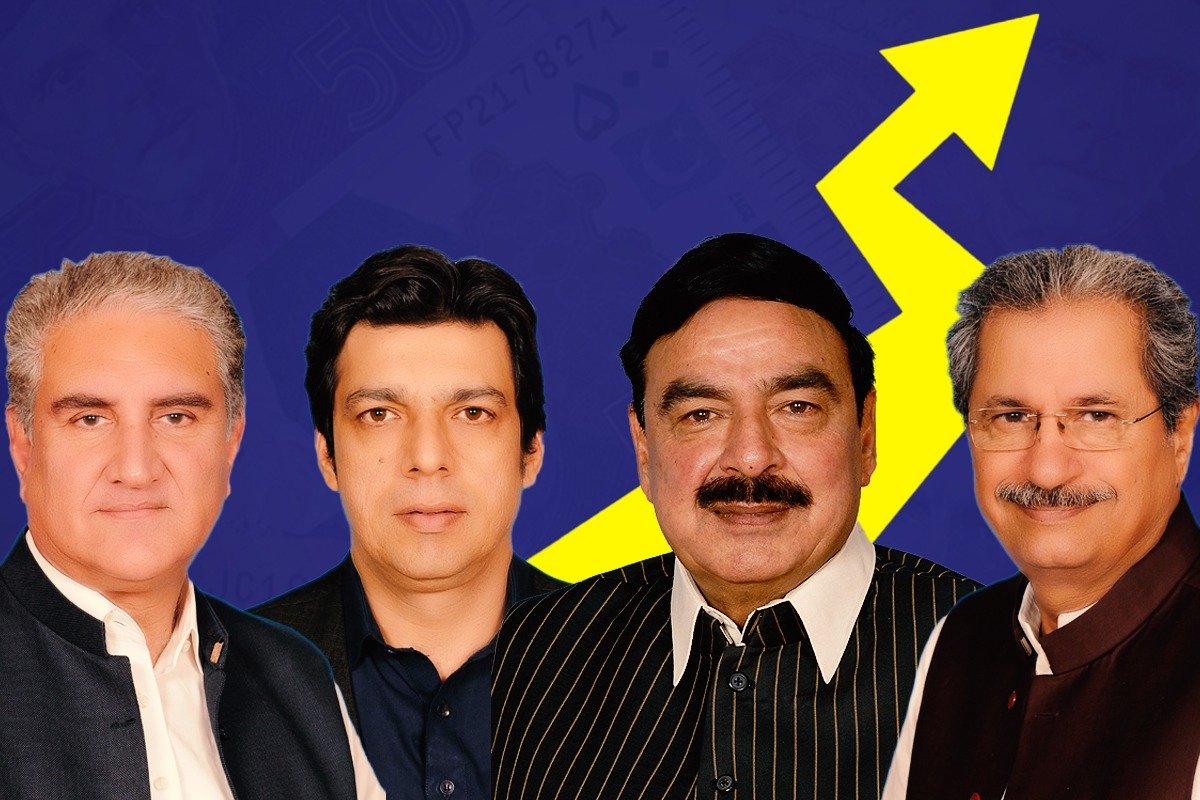
According toSAMAA TV, Shah Mehmood Qureshi and Sheikh Rasheed Ahmad, Omar Ayub Khan, Azam Khan Swati, Khusro Bakhtiar, Faisal Vawda, Shafqat Mehmood, Fehmida Mirza, Zubaida Jalal, Mahboob Sultan, and Tariq Cheema are among the listed former ministers.
Since select ministers received notices to explain their excessive wealth, the majority blamed weak wealth and asset declaration regulations, which did not contribute to increases in the valuation of assets overtime or the amalgamation of entities.
An inquiry into assets spontaneously declared before the Election Commission of Pakistan (ECP) and Pakistan’s tax authorities — primarily the Federal Board of Revenue (FBR) — by cabinet members who worked under former Prime Minister Imran Khan disclosed that plenty of of them saw a tremendous upsurge in their riches, with growth proportions primarily in the triple digits.
As per the official record, the ECP sent notices to at least six former ministers while they were still in government in 2019 and 2020, requesting them to clarify their wealth-related issues.
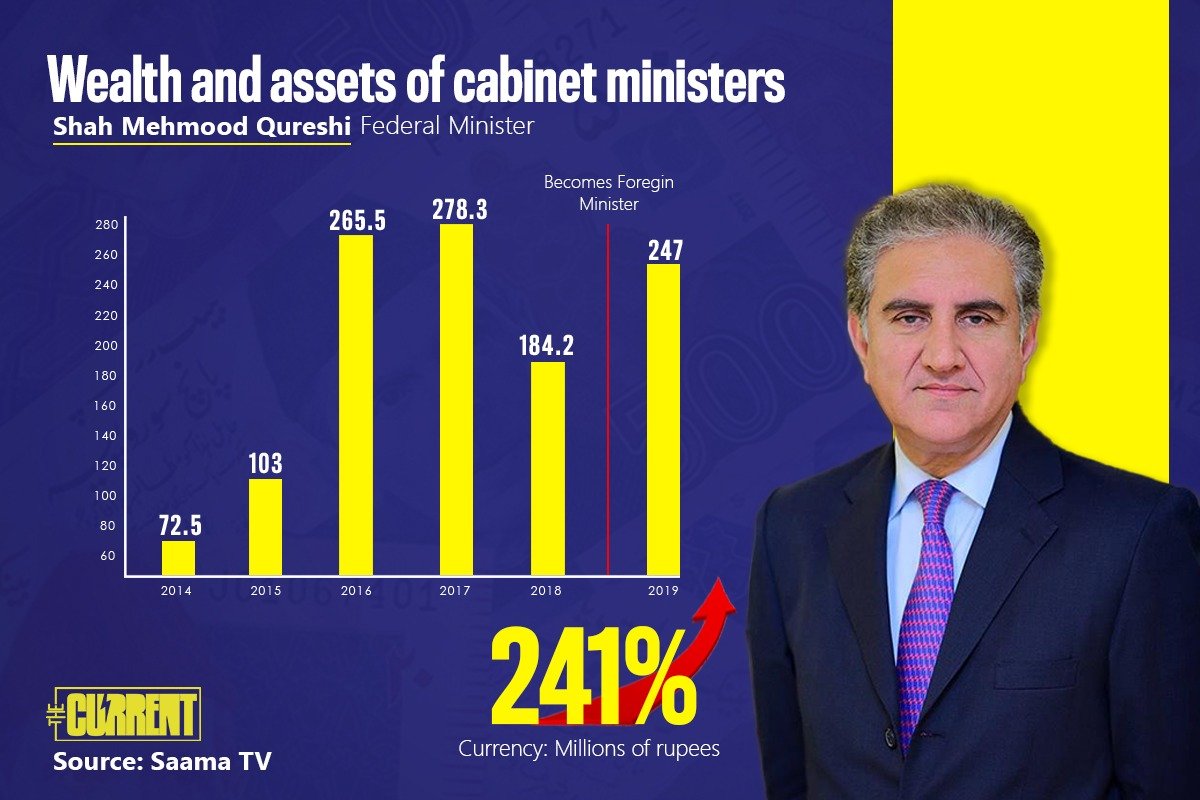
From 2014 to 2019, former foreign minister Shah Mahmood Qureshi, who has been a staple of the parliament for more than a decade and served twice in the federal cabinet in two different governments, had a 241 per cent growth in his wealth.
He and his wife held assets worth only Rs72.5 million in 2014, according to asset declarations he submitted to the ECP and the FBR. In the following three years, his assets nearly quadrupled, reaching Rs278.3 million, a 283.86 per cent increase over his wealth in 2014. Qureshi’s fortune dropped dramatically to Rs184.2 million in 2018, the year he returned to the Treasury benches, albeit with a new party, the PTI. However, while in power, it soon increased to Rs247.1 million in 2019, a rise of 240.82 per cent since 2014.
When questioned, Qureshi recounted how the worth of his assets had evolved over the years.
“The reason for the increase in assets was that during 2015-16, my wife received her share from the sale of property situated in Lahore, which had been gifted by her mother, and shares from sale proceeds of inherited property worth Rs169.6 million and Rs22.6 million,” he claimed. In October 2017, duplicates of sale deeds were handed to the ECP, according to the former minister.
“The ECP raised this observation too,” he said regarding the increase in his wealth, adding, “I and my dependent family members are all filers with the FBR”.
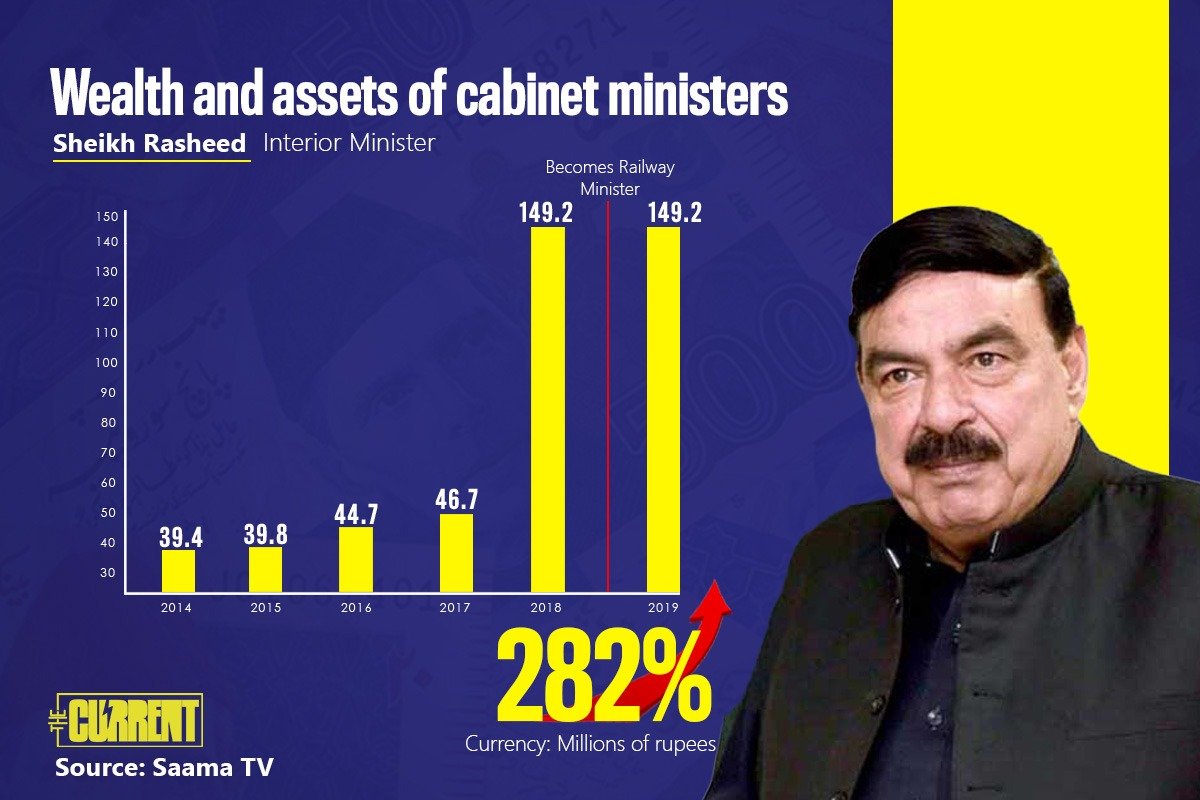
Sheikh Rashid, the former interior minister, watched his fortune increase by nearly 278.68 per cent between 2014 and 2019.
The financial disclosures for 2014 revealed that he only had Rs39.4 million in assets. Earnings climbed by Rs0.4 million to Rs39.8 million. His holdings steadily expanded over the next two years, reaching Rs44.7 million in 2016 and Rs46.7 million in 2017.
Conversely, in 2018, the time he was elected to power, his assets boosted by Rs100 million to Rs149.2 million. In 2019, there was no movement in reported assets. After inquired why his assets had suddenly changed, Rashid said that the discrepancy was due to an advance payment he had obtained for reselling a portion of land in 2018.
“I received Rs100 million as advance after making a deal of land to be sold last year, [2021],” he said, adding, “There is no such increase in my assets”. The former interior minister stated that the rise in his declarations submitted with the FBR and the ECP had been properly disclosed.
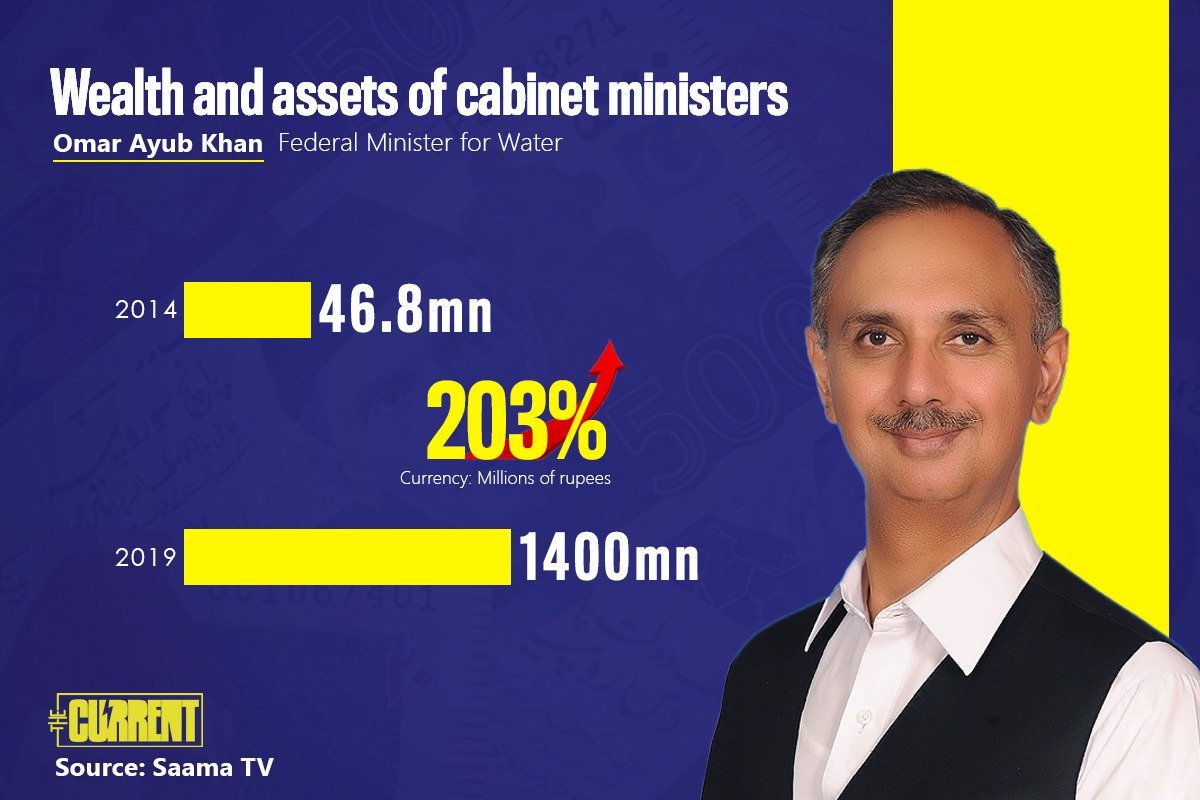
Between 2014 and 2019, the fortune of former federal minister of water Omar Ayub and his wife jumped by 203 per cent.
As per Ayub’s filings to the ECP and FBR in 2014, he and his wife held assets worth Rs461.8 million. This comprised Rs132 million in assets held by his wife and Rs329 million in assets owned by the minister. This value had risen to Rs1.4 billion by 2019. Surprisingly, while his wife’s holdings increased slightly to Rs201 million, Ayub’s assets increased to Rs1.2 billion. Each has debts worth only Rs26.3 million, according to the disclosures.
As a result, the ECP expressed concerns about Ayub’s and his family’s unexpected surge in wealth.
“It was explained to the ECP in 2019 that it [increase in wealth] is because of group formation having no cash involvement,” Ayub said, confirming that the top poll body had issued him a notice on this subject. Ayub claimed that he owned shares in Nova Synpac Ltd. and NovaGene Pharmaceuticals Ltd., which increased in value by approximately Rs1.071 billion.
“My assets have decreased (excluding this group formation) since I took an oath as a minister because I resigned from my group,” he claimed, adding that the increase was due to the consolidation of all of his businesses under the group.
“This cannot be reflected in a declaration, which is always a reflection of statements submitted to the FBR and there cannot be any difference [between them] otherwise it would have been challenged there,” he explained.
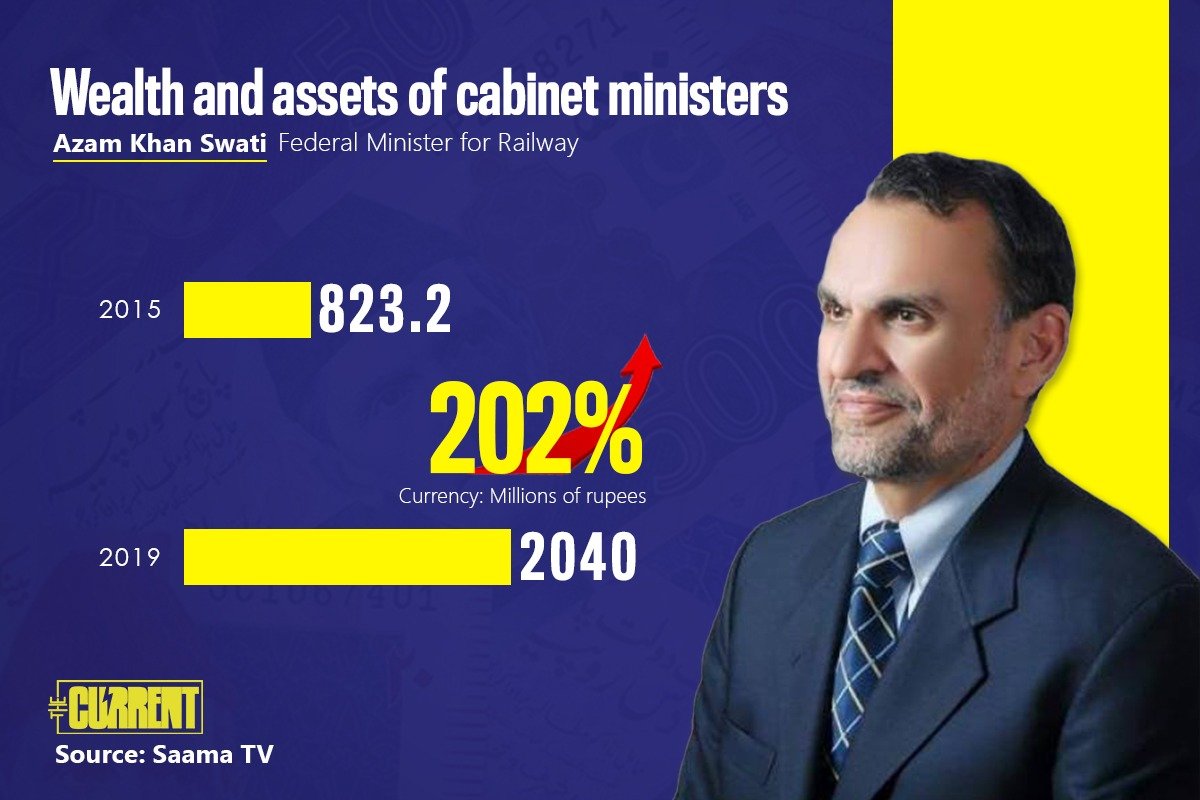
Azam Swati, the former federal railways minister, saw his fortune grow by 202 per cent from Rs823.2 million in 2015 to about Rs2.04 billion in 2019. He reported that his liabilities increased from Rs417 million in 2015 to Rs811 million in 2019.
“[Your] figures are wrong due to incomplete information being furnished before ECP by members and cabinet members owing to faulty legal requirements mentioned in ECP Act 2017,” he explained.
He further said that his situation was slightly unusual. “In Pakistan, I have no income and no business.” I am confident that our FBR wealth statement [filed] will be compared to ECP in 2019 [asset declarations],” he remarked, worried that the statistics may contain a few errors.
“ECP has no efficiency and capability to audit assets and liabilities,” he disclosed, adding, “We were making mistakes filing combined [wife and husband together]”.
“Now we have corrected the mistake and filed separately because the wife is not dependent,” Swati told SAMAA TV.
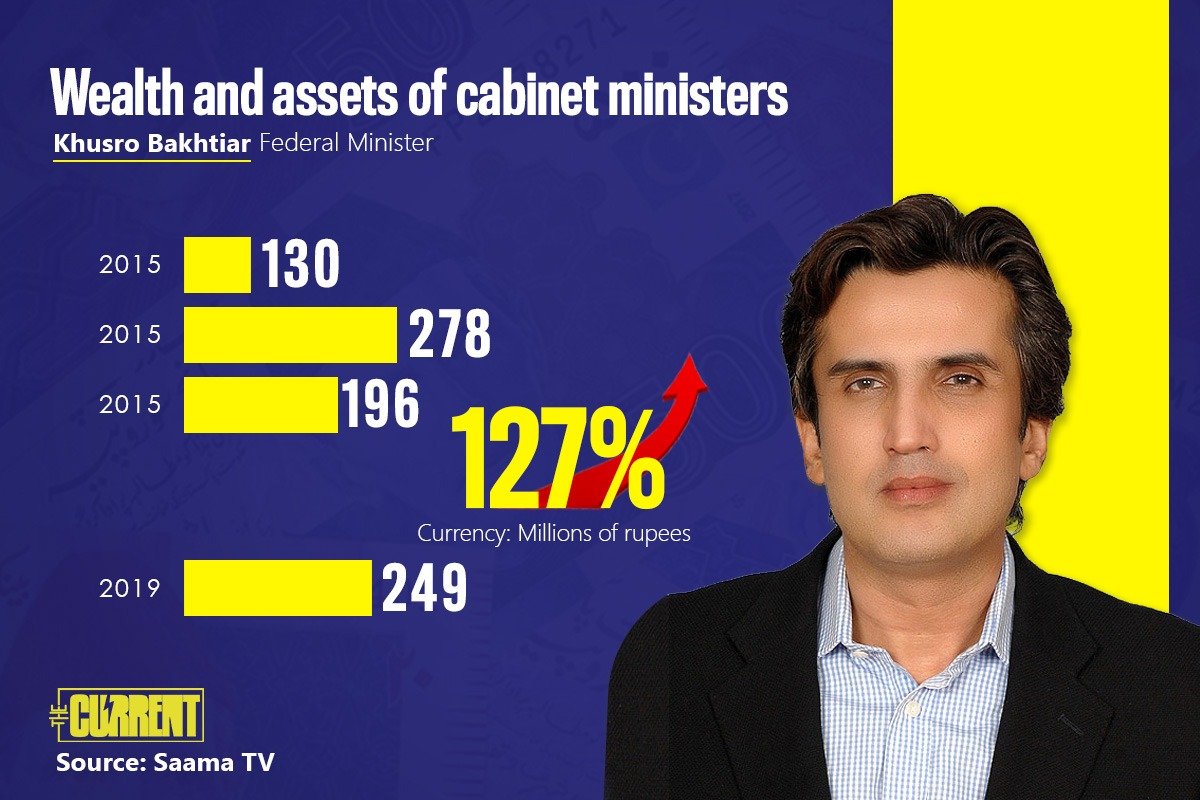
Khusro Bakhtiar, the former federal commerce minister, saw his fortune rise by 127.8% from Rs109.3 million in 2013 to Rs249 million in 2019. In 2014, he had assets of Rs130 million, which more than doubled to Rs278 million in 2015, shrank to just Rs196 million in 2016, and then surged again in the next three years.
“Increase in assets were mainly comprised of [various] sources during the year 2014 to 2019,” he told SAMAA TV, detailing that these sources included savings from agricultural income, proceeds from the sale of land worth Rs40 million, other sources which contributed Rs20 million.
Bakhtiar also claimed that he actually paid Rs27.5 million in agricultural taxes from 2017 to 2020, and that he owed Rs60 million in 2016.
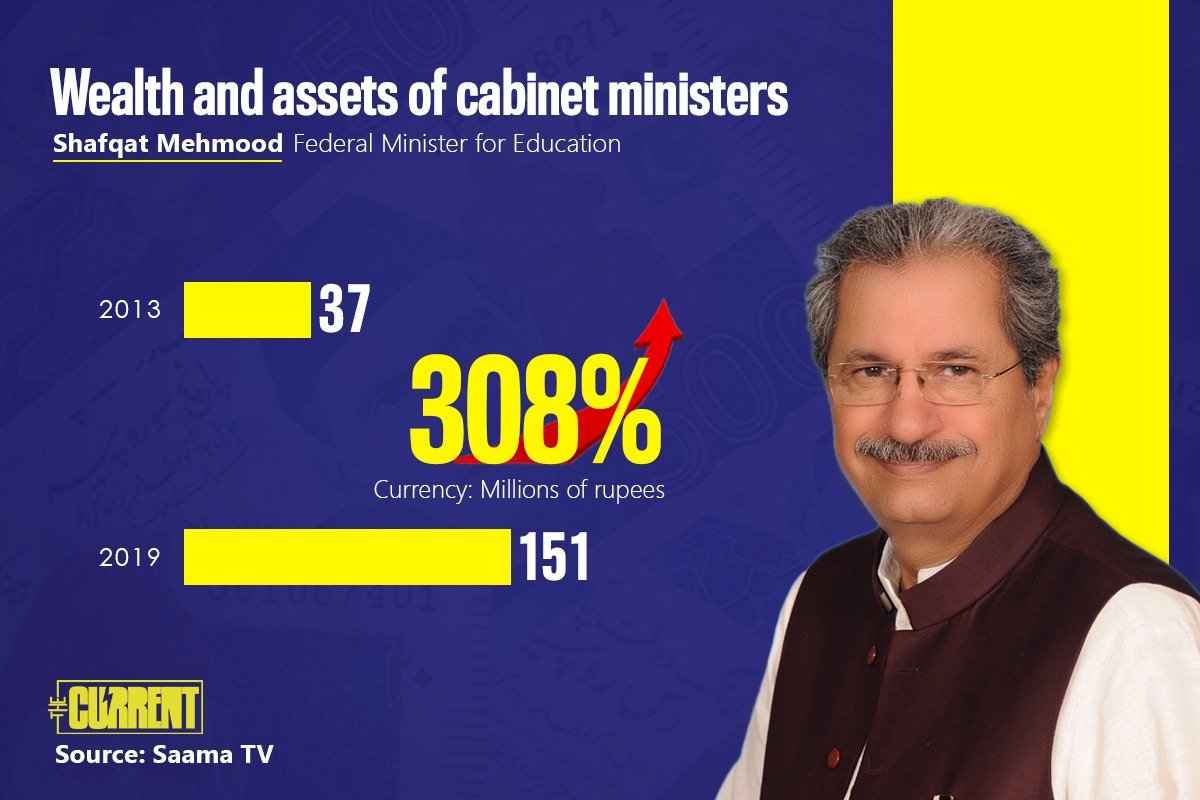
Former federal minister for education Shafqat Mahmood and his family had a 308 per cent growth in asset valuation between 2013 and 2019, making them one of the most successful federal ministers in terms of percentage increases. According to Mehmood’s filings, his and his family’s assets were valued at just Rs37 million in 2013, but had grown to Rs151 million by 2019.
“My assets have not changed since 2013 onwards,” Mehmood asserted, explaining “The change that you see is the cost re-evaluation from purchase price to market price”. The ex-minister further said that he has 360 kanals of hereditary land, a few more plots, and automobiles that he never assessed.
“There will, of course, be some variation regarding bank accounts. There will also be a slight difference in detail offered to FBR and ECP with regards to bank accounts,” he maintained. He went on to say that in his previous disclosure, he had combined the amounts in all of his bank accounts to present a single total.
“My wife is a distinct taxpayer because she works, but I have included her assets as well”, he explained.
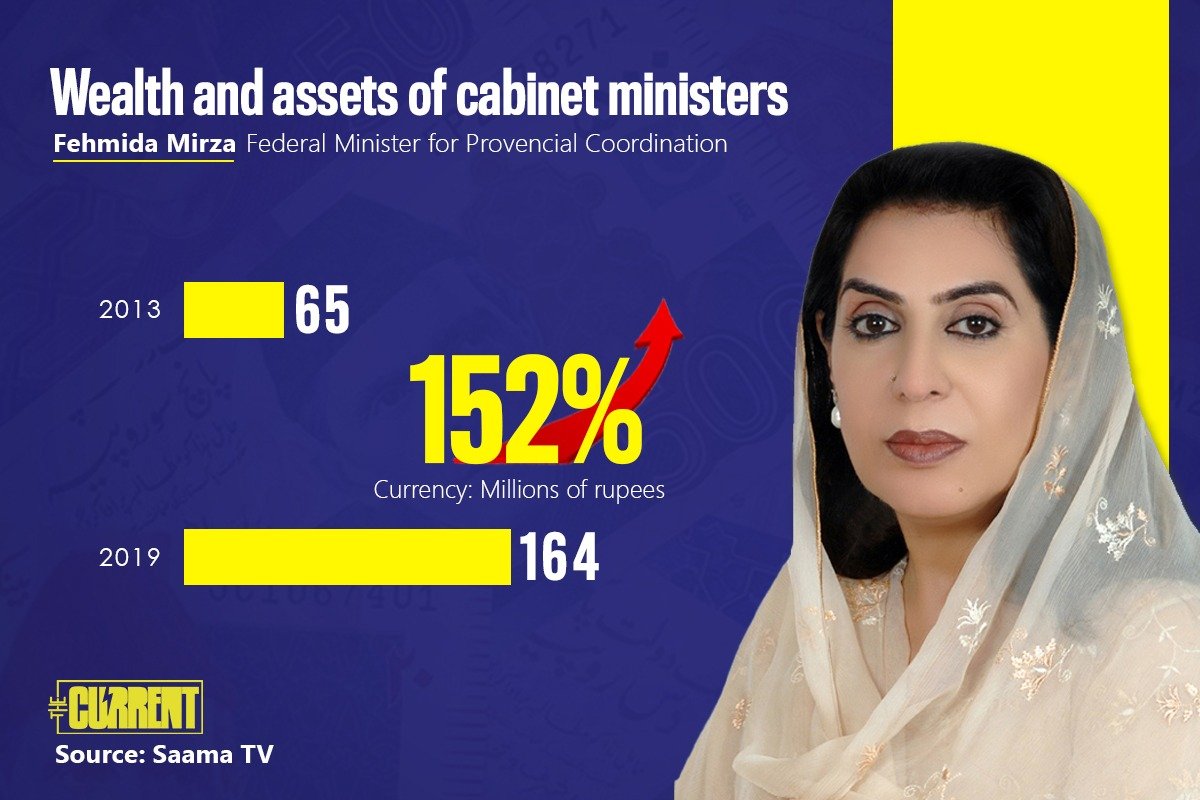
Fehmida Mirza, the former federal minister for interprovincial coordination, had a similar scenario, with her net worth rising from Rs65 million in 2013 to Rs164 million in 2019.
“I did not see any rise in my assets and wealth at all,” she told SAMAA TV. She did, although, reveal that she had sold some property in Pakistan in order to purchase a home in the United Kingdom.
“This new increase in my assets has already been declared with the FBR and the ECP,” she stated.
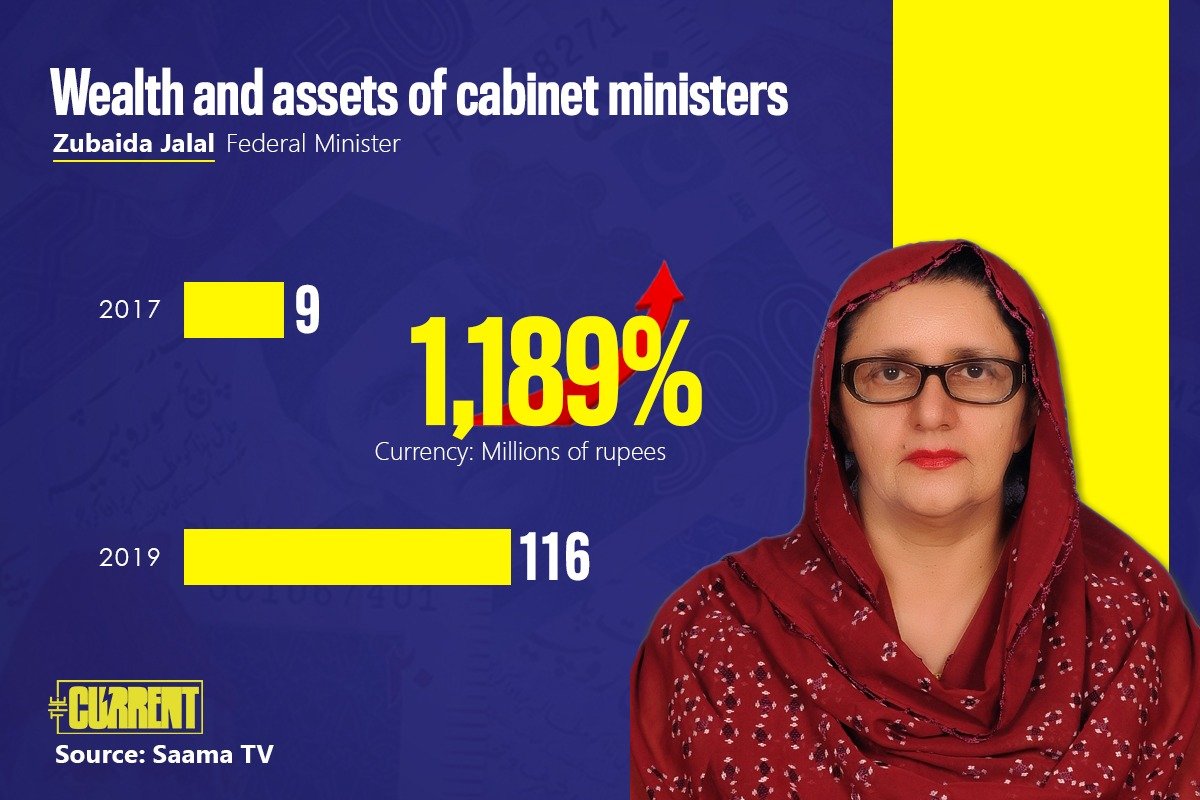
Contrary to the PTI’s cabinet’s millionaire members, one of the “weakest” members of the federal cabinet, former federal minister Zubaida Jalal and her husband, had a 1,189 per cent growth in their fortune in a short period of time. Their riches increased from Rs9 million to Rs116 million in 2019.
Jalal, on the other hand, described the quick spike in wealth as the outcome of changes in declaration requirements.
“There is no big difference in my assets’ declaration” she asserted while speaking to SAMAA TV. The value of immovable assets was not mentioned in data provided in past elections, she said, noting that the ECP declaration requirements changed over time.
“[We are] required to mention values of assets in the asset declaration for this time,” she stated. She explained that the variations in asset values were attributable to market forces working on enterprises.
“Ups and downs will keep happening [in mining operations and business],” she said, as she reminded that her husband owns the National Coal Mining Company since the 1960s.
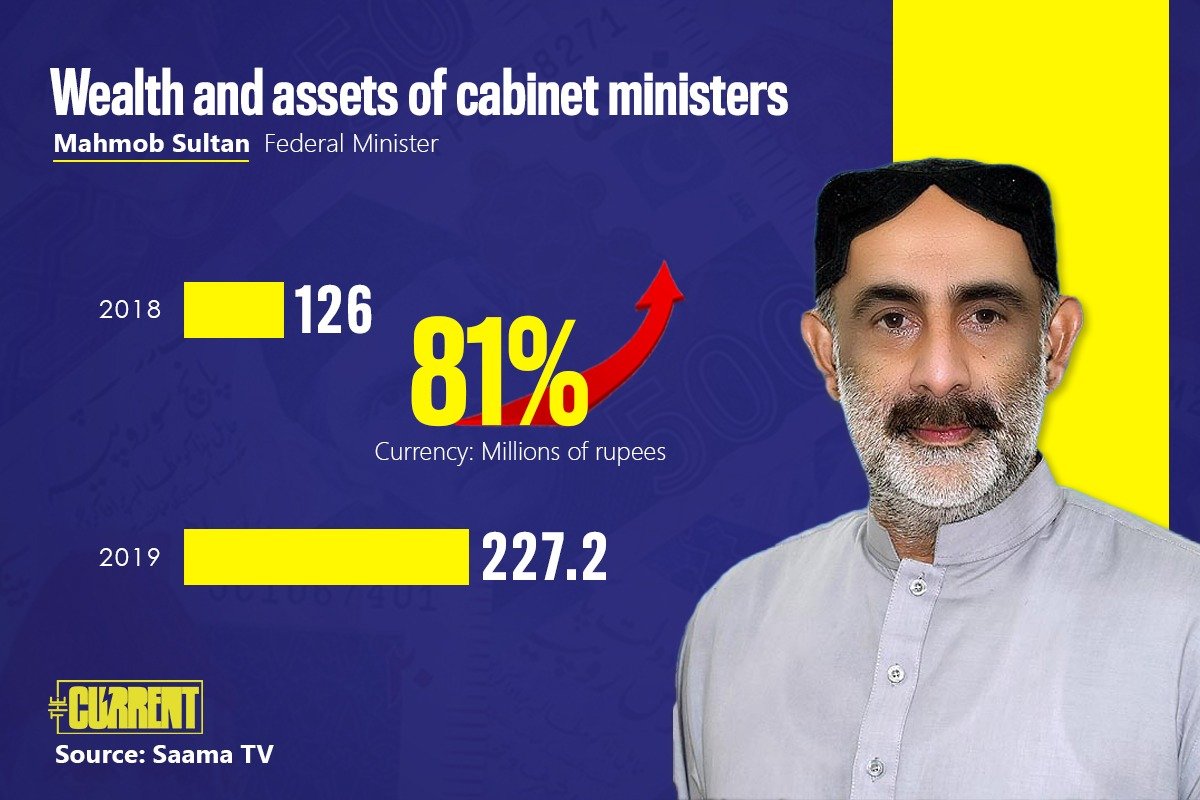
Former state minister Mahboob Sultan was one among the ministers who saw only double-digit asset growth. Only 81 per cent of his assets increased from Rs126 million in 2018 to Rs227.2 million in 2019. It’s worth noting, however, that his growth of nearly Rs100 million occurred while he was in the cabinet of ministers.
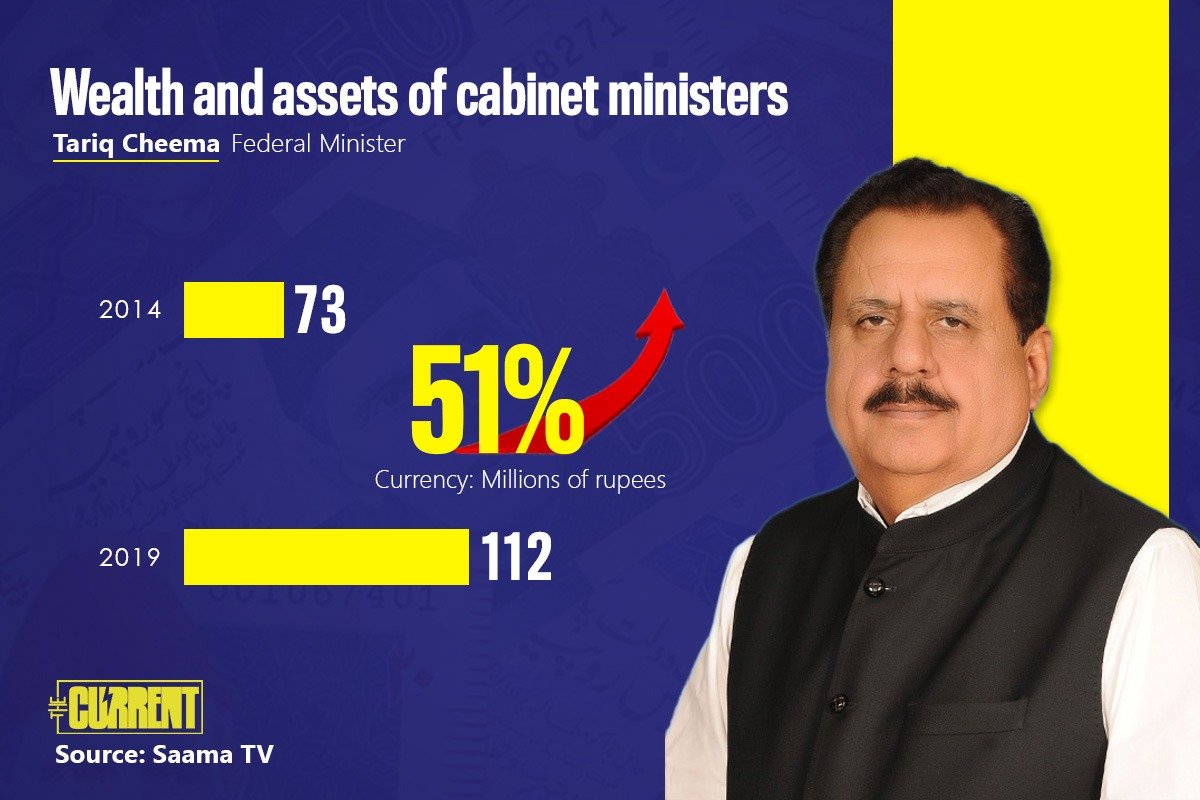
Tariq Cheema, the former federal minister for housing and infrastructure, showed the smallest growth in his wealth, going from Rs73 million in 2014 to Rs112 million in 2019. He did not, however, assess the value of his inherited assets and report them to the electoral or tax authorities.
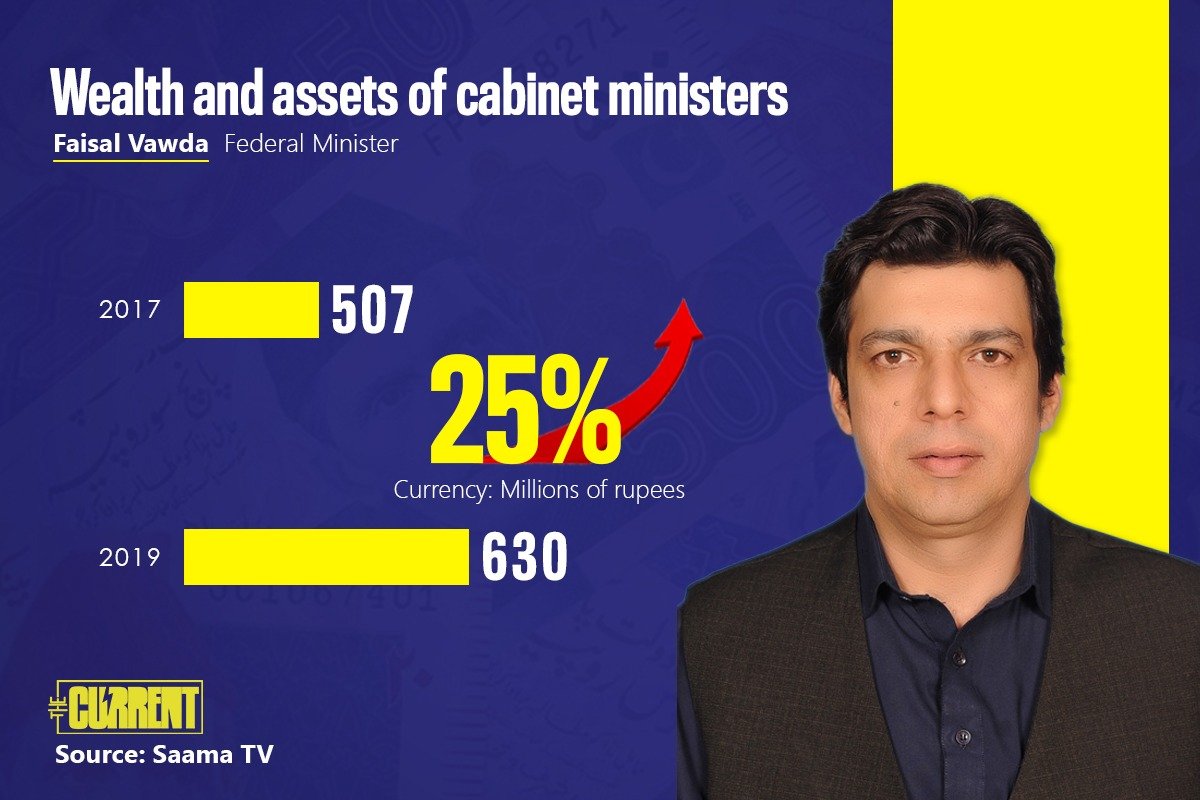
Former federal minister Faisal Vawda and his family witnessed their fortune increase by 25 per cent from Rs507 million in 2017 to Rs630 million in 2019. He was among the most controversial cabinet ministers who were eventually dismissed by the ECP.
Despite multiple requests from SAMAA TV, neither Sultan, Cheema, Vawda, nor an ECP official have commented on inquiries regarding their wealth.
After the much-awaited meeting today about the schools’ closure, the National Command and Operation Centre (NCOC) did not make a decision on whether schools will be closed or not in the wake of the highly transmissible Omicron variant.
The NCOC had called a meeting of the provincial health and education ministers on Monday.
In a statement, they said, “Decision about education institutions will be taken on data of positive cases of various institutions for which massive testing in educational institutions is being carried out.”
Punjab health minister Dr Yasmin Rashid informed the ministers that 85 per cent of the students in Punjab have been fully vaccinated and the Covid-19 situation in the province is under control.
In Sindh, Chief Minister (CM) Murad Ali Shah decided that educational institutions will continue in the province despite an alarming surge in cases as Karachi has reached a 40 per cent positivity rate.
Meanwhile, earlier today a total of 4,340 new cases have been reported in the country.
The National Command and Operation Centre (NCOC) has decided to shift the annual winter vacations for education institutions from December to January, reports Geo News.
The decision was made in a meeting held on Tuesday, which was attended by all the education ministers who backed and agreed to the proposal.
According to the NCOC, the vaccination process will continue in educational institutions. However, the institutions will remain closed in areas where heavy snowfall occurs.
On the contrary, Sindh has already announced winter vacations for educational institutions from December 20, 2021 to January 3, 2022.
Prior to this development, Federal Minister for Education Shafqat Mahmood on Tuesday said that as per the “agreed proposal”, winter vacations should be announced from December 25 to January 4.
However, he added that further notifications will be issued from the concerned governments.
Federal and provincial secretaries met today. The agreed proposal was that winter holidays should be from Dec 25 to Jan 4. Further notifications will be from the concerned governments
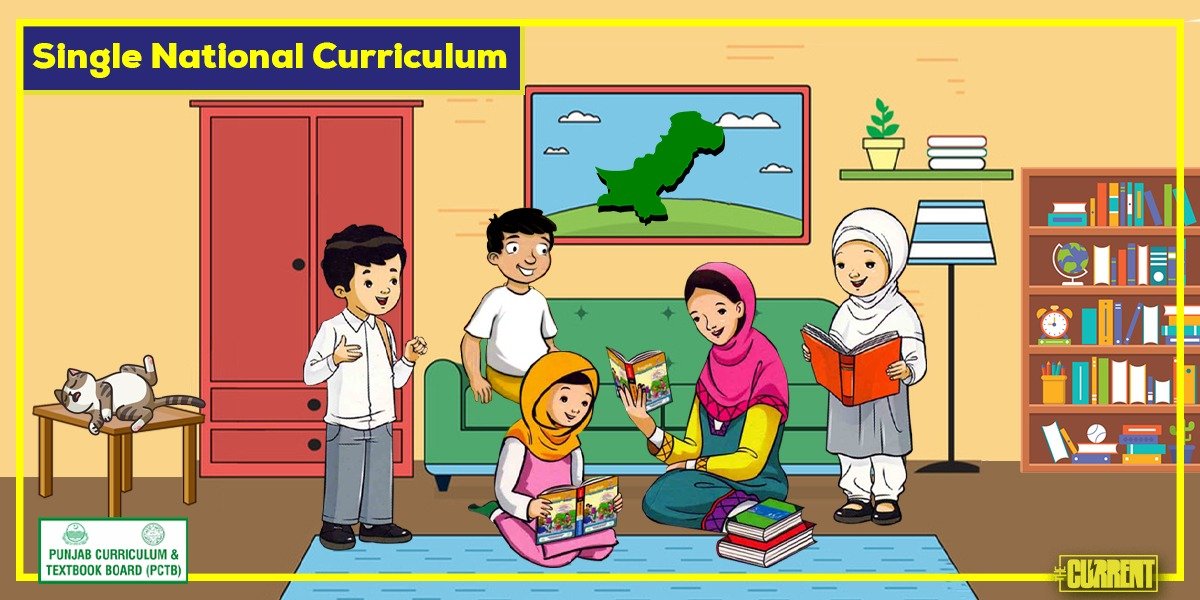
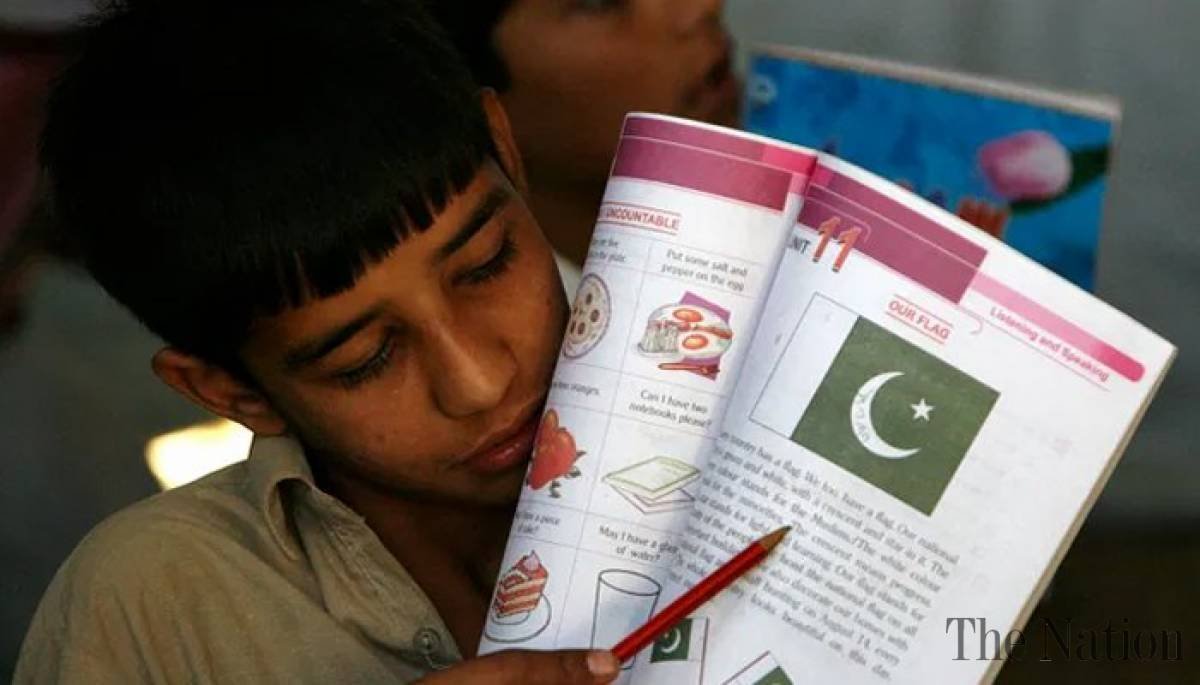
On August 16, 2021, Prime Minister Imran Khan officially launched the Single National Curriculum (SNC). The newly launched curriculum was prepared by the National Curriculum Council (NCC) and the Ministry of Federal Education, in consultation with the provinces. According to PM Khan, “SNC would transform the nation into a unified one.”
What is SNC?
According to the Ministry of Federal Education and Professional Training, the SNC is a ‘uniform’ system of education, which means the same curriculum for everyone. All public schools, private schools, and madrassas were meant to have the same curriculum so that the learning outcomes are similar and without any discrimination in teaching standards. This is not the first time SNC was imposed in Pakistan. It was previously introduced in 2006 by Former President Musharraf. Whereas the previous SNC was a curriculum-based initiative, the one introduced by the PTI government is imposing the use of the textbooks produced by the provincial boards.
Is it being implemented across the country?
No. Sindh has decided not to implement the curriculum since education is a provincial issue. Only Punjab and Khyber Pakhtunkhwa have enforced it so far. However, many schools in both provinces — including the prestigious Aitchison College, Lahore — expressed their concerns over the books in the curriculum. The Director of the National Curriculum Council (NCC), Dr Mariam Chughtai, has also said that madrassas will implement the SNC syllabus in five to six years, which undermines the reason why the government had wanted to introduce the SNC in Pakistan – to bring madrassas into the mainstream so students would be able to get jobs in other professions after they graduated.
Controversies surrounding the SNC
After the SNC syllabus was imposed on schools across Punjab, many controversies surrounding the books and the curriculum came forward. From the disparity in gender representation, the reinforcement of patriarchal gender roles, the lack of female heroes, and religious texts in the non-religious books.
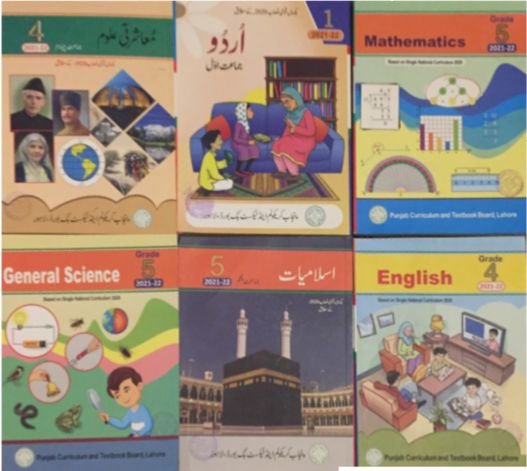
To see if the criticism is valid, The Current analysed the following books published under the Punjab Textbook Board (PTB):
Urdu books from grades 1 to 5, English books from grades 1-5, Mathematics books grades 1, 2, 4, and 5, General Science grades 4-5, Waqfiyat Aama grade 1 and 3, Social Studies 4-5, and Islamiat grade 1- 5.
Two books were not available at the time of research. Grade 3 Math and Waqfiyat Aama grade 2, which have not been included in the study.
The analysis here has been divided into two parts.
Part one comprises the data analysis of all the books included in the SNC by the Punjab Text Book board.
Part two comprises the data analysis of individual subjects being taught to the students.
We studied the total number of male and female representations in the books, a comparison of the eastern and western wear of both genders, the presence of religious (Islam and others) content in non-religious books, and studying the distribution of power roles assigned to both men and women.
Here is the list of most common criticism against the curriculum and the evidence we found:
SUMMARY OF CONTENT IN ALL SNC BOOKS
1- Disparity in Gender Representation:
One of the most debatable points in the entire SNC is the representation of men and women.
After a thorough evaluation, we found that the concerns about the disparity in gender representation are TRUE.
The study reveals that a total of 60.2 percent of the books have images of men, including boys and only 39.4 percent of the books have images of women, including girls.
2-Women represented in hijab vs non-hijab, and women in western clothes:
What the women are wearing became a source of contention in the discussion about the SNC, with critics suggesting that the women should equally represent the country in terms of the hijab, eastern clothes, and the choice to wear western wear.
It is TRUE that there is no equal representation of women’s appearance in the books.
Women’s appearance was divided into three categories.
A) Number of women wearing eastern clothes with hijab.
B) Number of women wearing eastern clothes without hijab.
C) Number of women wearing western clothes.
Our research shows that 41.6% of all women and girls in the SNC books are wearing a hijab, 28.9% are wearing eastern clothes without a hijab, and 29.4% of the images show girls wearing western wear. It is important to note that in the western wear percentage, almost all of the images are of young girls. Older women are not shown wearing western wear.
3-Men represented in eastern vs western clothes:
Since the appearance of women in eastern wear and hijab became controversial, we also studied how many times men appeared in western or eastern wear.
A massive 79.9 percent of men were seen wearing western clothes, in comparison to 20 percent dressed in eastern clothes.
4- More men in ‘power roles’ compared to women:
Another controversy suggested that the books did not show women in positions of ‘power’, and they were mostly listed as helpers or homemakers. While there were many images that showed women in ‘inferior roles’ to men, there were women that were shown in roles of power.
This controversy is TRUE.
We defined power roles shown in the books as doctor, pilot, lawyer, police officer, traffic warden, army sports personality, etc and after analysing all the books, we found that a men are given power roles three times more than women. The results in the graphic below are based on the total number of images shown of men and women in all the SNC Punjab books.
I
5. Religious content in non-religious books
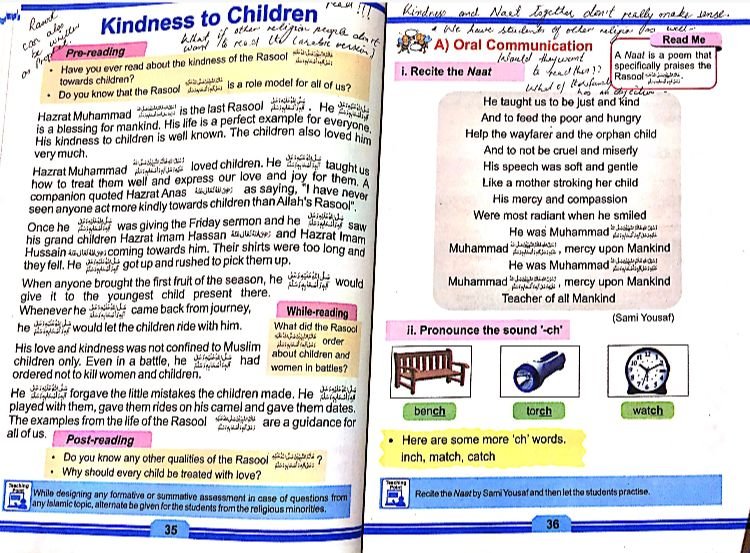
In almost all the books which were studied, we saw the presence of religious references or mentions in non-religious books. Minorities felt their rights were being compromised since books that are not for religious studies should not have references to a specific religion, which may come under the context of ‘preaching’.
In our analysis, we saw a total of 7.77 percent of religious text in all SNC non-religious books, which lends TRUTH to the fact that there is religious content in non-religious books.
Religious content is present in 7.7 percent of English, Math, Social Studies, Urdu, Science, and General Knowledge books.
7.47 percent of books have references to Islam while 0.27 percent mention other religions in all non-religious books.
Dr Mariam Chughtai, while answering a question for The Current about the religious references in non-religious books, did not provide a clear answer but stated that these are model books that require changes.
SNC BOOKS ANALYSIS – SUBJECT ANALYSIS
This section of the report comprises an analysis of individual subjects being taught to students. The subjects under study were, Urdu books from grades 1-5, English books from grades 1-5, Mathematics books grades 1, 2,4, and 5, General Science grades 4- 5, Waqfiyat Aama (General Knowledge) grades 1-3, Muashrati Uloom (Social Studies) grades 4-5.
The graphical representation of the subject-wise evaluation is as follows:
English:
In 668 pages of English books, 58.1 percent have male representation while females have 41.8 percent.
29.7 percent of women are seen with Hijab and 70.2 percent are without Hijab.
There is a total of 9.8 percent presence of religious text in English books. This is based on the total number of pages in English books.
Mathematics:
In 672 pages of the Math books, when gender representation was analysed, 51.1 percent of the books have male representation and 48.8 percent have female representation.
A total of 53.9 percent of females are seen without hijab and 46 percent are seen wearing hijab.
The Math books have a 4.1 percent presence of religious text. This is based on the total number of pages in Math books.
Urdu:
The five Urdu books comprising 791 pages. A total of 59.7 percent presence of males are seen as compared to 40.4 percent of females.
58.5 percent of women/girls are seen wearing hijab and 41.4 percent are seen without hijab.
12.8 percent of religious text is present in Urdu books. This is based on the total number of pages in Urdu books.
General Science:
Out of 310 pages, 76.8 percent have male representation as compared to 23.1 percent female representation.
64 percent of women/girls are seen without hijab and 36 percent of women/girls are seen with hijab.
The General Science books have a 0.96 percent presence of religious content. This is based on the total number of pages in Science books.
Waqfiyat Aama (General Knowledge):
49.5 percent of male images are seen in comparison to 50.15 percent of females.
23.1 percent of females are seen with hijab and 76.8 percent without hijab.
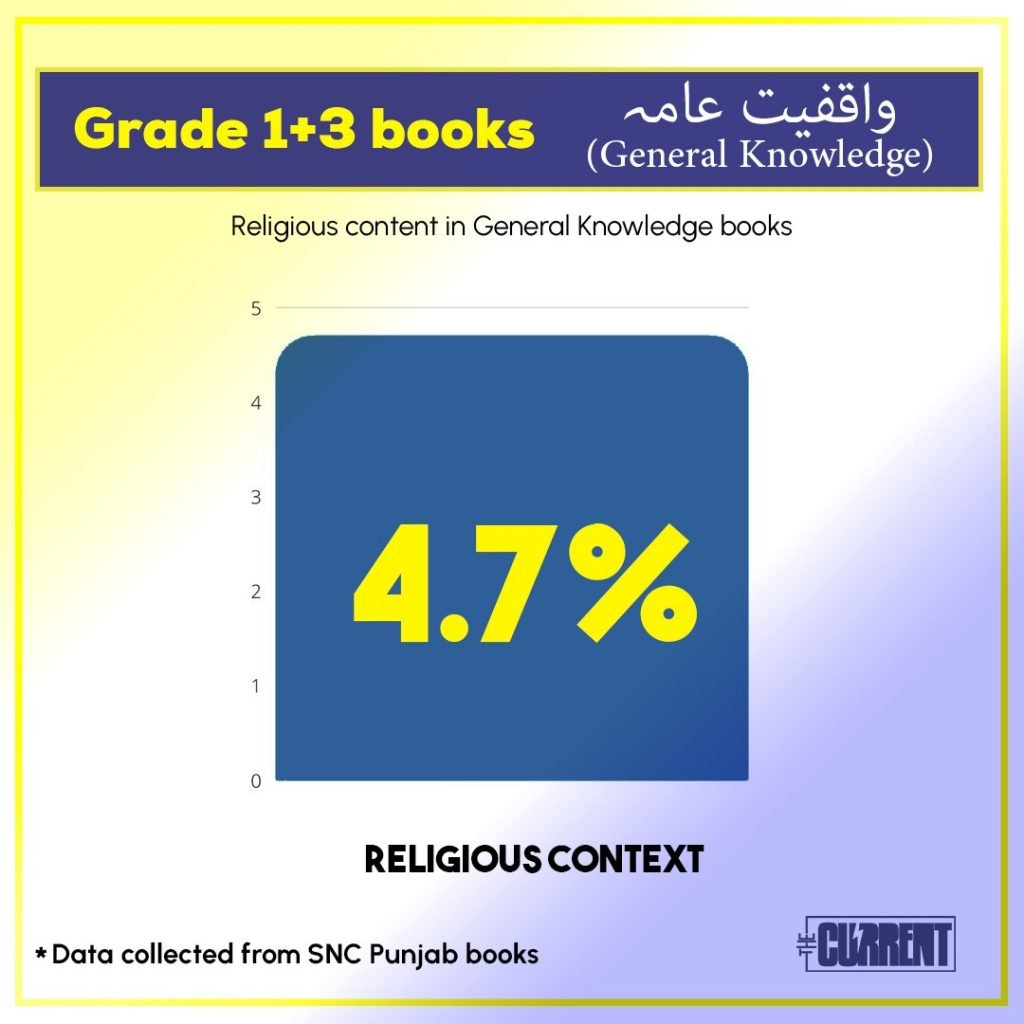
There is a 4.7 percent presence of religious text in the books studied. This is based on the total number of pages in General Knowledge books.
Muasharti Uloom (Social Studies):
From 234 pages analysed, 65.1 percent of men/boys are represented in the books and 34.8 percent of females are shown.
36.8 percent of females are seen without hijab and 63.1 percent are seen with hijab.
10.2 percent of religious content is present in the books. This is based on the total number of pages in Social Studies books.
The last portion of the report highlights the pros and cons, which we have observed in almost all the books. We have provided both positive and negative outcomes deduced from the books after careful analysis.
The positive outcome deduced from the books:
1. The books are locally published and designed. The books are affordable, with a total set for one grade set at Rs. 800 per child according to Dr Chughtai.
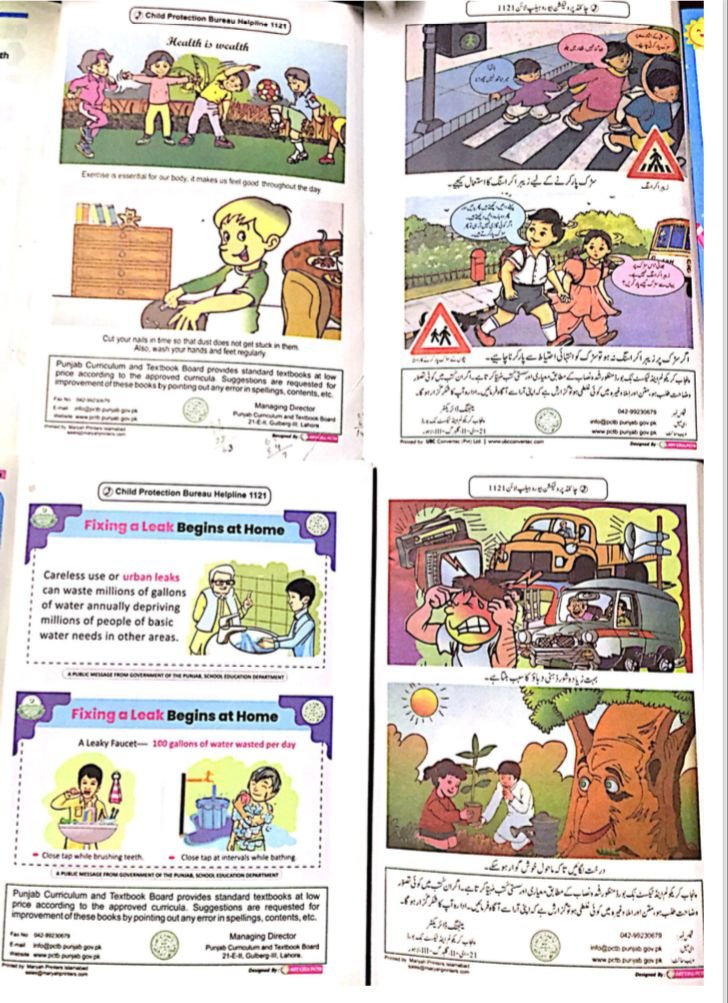
2. There is a public service message printed at the end of each book to raise awareness against talking to strangers, crossing the road, exercising, and even information about fighting dengue.
The possible negative impact of the books
1. After analysing the books, we deduced that mostly nuclear families have been shown in the books. No representation of single parents or children being raised by guardians is seen. Moreover, the presence of both parents is seen as almost essential in all stories in the books.
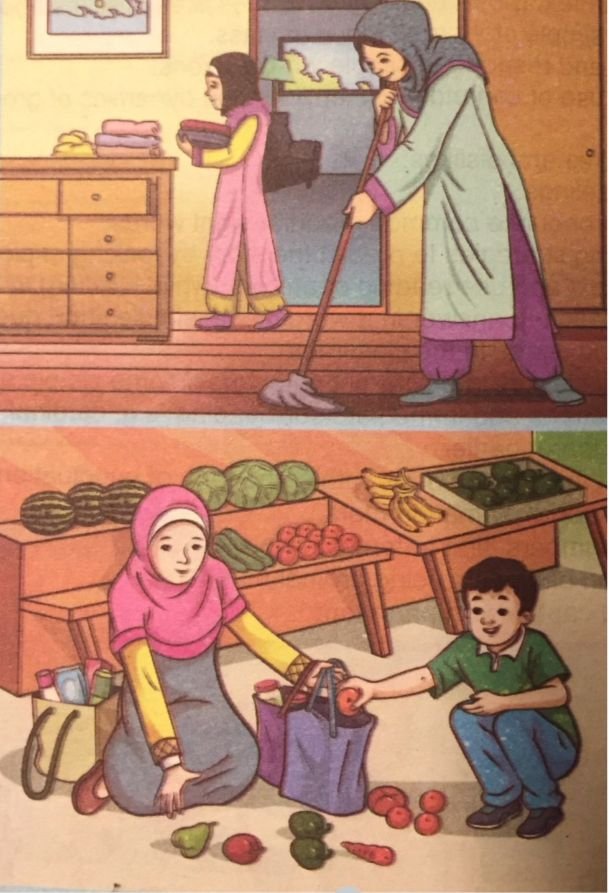
2. Women are mostly shown doing domestic work, taking care of the family, and looking after their children. In stories as well, they seem to come second to their male counterparts.
3. As discussed in detail above, there is the presence of religious text in non-religious books.
4. The stylisation of the books are difficult to understand, fonts and texts are way too clustered. The quality of the pages is not refined, making them unattractive and confusing for students.
CONCLUSION:
According to NCC director, Dr Chughtai, the curriculum is an evolving process and the books can be changed in future publications, based on the response by schools and parents. The biggest hurdle to the books is that the teachers have not been trained in teaching these new books and according to Dr Chughtai, it is up to the school to teach and implement the books. There are no worksheets given with the books and from initial student reactions, students are confused and wary of books that are laid out in a clustered fashion. There is also the subject of a language change. Where students study general knowledge, a precursor to Science, in Urdu, they switch to difficult English in grades 4-5.
While the government should be commended in trying to create a national syllabus, the forced enforcement of the books along with the lack of supplemental information and training will make this very difficult for teachers and students. Moreover, parents should be given a choice as to what they want their children to study. This implementation should be a free choice rather than that of enforcement. What would have been a practical approach is that the government should have improved the structure of the government/public schools, provided better teacher training, spent more on financially improving the conditions rather than lowering the standard for all.
*Graphics credits: Asma Ahmad (Graphic Designer)
How did we collect the data?
The percentage of male characters in the books: Divided the total number of male by the total number of characters. The percentage of female characters in the books: Divided the total number of female by the total number of characters.
The percentage of Islam: Divided the Islamic pictures or references given in the books by the number of total pages of all books. The percentage of other religion: Divided the other religions pictures or reference given in the books by the number of total pages of all books.
The percentage of female power roles: Divided the number of female by the total number of characters (female and male). The percentage of male power roles: Divided the total number of male by the total number of characters (female and male).
The same process/calculation/method was applied to the findings of each book.
Federal Minister for Education Shafqat Mahmood tweeted that he is grateful for the views, both negative and positive, on Single National Curriculum (SNC). He added that curriculums and textbooks are not static and need constant updating.
“I am grateful for the views, both negative and positive, on the single national curriculum (SNC) and on the textbooks developed to implement it,” wrote the minister.
I am grateful for the views, both negative and positive, on the single national curriculum (SNC) and on the textbooks developed to implement it. Curriculums and textbooks are not static and need constant updating. The feedback received will be a great help in the review exercise
Punjab Education Minister Dr Murad Raas reacted to the criticism following the implementation of SNC. He tweeted that he would be conducting a live session on Sunday to answer questions related to SNC.
Will be having a live session on Twitter this coming Sunday evening to answer as many questions as possible regarding Single National Curriculum. This session is specially for the parents. Will update the time slot. Looking forward.
Earlier, Sharmeen Obaid-Chinoy came forward and criticised the new curriculum. In addition, SNC is also receiving criticism on social media.
According to the new curriculum, schools will be free to teach additional material or even additional subjects. In the beginning, three subjects — Islamic Studies, Social Studies and General Knowledge — will be taught in the Urdu language at the primary level (Grade 1-5). Quranic learning with translation will also be mandatory in Grade 6-12.
Mahmood had earlier announced the SNC would be implemented from the new academic session on August 2 in all public and private schools as well as madrassah of Punjab.
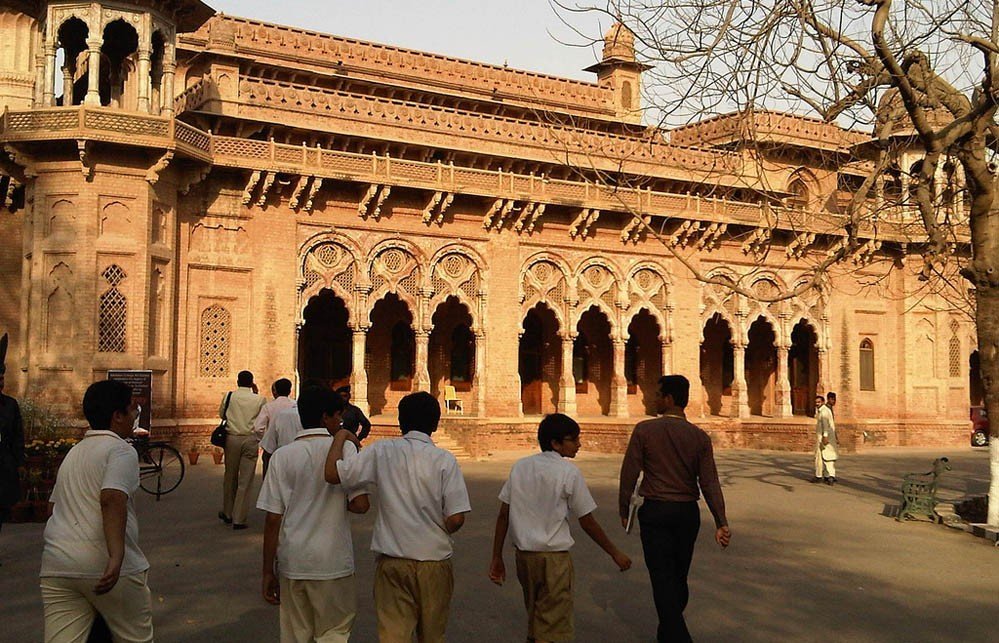
The Punjab Government warned Aitchison College, a school for boys in Lahore, via a letter on Tuesday for not implementing Single National Curriculum (SNC) within its campus.
In a tweet, Education Minister Punjab Murad Raas, while sharing the official letter stated, “Letter sent to Aitchison College Lahore for not implementing SNC in its entirety by Punjab Curriculum Textbook Board. Zero exemptions. I will not let anyone challenge the writ of the government.”
Letter sent to Aitchison College Lahore for NOT implementing Single National Curriculum in its entirety by Punjab Curriculum Textbook Board. Zero exemptions. I will not let anyone challenge the writ of the government. pic.twitter.com/lKVdWOSQy5
The letter was issued to Aitchison College Principal Michael A Thomson by the Punjab Curriculum and Textbook Board (PCTB) stating, “You are again requested/advised to kindly do not prescribe those books which have not been given Non-Objection Certificate (NOCs) by PCTB.”
Furthermore the letter reads “It is to apprise you that the PCTB reviews and issues NOCs to the books after due process not on the request of an educational institution (school/college), but on the request of book developer (person/agency/private publisher) who apply for the same.”
Parents at Aitchison told Dawnthat the administration had implemented the SNC from Tuesday. Science, Islamiat and history books were introduced in Urdu.
Prior to this notice, Federal Minister Education Shafqat Mahmood also said that there would be no exemption for Aitchison College or any other school.
Aitchison College Principal Mr Thomson hasn’t commented on this issue yet. Earlier, when an official questioned him about it, he replied that the school did not fall within the department’s purview.
What is SNC?
It is a ‘uniform system of education, which means the same curriculum for everyone but has been highly controversial because of the content and images in the books approved for the curriculum. Sindh has decided not to implement the curriculum since education is a provincial issue.
According to the new curriculum, Schools will be free to teach additional material or even additional subjects. In the beginning, three subjects — Islamic Studies, Social Studies and General Knowledge will be taught in the Urdu language at the primary level (Grade 1-5). Quranic learning with translation will also be mandatory in Grade 6-12.
Mehmood had earlier announced the SNC would be implemented from the new academic session on August 2 in all public and private schools as well as madrassah of Punjab.
Minister for Education Shafqat Mahmood on Wednesday blamed the Pakistan Muslim League-Nawaz (PML-N) for the ruckus in the National Assembly.
Speaking on Geo News’ programme ‘Aaj Shahzeb Khanzada Kay Saath’, Mahmood said there is a group within the PML-N that is “perhaps aligned with Maryam Nawaz Sahiba that wishes for chaos to ensue”.
کل اپوزیشن لیڈر کی تقریر میں شورشرابہ پہلےحکومت نے کیا۔ فوٹیج بھی موجود ہے مگرپھر بھی اسپیکر نے جن سات اراکین اسمبلی کیخلاف کارروائی کی ان میں سے چار اپوزیشن کے ہیں۔کسی حکومتی وزیرکیخلاف کارروائی نہ کی۔ کیاسب وزیراعظم کے کہنے پرہورہاہے؟
He claimed that when Minister for Finance Shaukat Tarin was presenting the budget in parliament, the Opposition came close to the prime minister and said words like ‘Donkey Raja’.
Mahmood said that the Opposition itself asked for a committee to be formed to investigate the ongoing ruckus but when they were asked by the Speaker to turn in their members’ names, “they refused to do so”.
“Then, when Shehbaz Sharif’s speech began, a member of the PML-N threw a bottle in MNA Akram Cheema’s direction and he was wounded. He was left all bloodied.”
Speaking of the Opposition’s decision to bring a no-confidence motion, Mahmood said that they will soon “run away from the move”.
Meanwhile, PML-N’s Rana Sanaullah said that both Speaker and Deputy Speaker are custodians of the House. It is very important that both the treasury benches and the Opposition need to have confidence in them.
جب اسپیکر کے خلاف تحریک عدم اعتمادناکام ہی ہونی ہے تو کیوں اپوزیشن یہ کرنے جارہی ہے؟ دیکھیے
Sanaullah said that no-confidence motion against both the Speaker and the Deputy Speaker signals a trust deficit. “They have lost the confidence of the parliament.”
He also accused the prime minister of “conspiring to diminish respect for the parliament”.