Tag: Shell

  • 10th Shell Tameer Awards – The Brilliance of Future Innovators

    10th Shell Tameer Awards – The Brilliance of Future Innovators

    A visionary concept like that of the likes of Shell’s flagship programme, the Shell Tameer, is one that gives youth a dynamic platform where sustainable, revolutionary, and scaleble ideas can prosper. Shell Tameer Awards is a beacon of hope for innovators and their developmental portfolios designed to fortify economies. Shell Tameer lays the foundation of entrepreneurship, and innovation to create meaningful changes in the country. A nationwide spectacle became the nexus where innovative ideas and creative minds across Pakistan came together to share a platform for the benefit of the country.

    Shell Tameer Awards 2023 saw a plethora of impeccable ideas poised to redefine Pakistan’s trajectory of progress. These ideas promise to bring transformative solutions to the challenges faced by the nation and its people, acting as a catalyst for economic growth.

    Diverse in scope and impact, the Shell Tameer Awards boast a spectrum of categories that mirror the multifaceted challenges and opportunities of our time, let’s shed some light on a few of many extraordinary visions that we encountered on the 10th Shell Tameer Awards.

    Clean Energy Solutions

    Clean Energy Jamal Ahmed – Solar Safe – A pioneering startup from Peshawar, specialising in solar panel cleaning, maintenance, and repair services for solar PV systems. It aligns with the principles of sustainability and circular economy by extending up to 10 years the lifespan of solar panels and maximising the energy of energy production.

    Sheraz Khalid – ECO CHAR – An environmentally friendly clean-tech based charcoal manufacturer that addresses the issue of sub-standard fuel in domestic, industrial, and commercial sectors.

    Empowering Women

    Shehnaz Akhtar – HALANCE NATURALS PVT LTD – A company that works towards creating natural and clean skincare, hair oils and essential soaps, scrubs, and shampoos nurtured through organically grown fruit goodness that grows from pesticide-free farming.

    Technology Innovation

    Farha Masood – BIO-NANO INNOVATIONS – A young startup developing specialised wound dressing for diabetic patients who consistently face issues of foot ulcers, bacterial invasion, and infections. The business aims to commercialize affordable adhesive dressings to provide aseptic conditions and promote wound healing for diabetic patients.

    Abdul Hanan – Softwares Solution – A smart system designed to serve over 70 million people suffering from stammer/stutter by taking voice input and predicting the next word/sentence as transcribed output.

    Anjum Javed – AGRIBOTX – Forefront runner of a transformative solution – Precision Robotics for future farming harnessed with cutting-edge technology, AI, and data-driven insights to develop a comprehensive suite of robotic solutions.

    Circular Economy

    Humza Rehman – RDUINOTRONICS – A high-quality filaments producer that uses discarded plastic bottles to manufacture filaments suitable for 3D printers, hence addressing the issue of plastic waste and fulfilling the need for more accessible and cost-effective filaments.

    Bushra Ali Khan – BAAZYAFT – An eco-friendly initiative where underprivileged communities, including transgenders and deserving females, produce home accessories, stationery items, and fashion accessories from textile waste.

    The Shell Tameer Awards extend beyond the winner’s podium, all 30 finalists benefit from global consultancy, exposure, and constructive feedback from industry leaders, helping them progress their business and further their ideas from concept to reality.

    Shell Tameer emerges as a catalyst for entrepreneurship and a flag-bearer of creative potential across Pakistan. It empowers leaders, game-changers, and trailblazers to shape national economic growth. Two decades on, the program continues to foster innovative solutions, building a modern, convenient, and vibrant ecosystem that propels the future of the nation. As we celebrate another successful year of the 10th Shell Tameer Awards, we eagerly anticipate the untold stories and hidden brilliance that will shape the next chapter of Pakistan’s journey towards progress and innovation.

    AD
  • Petrol price increased to historic high of Rs305.36 per litre

    Petrol price increased to historic high of Rs305.36 per litre

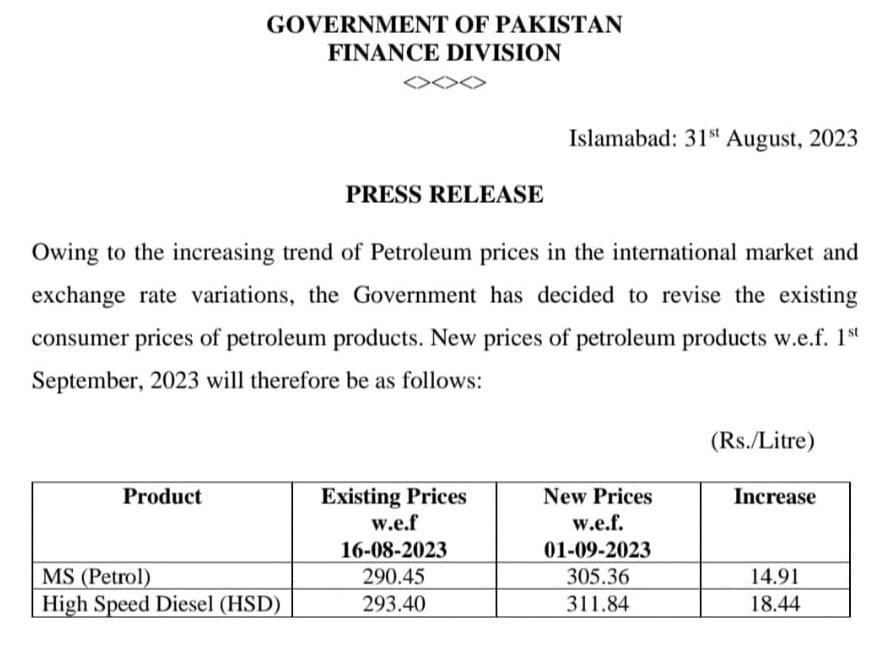
    For the first time in Pakistan’s history, the price of petrol has crossed the Rs300 mark due to a recent hike of Rs14.91. This brings the new petrol price to Rs305.36 per litre. The diesel price has also increased by Rs18.44, now at Rs311.84 per litre.

    The government has attributed these revisions to the upward trajectory of global petroleum prices and the consequential fluctuations in exchange rates.

    A statement issued by the finance ministry highlights that due to the escalating trend of petroleum prices in the international market and the subsequent shifts in exchange rates, the Government has opted to recalibrate the prevailing consumer prices of petroleum products.

    In the days ahead, the effects of these significantly heightened petrol and diesel prices will become evident. These price fluctuations are poised to have a substantial impact on individuals who rely on personal vehicles, such as bikes and cars, as well as those who depend on public transportation services.

  • Petrol price may go down by Rs9.63 per litre for the next fortnight

    The price of petrol is expected to decrease by Rs9.63 per litre for the next two weeks, while diesel prices are anticipated to increase.

    According to reports, the Oil and Gas Regulatory Authority (OGRA) has advised lowering gasoline prices for the final fifteen days of the current month, September.

    However, a final decision about increased petroleum pricing would only be made after receiving Prime Minister Shehbaz Sharif’s approval.

    For the specified period, the cost of diesel is probably going to go up by Rs3.04 per litre, bringing the price from Rs247.26 per litre to Rs250.30.

    The federal government announced an increase in the price of gasoline and diesel for the first two weeks of September on August 31.

    The price of gasoline increased by Rs2.07 to reach Rs235.98 per litre, while the price of high-speed diesel increased by Rs2.99 to reach Rs247.43.

    According to Express Tribune, various strategies have reportedly been used by the government and OGRA to maintain low petroleum prices in order to avert political reaction.

  • Shell Pakistan posts after-tax profit of Rs7.4 billion in first half of 2022

    Shell Pakistan posts after-tax profit of Rs7.4 billion in first half of 2022

    The results for the first half of the year are announced by Shell Pakistan Limited’s (SPL) Board of Directors. In comparison to the profit of Rs2,153 million recorded during the same period last year, the company reported an after-tax profit of Rs7,469 million in 2022.

    The significant rebound is a result of increased company performance with a strategic focus, a positive shift in the government’s pricing methodology for the S&P Global Platts indexes, and safe and effective fuel operations.

    According to Brecoder, the petroleum business added 13 new retail locations during this span, that will contribute to increased volume. In the market for premium fuels, Shell V-Power continues to be the market leader.

    In order to ensure that the business plays a significant part in the development of Pakistan’s energy future, the company will actively work to curtail the impact of present impediments and strive to grasp opportunities.

    Earlier, the business also confirmed its decision to cease its aviation operations in Pakistan. Currently, SPL operates its aviation-related business out of four locations.

    Including Nawabshah Airport, Begum Nusrat Bhutto Airport in Sukkur, Quetta International Airport, and Jinnah Airport in Karachi. SPL has concluded that it is no longer commercially viable to continue with its aviation operations in the country after careful consideration.

    In order to promote practices that will make Pakistani roads safer, the business also wrote the road safety book “Once Upon a Road.” The book will be covered in Pakistan’s sixth-grade curriculum developed by the Care Foundation.

  • Here’s where you can get petrol in Lahore

    Here’s where you can get petrol in Lahore

    Following oil industry’s warning of possible petroleum product shortages in Punjab and neighbouring areas due to road and highway blockades, a number of petrol pumps in the city have been closed.

    Majority of petrol pumps in Lahore have been shut, particularly in the Cantt, DHA, Gulberg, and Johar Town area. When asked, the majority of retailers refused to comment on when petroleum sales would resume.

    We have, however, contacted multiple managers of prominent petrol pumps in Lahore and asked if they are currently selling fuel.

    Here are a few filling stations in different parts of the city that are still selling fuel:

    1. Euro Oil petrol pump opposite Shahnawaz Mercedes-Benz Showroom Gulberg
    2. Total parco Mazang road, Mazang Chungi
    3. Hascol DHA phase 2 U Block, opposite DHA cinema
    4. PSO Chowk Thokar Niaz Baig , Multan Road

    Earlier, Oil Companies Advisory Council (OCAC) said that oil marketing companies are supplying fuel to retailers but the deliveries could be slowed owing to road blockages in Punjab’s major cities.

  • Pakistan starts oil and gas production from Dhok Sultan DS X-1

    Pakistan starts oil and gas production from Dhok Sultan DS X-1

    Pakistan’s state-owned natural gas and petroleum products supplier Pakistan Petroleum Limited (PPL) has started production from the recently installed Oil Handling Facilities (OHF) in the Dhok Sultan Block in Punjab province.

    The business claimed in a filing on May 6 that it is the operator of the Dhok Sultan Block and owns 75 per cent of the working interest, while Government Holdings (Private) Limited (GHPL) owns 25 per cent.

    As per the filing, The present production figures from DS X-1 are 5 MMscfd gas, 3000 bbls/day oil, and 25 M.Ton/day LPG. The Dhok Sultan OHF is in charge of oil production, while the Meyal Gas Processing Facilities (MGPF) of Pakistan Oilfields Limited (POL) in District Attock is in charge of gas processing.

    The gas production from this facility will go to Sui Northern Gas Pipelines Limited, while the oil will go to Attock Refinery Limited, according to the business.

    This finding is currently in the Extended Well Testing (EWT) production phase, and the data obtained during this phase will aid in its continued development. Through indigenous hydrocarbon production, the start of production from DS X-1 will contribute to increasing energy security and saving significant foreign cash for the country, according to the company.

    Considering the high demand, Pakistan’s economy is significantly reliant on fossil fuels, with petroleum products and other fuels accounting for a large portion of the country’s import bill.

    Read more: Pakistan’s foreign currency reserves down by $328 million

    Due to its surge in the global market, Pakistan’s oil imports have increased dramatically in recent months. The overall petroleum group’s imports were $14.812 billion in the first nine months of the current fiscal year (2021-22), up from $7.553 billion in the same time in 2021.

  • Massive hike of Rs83.5 for petrol, Rs119 for diesel proposed by OGRA

    Massive hike of Rs83.5 for petrol, Rs119 for diesel proposed by OGRA

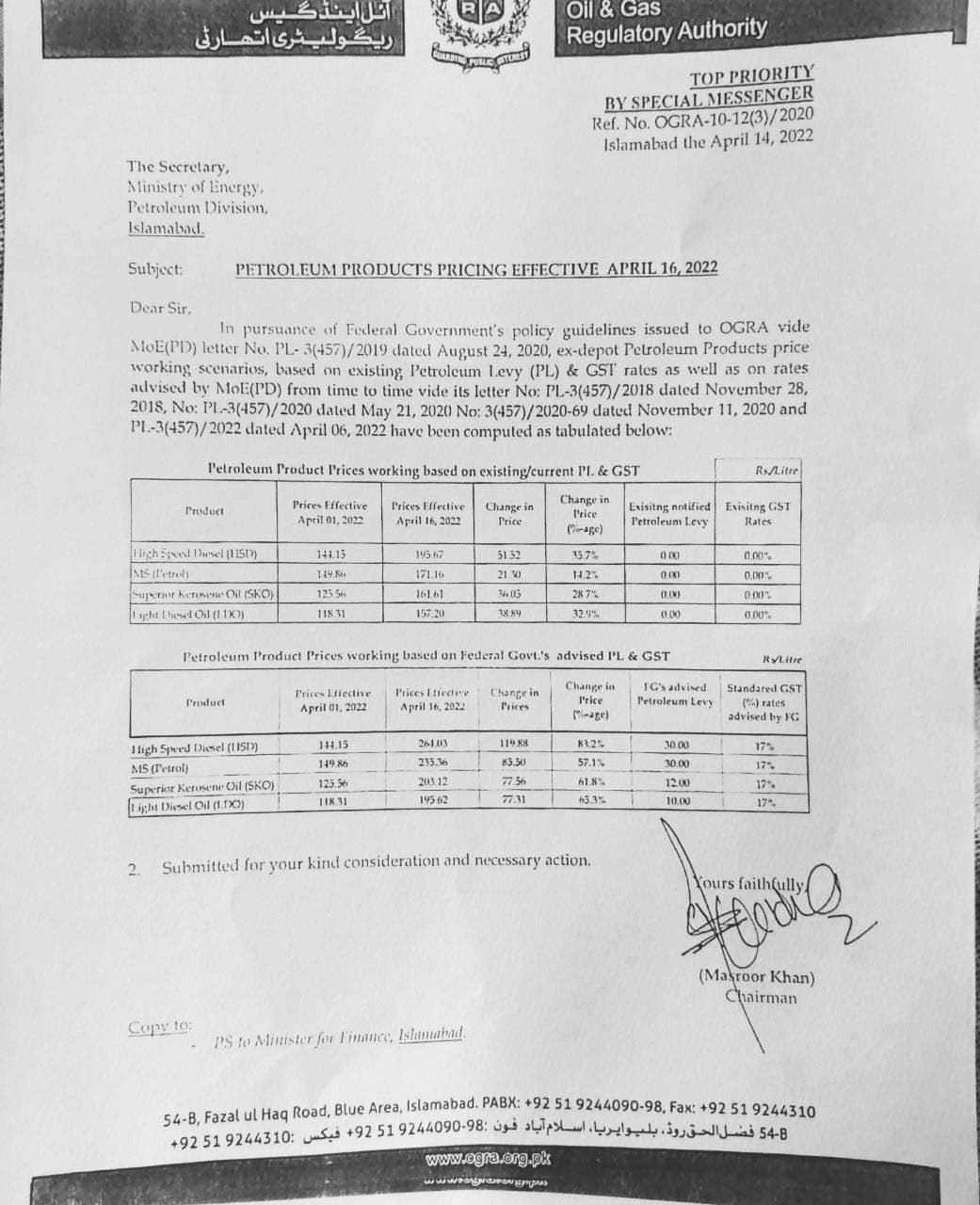
    The Oil and Gas Regulatory Authority (OGRA) suggested the federal government elevate fuel prices by up to Rs83.5 per liter for petrol and Rs119 for diesel.

    A summary to the petroleum division was presented by OGRA for the huge increase in petroleum rates to come into effect on April 16 in Pakistan.

    The proposed raise was calculated using a 70 per cent GST rate plus a Rs30 per liter levy. It is worth noting that the current duty on fuel and diesel is Rs30 per liter, plus 17 per cent GST.

    On the basis of complete levy and taxes, the body has recommended raising petrol prices by Rs83.5 per liter, while diesel prices should be raised by Rs119 per liter.

    According to reports, the OGRA proposed raising the petrol price to Rs21.53 per liter in line with the current tax rate, Rs51.3 for diesel, and Rs77.56 for kerosine oil on the grounds of full tax and levy.

    Read more: Gold prices go up by Rs350 per tola to Rs130,300

    Concerning other oil products, a full tax rate and levy hike of Rs77.31 was suggested for light diesel, Rs36.5 for kerosine oil, and Rs38.89 for light diesel. According to sources, the finance ministry would make the final decision on the OGRA summary after briefing Prime Minister Shehbaz Sharif.

  • WASA to initiate a crackdown on service stations in Lahore that waste water

    The Water and Sanitation Agency (WASA) has taken note of the car wash facilities in Lahore that are wasting water and will penalize those responsible.

    The Managing Director (MD) of WASA, M. Tanveer summoned a meeting of key personnel, who organized units to conduct a crackdown operation. The teams would comprise officials from the operations and revenue departments who will provide the Managing Director with a daily status report.

    Tanveer called for immediate action against vehicular washing facilities that do not have a water recycling facility.

    Car wash stations will be given a warning at first and will face severe consequences if they do not install a recycling plant.

    According to a recent high court appeal, service stations consume around 200 liters of water for a small car and 300 liters for a bigger vehicle.

    WASA instructed that service stations must recycle 70 per cent of the water they use, or they will be shut down. The authority will also impose hefty fines on anyone who tosses trash into drainpipes and sewer lines in order to avoid sewage from blocking.

  • Petroleum sales increase by 23% in March, despite hefty oil prices

    Petroleum product sales rebounded in the last month after a dismal February with Oil marketing companies (OMC) witnessing an increase of 23 per cent in sales of petroleum products on a year-over-year (YoY) basis in March 2022.

    Overall petroleum sales in March 2022, increased to 1.82 million tonnes compared to 1.54 million tonnes in March 2021, as per the data released by Arif Habib Limited.

    The stability comeback shows a 19 per cent increase in overall OMC sales on a month-over-month (MoM) basis.

    OMC volume growth was driven by furnace oil, which climbed by 34 per cent on a YoY basis, followed by HSD volume growth of 29 per cent and MS volume growth of 13 per cent. MoM growth in OMC volumes followed a similar pattern, with FO taking the lead.

    Although the increase in furnace oil volumes was driven by increased furnace oil usage in the power sector due to low gas and Re-Gasified Liquefied Natural Gas (RLNG) availability.

    The increase in HSD volumes was driven by increased demand from the transportation and agriculture sectors and increased usage in generators and the power sector.

    Moreover, the government’s price caps and the additional number of days in March compared to February were the main contributors to MoM growth in diesel and gasoline sales.

    Consequently, petroleum sales increased by 19 per cent on a YOY basis in 9MFY22, with double-digit increases for petroleum products.

    Diesel sales grew by 17 per cent, followed by 16 per cent increase for furnace oil and a 10 per cent growth for motor oil.

    While some are expecting a drop in petroleum sales due to the political turmoil and rising commodity prices, others say that higher oil consumption cannot be overturned as the summer is already here and people are likely to consume more electricity, also that the power sector may switch to furnace oil due to RLNG commitment defaults.

  • Petrol, Diesel prices to remain unchanged till April 15

    The government has decided to maintain the existing prices for petroleum products for the fortnight. Petroleum prices will remain unchanged from April 1 to April 15, as per a statement released by the finance division.

    Petrol is currently priced at Rs149.86 per liter, while diesel, kerosene oil, and light diesel are priced at Rs144.15, Rs125.56, and Rs118.31 per liter, respectively.

    Following an increase in global market prices at the time, the government approved a record-breaking Rs12.03 per liter hike for petrol on February 15. Surprisingly, on February 28, the government decreased POL prices by Rs10 per liter, to lessen the impact of existing inflation on the public.

    The Oil and Gas Regulatory Authority (OGRA), on the other hand, has raised the price of liquefied petroleum gas (LPG) by Rs13 per liter.

    Read More: Nisab amount of zakat deduction set at Rs88,927 for 2022

    After an increase of Rs157 per domestic cylinder and Rs606 per commercial cylinder, the prices of domestic and commercial LPG cylinders have been fixed at Rs2,916 and Rs11,220, respectively, for April 2022.

    Conversely, in the aftermath of the Russia-Ukraine conflict, the international market saw massive volatility as crude oil prices reached new highs.