Tag: Sindh government

  • Karachi’s rain mess: A case of governance failure, corruption and political turf wars

    Karachi’s rain mess: A case of governance failure, corruption and political turf wars

    “The curious case of this city is that it is administered by a mix of federal and provincial controlled landholding associations, cooperative housing societies, military-run cantonments, the navy, the railways and the industrial area authorities to name a few.”

    A commercial port city with more than 20 million residents, Karachi has continued to suffer decades of civic mismanagement, gaps in urban planning and development given the lack of adequate governance, corrupt civic agencies and political parties vying for power. None of the myriad agencies that control resources and management in this city have honestly bettered the city and the lives of its people.

    Take the tussle between the PPP and the MQM that has not only brutally destroyed the socioeconomic fabric of districts such as Lyari, a sprawling slum settlement turned into a hotbed of violence, guns and drugs when rival gangs were patronised by the city’s two political parties, but also resulted in turf wars affecting the running of civic institutions. The political bifurcation of jurisdictions within this city has, therefore, resulted in a complete breakdown of basic service provision over years – lack of clean drinking water, electricity, housing, security are just a few municipal services that should be under the local government system but this is not the case. Even an elected mayor has no jurisdiction over certain areas of this city. When a city’s history is rooted in ethnic and identity-based politics building urban infrastructure, providing municipal services, or even intervening in areas that are essentially administered by a particular political party is near to impossible.

    Last week, Karachi was submerged in 230mm of rainfall in less than 12 hours, the most ever recorded, according to the Pakistan Metrological Department, exposing again glaring gaps in urban development, especially in low-income and vulnerable communities. Wealthy residential areas were not spared where drainage channels were choked. One such densely populated urban settlement with poor access to water and sanitation, Lyari is located about 15 minutes from the city’s business hub at I.I. Chundhrigar Road where you’d find most of the banking sector is headquartered. Streets were inundated with rain and sewerage water for days and later cleared up by residents because no government assistance reached these communities. Similarly, homes, businesses and streets in the city’s old quarter of Kharadar – a symbol of pre-colonial history which becomes the centre for Muharram processions (near Mithadar where the Edhi main office is located and adjacent to Jodia Bazaar) – literally drowned in a mix of rain, putrid sewerage water and floating garbage, increasing the risk of diseases, such as dengue and malaria. Some commercial/residential areas remain flooded with no electricity almost a week after the downpour in this city; sewerage water has collected in empty plots according to residents in different areas of Karachi where gutters are broken.

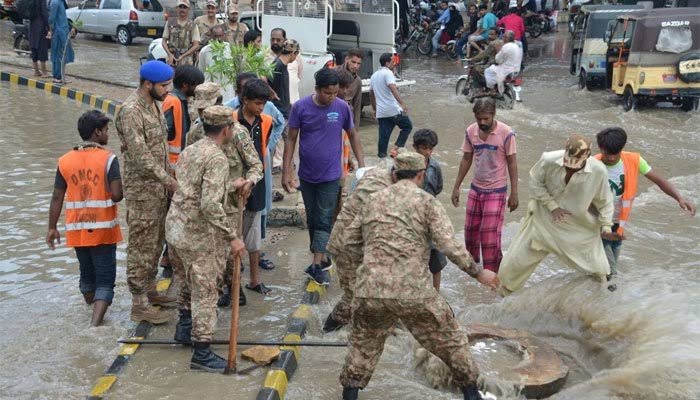
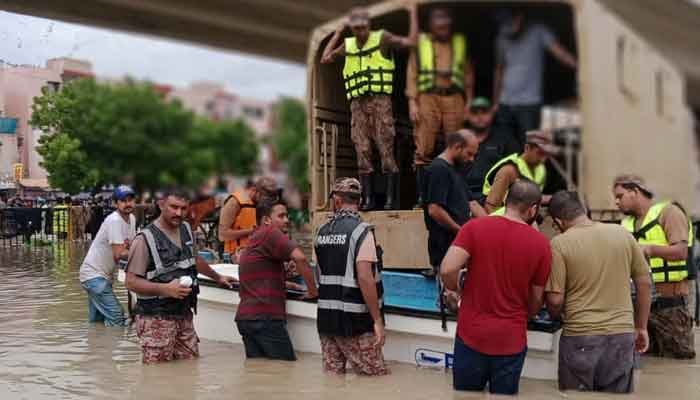
    First let’s be clear here: vulnerable neighbourhoods with already inadequate urban and social infrastructure have long been neglected by the ruling political powers and whomsoever authority is in charge of a given district. Then, the urban poor in Karachi are like none other. I recently read on Twitter: ‘The Lebanese people are like kids who’ve had to raise themselves because the parents were never around to take care of them.’ Now apply that to Karachi and it makes sense. Migration from rural to urban, and from the north has meant living in overcrowded, unsafe environments with little access to education, health, or sanitation, and with the COVID-19 crisis having reduced livelihood opportunities even further because of mobility restriction and decreased economic activity, natural disasters have the potential to decimate lives and homes. So why no focused body that can fix Karachi? The curious case of this city is that it is administered by a mix of federal and provincial controlled landholding associations, cooperative housing societies, military-run cantonments, the navy, the railways and the industrial area authorities to name a few. Many question the absence of the relevant authorities responsible for civic provisions, such as drain clearing before the annual monsoons, sewerage repairs and garbage collection. In fact, it was army personnel, volunteer rescuers, and even volunteers from the Islamist group Tehreek-e-Labbaik who rescued and evacuated people from many inundated residential neighbourhoods — some using boats for rescuing residents living in the newly constructed Naya Nazimabad area while some families waded through waist-high water. 

    Floating cars and destroyed homes: an apocalyptic sight

    Moreover, substandard construction in the city and informal settlements, built close to water draining channels or nullas, were perilously flooded or sunk during these rains given their poor physical infrastructure. This kind of urban flooding is to be expected as climate patterns change experts warn. And we have witnessed urban flooding in the past in Karachi. Warnings from the late Perveen Rahman, Orangi Pilot Project’s director, of the possibility of urban flooding if the mangrove plantation was removed on either side of Mai Kolachi because it served as a catchment area that could prevent flooding, were never heeded.

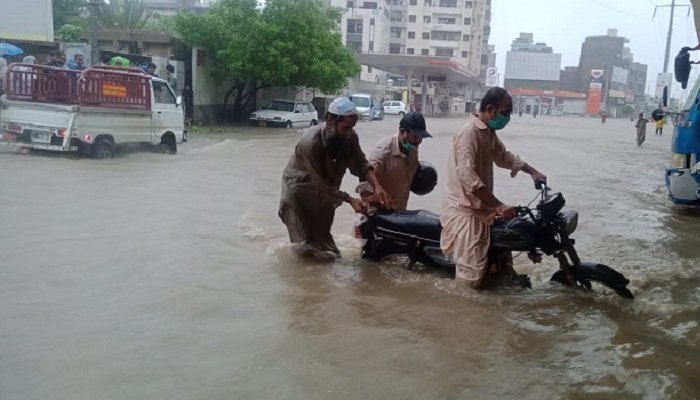
    The human toll of the recent rain tragedy has left Karachi’s residents reeling with more anger than ever and rightly so. I use the term tragedy here because rain in Karachi is hardly romantic or calls for a relaxing cup of tea and pakoras – rather it’s become synonymous with loss of lives, homes and livelihoods that could have been avoided had the concerned authorities prioritised rain preparations by declogging stormwater drains beforehand or constructing drainage facilities where none exist. Hundreds of people were forced to take shelter in the homes of relatives while scores of cars and other vehicles caught in the torrential downpours either remained submerged in water, many seen floating away as the water began flowing akin to a river developing rough currents. Scenes captured and shared as photographs and videos on social media were as if this city had been hit by a passing meteor and destroyed with a vengeance. Main thoroughfares and all seven newly constructed underpasses were submerged under several feet of water; children and motorcyclists drowned in waterlogged underpasses; young men slipped into storm drains (nullahs); 21 bodies were pulled out of just one water channel near Korangi; cars were seen stranded or floating everywhere in the city; underpasses resembled swimming pools turned nasty, and electricity was cut in areas for over five days to save people from getting electrocuted because this city has a surplus supply of unnecessary wires dangling on electric poles or lying unattended on roads and pavements. All this while empty shipping containers placed to block streets during the ninth and tenth of Muharram were seen dangerously floating down Zaibunissa street in Saddar jostling calmly for space with cars and buses. In the case of a police van caught in moving water currents on the main Sharah-e-Faisal thoroughfare that leads to Jinnah International airport – images of which went viral on social media – around five policemen were rescued by passersby who threw a rope ladder at them. Where were the authorities, the rescue services other than volunteers such as Edhi and Chippa to help in this disastrous monsoon deluge is a question we need to ask the provincial/federal government.

    And it was not just Karachi that witnessed the monsoon rains this year but images from the interior of Sindh are heartbreaking – entire villages have drowned, mud homes entirely washed away with families having lost their meagre belongings, hungry children huddled together under the open skies – and these are communities that persistently suffer from drought, malnutrition, lack of healthcare, unemployment. Again, why has this government neglected its most vulnerable people needing protection, shelter and food? According to the NDMA, troops using boats evacuated 300 people from the rain-hit district of Dadu in Sindh, while 1,245 people were evacuated from Karachi’s rain-hit areas last week, where residents lost their life’s savings when businesses were destroyed and homes flooded with sewerage water, especially where the city’s outdated drainage and waste systems were overwhelmed by an unprecedented spell of heavy rain. That is not to say urban flooding was unexpected. Although flood warnings were issued, it appears authorities in charge of overseeing the city’s basic services and infrastructure were at their usual lethargic best without formulating any kind of preemptive response.

    When DHA drowned in sewerage water

    This year’s monsoon rains did not distinguish between slum settlements and the wealthy Clifton and Defence Housing Authority (DHA) neighbourhood. Given DHA is a housing authority for the rich and famous, in the aftermath of these rains that didn’t appear so – the sprawling area that comprises DHA was inundated with water as aerial views shared on social media revealed not a dry patch. Originally founded in 1953 as Pakistan Defence Officers Housing Authority, Zia-ul-Haq passed a Presidential Order in 1980 to create DHA, a civic authority run by the powerful military controlling five per cent of urban land in this city. It is a private enterprise given a governing body run by chiefs of defence institutions, essentially administered by serving brigadiers under the direct command of corps commanders. It was decided then that DHA would have its own rules and essentially not adhere to the local government system that oversees the municipal provisions of the city. This Presidential Order divided the Karachi Cantonment – the southern side named Clifton Cantonment that was given DHA Phase 1. In other words, DHA and Cantonment Board Clifton (CBC) do not come under the mayor of the city who cannot control the drainage, water supplies and planning for this area.

    Residents from DHA, one of the largest landholding bodies in this city, were hard hit this year when scores of houses were flooded in the city’s posh district home to politicians, ministers, entrepreneurs and industrialists. No one from this authority emerged to apologise for the putrid mess that was open gutters and collected rainwater measuring over five feet in certain areas and no one attempted to provide assistance for those vulnerable residents trapped in their homes without electricity, food, water and medicine; some even at the risk of drowning. Many took to twitter cussing the electricity supplier, the Sindh government and the DHA authorities, as they witnessed green streets drowning mercilessly with such rainwater intensity that gated homes were left in utter disarray; heavy metal gates flung wide open with currents of the free-flowing water, expensive cars floating aimlessly or submerged and basements of homes flooded with expensive paintings and books destroyed in some homes. The urban middle-class deprived of basic amenities, clean water and electricity for years intermittently, say they watched this side of the Clifton bridge as they term the elite, drowning and waited for a reaction. The point being if you pay your taxes, water taxes included, and get nothing in return, because you’re compelled to buy your water, electricity and security, something has to give – and these rains meant no one was going to sit back and take the callousness suffered over years.

    Residents mobilised over Facebook and protested outside the office of the CBC, DHA’s sister organisation, to register their anger at having paid taxes for years but not having received any services, such as solid waster management disposal – the city actually has no plan for waste disposal – or running water without having to purchase water tankers and pay a whopping Rs 7,000 for one tanker. Furthermore, the stormwater drains clogged with garbage in DHA and elsewhere in the city, have not been removed as a preemptive move before the summer rainfalls. Hundreds of residents protested outside the offices of the CBC demanding the authorities clear the water hours, and present their audit for the past five years. Despite a legitimate right to protest, the organisers are now faced with police charges for rioting — and for shaking the CBC head out of his lethargic stupor. Fed-up with the city administration, other protests happened, in the days to follow, including all Karachi residents irked by years of neglect. A friend who said she’d stopped the water from seeping into her dining room and flooding her house, calling the city a disaster zone, a death trap. I can’t worry unless something hits me in the face, she said. Or else I’d die of anxiety. And I forgot to mention if you have a generator, which most Karachiites at home and for their businesses would do, finding a petrol station at 4 am was a nightmare when you ran out of petrol or diesel. 

    In certain residential and commercial areas of this city, even as I write this, electricity is yet to return; roads are filled with water, and sewerage, despite the Sindh government’s representatives, including the chief minister rolling up their sleeves and supervising water drainage. Draining the water from main roads has largely been left to volunteers and the Sindh government (read Sen Murtaza Wahab’s twitter updates) when the concerned authorities were unable to move in swiftly and do their job. Businesses have been gutted; supplies worth hundreds of thousands lost all over this destitute city, but who is listening to these troubles? Who will work or represent the interests of this city and its people? All of Karachi deserves greater attention because it has suffered years of neglect and economic hardship despite generating maximum revenue. No city can function with multiple agencies and multiple service provision jurisdictions. According to a paper on landownership in Karachi authored by Arif Hasan, Noman Ahmed and others, this city is governed by 13 different land management authorities which resultantly means no consensus is achieved and there is no coordinating mechanism, because of clashing interests. Over the years this has translated into a lack of low-income housing, amenities and utilities.

    Making Karachi liveable

    So while it is critical for megacities like Karachi where urban sprawl has not been able to keep up with the growing population needs to focus resources on immediate management and response to natural disasters or an urban crisis, attention must be paid to how long-term measures can be implemented to build a more sustainable and liveable city. This approach is imperative after an intensely destructive monsoon season countrywide that has revealed how unprepared and clueless we are when it comes to managing disasters of this unprecedented scale – natural disasters intensifying over the years as unusual weather patterns emerge clearly warning of the impact of climate change (Karachi’s extreme heatwave in 2015 is yet another example) If climate change is not addressed adequately by this government, without a disaster management infrastructure and expertise to match, severe weather will cause loss of lives and livelihood. Mitigating the effects of climate change  (on agriculture, for example) is imperative, especially in vulnerable areas, rural districts in Sindh, even KP and Balochistan, where the capacity to sustain climate change shocks is non-existent, and where disaster prevention is unaddressed.

    Karachi’s woes require a serious reorganisation of administrative duties so whomsoever civic agency is responsible gets the job done without political and commercial interference (especially in the use of land to their own advantage) while keeping at the fore the impact of climate change (droughts, floods, rain intensity will adversely affect water and food security in the near future) Governance must no longer be compromised because of conflict between stakeholders at the expense of the people. Strengthening local bodies is critical. As a party, the PPP has never allowed for that because it becomes a political issue whereas the PML-N gets voted on its governance track record in Punjab, so it must keep to a standard when it comes to civic services.
  • Karachi: Resilient no more

    Karachi: Resilient no more

    A city once known as the ‘city of lights’ has now been without electricity for almost three days and counting.

    Karachi resembles a dump now with dilapidated roads, virtually no sewerage system, no government public transport, buildings on top of each other without following any safety laws, no emergency response system, nothing. Recent visuals on our television screens, social media and WhatsApp following the monsoon rains in Karachi are horrendous. Cars floating around, houses drowning in sewerage water and rainwater, people being electrocuted, no electricity, no food, no relief in sight. A wheelchair-bound woman drowned in her house due to the mismanagement of those in power, someone who had a heart attack could not reach the hospital in time due to flooding…each story is worse than the other. More than 80 people have so far lost their lives.

    The ‘resilience’ of the people of Karachi has been taken for granted but Karachi has had enough!

    The Pakistan People’s Party (PPP) has been in power in Sindh for the last 12 years. In those 12 years, we have not seen the provincial government take any responsibility whatsoever for the woes of the provincial capital. Blaming the Muttahida Qaumi Movement (MQM) because it ruled Karachi for almost a decade before the PPP government came to power can only be done so much. If the Opposition parties tell the ruling PTI to stop blaming past governments and focus on their own performance, then the same rule should apply in Sindh. The MQM may not have done as much as it should have back then but it is no excuse for a government that has been ruling the Sindh province for over a decade now.

    It will also not paper over the fact that the local bodies system is so weak that no city government can be blamed for anything catastrophic. If the PPP wants to shift the blame, it should have had a fully empowered local bodies system in place. When a government does not want to devolve power and then not do anything itself, then who is to blame? Climate change may be another reality but it is not something that has come out of the blue. Where is the emergency relief system to work in times of natural disasters? If it were not for the Edhi foundation and Chhipa and other private organisations, the city of Karachi would have been an orphan city. Private citizens are helping each other out rather than the government. Where is the empathy of the rulers? Some of the tweets by provincial ministers are full of apathy towards the people of Karachi; clearing a few roads of rainwater do not make the problems of Karachi go away.

    Now that a committee has been formed with all stakeholders to address the issues plaguing the largest city of Pakistan, it is hoped that regardless of their political affiliations, all stakeholders would work towards reaching a solution and not play politics at the cost of innocent lives. The people of Karachi have witnessed ethnic warfare, sectarian killings, mafias, crime and much worse. They deserve a break now. The Sindh government and all other stakeholders need to work together in order to bring some semblance of normalcy back to a city that is the heart of Pakistan. 

  • What’s going on in Karachi? It’s not just flooding…

    What’s going on in Karachi? It’s not just flooding…

    As many as 19 people died in various rain-related incidents in the port city on Thursday, taking the tally of deaths during the three-day monsoon spell in the city to 30.

    While blame games continue as authorities hesitate to take responsibility for the lack of monsoon infrastructure in the country’s largest city, the ruling Pakistan People’s Party (PPP) wants all stakeholders to contribute in ameliorating the situation instead of politicising a “pure natural disaster”.

    HOW MUCH HAS IT RAINED?

    Meteorological officials said downpours in August have shattered the 89-year-old record for the city. Some 484mm (19 inches) of rain has fallen this month so far, 130mm on Thursday alone, they said.

    According to data released by the Met Office, Pakistan Air Force (PAF) Faisal Base recorded 130 millimetres of rain while Nazimabad has recorded 105.6mm since Thursday morning. Mausamiyat received 74.3mm of rain, while Saadi Town recorded 72mm. About 98.5mm of rain was recorded in PAF Masroor Base, Surjani received 73mm while Kemari recorded 82.5mm.

    Many major arteries witnessed severe traffic jams. Power was suspended in several areas as a precautionary measure, a K-Electric spokesperson said.

    Karachi Commissioner Muhammad Suhail Rajput urged people not to leave their homes during the spell which, according to a Met Office prediction, is expected to continue for another two days.

    Videos and photos making rounds on social media showed submerged cars and motorcycles and water entering houses and buildings, wreaking havoc in the provincial capital.

    Scores of social media users, including Federal Minister Ali Zaidi, posted videos and pictures showing Defence Housing Authority flooded with rainwater after heavy showers pounded the city for hours.

    “This is DHA KHI,” Zaidi wrote on Twitter, adding, “Bang in front of my house- which is now partly flooded- but many homes in the neighborhood are under 4 feet of water”.

    “May Allah have mercy on those who live in low lying areas of this city,” he said in another tweet.

    “This is DHA Phase 6 Karachi. What is happening in the low-lying areas of KHI today is devastating yet once again. Testing times for Karachiites yet again! No doubt Allah tests those He loves the most,” he said in another tweet.

    Sindh Governor Imran Ismail, in a tweet, said that Prime Minister (PM) Imran Khan is monitoring the situation that has arisen in Karachi due to the torrential rains.

    “Briefed PM Imran Khan over Sindh rain situation, Karachi needs special attention. This is an unusual and abnormal rain situation which requires an emergency response. PM is monitoring the situation and assured to take any action required,” tweeted Ismail.

    The premier himself has also tweeted over the disastrous situation in the port city.

    In a subsequent tweet, he said that a plan for a permanent solution to the problems facing the people of Karachi will also soon be announced.

    RELIEF, RESCUE OPERATION CONTINUES:

    In a statement, the military’s media wing Inter-Services Public Relations (ISPR) said that many areas were inundated and people stranded due to heavy rains in various parts of Sindh.

    An Army Flood Emergency Control Centre has been established in Karachi for assisting flood victims while a medical camp has been set up at the district centre of Gulberg, Liaquatabad and New Karachi for providing necessary medical care, the Inter-Services Public Relations (ISPR) said.

    It said the dewatering of more than 36 sites in Karachi had been completed while cooked meals covering 10,000 people had been distributed among flood victims in various areas.

    The following telephone numbers can be contacted for immediate assistance by the army:

    • 021-34491082

    • 021-99247267

    • 021-99207795

    Meanwhile, army engineers completed the enhancement of the bund along M9 near the Northern Bypass to avoid flooding.

    Army troops also filled a breach in the Malir River near Quaidabad, according to the ISPR. “Pakistan Army engineer boats are busy shifting people to safer places,” the statement said.

    A relief and medical camp has also been established in Latifabad area of Hyderabad. Food was provided to the affected population while army engineers were busy in dewatering various areas, it added.

    According to the ISPR, army troops “have been forwardly placed at Dadu for any eventuality and spillover at Nai Gaj Dam”.

    The banks of Puran Nullah in tehsil Jhudo of Mirpurkhas district had been damaged due to heavy rains, as a result of which water entered the nearest five villages. However, the breach was plugged with the combined efforts of army troops and civil administration to stop the flow of water to these areas, the ISPR said.

    The statement came a day after the army chief, General Qamar Javed Bajwa, directed Karachi crops to step up flood relief operations.

    Meanwhile, the personnel of Pakistan Rangers Sindh continued the relief and rescue operation in the rain-affected areas of Karachi in a coordinated manner.

    According to the Rangers spokesperson, the Rangers constituted separate teams for relief and rescue work to carry out the operation in a faster manner while reserve teams were also present in various areas to deal with any kind of emergency.

    Rations were also being distributed in the areas where food supply is low with the help of philanthropists.

    Rangers asked the people to contact Rangers helpline 1101, Rangers check post or WhatsApp number 0347-9001111 for immediate assistance regarding rescue or relief.

    Pakistan Navy’s rescue and relief operation also continued in various parts of the city during heavy spell of rain.

    Pakistan Navy Emergency Response and rescue teams evacuated stranded people to safer places and recovered bodies being washed away in flash flood, a Pakistan Navy press release said.

    In assistance to civil administration, Pakistan Navy Emergency Response teams along with boats and requisite life-saving equipment were deployed in different areas of the city, including Diamond City Malir, Shah Faisal Town, Korangi Crossing, Sammo goth and Bahria Town Karachi.

    During search and rescue operations, Pakistan Navy divers recovered two dead bodies from Shah Faisal Town and Korangi crossing areas while 55 individuals were evacuated from flooded areas of Malir and Korangi crossing. Besides, Rescue teams have also evacuated 20 families stranded in Sammo Goth and shifted them to safe place.

    Pakistan Navy’s helicopter conducted aerial recce of Korangi crossing, Quaidabad (Malir nadi), and Goth Shafi Muhammad while aerial recce with the help of a quadcopter was also carried out in Saddar Town in support of relief operations to localise individuals requiring assistance. Additionally, ration bags and cooked meal was also dropped at various areas.

    FLIGHT SCHEDULE DISRUPTED:

    Meanwhile, the flight schedule was disrupted at Jinnah International Airport Karachi due to rough weather and heavy rainfall. The Civil Aviation Authority (CAA) announced the suspension of a number of its flights on Thursday due to torrential rains in the port city.

    A Lahore-bound private airline flight-522 and Islamabad bound PK-368 flight have been delayed, said the CAA spokesperson.

    Moreover, Karachi to Faisalabad flight PK-540 and Lahore-bound Pakistan International Airline (PIA) flight PK-304 have also been delayed.

    NETWORK OUTAGES AMID POWER BREAKDOWN:

    The national telecom regulator informed on Friday that cellular services in the city were not blocked and outages faced by users were due to the prolonged power breakdown.

    Speaking to Geo, Pakistan Telecommunication Authority (PTA) spokesperson Khurram Mehran said, “Due to prolonged power failure in the city, many towers are out of service and their generators are shut because there’s no fuel to power them.”

    Mehran said the blockages have nothing to do with Muharram security, as was being speculated in some circles.

    The power utility, K-Electric, meanwhile claimed that its teams were working to the best of their ability to deal with the current circumstances and restore electricity with limited available resources.

    “Many KE vehicles got stuck in flooded roads and streets across the city. Also, our staff is working in long shifts because relievers were unable to make it to service centers due to water logging,” the company said in a statement issued earlier today.

    KE therefore warned that restoration work may take longer than expected time as the situation remains ‘difficult’.

    HUB DAM FILLS TO MAXIMUM CAPACITY:

    The water level in Hub Dam, which supplies water to Karachi and meets the water needs of several areas in Balochistan, crossed the 339-foot mark yesterday and filled to its maximum capacity for the first time in 13 years.

    The water level in the dam had risen due to the recent spell of torrential rains in Karachi and Sindh and the dam has now begun to flow out from the spillways into the sea near Mubarak Village.

    The WAPDA administration had earlier closed the Hub Dam to visitors in view of health hazards. However, residents of the settlements around the dam, residents of the Hub Dam Residential Colony, Karachi residents and others arrived in large numbers in the spillway area to witness the streams overflowing, which look much like waterfalls.

    In the catchment area of Hub Dam, which stretches up to the mountain range of Balochistan, the water level has risen by more than 9 feet in three days.

  • KYA BOLA? (Aug 27): ‘PML-N ko Pakistan bananay ki sazaa’ to ‘Nawaz Sharif ki siyasat mein wapsi’

    KYA BOLA? (Aug 27): ‘PML-N ko Pakistan bananay ki sazaa’ to ‘Nawaz Sharif ki siyasat mein wapsi’

    Following are some snippets that stood out from Urdu newspapers on August 27, 2020, which The Current takes no responsibility for.

    ‘PML-N Ko Pakistan Bananay Ki Sazaa’

    It has been reported by Daily Jang that PML-N senior leader Ahsan Iqbal has said,“Muslim League Noon ko Pakistan bananay ki sazaa mil rahi hai… humein yaqeen hai Askari idaro ka hukoomat ki intaqami karwaiyo se koi taaluq nahi.” 

    ‘PPP K Sindh Mein 12 Saal’

    According to Daily Jang, MQM-P leader Khushbakht Shujaat has said, “Karachi ki abaadi aur raqba itna barra hai k isay alehda intazami unit banana hoga… Sindh hukoomat ne 12 saal se districts ko share nahi dia.

    ‘Nawaz Sharif Ki Siyasat Mein Wapsi’

    It was reported by Daily Dunya that former attorney general Irfan Qadir has said, “Nawaz Sharif pr NAB ki janib se dabaao barhta jaa rha hai. NAB mein Maryam Nawaz ki paishi se zahir hota tha k shayad Nawaz Sharif siyasat mein active honay jaa rahay hain.”

  • ‘PPP trying to occupy Karachi’

    ‘PPP trying to occupy Karachi’

    Pak Sarzameen Party (PSP) chief Mustafa Kamal has claimed that the Pakistan People’s Party (PPP) is trying to occupy Karachi, warning that if it did so, the people would take the Sindh government away from it as well.

    Addressing a protest amid heavy rain a day after the Sindh cabinet approved the creation of a seventh district in the city, Kamal said neither the “Sindh card” nor the “Muhajir card” would work anymore.

    “We will never allow our motherland, Sindh, to be divided and nor will we let anyone rip its heart, Karachi,” he stated.

    “The PPP is fanning ethnic hatred in the province, but we will thwart every conspiracy hatched by it or the Muttahida Qaumi Movement-Pakistan (MQM-P) to create rifts between Sindhis and Muhajirs for their own political gains.”

    Kamal claimed that the PPP-led provincial government always made decisions on ethnic grounds, pointing to changes in National Assembly seats in the city following the census.

    ‘65% FUNDS USED IN OTHER PROVINCES GENERATED IN KARACHI’:

    Separately, The Express Tribune has quoted Karachi Mayor Waseem Akhtar as claiming that approximately 65 per cent of developmental funds used in other provinces are generated in Karachi but the port city remains neglected.

    Inaugurating a library and art gallery at Markaz-e-Islami in Aisha Manzil, he said that people of Karachi paid Rs1,100 to Rs1,200 in taxes, but received nothing in return.

    Akhtar maintained that the Karachi Metropolitan Corporation had spent all the funds at its disposal to facilitate the people. “We tried our best to carry out uplift works despite having limited resources.”

  • Sindh Govt comes under fire for ‘painting ancient archaeological sites white’

    The Sindh Government has come under fire after they shared pictures of restoration work done on Tando Fazal Monument (Masjid) Hyderabad. Their efforts did not sit well with the public who accused them of destroying heritage sites and whitewashing them. Following the criticism and backlash, the culture department deleted the tweets from social media.

    Read more – Pakistan’s forgotten heritage sites

    Social media users did not hold back from expressing their outrage over the matter.

    Some users urged the government and Supreme Court to look into the matter.

    Meanwhile, others made a meme out of the scenario.

    https://twitter.com/SyedXaidi110/status/1293567234397396994?s=20

    Later, Minister for Culture, Tourism and Antiquities, Sardar Shah explained the process and steps that were taken to restore the monument.

  • Coronavirus in Pakistan: A July-August diary

    Since the beginning of July, there has been a decline in new coronavirus cases and the number of recovered patients has also increased. By the time this report was filed, there were 26,834 active COVID-19 cases in the country.

    While Prime Minister (PM) Imran Khan, as well as members of his team and other experts, repeatedly urged people to follow social distancing guidelines and standard operating procedures (SOPs) on Eidul Azha in order to avoid a June-like surge in coronavirus cases in the days to come, people were seen flaunting the same not only over the Eid weekend but also during rallies protesting illegal Indian annexation of held Kashmir on August 5.

    It was reported by Gulf News that the upper class of Karachi completely ignored Sindh government directives by sacrificing animals wherever they wished to despite 500 sites being designated by the provincial administration for the purpose. “Residents in the most expensive and posh neighbourhoods of the city were no exception… officials didn’t make any effort to ensure the people followed the law,” the report said.

    Meanwhile, the Punjab government on August 3 announced to lift the smart lockdown two days ahead of the scheduled date. The government announced to lift all restrictions on the third day of Eid because of a “significant” reduction in coronavirus cases.

    While Punjab Chief Minister (CM) Usman Buzdar expressed satisfaction over the observance of SOPs on Eidul Azha, Federal Minister for Planning, Development and Special Initiatives Asad Umar announced on Thursday that restrictions on the hospitality and recreational sectors, put in place nearly five months ago to curb the spread of the coronavirus, would be lifted by August 10.

    Dine-in restaurants, parks, cinemas, tourist spots and salons would be re-opened while marriage halls would remain closed at least until September 15 and the decision to re-open educational institutes would be looked into during the first week of September, he said.

    However, just a day after the announcement, Punjab witnessed a sudden increase in the number of new coronavirus cases. The everyday cases that had on an average dropped to below 100 during the past one month after reaching a new high in June, once again increased to around 300.

    Although some medical experts were not perturbed and declared it a routine surge, others believed that it might be a signal for the beginning of the second wave of the outbreak. Punjab reported 277 new confirmed cases of COVID-19 besides five deaths during the last 24 hours against 235 a day earlier, Dawn reported.

    Besides the lifting of lockdown restrictions for the economy’s sake in July, the surge is also being attributed to the fact that next to none social distancing guidelines were followed during the preparations and hosting of seminars and rallies to mark ‘Youme Istehsal [Exploitation Day]’ on the first anniversary of Narendra Modi-led India’s annexation of occupied Kashmir.

    Even though the coronavirus situation in Pakistan is getting better on paper, how the pandemic turns out over the next few days is subject to the behaviour of the masses and the policies of the government.

  • KYA BOLA? (Aug 5): ‘Hukoomat k sath ab kabhi nahi baithoonga’ to Fayazul Hasan Chohan’s cameo in Independence Day song

    KYA BOLA? (Aug 5): ‘Hukoomat k sath ab kabhi nahi baithoonga’ to Fayazul Hasan Chohan’s cameo in Independence Day song

    Following are some snippets that stood out from Urdu newspapers on August 5, 2020, which The Current takes no responsibility for.


    ‘Hukoomat K Sath Ab Kabhi Nahi Baithoonga’

    It has been reported by Daily Jang that Pakistan Muslim League-Nawaz (PML-N) leader and former prime minister (PM) Shahid Khaqan Abbasi has distanced himself and his party from any proposals to amend National Accountability Bureau (NAB) laws, saying, “Hukoomat k sath ab kabhi nahi baithoonga. Hukoomat jhoot bolnay pr awaam se maafi maangay. Jahaan wazire azam aur wuzra assembly k floor pr jhoot boltay hon, unn se kya baat karein?”


    PPP Ki 12 Saala Karkardagi

    Daily Jang has quoted Special Assistant to Prime Minister on Political Communication Dr Shahbaz Gill as saying, “People’s Party walay ehal hotay to NDMA ko Karachi naa bhejna parrta… jin ki 12 saala karkardagi ka pol chand millimeter baarish ne khol dia, unn se bughz kaisa?


    Fayazul Hasan Chohan’s Cameo

    According to Daily Jang, Punjab Information Minister Fayazul Hasan Chohan will be making a cameo appearance in the Independence Day song to be released later this month ahead of August 14 celebrations.

    Chohan, a popular member of the Punjab government, is rather infamous for his “reckless” statements, one of which was against members of the Hindu community and had cost him his job.

  • KYA BOLA? (Aug 4): ‘Wazire Aala Pervaiz Elahi’ to ‘Murad Ali Shah ko Usman Buzdar se seekhna chaheye’

    KYA BOLA? (Aug 4): ‘Wazire Aala Pervaiz Elahi’ to ‘Murad Ali Shah ko Usman Buzdar se seekhna chaheye’

    Following are some snippets that stood out from Urdu newspapers on August 4, 2020, which The Current takes no responsibility for.


    ‘Wazire Aala Pervaiz Elahi’

    It has been reported by Daily Jang that the participants of a meeting chaired by Pakistan Muslim League (PML) chief Chaudhry Shujaat Hussain, believe, ” Agar Usman Buzdar ko hataya gya to Pervaiz Elahi ko umeedwar hona chaheye.”


    Imran Khan Ki Walida Ka Khat

    Senior journalist and analyst Suhail Warraich, in his column for Daily Jang, has cited a fictitious letter by the mother of Prime Minister Imran Khan, wherein she told her son, “Tumharay siyaasi hareefon k ghar khushiyan manai jaa rahi hain. Dono khandaan khush hain k Imran Khan ne 2 saal se koi siyaasat nahi ki.”


    ‘Murad Ali Shah Ko Usman Buzdar Se Seekhna Chaheye’

    Daily Dunya has quoted Punjab Information Minister Fayazul Hasan Chohan as saying, “Baat baat pr tanqeed karnay walay Bilawal aur Murad Ali Shah, Usman Buzdar sr governance k gurr seekhein. Safai k behtareen intezaamat pr hazaaro logo ne Usman Buzdar aur Punjab intezaamia ki tareef ki.”

  • Army called to assist govt in dealing with Karachi flooding

    Army called to assist govt in dealing with Karachi flooding

    Pakistan Army has been called to assist the civil administration in dealing with the urban flooding situation in the business hub of the country, announced the Inter-Services Public Relations (ISPR).

    According to the military’s media wing, the armed forces have been summoned in the city to assist the civil administration in dealing with the urban flooding situation.

    Separately, National Disaster Management Authority (NDMA) Chairman Lieutenant General Muhammad Afzal called on Sindh Chief Minister Syed Murad Ali Shah on Thursday after Prime Minister (PM) Imran Khan tasked him to clean rain-hit Karachi.

    According to the CM House spokesman, the meeting was also attended by Local Government Minister Syed Nasir Hussain Shah.

    They discussed the situation developed in the city in the aftermath of the two-day rainfall that saw urban flooding in parts of the city.

    It is pertinent to mention here that  Prime Minister Imran Khan on Wednesday asked NDMA to extend help in cleaning rain-battered Karachi.

    Taking to Twitter, the prime minister directed the NDMA chairman to reach Karachi immediately and oversee the cleanliness drive.

    “I have asked the Pak Army to also help in cleaning up the city,” he said.

    Sindh Minister Saeed Ghani at that time responded to the move saying that he does not know why the premier has asked Pakistan Army to assist the cleanliness of the metropolis.