Tag: SNGPL

  • SNGPL to provide uninterrupted gas supply during Sahr and Iftar in Ramadan

    SNGPL to provide uninterrupted gas supply during Sahr and Iftar in Ramadan

    Sui Northern Gas Pipelines Limited (SNGPL) has affirmed its commitment to providing uninterrupted gas supply during the holy month of Ramadan, specifically catering to the Sahr and Iftar periods. The decision comes as a proactive measure to facilitate consumers adhering to their religious practices.

    According to a spokesperson from Sui Northern, the gas supply will remain constant from 2:30 am to 8 am for Sahr (pre-dawn meal) and from 3 pm to 10 pm for Iftar (breaking of the fast). This move is aimed at ensuring a seamless gas service for consumers at crucial times during Ramadan.

    In addressing potential gas pressure issues, Sui Northern Gas has formed monitoring teams and established control rooms. These initiatives are designed to swiftly resolve any challenges that may arise, emphasising the company’s dedication to a reliable gas supply throughout the holy month.

    Consumers experiencing gas pressure or supply problems are encouraged to contact the dedicated helpline at 1199.

  • OGRA approves massive gas tariff hike for SNGPL, SSGC consumers

    OGRA approves massive gas tariff hike for SNGPL, SSGC consumers

    In a move to address the fiscal challenges faced by Sui Northern Gas Pipelines Limited (SNGPL) and Sui Southern Gas Company Limited (SSGC), the Oil and Gas Regulatory Authority (OGRA) has granted approval for a noteworthy increase in gas tariffs.

    Effective January 1, 2024, consumers of SNGPL will experience a 35.13 per cent surge, while SSGC customers will witness an 8.57 per cent rise.

    This marks the second adjustment in gas prices within the current fiscal year, following a substantial 193 per cent increase announced by OGRA, effective November 1, 2023. The decision to implement these changes is aimed at bridging the Rs98 billion shortfall collectively faced by both gas companies.

    The interim government’s initial projections aimed to collect Rs980 billion, intending to cover the estimated revenue requirements of Rs700 billion for both SNGPL and SSGC.

    The recommended average increase in the prescribed gas price is set at 23 per cent, reaching Rs1,590 per mmbtu, compared to the previous average of Rs1,291 per mmbtu determined on June 2, 2023.

    Specifically, OGRA has outlined a 50 per cent increase (Rs415.11 per mmbtu) for SNGPL, elevating the gas price to Rs1,238.68 per mmbtu, effective July 1, 2023.

    Simultaneously, the gas price for SSGC has been raised by 45 per cent (Rs417.23 per mmbtu) to reach Rs1,350.68 per mmbtu.

    The decision to increase gas prices aligns with the interim government’s commitment to the International Monetary Fund (IMF), with an agreement to announce a raise in gas sale prices by February 18, 2024.

    However, the OGRA Ordinance stipulates that if the government remains unresponsive to OGRA’s notification within 40 days, the determined tariff by the regulator will be automatically enforced.

    The recent approval underscores the ongoing efforts to address financial challenges and ensure the sustainability of the gas sector in Pakistan.

  • SNGPL cracks down on gas theft, imposing Rs3 crore in fines

    SNGPL cracks down on gas theft, imposing Rs3 crore in fines

    In an ongoing endeavour to combat gas theft, Sui Northern Gas Pipelines Limited (SNGPL) has successfully identified and addressed 55 instances of unauthorised gas connections, resulting in the imposition of fines amounting to Rs30 million.  

    According to APP, these concerted efforts have been executed across various regions of Pakistan. 

    According to a company spokesperson, within the city of Lahore, the local SNGPL team has taken decisive action by discontinuing 15 gas connections due to unlawful gas consumption, in addition to two connections linked to the unauthorised use of compressors.  

    Furthermore, 47 cases of underbilling have been meticulously scrutinised, leading to the initiation of a First Information Report (FIR) against the offenders. 

    In Bahawalpur, the SNGPL team has demonstrated their commitment by disconnecting seven connections attributed to compressor usage and 16 connections associated with unauthorised gas consumption.  

    Additionally, 17 cases of underbilling have been diligently processed. The company has levied a fine of Rs40,000 on those engaged in pilfering gas. 

    In Multan, 11 connections have been severed due to illegal gas consumption, while nine have been disconnected for compressor usage. Six instances of underbilling have undergone rigorous examination, resulting in the imposition of appropriate fines. 

    In Sheikhupura, one connection has been disconnected due to compressor usage, and a comprehensive review of 63 underbilling cases has been undertaken.  

    In both Peshawar and Karak, 44 gas connections have been terminated owing to direct gas consumption and the presence of illicit connections. Additionally, two FIRs have been filed against those involved in gas theft. 

    In Rawalpindi, six gas connections have been discontinued due to direct and unauthorised gas consumption, with one connection linked to the use of compressors. 

  • SNGPL announces mealtime-focused gas supply plan for Lahore residents

    SNGPL announces mealtime-focused gas supply plan for Lahore residents

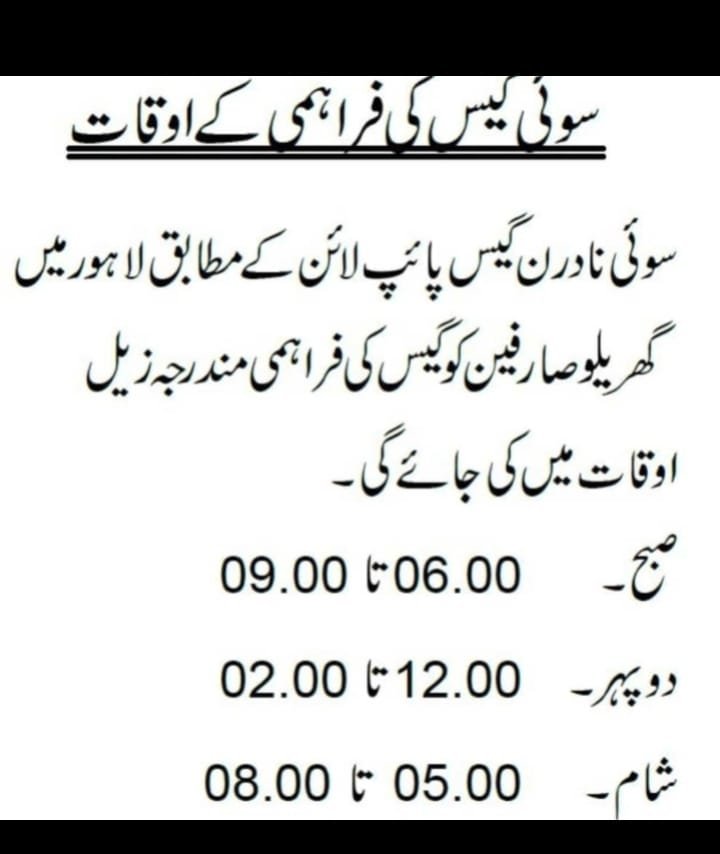
    Sui Northern Gas Pipelines Limited (SNGPL) has introduced a fresh schedule for supplying natural gas to residential consumers in Lahore.

    As per the latest notification, the provision of sui gas will be facilitated from 6:00 AM to 9:00 AM in the morning, from 12:00 PM to 2:00 PM during the afternoon, and from 5:00 PM to 8:00 PM in the evening.

    These timings appear to align with SNGPL’s decision to ensure gas availability primarily during meal times in the three major segments of the day. This revised timetable will take effect starting from August 18, 2023.

  • SSGC, SNGPL customers face load shedding and low gas pressure

    SSGC, SNGPL customers face load shedding and low gas pressure

    Many households in Pakistan served by the Sui Southern Gas Company (SSGC) and Sui Northern Gas Pipelines (SNGPL) are experiencing low gas pressure or no gas supply in the month of May. SSGC customers are facing seven to eight hours of load shedding, from 10 pm to 5-6 am, while SNGPL residential consumers are encountering a similar situation.

    The SSGC is facing a gas shortfall of 265 mmcfd as its demand is 1,165 mmcfd, but its supply is only 900 mmcfd, including 90 mmcfd of RLNG. The Sui Northern system has also lost 85 mmcfd gas for 12 days due to annual maintenance.

    A spokesperson from SSGC stated that the gas load shedding is being done for seven to eight hours to maintain the gas line pack so that the gas supply can be provided for 16-17 hours. Balochistan is receiving only 109 mmcfd of gas. The Sui Northern system’s situation is also vulnerable due to the suspension of supply from the Nashpa plant for 12 days.

    An official from Sui Northern stated that the gas companies are only providing gas for cooking times as per their agreement with residential consumers and not for 24 hours. However, the gas companies used to supply gas for 24 hours, which was not agreed upon by the domestic consumers.

    According to The News, the Punjab power sector is receiving 605 mmcfd RLNG, while the fertiliser sector is receiving 88 mmcfd. The power sector’s RLNG consumption has reduced to 605 mmcfd due to low temperatures. The government is receiving 900 mmcfd gas, but it has a purchasing capacity of 1,200 mmcfd. Pakistan is receiving RLNG of nine cargoes on long-term agreements, eight from Qatar and one from ENI.

    Despite the decline in RLNG prices to $12-13 per barrel in the international market, Pakistan LNG Limited (PLL) is reportedly unable to purchase spot cargoes due to a dollar liquidity crisis.

  • OGRA approves 74% hike in sui gas prices amid economic crisis

    OGRA approves 74% hike in sui gas prices amid economic crisis

    The Oil and Gas Regulatory Authority (Ogra) has approved an increase in the price of natural gas of up to 74 per cent at a time when the country’s people are struggling to make ends meet owing to rising inflation.

    According to specifics, the Sui Southern Gas Company (SSGC) and the Sui Northern Gas Pipelines Ltd. (SNGPL) would each be permitted to raise gas rates by up to 74.42 per cent and 67.75 per cent, respectively.

    Ogra’s decision will be implemented after the approval of the federal government. If the federal government does not approve it within 40 days, the decision will be implemented automatically.

    The oil and gas regulator has okayed increases of Rs406.28 and Rs469.28 per million British thermal units (mmBtu) for SNGPL and SSGC, respectively.

    OGRA further said that the average gas price for SNGPL would reach Rs952.17 per unit from the current price of Rs545.89 per mmBtu, while that of SSGCL would reach Rs1,161 per unit from the current Rs692.63 per mmBtu.

    LPG price hike

    Earlier, the prices of liquefied petroleum gas (LPG) were increased by Rs5 per kg without a notification from OGRA.

    The LPG price has now jumped to Rs260 per kg from Rs255 after an increase of Rs5. Meanwhile, the prices of domestic and commercial cylinders increased by Rs60 and Rs230, respectively.

    The gas is available for Rs270 per kilogramme in Murree, while its price exceeds Rs300 per kilogramme in Gilgit-Baltistan and Skardu.

  • Domestic users to experience 16-hour gas load shedding during winter

    Domestic users to experience 16-hour gas load shedding during winter

    Due to the requirement for a $37 per mmbtu subsidy, the federal government is unable to guarantee that domestic customers of both Sui Northern Gas Pipeline Limited (SNGPL) and Sui Southern Gas Company (SSGC) will have uninterrupted access to eight hours of gas per day during cooking hours in the upcoming winters.

    A parliamentary panel was informed on Thursday by Captain Muhammad Mahmood (retired), Additional Secretary (Incharge) for the Ministry of Energy’s Petroleum Division, that neither the government nor the gas firms had the resources to severely subsidise the domestic gas consumers. The secretary said, “We can’t supply gas at $3 per MMBtu against a current purchase of $40 per MMBtu.”

    He made it clear that every effort will be taken to guarantee household gas supply for three hours in the morning, two hours in the afternoon, and three hours in the evening.

    In response to a query, he stated that the Sindh gas load-shedding was a result of the allocation of gas between home and industrial uses. He claimed that in Sindh, 60 per cent of gas was delivered to industry and the remaining 40 per cent to homes and other sectors, in contrast to KP where 80 per cent of gas was supplied to domestic users.

    Imran Maniar, the managing director (MD) of SSGC, informed the committee that Balochistan contributed 110 mmcfd while Sindh produced 740 mmcfd.

    He claimed that due to the 10 per cent annual depletion of domestic gas reserves and the 100 per cent dependency on imported gas in ten years, there will be no gas in the upcoming winter.

    He stated that it was anticipated that in three to four years, LNG prices would decline significantly and the government would be able to finish building the new LNG facilities as planned.

    Due to the high expense of security and the country’s continued political unrest, new corporations were not expressing interest in oil and gas exploration. “The investors are waiting as they would not invest when new general election will be held next year,” he said.

    He added that due to sanctions, the anticipated import of gas from Russia or Iran was not feasible.

    In response to a question, the secretary stated that the cost of storing gas in the nation was high and that industrialised nations lacked such facilities; nonetheless, during recent gas crises, Germany and England began developing gas storage facilities.

    The previous administration authorised a draught of a new Pakistan Upstream Regulatory Authority to separate policy from regulation, according to Director General (DG) PC, Petroleum Division Kashif Ahmed.

    Provinces disagreed with a few of the proposed regulatory authority’s provisions, though. He stated that the authority would have four members from four different provinces and one vice chairman. “After getting approval from the competent forum, it will take three to four years for the establishment of the regulator for the upstream sector,” he added.

  • Severe gas shortage affect residents of Rawalpindi

    Severe gas shortage affect residents of Rawalpindi

    Since most of Rawalpindi has been without gas for more than a week, the Sui Northern Gas Pipelines Limited (SNGPL) has failed to supply natural gas for domestic users, even during the busiest summer months, and nothing has been done to remedy the situation.

    On Friday, there were long queues of customers waiting to purchase ‘naan’ at exorbitant prices at all ‘tandoors’ and hotels.

    According to Mukhtar Shah, General Manager of Sui Northern Gas Pipelines Limited (SNGPL) for the Rawalpindi region, there is a gas shortage for consumers as a result of the wet weather. In cloudy weather, there is a significant difference between supply and demand, he claimed. He claimed that we are working to make natural gas available everywhere.

    On the other hand, under the condition of anonymity, a few key post officers from SNGPL told The News that the relevant department had cut off natural gas to domestic users in order to benefit nearby businesses and CNG stations. According to the sources, the officers claimed that corrupt officers were profiting greatly from it.

    The LPG vendors were also making money by offering gas in black for an exorbitant Rs300 per kilogramme. The price of LPG gas has also increased by the government and been set at Rs260 per kilogramme, but dealers have been taking full advantage of the current circumstance and selling the commodity in black.

    Gas has not been available for more than a week in the following areas:

    Sher Zaman Colony, Shah Faisal, Shah Khalid, Adiala Road, Qasim Market, Misriyal, Chakra, Satellite Town, Jhanda, Mareer Hasan, Saleha Street, Munawar Colony, Mubarak Lane, Dhoke Juma, New Lalazar, Tahli Mohri, Defence Road, Dhoke Kala Khan, Gulistan Colony, Naik Alam, Dhoke Manga Khan, Kashmir Colony, Gulshanabad, Dhamyal, Quaid-e-Azam Colony, Scheme-III, Dhok Ratta, Arya Mohalla, Tipu Road, Lalkurti, Tench Bhatta, Jan Colony, Dhoke Ratta, Dhok Munshi, Rehmatabad, Dhoke Banaras, Sadiqabad, Muslim Town, Tipu Road, Raheemabad and several other localities.
  • OGRA lowers RLNG cost by $4.6 per MMBTU

    OGRA lowers RLNG cost by $4.6 per MMBTU

    Re-gasified liquefied natural gas (RLNG) will cost consumers of public gas utilities 20.57 per cent less in July 2022 than it did in June, according to a notification from the Oil and Gas Regulatory Authority (Ogra).

    The government has set the RLNG price for Sui Northern Gas Pipelines Limited’s (SNGPL) customers at $17.4603 per metric million British thermal units (MMBTU), according to a notification released on Friday.

    Compared to the rate of $20.7691 per MMBTU for June 2022, the new price is $3.3088 less. The general sales tax (GST) is not included in the weighted average sale price.

    The RLNG price will be $17.9575 per MMBTU for Sui Southern Gas Company (SSGC) customers as opposed to the SNGPL consumer price, which represents a $4.6501 per MMBTU decrease for July over $22.6076 per MMBTU.

  • 40-50 per cent hike expected in gas tariff

    40-50 per cent hike expected in gas tariff

    The government plans to hike the system gas tariff by up to 50 per cent as part of its efforts to gain access to the International Monetary Fund (IMF) bailout.

    The Ministry of Energy anticipates the Oil and Gas Regulatory Authority (OGRA) determining the revenue requirement for the coming fiscal year in June. As per The News, which cited sources, the tariff increase will take effect on July 1, 2022.

    Sui Southern Gas Company Limited (SSGC) and Sui Northern Gas Pipelines Limited (SNGPL), according to an Energy Ministry official, have suffered massive combined losses of Rs550 billion in recent years.

    Both are losing money since the system gas rate has not been raised in a long time. SNGPL is expected to lose Rs350 billion, while SSGC is expected to lose roughly Rs200 billion.

    OGRA will now calculate the system gas tariff under the modified OGRA statute. The IMF has encouraged the government to ensure that gas firms do not lose money as a result of the gas tariff’s stagnation, as well as to follow the modified OGRA law in its entirety.

    It’s worth noting that the government raised the price of petroleum goods by Rs30 per liter last week after the IMF stated that the bailout package would not be resumed unless the country ended petroleum product subsidies.