Tag: State Bank of Pakistan

  • Pakistan Stock Exchange surpasses 49,000 points, reaches new high since 2017

    Pakistan Stock Exchange surpasses 49,000 points, reaches new high since 2017

    The Pakistan Stock Exchange (PSX) witnessed a remarkable surge on Thursday as it extended its bullish momentum, crossing the 49,000 level and reaching its highest point in six years. This impressive rally was fueled by positive economic data and a series of favourable factors contributing to investor confidence.

    During the intraday trade, the PSX’s benchmark KSE 100-share Index experienced a significant gain of 560.20 points, amounting to a 1.15 per cent increase, ultimately settling at an impressive 49,324.50 points. This milestone represents the index’s highest level since June 9, 2017, marking a notable achievement for Pakistan’s financial markets.

    The impressive growth of the benchmark index has been sustained since Pakistan signed a staff-level agreement with the International Monetary Fund (IMF) for a substantial $3 billion Standby Agreement. Since the agreement’s signing, the market has witnessed an extraordinary upswing, with the benchmark index having gained an impressive 7,871 points.

    Market analysts and experts have identified multiple reasons behind the consistent surge in the market. Among these factors is the State Bank of Pakistan’s (SBP) decision to maintain the policy rate, effectively keeping the status quo. The SBP’s prudent approach to monetary policy has contributed to stability and encouraged investors to take bullish positions in the market.

    Furthermore, the positive economic data, both from domestic and international sources, has also played a pivotal role in bolstering investor confidence. With indicators pointing towards a strengthening economy, investors have been encouraged to increase their stakes in the market, resulting in the record-breaking performance of the Pakistan Stock Exchange.

    As the market continues to show resilience and upward momentum, financial experts and policymakers are cautiously optimistic about the future outlook. They emphasise the importance of sustaining a positive economic trajectory through sound policy measures and a vigilant approach to market dynamics.

    Market participants and investors are closely monitoring the developments and will likely adjust their strategies in response to any shifts in economic indicators and policy decisions. The surge in the Pakistan Stock Exchange serves as a testament to the country’s economic potential and its ability to attract local and foreign investors to participate in its thriving financial markets.
  • Gold price drops by Rs2,000 per tola as Pakistani rupee gains ground against US dollar

    Gold price drops by Rs2,000 per tola as Pakistani rupee gains ground against US dollar

    The gold price in Pakistan experienced a significant decline of more than Rs2,000 per tola following the appreciation of the local currency against the US dollar in the interbank market.

    According to the data released by the All-Pakistan Sarafa Gems and Jewellers Association (APSGJA) on Wednesday, the price of 24-carat gold witnessed a decrease of Rs2,400 per tola and Rs2,058 per 10 grammes, settling at Rs222,100 and Rs190,415, respectively.

    Conversely, the international market recorded a $12 increase in the price of gold, bringing it to $1,972.

    The fluctuating gold rate in Pakistan can be attributed to ongoing political and economic uncertainties and high inflation, prompting individuals to seek gold as a safe investment and hedge during such times.

    As per the data provided by the association, the price of silver remained constant at Rs2,750 per tola and Rs2,357.68 per 10 grammes.

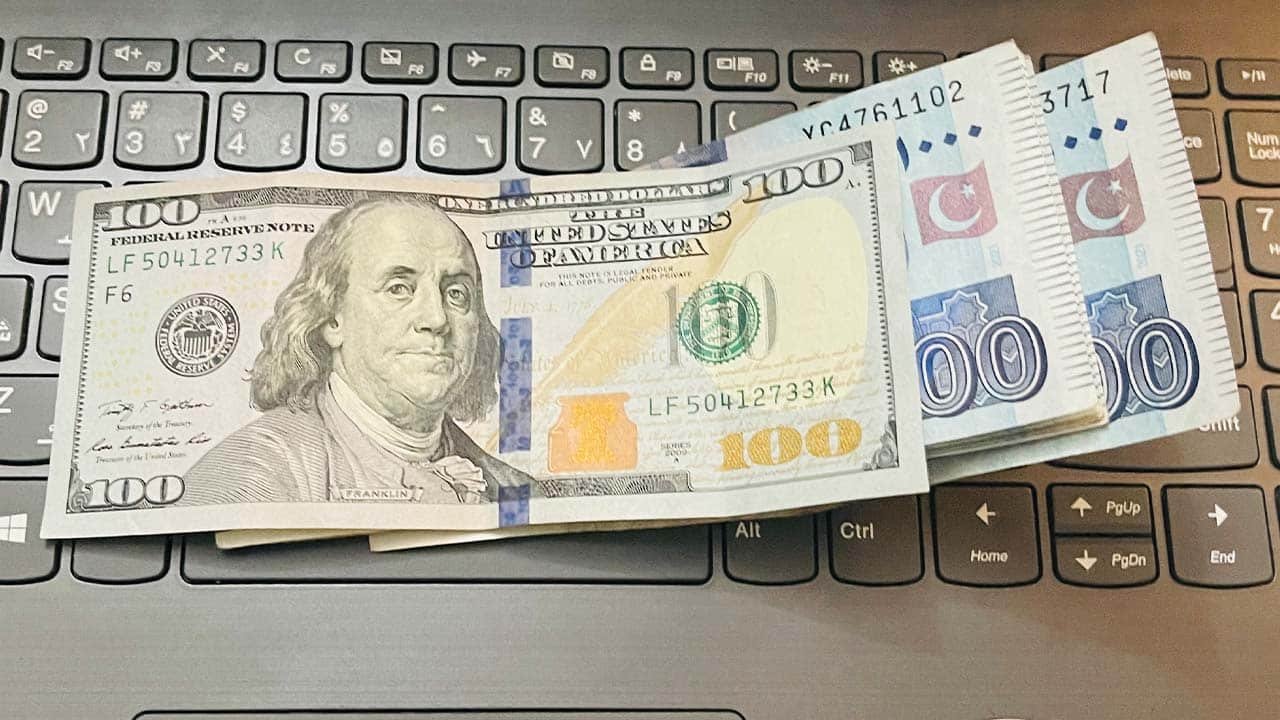
    In parallel, the local currency demonstrated a positive trend against the US dollar in the interbank market today, appreciating by Rs1.48 or 0.52 per cent. The State Bank of Pakistan (SBP) reported that the rupee closed at Rs287.04 against the dollar.

  • PKR to USD: Pakistani rupee drops to Rs288.52 against US dollar

    PKR to USD: Pakistani rupee drops to Rs288.52 against US dollar

    The Pakistani rupee continued its downward trend for the eighth consecutive session, experiencing a depreciation of 0.21 per cent against the US dollar on Tuesday. According to the State Bank of Pakistan (SBP), the rupee closed at Rs288.52, marking a decrease of Re0.6.

    Over the past eight trading sessions, the currency has lost nearly 4.2 per cent or Rs12.02 against the US dollar. On the previous day, Monday, the rupee also suffered losses against the US dollar for the seventh successive session, depreciating 0.39 per cent and settling at 287.92 in the inter-bank market.

    In a significant development, the National Electric Power Regulatory Authority (NEPRA) approved an increase in the basic electricity tariff by Rs7.5 per unit from July 1, 2023, across the country. The chairman’s remarks indicated that this decision was influenced by the election year, and political choices were being made to alleviate the burden on 68 per cent protected consumers.

    On the international front, the US dollar gained strength ahead of three major central bank meetings scheduled for the week. Meanwhile, the euro faced challenges, hitting a two-week low on Tuesday due to a deteriorating economic situation in the eurozone, which complicated the bloc’s interest rate outlook despite the European Central Bank’s (ECB) hawkish stance.

  • US dollar surges against Pakistani rupee for eighth consecutive day in interbank market

    US dollar surges against Pakistani rupee for eighth consecutive day in interbank market

    The US dollar has been steadily appreciating against the Pakistani rupee for eight consecutive days, showing a continued upward trend in its value. On Tuesday, the currency further strengthened in the interbank market.

    At the start of the daily trading session in the interbank market, the American currency gained Rs1.8, reaching a value of Rs289 against the local currency. Over the course of the last eight days, the US dollar has gained Rs12.50 against the rupee in the interbank market.

    Interestingly, on Monday, despite receiving financial support from the International Monetary Fund (IMF) and other friendly countries, the Pakistani rupee depreciated even further against the US dollar.

    According to the State Bank of Pakistan (SBP), the dollar’s rate increased by Rs1.1 on Monday, with a closing rate of Rs287.92. In comparison, it had closed at Rs286.81 on Friday, showing a 0.39 per cent decline in the value of the rupee against the US dollar.

  • Gold price increases by Rs6,200 to Rs221,000 per tola

    Gold price increases by Rs6,200 to Rs221,000 per tola

    On Tuesday, the gold price in Pakistan experienced a significant increase, aligning with the international market trends and the depreciation of the Pakistani rupee.

    The All-Pakistan Sarafa Gems and Jewellers Association (APSGJA) reported that the price of 24-carat gold rose by Rs6,200 per tola and Rs5,316 per 10 grammes, reaching Rs221,000 and Rs189,472 respectively.

    Simultaneously, the global market witnessed a $10 rise in the price of gold, settling at $1,967 per ounce.

    In contrast, the prices of silver per tola and 10 grammes remained unchanged at Rs2,650 and Rs2,271.94 respectively. The gold rate in Pakistan has shown volatility in recent times due to ongoing political and economic uncertainty, coupled with high inflation.

    Read more: Pakistan’s current account surplus soars to $334 million in June

    Furthermore, the Pakistani rupee displayed weakness against the dollar in the interbank market on Tuesday, depreciating by Rs3.78, as per data from the State Bank of Pakistan.

  • Pakistan’s foreign exchange reserves rise to $8.4 billion

    Pakistan’s foreign exchange reserves rise to $8.4 billion

    Foreign exchange reserves held by the State Bank of Pakistan (SBP) have surged by over $4 billion following a deposit of $1.2 billion from the International Monetary Fund (IMF).

    As per data shared by the central bank, Pakistan has also received $1 billion from the UAE and $2 billion from Saudi Arabia, resulting in a significant increase in the SBP’s foreign exchange reserves, which now stand at $8.4 billion.

    During a televised address earlier today, Finance Minister Ishaq Dar stated that Pakistan’s foreign exchange reserves are projected to reach approximately $13-$14 billion by July 14.

    He emphasised that Pakistan is experiencing a resurgence in development and prosperity. Minister Dar acknowledged the instrumental role played by Prime Minister Shehbaz Sharif in reaching an agreement with the IMF, highlighting the unwavering support provided by the economic team throughout the intricate process.

    It is noteworthy that the International Monetary Fund granted approval for a $3 billion loan to Pakistan, subsequent to the signing of a staff-level agreement last month.

  • Pakistan receives $1.2 billion deposit from IMF

    Pakistan receives $1.2 billion deposit from IMF

    The State Bank of Pakistan (SBP) has received a substantial deposit of $1.2 billion from the International Monetary Fund (IMF), offering a glimmer of hope to the economically strained nation that has been on the verge of default for an extended period.

    This deposit follows the approval by the IMF’s executive board, during a late-night session, of a nine-month programme under a $3 billion Stand-By Agreement (SBA). The agreement, reached after arduous negotiations over fiscal discipline lasting eight months, marks a significant milestone for Pakistan.

    Last month, Pakistan successfully reached a staff-level agreement with the IMF, securing a short-term pact that exceeded expectations in terms of funding for the country, which is home to 230 million people. This achievement is of particular importance given the acute balance of payments crisis that Pakistan faced, with its central bank reserves barely sufficient to cover a month’s worth of controlled imports.

    During a televised address from Islamabad, Finance Minister Ishaq Dar expressed that Pakistan will receive the remaining balance of the agreed amount following two reviews. The first review is scheduled for November, while the second review will take place in February.

    These reviews are crucial milestones that need to be met to ensure the disbursement of the funds by the IMF, thus supporting Pakistan’s pursuit of economic stability.

  • US dollar surges by Rs1.90, closes at Rs279.80 against Pakistani rupee

    US dollar surges by Rs1.90, closes at Rs279.80 against Pakistani rupee

    According to the State Bank of Pakistan, the US dollar demonstrated further appreciation against the Pakistani rupee in the interbank market on Monday.

    The American currency gained Rs1.90 against the local currency, closing at a rate of Rs279.80, compared to the previous day’s closing rate of Rs277.90.

    Concurrently, in the open market, the dollar is being traded at Rs283. It is noteworthy that the Pakistani rupee had experienced a gain of Rs10.58 over the course of last week.

    Anticipating future trends, Malik Bostan, the President of the Exchange Companies Association of Pakistan (ECAP), expressed his belief that the value of the dollar will continue to decrease in the upcoming days.

    Furthermore, the price of gold in Pakistan also experienced a slight increase at the beginning of the week, corresponding to the devaluation of the rupee against the dollar.

    As per the data released by the All-Pakistan Sarafa Gems and Jewellers Association (APSGJA), the price of 24-carat gold rose by Rs800 per tola and Rs686 per 10 grammes, reaching Rs209,000 and Rs179,184 respectively.

  • Remittances in June 2023 decline by 21.4%, hitting $2.2 billion: SBP

    Remittances in June 2023 decline by 21.4%, hitting $2.2 billion: SBP

    In June 2023, remittances experienced a year-on-year decrease of 21.4 per cent, falling to the $2.2 billion mark compared to $2.8 billion in June 2022, according to data released by the State Bank of Pakistan (SBP).

    Simultaneously, cumulative remittances sent by overseas Pakistanis for the 12-month period ending on June 30, 2023, diminished to $27 billion, reflecting a 14 per cent decline in the financial year 2022-23 when compared to the record-high inflows of $31 billion reported in the previous financial year.

    In terms of monthly trends, remittances received by the country from overseas Pakistanis increased by 3.85 per cent from $2.102 billion in May to $2.18 billion in June 2023.

    The primary sources of remittance inflows during June 2023 were Saudi Arabia ($515 million), the United Kingdom ($343 million), the United Arab Emirates ($325 million), and the United States ($272 million).

    Moreover, proceeds from expatriates residing in European Union countries showed an 11 per cent month-on-month increase in June 2023, amounting to $272 million. Similarly, remittances from other GCC countries (Bahrain, Kuwait, Qatar, and Oman) totaled $271.9 million.

    The decline in inflows reported for FY23 can be attributed to various austerity measures implemented by the coalition government and the banking regulator. These measures included high taxes on cash held in banks and exchange companies, aimed at increasing remittance collections.

    Import restrictions, coupled with unfavorable domestic economic conditions during FY23, had a detrimental impact on remittance inflows. These factors resulted in reduced demand and led to a diversion of a significant portion of expatriate inflows towards informal currency exchange channels.

    Fundamentally, the contraction in imports caused by policy measures, along with demand suppression, exchange rate depreciation, and the preference for undocumented channels to maximise profits, all contributed to curbing remittance inflows during FY23. As a consequence, the expatriate Pakistani community residing in various countries faced inadequate facilitation.