Tag: State Bank of Pakistan

  • Here is why some banks are charging Rs2.50 at ATM withdrawals

    Here is why some banks are charging Rs2.50 at ATM withdrawals

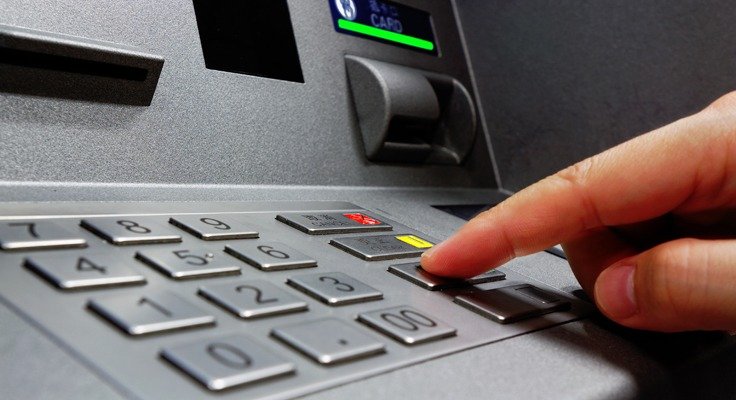
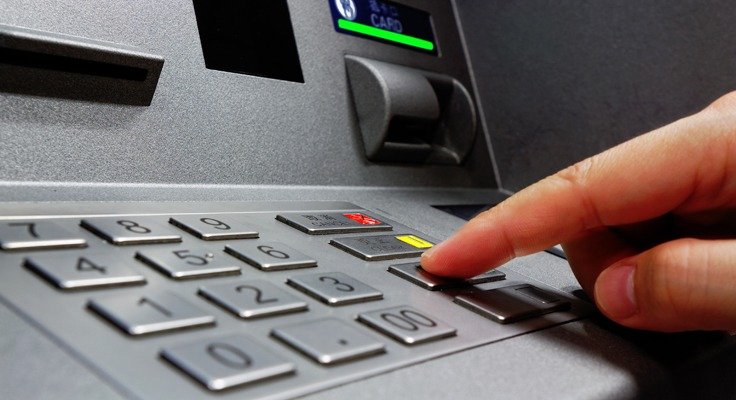
    Many people have been charged Rs2.50 at Automated Teller Machines (ATM), creating buzz on social media. But what is it all about?

    As per details of the new charges, the State Bank of Pakistan (SBP) has not issued any directives to commercial banks to charge against the service of transaction receipts.

    But one of the largest banks in the country, Habib Bank Limited (HBL), confirmed that the initiative is part of a “GO GREEN” exercise by 1Link to urge customers to avoid unnecessary use of paper and keep the environment clean.

    1Link, which provides ATM services to the banks in Pakistan, came up with a unique justification in their official statement.

    Ther payment switch operator stated that the SMS Service is free and could be used as an alternative. Many banks charge an amount ranging from Rs50 to 75 + tax on a monthly basis. Notwithstanding, the central bank directed them to make SMS services free.

    The fee of Rs2.5 on printing receipts has been implemented by some banks. One after another, banks will likely impose the charges on the customers.

    Some banks might use it as a marketing strategy to their advantage and refrain from this practice.

    What are your views on this? Share with us in the comments below.

  • Expats remitting around $7m per day, PM told

    Expats remitting around $7m per day, PM told

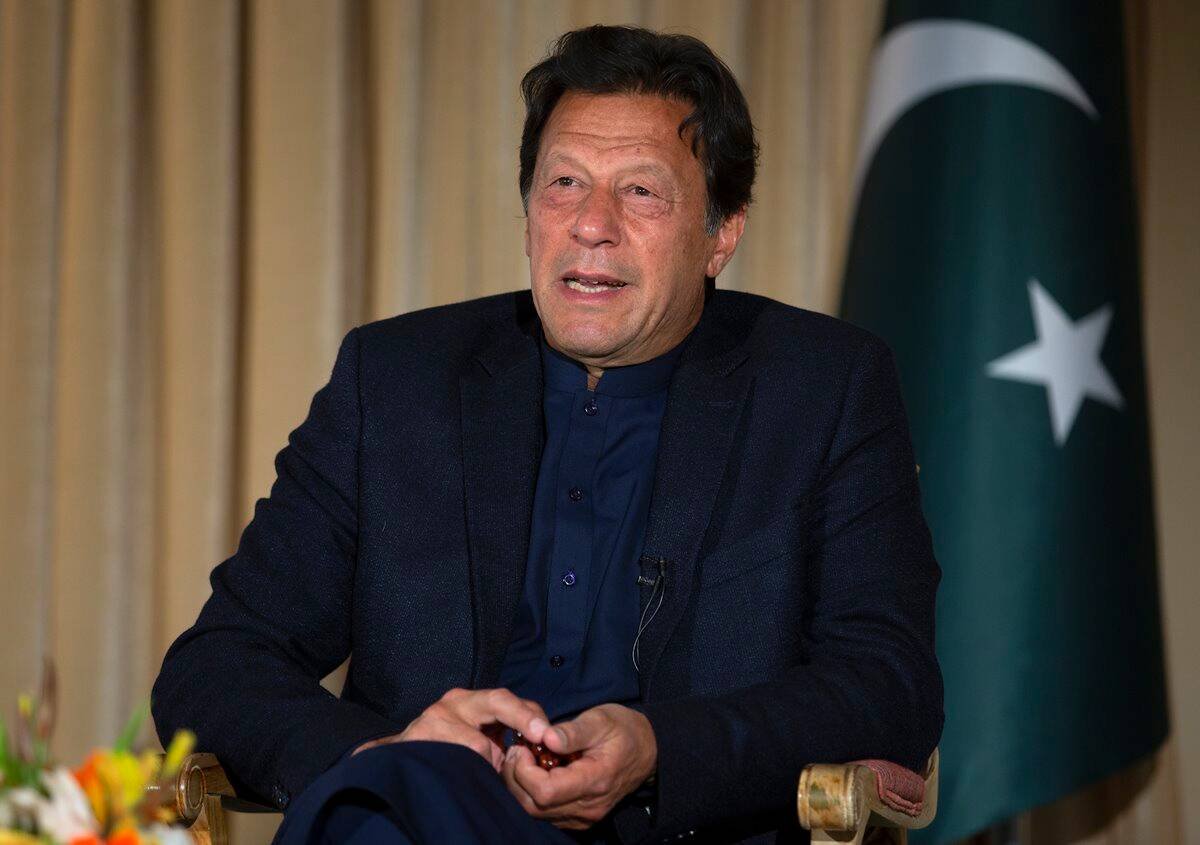
    Prime Minister (PM) Imran Khan said that 82,728 Roshan Digital Accounts (RDA) opened so far in 97 countries of different continents by the overseas Pakistanis.

    $436 million through these facilities have been remitted in digital accounts. On average, Pakistani expatriates are remitting around $6 to $7 million every day.

    The prime minister was presiding over a meeting to review the progress of the facilities made available for the overseas Pakistanis under the Roshan Digital Account.

    The facility was introduced under the vision of PM Imran and received encouraging response from overseas Pakistanis.

    The expatriates from Saudi Arabia (KSA), The United Arab Emirates (UAE), United Kingdom (UK), and the United States of America (USA) had taken lead in utilising the facility.

    The participants were apprised of the cooperation of ministries of Foreign Affairs and Finance, Overseas Pakistanis and Human Resource Development as well as the Federal Board of Revenue (FBR) in the success of Roshan Digital Account.

    The Roshan Digital Account (RDA) is the brainchild of the government of Pakistan and has been initiated by the State Bank of Pakistan.

    The RDA initiative aims at connecting the diaspora with Pakistan financially by facilitating their remittances and will operate in collaboration with eight leading commercial banks operating in Pakistan.

    The eight leading banks have been providing innovative banking solutions for millions so that they can open an account in any bank through an entirely digital and online process; without visiting a bank branch, embassy or consulate. All they need to do is submit the basic set of information and documents.

  • Auto loans in Pakistan increased by Rs41 billion in Dec 2020

    Following a decrease in the interest rates and the revival of business after the pandemic-induced lockdown, auto loans increased by 19 per cent, reaching Rs41 billion in December 2020.

    The figures issued by the State Bank of Pakistan show that the car loans in December 2019 were recorded at Rs219 billion, which increased to Rs256 billion during the corresponding period in 2020.

    It is also reported that the growing demand for 1300cc passenger vehicles is the key factor behind the surge in these loans.

    According to media reports, the newly launched Toyota Yaris is responsible for the surge in car loans. Toyota Yaris has outsold Honda City and Civic combined.

    Another key driver of the increase in loans is the lowered interest rates. The State Bank of Pakistan had reduced the interest rates by 625 basis points to 7 per cent in 2020. Additionally, a decrease in the rates of soft interests meant lesser instalments for car financing programmes.

    It seems like a car price hikes by the automakers in 2020 had the least impact on the rising demand for cars. With new players entering the market before the expiration of the Auto Development Policy (ADP) 2016-2021, the demand for cars is likely to surge even more.

  • Has State Bank really restricted ATM withdrawal limit to Rs1,000?

    Has State Bank really restricted ATM withdrawal limit to Rs1,000?

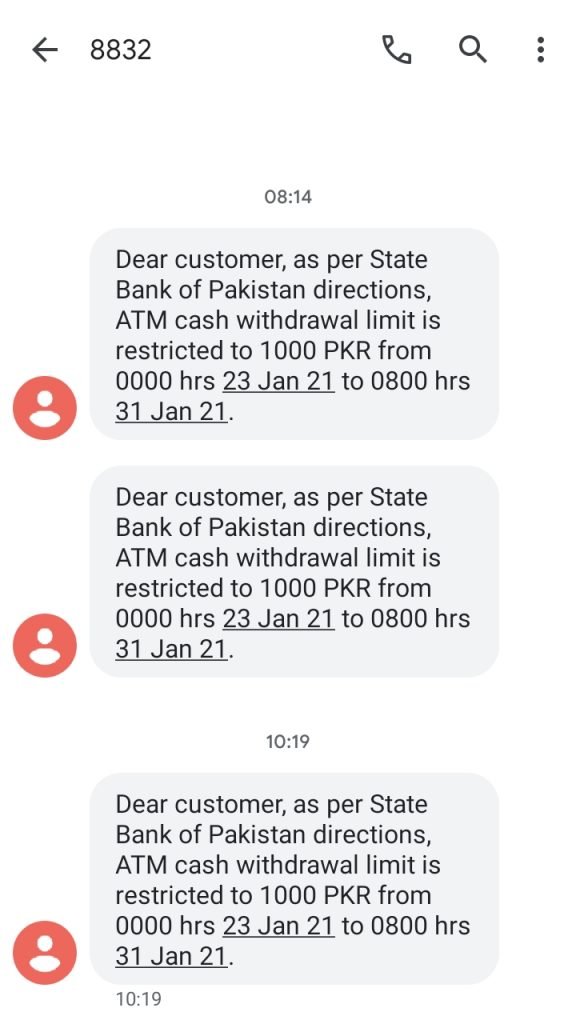
    People are receiving an alleged message from the State Bank of Pakistan about restrictions on ATM cash withdrawals till the end of the month.

    The peculiar message that you may receive from ‘8182’ or ‘8832’ will read: “Dear Customer, as per State Bank of Pakistan directions, ATM cash withdrawal limit is restricted to 1000 PKR ” till Jan 31.

    However, the central bank has distanced itself from these messages. It said the decision to set withdrawal limit is taken by the banks, not the SBP.

    Meanwhile, the SBP also sent a message to the banks, asking them to “send appropriately worded messages” to their consumers to curb the flow of misinformation.

    In a the message to the banks, the SBP said that it has received “multiple reports…that customers are receiving messages with the context that SBP has put some kind of restrictions on ATM cash withdrawals”.

    “The SBP has not given any such instructions to the financial institutions,” the statement clarified.

    “In this regard, kindly make sure to send appropriately worded messages to your customers on urgent basis, reassuring them regarding this false spread of messages,” the SBP clarification read.

  • Foreign investment falls by 30%

    Foreign investment falls by 30%

    Foreign direct investment (FDI) fell by 30 per cent in the first half of the current fiscal year (H1FY21), according to data released by the State Bank of Pakistan (SBP).

    According to a report based on the data compiled by a local media outlet, Pakistan received $952 million in foreign investment during July-December FY21 compared to $1.357 billion in the corresponding period last year.

    In addition to the damage done by the pandemic, the impact of heavy outflow from the portfolio also played a key role in making the balance sheet poorer in the first half of FY21. The data shows that the outflow during July-December was $244m compared to a net inflow of $18.8m in the same period last year.

    The breakup further shows that China made 38pc contribution to the overall $952m FDI the country received in July-December period of FY21. However, the FDI inflows from China also contracted to $359m in the period under review compared to $396m in the same period of last fiscal year.

    The other significant contributions were from the United States and UK at $65m and $63m, respectively, both improved from $44m and $58m in the same period of last fiscal year. The United Arab Emirates (UAE) has started disinvesting; however, in July-December FY21, the inflow was $16.3m.

    The country received the highest foreign investment of $261m in electricity, gas, steam and air conditioning supply sectors. While an inflow of $137m was noted in financial and insurance sectors.

  • SBP reserves jump $261m to $13.4bn

    SBP reserves jump $261m to $13.4bn

    The State Bank of Pakistan has witnessed a 1.98 per cent increase in its foreign exchange reserves after an influx of $261 million during the week ending on December 31, 2020.

    According to the data issued by the central bank on Thursday, the current exchange reserves stand at $13.4 billion as of now. The state-run news agency, APP, reported that overall liquid foreign currency reserves, including net reserves held by the banks, SBP excluded, stood at $20,512.1 million.

    Net foreign reserves held by commercial banks clocked in at $7.09 billion. According to the State Bank, the increase came on the back of official inflows of the government.

    On Wednesday, the Pakistan Stock Exchange (PSX) gained over 500 points to cross the 45,000-point threshold for the first time since May 2018. According to the reports, “Exploration & production and oil & gas marketing sectors rebounded strongly, whereas cement and fertilizer sectors continued with previous day’s positive momentum.”

    “International crude oil prices jumped significantly on the conclusion of agreement among OPEC+ countries, which became the basis for an uptick in E&P stocks. Cement sector leaped on the expectation of an increase in cement price in the northern region, while banking sector contributed positively in anticipation of annual results.”

  • Sixth consecutive month: Remittances remain over $2 billion

    Sixth consecutive month: Remittances remain over $2 billion

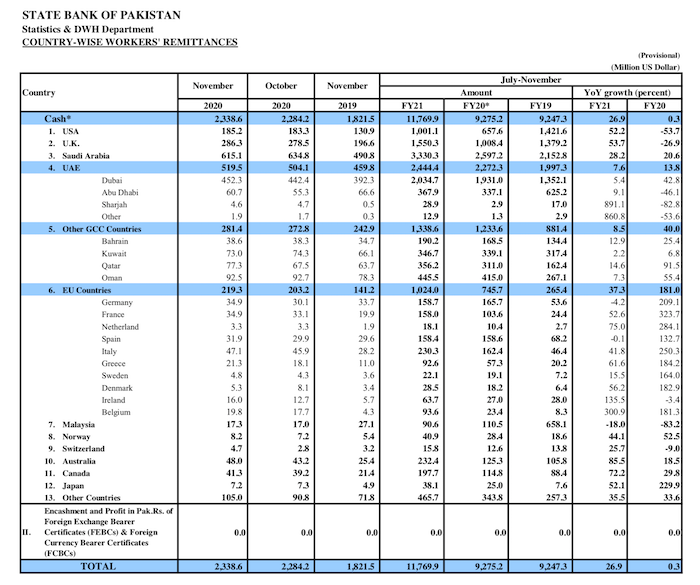
    Pakistan has maintained a strong momentum in workers’ remittance for the sixth consecutive month in November with over $2 billion, the State Bank of Pakistan (SBP) has reported.

    Workers’ remittance increased 28.4% year-on-year in November 2020, pushing the cumulative flows to $11.8 billion during the July-November FY21 with a rise of 26.9% compared to same period last year.

    “This significant growth reflects continued government and SBP efforts to formalise remittances under Pakistan Remittances Initiative (PRI), growing use of digital channels amid limited international travel, orderly exchange market conditions and improved global economic activity,” said the central bank.

    The top four countries that contributed to the highest inflows are Saudi Arabia ($3.3 billion), United Arab Emirates ($2.4 billion), United Kingdom ($1.6 billion) and the United States ($1 billion).

  • Remittances rise to record single month high of $2.77 billion in Pakistan

    Remittances rise to record single month high of $2.77 billion in Pakistan

    Remittances rose to $2.77 billion in July, which is the highest ever level of remittances in a single month in Pakistan, according to data released by the State Bank of Pakistan (SBP) on Monday.

    That represents a year-on-year growth of 36.5pc when compared with July 2019, and 12.2pc when compared to June 2020. Last month, remittances were recorded at $2.47 billion, which the SBP had dubbed as ‘historic’ at the time.

    Most of the remittances in July were received from Saudi Arabia, at $821.6 million; followed by UAE, at $538.2 million; UK, at $393.9 million; and the US, at $250.6 million.

    The central bank also noted that the growth rate in remittances compared to the same month in the previous year is around twice as high as the Eid-ul-Adha related seasonality typically experienced over the last decade.

    “Given the impact of COVID-19 globally, this increase in worker’s remittances is encouraging,” the SBP said.

    Overall, there are two main factors that explain the rise in remittances, along with some minor reasons.

    The first is that it seems the use of official channels to send remittances has increased, and there has been a decline in traditional hawala and hundi methods of sending cash home.

  • Why do businesses not grow in Pakistan?

    Why do businesses not grow in Pakistan?

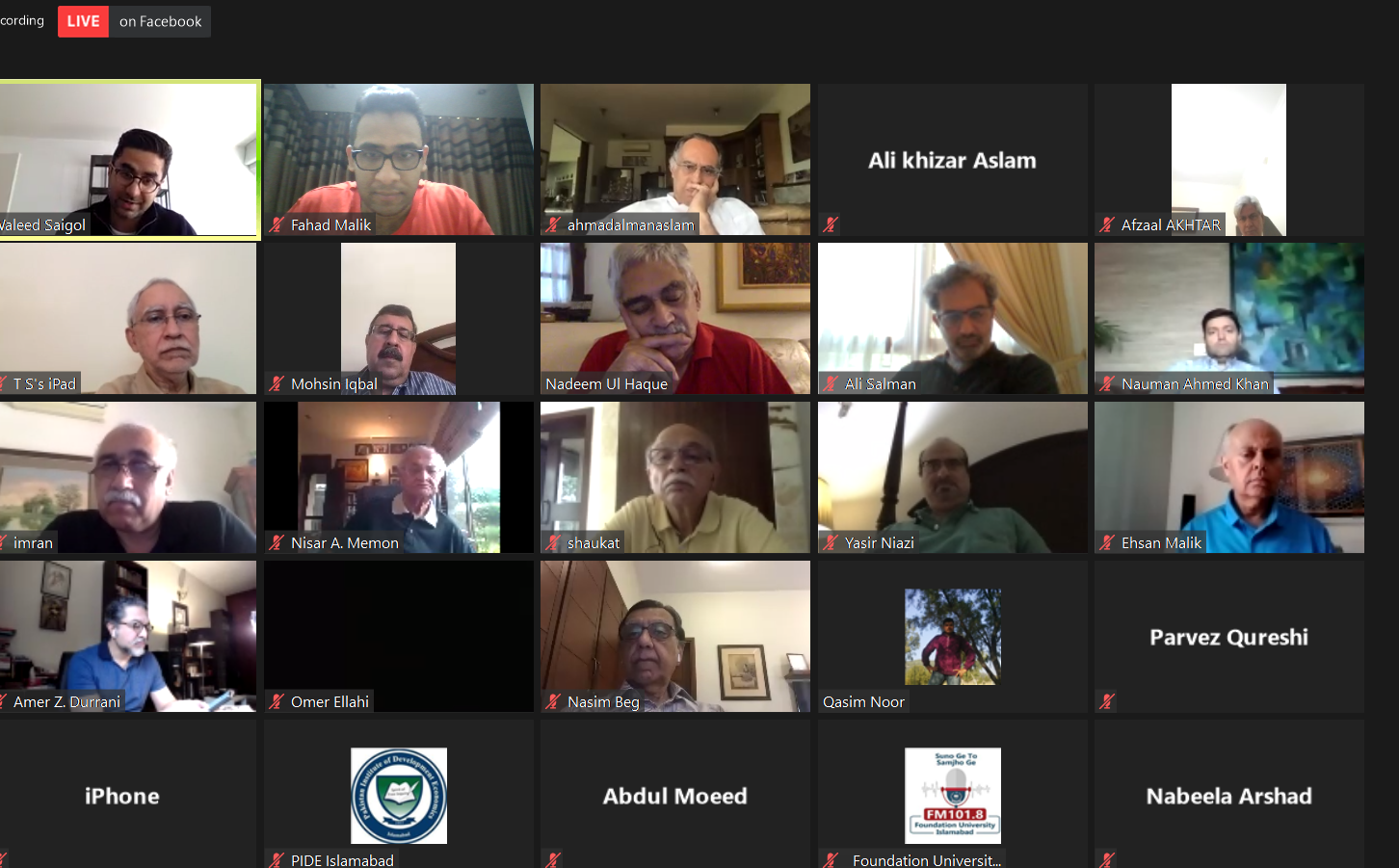
    CEO Maple Leaf Capital, Waleed Saigol, has said that businesses grow in Pakistan but at a slow pace, and the problem lies within the policies and mindset of the country’s power groups.

    Speaking at a virtual conference hosted by Pakistan Institute of Development Economics (PIDE) on Thursday, with prominent businessmen, including over a hundred chief executive officers (CEOs) and leaders of the business community, in attendance to discuss “Why Businesses Do Not Grow in Pakistan?”, he said that ironically, Pakistan had developed nuclear bombs under pressure, however, state institutions “didn’t prioritise economic and business growth”.

    “The role of media is also questionable… our news anchors do not bring these issues to the public, besides, we as a nation like to discuss controversies to malign each other. If we want to see business growth in Pakistan, we have to sort out interference by the country’s institutions,” Saigol maintained.

    In response to Saigol, Dr Nadeemul Haq, the vice chancellor of PIDE, said, “Undoubtedly, Pakistan is a talent-repellent state. All our talented people go and serve in big companies around the world rather than working here.”

    While moderating the conference, Dr Haq took the conversation to Alman Aslam, who is a business advisor to local and foreign companies.

    “We need to understand why all this is happening in Pakistan. A businessperson here has to do many things that have nothing to do with business growth, but for the mere survival of his or her company,” Aslam said.

    “Company owners are harassed by corrupt tax collection authorities of Pakistan,” he alleged, adding that it reminded him of centuries-old tax collection practices.

    “The court system is flawed, take a matter to court and you will not get justice in 20 years. Besides, how can private companies excel when the government is intervening in every business? We have authorities like the Lahore Development Authority (LDA) that bully and interfere in the matters of private companies. If you want companies to grow, just allow them to grow.”

    An argument was raised in the discussion that Pakistani businessmen cannot think globally, in response to which Saigol said, “We cannot think globally because we are not allowed to think globally.”

    “The illogical policies of the government don’t let businessmen make viable investments here in Pakistan or anywhere abroad. Similarly, no foreign company will come here to invest. It took Lucky Cement Group two years to send $50 million to Africa to set up their plant,” Saigol added, lamenting that to transfer $1 million, you needed an approval from the State Bank of Pakistan (SBP), and to make a payment of more than $10 million, you needed an approval from the Economic Corridor Committee (ECC).

    “Just imagine the level of regulations here,” he concluded.
  • SBP to provide disinfected cash during coronavirus pandemic

    SBP to provide disinfected cash during coronavirus pandemic

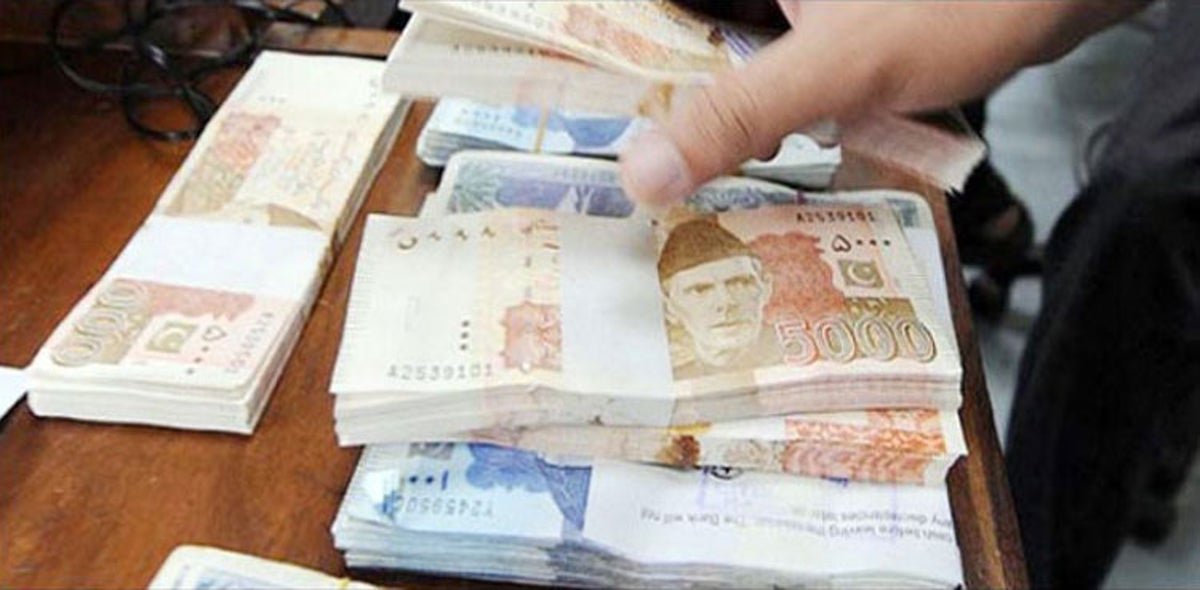
    The State Bank of Pakistan (SBP) on Monday announced that banks will provide fit, authenticated and disinfected cash during the coronavirus pandemic.

    While there is no conclusive scientific study that links the spread of the current strain of coronavirus to contaminated currency notes, the World Health Organisation (WHO) has advised taking measures to maintain proper hygiene post-handling of notes.

    SBP tweeted a series of tweets:

    “Banks will provide fit, authenticated and disinfected cash. SBP will ensure to clean, disinfect, seal and quarantine all cash being collected from hospitals and clinics and to block circulation of such cash in the market.

    ”Banks will ensure continuous availability of ATMs 24/7. Also call centers and helplines will be operative 24/7.

    ”Large scale closure of branches may cause rush and congestion in the operative branches, which may be counterproductive to efforts to contain the spread of the disease. Banks may close branches where the staff is infected and for which requisite human resource is not available.”