Tag: State Bank of Pakistan

  • Pakistan’s inflation soars to 29.2% in November, exceeding October figures

    Pakistan’s inflation soars to 29.2% in November, exceeding October figures

    In November, Pakistan’s headline inflation surged to 29.2 per cent year-on-year, as reported by the Pakistan Bureau of Statistics, surpassing the October figure of 26.9 per cent. 

    On a monthly basis, there was a 2.7 per cent increase. The average inflation for July-November reached 28.62 per cent, up from 25.14 per cent in the same period the previous year.

    CPI inflation in urban areas rose to 30.44 per cent in November 2023, compared to 25.5 per cent in the previous month and 21.6 per cent in November 2022. On a monthly basis, it increased to 4.34 per cent, reflecting a substantial jump from the previous month and November 2022.

    Conversely, rural CPI inflation stood at 27.53 per cent year-on-year in November 2023, showing a slight decrease from the previous month but an increase from November 2022.

    Anticipated by several brokerage houses, the November inflation spike, driven partly by a rise in gas tariffs, aligns with predictions. 

    JS Global and Arif Habib Limited had forecasted CPI-based inflation to be around 28.26 per cent and 28.2 per cent, respectively.

    Beyond inflation, Pakistan faces economic challenges. A recent staff-level agreement with the IMF, subject to board approval in December, will provide access to SDR 528 million. The International Monetary Fund (IMF) expects inflation to decrease in the coming months due to improved supply conditions.

    Despite maintaining a key policy rate of 22 per cent, the State Bank of Pakistan projects a downward trajectory for inflation, citing fiscal consolidation, commodity availability, and exchange rate alignment as offsetting factors against risks like global oil price volatility and increased gas tariffs.

    Caretaker Finance Minister Dr Shamshad Akhtar expressed optimism about gradual inflation reduction, attributing it to improved financial management. The government believes effective policies will contribute to an overall improvement in economic conditions.


  • Pakistan’s forex reserves rebound: SBP gains $77 million in a week 

    Pakistan’s forex reserves rebound: SBP gains $77 million in a week 

    According to data released on Thursday, the State Bank of Pakistan (SBP) witnessed a weekly increase of $77 million in its foreign exchange reserves, reaching $7.26 billion as of November 24.  

    The total liquid foreign reserves for the country amounted to $12.39 billion, with commercial banks holding net foreign reserves at $5.13 billion. 

    During the week ending on November 24, 2023, SBP’s reserves increased by $77 million, reaching $7,257.0 million. Contrastingly, the previous week saw a decrease of $217 million in Pakistan’s central bank reserves. 

    In July of this year, the central bank’s reserves received a boost as Pakistan obtained the initial tranche of approximately $1.2 billion from the International Monetary Fund (IMF) following the approval of a new $3-billion Stand-By Arrangement (SBA).  

    This boost was complemented by inflows from Saudi Arabia and the UAE. 

    However, the SBP reserves faced pressure due to debt repayments, a surge in import payments after the easing of restrictions, and a lack of fresh inflows. 

    In a significant development, the IMF announced last week that its staff and Pakistani authorities had reached an agreement on the first review of the SBA.  

    The staff-level agreement is pending approval by the IMF Executive Board. 

    The IMF team reached a staff-level agreement (SLA) with the Pakistani authorities on the first review of their stabilization program supported by the IMF’s $3 billion (SDR2,250 million) SBA.  

    Upon approval, approximately $700 million (SDR 528 million) will become available, bringing total disbursements under the program to almost $1.9 billion. 

    Following the SLA with the IMF, Caretaker Finance Minister Dr Shamshad Akhtar expressed confidence that external financing would not be an issue, anticipating inflows in December 2023 to contribute to an increase in foreign exchange reserves. 

  • PSX hits historic high: KSE-100 index surpasses 59,000 mark for the first time

    PSX hits historic high: KSE-100 index surpasses 59,000 mark for the first time

    The Pakistan Stock Exchange (PSX) extended its impressive performance, achieving a historic milestone as the benchmark KSE-100 Index surpassed the 59,000 mark for the first time ever on Friday.

    At the close of the session, the benchmark index concluded at 59,086.35, registering a gain of 186.51 points, or 0.32 per cent. This marks its highest closing level to date.

    Earlier in the day, the KSE-100 index reached an intra-day peak of 59,502.28. However, profit-taking activities in the second half of the trading session led to a partial retreat from these gains.

    The trading session commenced with widespread buying, particularly in key sectors such as automobile assemblers, cement, chemicals, commercial banks, oil and gas exploration companies, OMCs, and technology and communication, all contributing to a positive market trend.

    In the preceding session on Thursday, bulls maintained control of the bourse, with the benchmark index settling at 58,899.84, marking a substantial increase of 701.08 points, or 1.20 per cent.

    The bullish momentum in the stock market follows the recent staff-level agreement between Pakistani authorities and the International Monetary Fund (IMF) on the first review under the nine-month $3 billion Stand-By Arrangement (SBA).

    Market experts anticipate increased inflows in the coming weeks due to this agreement. However, data released on Thursday revealed a decrease of $217 million in foreign exchange reserves held by the State Bank of Pakistan (SBP) on a weekly basis, reaching $7.2 billion as of November 17.

  • SBP reports second consecutive weekly decline in forex reserves

    SBP reports second consecutive weekly decline in forex reserves

    During the week ending on November 17, 2023, the State Bank of Pakistan (SBP) experienced a decline of $217 million in its foreign exchange reserves, settling at $7,180.0 million, as revealed by data released on Thursday.

    The total liquid foreign reserves for the country amounted to $12.3 billion, with commercial banks holding net foreign reserves of $5.1 billion.

    The central bank attributed this reduction in reserves to debt repayments. In a statement, the SBP explained, “During the week ended on November 17, 2023, the SBP’s reserves decreased by US$ 217 million to US$ 7,180.0 million due to debt repayments.”

    This marks the second consecutive week of a decline in the dollar stockpile, following a $115 million decrease in the previous week.

    It’s noteworthy that in July of this year, the central bank’s reserves received a significant boost as Pakistan received the initial tranche of approximately $1.2 billion from the International Monetary Fund (IMF).

    This followed the approval of a new $3 billion stand-by arrangement (SBA). Additional inflows were received from Saudi Arabia and the UAE.

    However, the SBP’s reserves have been facing pressures due to ongoing debt repayments, increased import payments following the relaxation of restrictions, and a lack of fresh inflows.

    In a positive development, the IMF announced last week that its staff and Pakistani authorities had reached an agreement on the first review of the SBA.
    The staff-level agreement is pending approval by the IMF Executive Board.

    The IMF stated, “The IMF team has reached a staff-level agreement (SLA) with the Pakistani authorities on the first review of their stabilisation programme supported by the IMF’s US$3 billion (SDR2,250 million) SBA.”

    Upon approval, approximately US$700 million (SDR 528 million) will become available, bringing the total disbursements under the programme to nearly US$1.9 billion.

    Caretaker Finance Minister Dr Shamshad Akhtar, speaking to the media after the SLA with the IMF, expressed confidence that external financing would not be an issue, anticipating increased inflows in December 2023, which would contribute to boosting the foreign exchange reserves.

  • Senators propose discontinuation of Rs5,000 currency note to fight corruption

    Senators propose discontinuation of Rs5,000 currency note to fight corruption

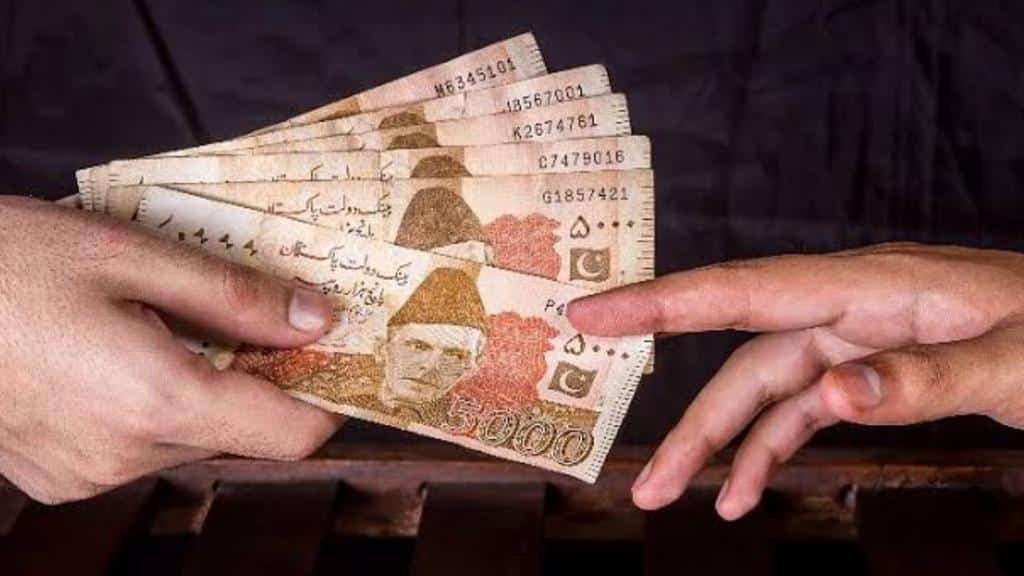
    Pakistan Tehreek-e-Insaf (PTI) senators are advocating for the discontinuation of the Rs5,000 currency note as a strategic move to combat corruption and inflation.

    On Monday, Senator Mohsin Aziz presented a resolution in the Upper House of Parliament urging the prohibition of the highest-denomination currency.

    According to Senator Aziz, the Rs5,000 note is frequently associated with corruption, terrorism, and smuggling.

    Providing details, Senator Aziz revealed that Rs5,000 currency notes totaling Rs3.5 trillion have been issued to date.

    Notably, he emphasised that Rs2 trillion worth of Rs5,000 notes are not currently in circulation but are securely stored in “safe deposit,” which he alleges is linked to money laundering, tax evasion, and smuggling.

    Senator Aziz called for a specific timeframe during which individuals should surrender the highest denomination notes.

    Supporting this initiative, another PTI Senator, Waleed Iqbal, echoed Senator Aziz’s call to discontinue the Rs5,000 currency note.
    He suggested that promoting digital payments would be instrumental in reducing reliance on physical currency.

    Responding to these claims, Caretaker Information Minister Murtaza Solangi stated that Rs5,000 currency notes totaling 905 million have been issued thus far, with Rs4.5 trillion currently in circulation.

    Solangi attributed the autonomy granted to the State Bank of Pakistan (SBP) by the previous government as a contributing factor to the situation. He asserted that the SBP operates within the confines of its laws.

    This isn’t the first time that officials have targeted the highest denomination note for its alleged role in fostering corruption.

    In September of this year, former Federal Board of Revenue (FBR) chief Shabbar Zaidi emphasised the importance of discontinuing Rs5,000 notes and imposing restrictions on the physical movement of dollars as crucial steps in curbing the cash economy in the country.

  • Pakistan’s forex reserves dip by $79 million amidst external debt repayments

    Pakistan’s forex reserves dip by $79 million amidst external debt repayments

    Pakistan’s total liquid foreign exchange reserves declined by $79 million in the past week, primarily due to external debt repayments. 

    According to the State Bank of Pakistan (SBP), as of November 10, 2023, the country’s total reserves amounted to $12.535 billion, down from $12.614 billion on November 3, 2023.

    During the reviewed week, SBP’s reserves decreased by $115 million to $7.397 billion due to debt servicing. Conversely, commercial banks’ net foreign reserves increased by $36 million, reaching $5.139 billion by the end of the week.

    In a significant development, the International Monetary Fund (IMF) announced on Wednesday that a staff-level agreement (SLA) has been reached on the first review of a nine-month stand-by arrangement (SBA) totaling $3 billion with Pakistani authorities.

    Pending approval by the IMF Executive Board, the SLA signifies a milestone, and upon approval, an amount of SDR 528 million, approximately a $700 million loan tranche, will be disbursed to Pakistan. 

    This disbursement will bring the total funds received under the IMF SBA to $1.9 billion.

    These incoming funds are expected to contribute to replenishing the country’s diminishing foreign exchange reserves. 

    The IMF team, led by Nathan Porter, conducted discussions in Pakistan from November 2–15, 2023, culminating in the announcement of the SLA upon the completion of the economic review.

  • Pakistan Stock Exchange sets record at 56,665 points following strong buying activity

    Pakistan Stock Exchange sets record at 56,665 points following strong buying activity

    The Pakistan Stock Exchange (PSX) experienced a positive trading session on Tuesday, with the benchmark KSE-100 index concluding at a record high of 56,665.93 after gaining 142 points.

    The day commenced with optimistic market sentiment, but a brief shift into negative territory occurred due to profit-taking activities.

    Nevertheless, a robust surge in buying activity during the latter part of the day allowed the index to finish in positive territory, reflecting a 0.25 per cent increase or 142 points. Despite notable profit-taking during the session, the market achieved a positive closure following periods of heightened volatility.

    Key contributors to the market’s performance during the session were identified in the power generation and distribution, technology, and communication sectors, as well as the automobile assembly sector, according to the brokerage house.

    This positive trend follows Monday’s milestone, where the KSE-100 Index surpassed the 56,500 level for the first time, recording a historic gain of over 1,132 points.

    Conversely, the Pakistani rupee sustained losses against the US dollar for the 16th consecutive session, depreciating by 0.11 per cent in the inter-bank market on Tuesday.

    According to the State Bank of Pakistan, the currency settled at 287.87, indicating a decrease of Re0.32.

    Market metrics revealed a decrease in volume on the all-share index, registering 526.3 million compared to the previous session’s 660.6 million.

    However, the value of shares witnessed an uptick, reaching Rs22.4 billion from Rs21.1 billion in the preceding session.

  • Agricultural boom: Pakistan’s farm exports surge by more than 70%

    Agricultural boom: Pakistan’s farm exports surge by more than 70%

    In October 2023, Pakistan experienced a notable surge in exports, marking a 13.5 per cent increase to reach $2.7 billion, as reported by the Pakistan Business Forum (PBF).  

    Simultaneously, the trade deficit saw a 4.5 per cent reduction during the same period, indicating positive economic developments. 

    Chaudhry Ahmad Jawad, the Vice President of PBF, highlighted the remarkable 73 per cent growth in the agriculture sector for October.  

    Notably, exports of rice and sesame seeds played a pivotal role in this expansion, showcasing a diversification of the country’s export portfolio and underscoring the robustness of the agricultural industry. 

    Jawad emphasised the imperative for Pakistan to boost its service exports, particularly in information and communication technology (ICT), to address the balance of payment deficit.  

    Drawing a comparison with India, he noted India’s remarkable achievement in ICT exports surpassing $140 billion in fiscal year 2022–23, contrasting with Pakistan’s stagnant growth at $2.6 billion in fiscal year 2021–22.  

    The key differentiator, as Jawad pointed out, is the focus on technology and engineering in India over the years, leading to a skilled labour pool. 

    While acknowledging the challenges in the short to medium term, Jawad expressed optimism about Pakistan’s potential for growth in the ICT sector. He suggested addressing the skills gap by offering crash courses to enhance the capabilities of IT graduates. 

    Jawad further underscored concerns raised by IT companies in Pakistan, stating that despite an abundance of talent, the technology sector faces difficulties due to a lack of demand and challenges in remitting money outside Pakistan.  

    He called for government intervention to tackle these issues, pointing to the State Bank of Pakistan’s efforts in 2020 and emphasising the need for ongoing attention to restore confidence. 

    Finally, a PBF official commended the caretaker IT minister’s goal of increasing ICT exports to $10 billion and bringing renowned payment gateways like PayPal and Stripe to Pakistan.  

    However, he raised concerns about existing limitations on exporters’ remittances, urging the finance division to address this critical issue. 

  • SBP orders bank closures in smog-affected Punjab districts

    SBP orders bank closures in smog-affected Punjab districts

    On Wednesday, the State Bank of Pakistan (SBP) announced the closure of bank branches in Lahore division and certain districts of Punjab severely affected by smog.

    According to a statement issued by the central bank, all banks and Micro Finance Banks (MFBs) are required to keep their branches closed in Lahore Division, including Lahore, Nankana Sahib, Sheikhupura, and Kasur districts, as well as Gujranwala, Hafizabad, Sialkot, and Narowal districts, on November 10.

    This decision was made in accordance with a notification from the Punjab government dated November 8, 2023. The Punjab government declared an “environmental and health emergency” in Lahore and two other divisions from November 9 to 12 to address the smog’s impact.

    According to the notification, all markets, shopping malls, restaurants, cinemas, gymnasiums, schools, and both public and private offices will remain closed for four days in Lahore, Gujranwala, and Hafizabad divisions. Public and private transport to and from these areas will also be restricted.

    Section-144 and health emergencies have been imposed in the Lahore division to control smog, following deteriorating air quality in the region over the past few days. Section 144 has been imposed in Lahore, Kasur, Sheikhupura, and Nankana Sahib districts.

    During environmental and health emergencies, educational institutions, government and private offices, cinemas, parks, and restaurants will remain closed, and markets will be shut on Saturday, as specified in the notification.