Political unrest caused significant selling pressure on the Pakistan Stock Exchange (PSX), which saw the benchmark KSE-100 Index lose more than 1,400 points on Tuesday during trading.
The KSE-100 Index was down 1,432.25 points, or 3.5 per cent, at 39,538.57 around 3 o’clock, below the 40,000-mark, according to the PSX website.
Investors were under pressure to sell their shares across the board due to Pakistan’s escalating political unpredictability and economic uncertainties.
For a while now, there has been pressure on the market. Just last week, the benchmark KSE-100 Index dropped nearly 550 points due to domestic and global events, and the PSX experienced intense selling pressure. On Friday, it increased to close higher, but this week started off negatively once more.
Experts claim that market pressure is resulting from the Pakistan Tehreek-e-(PTI) Insaf’s announcement that it will dissolve the Punjab and Khyber Pakhtunkhwa assemblies, according to Brecorder.
In particular, the pressure has intensified since Monday’s event.
A worsening economic crisis is accompanied by louder political clamour as foreign exchange reserves drop to dangerously low levels and negotiations with the International Monetary Fund (IMF) keep getting postponed.
Analysts have also stated that although the World Bank’s approval of $1.692 billion for flood relief efforts in Sindh should have had a positive effect, political commotion is also obscuring this good news.
Pakistan’s stock market is expected to remain under pressure till Friday until clarity is achieved on the political front.
The news that the country will get a financial package from friendly countries led to another bullish session at the Pakistan Stock Exchange on Friday.
The benchmark index started the pre-Friday prayer session in the green, according to Arif Habib Ltd, but lacklustre activity caused the index to drop 96.39 points at the end of the session.
However, as trading started again, the benchmark recovered. Following Finance Minister Ishaq Dar’s announcement of a $13 billion package from China and Saudi Arabia, investors started looking for equities. While significant activity was seen in the oil and exploration sector, volumes overall remained stable.
The KSE-100 index settled at 43,092.95 points, up 191.68 points or 0.45 per cent from the preceding session.
The trading volume decreased 20.8 per cent to 232.8m shares while the traded value went down 25.4 per cent to $34.4m on a day-on-day basis.
Stocks contributing significantly to the traded volume included Cnergyico PK Ltd (21.1m shares), WorldCall Telecom Ltd (17.9m shares), TPL Properties Ltd (15.1m shares), Pakistan Refinery Ltd (14.8m shares) and Oil and Gas Development Company Ltd (12.5m shares).
Sectors that contributed to the index performance were exploration and production (129.3 points), technology and communication (98.4 points), oil marketing (22.8 points), tobacco (13.1 points) and food and personal care products (12.8 points).
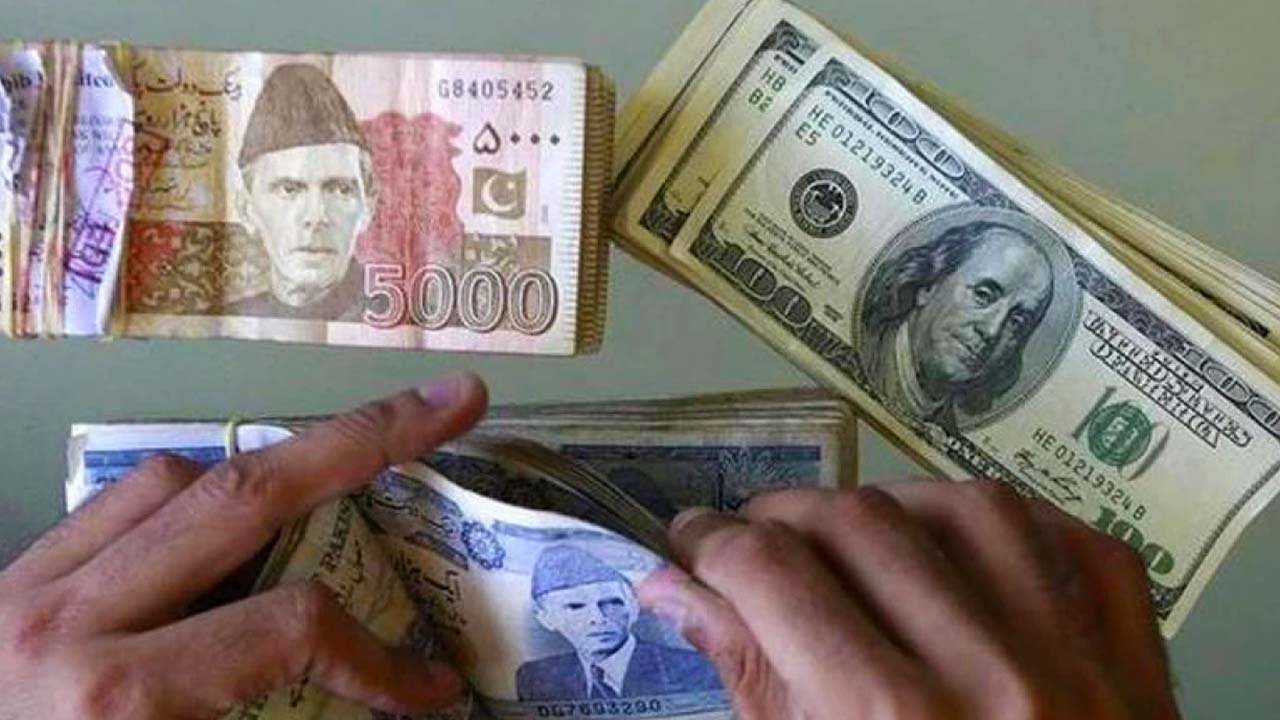
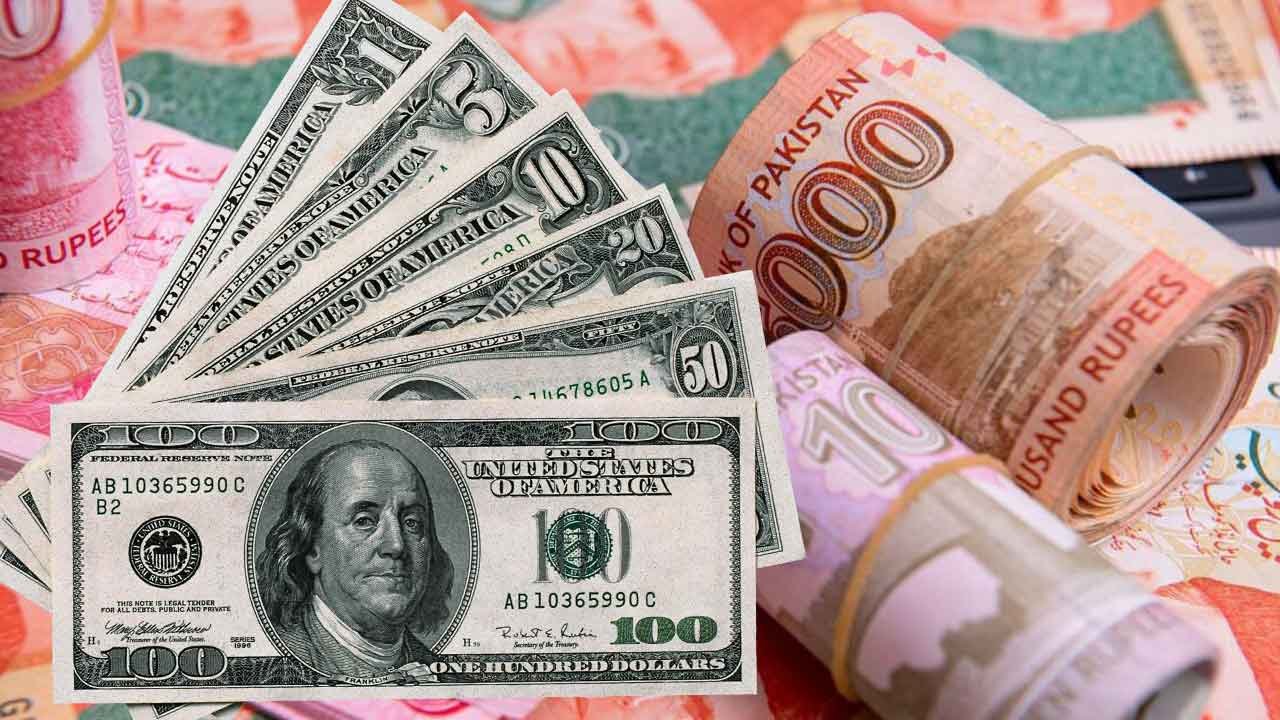
The Pakistani rupee was trading between Rs222-223 on Wednesday as losses against the US dollar persisted in the early hours of trading.
During intra-day trading, the rupee was quoted at Rs222.49 at roughly 10:30 am, depreciating by Rs1.07 or 0.48 per cent against the US dollar.
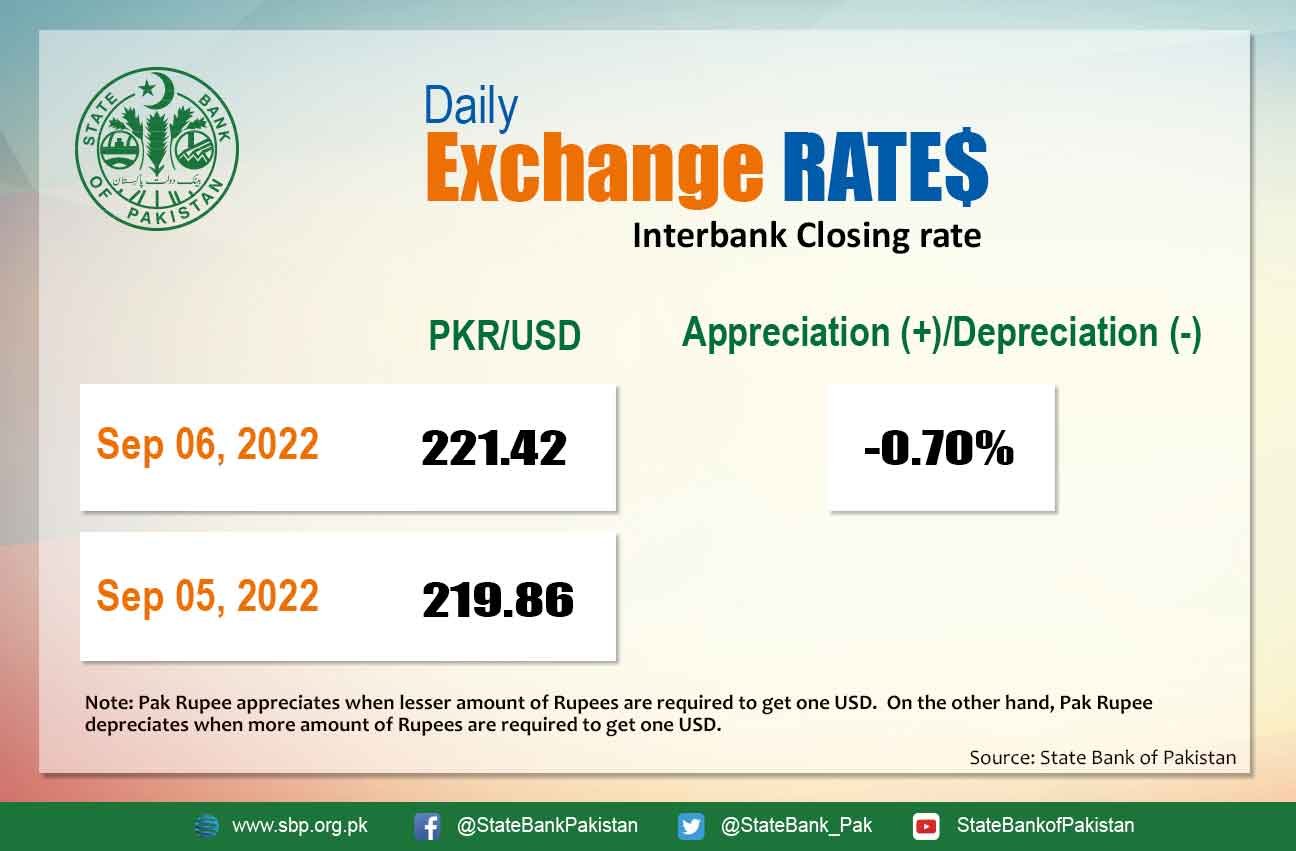
The local unit lost for the third session in a row on Tuesday, falling down Rs1.56 or 0.7 per cent against the dollar to close at Rs221.42.
According to analysts, the government’s decision to let the duty-free import of edible commodities to promote food security after floods severely damaged the nation’s agriculture sector has led to a spike in demand for dollars on the local market.
However, the dollar is also strengthening globally. On Wednesday, after U.S. economic data supported the notion that the Federal Reserve will continue with policy tightening, it reached fresh highs against the yen and the Australian and New Zealand dollars.
The US dollar index, which compares the value of the dollar to six important rival currencies, increased 0.08 per cent to Rs110.43, remaining close to the 20-year high set on Tuesday of Rs110.57.
On Wednesday, oil prices, a major factor in determining currency parity, fell more than $1 to their lowest level since before Russia invaded Ukraine as COVID-19 restrictions in the world’s top crude importer China and anticipation of further interest rate increases stoked concerns about a global economic slowdown and a decline in fuel demand.
On Monday, the Pakistani rupee (PKR) remained under pressure to start the week, falling Rs2.01, or 0.93 per cent, versus the US dollar in the interbank market.
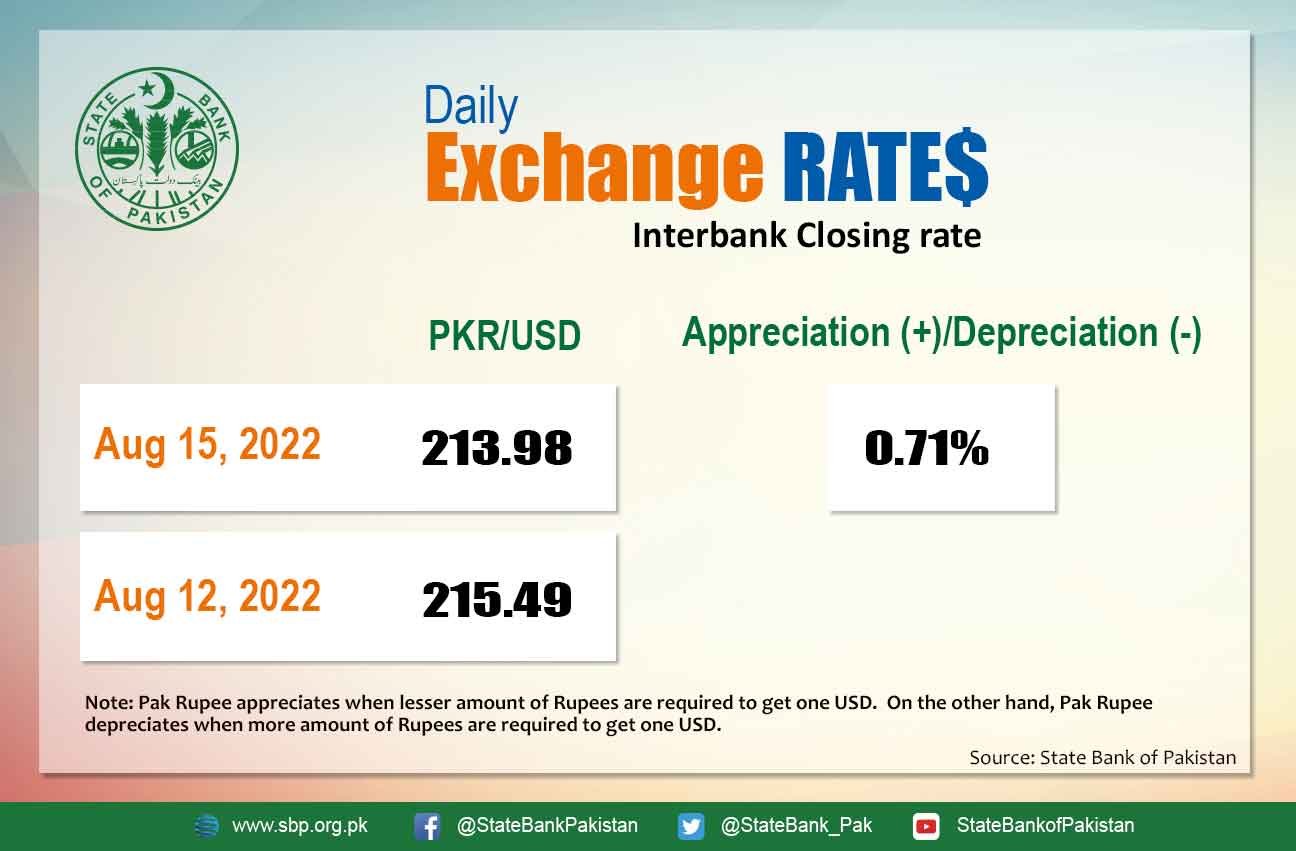
The local currency dropped from Friday’s closing rate of Rs214.65 to Monday’s closing rate of Rs216.66 per dollar, according to the State Bank of Pakistan.
The dollar fluctuated between Rs213-214 during the previous week. It ended at Rs214.65 on Friday after ending at Rs213.98 on Monday. Last week, the rupee lost 0.31 per cent of its value against the dollar.
The KSE 100-index of the Pakistan Stock Exchange (PSX), on the other hand, experienced a bearish trend on Monday, shedding 443.99 points, or 1.03 per cent, and finishing at 42,826.66 points as opposed to 43,270.65 points on the last working day.
When compared to the previous trading day, when 306,208,580 shares were traded, a total of 194,667,559 shares were traded on Monday (today). The price of the shares was Rs5.331 billion as opposed to Rs6.393 billion on Friday.
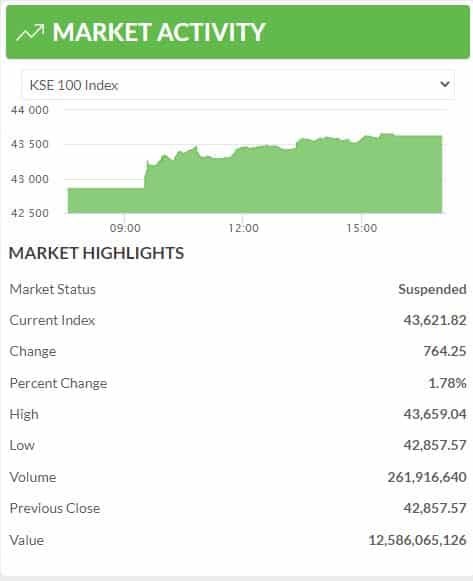
As trading began on Monday, the Pakistan Stock Exchange (PSX) resumed its upward trend, rising more than 700 points to cross the 43,000-mark.
The benchmark KSE-100 index gained 764.25 points, or 1.78 per cent, from its previous finish of 42,857.57.
PSX – August 15, 2022
The benchmark KSE-100 index increased by 731.54 points, or 1.71 per cent, by 2:13 pm to reach 43,589.11 points, according to the PSX website.
Additionally strengthening by Rs1.51, the Pakistani rupee (PKR) ended the day at Rs213.98. Since last week, the local currency has been steadily rising against the US dollar.
Rupee latest closing -August 15, 2022
The IMF’s letter of intent and Saudi Arabia’s pledge of more support were among the good developments over the weekend that contributed to the index’s strong start.
The rupee’s robust rebound and the IMF tranche anticipated at the end of this month can be credited for the upward trend.
The KSE-100 increased for the fourth consecutive session on Friday as the rupee continued to strengthen against the US dollar, maintaining positive investor confidence at the Pakistan Stock Exchange (PSX).
The price of WTI crude oil was $87.95 per barrel during the day, while Brent crude oil was being sold at $93.75 per barrel, bringing the global oil prices to multi-month lows.
The domestic equities market gained 670.87 points, or 1.62 per cent, to close at 42,096.24 points as a result of this development.
The Pakistani currency’s ongoing rebound, which continued for the sixth day in a row against the US dollar, provided additional support for the market.
Despite initial selling pressure on the market and a period of time in which the KSE-100 index traded flat, investor interest picked up toward the end of the first session, and the market closed roughly 300 points higher.
The rise gained momentum in the second session, which enabled the index to pass the 42,000-point threshold and conclude with significant gains.
The day ended strongly for index heavyweights in the banking, fertiliser, cement, chemical, automobile, and cement industries. On a weekly basis, the benchmark KSE-100 increased by 4.85 per cent. Capital Stake said that the PSX had strong sentiment for the fourth straight session.
According to Topline Securities’ analysis, Pakistan’s stocks saw good momentum as a result of softening global energy prices for coal and oil, which experienced some correction.
The decline enabled the market maintain its purchasing mood from Thursday and helped the KSE-100 index conclude the day at 42,096 points.
The dollar was trading at Rs223 on Thursday, as the Pakistani rupee (PKR) increased by Rs5.79 in interbank trade to extend its winning streak versus the dollar to five days.
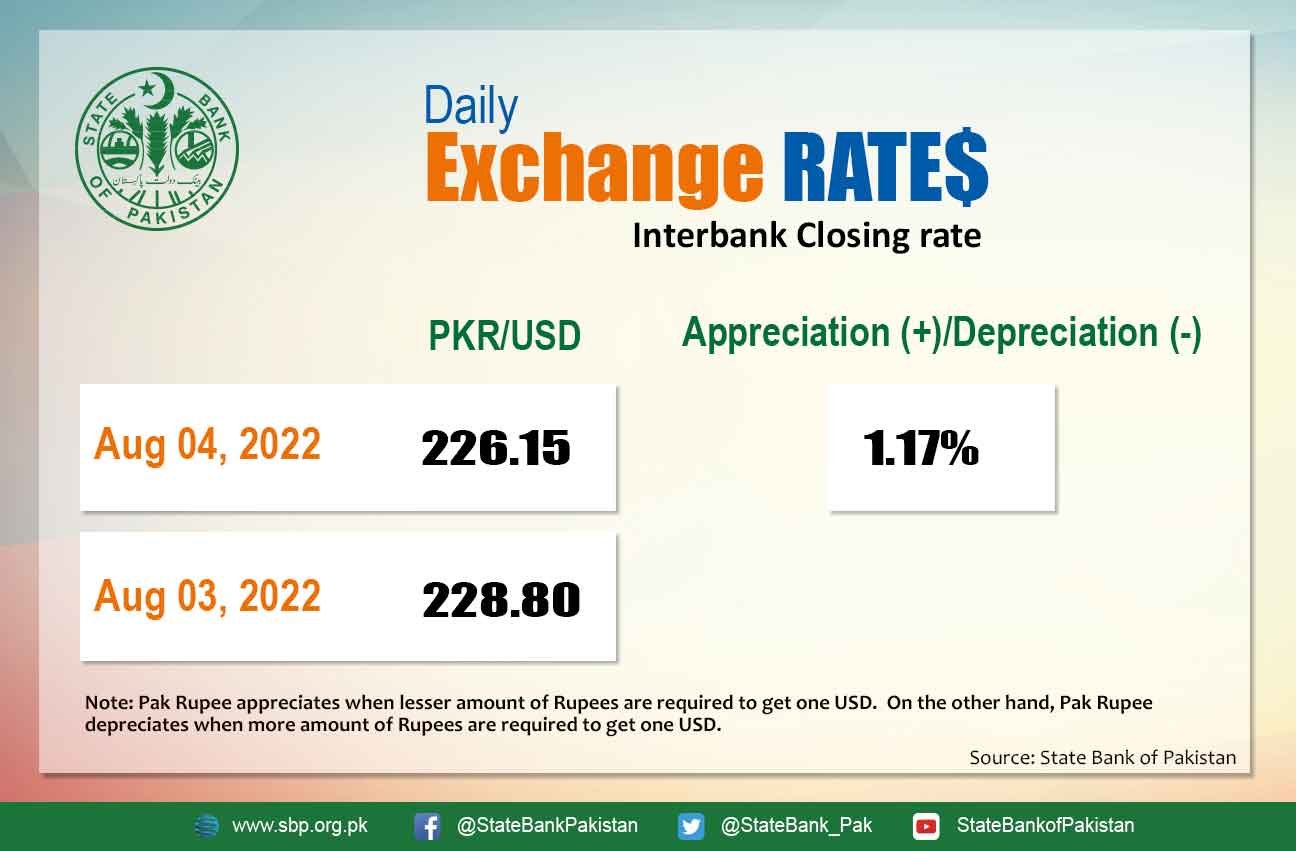
The Pakistani rupee increased against the US dollar for the fifth day in a row, rising Rs2.65 to close at Rs226.15.
US dollar to Pakistani rupee rate – 4 August 2022
As the market opened on a good note and remained optimistic with heavy volumes in nearly all sectors for a while, the benchmark KSE-100 likewise rose up to 500 points before 12:00 pm. However, as of 1:40 pm, the market fell by 290 points.
On Wednesday, the rupee gained the most against foreign currencies in a single day, ending the day at Rs228.80. The dollar’s decline versus the rupee reached its biggest level since November 2, 1998, when it dropped by Rs5.10.
The local currency is strengthening as a result of increased export inflows and reduced import expenditures, with optimism that the cash-strapped nation was getting closer to winning an IMF bailout bolstering confidence.
A board meeting is provisionally scheduled for late August after sufficient finance assurances are secured, according to a statement released on Tuesday by Esther Perez Ruiz, the IMF’s Resident Representative for Pakistan.
The dollar may devalue between Rs180 and Rs190 against the Pakistani rupee if the IMF releases the $1.2 billion tranche in August, according to Malik Bostan, chairman of the Exchange Companies Association of Pakistan (ECAP).
A day after economic slowdown fears dragged the major British stocks to their sixth straight session of losses, UK equities stabilised on Tuesday, with some positive momentum from financial sectors and some excellent earnings announcements.
By 0712 GMT, the FTSE 100 had up 0.6 per cent, with shares in British bank HSBC up 2.6 per cent providing the biggest boost to the blue-chip index.
Following volatile crude prices, oil majors BP Plc and Shell Plc climbed 1.5 per cent and 0.8 per cent, respectively.
After finishing at its weakest level in more than three months on Monday, the domestically focused mid-cap FTSE 250 index gained 0.7 per cent. Paragon Banking increased by 4.7 per cent after raising its expectations for 2022 and indicating robust new lending growth.
FirstGroup jumped 1.2 per cent when the transportation company reported a higher yearly profit and restarted dividend payments, as passenger numbers on its buses increased after COVID-19 limitations were relaxed.
Crest Nicholson rose 6.1 per cent after projecting an adjusted profit before tax of between 135 and 140 million pounds for fiscal year 2022. In 2021, the housebuilder made an adjusted profit of 107.2 million pounds.
Airlift Technologies, a national grocery delivery service, has laid off 31 per cent of its workforce.
The company posted a statement on its official LinkedIn account confirming the layoff of its workforce; “In the light of the significant downturn in global capital markets, Airlift is undertaking a strategic realignment to reduce the surface area of operations and to increase focus in key areas that drive sustainability and profitability.”
“The decision to part ways with talented teammates has been incredibly challenging for the company. For impacted teammates, Airlift stands committed to providing financial and placement support to help find new roles,” the statement read.
Quick commerce startup Airlift closes down all cities apart from Karachi, Lahore and Islamabad, lays off 31% staff. pic.twitter.com/hSM8Cz3kYE
Usman Gul, the 33-year-old co-founder, and CEO commented on the company’s decision to permanently shut down, saying, “I think if the lens of change is ‘Did Airlift offer great returns to investors?’ then yes, regrettably, it was unsuccessful. If you’re talking about bringing Pakistan into a new reality or altering the entire ecology, then by that yardstick of success, we’ve come a long way,” Gul told Rest of World.
“In many ways, Airlift raised the bar of ambition for Pakistani startups in a big way. Our teams at Airlift redefined the standard of execution, strategy, building a world-class culture, developing a cutting-edge product, raising sizable fundraising rounds,” Gul continued.
What is the point of raising the greatest series B in the nation if the business fails 11 months later? Gul believed that these were improper inquiries when questioned about the $85 million that Airlift blew through in less than one year. He said that the appropriate questions to ask were: “What enabled Airlift to raise $100 million-plus in three years? That’s never happened in Pakistan before. What did this team do differently?”
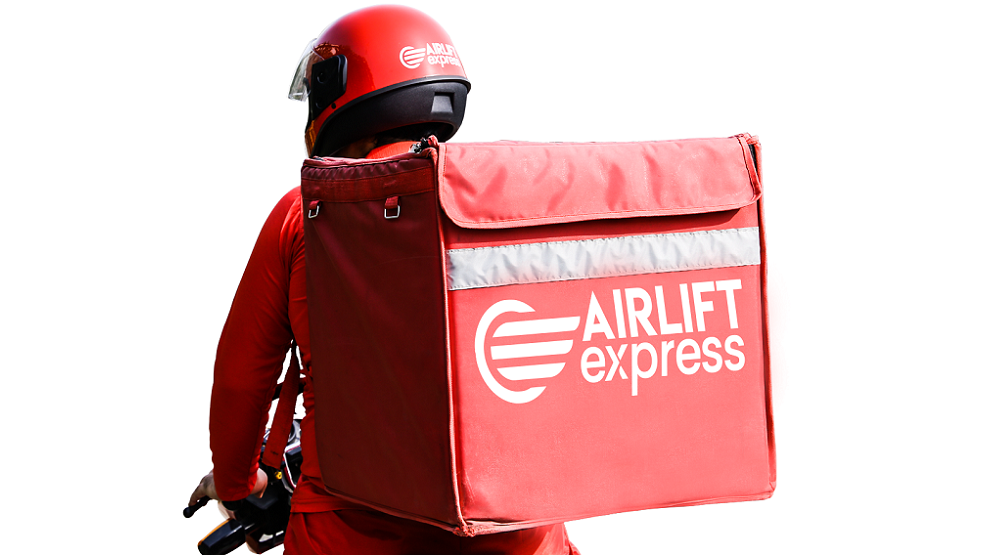
Airlift was started in 2019 by Usman Gul, Ahmed Ayub, Awaab Khaakwany, Meher Farrukh, Muhammad Owais, and Zohaib Ali as a mass-transit option that connected consumers with buses at reduced costs. Due to the pandemic, Airlift’s transportation operations were halted in March 2020. During the covid pandemic, the company then pivoted its business plan and launched Airlift Express, a grocery delivery service with $10 million in investment. Airlift, last year in August, secured a mega-round of funding of $85 million dollars.
A former Airlift employee described the layoff as “shocking, unexpected, and heartbreaking.”
WHAT FINANCIAL EXPERTS THINK HAPPENED AT AIRLIFT
Ariba Shahid, Financial Journalist at Profit Magazine and DealStreetAsia, while talking to The Current about the layoffs at Airlift, said, “While downsizing is sad considering people lose their livelihoods, sometimes young startups need to scale back operations, recalibrate and start differently or fresh,” adding “In order to do so, they sometimes downsize. There is nothing wrong in doing so. I don’t think any business downsizes unless it’s absolutely necessary.”
Taking about the reason behind the layoffs Ariba added, “There are a number of ways to look at it. One likelihood is that Airlift’s funding was contingent on it attaining milestones. So maybe, they did not get the entire $85 million.”
“The other scenario is that they burned through approximately $10 million a month in customer acquisition costs and expansion. It is difficult for consumers to change their consumption pattern and move onto quick commerce. It also costs a lot to expand and grow, especially internationally, like Airlift did in South Africa. The macroeconomic environment with rising inflation and diminishing purchasing power makes it even more difficult.”
“Airlift was one of the bigger names in the ecosystem. The same way Airlift was used as an example while raising funds, it may be seen as a warning sign. However, the global liquidity crunch plays a bigger role at this point in time, in addition to Pakistan’s weakening macroeconomic sentiments.”
“There is no right or wrong way to run a startup at this point because the ecosystem is very nascent. There are no examples locally to follow. However in order to succeed startups need to ensure they are clean, transparent, do not fudge numbers, accept realistic valuations, stop obsessing over large rounds, and know when to stop blitz-scaling,” she added, talking about Pakistani startups.
While answering a question about the situation of Pakistan’s job market Ariba said, “Too soon to say that but yes, one can expect more layoffs across industries considering working capital will be more expensive, political instability, low investment inflows.”
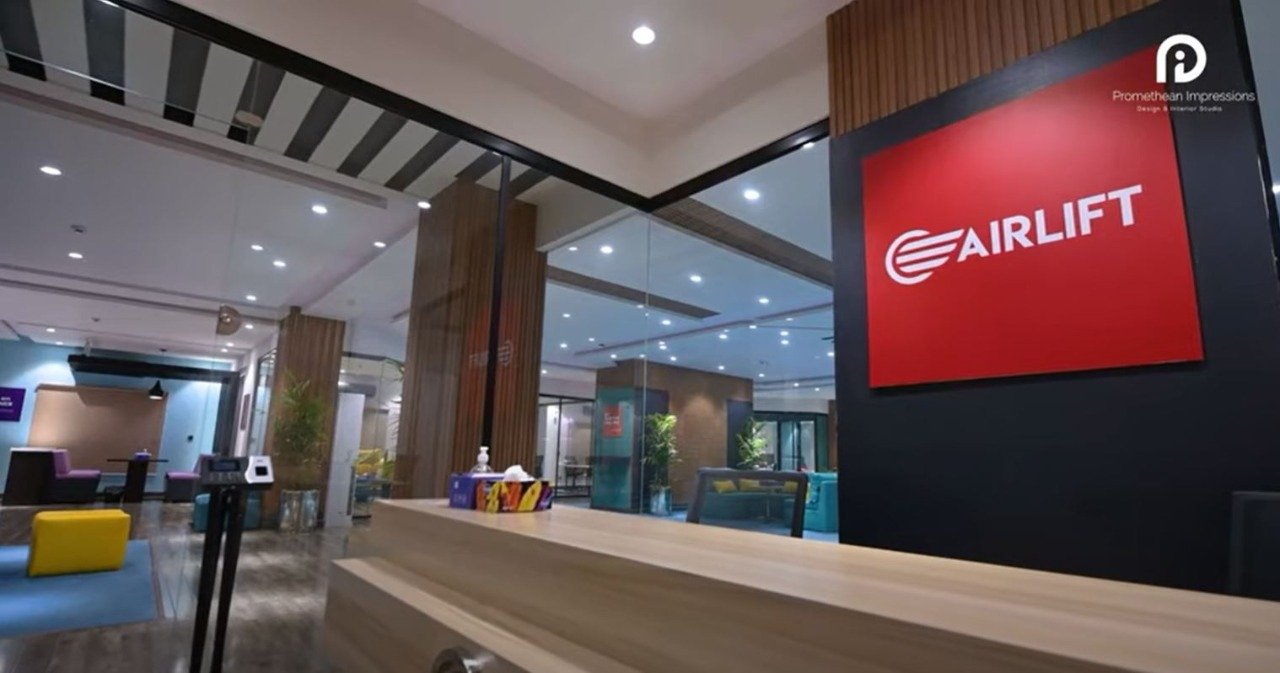
Aitlift’s Lahore office
Dr Aqdas Afzal, Program Director and Assistant Professor of Economics, Habib University while talking to The Current about the possible reason behind the layoffs said, “The reason is not related to the Pakistani market, there is an economic downturn in the entire world. The inflation in UK and US is highest in last 40 years.”
He continued by adding that, “the main input of Airlift’s delivery is fuel and as considering the fuel inflation, they have withdrawn their services from those markets and cities from where they don’t get much sales and find it difficult to drive “sustainability and profitability.”
“I don’t think Pakistani startups are doing anything wrong, as we have seen they have been able to get get a lot of seed money.”
He further said, “In the coming days you will see a lot more startups booming in Pakistan.”
“The government needs to provide reliable, fast speed and affordable internet, because it is slowly becoming the weakest link for Pakistani startups.”
“I don’t think that Pakistan’s job market is collapsing,” said Afzal while answering a question about Pakistan’s job market.
He added, “We are in low value-added end of the spectrum in terms of freelancing skills and we should see if our educational institutions are teaching the level of coding that freelancers around the world are doing.”
Aitlift’s Lahore office
WHAT LAID-OFF EMPLOYEES HAVE TO SAY
Airlift released a database of the names of113 staffers who were abruptly terminated from their positions and were then ‘open to work.’ The employees listed in the database served in various departments of the cash-strapped venture, including operations, human resources, customer service, rider support specialists, and several software engineers, that were based in Pakistani cities including Karachi, Lahore, Islamabad, Gujranwala, Faisalabad, Hyderabad, and Peshawar, with the remainder in South Africa.
“The layoff news shocked the entire workforce as we had no idea the company would announce a massive layoff along with closing key warehouses in different cities,” an employee at Airlift Head Office Lahore, told The Current, “I was aware that the stock market was collapsing dramatically, with some well-known corporations laying off a large number of staff, but I had no idea that the capital market’s volatility would have such an immediate impact on Airlift.”
According to another insider, the company was unable to generate sufficient profit to entice international investors, which is why layoffs had to be done.
Khan revealed that he is looking for work and has undergone three job interviews so far. “After the news of the Airlift went viral on social media, I was approached by a couple of companies and individuals, although I have yet to receive job confirmation,” he claimed.
“I have had a wonderful time at the Airlift. The management took good care of the overall staff. The payouts were never delayed,” Husnain Raza, who was employed as a Rider Operations Specialist at Airlift barely a year ago, told The Current. “The company had to take this horrendous step or it could’ve been dissolved.”
Ex-Operations Lead at Airlift Faisalabad, stated that he is not concerned since the company has offered to compensate the employees who were laid off without notice with 1-2 months of salary. “I assume I’ll find another job until then,” he asserted.
The Current has reached out to the founders of Airlift for a comment on why the layoffs took place and about the future of the company. We are still waiting for a comment and until we get one, here is the statement issued by the company on the dismissal of their staff.
GLOBAL IMPACTOF THE ECONOMIC DOWNTURN
The impact of the global economy is not just being seen at Airlift or in Pakistan.
Cutbacks, contract terminations, and layoffs have impacted at least 5,600 startup employees since the beginning of 2022 at a number of unicorns, global tech companies in India, and growth-stage startups.
Startups like Unacademy, Furlenco, and many others have cut back and downsized in order to improve profitability. Better.com, a mortgage technology company based in the United States, has also asked employees to sign voluntary separation agreements. These layoffs occurred at Better.com’s India operations, where another 920 employees were let go earlier this month, following a total of over 3,000 laid off by April.
Unacademy, the edtech unicorn, laid off over 1,000 employees and shut down its online education platform, PrepLadder, in April 2022. More than 800 employees at BYJU’s-owned WhiteHat Jr were told to resign because they refused to work from the office.
Furthermore, Cars24, a marketplace, laid off workers in order to cut costs and move toward automation. In this downsizing, the unicorn may lay off up to 600 employees soon.
Alongside startups, some big names, such as Netflix, have cut staff this year, with some blaming the COVID-19 pandemic and others faulting ‘overhiring’ during periods of speedy growth. In 2022, Robinhood, Glossier, and Better are just a few of the technology firms that have significantly reduced their staff numbers.
The capital markets have taken a beating in 2022, and this has filtered down to the private sector. Fears about inflation, rising interest rates, and geopolitical issues have all contributed to a volatile financial market.
Startups, particularly those that profited from a pandemic growth that is now slowing, are beginning to feel the strain as well. Valuations have begun to fall, especially at the later phase, and entrepreneurs say it is far more challenging to raise new funding in such a situation.
A multitude of companies that experienced pandemic-related surges are experiencing a correction as a result of a variety of factors, including rising inflation, economic distress, war, and shifting consumer taste buds. Companies such as Meta and Twitter have publicly announced hiring freezes, and Snap confirmed this week that it is slowing hiring as revenue targets are missed.
If a company is bleeding money, it will most likely begin to lay off employees, preserving only those who are required to work to retain the business’s level of operations. If the company dissolves, the remaining workers may be laid off as well.
Among the most likely causes for layoffs is that the company is trying to cut costs in some way. This could be because the company needs to pay off debts, fewer sales or the company no longer has the financial backing of investors like Airlift.
As technological advancements and automation grow common in businesses, employers sometimes lay off employees in order to cut costs and reduce position redundancy. Moreover, if the employee satisfies certain requirements and is prepared to make the change, the organisation may commit to finding another role for them and transferring them to the position.
Elon Musk and Twitter are back in the spotlight after a Florida pension fund filed a lawsuit on Friday to restrict the Tesla CEO’s $44 billion takeover of the microblogging site.
The Orlando Police Pension Fund filed a complaint in Delaware Chancery Court, claiming that under Delaware law, Musk cannot entirely take over the company until at least 2025 unless two-thirds of the company’s shares are owned by Musk.
Musk became an “interesting investor” when he acquired over 9 per cent of the Twitter share, according to the complaint, forcing the delay.
According to CNN, the whole Twitter board of directors is a defendant in the case, including CEO Parag Agrawal. The current application aims to push the merger’s completion date back to at least 2025.
The US Federal Trade Commission (FTC) is investigating SpaceX’s creator for antitrust violations, which might postpone the deal’s completion.
Musk’s initial purchase of the 9 per cent interest is being investigated by the FTC, which is questioning whether he fulfilled an antitrust filing obligation when the stocks were first purchased in April.
The Republican Party strongly supports the Twitter agreement, hoping that conservatives banned from the site, such as former President Donald J Trump, will be allowed to return. Neither Twitter nor Musk has responded to the recent news.