Tag: subsidy

  • No plan proposed to raise petrol prices at pre-budget seminar, clarifies Miftah

    No plan proposed to raise petrol prices at pre-budget seminar, clarifies Miftah

    After a tremendous increase of Rs60 in less than a month, Finance Minister Miftah Ismail announced Tuesday that the price of petroleum goods in the country would rise even more.

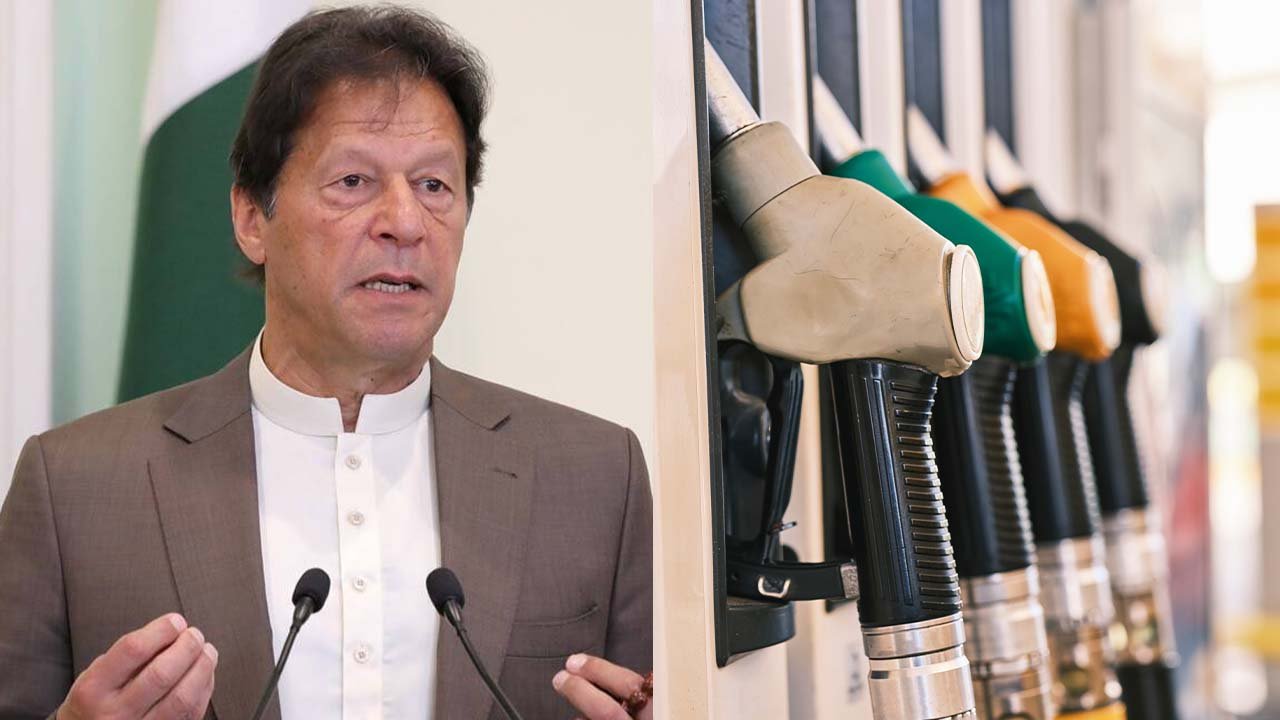
    Ismail mentioned in his statement at the one-day pre-budget business conference that if the government had followed ex-prime minister Imran Khan and former finance minister Shaukat Tarin’s contract with the International Monetary Fund (IMF), petrol would have cost Rs300 per liter.

    “The previous government had agreed with the IMF that they would not give subsidies,” the finance minister said, lashing out at the Khan-led government for messing up the economic policies of the country.

    Furthermore, The News reports that the government cannot simply withdraw subsidies without also imposing taxes on petroleum items.

    “The IMF has asked for 100 per cent withdrawal of subsidy on POL products. Once the subsidy is over, then the government will have to impose taxes and petroleum levy,” the publication reported, adding that there is still a subsidy of Rs9.32 per liter on petrol and Rs23.05 per liter on diesel.

    The finance minister had ruled out the potential of a financial emergency in the country the day before, as the government took efforts to address the country’s continued economic upheaval.

    No petrol hike discussed at the pre-budget meeting

    UPDATE: Miftah Ismail, on the other hand, has clarified that he never mentioned a hike in petroleum prices during the pre-budget meeting, despite the fact that social media and known channels have been swamped with headlines of yet another hike, with several netizens sharing images of folks rushing to petrol pumps yet again. “Channels running these tickers are doing a disservice to their viewers,” said the Finance Minister.

    “In the pre-budget seminar I never even spoke about petroleum prices. Channels running these tickers are doing a disservice to their viewers. There will be no increase in prices today and there is no summary or plan to raise prices,” he tweeted.

  • 40-50 per cent hike expected in gas tariff

    40-50 per cent hike expected in gas tariff

    The government plans to hike the system gas tariff by up to 50 per cent as part of its efforts to gain access to the International Monetary Fund (IMF) bailout.

    The Ministry of Energy anticipates the Oil and Gas Regulatory Authority (OGRA) determining the revenue requirement for the coming fiscal year in June. As per The News, which cited sources, the tariff increase will take effect on July 1, 2022.

    Sui Southern Gas Company Limited (SSGC) and Sui Northern Gas Pipelines Limited (SNGPL), according to an Energy Ministry official, have suffered massive combined losses of Rs550 billion in recent years.

    Both are losing money since the system gas rate has not been raised in a long time. SNGPL is expected to lose Rs350 billion, while SSGC is expected to lose roughly Rs200 billion.

    OGRA will now calculate the system gas tariff under the modified OGRA statute. The IMF has encouraged the government to ensure that gas firms do not lose money as a result of the gas tariff’s stagnation, as well as to follow the modified OGRA law in its entirety.

    It’s worth noting that the government raised the price of petroleum goods by Rs30 per liter last week after the IMF stated that the bailout package would not be resumed unless the country ended petroleum product subsidies.

  • PM Shehbaz to announce relief package for the poor

    PM Shehbaz to announce relief package for the poor

    Prime Minister (PM) Shehbaz Sharif will announce a relief package soon for those who are unable to afford fuel after a massive hike imposed by the government.

    This is undoubtedly an excellent news for the lower-income strata, as the recent petrol hike has weighed heavily on the inflation-stricken masses.

    Finance Minister Miftah Ismail announced last night a gigantic increase in the price of oil products in an attempt to reestablish the International Monetary Fund (IMF) plans to assist the country’s fragile economy.

    The decision was made in light of IMF guidelines, which required the removal of oil subsidies in order to restart Pakistan’s much-needed programme. On a talk show, Miftah Ismail slammed former Prime Minister Imran Khan for his contract with the IMF.

    “Imran Khan promised the IMF a Rs30 levy and a 17.5% sales tax on petroleum products,” he explained.

    The government is losing Rs120 billion per month as a result of Imran Khan’s unilateral decision to provide petrol subsidies, according to the finance minister.

    “Prime Minister Shehbaz Sharif had to make a difficult choice. However, he will announce a relief package for those who cannot afford high fuel prices in his address to the nation today,” Ismail added.

    According to Miftah, the government has already stated that the IMF programme will not begin unless petroleum subsidies are eliminated.

    Miftah Ismail voiced concerns about losing political capital as a result of the current decision to raise fuel prices, saying, “honestly telling you, we have admitted that by deciding on hiking fuel prices, we will suffer politically, but this is our country, and we will sacrifice to fix its issues”.

    Ismail acknowledged that the current increase in gasoline prices will shift the burden to the masses and increase inflation.

    Miftah dismissed the possibility of a default, saying, “I’m guaranteeing two things: the IMF programme will be restored, and Pakistan will not go bankrupt”.

  • Petroleum Division refutes Imran Khan’s assertion about Russia’s low-cost fuel offer

    Petroleum Division refutes Imran Khan’s assertion about Russia’s low-cost fuel offer

    There is no formal evidence in the petroleum division of Russia’s offer of inexpensive LNG, crude oil, and POL products, as former Prime Minister Imran Khan has often claimed.

    Syed Zakria Ali Shah, Joint Secretary of Development and a spokesman for the Petroleum Division, stated this to a reporter.

    According to sources in the petroleum sector, trading of crude oil, POL products, and LNG was not even on the table when Khan discussed the purchase of LNG. There was no mention in the meeting minutes of any Russian offer of providing LNG and gasoline at a 30 per cent lower rate.

    According to the spokesman, the government wrote letters to Russia on March 30 through the Ministry of Foreign Affairs in reference to the February 2022 visit of a Pakistan delegation, expressing Pakistan’s desire to enter long-term agreements on the import of crude, POL products, and LNG at discounted rates.

    The Petroleum Division also wrote to the Foreign Ministry, asking if Russia had provided any lower tariffs on LNG and fuel items. He also stated that it had given two reminders to this effect in the first week of April 2022, but the ministry stated that it had not received any letter from Russia for conversation in this respect.

    The Former energy minister, Hammad Azhar attracted the attention of his Russian peer, in a letter dated March 30, 2022, to an Inter-Governmental Agreement (IGA) on LNG cooperation that had been in force between the two friendly nations since 2017. The Russian minister was informed that Pakistan was willing to strengthen its partnership by expediting negotiations between the two selected nominees so that a long-term agreement for LNG delivery on a G2G basis could be reached as soon as possible.

    Then-energy-minister recommended two to three Russian LNG cargoes each month, each holding 140,000 cubic metres of LNG.

    There was no mention of any Russian offer in that letter, only a request for negotiation on a long-term contract for the import of gasoline and LNG at a reduced rate.

    According to officials at the energy ministry, India has been purchasing crude oil from Russia for decades and has continued to do so despite EU and US sanctions imposed as a result of its conflict with Ukraine. They claimed that India’s foreign policy was largely independent due to its strong economic power and enticing market for large economies.

    They further claimed that India had obtained a special dispensation from the US from its sanctions against Iran and had been buying crude oil and POL products from Iran despite US and UN sanctions for a long time. They claimed that India was the US’s strategic partner in the area against China.

    “India always pitches its argument before the US saying if it does not import fuel from Iran, its economy will hurt and it will never be on a par with China. As far as Pakistan is concerned, it is not possible to import crude oil, POL products, and LNG at discounted rates even in the wake of EU and US sanctions on Russia, as the country’s economic muscle is very weak and the country is always dependent on the IMF programme”. The officials said that Pakistan had also failed to complete the IP gas line project just because of US and UN sanctions on Iran.

    Via: The News

  • The recent ban on imports might barely make a dent

    The recent ban on imports might barely make a dent

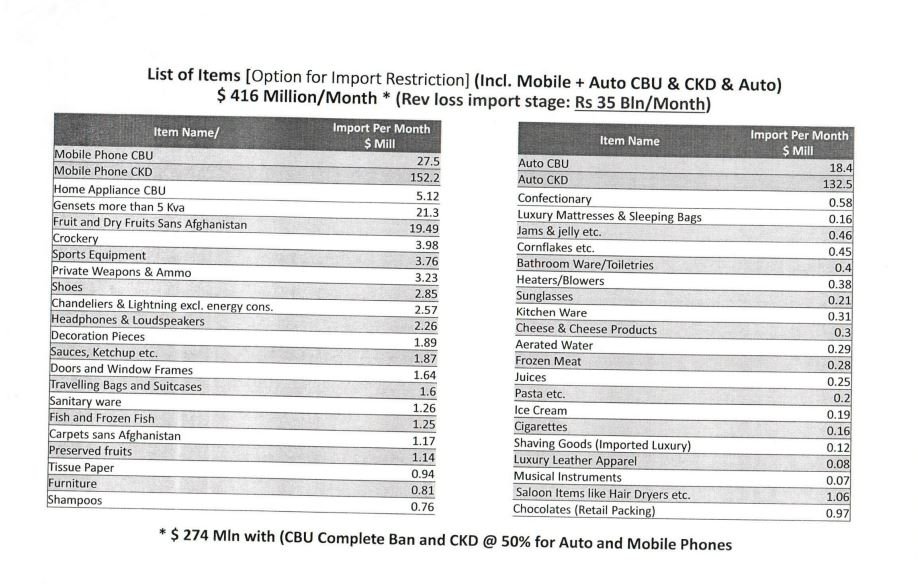
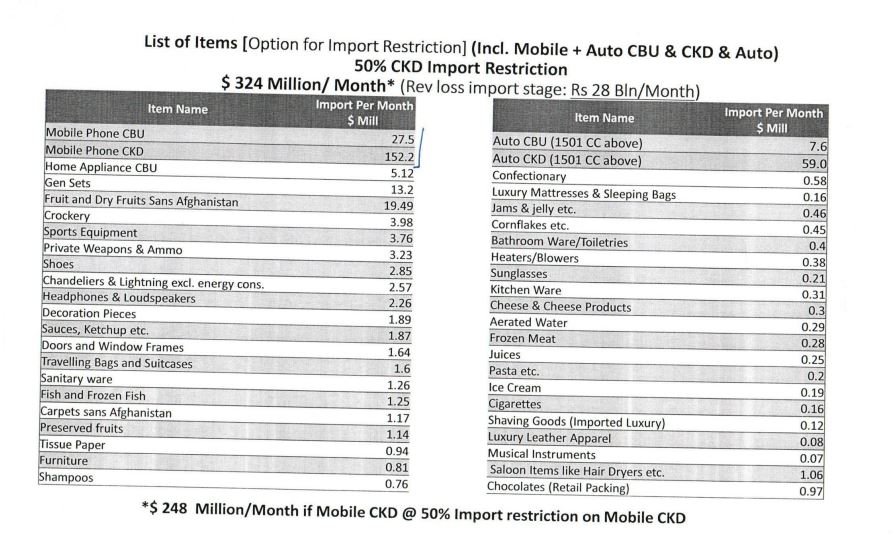
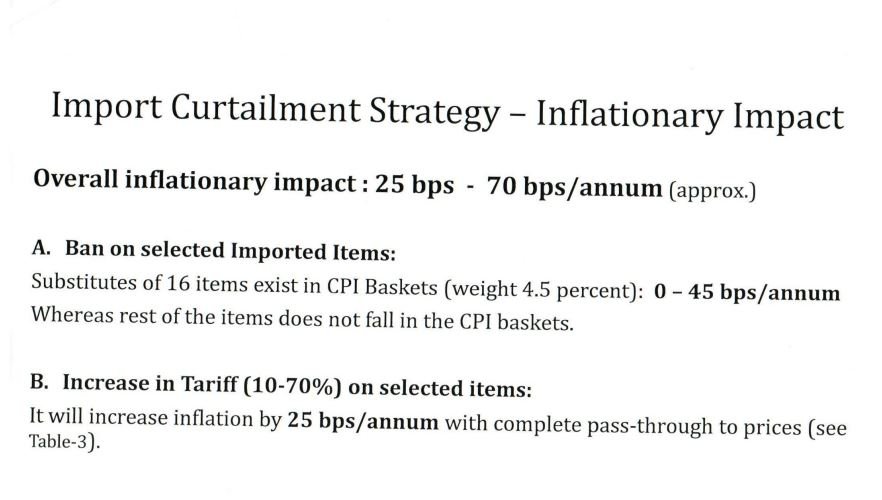
    On Thursday, May 19th, 2022, the federal cabinet issued a list of 41 items which will be banned from being imported for two months. This is in an attempt to address the current account deficit. The list of products is banned from being imported into the country, which means that essentially any shops or restaurants which rely on using these products will be forced to find local alternatives.

    These products will be banned regardless of what branding or packaging they use and only on the basis of whether the specific product is imported or not. Even products which are imported from abroad but packaged locally, will now be banned.

    Economists, university professors and business journalists took to Twitter to analyze and assess the merits and demerits of this decision. The discussion around luxury products and the fact that a lot of products which are labelled as “luxury items” are actually essential. Sanitary imports, valued at $16.4m are wrongly categorized as non-essential and although local alternatives also exist but it is definitions like these which disallow such decisions to be founded in research and expertise.

    The valuation of these imports which was published by the Pakistan Bureau of Statistics, was being quoted to ridicule the decision by many. What’s interesting to note is that most brands which appear to be entirely local, import a major chunk of their supply and will now be forced to smuggle goods instead.

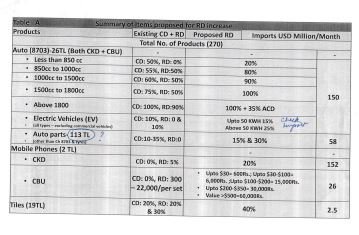
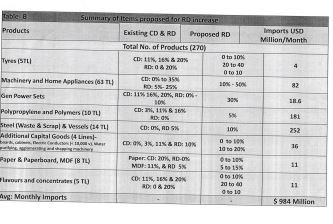
    Only from the data shared by PBS it becomes clear that for the fiscal year 2022, June to March, the total value of petroleum imports was $11 billion, while the total value of banning all these non-essential “luxury” items is a total $984 million, which forms only about 8.9% of the total value of petroleum imports.

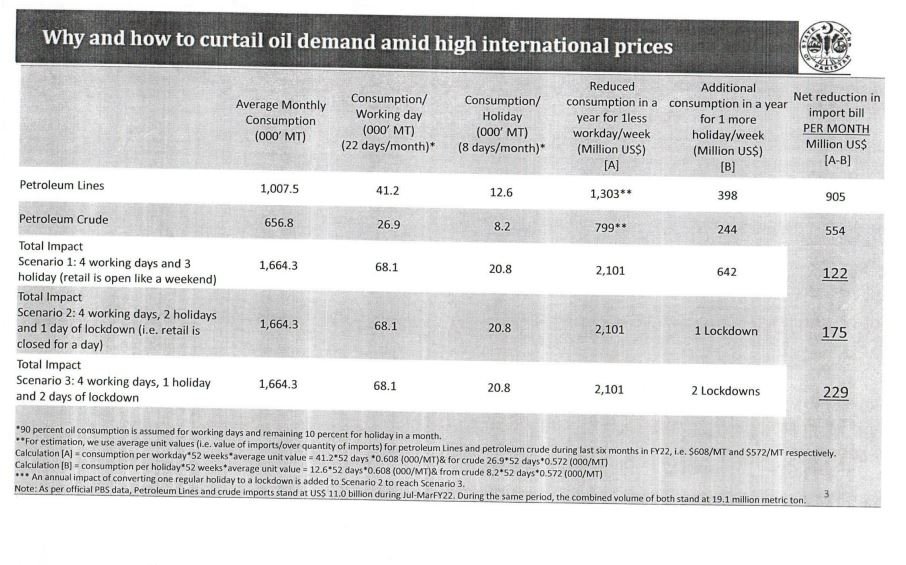
    In conversation with Profit Magazine’s Ariba Shahid, she clarified that this would still prove to be a largely fruitless move since the most significant chunk of the import bill is still being used up to run the energy sector without any thought being given to the humongous fuel subsidies . “For a very long time the State Bank of Pakistan has been talking about how if we remove the oil component from it, the current account deficit is improving, which is true and basically means that people are not spending money to buy other items and most of the import bill is petrol and soy bean oil.”

    Economists Ammar Khan and Atif R Mian also took to Twitter to analyze this decision of “patchwork economics”. Commenting on this unsustainable gap in Pakistan’s balance of payment, on April 15th, 2022 during a discussion on Pakistan’s economy at Princeton University, he explains that for Pakistan to grow it is a necessary condition for Pakistan to deal with this problem and digs deeper into the structure of the economy. He particularly takes apart urban land reforms, the necessity to levy a capital gains tax on speculative real estate transactions and analyzes how Pakistan is not even economically stable enough to grow at the rate of India and Bangladesh and it is primarily due to the elite capture of the economy that disallows the economy to attempt to fix its loopholes.

    Echoing similar sentiments, Ariba Shahid explained that due to a weaker economy, the import bill is not as significantly high due to a reduced demand pull because of a lowered purchasign power and hence banning these products will be insignificant and might barely make a dent in the current account deficit. “The need of the hour is to reverse the fuel subsidy,” says Shahid, “This decision will swell up the grey market economy and smuggling will increase.”

  • PM Shehbaz rejects OGRA’s proposal, petrol price to remain unchanged till April 30

    PM Shehbaz rejects OGRA’s proposal, petrol price to remain unchanged till April 30

    Pakistan’s new Prime Minister (PM) Shehbaz Sharif on Friday dismissed the proposal from the Oil and Gas Regulatory Authority (OGRA) to raise the price of petroleum products for the fortnight. The recent decision is aimed at providing relief to the public affected by inflation.

    It is worth noting that the present government’s choice to maintain the same prices will oblige it to provide another substantial subsidy till the end of April 2022.

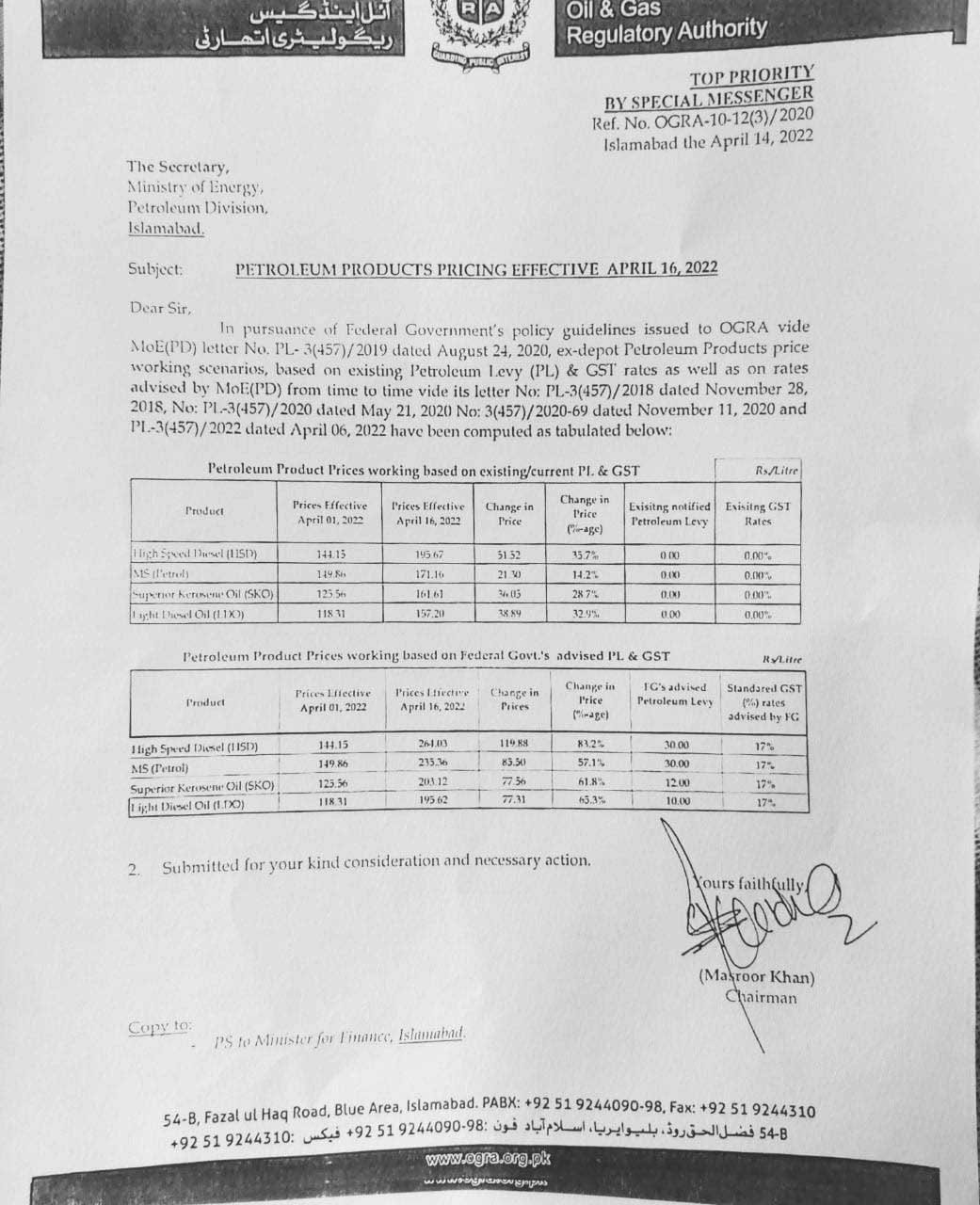
    Earlier, OGRA suggested to the Finance Division that the price of petrol be increased by Rs21.50 and that of diesel be hiked by Rs51.30 in view of the current petroleum levy and general sales tax (GST).

    Read more: Massive hike of Rs83.5 for petrol, Rs119 for diesel proposed by OGRA

    The authority also proposed a hike of Rs83.50 per liter of petrol and Rs119.88 per liter of diesel considering the federal government’s recommended petroleum levy of Rs30 and 17 per cent GST, as per the official statement.

  • Khyber Pakhtunkhwa cabinet approves Rs2.5 billion subsidy under Ramzan package

    The Khyber Pakhtunkhwa (KP) cabinet on March 29 okayed a subsidy package of Rs2.5 billion for the upcoming holy month of Ramzan, to ensure an uninterrupted supply of edible items at lesser rates.

    KP Chief Minister Mahmood Khan presided over the meeting, which was attended by ministers, chief minister’s advisers, and administrative secretaries.

    Following the meeting, government spokesman Barrister Mohammad Ali Saif revealed that 2,800 points had been set up around the KP to sell 20kg bags of wheat flour for Rs800 instead of the customary Rs1100 during Ramzan, while 10kg bags would be sold for Rs400.

    During Ramzan, the cabinet also decided to set up 83 sasta bazaars, 123 Ramazan facilitation centers, 42 mobile utility stores, and 96 Ramzan dastarkhwans.

    All of these points will be supervised by monitoring units led by respective secretaries and deputy commissioners to prevent price hikes and shortages of vital commodities on the market.

  • Budget explained: How it will affect you

    Budget explained: How it will affect you

    Finance Minister Shaukat Tarin unveiled the budget 2021-22. The total expenditure of the budget had been kept at Rs 8,478 billion and had set the tax collection target at Rs 5,829 billion. 

    Leader of the Opposition in the National Assembly Shehbaz Sharif and Pakistan People’s Party (PPP) chief Bilawal Bhutto Zardari were in the house. Opposition members continued to bang desks and shouted slogans of “Go Niazi Go!” as the minister spoke.

    Earlier, Bilawal met Sharif at his chamber in the assembly and they decided both parties would jointly oppose the PTI’s budget.

    Tarin began his speech by saying it was an honour for him to present the Pakistan Tehreek-e-Insaf (PTI’s) third budget.

    The minister paid tribute to the PTI government for stemming the spread of the coronavirus pandemic and taking steps to ensure businesses did not suffer massive losses in the country due to the lock downs.

    Pension

    Pensioners will get 10 per cent rise. Integrated allowance for Grade 1-5 has been raised from Rs 450 to Rs 900.

    Defence budget

    He said the defence budget of the country had been allocated Rs 1,370bn while the government had earmarked Rs 1,168 bn for development and non-development grants for provinces. 

     Subsidies

    The government had allocated Rs 682bn for subsidies to various sectors of the economy, adding that Rs 479bn had been allocated to run the civil government. 

    Coronavirus

    The government was serious in stemming the spread of the coronavirus and keeping its adverse effects at bay, adding that the government had set aside Rs100bn for it. 

    He announced the government’s initiative to earmark $1.1bn to procure coronavirus vaccines, adding that the government aimed to vaccinate 100mn people by July 2022.

    Ehsaas Emergency Cash Program

    “The government, through the Ehsaas Emergency Cash Programme, provided cash to 12mn people across the country,” he said. The finance minister announced that the government had set aside Rs260bn for the Ehsaas programme in the budget. 

    Remittances

    Tarin said remittances had increased in Pakistan to record levels, adding that these are expected to rise to $29bn by the end of this month. “This is proof of the love that overseas Pakistanis harbour for Prime Minister Imran Khan,” he said.

    Tax Collection

    Speaking about tax collection, he said it had grown by 18% and had crossed Rs4,000bn, adding that critics had no response to the government’s impressive performance in this regard. 

    Growth Sector

    Finance minister announced that the country’s economy was now entering the growth period, adding that almost every sector is growing. 

    He said Pakistan was seeing a “historic growth” in agriculture, stating that apart from cotton, all other crops saw extraordinary increases. He said that growth in the services sector helped improve numbers pertaining to poverty and had also played a major part in generation of wealth in Pakistan. 

    Tarin said the government had kept the growth target at 4.8% for the fiscal year, adding that the government will not leave the poor and the destitute at the mercy of inflation.  “Never in our economic history, were poor people able to realise their dreams,” he said, adding that PM Imran Khan wanted to uplift the poor. 

     Interest-free loans

    He said the government had decided to provide interest-free loans of up to Rs500,000 to the poor. 

     Development package

    He announced that the Public Sector Development Programme will be increased from Rs630 billion to Rs900 billion to counter the adverse impact of the coronavirus pandemic. 

    Tarin announced a development package for 14 districts in Sindh, adding that these will focus on improving education, solving the province’s water issues, and carrying out development in these districts. Rs16.5 billion have been allocated for Karachi-based projects for the fiscal year 2021-22.

    For developmental projects in Gilgit-Baltistan, the government has allocated Rs 40 billion. Meanwhile, Rs 54 billion have been allocated for Khyber-Pakhtunkhwa. Rs 601 billion will be given to South Balochistan for uplift programs, he added.

    Sales Tax

    The minister announced that the government has slashed sales tax on locally manufactured cars from 17% to 12.5%. The government has also exempted Federal Excise Duty (FED) on 850cc cars and will slash duty on electric cars.

    Tarin said the government was slashing withholding taxes on mobile phones, adding that it will be reduced to 10% at first and then 8% later. 

    If mobile phone call duration exceeds three minutes, one rupee per call in addition to the rates of duty will be charged. For SMS service, ten paisa per SMS in addition to the rates of duty will be charged.

    Tax on Internet services not approved by the Cabinet. FED reduced to 16 per cent from 17 per cent . IT and IT-enabled services given zero duty regime status. Data storage and Cloud computing included in the definition of IT enabled services.

    Third-party audit

    Tarin said the government was introducing third-party audits which would thwart the Federal Board of Revenue (FBR) harassing any individual or business entity. He said those who are found guilty of evading taxes or deliberately hiding their income will be fined severely. 

    Energy sector

    In the budget for the next fiscal year, a special plan for the elimination of circular debt would be introduced. “The government plans to reduce line losses through investment,” Tarin added. Moreover, an electric vehicle policy would also be announced.

    Development expenditures

    In the next fiscal year, the government has increased the PSDP budget to Rs 900 billion from Rs 630 billion. Tarin assured that the government would improve road infrastructure. Furthermore, through PSDP, it will invest in high return projects.

    Agriculture

    Talking about agriculture, the minister said that the agriculture sector witnessed historic growth.

    Unveiling the federal budget, the finance minister announced a national agriculture emergency program. The government plans to enhance livestock on modern lines and has decided to allocate Rs12 billion for the most important sector.

    Dasu, Diamar-Bhasha and Mohmand dams are a part of the budget. Rs91 billion have been allocated for water resources. Moreover, Rs14 billion have been allotted for the Neelum Jhelum power project. Tarin mentioned that the ML-1 project will be completed in three packages.

    Sharing the allocations for next year, he mentioned that Rs22 billion have been allocated to produce 100 MW electricity at Jamshoro. Moreover, Rs22 billion have been allocated for coal-based power projects, Rs16.5 billion for Tarbela fifth extension and Rs118 billion for different power transmission lines.

    Climate change

    The federal minister stated that Pakistan is one of the 10 countries most hit by climate change. Highlighting PM Imran’s vision of planting trees, he said Rs14 billion have been allocated for the government’s vision of “One Billion Tree Tsunami.”

    Rs 118 billion have been allotted under PSDP for the social uplift. Non-tax revenues to rise by 22% during FY22, meanwhile federal expenditures to rise 15%.

    Under the budget, $1.1 billion have been allocated for vaccine import.
  • Imran announces Rs30 billion subsidy for Naya Pakistan housing

    Imran announces Rs30 billion subsidy for Naya Pakistan housing

    Prime Minister (PM) Imran Khan has announced Rs30 billion in subsidy for his government’s flagship Naya Pakistan housing scheme project in line with helping the underprivileged class build their own homes.

    Addressing the nation after chairing a meeting of the National Coordination Committee on Housing, Construction, and Development, PM Imran on Friday said the scheme was aimed at the “working class, the welder, the small shop owner, who do not have a lot of money to build their own houses”.

    “The goal of the Naya Pakistan housing scheme was to construct houses for this strata of the society, which doesn’t have cash.”

    “We faced many hindrances while launching the scheme due to some existing legislation, such as the foreclosure law, which allows banks not to lend out money without a confirmation of repayment.”

    “[However] despite a lot of hurdles, we were successful in passing the law for Pakistan, which is now implemented around the world,” he said.

    The prime minister also spoke of the construction sector, saying it faced a lot of obstacles, but that the NCC had worked on formulating policies for its revival.

    “We have decided to revive our economy with housing and construction industry so that people can get jobs and we can generate revenue in times of global recession and pandemic,” he noted.

    “I, myself, will preside this meeting every week to supervise the working and progress of the committee regarding the Naya Pakistan housing scheme.”

    “We only have time till December 31 to provide incentives to the construction industry,” he added.

    PM Imran explained that under the Naya Pakistan housing scheme, Rs30 billion had been allocated as a subsidy, which would translate into Rs300,000 for each of the 100,000 households during the first phase of the programme.

    A 5% interest is levied on a five-marla house and 7% for 10-marla, he noted. “We have also directed the SBP [State Bank of Pakistan] to keep 5% of the portfolio for the construction industry, which is calculated to be Rs330 billion,” he said.

  • Rs10 billion subsidy approved to control inflating food prices

    Rs10 billion subsidy approved to control inflating food prices

    To counter the effects of inflating food prices, the federal cabinet on Tuesday approved a detailed package of Rs10 billion subsidies for Utility Stores, Dawn reported.

    According to reports, the government will open thousands of stores in Pakistan, moreover, consumer items at subsidised rates will be supplied to 50,000 tandoors and dhabas.

    To address the sugar crisis in Pakistan, the cabinet meeting presided by Prime Minister (PM) Imran Khan also decided to lift the ban on sugar import and regulatory duty on it. Also, the cabinet in its meeting decided to establish five “free zones” along the Pak-Afghan border, where Utility Store Cooperation will set up its stores to curb smuggling.

    RATES:

    Under Rs10bn subsidy, a 20 kg bag of wheat flour will be sold for Rs800, sugar will be priced at Rs70 per kg, ghee at Rs175, pulses at Rs15 and rice will be available at Rs20 per kg at Utility Stores.

    In the meeting, the cabinet agreed that rupee devaluation against the dollar and the increase in gas and electricity tariffs were some of the reasons for the increase in food items prices. Cabinet also agreed that there would be no further increase in gas and electricity rates.

    Advisor to PM on Information and Broadcast Dr Firdous Ashiq Awan. addressing a press conference, said, “The government would provide Rs2bn monthly subsidy to the USC for wheat flour, rice, sugar, pulses and ghee. She said the basic objective to give Rs10 billion subsidy was to ensure a sufficient supply of food items through Utility Stores.

    The also meeting decided that the government would use Pakistan Agricultural Storage and Services Corporation as a reservoir to store sufficient quantity of essential items so that in times of crisis these reserves could be utilised.