Tag: Sunni Ittehad Council

  • SIC warns PTI against public conflicts after Marwat’s statement

    SIC warns PTI against public conflicts after Marwat’s statement

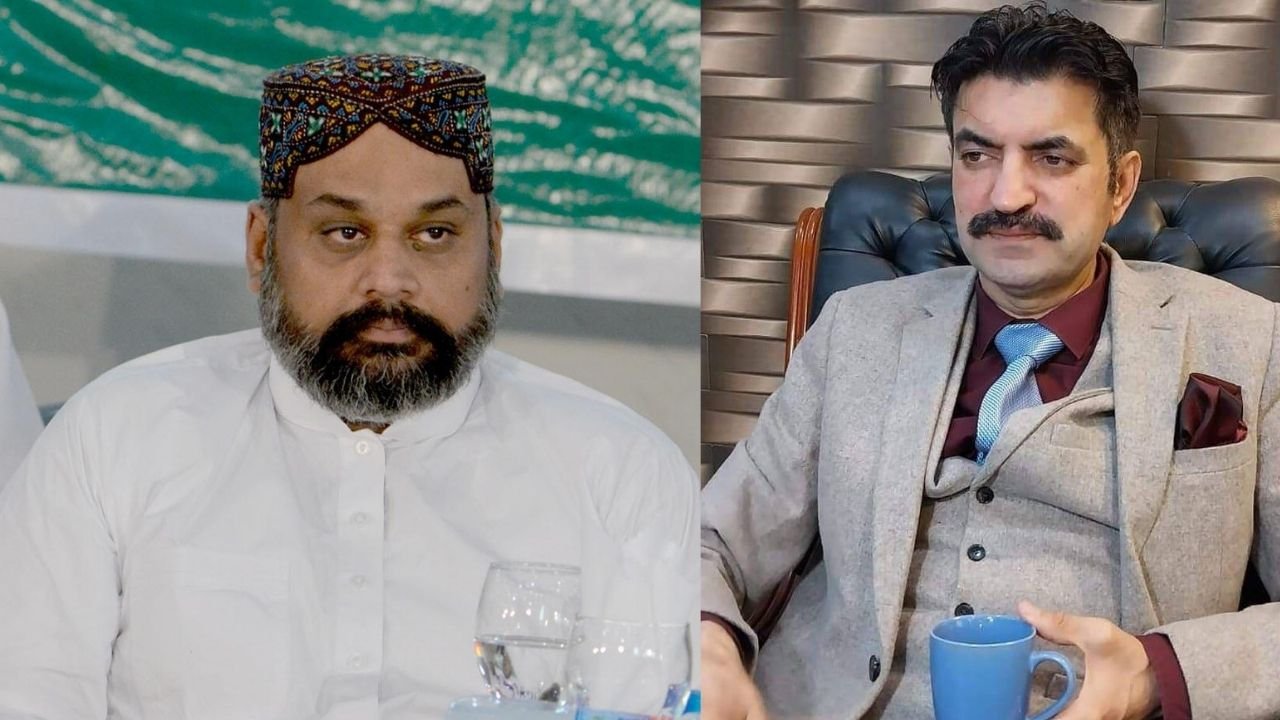
    Sahibzada Hamid Raza, Chairman of the Sunni Ittehad Council (SIC), issued a stern warning to leaders of the Pakistan Tehreek-e-Insaf (PTI), cautioning them against airing internal grievances publicly.

    Raza’s remarks came in response to PTI leader Sher Afzal Marwat’s statement, where he criticized the decision to ally with the SIC, attributing it to the loss of 80 seats.

    Marwat said the first major mistake was committed when party founder Imran Khan gave instructions for a political alliance with the Jamiat Ulema-i-Islam Sherani and the second major mistake was the announcement of the inclusion into the Majlis Wahdat-i-Muslimeen, adding that some people gave a sectarian colour to the issue and gave threatening messages to the PTI leadership.

    Expressing strong disapproval of Marwat’s comments, Raza advised PTI to resolve its internal issues internally, underscoring that the decision to collaborate with the SIC was endorsed by PTI founder Imran Khan.

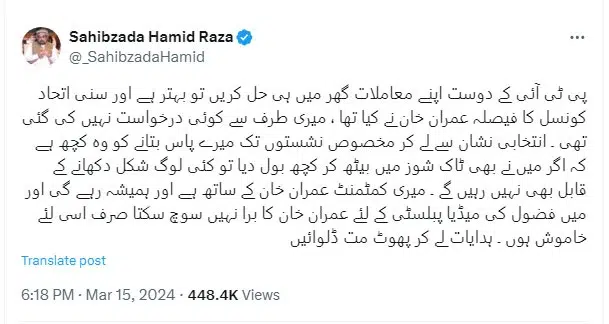
    Raza wrote on X (former Twitter), ” It is better that PTI friends resolve the matters internally and Imran Khan made the decision of Sunni Ittehad Council, I didn’t make any request. From electoral symbol to reserve seats I have so much to tell that if I say something in a talk show then these people won’t be able to show their faces.”
    In a statement made during the Geo News talk show ‘Naya Pakistan with Shahzad Iqbal Kay Sath,’ PTI leader Senator Barrister Ali Zafar shed light on the decision-making process regarding alliances for reserved seats.

    Zafar revealed that initially, the plan was to merge with Majlis Wahdatul Muslimeen (MWM), but it was later altered in favor of the SIC following discussions with Imran Khan.

    Expressing his astonishment on the development, Zafar said: “When I asked Imran Khan about this, he said he had not changed the decision.”

    Ali Zafar, however, emphasised: “The decision will have to be revised no matter how it was taken; it was our mistake; as to where and how this miscommunication was committed.”

    He conceded that Sher Afzal Marwat was right.

    “At first, a decision was made to join the MWM. Prior to that, a decision was also made to unite with Maulana Sheerani’s party as Sheerani’s group also participated in the election and had also given a list of reserved seats.”

    Zafar emphasized the need for clarity in decision-making, noting discrepancies in interpreting constitutional provisions and the Elections Act.

    He indicated that the matter may need adjudication by the Supreme Court to resolve conflicting opinions.

    The Supreme Court has to decide whether our interpretation is correct or the verdict of the ECP or the Peshawar High Court.

    “We also referred to the Election Commission’s decision to give specific seats to the BAP party in the court. To which, the ECP said that they do not know why they gave reserved seats to the BAP, so this decision cannot be used as an example here,” he said.
  • Oath-taking of MNAs on reserved seats unconstitutional: Omar Ayub Khan

    Oath-taking of MNAs on reserved seats unconstitutional: Omar Ayub Khan

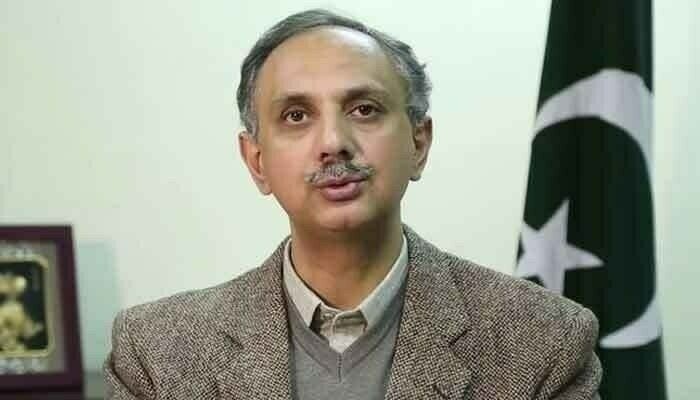
    Omer Ayub Khan, lawmaker backed by Pakistan Tehreek-e-Insaf (PTI) and Sunni Ittehad Council (SIC), strongly objected to the oath-taking of members of the National Assembly (MNAs) on reserved seats, calling it “unconstitutional.

    A group of newly elected lawmakers on reserved seats in the NA were sworn in. NA Speaker Ayaz Sadiq administered the oath to the MNAs amidst chanting by PTI-backed SIC lawmakers.

    Taking the floor, Ayub — Imran Khan’s pick for the leader of the opposition — said: “Today’s oath-taking of MNAs on reserved seats is illegal and has no [legal] standing.”

    Raising questions over the oathtaking, the PTI leader asked a country can be run without the rule of law. “The system cannot work like this.”

    The Peshawar High Court (PHC) has extended a stay order on the oath-taking ceremony for lawmakers who were supposed to take their oaths on reserved seats supported by the PTI-backed SIC. This extension lasts until March 13.

  • Mahmood Khan Achakzai nominated for President by Sunni Ittehad Council after fiery speech

    Mahmood Khan Achakzai nominated for President by Sunni Ittehad Council after fiery speech

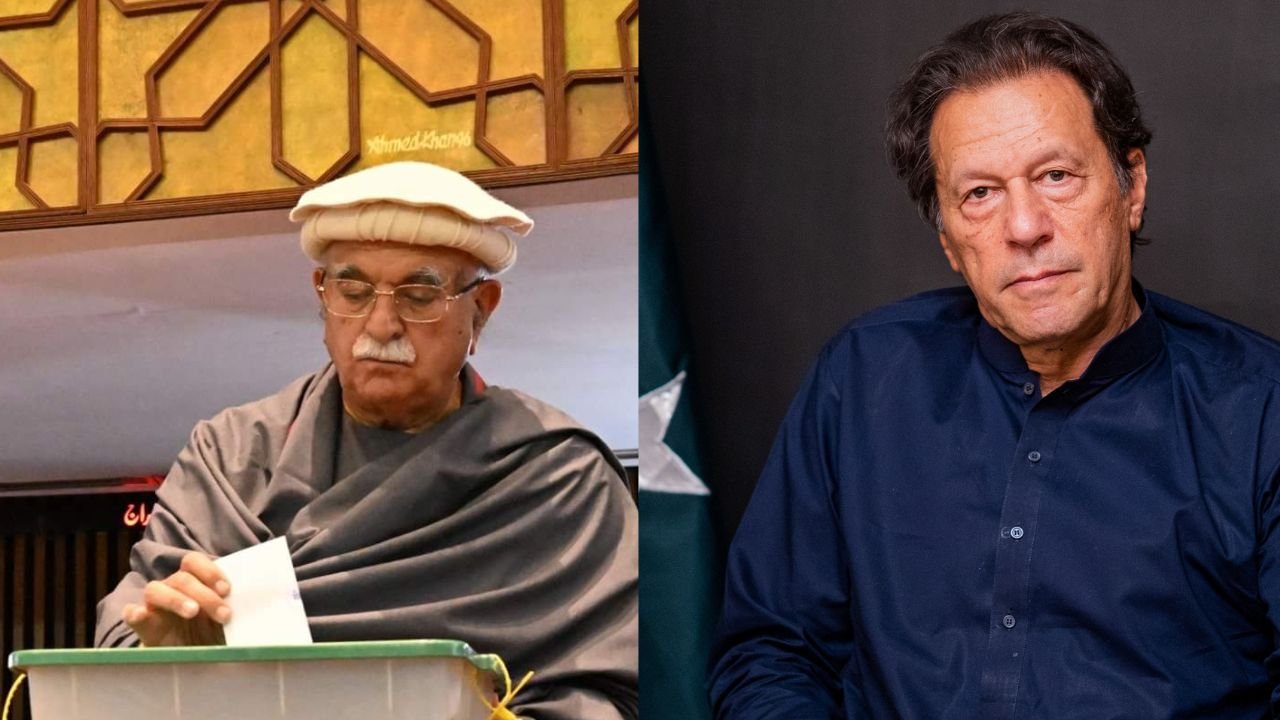
    Sunni Ittehad Council (SIC) has put forward the name of Mahmood Khan Achakzai, the leader of Pashtun­khwa Milli Awami Party (PKMAP), as their candidate for the upcoming presidential election in Pakistan.

    The announcement was made on Saturday by the SIC, endorsing Achakzai to vie for the country’s highest constitutional position against Asif Ali Zardari, the Pakistan Peoples Party (PPP) Co-chairman, who is backed by the Pakistan Muslim League-Nawaz (PML-N) and other allied parties forming a coalition government.

    Achakzai, who secured a National Assembly seat from Balochistan’s NA-266 constituency, received backing not only from his party but also from the Pakistan Tehreek-e-Insaf (PTI) founder, Imran Khan. Despite Khan’s current incarceration in Rawalpindi’s Adiala jail, he urged his party members to support Achakzai’s candidacy.

    In 2014, Khan had made fun of Achakzai in a public rally during his dharna, mimicking the Baloch leader’s shawl with a duppata.

    Confirming the nomination, PTI Chairman Barrister Gohar Khan affirmed their support for Achakzai in the presidential poll. This move comes following PTI’s efforts to gather political support against alleged electoral irregularities, with a recent meeting between PTI representatives and Achakzai, along with Balochistan National Party (Mengal) chief Akhtar Mengal.

    During the meeting, Achakzai expressed his party’s commitment to support any political entity advocating for constitutional supremacy and parliamentary empowerment.

    The presidential election, scheduled for March 9, is set to follow a stringent timeline outlined by the Election Commission of Pakistan (ECP). The deadline for the submission of nomination papers is today, with scrutiny scheduled to be completed by March 4. Candidates have until March 5 to withdraw their nominations, following which the final list of candidates will be published on March 6, preceding the polling.

    The current President, Dr. Arif Alvi, completed his five-year term on September 8, 2023, making him the fourth democratically elected president to do so. However, due to the absence of the required electoral college, he continues to hold office until his successor is elected.

    According to constitutional provisions, the president is elected by members of the National Assembly, Senate, and the four provincial assemblies. The oath-taking ceremony for the newly elected president will be administered by Chief Justice Qazi Faez Isa following the election process.

    During his fiery speech yesterday in parliament, Achakzai asked the speaker to have four resolutions passed from the house including, “This parliament announces that there will be no role of Establishment and intelligence institutions in the politics of Pakistan. This parliament will be the representative of internal and external affairs of Pakistani politics. No General will come in between.”

    He accused certain individuals of attempting to turn the parliament, representing 220 million people, into a marketplace. He emphasized the importance of upholding the Constitution and resisting any efforts by the establishment to manipulate it and further stated that just as Nawaz Sharif advocated for respecting the vote, Imran Khan has also risen to power through the people’s support.

    The PKMAP leader raised concerns about attacks on the parliament, stating that the recent attempt was futile as the people had thwarted it. He called for accountability for those seeking to undermine the democratic process.

    The presidential candidate for SIC also criticized the military and intelligence agencies’ involvement in politics, stating that they must refrain from such interference and focus on their designated roles.

    In his impassioned speech, Achakzai underscored the importance of honoring judges who did not support martial law by recognizing them as heroes, while suggesting that those who did support such measures should have their salaries revoked.