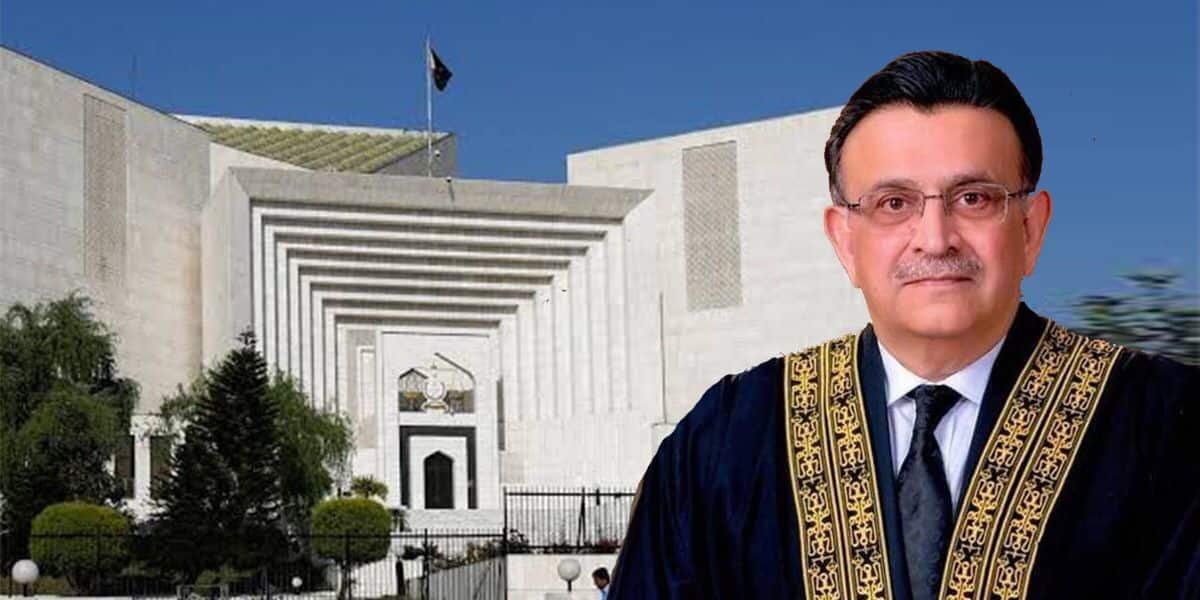
Tag: suo moto

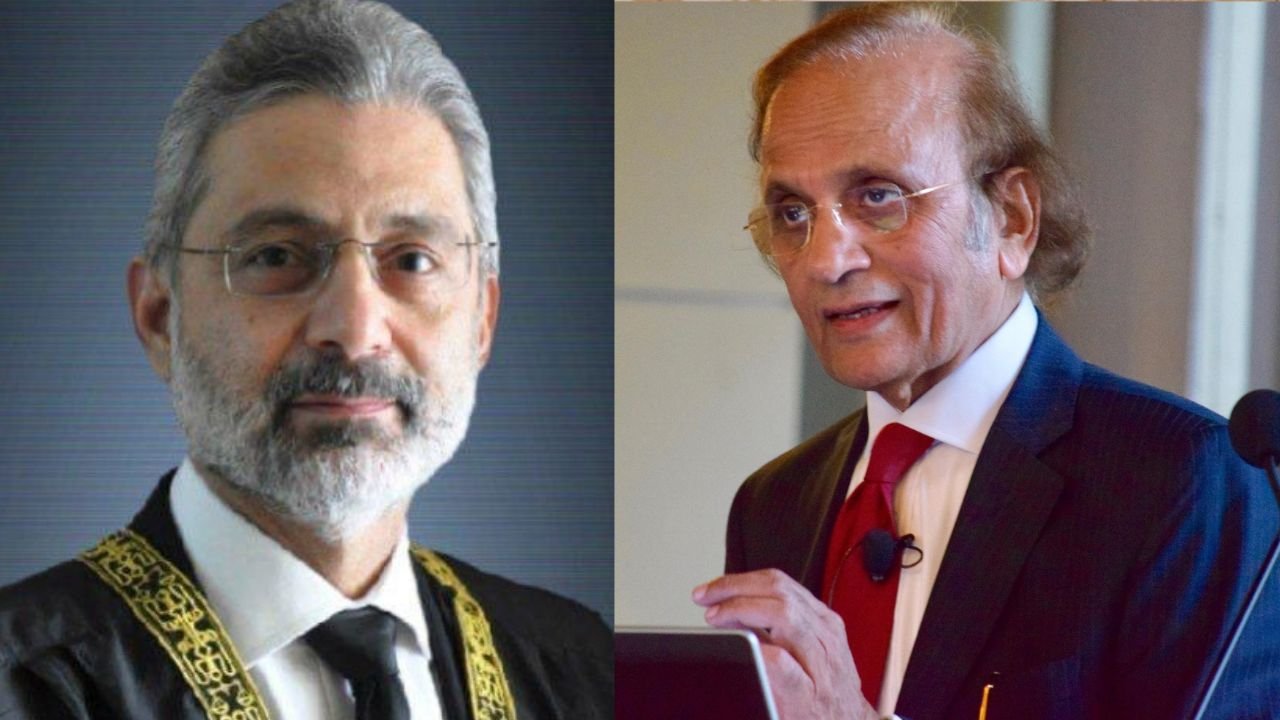
  • Judges’ letter: Justice Yahya Afridi recuses from suo moto case

    Judges’ letter: Justice Yahya Afridi recuses from suo moto case

    Justice Yahya Afridi of the Supreme Court has withdrawn himself from the suo motu case that the apex court took up after receiving a letter from Islamabad High Court (IHC) judges, alleging complaints about intelligence agencies interfering in judicial matters.

    Justice Afridi, who was part of the seven-member bench hearing the case, added his recusal in a note attached to the written order issued after the first hearing.

    The judge said the judges should consider the issues in the letter from the IHC judges according to the code of conduct of the Supreme Judicial Council.
    “High Courts are independent courts under the Constitution. Article 184/3 should not be invoked on independence of high courts,” Justice Yahya maintained.
    The seven-member bench conducting the hearing of suo motu case is headed by Chief Justice Qazi Faez Isa and comprised six other judges — Justice Syed Mansoor Ali Shah, Justice Yahya Afridi, Justice Jamal Khan Mandokhel, Justice Athar Minallah, Justice Musarrat Hilali and Justice Naeem Akhtar Afghan.

  • Petition filed against IHC judge who wrote the letter alleging interference

    In a surprising turn of events, a complaint has been filed with the Supreme Judicial Council (SJC) against Islamabad High Court (IHC) Senior Puisne Judge Mohsin Akhtar Kayani, seeking his removal over alleged misconduct.

    The complainant, Waqas Malik Advocate, is a former secretary of the IHC Bar Association. He filed the complaint accusing the judge of pursuing an ‘anti-state agenda’ and also collusion with other judges.

    Justice Kayani is one of the six judges on March 27 wrote a scathing letter to SJC alleging deep meddling in judicial affairs by spy agencies.

    The letter had stirred a national controversy and even an inquiry commission was not enough when Justice Tassaduq Jillani refused to head the one-man commission.

    The Supreme Court took Suo Moto notice after Justice Jillani refused to head the commission.

    Coincidentally, the letter by IHC judges was followed by a series of threatening and poison-pen letters sent to judges of the higher judiciary by anonymous individuals.

  • ‘Kisi ka koyi aur agenda hai…woh chief justice bun jayein’, CJ Isa says won’t allow attack on judiciary

    ‘Kisi ka koyi aur agenda hai…woh chief justice bun jayein’, CJ Isa says won’t allow attack on judiciary

    Justice Qazi Faez Isa has said during the hearing of Supreme Court’s Suo moto notice taken on the Islamabad High Court judges’ letter that, “There is zero tolerance on the independence of judiciary.”

    The hearing is being conducted by a seven-member SC bench headed by Chief Justice Qazi Faez Isa and comprising six other judges — Justice Syed Mansoor Ali Shah, Justice Yahya Afridi, Justice Jamal Khan Mandokhel, Justice Athar Minallah, Justice Musarrat Hilali and Justice Naeem Akhtar Afghan.

    CJP Isa remarked, “Judges must be sure that they are not in danger.” He also emphasized that he could not exercise contempt power in any other court because “the court which is in contempt will exercise this power itself.”

    Importantly, the lawyers had demanded a full court in the suo moto case to which CJP raised an important point that where were these lawyers when not a single meeting of the full court was conducted in four years.

    The chief justice said: “My colleagues and I will stand before any attack on the independence of judiciary.”

  • Tasadduq passes the buck back to the Supreme Court

    Tasadduq passes the buck back to the Supreme Court

    Former Chief Justice Pakistan Tassaduq Hussain Jillani on April 1 recused himself from heading the “inquiry committee” that was approved by the Federal Cabinet regarding the Islamabad High Court judges’ letter.

    Jillani’s letter was written to Prime Minister Shehbaz Sharif with the subject “One Man Inquiry Commission.”
    Last week, on Tuesday, six judges of IHC wrote an explosive letter to the Supreme Judicial Council (SJC) alleging blatant interference of intelligence agencies in judicial matters.

    The very next day, calls for investigations began to gain ground which led to CJP Qazi Faez Isa holding a full court meeting of the Supreme Court judges.

    On Thursday, the PM met with CJP and an inquiry commission was made to probe into the matter. The Federal Cabinet approved and appointed Tassaduq Jillani as the commission head on Saturday.

    However, more than 300 lawyers wrote a joint letter to the Supreme Court urging them to take Suo Moto initiative in the judges’ allegations.

    The Supreme Court on Monday took suo motu notice of the IHC judges’ letter while the former CJP Jillani also refused to head the one-man inquiry commission citing that the letter referenced the top court to intervene so it would be “violative of judicial propriety” for him to inquire into a matter which “may fall within the jurisdiction of a constitutional body which is the SJC or the Supreme Court itself”

  • Lawyers call upon the SC to use suo moto powers to probe IHC judges letter

    More than 300 lawyers across the country have urged the Supreme Court to initiate proceedings under Article 184(3) on the Islamabad High Court Judges’ letter to the Chief Justice of Pakistan alleging “interference” by the executive in judicial matters.

    On March 26, six IHC judges — Justice Mohsin Akhtar Kiyani, Justice Tariq Mehmood Jahangiri, Justice Babar Sattar, Justice Sardar Ejaz Ishaq Khan, Justice Arbab Muhammad Tahir, and Justice Saman Fafat Imtiaz — wrote a letter to the Supreme Judicial Council (SJC), demanding a judicial convention over the alleged meddling of spy agencies in legal matters.

    Last week, the CJP met with the Prime Minister to discuss this matter and it was mutually agreed to make an inquiry commission chaired by a retired judge to investigate the allegations.

    “We further call upon the Supreme Court of Pakistan to take cognisance of the matter in its jurisdiction under Article 184(3) of the Constitution as this issue eminently relates to the public interest and to the enforcement of fundamental rights,” the lawyers’ statement came after the commission was approved by the federal cabinet.

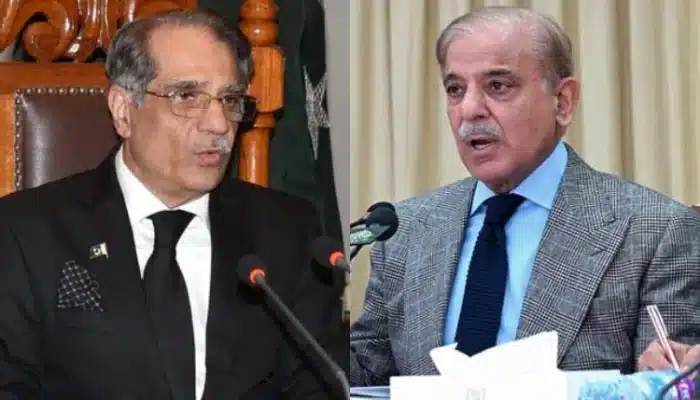
  • Audio leak: Is Saqib Nisar discussing contempt of court case against Shehbaz Sharif?

    Audio leak: Is Saqib Nisar discussing contempt of court case against Shehbaz Sharif?

    The season of audio leaks continues as a new one has hit the interwebs on Tuesday, involving an alleged conversation between Pakistan Tehreek-e-Insaf (PTI) lawyer Khawaja Tariq Rahim and former Chief Justice of Pakistan (CJP) Saqib Nisar.

    The former head of the apex court can be heard speaking about the judgement of a seven-member bench on a “suo moto” notice taken by the apex court in 2010 to Rahim and asking him to look into the matter.

    Moreover, Nisar also refers to the ouster of Pakistan Tehreek-e-Insaf (PTI) leader Sardar Tanveer Ilyas as the Azad Jammu and Kashmir prime minister over contempt of court.

    At this, the senior lawyer said that they were planning to file another contempt case.

    Here is the content of the audio leak:

    Nisar: Khawaja Sahab, I wanted to tell you something.

    Khawaja Tariq: Yes.

    Nisar: A judgement, please look into that. This is a seven-member judgement.

    Khawaja Tariq: By whom?

    Nisar: This is the sou moto (notice) number 4 of 2010, sir. This seven-member judgement, 2012, has been reported on page number 553 of the Supreme Court.

    Khawaja Tariq: Okay

    Nisar: This is okay, right?

    Khawaja Tariq: I will look into it.

    Nisar: Whoever is your lawyer, tell him to check it out. It states that if… never mind, you’ll know when you will read it.

    Khawaja Tariq: I will read. I have seen the seven-member bench judgement. They have stated in it that until the act is not formulated… if you read it carefully, clause three has it…

    Nisar: Yeah, yeah.

    Khawaja Tariq: They have given a way in it as well. Just see that.

    Nisar: Yes sir, I have seen that. That is the way out for you.

    Khawaja Tariq: That is the way out.

    Nisar: That is the way out or else there is no case.

    Khawaja Tariq: Yes exactly. I will see that as well.

    Nisar: And secondly Khawaja sahab, if someone is ready from your side, then use Muneer Ahmed Khan’s [case] as well. It is a very clear case of contempt of court.

    Khawaja Tariq: We are working on it.

    Nisar: Whatever happened in Azad Jammu and Kashmir, after that any…

    Khawaja Tariq: We are only waiting for the three-member bench’s verdict. It can take another half an hour. After that, we are filing another contempt of court case.

    Nisar: Okay then. Thank you, sir, thank you. 

    The leaked conversation has prompted online speculation that the former Chief Justice is discussing a contempt of court charge against current Prime Minister Shehbaz Sharif.

    In March, another alleged audio clip of Nisar and Rahim surfaced online in which the two talked about formulating a case against Pakistan Muslim League- Nawaz (PML-N) Vice President Maryam Nawaz.
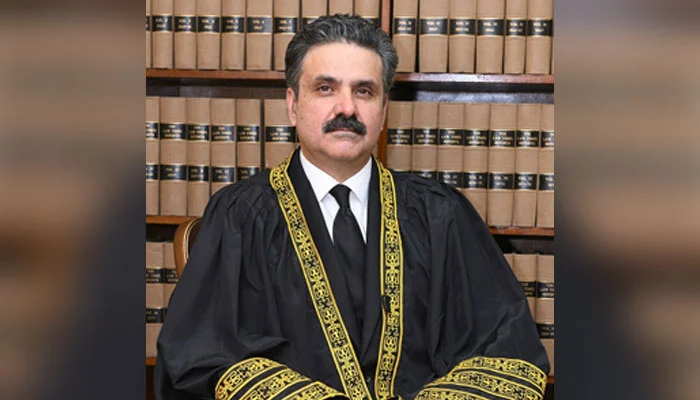
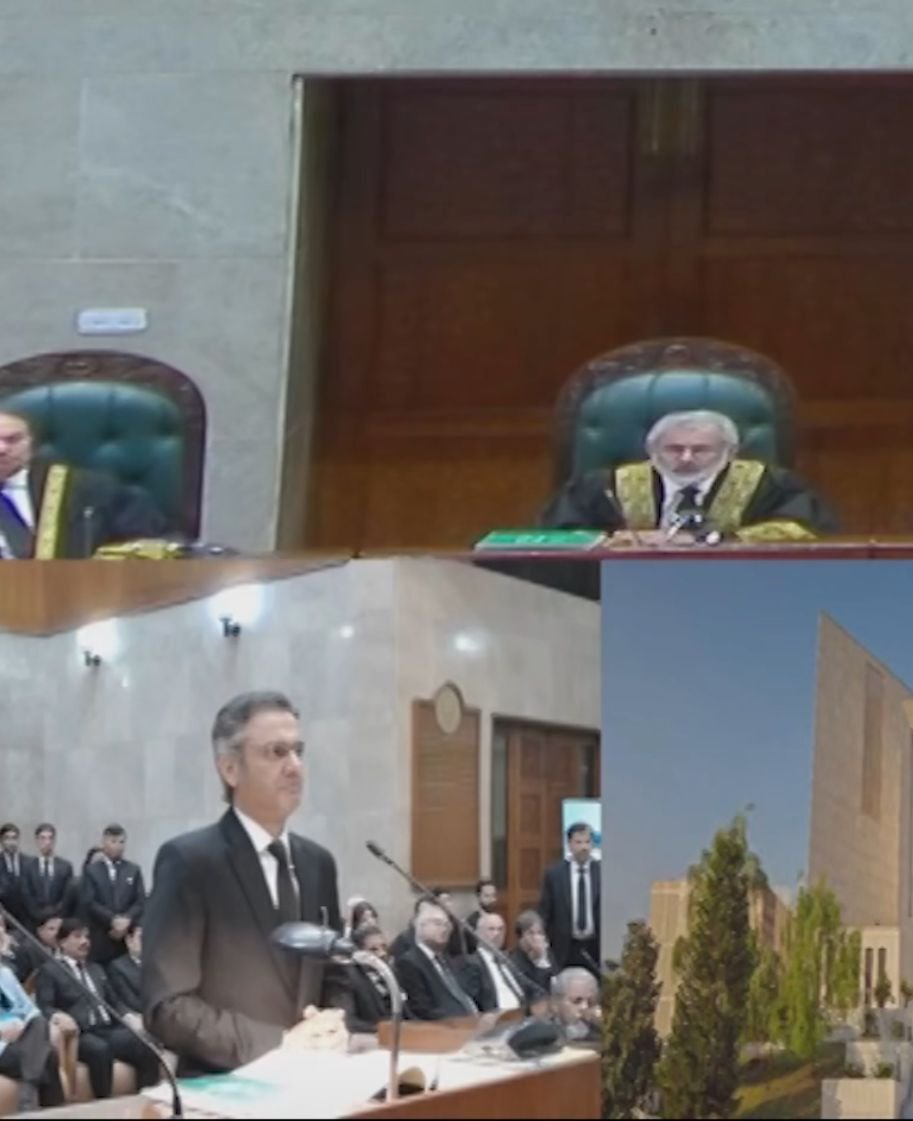
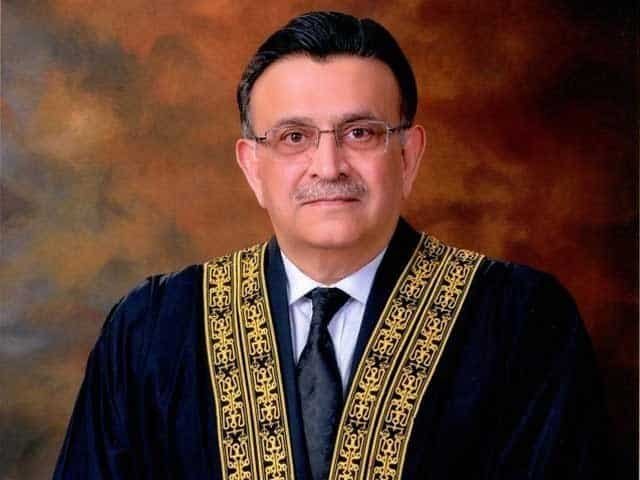
  • Govt demands resignation from Chief Justice Bandial

    Govt demands resignation from Chief Justice Bandial

    Federal Minister for Information and Broadcasting Marriyum Aurangzeb, in a press conference on Friday, demanded Chief Justice of Pakistan (CJP) Umar Ata Bandial’s resignation after Justice Athar Minallah’s hard-hitting note that said that the suo motu case of the delay in holding polls in Khyber Pakhtunkhwa and Punjab was dismissed by 4-3.

    Calling the CJP “controversial”, Aurangzeb stated that when the court’s proceedings become controversial with judges of the top court refusing to accept the judgement, how will the people accept the verdict.

    “Justice Minallah’s note is a question mark,” she said.

    Without naming Pakistan Tehreek-e-Insaf (PTI) Chairman Imran Khan, the minister said that it is not acceptable for the government that a breacher of the constitution is facilitated by the judiciary.

    She added that parliament will decide about elections, not Imran Khan.

    It is pertinent to mention that CJP Bandial is set to retire by September this year, after which Justice Qazi Faez Isa will become the new chief justice.

  • Crisis in SC deepens as Athar Minallah says that election suo motu case was dismissed by 4-3

    Crisis in SC deepens as Athar Minallah says that election suo motu case was dismissed by 4-3

    The crisis in the Supreme Court of Pakistan has deepened after another judge said that the suo motu case of delayed polls in Punjab and Khyber Pakhtunkhwa (KP) was dismissed by 4-3.

    Former Islamabad High Court (IHCJ) Chief Justice (CJ) Justice Athar Minallah released a detailed note, agreeing with Justice Jamal Khan Mandokhail and Justice Mansoor Ali Shah “particularly regarding the final outcome of the petitions and the suo motu assumption of jurisdiction by a majority of 4 to 3 because this was the understanding in the meeting held in the anteroom on 27.02.2023. It is noted that I had not recused nor had any reason to dissociate myself.”

    Justices Shah and Mandokhail had argued against the decision of taking suo motu by Chief Justice of Pakistan (CJP) Umar Ata Bandial.

    Following are the main points given by Minallah in his note:

    • He said that he read Mansoor Ali Shah and Mandokhail’s notes and agreed that the SC verdict was 4-3.
    • Referring to Munib Akhtar’s own judgment saying CJP’s power to take suo motu and form benches has “created imbalance, which ought to be corrected,” he noted that CJP’s power to form benches under SC Rules must be exercised transparently and fairly.
    • He pointed out that Pakistan Tehreek-e-Insaf (PTI) itself went to Lahore High Court (LHC) first, which allowed petitions and directed election in 90 days. So then why should SC wade into dispute, he asked.
    • Justice Minallah wrote that the court is being dragged into a political crisis, emphasising that the crisis escalated when PTI chose to resign from National Assembly instead of sitting in Opposition. He further said that the dissolution of the provincial assemblies was part of a political strategy.
    • Says SC has the duty to inspire public trust and not appear politically partisan. Everyone (including SC) has to take a step back and not stand on ego.
    • He called the political climate in the country “toxic”, saying that “it is inconceivable that political parties will even agree to have a dialogue, let alone arriving at a consensus.”
    • He said: “It is the duty of the Court to ensure that political stakeholders are not encouraged to bring their disputes to the courts for judicial settlement by bypassing the institutions and forums created under the Constitution. It weakens the Majlise-Shoora (Parliament) and the forums meant for political dialogue and, simultaneously, harm the judicial branch of the State by prejudicing public trust in its independence and impartiality.”
    • “When politicians do not approach the appropriate forums and bring their disputes to the courts, the former may win or lose the case, but inevitably the court is the loser”, he ended the note.
  • Election suo moto: Supreme Court will hear the case tomorrow

    Election suo moto: Supreme Court will hear the case tomorrow

    Chief Justice of Pakistan (CJP) Umar Ata Bandial on Tuesday pointed out that the Election Commission of Pakistan’s (ECP) decision to postpone polls in Punjab was taken in haste.

    During the hearing, the criticism from top court judges, Justice Syed Mansoor Ali Shah and Justice Jamal Khan Mandokhail was also discussed.

    “Two honourable judges gave a decision. It’s the opinion of those two judges but is not related to the current case. Do not bypass a sensitive matter,” remarked the CJP.

    However, the two judges also said that the suo motu proceedings initiated by the CJP were “wholly unjustified”, besides being initiated with “undue haste”.

    About the polls matter, CJP Bandial remarked that the court does not want to drag this matter. He also said that elections are necessary for a democracy.

    The hearing was then postponed till 11:30am tomorrow (Wednesday).

    CJ Bandial says he respects colleague’s criticism, resumes hearing over polls

    After criticism of the unfettered powers enjoyed by Bandial by his fellow judges Justice Syed Mansoor Ali Shah and Justice Jamal Khan Mandokhail, the head of the apex court said that the note is his colleagues’ opinion.

    Earlier on Tuesday, the five-member larger resumed the hearing on election suo moto, with Justice Jamal Khan Mandokhail sitting on the bench.

    ‘One-man power show’: Chief Justice under fire by his own colleagues

    On March 27, the top court judges said that the suo moto taken by the top court over the delay in elections was rejected by four judges so there is no point in the proceedings of the case.

    Turning their guns toward CJP Bandial, the two judges said that the SC can’t rely on him for its decision. Using strong words against the CJP, both of them were of the view that institutions should review this “one-man power show”.

    “When one person has too much power, there is a risk that the institution may become autocratic and insulated, resulting in one-man policies being pursued, which may have a tendency of going against the rights and interests of the people,” the document read.

    They said that CJP has unlimited powers and he can enjoy that tirelessly.

    Regarding the election matter, the top court judges directed Lahore High Court (LHC) and Peshawar High Court to settle the problem in both provinces.

    It should be noted that the Supreme Court had taken notice itself regarding the date of the election in Punjab and Khyber Pakhtunkhwa (KP) and initially a 9-member larger bench was formed on it. However, later, a five-member bench heard the case and announced that elections should be held within 90 days.

    Earlier, a bench headed by Bandial heard a plea by Pakistan Tehreek-e-Insaf (PTI) against the Election Commission’s decision to delay Punjab elections till October 8.

  • Supreme Court orders to hold polls within 90 days both in Punjab and KP

    Supreme Court orders to hold polls within 90 days both in Punjab and KP

    The Supreme Court of Pakistan has on Wednesday directed all relevant authorities to hold elections in Punjab and Khyber-Pakhtunkhwa (KP) within 90 days.

    The decision was passed three-two in favour of the verdict by the five-member bench, with Justice Mansoor Ali Shah and Justice Jamal Khan Mandokhail giving dissenting notes.

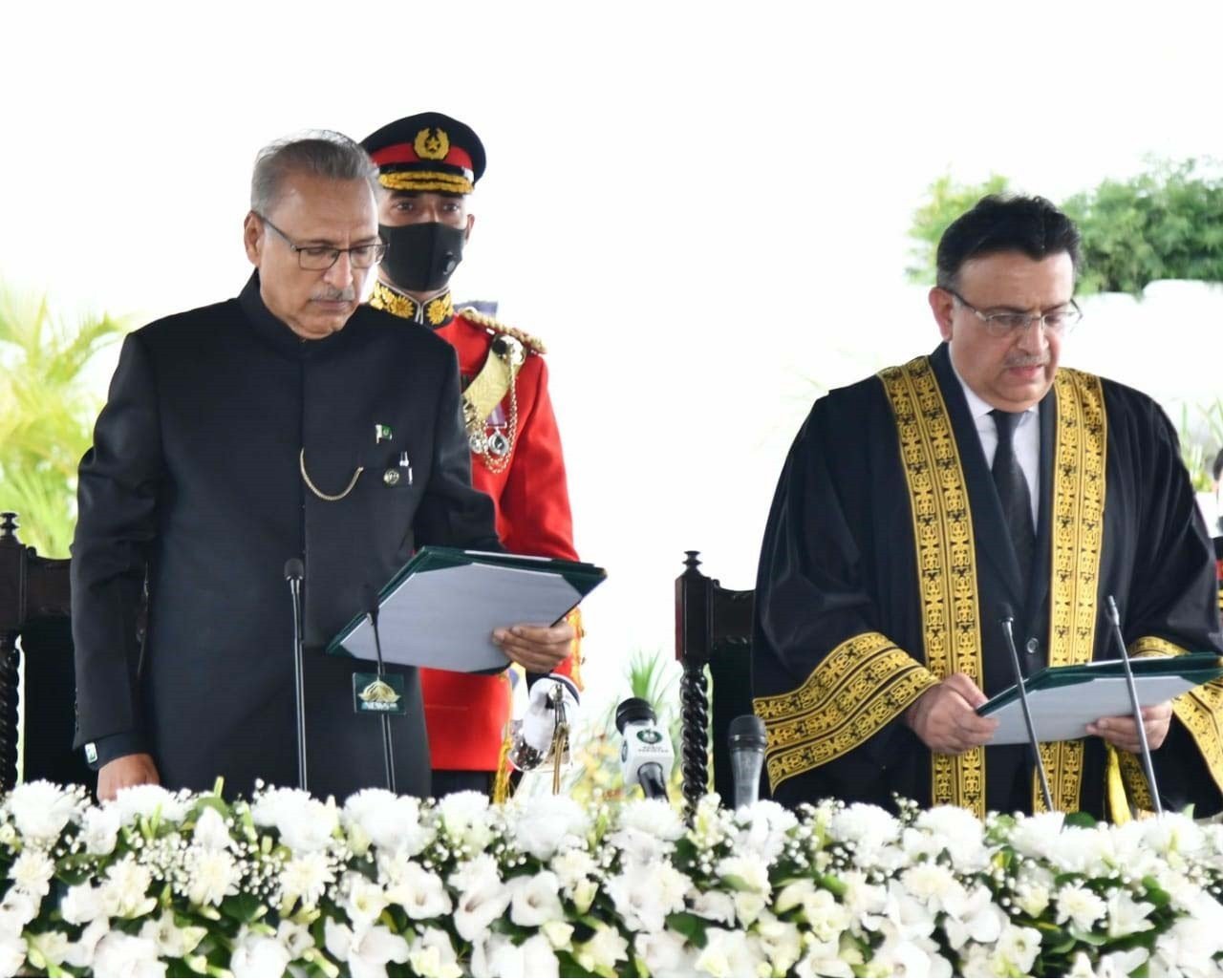
    Reading out the verdict reserved on Tuesday evening, Chief Justice Umar Ata Bandial said that the Election Commission of Pakistan (ECP) should suggest a date for polls to President Arif Alvi.

    “Elections must be held within 90 days of the dissolution of the assembly,” the verdict says, emphasizing that it was the constitutional responsibility of the Governor to announce an election date.

    “Parliamentary democracy is a salient feature of the Constitution. There can be no parliamentary democracy without Parliament or the provincial assemblies. And there can be neither Parliament nor provincial assemblies without the holding of general elections as envisaged, required and mandated by and under the Constitution and in accordance therewith,” the top court remarked.

    The court order stated, “In situations where the assembly is not dissolved by order of the governor, the constitutional responsibility of appointing a date for the general election that must follow is to be discharged by the president.”

    “The Election Commission must proactively be available to the president or the governor, and be prepared for such consultation as required for a date for the holding of general elections,” the order said.

    The court directed President Arif Alvi to announce the date of the Punjab election after consulting with the Election Commission of Pakistan (ECP), and directed the KP governor to announce the date for polls in his province.

    It further said that in ordinary circumstances, the general election in Punjab ought to be held on April 9 — the date given by the president — but because there were delays in the announcement of the poll date, it might not be possible for the province to meet the 90-day deadline.

    “The Election Commission is therefore directed to use its utmost efforts to immediately propose, keeping in mind ss. 57 and 58 of the 2017 Act, date to the president that is compliant with the deadline. After consultation with the ECP, the President shall announce a date for holding the general election to the Punjab Assembly.”

    Meanwhile, the SC directed the KP governor to appoint a date for elections in the province after consulting the ECP.