Tag: Supreme court of Pakistan

  • Supreme Court bhi mehfooz nahin; two computers stolen from top court

    Supreme Court bhi mehfooz nahin; two computers stolen from top court

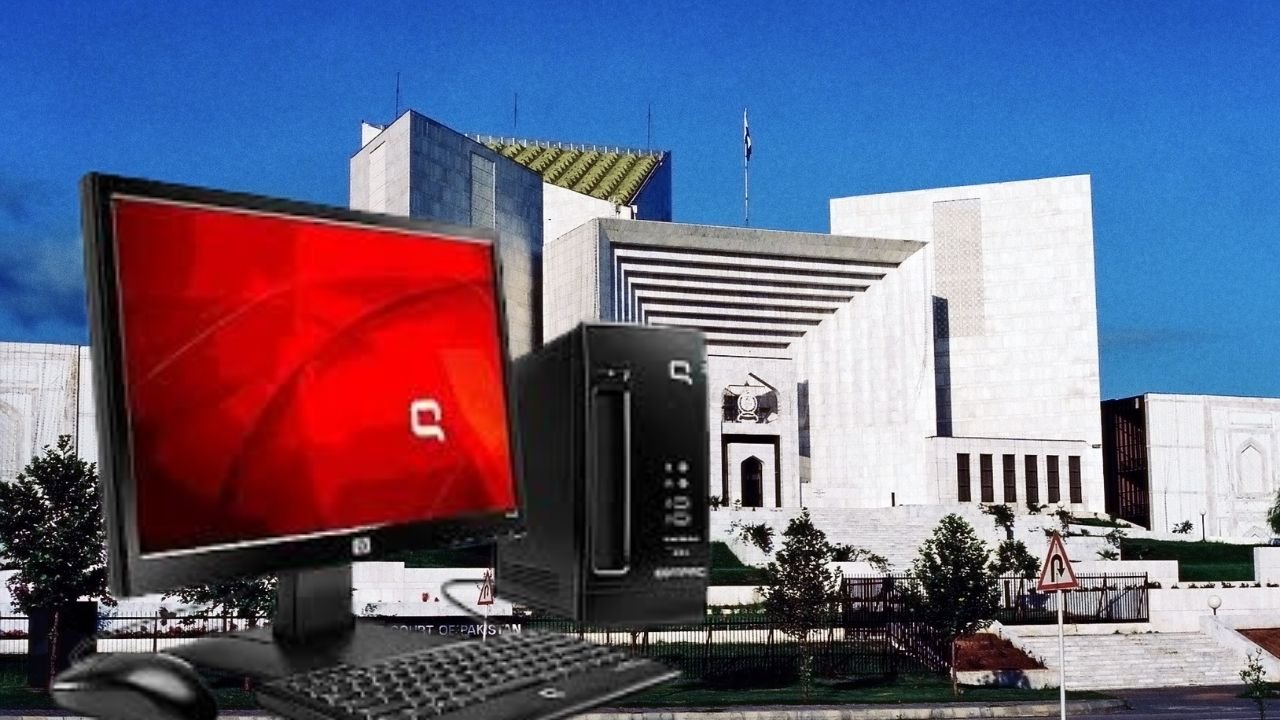
    Two computers have been stolen from the Supreme Court of Pakistan, the topmost court in the country.

    Geo News’ Arfa Feroz Zaki reported that an FIR of the incident has been registered upon the request of the director of IT department in Supreme Court in the police station of the Secretariat.

    The FIR states that the two computers were shifted to a room on the third floor of the building of the court.

    The Senior Deputy Director also shed light on the situation as he said that the two new computer systems comprising of a CPU and LCD were found missing from the room. The total cost of these two systems is said to be PKR 600,000.

    CCTV examination of the building has led to suspicion towards two employees, namely Faisal Khan and Zahid Iqbal.

    Geo’s sources say that Zahid Iqbal is serving as a driver for the Chief Justice of Pakistan whereas Faisal Khan is appointed as Naiq Qasid in the court.

  • Former DG ISI Faiz Hameed denies meeting former judge Shaukat Aziz Siddiqui

    Former DG ISI Faiz Hameed denies meeting former judge Shaukat Aziz Siddiqui

    Lieutenant General (retd) Faiz Hameed, former director general of Inter-Services Intelligence (ISI), has firmly denied allegations of him meeting former Islamabad High Court judge Shaukat Aziz Siddiqui and manipulating the judicial proceedings related to the Panama Papers case, Geo has reported.

    General Hameed labeled the accusations as “absolutely false, frivolous, concocted, and based on an afterthought.”

    He emphasized that he neither contacted Judge Siddiqui nor engaged in any meetings with him, rejecting any involvement in discussions about the appeals filed by Pakistan Muslim League-Nawaz (PML-N) leader Nawaz Sharif in the court.

    IHC former chief justice Muhammad Anwar Khan Kasi also submitted his response to the Supreme Court rejecting Siddiqui’s allegations.

    In addition, Brigadier (retd) Irfan Ramay’s reply has also been submitted to the top court, in which he denies the allegations against him and meeting Siddiqui.

    Contrary to Faiz Hameed’s reply, Siddiqui claims he has concrete evidence of two meetings with Gen (retd) Faiz Hameed at his official residence in 2018.

    Talking to Geo News, Siddiqui says he not only has a list of witnesses but also material evidence to prove his allegation that the then-DG ISI visited him twice when he was a senior serving judge.

    Siddiqui says if required, he can furnish the evidence to the Supreme Court, which is presently hearing an appeal against his dismissal by the Supreme Judicial Council (SJC) in October 2018.

    Referring to the replies of Gen (retd) Faiz and others submitted to the Supreme Court in his case, he says the replies that deny his allegations prove the point that he was dismissed from service by the SJC without inquiring about the matter.

    Siddiqui says a day after his address to the Rawalpindi Bar Association on July 22, he had formally approached the then chief justice Saqib Nisar requesting him to constitute a commission to probe the authenticity and truthfulness of what he had alleged in the address.

    “If an independent commission holds that there’s no reality in the facts presented in the meeting of District Bar Association Rawalpindi, I am ready to face the consequences, but at the same time, I have a right to enquire that if my presented facts proved correct, what would be the fate of those persons, be they the serving army personnel who are involved in manipulating the judicial system,” reads his letter written to the then CJP.

    Siddiqui requested the issuance of directives for open proceedings of an independent commission, allowing media, civil society, and the legal fraternity to attend the inquiry into his allegations.

    Expressing his distress, Siddiqui stated, “It is a matter of concern that the independence of my institution has been compromised by the intervention of a few individuals of the prestigious institution of the Army and its allied agencies.”

    He noted that he had previously pointed out this intervention, leading to the initiation of a reference against him, along with another he deemed fabricated.

    Siddiqui’s troubles began after he addressed the District Bar Association on July 21, 2018, at the invitation of the executive body.

    During this address, he presented facts related to the Constitution’s applicability, the rule of law, the independence of the bar and bench, and the dispensation of justice.

    Following his revelations, Siddiqui claimed that a false and malicious campaign was launched against him on social and electronic media.

    The former judge expressed his disappointment, revealing that he learned of the Supreme Court’s instant annoyance through social media and the press release of the Supreme Court’s Public Relations Officer (PRO). Siddiqui noted that such outbursts of anger from the Supreme Court were not new and unusual in his experience.

    Despite Siddiqui’s request for an independent commission to probe the authenticity of his claims, none was constituted.

    Read more: Supreme Court issues notice to ex-DG ISI Faiz Hameed in Shaukat Aziz Siddiqui plea

  • Two judges in a row: Future Chief Justice, Justice Ijaz ul Ahsan resigns

    Two judges in a row: Future Chief Justice, Justice Ijaz ul Ahsan resigns

    The second-most senior judge of the Supreme Court, Justice Ijaz-ul-Ahsan has resigned after removing himself from the Supreme Judicial Council (SJC).

    Journalist Azaz Syed took to X (former Twitter) and wrote, “Breaking: A future Chief Justice, Justice Ejaz ul Ahsan also tenders his resignation. Now rostrum of future chief justices will also be changed. Ejaz ul Ahsan isb neither a judge now nor a future CJ.”

    The move comes after earlier this week, Justice Mazahar Naqvi also tendered his resignation. The resignation was allegedly triggered by an open meeting of the Supreme Judicial Council.

    Senior Journalist Matiullah Jan tweeted what he believes, is the reason for Justice Ijaz’s resignation.

    The council was held under the chairmanship of Chief Justice of Pakistan Qazi Faez Isa on a complaint against Justice Mazahar Naqvi, in which Justice Sardar Tariq, Chief Justice of Lahore High Court Justice Amir Bhatti, and Chief Justice of Balochistan High Court Naeem Akhtar Afghan participated. However, Justice Ijaz-ul-Ahsan did not attend the council meeting.

    In the meeting of the Supreme Judicial Council, no one appeared in the council on behalf of former judge Mazahar Naqvi, on which the Chief Justice questioned whether Justice Mazahar Naqvi’s lawyer Khawaja Haris, or his juniors were present.

    The Chief Justice spoke to the Attorney General that did you receive Justice Ijaz-ul-Ahsan’s resignation. The Chief Justice directed the Attorney General to read out the resignation, on which he read out the resignation of the former judge.

    The Chief Justice of Pakistan said that the article under which the resignation was given should be read, on which the Attorney General read out Article 179.

    The Chief Justice asked if the Council could act without Justice Ijaz or will it be the next senior judge. The attorney general said that the council must include a senior judge.

    Justice Qazi Faez said that Justice Ijaz-ul-Hasan has resigned from joining the council and the next senior judge is Justice Mansoor Ali Shah. It then has to be ascertained whether Justice Mansoor is available or not.

    The Chief Justice directed the Secretary of the Council to find out the availability of Justice Mansoor and said that if Justice Mansoor is available, then the Council will sit again.

    Under Clause three of Article 209 of the Constitution, if there is no judge in the Council, the next senior judge can be included.

    Later, Justice Mansoor Ali Shah joined the council in place of Justice Ijaz-Ul-Ahsan and the council stopped the council meeting until the availability of Justice Mansoor Ali Shah.

  • Legal fraternity criticises Justice Naqvi’s resignation over expected perks

    Legal fraternity criticises Justice Naqvi’s resignation over expected perks

    Justice Sayyed Mazahar Ali Akbar Naqvi, who has been facing allegations of misconduct, has resigned from the Supreme Court (SC) on Wednesday. The esteemed justice cited circumstances that had become “a matter of public knowledge” as the reason behind his resignation.

    The resignation letter, obtained by Dawn.com, was formally addressed to President Dr. Arif Alvi. Justice Naqvi expressed gratitude for the honor of serving as a judge, both in the Lahore High Court and later in the Supreme Court of Pakistan.

    “In the circumstances, which are a matter of public knowledge and to some extent public record, it is no longer possible for me to continue to serve as a judge of the Supreme Court of Pakistan,” stated Justice Naqvin

    Acknowledging the importance of due process, he added, “Considerations of due process also compel. I, therefore, effective today, resign as a judge of the Supreme Court of Pakistan.”

    Mian Dawood, a Lahore-based lawyer, one of the complainants against Justice Sayyed Mazahar Ali Akbar Naqvi, declared the resignation a win for lawyers and asserted that they would challenge his resignation in the Supreme Court.

    Pakistan Muslim League Nawaz (PMLN) leader Khwaja Asif demanded that assets of the judge and his children should be investigated in the same manner as is done for politicians.

    Lawyer Abdul Moiz Jaferii took tok X (former Twitter) and said, “This resignation should be rejected. He should face the SJC and the truth should out. If he is guilty of the accusations against him, he should not have the choice to take a million rupee a month pension off into the sunset like other supposedly compromised agents before him.”

    Lawyer Nighat Dad also criticised the move and said, “Pakistanis should only focus on the perks #JusticeMazaharAkbarNaqvi he and his family will be enjoying from our tax money after resignation. His pension amount will be determined on the basis of years of service. He will have one driver and one orderly. A police guard at residence. 300 free local calls, 2000 units of electricity, 25 HM of gas, water and 300 litres of petrol per month.”

    Journalist Matiullah Jan also questioned the merits of resignation.

    The Case

    In October last year, the SJC had issued a show-cause notice to Justice Naqvi in connection with 10 complaints lodged against him and directed the judge to submit a reply within two weeks.

    The ten complaints include the complaints of Mian Dawood, a Lahore-based lawyer, Pakistan Muslim League- Nawaz (PML-N) Lawyers Forum, Punjab, PBC Vice Chairperson Haroon Rasheed and Council’s Chairperson Executive Committee Hasan Raza Pasha and Advocate Ghulam Murtaza Khan, for amassing illegitimate assets and misconduct.

    In his response, Justice Naqvi raised issues with the SJC inquiry against him and called for Chief Justice of Pakistan (CJP) Qazi Faez Isa and two other judges to recuse themselves from the matter.

    On Nov 20, Justice Naqvi contested the SJC proceedings against him and also challenged the show-cause notice issued to him by the council, stating the initiation of proceedings was coram non-judice and without lawful authority.

    Subsequently, the SJC issued a fresh show-cause notice to Justice Naqvi on Nov 22, with a direction to come up with his defense by filing a reply within a fortnight.

    On December 4, Justice Naqvi had again approached the apex court and expressed his intent to pursue the constitutional petition he had moved earlier seeking to quash the revised show-cause notice issued by the SJC.

    Two days later, Justice Naqvi had invited the attention of the SC committee comprising three senior-most judges to the silence over his petitions challenging the issuance of the show-cause notice (SCN) despite the lapse of time as stipulated in the Supreme Court (Practice & Procedure) Act, 2023.

    Justice Naqvi had also written a separate letter to the SJC secretary, asking the latter to furnish a number of documents without which, the judge said, he would not be in a position to prepare his reply to the show-cause notice within time.

    On December 15, the SJC, in an open hearing, had given two weeks to the top court judge to respond to the misconduct allegations and directed him to submit a reply to the show-cause notice by January 1.

    On January 8, Justice Naqvi had withdrawn his objection to the three-judge bench hearing his plea challenging the issuance of a show-cause notice to him.
  • Supreme Court issues notice to ex-DG ISI Faiz Hameed in Shaukat Aziz Siddiqui plea

    Supreme Court issues notice to ex-DG ISI Faiz Hameed in Shaukat Aziz Siddiqui plea

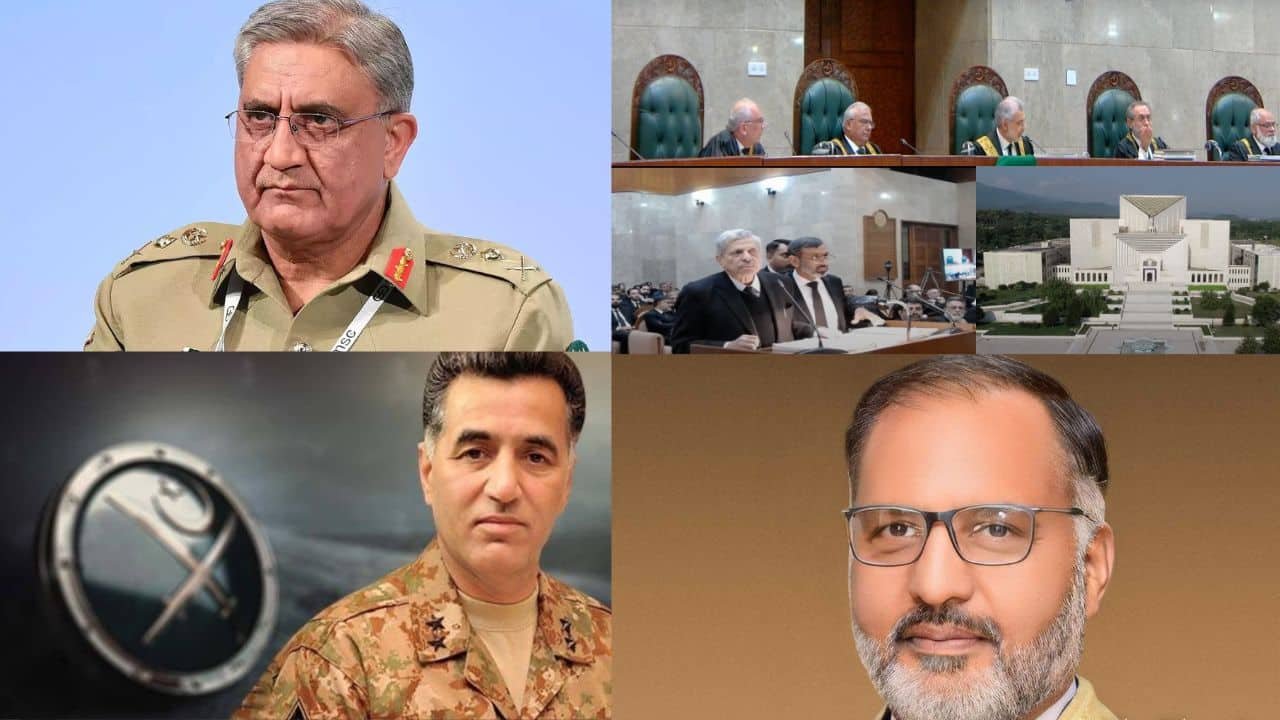
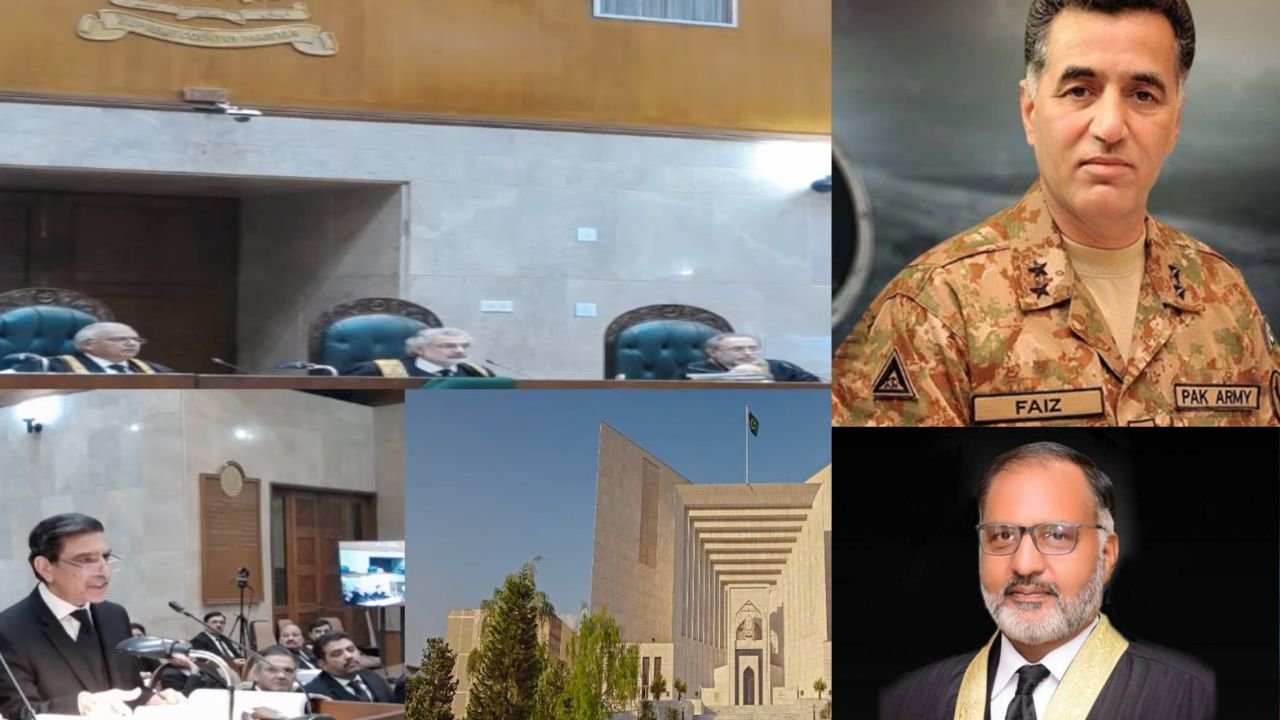
    The Supreme Court on Friday issued notices to former Inter-Services Intelligence (ISI) director-general Faiz Hameed and others on former Islamabad High Court (IHC) judge Shaukat Aziz Siddiqui’s petition challenging his removal.

    The notices were also issued to former IHC chief justice Anwar Khan Kasi, former registrar of the Supreme Court Arbab Muhammad Arif, and retired brigadier Irfan Ramay.

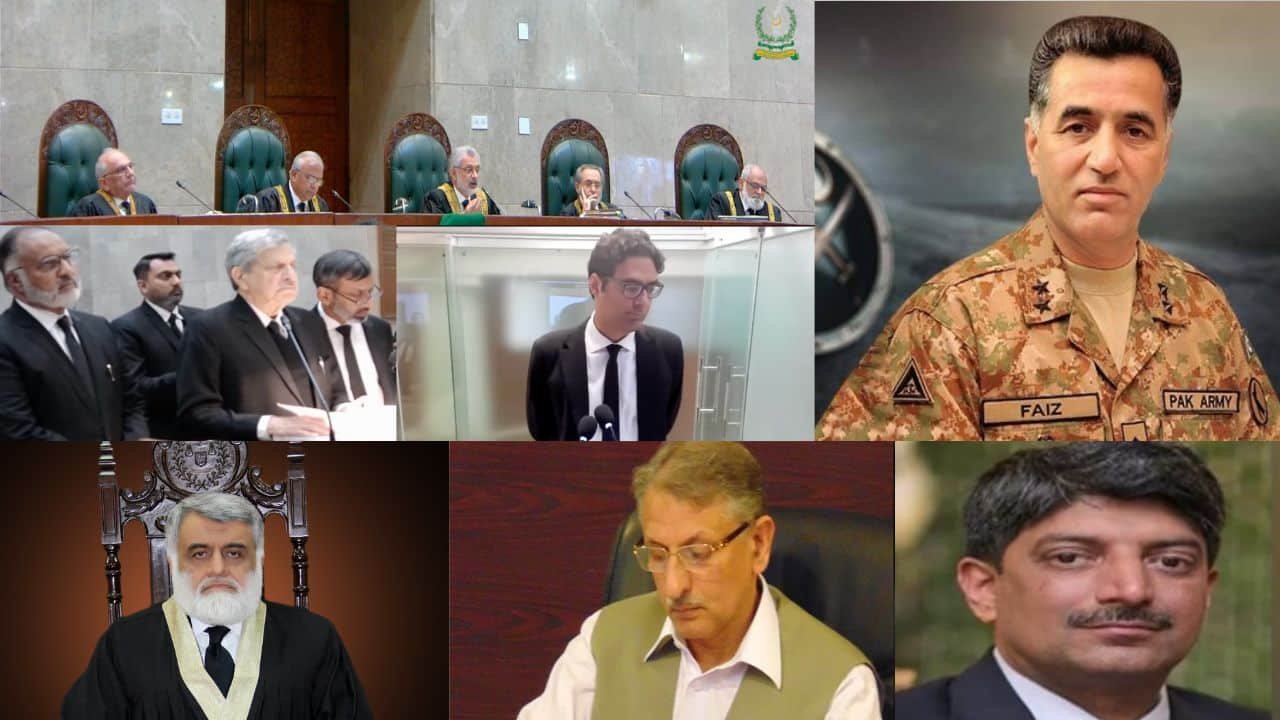
    A five-member bench led by CJP Qazi Faez Isa, comprising Justice Amin-ud-Din Khan, Justice Jamal Khan Mandokhail, Justice Hasan Azhar Rizvi, and Justice Irfan Saadat Khan, conducted proceedings on the plea.

    Today’s hearing was broadcast live on the apex court’s website as well as on its YouTube channel.

    Siddiqui nominated seven individuals in his amended plea, however, the court remarked that three others — former chief of army chief General (retd) Qamar Javed Bajwa, and two retired brigadiers- Faisal Marwat and Tahir Wafai — had no direct connection with the case.

    A day earlier, the top court ordered Siddiqui to nominate former spy chief Hameed, former army chief General (retd) Qamar Javed Bajwa, and others in the plea against his dismissal.

    Following the order, the former judge requested to make Bajwa and Hameed parties in the case related to his suspension along with IHC chief justice Anwar Khan Kasi, former registrar of the Supreme Court Arbab Muhammad Arif, retired brigadier Irfan Ramay, retired brigadier Faisal Marwat and retired brigadier Tahir Wafai.

    The case was fixed for hearing earlier this month after the judge filed a miscellaneous application with the Supreme Court to conduct an early hearing of his plea against the decision by the Supreme Judicial Council (SJC) on his dismissal.

    Lawyer Hamid Khan represented the former IHC judge in the case.

    The Case

    President Arif Alvi on October 11, 2018, removed Justice Shaukat Aziz Siddiqui as judge of the Islamabad High Court (IHC) on the recommendation of the Supreme Judicial Council (SCJ).

    The president took the decision under Article 209(5)on the SJC recommendation under Article 209(6) read with Article 48(1) of the Constitution, a notification issued by the Ministry of Law and Justice stated.

    The council unanimously opined that while delivering the speech before the District Bar Association in Rawalpindi on July 21, Justice Shaukat Aziz Siddiqui, an IHC judge, displayed conduct unbecoming of a high court judge.

    Judges on the panel included: Then Chief Justice of Pakistan Mian Saqib Nisar, Justice Asif Saeed Khosa, Justice Gulzar Ahmad, Lahore High Court’s Chief Justice Yawar Ali, and Chief Justice of the Sindh High Court Justice Ahmed Ali Sheikh.

    Justice Khosa said that the judge in question chose to address a meeting of the district bar association, Rawalpindi on July 21 at a time when many inquiries were pending against him before the SJC under Article 209.

    In his speech, Siddiqui accused the Inter-Services Intelligence (ISI) of manipulating judicial proceedings, especially in the Panamagate case.

    The ex-judge had submitted a plea against the Supreme Judicial Council’s (SJC) decision to dismiss him after a complaint was filed against him for inflammatory speeches.

  • Live proceedings of case against dismissal of ex-judge Shaukat Siddiqui

    Live proceedings of case against dismissal of ex-judge Shaukat Siddiqui

    The Supreme Court (SC) on Thursday resumed the hearing of a plea filed by former Islamabad High Court (IHC) judge Shaukat Aziz Siddiqui and ordered him to nominate former Inter-Services Intelligence (ISI) chief General Faiz Hamid and others in the plea against his dismissal.

    A five-member bench led by Chief Justice of Pakistan Qazi Faez Isa heard the case. The other members of the bench are Justice Aminuddin Khan, Justice Irfan Saadat Khan, Justice Jamal Khan Mandokhail, and Justice Syed Hasan Azhar Rizvi.

    The proceedings were broadcast live on the apex court’s website as well as on its YouTube channel.

    Lawyer Hamid Khan represented the former IHC judge in the case.

    Siddiqui has filed a miscellaneous application with the Supreme Court along with the case related to his dismissal from office. 

    The former judge has requested to make former army chief Gen (retd) Qamar Javed Bajwa and former ISI head Faiz Hameed parties in the case related to his suspension.

    The case was fixed for hearing earlier this month after the judge filed a miscellaneous application with the Supreme Court to conduct an early hearing of his plea against the decision by the Supreme Judicial Council (SJC) on his dismissal.

    Order

    The SC order, issued by the bench, mentioned that allegations were levelled against some personalities who were not present at the case’s hearing. It added that those accused in the case must be made parties.

    “How will he, who is not a party, present his position in front of the court?” the order read.

    The order also mentioned that the bench will not be available to hear the petition from Monday due to winter vacations.

    The case

    President Arif Alvi on October 11, 2018, removed Justice Shaukat Aziz Siddiqui as judge of the Islamabad High Court (IHC) on the recommendation of the Supreme Judicial Council (SCJ).

    The president took the decision under Article 209(5)on the SJC recommendation under Article 209(6) read with Article 48(1) of the Constitution, a notification issued by the Ministry of Law and Justice stated.

    The council unanimously opined that while delivering the speech before the District Bar Association in Rawalpindi on July 21, Justice Shaukat Aziz Siddiqui, an IHC judge, displayed conduct unbecoming of a high court judge.

    Judges on the panel included: Then Chief Justice of Pakistan Mian Saqib Nisar, Justice Asif Saeed Khosa, Justice Gulzar Ahmad, Lahore High Court’s Chief Justice Yawar Ali, and Chief Justice of the Sindh High Court Justice Ahmed Ali Sheikh.

    Justice Khosa said that the judge in question chose to address a meeting of the district bar association, Rawalpindi on July 21 at a time when many inquiries were pending against him before the SJC under Article 209.

    In his speech, Siddiqui accused the Inter-Services Intelligence (ISI) of manipulating judicial proceedings, especially in the Panamagate case.

    The ex-judge had submitted a plea against the Supreme Judicial Council’s (SJC) decision to dismiss him after a complaint was filed against him for inflammatory speeches.

  • Civilians to be tried in military court; Supreme Court decides

    Civilians to be tried in military court; Supreme Court decides

    The Supreme Court has, by a majority of 5-1, suspended its October 23 order that declared the trials of civilians in military courts null and void regarding the May 9 riots.

    The decision came in response to intra-court appeals (ICAs) filed by the federal and provincial governments, as well as the defense ministry, challenging the earlier verdict.

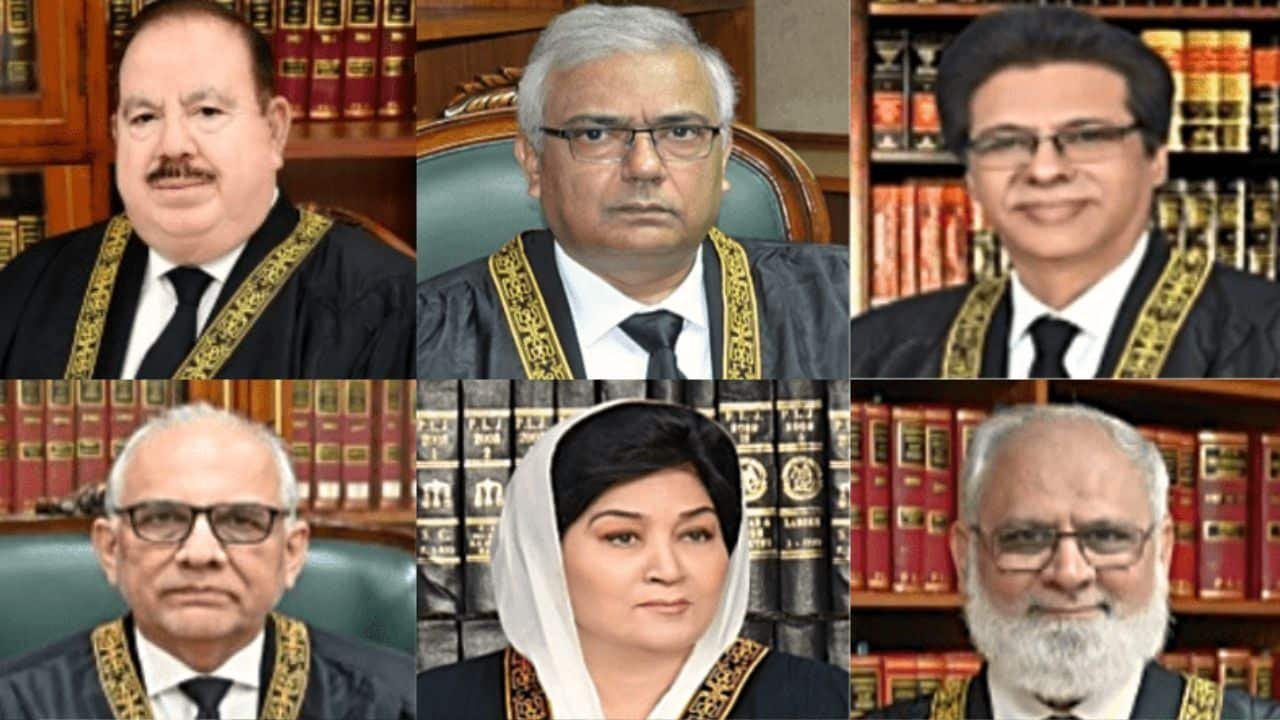
    A six-member bench of the Supreme Court, headed by Justice Sardar Tariq Masood and comprising Justice Aminuddin Khan, Justice Muhammad Ali Mazhar, Justice Syed Hasan Azhar Rizvi, Justice Musarrat Hilali, and Justice Irfan Saadat Khan heard the set of intra-court appeals.

    Justice Hilali differed with the majority decision.

    On October 23, a five-member apex court bench headed by Justice Ahsan unanimously admitted the pleas and nullified the government’s decision to try civilians in military courts in connection with the May 9 riots which erupted after the arrest of Pakistan Tehreek-e-Insaf (PTI)-then chairman Imran Khan.

    Four judges out of the five declared that Section 2(1)(d) of the Army Act and 59(4) (civil offences) are “ultra vires the Constitution and of no legal effect”.

    “Without prejudice to the generality of the foregoing the trials of civilians and accused persons, being around 103 persons […] shall be tried by criminal courts of competent jurisdiction established under the ordinary and/or special law of the land in relation to such offences of which they may stand accused,” the short order read.

    Following its verdict, the federal and the provincial governments along with the defence ministry filed intra-court appeals (ICAs). However, the caretaker government of Sindh refused to file any plea against the SC order.

    Justice Masood, who faced objections regarding his inclusion in the bench, refused to recuse himself.

    Former Chief Justice Jawwad S Khawaja and others had raised concerns about Justice Masood’s previous expressions on the matter, but the judge maintained his position.

    The Supreme Court’s recent decision to suspend the October 23 verdict means that the trials of 103 civilians will continue, with the final ruling conditional upon the Supreme Court’s subsequent orders.

  • ‘Mahr has to be paid whenever demanded by the wife’: Chief Justice

    ‘Mahr has to be paid whenever demanded by the wife’: Chief Justice

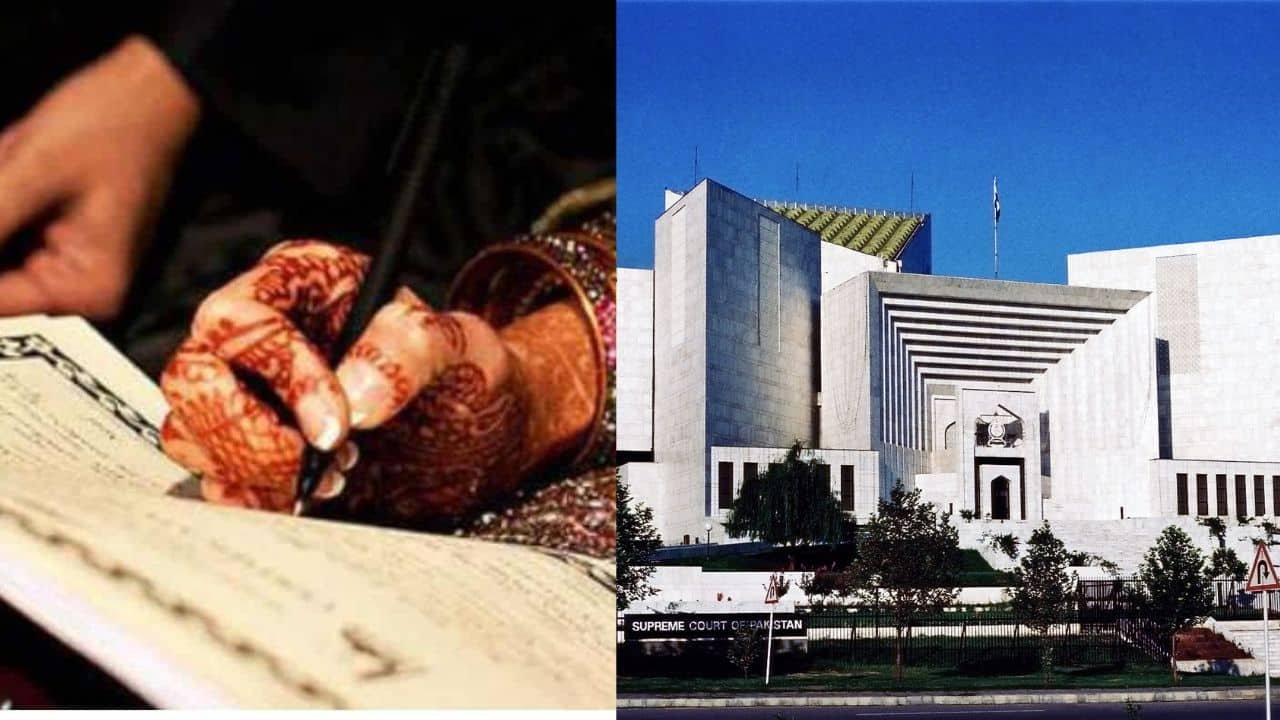
    The Supreme Court has ruled that haq mahr must be paid by the husband whenever the wife demands it, not just in the event of divorce. Mahr is the mandatory payment or gift from the groom to the bride at the time of marriage. It is a fundamental part of an Islamic marriage contract and is considered the bride’s exclusive right, reports The Express Tribune.

    In a petition to the court, a husband had contended that since he had not divorced his wife, he was not liable to pay the mahr.

    Rejecting the contention, a three-member bench led by Chief Justice Pakistan Isa referred to a 2001 judgment in which the Supreme Court had held that mahr can be demanded even when a marriage continues and that the husband is under obligation to pay the amount agreed upon at the time of the wedding.

    Referring to that case, the bench lamented that the wife had to file a suit for recovery of her mahr and maintenance and the husband unnecessarily involved her in legal proceedings that reached the court after six-and-a-half years.

    Chief Justice Isa criticised lower courts that did not penalize the husband for filing unnecessary appeals. “If the man was fined for filing unnecessary appeals, it would not have taken too long to decide the case. Filing of unnecessary appeals is paralyzing the judicial system,” he observed.
    The CJP said that the courts should not hesitate to impose fines to end unnecessary litigation.

    The chief justice ordered Khalid Parvez, the petitioner, to pay a Rs100,000 fine, the cost of legal proceedings along with mahr to his wife Samina, and dismissed his appeal, reported Dunya News.

    “Mahr has to be paid whenever demanded by the wife,” said a three-page written order authored by Chief Justice of Pakistan Qazi Faez Isa in a case related to non-payment of the money. The court also noted that mahr is an Islamic concept mentioned in the Holy Quran— Surah An-Nisa verse 4 and Surah Al-Baqrah verses 236-7. It is specifically recognized by the law of Pakistan in Section 2 of the Muslim Personal Law (Shariat) Application Act, 1962.

  • Chief Justice Qazi Faez Isa nay Mercedes neelami pay lagga dee

    Chief Justice Qazi Faez Isa nay Mercedes neelami pay lagga dee

    Chief Justice of Pakistan Qazi Faez Isa, has ordered that two luxury vehicles, allocated for his use by both the federal and Punjab governments, should be auctioned, as per Geo News.

    The decision comes as Chief Justice Isa deems the allocation an “inappropriate splurge of scarce public resources.”

    The Supreme Court registrar communicated the Chief Justice’s decision through a letter addressed to the federal government, cabinet secretary and Punjab chief secretary.

    The letter revealed that in September 2020, the apex court purchased a new Mercedes Benz, 2996 CC sedan for the Chief Justice at the cost of Rs61 million.

    Furthermore, the Government of Punjab provided a brand new bullet-proof Toyota Land Cruiser with registration number LEG-S00 for the use of the Chief Justice of Pakistan.

    The vehicle is currently stationed at the Supreme Court Rest House in the Government Officers Residence (GOR), Lahore.

    The communication emphasized that, by established rules, every judge of the apex court is entitled to two vehicles.

    “Justice Isa has not used the said Mercedes sedan nor the Toyota Land Cruiser,” said the letter. It further stated that it is an “inappropriate splurge of scarce public resources to buy imported luxury vehicles for the use of constitutional and public office holders”.

    “Therefore, these vehicles may be collected and auctioned and the money realised from the sale be spent on much needed public transport,” said the letter.

    Justice Isa took oath as the 29th CJP in September of this year after his predecessor Umar Ata Bandial hung up his robes.

    Justice Isa’s tenure as the country’s chief justice, however, will be quite brief, as he is set to retire from the position on October 25, 2024.

    He took oath as the apex court’s judge on September 5, 2014.

  • Show cause notice issued to Justice Mazahar Ali Akbar Naqvi

    Show cause notice issued to Justice Mazahar Ali Akbar Naqvi

    The Supreme Judicial Council (SJC) issued a detailed show-cause notice to Justice Mazahar Ali Akbar Naqvi on Wednesday, urging him to respond within 14 days.

    The show-cause was served with a 4-1 majority vote, with Chief Justice of Pakistan (CJP) Qazi Faez Isa, Justice Sardar Tariq, Justice Ameer Bhatti, and Justice Naeem Afghan voting in favor, while Justice Ijazul Ahsan dissented.

    The notice comes in response to 10 complaints filed against Justice Naqvi, addressing allegations of financial misconduct and possessing assets beyond means.

    Ten complaints include the complaints of Mian Dawood, a Lahore-based lawyer, Pakistan Muslim League- Nawaz Lawyers Forum, Punjab, PBC Vice Chairperson Haroon Rasheed and Council’s Chairperson Executive Committee Hasan Raza Pasha and Advocate Ghulam Murtaza Khan, for amassing illegitimate assets and misconduct.

    During the SJC meeting, complainants presented evidence, while Justice Naqvi’s objections were also reviewed by the council.

    Justice Naqvi previously challenged the SJC inquiry, asserting that it was launched based on alleged misconduct and assets beyond means.

    The objections raised by Justice Naqvi were examined during Tuesday’s meeting by council members, who also heard perspectives from complainants.

    The allegations against Justice Naqvi involve financial misconduct, and the show-cause notice underscores the seriousness with which the SJC is approaching the matter.

    The hearing is scheduled to continue, and Justice Naqvi’s response will be pivotal in determining the course of the proceedings.