Tag: Supreme court of Pakistan

  • Imran Khan says ‘mistake’ made when filing a presidential reference against SC judge Faez Isa

    During a meeting with the Insaf Lawyers Forum (ILF), former Prime Minister (PM) Imran Khan accepted his mistake of filing a presidential reference for the removal of Supreme Court (SC) judge Justice Qazi Faez Isa, reports Hasnaat Malik for The Express Tribune.

    As per the news outlet, several attendees of the meeting have said that Khan thinks that the then relevant officials had misguided his government and Khan himself was not interested in pursuing the reference against Justice Faez Isa. Former Attorney General for Pakistan (AGP) Khalid Jawed Khan had convinced him that Justice Isa was an honest judge and he was misled in this case.

    A senior Pakistan Tehreek-e-Insaf (PTI) lawyer said that Khan believed that one section within the judiciary was annoyed because of this reference case.

    In 2020, Khan accused Justice Faez of concealing assets and filed a reference against him. Justice Isa then asked the Supreme Court that a full bench be constituted, a plea that was accepted by then Chief Justice of Pakistan (CJP) Asif Saeed Khosa and after a months-long trial, in November a full bench of the apex court dismissed the petition against him.

    The purpose of the meeting with ILF was to discuss PTI’s social media activists who were being harassed by law enforcement agencies.

    PTI Secretary Asad Umar has announced that a petition will be filed against these unlawful and illegal raids and harassment of the party workers in the Islamabad High Court (IHC) today (Thursday).

  • Journalists covering the Parliament session today

    The National Assembly (NA) session chaired by Speaker Asad Qaiser is currently on-going under the Supreme Court (SC) order.

    Here is a lots of journalists and reporters who are in Parliament right now. Click on their names to follow them on Twitter.

    Journalist Asma Shirazi shared a picture where Mohammad Malick, Gharidah Farooqi, Dr Shahid Masood, Batool Rajput, Aamir Ghauri, Saleh Zaafir and Shahid Maitla can be seen.

    Other than them, Journalist Zahid Gishkori is also currently present in the Parlaiment.

    Journalist Nayyer Ali alongside BBC’s Farhat Javed Rabani and Independent Urdu’s Mona Khan posed for a picture.

    Multimedia Journalist Aamir Saeed and Geo News’ Azaz Syed are also present. Syed also interviewed NA Deputy Speaker Qasim Suri.

  • ‘Imran Khan stumped’: What led Khan to this point?

    ‘Imran Khan stumped’: What led Khan to this point?

    The Supreme Court of Pakistan (SCP) has “stumped” Prime Minister (PM) Imran Khan through its historic verdict on April 7. The verdict seems to have cleaned bowled Khan as the National Assembly (NA) was restored after the apex court declared the government’s decision to dissolve the assembly and NA Deputy Speaker Qasim Suri’s ruling against the Constitution. This decision is being described as a win for the Constitution of Pakistan.

    In its verdict, the top court has called for convening the NA session on April 9, at 10:00am.

    Court order

    The apex court’s five-member larger bench — headed by Chief Justice of Pakistan (CJP) Umar Ata Bandial and comprising Justice Muneeb Akhtar, Justice Aijazul Ahsan, Justice Mazhar Alam, and Justice Jamal Khan Mandokhel — heard the case and then later issued the ruling. The decision was unanimously given by 5-0 judges.

    Here is what the court order has to say:

    “In consequence of the foregoing, it is declared that at all material times the Prime Minister was under the bar imposed by the Explanation to clause (1) of Article 58 of the Constitution and continues to remain so restricted. He could not, therefore, have at any time advised the President to dissolve the Assembly as contemplated by clause (1) of Article 58.”

    “In consequence of the foregoing, it is declared that the advice tendered by the Prime Minister on or about 03.04.2022 to the President to dissolve the Assembly was contrary to the Constitution and of no legal effect,” said the order.

    The Supreme Court also “declared that the assembly was in existence at all times, and continues to remain and be so”.

    SC ordered for the session of NA to reconvene on Saturday, April 9 no later than 10:30am, saying that the session cannot be prorogued without the conclusion of the no-trust motion against Prime Minister Imran Khan.

    Pledge to fight for Pakistan “till the last ball”: PM Khan

    After the verdict was announced, PM Khan took to Twitter and said that he pledged to fight for Pakistan till the last ball.

    “I have called a cabinet mtg tomorrow as well as our parliamentary party meeting, and tomorrow evening I will address the nation. My message to our nation is I have always and will continue to fight for Pakistan till the last ball.”

    Government’s reaction to the decision:

    Information and Law minister Fawad Chaudhry took to Twitter and said, “This unfortunate decision has exacerbated the political crisis in Pakistan.”

    “Immediate elections could have brought stability to the country. Unfortunately, the importance of the people has been overlooked,” said Chaudhry.

    Minister for Human Rights Shireen Mazari tweeted, “A judicial coup happened last night down to ordering how & even at what time NA session must be held, ending parliamentary supremacy!”

    In another tweet, Mazari wrote, “The long shadows hanging over this judicial decision think the game has been won but frankly it has just started.”

    Special Assistant to the PM Dr Shahbaz Gill said, “Our forefathers cut off their necks in 1947 and crossed the Wagah border to live in an independent country.”

    “Looks like they’re back in the 1947 situation,” said Gill.

    Opposition’s reaction to the SCP ruling

    Reacting to the decision of the top court, the Leader of the Opposition Shehbaz Sharif tweeted, “Mubarak to all who supported, defended & campaigned for the supremacy of the Constitution. Today, politics of lies, deceit & allegations has been buried.”

    Pakistan People’s Party (PPP) Chairman Bilawal Bhutto-Zardari took to Twitter and celebrated the Opposition’s win by writing: “Democracy is the best revenge.”

    Pakistan Muslim League Nawaz’s (PML-N) leader Maryam Nawaz said, “Congratulations to Pakistan for getting rid of the most incompetent and most failed government.”

    Timeline of the events since April 3

    The legal battle against NA dissolution raged on for five consecutive days.

    April 3:

    National Assembly (NA) Deputy Speaker Qasim Suri on April 3 said that the no-confidence motion, presented on March 8, should be according to the law and the Constitution. “No foreign power shall be allowed to topple an elected government through a conspiracy,” he said, adding that the points raised by the law minister about Article 5 were “valid”.

    After Suri on Sunday “dismissed” the no-confidence motion against PM Khan, terming it against Article 5 of the Constitution, the legal war began. PM Khan then addressed the nation, saying he had advised President Dr Arif Alvi to dissolve the National Assembly, which the President approved. 

    CJP Umar Ata Bandial took suo motu of the dismissal of the no-confidence motion.

    April 4:

    On Monday, April 4 the CJP had remarked that the court would issue a “reasonable order on the issue”, but the hearing was adjourned after Farooq H. Naek, the counsel of PPP and other Opposition parties, presented his arguments.

    April 5:

    The Supreme Court on Tuesday, April 5 sought a record of the National Assembly proceedings conducted on the no-confidence motion filed against Prime Minister Imran Khan and adjourned the proceedings till April 6.

    PPP Senator Raza Rabbani quoted media reports about the ECP had said it was not possible to hold general elections within three months. However, the ECP denied issuing any statement concerning elections.

    April 6:

    CJP Bandial on Wednesday, April 6, said, “We first want to wrap up the case on what happened in the NA on April 3,” the CJP remarked.

    The chief justice said that “negative statements” are being issued against the court and it is being said that the court is delaying the matter.

    April 7:

    The court, in its short order, on Thursday, April 7, ruled that the deputy speaker’s ruling was “contrary to the Constitution and the law and of no legal effect, and the same are hereby set aside”.

  • ‘Return to April 3’: Twitter hails Supreme court’s verdict

    ‘Return to April 3’: Twitter hails Supreme court’s verdict

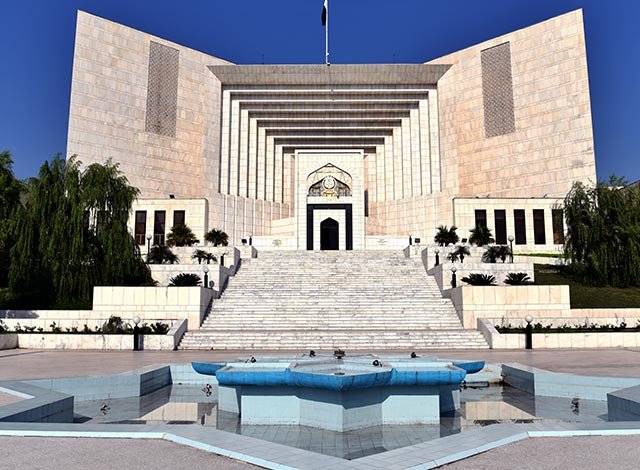
    The Supreme Court of Pakistan (SCP) has declared the National Assembly (NA) Deputy Speaker Qasim Suri’s ruling on the dismissal of a no-confidence motion against Prime Minister (PM) Imran Khan as unconstitutional and illegal.

    The session chaired by the Chief Justice of Pakistan (CJP) Umar Ata Bandial and the five-member bench has unanimously ruled that President Dr Arif Alvi’s decision to dissolve the National Assembly is “illegal” and restored Imran Khan as Prime Minister as well as his cabinet ministers. They will now face the no-confidence motion on Saturday, April 9th 2022.

    This is how Pakistani social media reacted to the decision:

  • What do the legal experts have to say about the expected SC verdict?

    What do the legal experts have to say about the expected SC verdict?

    All eyes are on the Supreme Court of Pakistan (SCP) as the country waits for the verdict of the dismissal of the no-confidence motion tabled against Prime Minister (PM) Imran Khan by National Assembly (NA) Deputy Speaker Qasim Suri. Pakistan is in a state of political chaos as the no-confidence motion against Khan was dismissed abruptly on Sunday, April 3.

    Supreme Court will announce its verdict on Deputy Speaker Qasim Suri’s ruling at 7:30pm today.

    Chief Justice of Pakistan (CJP) Umar Ata Bandial on Thursday said that it was clear that the April 3 ruling of Deputy Speaker Qasim Khan Suri was “incorrect”.

    Here is what legal experts have to say about the expected verdict.

    Ahsan Bhoon, President of the Supreme Court Bar Association (SCBA) said, “I am hopeful that the SCP will give its verdict in accordance with the constitution,” adding, “It is important to emphasise the need for an election order while maintaining the dissolution order of the Assembly.”

    SC lawyer Feisal Naqvi wrote in his op-ed in The News titled, ‘Destroying democracy from within‘: ” If today, the entire opposition can be disenfranchised on the basis of one man’s suspicions of treason, then tomorrow the entire opposition can be disenfranchised on the basis of different suspicions. No parliamentary system can work in such manner.”

    Lawyer Salaar Khan tweeted, “If the SC decides to return proceedings to the original position, the vote of no-confidence proceeds. If it fails, Imran Khan stays PM. If it succeeds, the next PM can be elected immediately thereafter. In either case, we have a stable government.”

    However, Salaar also wrote, “Mixed signals coming in from the SC. On the one hand, it has indicated that it believes the Speaker/Deputy Speaker’s ruling to be illegal. On the other, terms like ‘public interest’ and ‘stability’ suggest that we may be veering close to Necessity.”

    SC lawyer Salahuddin Ahmed tweeted, “Real mistake of SC was in not constituting a full court or larger bench of 5/7 senior-most judges. In a polarised political atmosphere; they will be lambasted whatever they decide.”

    PM Khan on March 27 claimed that the Opposition’s no-trust move is part of an alleged “foreign-funded conspiracy” hatched against his government. It is pertinent to mention here that the Opposition tabled the no-confidence motion against PM Khan on March 8. The government claims to have received the threatening communique on March 7.

    Deputy Speaker Qasim Suri on April 3 said that the no-confidence motion, presented on March 8, should be according to the law and the Constitution. “No foreign power shall be allowed to topple an elected government through a conspiracy,” he said, adding that the points raised by the minister were “valid”.

  • All eyes are on the Supreme Court: What can we expect today?

    With what seems like an uncalled-for use of power, the abrupt dismissal of the no-confidence motion against Prime Minister (PM) Imran Khan is being termed an “unconstitutional trump card”. Citizens of Pakistan have serious reservations over how Article 5 has been used as an ‘excuse’ by the Pakistan Tehreek-e-Insaf (PTI) government to effectively subvert the constitution.

    Pakistan is in a state of constitutional crisis and all eyes are on the Supreme Court of Pakistan (SCP). The main question is which way will the SCP direct the future of Pakistan? The two options that seem likely to emerge after the hearing will primarily shape the future politics and state of democracy in Pakistan.

    The Supreme Court of Pakistan is scheduled to hold a hearing on the suo motu notice taken by Chief Justice of Pakistan (CJP) Umar Ata Bandial. A five-member Supreme Court bench will hear the case for and against the dismissal of the no-confidence motion yesterday. CJP Bandial will head the session starting at 1pm on Monday.

    If the apex court decides in favour of the Opposition

    If the five-member bench decides in favour of the Opposition, the NA session will reconvene and the Lower House will have to continue with the voting on the no-confidence motion tabled against PM Khan. If Khan loses the majority, he can no longer hold office. And that the apex court will call for a fresh election in a time period of six months.

    If the apex court decides in favour of the government

    If the honourable judges of the Supreme Court decide in favour of the government, then fresh elections will be called in a time of 90-120 days. Meanwhile, it is also being speculated that the apex court will remark that it has nothing to do with the parliament and that what does goes inside the assembly strictly stays within the assembly.

    It is pertinent to mention here that Deputy Speaker of National Assembly Qasim Suri, on Sunday, April 3, dismissed the no-trust motion against Khan, terming it “unconstitutional”, saying that it was backed by “foreign powers”.

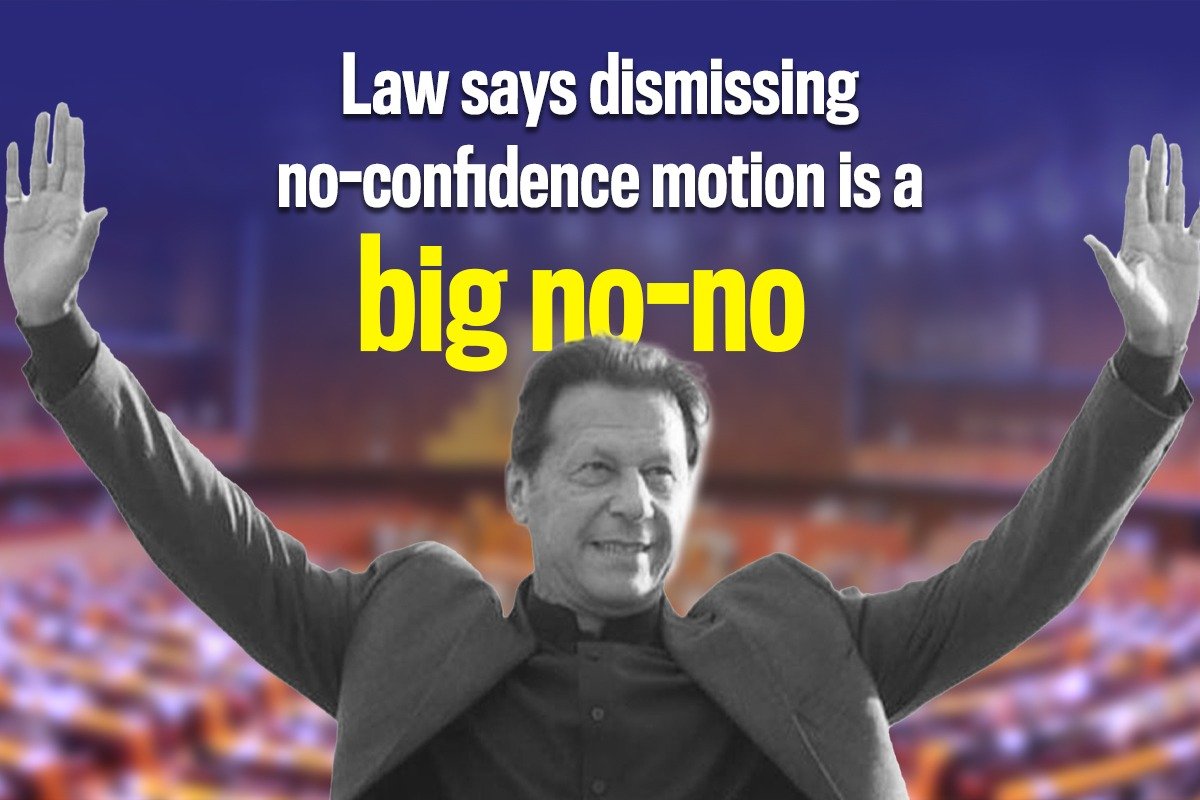
  • Explainer: Law says dismissing no-confidence motion is a big no-no

    Explainer: Law says dismissing no-confidence motion is a big no-no

    Pakistan is in a state of political chaos as the no-confidence motion against Prime Minister (PM) Imran Khan was dismissed abruptly on Sunday. The move came after National Assembly (NA) Deputy Speaker Qasim Suri termed it “unconstitutional”, saying that it was backed by “foreign powers”.

    Suri then quickly disallowed voting on the no-confidence motion and adjourned the session. Later, on PM Khan’s advice, President Arif Alvi dissolved the National Assembly, with the premier asking the nation to get ready for fresh polls.

    After the nation was left in shock, there was much talk about the “unconstitutional trump card” used by PM Khan.What everyone wants to know is: did Khan subvert the constitution of Pakistan?

    Lawyer Salaar Khan tweeted a brief comprehension of the constitutional premise of what happened on Sunday, April 3, which went viral on Twitter.

    “Instead of allowing the vote to proceed against the Prime Minister, the Deputy Speaker dismissed the resolution. After this, the President was able to dissolve the National Assembly on the PM’s advice,” tweeted Salaar.

    “Under Article 58 of the Constitution, the President may dissolve the National Assembly on the PM’s advice. However, a PM against whom a vote of no confidence ‘has not been voted upon’ cannot ask the President to dissolve the house,” wrote Salaar.

    “To get around this, the Deputy Speaker first ‘dismissed’ the no-confidence resolution submitted against the PM. He did this on the basis of a personal interpretation of Article 5, which provides for loyalty to the state.”

    “The rather feeble argument here was that because the letter that Pakistan had received from the US suggested a regime change would improve relations, the vote of the no-confidence motion, itself, was against anti-state,” said the lawyer.

    “The irony, of course, is that Article 5 also provides for obedience to the Constitution – which was arguably violated in the process of the dismissal of the no-confidence motion.”

    “Procedurally, a ‘motion’ for no-confidence is first moved and, if leave is granted, it becomes a ‘resolution’. Under the Rules of Business in the National Assembly, there is no provision that actually allows a Speaker or Deputy Speaker to dismiss a resolution.”

    “In fact, the role of the Speaker is very clearly defined in Schedule 2 of the Rules of Business in the NA, and is essentially limited, in a VoNC, to announcing the result.”

    “And so, because the Speaker can’t dismiss a resolution for a VoNC, there is still a VoNC that has not been ‘voted upon’ by the Prime Minister. Consequently, the PM could not have advised that the assembly be dissolved under Article 58.”

    “In fact, in doing so, it may even be argued that he not only violated Article 5, by not obeying the Constitution but also subverted the Constitution under Article 6. It is, however, important to note that Article 6 is often used rather flippantly in common parlance.”

    “Finally, is the question of what the SC may do in all of this. One provision of the Constitution that has been mentioned a lot is Article 69, which bars courts from interfering in certain Parliamentary proceedings.”

    “However, the SC has laid out exceptions to this bar. Courts can interfere where there is not an ‘irregularity’ but a ‘patent illegality’, where there is clear mala fide, or where the matter in question affects the composition of the house, itself (such as in Farzand Ali).”

    “But while the SC may well find that it can interfere, how far it will go is another question. In theory, the SC could find the dissolution to be without legal effect and even order voting to resume on the VoNC. But given recent precedent, that may be a long shot.”

    The Supreme Court of Pakistan took suo moto notice of the Assembly proceedings on Sunday, April 3, and restrained the state institutions as well as the political parties from taking any unconstitutional acts and exploiting the situation.

  • PM Khan ready to share ‘written letter of foreign conspiracy’ with CJP Bandial: Asad Umar

    PM Khan ready to share ‘written letter of foreign conspiracy’ with CJP Bandial: Asad Umar

    Federal Minister for Planning, Development, and Special Initiatives Asad Umar said that Prime Minister (PM) Imran Khan is ready to share the “threat letter” with Chief Justice of Pakistan (CJP) Umar Ata Bandial. PM Khan claimed during Pakistan Tehreek-e-Insaf’s (PTI) March 27 rally that he had evidence of a “foreign-funded conspiracy” to topple his government and showed a letter to the audience.

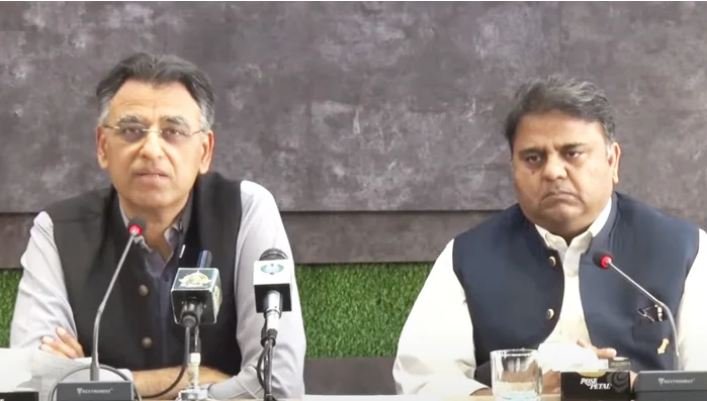
    Addressing a press conference in Islamabad alongside Information Minister Fawad Chaudhry, Minister for Planning and Development Umar said he has seen the letter himself, adding that if someone had doubts, the “prime minister is ready … he thought we can share with the chief justice of the Supreme Court”.

    Chief justice has a very good reputation

    Asad Umar said that after the masses questioned the credibility of the letter, the prime minister deliberated over sharing the letter with someone, and he thought that it would be right to share it with the CJP — as he is a credible person.

    “He holds a high office […] and the chief justice himself is a well-respected man,” the federal minister said, noting that it would be shared with the CJP when the need might arise.

    “Obviously, it is the highest office of justice in Pakistan, it is a huge position that has respect in this country. Personally too, the chief justice has a very good reputation. The prime minister said that on the nation’s behalf, if necessary, and for the people’s satisfaction, he is ready to present the letter to the chief justice of the Supreme Court.”

    Letter stated that if Imran Khan remained the prime minister, it would lead to “horrific consequences”

    “This is a very concerning thing and it is important because this letter clearly mentions the no-confidence resolution. There is no ambiguity that the no-confidence motion is being talked about.”

    Umar further said the letter stated that if Imran Khan remained the prime minister, it would lead to “horrific consequences”.

    ‘Letter shared with top civil, military leadership’

    Without naming anyone and in an apparent reference to opposition leaders, Umar referred to demands sharing contents of the letter.

    “They are asking why can we share the letter with them,” he said, adding that “national secrets are very sensitive in nature and there are clear laws on with whom these could be shared”.

    Umar then insisted that the letter was a “reality” and revealed that he had seen it.

    “I bear witness to it,” he said.

    Umar further said the letter had only been shared with the top civil and military leadership and a few members of the federal cabinet.

    Nawaz Sharif is involved in the “conspiracy” against PM Imran Khan

    Without naming anyone and in an apparent reference to Opposition leaders, Umar referred to demands sharing contents of the letter.

    “They are asking why can we not share the letter with them,” he said, adding that “national secrets are very sensitive in nature and there are clear laws on with whom these could be shared”.

    Umar then insisted that the letter was a “reality” and revealed that he had seen it.

    “I bear witness to it,” he said.

    Umar further said the letter had only been shared with the top civil and military leadership and a few members of the federal cabinet.

    Pakistan has a leader who is not attending foreign phone calls and is connected with the people

    “Until now, they were unaware, but now, they have been informed about the letter. So, it is up to them to decide whether they will side with forces working against Pakistan or not,” added Chaudhry.

    Chaudhry said this is “not a new thing” as earlier ex-prime minister Liaquat Ali Khan was assassinated, former premier Zulfiqar Ali Bhutto was prosecuted, and former military ruler Gen Zia-ul-Haq lost his life in a plane crash.

    The information minister said that the decisions taken in the past were part of Pakistan’s history. “But now, Pakistan has a leader who is not attending foreign phone calls and is connected with the people.”

  • Harvard University congratulates Ayesha Malik for becoming first female Supreme Court judge

    Harvard University has congratulated its alumnus, Ayesha Malik who is the first woman appointed as a judge of the Supreme Court of Pakistan in 75 years of its history.

    She has studied law and earned a degree of LL.M ( Master of Laws) in 1999 from Harvard Law School where she was named a Landon H. Gammon Fellow for academic excellence. Harvard Alumni Association also published an article on her achievement on its website.

    “Congratulations to @Harvard_Law alum Ayesha Malik LLM’99, who was appointed to the Supreme Court of Pakistan! She is the first woman to serve as a justice of Pakistan’s Supreme Court in the country’s 75-year history,” Harvard Alumni Association tweeted on March 27.

    Justice Ayesha Malik took oath as the Judge of the Supreme Court of Pakistan on January 24, 2022. Chief Justice of Pakistan (CJP) Gulzar Ahmed administered the oath.

  • Voting on no-confidence motion expected on April 3 or 4 : Sheikh Rasheed

    Voting on no-confidence motion expected on April 3 or 4 : Sheikh Rasheed

    Interior Minister Sheikh Rasheed has said that voting on the no-confidence motion against oust Prime Minister (PM) Imran Khan will take place on April 3 or 4.

    The federal minister’s comments came during a press conference.

    The interior minister said that everyone is allowed to hold public gatherings in Islamabad; however, according to the directions by the Supreme Court of Pakistan (SCP), no one will be allowed to enter the Red Zone.

    The minister also announced that Pakistan People’s Party MNA Jam Abdul Karim would be arrested upon arrival in Pakistan as he is nominated in the Nazim Jhokhio murder case. “He is coming to cast his vote from Dubai. I have directed the Federal Investigation Agency (FIA) and talked with IG Sindh. We will arrest him and hand him over to the Sindh police,” said Rasheed.

    Rasheed said that the suspect is being brought to Pakistan from Dubai without obtaining bail ahead of voting on the no-trust motion against PM Khan. “This shows that their [Opposition’s] legs are trembling,” he added. 

    Taking a jibe at the Opposition, he said that they are “fools” because they played a major role in the popularity of Imran Khan.

    It is pertinent to mention here that National Assembly (NA) Speaker Asad Qaiser adjourned NA session on the vote of no-confidence motion till Monday (March 28).