Tag: Supreme court of Pakistan

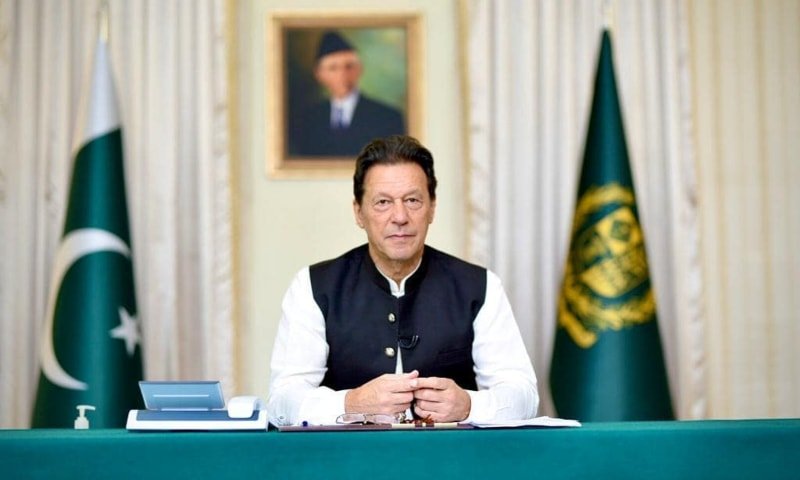
  • ‘Sadiq aur Ameen’: Can PM Khan be disqualified?

    ‘Sadiq aur Ameen’: Can PM Khan be disqualified?

    Prime Minister (PM) Imran Khan and his ruling party are being criticised by the Opposition after a scrutiny committee of the Election Commission of Pakistan (ECP) reported that the party received funding from foreign nationals and companies, under-reported funds, and concealed dozens of its bank accounts.

    Lashing out at the premier, Pakistan Muslim League-Nawaz (PML-N) president Shehbaz Sharif said, “Truth has a strange way of exposing people. The facade of ‘Sadiq aur Ameen’ [Truthful and honest] has been shredded into pieces.”

    The Current reached out to the legal experts to understand what will happen to PM Khan’s stance of being truthful and honest and will the Supreme Court (SC) disqualify him.

    It is being speculated that the ruling PTI may only face confiscation of funds but another notion is that the election commission can take action against the party head under the corrupt practices clause of the election act.

    Former Additional Advocate General Punjab and Advocate Supreme Court, Faisal Hussain Chaudhry while speaking to The Current said, “The Prime Minister cannot be declared or disqualified in this aspect. This aspect has been dealt with by SCP. Secondly one has to see whether the accounts were concealed.”

    “The party chairman submitted the accounts which were duly audited by a chartered accountant. It’s not his own, he just submitted the documents,” said Hussain.

    “Similar cases which contain the same allegation, more or less, are on Nawaz Sharif and Asif Ali Zardari are also pending. So, whatever the consequence of this case would be, it will be applicable to the other parties as well,” said Hussain.

    Reema Omer, a legal adviser for the International Commission of Jurists (ICJ) in a conversation with The Current said, “A question that arises from this case is whether PM Khan would cease to be “honest and Ameen” under Article 62(1)(f) of the Constitution if the ECP finds the PTI had received foreign funding, given that as head of the party, he issued certificates pledging that the PTI received no funds from any source prohibited under the law.”

    “Supreme Court’s interpretation of Article 62(1)(f) has been arbitrary and inconsistent, which makes it difficult to predict how such a plea would be decided,” she added.

    “However, given the dangers inherent in the SC disqualifying members of parliament on vague and subjective grounds and making declarations about their honesty, such a provision should be construed narrowly. It is time laws such as Article 62(1)(f) are repealed or read down — not given more teeth,” said Reema.

    “Imran Khan’s disqualification was one of Hanif Abbasi’s prayers in the petition before the Supreme Court. The SC did not give any definitive answer and left it open, to be determined once the issue of foreign funds is decided,” said Reema Omer.
  • Mosque constructed on land allotted for a park, Mufti says no to demolition

    Leading Islamic scholar and head of Darul Uloom Karachi, Mufti Taqi Usmani tweeted against the orders of the demolition of Madina Mosque which is located at Tariq Road, Karachi.

    On Tuesday, the Supreme Court of Pakistan ordered to demolish several structures that are constructed on unauthorised lands in Karachi including Madina Mosque.

    The apex court found out the mosque was constructed on the land that was allotted for the park.

    Mufti Taqi Usmani said in his tweet that the order of demolition of Madina Masjid on Tariq Road and construction of the park is totally “unjustified”. Thie mosque was constructed around 25 years ago on Tariq road and worshippers were using it since then.

    The Islamic scholar also said that the decree is incomprehensible without first hearing from the residents living in the neighborhood regarding the demolition of the mosque. He demanded that the court should review their order immediately.

    Meanwhile, authorities of Karachi held a meeting on Wednesday to implement the court orders since the construction of the mosque was done on illegal land.

  • Supreme Court orders Education Commission to close illegal private universities

    Supreme Court orders Education Commission to close illegal private universities

    The Supreme Court of Pakistan (SC) on Wednesday ordered the Higher Education Commission (HEC) to close down campuses of private universities all over the country that are running illegally.

    The SC remarked campuses of Preston University and Al Khair University have been set up illegally in Lahore and Karachi. Students sought help from the court about the HEC not issuing degrees to those who have studied from these universities.

    The case was heard by a three-member bench headed by Justice Umar Ata Bandial.

    The court gave directions to HEC to make special arrangements to award degrees to the students who had graduated from these illegal campuses. It also said that policies of HEC should be implemented with uniformity all over the country.

    The bench gave remarks that there should be no compromise on the provision of higher education to all young students. Provincial and Federal governments need to work closely and cooperate to maintain the standards of HEC.

    The SC noted that the issue was whether private universities are allowed to open sub-campuses outside their territorial limits or not. It added that HEC already made it very clear that they could set any sub-campuses and they issued many alerts as well.

    Counsel for students, Ali Zafar said that the session court had ordered the National Accountability Bureau (NAB) to take action against these universities. However, Justice Bandial replied, “The HEC has the powers. There is no need for NAB to investigate the matter.”

    The court said that the federal government would be ordered to change the laws if HEC is weak.

    “The students had approached the Lahore High Court (LHC) for their degrees. The LHC declared the [sub-]campuses of private universities illegal,” the counsel added.

    Justice Bandial acknowledged the high court verdict and emphasised pursuing the shut down of illegal campuses at the earliest.

  • Court sentenced former policeman for throwing acid on ex-fiance

    A Session court in Karachi gave life imprisonment to a former policeman, Zeeshan Umar for throwing acid on his ex-fiance, Raheela to take revenge over refusing his marriage proposal in 2015.

    Zeeshan Umar was found guilty of attacking 19-year-old Raheela Raheem, her brother, and her nephew on July 5, 2015, in Mobina Town. Another accused Agha Sohrab was acquitted due to lack of evidence.

    Additional District and Session Judge Javed Hyder Phulpoto pronounced the verdict reserved after recording arguments and pieces of evidence. The trial took six years to reach the final verdict.

    A fine of Rs1 million was also imposed on the convict by the judge.

    Counsel of the complainant, Salahuddin Panhwar said that according to the prosecution, Umar and Raheela got engaged in 2015 but their relationship was called off after a few months because the victim’s family considered him (Umar) a mugger.

    He further said that Raheela went to a local shop to put henna on her hands on the day of the incident, a day before Eid. She was standing outside the house carrying her six-month-old nephew, Muhammad Hadi, when the culprit suddenly appeared and threw acid on her face and the child.

    She lost one eye and her face got completely burnt. Her nephew also suffered serious burn injuries.

    Prior to this, the Supreme Court of Pakistan ordered the police to give security to the victim and her family in 2017. The counsel emphasised that they still need protection since higher-ups of police failed to follow court’s orders.

  • NAB arrests Speaker Sindh Assembly after Supreme Court rejects bail

    Speaker of Sindh Assembly Agha Siraj Durrani has been arrested by the National Accountability Bureau (NAB) in front of the Supreme Court (SC) after his bail hearing, reports Geo Urdu.

    Durrani was arrested for allegedly accumulating assets worth Rs1.6 billion through illegal means.

    He approached the SC after Sindh High Court (SHC) rejected his bail in assets beyond means case.

    Earlier today, it was reported that the apex court ordered him to surrender before NAB.

    During Durrani’s hearing, Justice Mansoor Ali Shah observed that the SHC rejected Durrani’s bail plea on the basis of merit.

    “Supreme Court cannot conduct a hearing on this plea without the high court’s verdict,” he said.

    SC ordered Durrani to turn himself in, saying: “First comply with the SHC’s order and surrender before NAB and then the court will conduct a hearing on this case next week.”

    The apex court also rejected Durrani’s request to restrict NAB officials from arresting him from the courtroom.

    Justice Bandial, who was heading the hearing, directed Durrani to first surrender before NAB.

    “We had given you concession earlier as well. There is a high court order against you. We will not interfere in NAB’s matter,” the judge stated.

  • PPP leader Khursheed Shah granted bail, name to be placed on ECL

    PPP leader Khursheed Shah granted bail, name to be placed on ECL

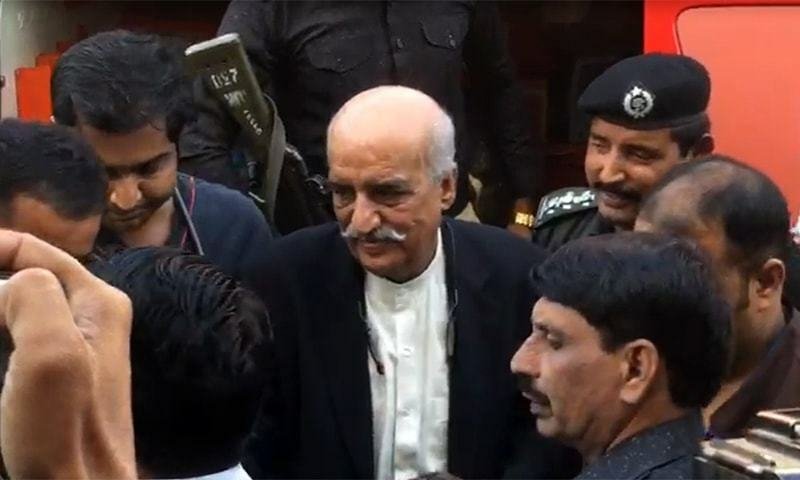
    Pakistan People’s Party (PPP) leader Khursheed Shah was granted bail from the Supreme Court (SC) of Pakistan today (Thursday) in the assets beyond means case, reports Geo News.

    The court has directed Shah to submit bail bonds worth Rs10 million as the surety against his bail and ordered that his name be placed on the Exit Control List (ECL).

    Justice Umar Atta Bandial, who chaired the hearing of Shah’s bail plea, also directed the National Accountability Bureau (NAB) to continue its investigations but not keep Shah permanently in jail.

    In July, the Sindh High Court (SHC) dismissed Shah’s request for bail. Later, he challenged the local court’s decision in the apex court.

    NAB had arrested Khursheed Shah on September 18, 2019, accusing him of allotting himself an amnesty plot illegally from a cooperative society in Sukkur.

    NAB also accused Shah of acquiring assets worth some Rs700 million in the names of his frontmen through illegally acquired money.

  • Noor Mukadam case: SC demands evidence against Zahir Jaffer’s mother

    Noor Mukadam case: SC demands evidence against Zahir Jaffer’s mother

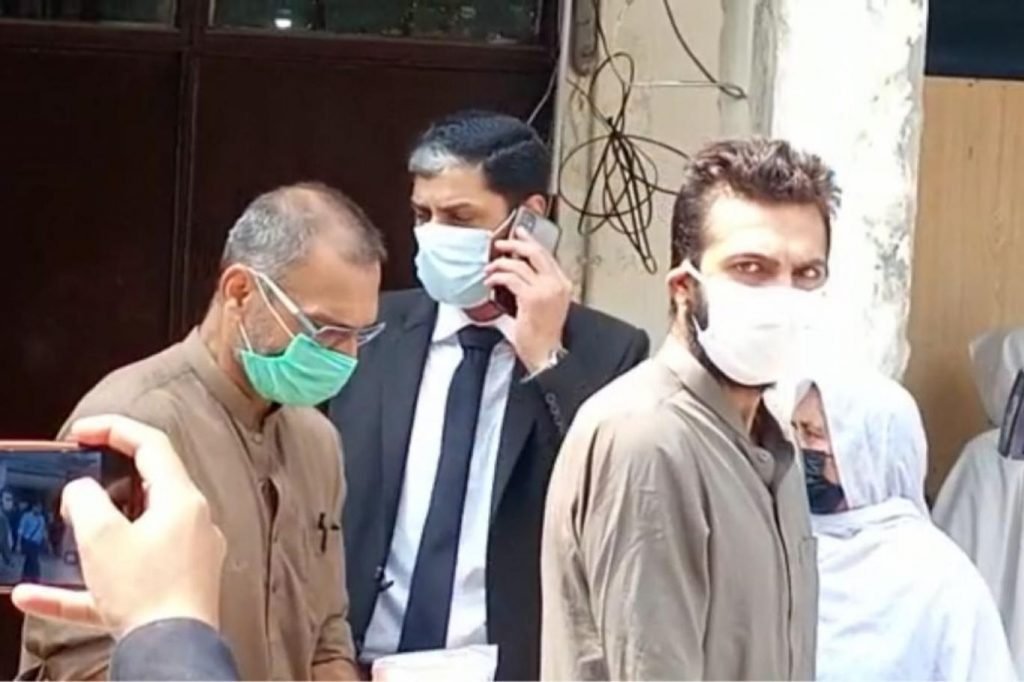
    The Supreme Court (SC) of Pakistan directed the prosecution to submit evidence against Zahir Jaffer’s (prime suspect in Noor Mukadam’s murder case) mother Asmat Adamjee, reports Dawn.

    The Court was hearing the bail pleas of ​​the parents of Zahir Jaffer, which were previously rejected by the Islamabad High Court (IHC).

    The petitioner’s lawyer Advocate Khawaja Harris stressed that the case against the petitioners was not based on solid evidence, rather the allegations were highly speculative.

    Justice Umar Ata Bandial, during the hearing, pointed out that there was no mention of Adamjee in the IHC’s order denying bail to the duo.

     “We are just trying to get the hang of the Noor Mukadam case,” Justice Bandial said while adding that the court was seeking information only to understand the facts of the case.

    Khawaja Harris argued that the order to complete the trial in two months will affect the right to a fair trial.

    To which the court said that the right to a fair trial was a must. “But the delay in handling the case only adds to anxiety.”

    Justice Bandial adjourned the court till October 18. However, last week a sessions court in Islamabad fixed October 14 for the indictment of 12 suspects in the case.

    Last week, Zahir Jaffer’s parents challenged IHC’s bail rejection by approaching the SC.

  • Delivering verdict in two months goes against rights of suspect: Zahir’s parents approach SC

    Delivering verdict in two months goes against rights of suspect: Zahir’s parents approach SC

    Zahir Jaffer’s parents have challenged Islamabad High Court’s (IHC) bail rejection by approaching the Supreme Court (SC), reported Geo News.

    Zahir is the prime suspect in Noor Mukadam’s murder case.

    Advocate Khawaja Harris filed a petition on behalf of his clients Zakir Jaffer and Asmat Adamjee, arguing that delivering a verdict in two months goes against the rights of the suspects and the principles of a transparent trial.

    According to the petition, a complete challan of the case has not yet been presented in the trial court, while the high court went beyond its jurisdiction by directing to complete the trial in two months.

    Furthermore, the petition argued that the police investigation was biased and not impartial. According to Zahir’s parents’ lawyers, the defendants will not be able to defend themselves properly in prison as it will be difficult for them to communicate with them being in prison.

    Last week, the IHC had rejected the bail pleas of both of Zahir’s parents and also ordered the court to complete the trial within eight weeks.

    However, in IHC’s detailed verdict, it was ruled that both Zakir and Asmat committed the crime of aiding Noor’s murder.

  • HRW lauds Pakistan for its first woman Supreme Court justice

    HRW lauds Pakistan for its first woman Supreme Court justice

    Human Rights Watch (HRW) in its latest report welcomed the nomination of Justice Ayesha Malik to the Supreme Court of Pakistan.

    The appointment of a woman to the Supreme Court would be a significant step in reforming the gender inequity in Pakistan’s legal profession, says HRW.

    Chief Justice of Pakistan Gulzar Ahmed has nominated Justice Ayesha A. Malik for the elevation to the Supreme Court.

    Pakistan is the only nation in South Asia to have never had a female Supreme Court judge.

    As per the HRW report, “Only about four per cent of Pakistan’s High Court judges are women. Of the 3,005 Pakistani judges in the lower and higher courts, only 519 – or 17 per cent – are women.”

    While some women head district courts, none have yet been appointed to the Supreme Court.

    Pakistan has produced women lawyers of international renown such as Hina Jilani and the late Asma Jahangir, the Pakistan Bar Council – which regulates lawyers – has never had a woman member. Jahangir remains the only female lawyer to have been elected as president of the Supreme Court Bar Association.

    Pakistan’s constitution, consistent with international law, provides that all citizens are equal under the law and prohibits discrimination on the basis of sex. 

    Women having less representation in the legal profession is due to harmful societal attitudes, harassment in the workplace, and structural barriers such as the opaque appointment process for judges.

  • Justice Ayesha Malik makes history, first woman judge elevated to the Supreme Court

    Chief Justice of Pakistan Gulzar Ahmed has nominated Justice Ayesha A. Malik for the elevation to the Supreme Court, tweeted senior journalist Hasnaat Malik.

    Justice Ayesha will be the first woman judge in the history of Pakistan to be elevated to the Supreme Court.

    She will become the first woman Chief Justice of Pakistan after Justice Yahya’s retirement in January 2030.

    Justice Ayesha A. Malik is one of the only two women judges in the 40 esteemed judges of the Lahore High Court. According to Women in Law, a group working for equal opportunities for women lawyers in Pakistan, only 15 per cent of women judges are part of the Pakistani judiciary.

    Justice Ayesha Malik’s name came to fame after her landmark judgment against the ‘two-finger test’ or two-finger virginity test of sexual assault survivors.

    Justice Ayesha Malik, 54, received her early education from Karachi Grammar School and her LLM degree from Harvard Law School in the United States, after which she returned to Karachi to practice law.