Tag: Supreme Court

  • Out of 687 staff members, only 45 women are employed in the Supreme Court

    Out of 687 staff members, only 45 women are employed in the Supreme Court

    New details reveal that among the total staff members of 687 in the Supreme Court, only 45 are women.

    The information came to light as a judicial order directed Supreme Court Registrar Jazeela Aslam to give details on staff following a petition filed in 2019, appealing the Right of Access to Information Act 2017 and Article 19-A of the Constitution.

    The apex court reportedly has 894 sanctioned positions at the moment but 207 of them are vacant and 687 employees were working as of September 25.

    146 are employed on a daily wage basis.

    84 new positions have been created since January 2017.

    The details also reveal that out of all the 45 women working in the apex court, 33 hold regular positions while 12 are contingent employees.

    Additionally, only two people with disabilities and two transgenders are employed.

  • Supreme Court declares trial of civilians in military courts null and void

    Supreme Court declares trial of civilians in military courts null and void

    The Supreme Court (SC) on Monday has declared trials of civilians in military courts null and void.

    A five-member bench of the Supreme Court has announced its decision on applications challenging the military trial of civilians involved in the May 9 riots.

    In the short verdict, the court ordered that 102 individuals detained under the Army Act should face trial in civilian courts. It additionally dictated that any trial of a civilian in a military court is considered invalid.

    The apex court’s bench — headed by Justice Ijaz Ul Ahsan, and comprising of Justice Munib Akhtar, Justice Yahya Afridi, Justice Sayyed Mazahar Ali Akbar Naqvi and Justice Ayesha Malik — heard petitions filed by PTI chief Imran Khan and others on Monday.

    The Attorney General of Pakistan (AGP), Mansoor Usman Awan, completed his arguments and he had focused on jurisdiction of military courts to try civilians under the Army Act.

    The day before, the federal government had notified the top court that military trials of civilians had already begun.

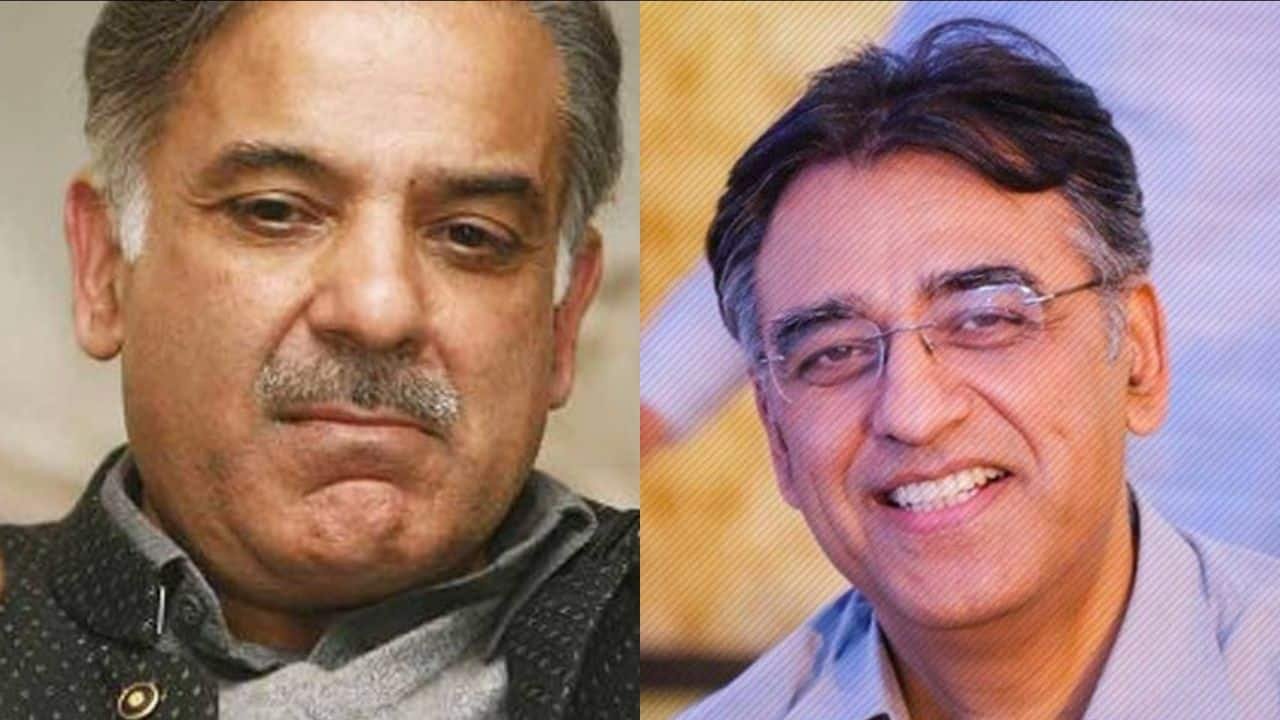
  • ‘Why is Shehbaz happy if the judgment is against Nawaz’ asks Asad Umar

    ‘Why is Shehbaz happy if the judgment is against Nawaz’ asks Asad Umar

    The Supreme Court (SC) has on Wednesday evening issued a verdict in favour of the SC (Practice and Procedure) Act, 2023, dismissing petitions challenging its validity.

    The decision was upheld by 10-5 majority. However, by an 8-7 decision, the majority of judges decided against the provision of law wherein retrospective right of appeal was given in the Act.

    Key Provisions of Act

    The act makes a number of significant changes to the way the Supreme Court operates. These include:

    • Requiring a three-member committee of senior judges, including the CJP, to approve all suo moto notices.
    • Establishing a transparent process for the formation of benches for hearing crucial constitutional issues.
    • Giving parties the right to appeal to the Supreme Court within 30 days of a final order from a lower court.
    • Requiring the apex court to hear applications alleging urgency or requesting interim relief within 14 days of filing.

    Reaction to the decision

    Former Prime Minister and President of _ (PML-N) Shehbaz Sharif welcomed the decision.

    “The Supreme Court’s verdict regarding the Practice and Procedure Act 2023 is a welcome step,” he wrote on X (formerly Twitter)

    Interestingly, when Asad Umar, PTI’s former secretary general, was asked about the judgment, he stated that it was the right decision but was intrigued to know if Nawaz Sharif would come back after the decision or not.

    “My question is, everyone is saying this is not a good judgment for Nawaz Sharif, why is Shehbaz Sharif liking this decision so much? I’m just asking an innocent question,” he said while talking to the media on Thursday morning.

    The verdict has caused a rift in the legal world. The decision, which involves Article 184(3), has led to intense discussions about what it means for the PML-N leader, Nawaz Sharif.

    As per Dawn, lawyer Mohammad Ikram Chaudhry explained that in cases where no review has been filed, it’s possible to request a “condonation of delay,” which means the court might accept an appeal or application even if it’s late.

    Mohammad Akram Sheikh noted that according to the law, a review must be requested within 30 days of the judgment. He mentioned that in some cases, the highest court has allowed for delays but stressed that the applicant would need to provide a valid reason for the delay.

    Senior lawyer Raja Inam Ameen Minhas mentioned that the Supreme Court Bar Association has an ongoing review petition against the disqualification of politicians. He argued that since the matter of disqualification is still under consideration, it’s “still appealable.”

    Barrister Zafarullah Khan, the former special assistant on law to the ex-PM, pointed out that the Supreme Court’s decision wouldn’t affect Mr. Sharif’s cases because he wasn’t seeking relief from the highest court. Instead, he intends to pursue his appeals against convictions, which would eventually reach the Supreme Court.

    Some lawyers believe that the decision is a setback for Nawaz Sharif, who recently planned to return to Lahore after spending four years in London.

    The decision declared Section 5(2) of an act as ultra vires, meaning that the lifetime disqualification in the Panama case remains in effect.

    Lawyer Abdul Moiz Jafferi questioned who really won in this matter.

    Lawyer Usama Khawar Ghumman argues that Nawaz Sharif and Jehangir Tareen can still contest elections.

    “Despite Supreme Court’s decision to strike down retrospective rights of appeal, Nawaz Sharif & Jehangir Tareen can, in the short run, contest elections due to the PDM-led Parliament’s amendment to Section 232 of the Election Act, 2017,” he wrote on X (formerly Twitter).
  • Supreme Court upholds Practice & Procedure Act 2023

    Supreme Court upholds Practice & Procedure Act 2023

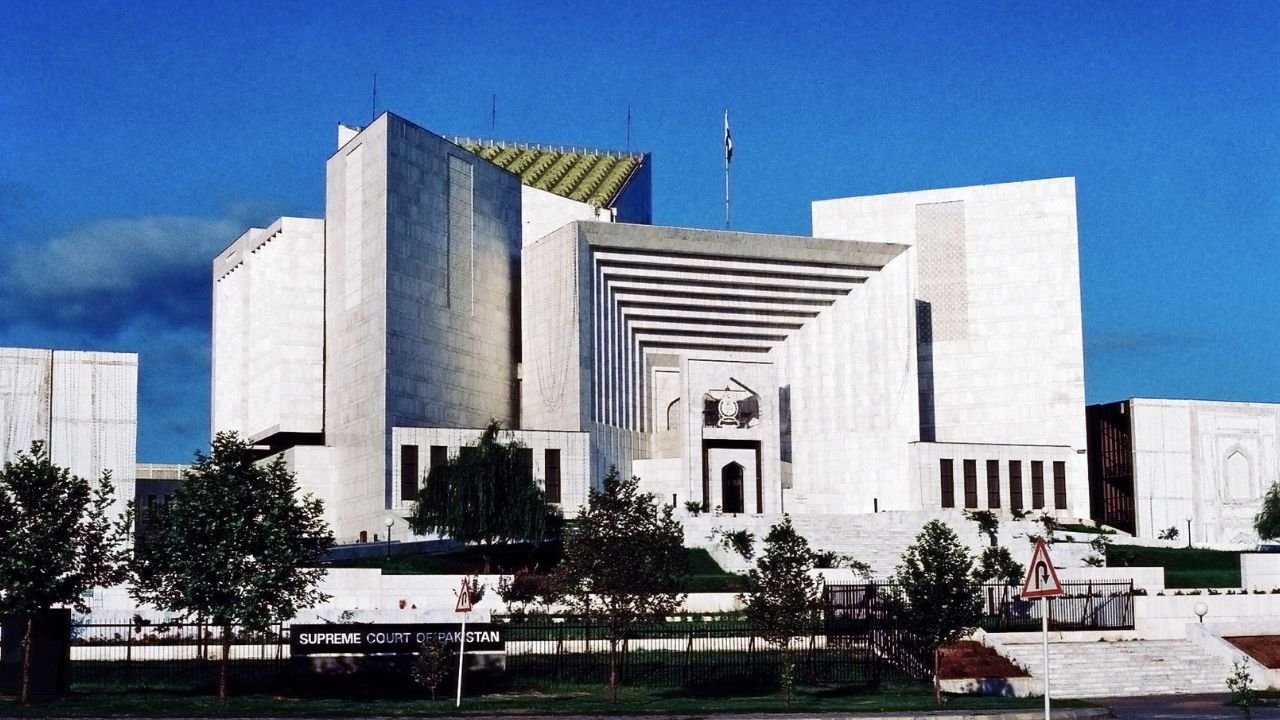
    The Supreme Court (SC) has issued a verdict in favour of the SC (Practice and Procedure) Act, 2023, dismissing petitions challenging its validity.

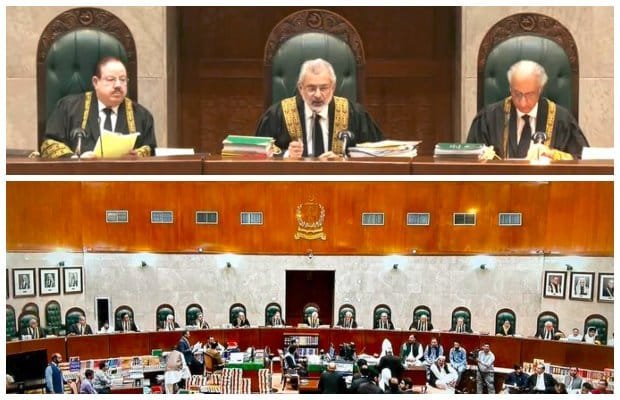
    Headed by Chief Justice Qazi Faez Isa, the SC full bench consisted of Justice Sardar Tariq Masood, Justice Ahsan, Justice Syed Mansoor Ali Shah, Justice Akhtar, Justice Yahya Afridi, Justice Aminuddin Khan, Justice Naqvi, Justice Jamal Khan Mandokhel, Justice Mazhar, Justice Ayesha, Justice Athar Minallah, Justice Rizvi, Justice Waheed and Justice Musarrat Hilali.

    The decision was upheld by 10-5 majority.

    While reading out the order, CJP Isa noted that five members of the full court bench — Justice Ijazul Ahsan, Justice Munib Akhtar, Justice Sayyed Mazahir Ali Akbar Naqvi, Justice Ayesha A Malik, and Justice Shahid Waheed — had opposed the law.

    The decision on the SC (Practice and Procedure) Act, 2023, case was delivered after the completion of all arguments. Attorney General Mansoor Awan presented a comprehensive case in favor of the act, leading to the full court’s decision in support of the legislation.

    The SC (Practice and Procedure) Act, 2023, has been a subject of considerable debate and legal scrutiny, with various petitions seeking its annulment. However, the apex court has preserved the Act, emphasising its continued relevance in the legal system.

    However, by an 8-7 decision, the majority of judges have decided against the provision of law wherein retrospective right of appeal was given in the Act.

    The Supreme Court (Practice & Procedure) Act, 2023, which has been at the centre of legal debate and judicial proceedings, introduced several crucial provisions, reshaping the functioning of the Supreme Court of Pakistan:

    1. Sou Motu Notice: The Act granted the power of taking suo motu notice to a three-member committee, consisting of senior judges, including the Chief Justice. This provision aimed to facilitate the initiation of legal proceedings in the apex court and ensure transparency. It also included the right to appeal.
    2. Constitution of Benches: According to the Act, every case, matter, or appeal brought before the Supreme Court would be heard and decided by a bench formed by a committee comprising the Chief Justice and the two most senior judges. Decisions of the committee would be made by a majority vote.
    3. Original Jurisdiction: When exercising the apex court’s original jurisdiction, the Act mandated that any matter invoking the use of Article 184(3) must first be presented before the committee.
    4. Interpretation of the Constitution: In cases where the interpretation of the Constitution was necessary, the Act stipulated that the committee would assemble a bench consisting of no fewer than five Supreme Court judges.
    5. Right to Appeal: In instances where a decision was made by a Supreme Court bench exercising Article 184(3) jurisdiction, the Act allowed for an appeal to be filed within 30 days of the bench’s order. This appeal would be scheduled for a hearing within a period not exceeding 14 days.
    6. Retrospective Right of Appeal: The Act also extended the right of appeal retrospectively to individuals who had been affected by an order made under Article 184(3) before the commencement of the SC (Practice and Procedure) Act, 2023, provided that the appeal was filed within 30 days of the Act’s implementation.
    7. Choice of Counsel: Parties involved in legal proceedings were granted the right to select their counsel for filing a review application under Article 188 of the Constitution.
    8. Urgency and Interim Relief: The Act outlined that any application claiming urgency or seeking interim relief in a case, appeal, or matter would be scheduled for a hearing within 14 days from the date of filing.
  • Court reserves verdict on Practice and Procedure Act 2023

    Court reserves verdict on Practice and Procedure Act 2023

    The Supreme Court (SC) has reserved its decision on petitions that challenge the 2023 SC (Practice and Procedure) Act, which restricts the authority of the Chief Justice of Pakistan.

    Chief Justice of Pakistan (CJP) Qazi Faez Isa led the full-court bench consisting of Justice Sardar Tariq Masood, Justice Ijaz Ul Ahsan, Justice Syed Mansoor Ali Shah, Justice Munib Akhtar, Justice Yahya Afridi, Justice Aminuddin Khan, Justice Sayyed Mazahar Ali Akbar Naqvi, Justice Jamal Khan Mandokhel, Justice Muhammad Ali Mazhar, Justice Ayesha A Malik, Justice Athar Minallah, Justice Syed Hasan Azhar Rizvi, Justice Shahid Waheed, and Justice Musarrat Hilali are hearing the case.

    “We will discuss amongst ourselves [now]. If there is a consensus, then we will announce it, otherwise, the decision will be reserved,” Chief Justice of Pakistan (CJP) Qazi Faez Isa said at the end of today’s hearing.

    During the hearing, the CJP emphasised the importance of maintaining a harmonious relationship between the Parliament and the SC.

    “Do not pit the Parliament and Supreme Court against each other,” he remarked, insisting on the idea of “live and let live”.

    “Why do we see each other’s institutions negatively? Why can’t it be said that one institution legislated for the betterment of another?” CJP Isa questioned.

    All the petitioners, including all political parties, concluded their arguments in today’s hearing. The Attorney General of Pakistan (AGP), Mansoor Usman Awan, also gave his arguments today.

  • Parliament enacted legislation with ‘good intentions’, says Chief Justice Isa

    Parliament enacted legislation with ‘good intentions’, says Chief Justice Isa

    The Chief Justice of Pakistan (CJP), Qazi Faez Isa, while hearing petitions filed against the Practice and Procedure Act (2023), remarked that the Parliament has enacted the legislation with good intentions. “If a patient is dying, can a person with medical understanding allow the patient to die just because he is not a doctor? Parliament is told that the number game should be complete, but one person comes and makes Parliament a rubber stamp,” he said.

    A full court headed by CJP Qazi Faez Isa is hearing petitions against the Practice and Procedure Act (2023) in the Supreme Court.

    During the hearing, Justice Ijaz-ul-Ahsan remarked that Parliament cannot make rules or legislate to make rules; only the Supreme Court has the authority to change the rules within the scope of the existing law.

    The CJP said that the Constitution says that the Supreme Court is authorised to make its own rules of practice and procedure.

    Justice Ijaz-ul-Ahsan said that the Constitution already binds the Supreme Court to make rules in accordance with the Constitution and the law, while the Chief Justice of Pakistan, while talking to the president of the Supreme Court Bar Association, Abid Zubairi, said that time is short, asking what difference does it make to the option.

    Abid Zubairi said in his arguments that even if the words of making rules according to the constitution and law are removed from the constitution, it will not make a difference, to which CJP Isa said that it is fine; the answer has come.

    Abid Zubairi said that when the Supreme Court made the rules, they could not be changed by law, and the CJP said that the hearing has to be completed today, as he wanted to hear the lawyers.

  • CJP Isa hints at winding up ‘Practice and Procedure’ Act case today

    CJP Isa hints at winding up ‘Practice and Procedure’ Act case today

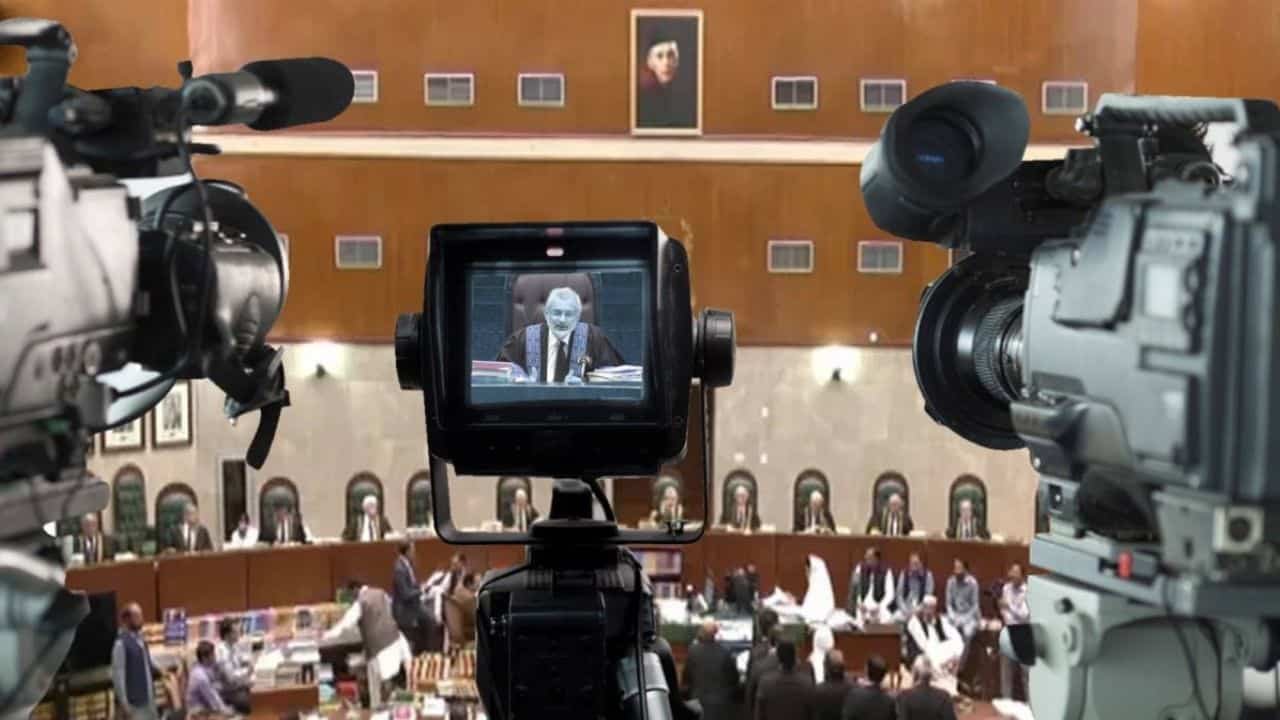
    A full court bench comprising 14 judges headed by Chief Justice of Pakistan (CJP) Qazi Faez Isa has resumed hearing  petitions challenging the SC (Practice and Procedure) Act on Tuesday.

    State-run PTV is live-streaming the court’s proceedings.

    The full court bench includes CJP Isa, Justice Sardar Tariq Masood, Justice Ijaz Ul Ahsan, Justice Syed Mansoor Ali Shah, Justice Munib Akhtar, Justice Yahya Afridi, Justice Aminuddin Khan, Justice Sayyed Mazahar Ali Akbar Naqvi, Justice Jamal Khan Mandokhel, Justice Muhammad Ali Mazhar, Justice Ayesha A. Malik, Justice Athar Minallah, Justice Syed Hasan Azhar Rizvi, Justice Shahid Waheed, and Justice Musarrat Hilali.

    At the previous court hearing, the full panel of judges in the apex court had requested responses from all involved parties by September 25th.

    At the beginning of the hearing, Faez Isa said that the court will try to wind up hearings on the case today (Tuesday).

    There are many cases already pending in the court, CJP added.

    CJP Isa also directed the petitioner’s lawyer to end his arguments in 10 minutes.

    The CJP stated that this legislation does not diminish the authority of the chief justice; instead, it distributes these powers among the judges.

    He commented that this law will have a specific impact on the chief justice and the two most senior judges.

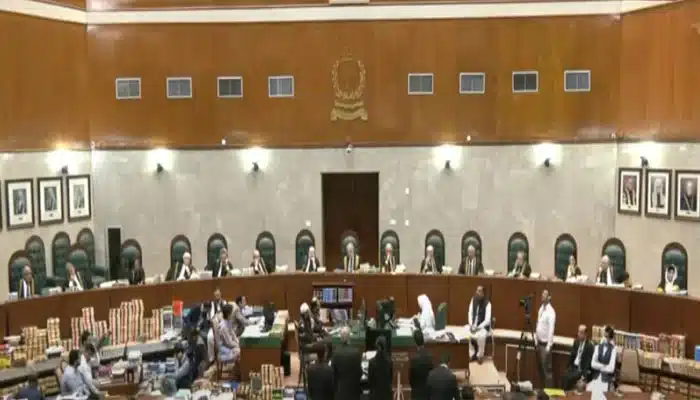
    “When martial law is imposed, everyone surrenders their weapons. There are many pictures [of judges] in this room who forgot their oath after the imposition of martial law,” CJP Isa remarked after the lawyer read out the judges oath in the court.

  • ‘They do love marriages, then become a problem for court’: Chief Justice

    ‘They do love marriages, then become a problem for court’: Chief Justice

    Chief Justice Qazi Faiz Isa has remarked that having a beard does not make a person a Muslim, people themselves marry for love and then it becomes an issue for the court as per Aaj news.

    The case of the extradition of two minor girls was heard in the Supreme Court by a three-member bench headed by Chief Justice Qazi Faez Isa.

    The court ordered the two girls to be handed over to their mother, ordering that the father of the girls will be able to visit the girls on Sundays from 10 am to 5 pm, and if the father violated the court order, contempt of court action will be taken against him.

    The lawyer of the father pleaded with the court that the girls should be with the father, as their mother works at night, and does not have time to take care of them.

    Chief Justice Qazi Faiz Isa expressed his anger and asked whether the lawyer has read the principle of extradition in Islam or not, stressing that according to Shariat, children stay with their mothers.

    The Chief Justice remarked that we are Muslims in name only, our work is not that of Muslims, just having a beard does not make a person a Muslim, action must also be taken. Prayer, fasting, and Hajj are not enough, he observed, adding that humanity and morals are also necessary. If the parents are not divorced, their mutual resentment will spoil the future of the children.

    The Chief Justice asked the children’s father whether he had a love marriage or an arranged marriage.
    Taimur, the father of the children, said that it was a love marriage.

    The Chief Justice remarked that people themselves marry for love, and then they become an issue for the court.

    The Supreme Court disposed of the case with the consent of the parents.

  • Chief Justice Faez Isa cracks down on adjournments

    Chief Justice of Pakistan (CJP) Qazi Faiz Isa has called on his fraternity to stop the practice of seeking adjournments in order to decrease the number of pending cases in the apex court of the country.

    On Monday, during a hearing of an agreement violation case, the CJP stated, “Get this out of our mind that adjournments will be granted [in cases] from now on,” he said, adding that they should now be considered a thing of the past.

    Emphasizing that there are numerous cases before the Supreme Court that are still pending, Qazi Faez Isa said that in every case, a notice will be given to parties on a single hearing, and a decision will be made about the arguments in the next hearing.

    CJP Isa said that by using this case, he was telling everyone that adjournments would no longer be granted.

    The top judge remarked that other courts grant time to submit case-related documents. The Supreme Court is the last resort court where records of all cases have been filed in advance, he added.

  • ‘Your talking to me has placed me in a most embarrassing position’, Former CJ Bandial slammed

    ‘Your talking to me has placed me in a most embarrassing position’, Former CJ Bandial slammed

    Former Chief Justice of Pakistan (CJP) Umar Ata Bandial, before his retirement earlier this month, had a telephonic conversation with Justice Sardar Tariq Masood to discuss a matter of complaints against fellow judges of the apex court, as per The News.

    As per the sources of Geo’s senior reporter Abdul Qayyum Siddiqui, Justice Masood received a phone call from CJ Bandial on the night of September 5, 2023. The two justices had a conversation, initially intended to discuss and resolve complaints against fellow judges of the Supreme Court, which took a bitter turn.

    Sources suggest that during the contentious telephonic conversation, former Chief Justice Bandial extended an offer to Justice Masood. Allegedly, he proposed that if a pending complaint against another judge were withdrawn, then the complaint against Justice Masood would also be resolved.

    Displeased by the call, Justice Masood wrote a letter to the former CJ on September 6, expressing his disapproval. Justice Masood was upset at how the former CJ had called him instead of forwarding the matter to the current members of the Supreme Judicial Council, including Justice Qazi Faez Isa, Justice Ijaz ul Ahsan, the chief justice of the Sindh High Court, and the chief justice of the Lahore High Court.

    The letter penned by Justice Masood — dated September 6 — reads as follows:

    Mr Justice Umar Ata Bandial, Honourable Chief Justice of Pakistan, Islamabad.

    “Dear Sir,

    Yesterday you spoke to me on the phone and informed me that a complaint against me was submitted by Mrs Amina Malik and you asked me what to do with it. Sir, with the greatest of respect I do not think it was appropriate for you to have talked to me about the said complaint. Sir, you’re talking to me has placed me in a most embarrassing position.

    Under the circumstances, it would be best if the said complaint is placed for consideration before the Supreme Judicial Council as I do not want an additional accusation of seeking favour to be leveled against me. I am confident that the Council will attend to it in accordance with the constitution and the law, and if the complaint is found to be false and intended to malign me then the Council will act pursuant to clause 14 of the Supreme Judicial Council (Procedure of Inquiry), 2005.

    Yours very sincerely,

    Justice Tariq Masood”

    Geo News attempted to contact the former chief justice to get his stance on this matter but, as of now, no response has been received.