Tag: survey

  • 44% say Khan should resign before no-confidence motion: survey

    44% say Khan should resign before no-confidence motion: survey

    According to a survey conducted by Ipsos, 44 per cent of respondents are of the view that Prime Minister (PM) Imran Khan should resign ahead of the no-confidence motion while 33 per cent think he should fight it, reports Geo News.

    42 per cent of respondents are of the opinion that the no-trust motion would succeed against PM Khan while 26 per cent say the government would successfully defeat the motion and 31 per cent say that they are unsure about the outcome.

    To a question that if the no-confidence motion becomes successful, 27 per cent think Leader of the Opposition and Pakistan Muslim League-Nawaz (PML-N) President Shehbaz Sharif should be the PM until new elections, 17 per cent say PPP Chairperson Bilawal Bhutto and 6 per cent prefer PML-N’s Shahid Khaqan Abbasi as the new premier.

    However, after the general elections, 18 per cent want PML-N supremo Nawaz Sharif to become PM, 16 per cent voted for Imran Khan, and 14 per cent for Shehbaz Sharif.

    According to the survey, a significant number of 48 per cent think that PTI’s allies should support the party’s rival, while only 27 per cent of the respondents said that the PTI coalition partners should come back to Khan.

  • 46 per cent of Pakistanis think Imran Khan is corrupt: survey

    46 per cent of Pakistanis think Imran Khan is corrupt: survey

    The Quarterly Performance Evaluation Survey (QPES), a Pulse Consultant’s indigenous tracking tool of public perceptions about the government’s performance has released its report.

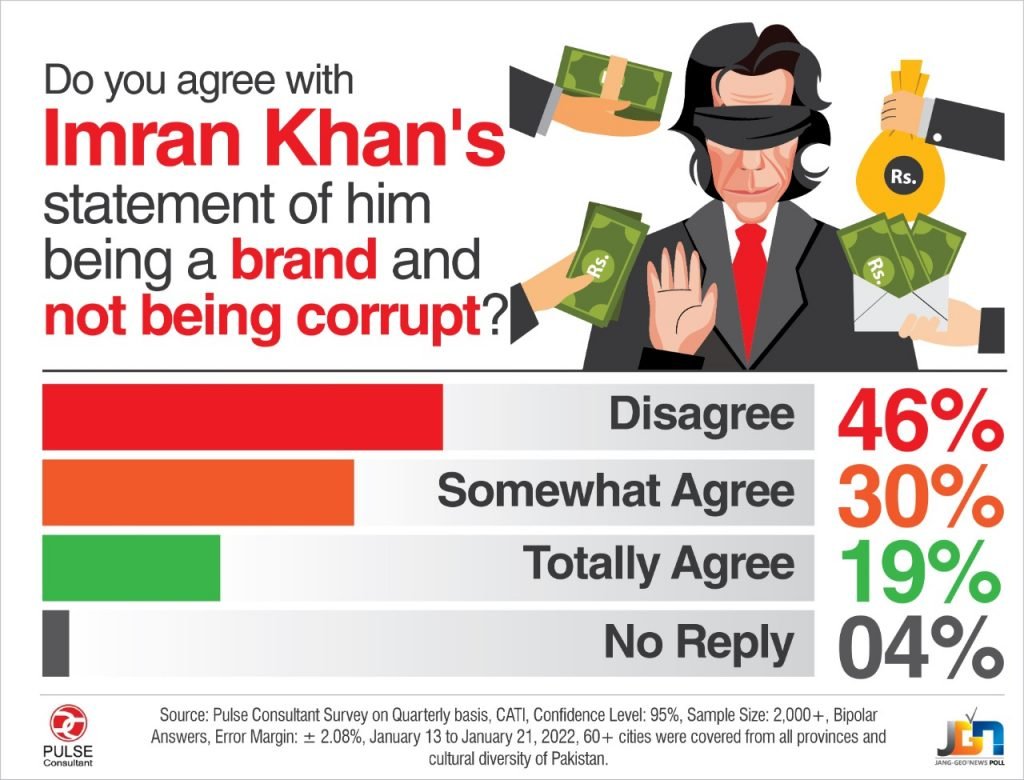
    According to a question in the report, when responders were asked: “Do you agree with [PM] Imran Khan’s statement of him being a brand and not being corrupt?” a total of 46 per cent didn’t agree with him and only 19 per cent believe the premier.

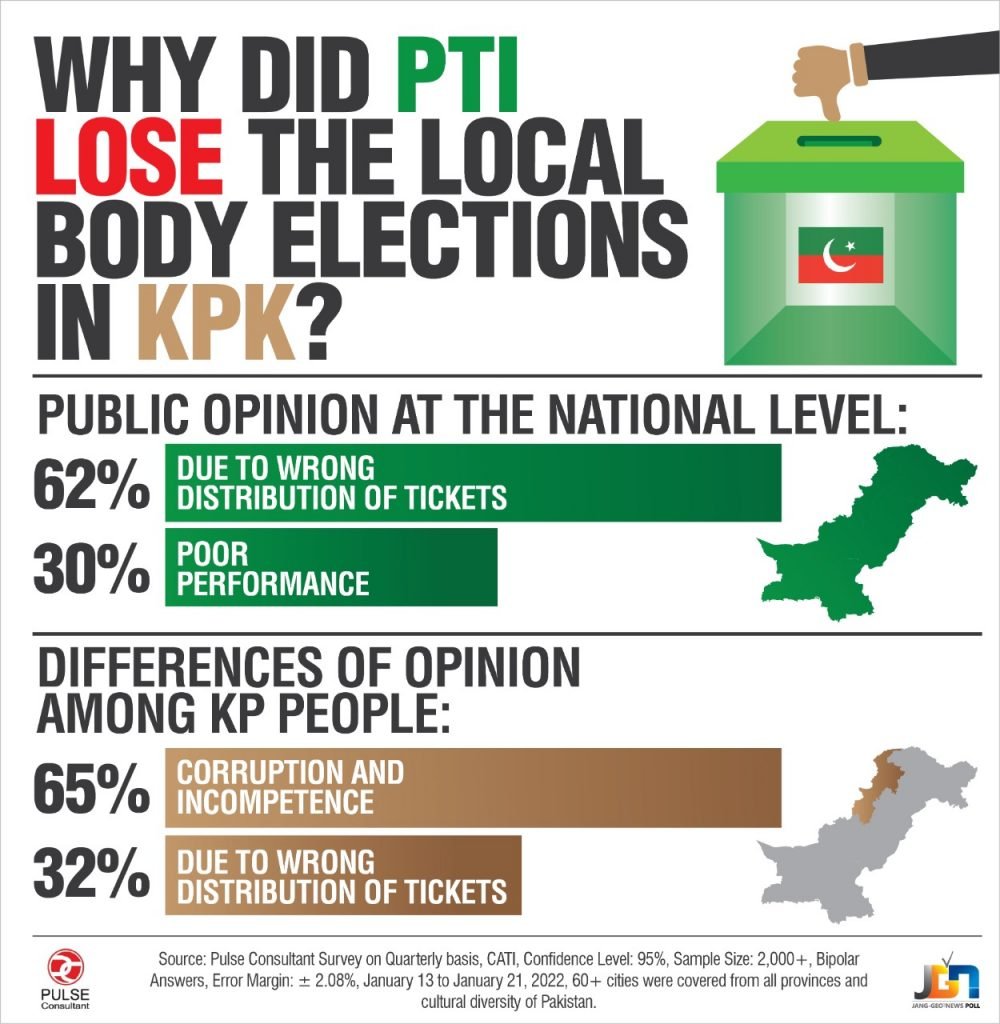
    65 per cent of responders from Khyber Pakhtunkhwa think that corruption and poor performance in the province led to Pakistan Tehreek-e-Insaf’s (PTI) defeat in the local election.

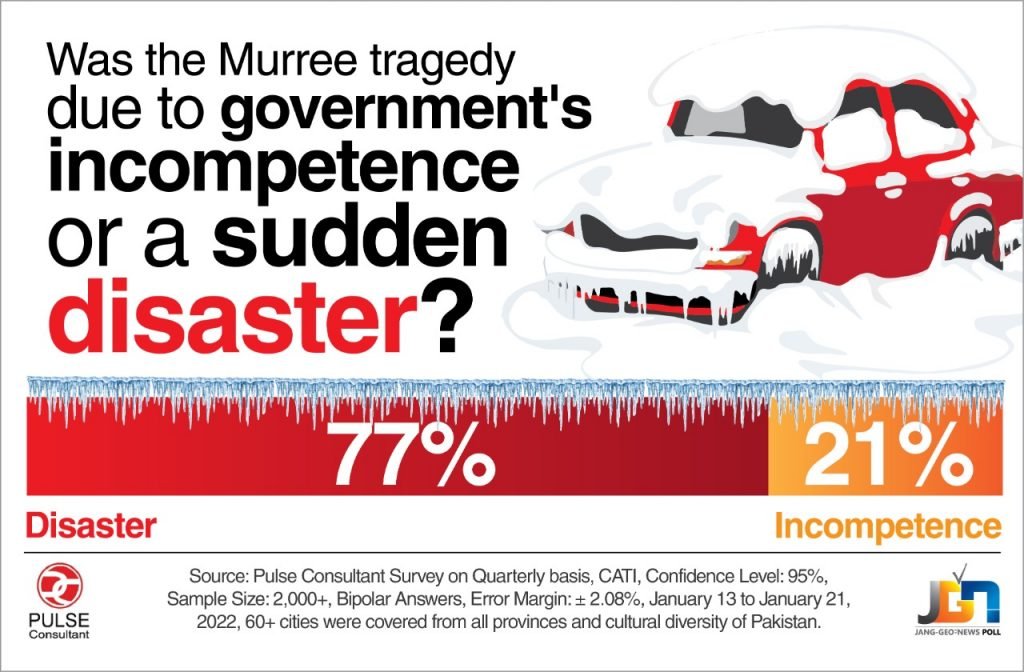
    It is revealed that 77 per cent think that the Murree tragedy was a sudden disaster.

    Further, the survey says that 18 per cent of the country is satisfied with PM Khan and 56 per cent believe PM Khan’s claim that Pakistan is out of the economic crisis. 15 per cent think that inflation will be reduced in the next three months.

    84 per cent of Pakistanis consider inflation as the biggest problem of the country and 99 per cent of Pakistanis say ‘Inflation has increased in past three months.’

  • Police and judiciary most corrupt institutions in Pakistan, reveals National Corruption Perception Survey 2021

    Police and judiciary most corrupt institutions in Pakistan, reveals National Corruption Perception Survey 2021

    The National Corruption Perception Survey 2021 conducted by Transparency International (TI) Pakistan finds the police and judiciary are the most corrupt institutions in the country, reports Ansar Abbasi for The News.

    The police department has been ranked at number one with 41.4 per cent votes while the judiciary comes at number two with17.4 per cent votes. According to the Judicial Statistics of Pakistan 2020 report by the National Judicial (Policy Making) Committee, there are 46,698 cases pending in the Supreme Court and 1,772,990 cases pending in the District Judiciary.

    In 2021, TI Pakistan conducted the NCPS 2021 in all four provinces. The survey was conducted from October 14, 2021, to October 27, 2021. It reflects the perception of the general public on governance issues. 

    According to the survey, the three most important causes of corruption are weak accountability (51.9 per cent), the greed of powerful people (29.3 per cent) and low salaries (18.8 per cent).

    40.1 per cent of Pakistanis say an increase in/stringent punishments is a way to reduce corruption while 34.6 per cent Pakistanis say accountability of public officers by expediting NAB’s handling of corruption cases, and 25.3 per cent say a complete ban on those convicted of corruption from holding public office are key to combat corruption in Pakistan.

    Moreover, the vast majority of people think the federal government’s self-accountability is unsatisfactory.

    In the report, a total of 89.1 per cent of Pakistanis claim that they did not pay any bribe to any government official during the federal government’s Covid-19 relief efforts for deserving citizens.

  • 59% traders consider Pakistan is not ‘moving in right direction’: Gallup Survey

    The ratio of traders who consider that Pakistan is not moving in the right direction has jumped from 37 per cent from the last quarterly report to 59 per cent states Gallup Pakistan’s fourth quarterly report of Business Confidence Index (BCI).

    The survey was conducted from October 13-28 and nearly 580 respondents, belonging to the country’s traders’ community participated in it.

    The report states that responders have expressed great anxiety over the future of business in the country as the ratio of those predicting improvement in future business has dropped from 70 per cent to 61 per cent in the survey, reports Geo News.

    Surprisingly, the given statistics in the report show that in Gallup Pakistan’s second quarterly report, 49 per cent of traders were happy with business activity but now 54 per cent of them expressed their satisfaction.

    While answering the question, “which issues do the respondents want the government to address instantly”, 48 per cent declared inflation as the biggest problem for business, 16 per cent sought relief for the business class, 14 per cent for the stability of the Pakistani currency, 13 per cent for consistency in government policies, 6 per cent for controlling corruption, 6 per cent for the elimination of Covid-19 and ending lockdowns, 3 per cent for ending political instability, 3 per cent for improving export policies and two percent for non-availability of PayPal.

    Among them, seven percent of respondents said they had no issue which could be resolved by the government.

  • 57% Pakistanis losing confidence in PM Khan overcoming economic crisis: Survey

    57% Pakistanis losing confidence in PM Khan overcoming economic crisis: Survey

    According to the quarterly survey by Pulse Consultants, almost six out of 10 people have no confidence in Prime Minister (PM) Imran Khan’s claim of coming out of the economic crisis, reports The News.

    The survey is based on 1,809 respondents’ opinions who were interviewed from October 04, 2021 to October 10, 2021. It covered 60+ cities from all provinces of Pakistan.

    According to the survey, the number of people losing faith in PM’s economic policies is around 57 per cent coupled with a drop in those who were confident that the prime minister will be able to turn the tide.

    In July, 17 per cent respondents expressed confidence in PM’s policies, which in the current survey has dropped to seven percent. Regarding questions about the direction of the economic policies, 56 per cent respondents in July found them to be in the wrong direction, but three months later it has risen by 19 per cent to 77 per cent. On the contrary, those perceiving them to be on the right track have dropped to 24 per cent from 43 per cent in July.

    Anxiety about the wrong direction is high is in the main political battleground provinces Punjab (79 percent) and Sindh (73 percent), as per the survey.

    Since November 19, 2018 more than 95 per cent believe that inflation has increased after every three months.

    Furthermore, the survey states that 68 per cent of people do not have savings and most of them have reduced their expenditures to make ends meet.

    When the respondents were asked about the country’s major concern, 77 per cent complained about inflation whereas 35 per cent found corruption, 25 per cent unemployment, 11 per cent load shedding, while 10 per cent termed inability to meet expenses as their biggest problem.

    The Pulse Consultant also asked the respondents about the performance of PM’s Adviser on Finance and Revenues, Shaukat Tarin, which showed that 53 per cent were dissatisfied with him.

    The survey was conducted through CATI (Computer assisted telephonic interviews), a state-of-the-art technology where all calls are recorded.

    The country is Heading Towards Wrong Economical Direction

    • Three amongst four Pakistanis believe that country is heading towards a wrong economic direction
    • In July 2021 there were 56% have that opinion but in October 2021 with an increase of 19%, 75% have that opinion
    • Anxiety about the wrong direction is high in Punjab (79%) & Sindh (73%) – the main political battleground followed by KP – PTI’s hometown (67%)

    PM Claim About Restoration of Country Economic Outlook

    • In July 2021, 6 out of 10 respondents (62%) had overall belief on PM IK’s claim that “country is out of economic crisis”
    • Now in October 2021, wave condition is vice versa – almost 6 out of 10 (57%) have opposite opinion and have no belief in PM IK’s narrative (In July 38% had no believe now by the increase of  19% -57% have no belief)

    Satisfaction with Shaukat Tarin

    • Dissatisfaction increased 15% (from 38% to 53%)
    • Satisfaction decreased 22% (from 35% to just 13%)

    Inflation Trend

    • Almost every Pakistani hit by inflation and 98% are reporting that ‘Inflation increased in past three months’

    Price Hike – Major Cause of Dissatisfaction

    • Like previous wave, in July Y2021 ‘Inflation’ is once again ranked as the gravest issue by (with the increase of 5%) 77% of the respondents.
    • If we read it with the answer “Expenses Not Meet” (اخراجات پورے نہیں ہوتے),of 10% – then it will reach to 87% – Ever highest in past three years
    • This is followed by & ‘Corruption’ (35%) & ‘Unemployment’ (25%), in  this wave ‘Corruption’ – overtake the ‘Unemployment’

    Expenses

    We asked the same questions about “Monthly Expenses Management” back in July 2020, in July 2020, 41% had the opinion that – their monthly expenses are according to their income – but with the decline of 9% , now 32% have the same opinion

    • Jul-20 Oct-21Monthly Expenses Meet 41% 32%
    • Monthly Expenses Not Meet 59% 68%
    • Punjab & KPK – where #PTI is holding the provincial Govt. unrest increase significantly – specially in KP
    • If we compare the results of July 2020 & October 2021 (after 13 months) – Upper Socio Economic Class is also complaining that their monthly expenses are not meeting
    • Those who claimed that – their monthly income meet expenses – 31% amongst them claimed that they save any money
    • On the other hand – those who complained that their household expenses are not meet – 37% amongst them reduced their expenses, 30% borrow money and 30% do some extra job/work other than regular
  • 78% Pakistanis think women ‘not safe’ here: Survey

    78% Pakistanis think women ‘not safe’ here: Survey

    Almost 78% of Pakistanis believe that no woman is safe in Pakistan while only 20% believe that women are safe in the country, a survey conducted by Pulse Consultant has shown.

    At least 18,000 Pakistanis participated in the survey conducted by a Karachi-based marketing and social research company, Pulse Consultant. 

    Most of the Pakistanis who think women are unsafe in the country were from Khyber Pakhtunkhwa.

    The survey showed that 35% of citizens of Khyber Pakhtunkhwa consider women safe to some extent in Pakistan, while only 19% consider them completely safe.

    Similarly, 35% of people in Punjab saw women as unsafe in Pakistan, 41% saw them safe to some extent, and 21% saw them completely safe.

    The rate of people who consider women unsafe in Pakistan from Sindh was 26% in the survey, while the rate of those who consider them safe to some extent was 49%. Meanwhile, 24% of the survey respondents considered them to be completely safe in the country.

    The survey showed that most Pakistanis who see women safe to some extent in Pakistan are from Balochistan, where 74% of people vouched for it.

    Whereas, 19% of citizens of Balochistan saw women as unsafe in Pakistan. Only 7% of the respondents from the province saw them as completely safe.

    The statistics compiled in the survey based on social status suggested that 45% of people from the lower class believe that women are not safe in Pakistan.

    The rate of people who saw women as unsafe from the lower middle class was 35%, 30% from the middle class, 29% from the upper-middle class, while 34% from the upper class.

    Meanwhile, statistics based on gender showed that women were more positive than men when it came to their safety in Pakistan.

    As many as 29% of women believe that they are safe outside the home, while only 22% of men vouched for it. 

    The survey was conducted through CATI (Computer assisted telephonic interviews), a state-of-the-art technology where all calls are recorded.

    Overall Perception of Women Safety in Pakistan

    •  Only 20% of Pakistanis feel that women are ‘safe’ in Pakistan
    •  43% believe that women are ‘somewhat safe’ – it means their opinion is in between – neither they believe that Pakistani women are ‘unsafe’ nor do they believe that Pakistani women are ‘safe’
    •  35% of Pakistanis believe that Pakistani women are entirely not safe in Pakistan
    •  Highest perception of “unsafety” reported from KP (46%) followed by Punjab (35%)

    Women Safety – Outside the home – Women’s Perception

    •  29% of the Pakistani females feel that they are ‘safe’ when they go outside the home
    • However, 35% of females believe that they are “smewhat safe” and similar population (35%) believes that they are absolutely “unsafe” when they commute in society
    •  The highest perception of “unsafety” again reported from KP (46%) followed by Punjab (36%)
    •  Almost half (51%) of the female respondents from ‘Upper Class’ & one third (38%) from ‘Lowest Class’ have a concern about safety when commuting outside the home

    Women Safety – Outside the home – Male’s Perception

    •  Interestingly, males consider females less safe (22%) in Pakistan as compared to female respondents (29%)
    •  The majority 45% of males believes that their family female members are “somewhat safe” and 30% believe that their family females’ members are ‘unsafe’ outside the home
    •  Interestingly, contrary to females belonging to ‘Upper Class’ (Where 51% believe that they are unsafe), almost one-third of males belong to the same class have the opinion that their female family members are safe (36%) and only one-fourth (25%) have the opinion that females family members are ‘unsafe’
  • Shaukat Tarin presents the Pakistan Economic Survey 2020-21

    Shaukat Tarin presents the Pakistan Economic Survey 2020-21

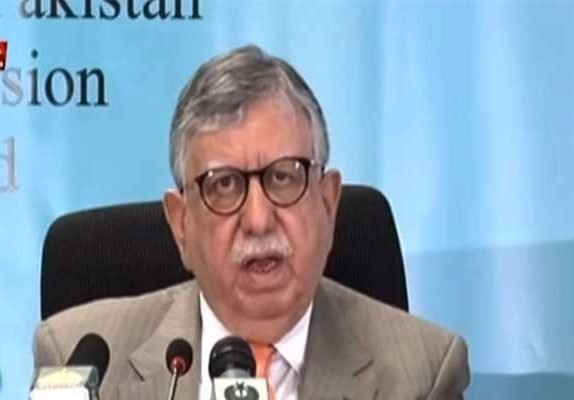
    Finance Minister Shaukat Tarin presented the Pakistan Economic Survey 2020-21 at a press conference in Islamabad on Thursday. However, the document did not have the latest figures on poverty and unemployment.

    Tarin revealed that the industrial and services sectors had helped the country post-Gross Domestic Product growth of 3.94 per cent in the first nine months of the fiscal year [FY](July to March), significantly higher than the target of 2.1 per cent.

    “The agriculture and manufacturing sectors helped the economy grow to 4.4%, laying stress on the need for sustainable growth in Pakistan in the years to come,” added Tarin.

    Coronavirus Pandemic

    The minister opened his press briefing by speaking highly of Prime Minister Imran Khan’s policies in combating the coronavirus pandemic.

    “The government itself had set [GDP] growth will be 2.1pc and the IMF predicted even lower. But the decisions by this government such as incentivising manufacturing and textiles, construction, and interventions in agriculture have helped the economy recover,” said Tarin.

    He said many people lost their jobs when the pandemic hit Pakistan, however, due to PM’s visionary policy of not imposing a complete lockdown across the country, millions of people who were unemployed were hired again. 

    “The economy is recovering,” he said. 

    Remittances

    Tarin said Pakistan’s remittances had broken records, adding that they had crossed $26bn. He said that lately imports, especially food in the form of wheat and sugar, were increasing as Pakistan’s economy was growing at the same time. 

    “We were net exporter of food but now, we have become a net importer,” he said. “Our exports registered a growth but our remittances increased manifold,” he added. 

    Ehsaas Programme

    Tarin spoke highly of the Ehsaas programme, adding that the World Bank had described it as “one of the best and the largest” poverty alleviation initiatives across the globe. 

    “Full credit goes to Sania Nishtar,” he said, adding that handing out cash to 15 million people was not a small achievement.

    Growth rate

    Tarin said he had told the prime minister it was time to focus on sustainable growth “until we go to 5-8pc GDP growth”.

    “We will do interventions and take care of the poor. The poor man has been crushed in this stabilisation phase because the dreams we have shown them have been of a trickledown economy. And this can only happen when growth is sustainable and continuous for 20-30 years,” he said.

    “Countries which had sustainable growth, they grew continuously for 20-30 years. What have we done? Every time we grow by borrowing money, which is credit-based growth.”

    Current Account

    According to the survey, during FY 2021, while the world was reeling from the economic impact of the pandemic, Pakistan’s “external sector appeared as a key buffer for resilience.”

     “The main driver of improvement in current account balance was the robust growth in remittances,” it stated.

    Trade Deficit

    “During July-March FY 2021, export of goods grew by 2.3 percent to $18.7 bn as compared to US$ 18.3 bn the same period last year. Import of goods grew by 9.4pc to $37.4 bn as compared to US$ 34.2 bn last year. Consequently, the trade deficit increased by 17.7per cent to $18.7bn as compared to $15.9bn last year,” the survey said.

    Inflation

    The finance minister said the government wanted to control inflation “but prices are still high and affecting the common man”.

    “So the way to solve this is by increasing production and that is why we have focused on agriculture in this budget,” Tarin said.

    Federal Board of Revenue (FBR)

    Speaking about the FBR, Tarin said he would end the practice of people being harassed by the bureau. “FBR will not audit [businesses or persons] but a third-party audit will be conducted,” he said. 

    International Monetary Fund (IMF)

    Tarin said Pakistan’s negotiations with the IMF were ongoing, adding that the international money lender had asked the government to hike tariffs and increase taxes. 

    The finance minister said Pakistan and the IMF want the same thing; sustainable growth, adding that the country cannot afford to increase taxes or hike tariffs so that the poor and the salaried class do not feel additional burden of inflation. 

    “This is a red line for the prime minister,” he said. “We will not further burden the poor,” he added. 

    Energy Sector

    Tarin said Pakistan’s economy was burdened due to the overcapacity in the power sector, saying that “it was a very big challenge and a black hole” for Pakistan. 

    Privitisation

     Tarin said it was fair to ask how he can privatise state-owned enterprises when all others, before him, promised to do the same but failed to. 

    “Nawaz Sharif used to shout the same slogan during the first time [when he was prime minister] and then for a second time [when he again became the prime minister] and then a third, but nothing happened,” he said. 
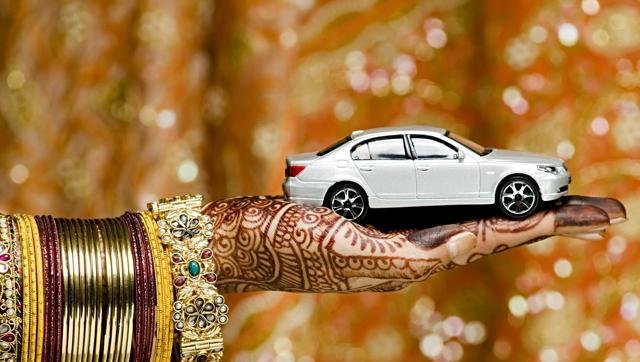
  • Survey reveals 61% Pakistanis support dowry

    Survey reveals 61% Pakistanis support dowry

    The Ministry of Religious Affair recently proposed a bill to ban dowry in the country.

    While the suggested bill was initially appreciated on social media, a new survey by Pulse Consultant revealed that 61% Pakistanis support dowry. More than 2,000 people participated in the survey. On the other hand, only 36% of people opposed the tradition.

    Further statistics revealed that 73% women voted in favour of allowing dowry while 24% opposed it. Among men, 59% were in the support of dowry.

    Earlier, The Current also asked people what they thought about and here is what they said.

  • SURVEY: Majority unhappy in PTI’s ‘Naya Pakistan’

    SURVEY: Majority unhappy in PTI’s ‘Naya Pakistan’

    At least 66 per cent Pakistanis have expressed dissatisfaction with the performance of the Pakistan Tehreek-e-Insaf (PTI) government, revealed a Gallup survey on Sunday.

    According to the survey, 59 per cent believed that the ruling PTI’s performance was worse than that of the previous governments. Further, 62 per cent Pakistanis have opposed the policies of the current government whereas 35 per cent feel that the country is heading in the right direction.

    In the survey, it was said that those who felt the country wasn’t heading in the right direction were only 48 per cent in 2018 — a figure that significantly shot up since the PTI came to power.

    Regarding the perception of the federal government’s performance, only 1 in 3 Pakistanis is satisfied (very or somewhat). Only 32 per cent are satisfied with the performance of the PTI government.

    According to the breakdown, only 16 per cent from Sindh, 13 per cent from Balochistan, 34 per cent from Punjab and 64 per cent from Khyber Pakhtunkhwa (KP) were satisfied with the ruling party’s performance.

  • 31% Pakistanis lost their jobs in 2019: report

    31% Pakistanis lost their jobs in 2019: report

    A global research company, IPSOS, conducted the second Global Consumer Confidence Index survey which revealed that about 31% of Pakistanis have either lost their jobs or know people who lost their jobs in 2019.

    It also stated that around 83% of Pakistanis are fearful of losing their jobs and inflation, unemployment and increasing poverty were the problems that were the most worrying for them.

    People are also uncomfortable making big expenditures. According to the survey, 91% of people are less comfortable buying a car or a home compared to a year ago. 90% are scared of making major household expenses.

    The survey also stated that 17% of businessmen fear going into a loss and only 21% believe that the country is going in the right direction.

    Meanwhile, Prime Minister Imran Khan is hopeful that 2020 will be the year of jobs in Pakistan right after the economy stabilization plan. He said that the media had tried to ‘insult’ and attack him for his goals.

    Results of the survey are based on a nationally representative sample of 2,900 people aged between 19 and 65. It was conducted in December 2019.