The International Monetary Fund (IMF) has asked Pakistani authorities to provide additional information about a petrol relief package, which has caused further delays in the signing of a staff-level agreement.
The petroleum ministry’s cross-fuel subsidy proposal was initially rejected by the Fund, which argued that more details are needed to verify its sustainability.
The Ministry of Finance has distanced itself from the plan, which was announced without the IMF review mission’s knowledge, and has advised the Ministry of Petroleum to withdraw the proposal and work with the Ministry of Finance to iron out the policy details before approaching the IMF for the next review.
According to The News, Minister of State for Finance, Dr Aisha Ghaus Pasha, has reportedly called the petrol subsidy plan “not workable” and clarified that there is no suggestion of subsidies on petroleum products. The Petroleum Division had suggested cross-subsidies on petroleum products, which is not feasible, she said.
The talks with the IMF are ongoing, with the only remaining issue being the lender’s confirmation of external financing from bilateral countries, including Saudi Arabia and the UAE, which is currently underway.
Pasha indicated that financial assistance is expected from bilateral friends soon, which will help finalize the staff-level agreement with the IMF.
Pakistan has requested assistance from the United States to obtain “lenient treatment” from the International Monetary Fund (IMF) due to a delay in signing the staff-level agreement (SLA).
The international lender has asked Pakistan to confirm external financing needs of $6 to $7 billion from Saudi Arabia, the United Arab Emirates, Qatar, and multilateral creditors until the end of June 2023.
However, Pakistan has been unable to persuade the lender to sign the agreement and has requested assistance from Washington and its western allies.
According to The News, Minister for Finance Ishaq Dar has contacted the US diplomatic corps based in Islamabad for help in ending the stalemate.
The IMF considers that the loan facility’s “sustainability” could not be guaranteed without full assurance of external financing.
Furthermore, the IMF has demanded a permanent abolition of power sector subsidies, which the government had only committed to until the end of the next financial year 2023-24.
The IMF demanded changes in the wording of the Memorandum of Economic and Financial Policies (MEFP) during the last meeting held in the previous week.
The IMF and Pakistani sides are yet to decide on further proceedings, with each side holding the other responsible for the delay in signing the SLA.
Google’s maiden “What is Pakistan searching for?” report has revealed what Pakistanis are looking for online.
According to the report, Pakistanis are looking for ways to connect with new communities, searching for high-quality products and how they can improve their lives and environment.
The data can be very useful for seasoned marketeers who’re trying to build businesses, or entrepreneurs looking for ways to engage with potential consumers.
In the past three years, Pakistan’s digital population has surged by 68 per cent, with over 78 million (seven crores and eight lakhs) users. Understanding the needs and expectations of this growing number of digital consumers is important for brands to remain agile and relevant, especially during these unprecedented times.
“Pakistanis and their smartphones are inseparable — always on the lookout for the best experiences and deals within their vicinity and at the same time seeking authoritative information during these trying times,” said Google Asia Pacific Industry Head for South Asia Faraz Azhar.
Google has highlighted five key areas that are shaping how Pakistani’s carry out an online search.
1.Increasingly sophisticated consumers
Consumers expect search engines to understand the intent behind what they need and deliver the best. They want high-quality products that are available with a convenient digital experience.
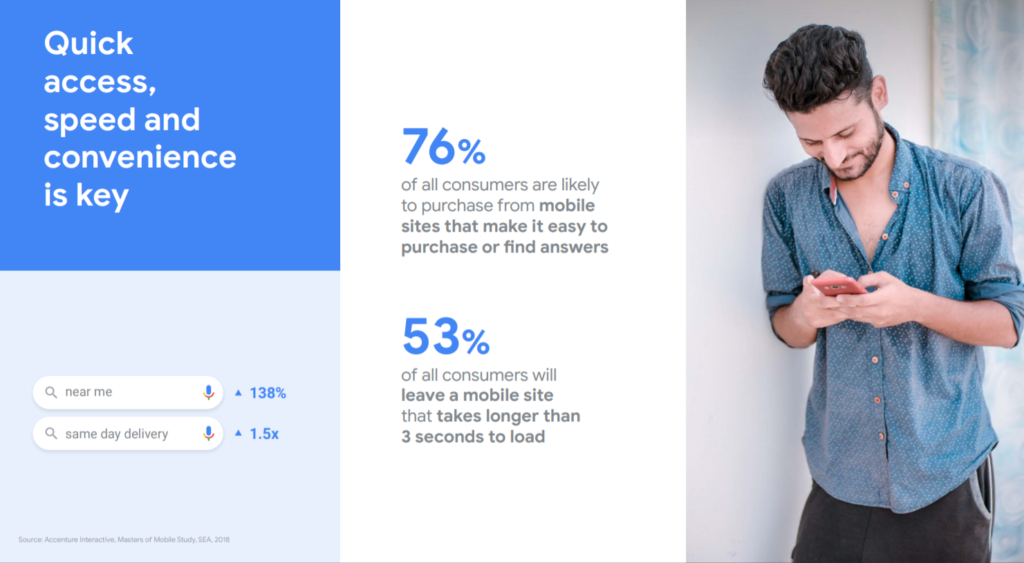
Four of five Pakistani consumers research products online before a purchase, and they switch between online search and video. They also want quick access to products and services.
As per the report, 138 per cent growth in “near me” searches and 1.5 per cent increase in “same-day delivery” queries was reported between the year 2018 to 2019. “Fast delivery” searches increased by a whopping 1300% and online grocery delivery searches increased by 300% since the coronavirus pandemic began.
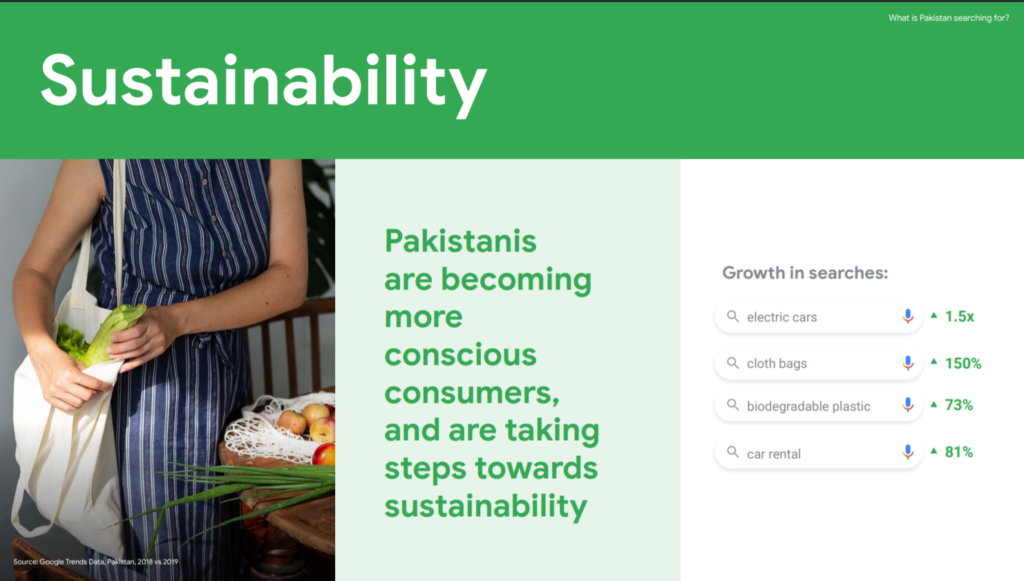
2.Towards sustainability and conscious consumption
A combination of the state of the world and an overall rise in awareness has seen the rise of environmentally-conscious consumers. Over the past year, these searches have risen sharply across Pakistan: “climate change” by 1.5x, “electric cars” by 1.5x and “reusable” by 1.3x.
Users were also curious about the visible impact on air quality and pollution levels, with searches such as “clear skies” increasing by 300 per cent, “clean air” by 225 per cent and “clear water” by 217 per cent.
3. Digital video continues to boom
Video streaming and sharing platforms where Pakistanis get their fix of information, entertainment, news and sports. The primary drivers are a combination of affordable data combined with the proliferation of devices and new platforms.
Every seven in 10 Pakistanis use YouTube every month, with searches related to “with me” increasing by 150 per cent, “Teeli” by 108 per cent and “village food secrets” by 168%.
4. Healthy lifestyle choice
While Pakistan has a rich and diverse culinary tradition, there has been a rise in searches for alternate diets and meal plans predicated around well-being.
Searches for “daily exercise” are up by 1.6x. Searches for “vegetarian cuisine”, “healthy supplements” and “intermittent fasting” have risen by 1.5x. Meanwhile, searches for “superfood” are up by a whopping 767 per cent and “high-intensity interval training (HIIT) workout” by 600 per cent.
5. COVID-19 implications
With COVID-19 restricting the movement of people outdoors, Pakistanis have started looking for ways to start (or continue) their usual physical routines indoors with “HIIT workout” YouTube search growing by 600 per cent, “gym at home” by 125 per cent and “home workouts” by 80 per cent. With more people confined indoors, interest in mental health and well-being has also become an important factor for Pakistanis, with a surge in searches for “meditation” (+56%) in March this year.
The information was gathered from a web conference organization by Syntax Communications with Google Asia Pacific team.