Tag: Taliban

  • ‘Anti-Pakistan bill moved in US Senate to build pressure on President Biden’: Shah Mahmood

    Reacting to the proposed bill moved in the United States (US) Senate, evaluating Pakistan’s alleged role in Afghanistan before and after the fall of Kabul to the Taliban, Foreign Minister Shah Mahmood Qureshi said that the Republicans submitted the bill to build pressure on US President Joe Biden.

    Qureshi, while speaking on Geo News programme ‘Aaj Shahzeb Khanzada Kay Saath’, said, “The anti-Biden administration in Congress views it [Afghanistan debacle] as a major opportunity to mount pressure on Biden. Pakistan cooperated with the US at every step.”

    “Besides India, some forces want to target and destabilise Pakistan and put the whole burden of the Afghan situation on Pakistan.”

    He said that in view of new realities, it is time to build new strategies. He also said that in the near future, a high-profile US personality will visit Pakistan.

    American senators have proposed a bill in the US Senate, demanding a deeper investigation into the Taliban’s victory in Afghanistan and sanctions on the group as well as those who assisted them in driving out the Ashraf Ghani-led regime.

  • ‘No perfume, no attractive clothes, boots shouldn’t make sound’: Taliban sets conditions for Afghan women

    ‘No perfume, no attractive clothes, boots shouldn’t make sound’: Taliban sets conditions for Afghan women

    “[There are] some special conditions that exist only for women. One is that the colour of their dress should not be very attractive. So that it does not attract people’s attention,” said a member of the Taliban on Afghanistan’s TOLO News, as per the subtitles of a video being circulated on social media.

    The Taliban member further says, “The second condition for women is that she should not smell good and should not use perfume when she leaves her home.”

    “The third condition is she should not wear long boots and that the boots should not make a sound,” read the subtitles.

    “Wearing long boots that make sound seems like an announcement,” he said.

    “I have said this every time, everywhere, the sound that a boot makes, what does that mean?”

    “The sound is an announcement for young men by the women. Hey young men, wake up, we just left the house with make-up. You are sleeping and are not looking at us,” he added.

    “It is a kind of announcements and these sort of boots are made to incite young men towards bad actions by women.”

  • Taliban ban barbers from trimming beards in Afghanistan

    Taliban ban barbers from trimming beards in Afghanistan

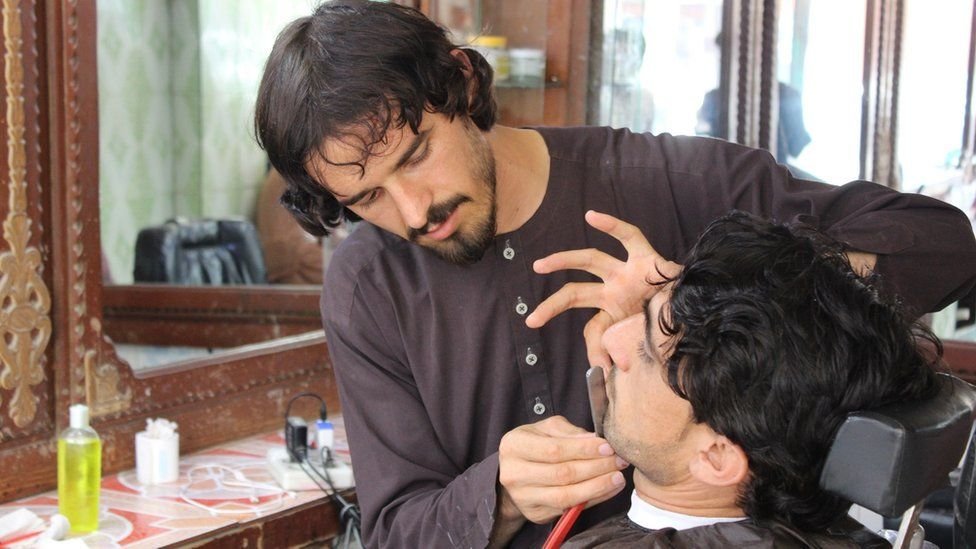
    The Taliban have banned hairdressers in Afghanistan’s Helmand province from shaving or trimming beards, saying it breaches their interpretation of Islamic law, reports the BBC.

    “Anyone violating the rule will be punished,” Taliban religious police say. Some barbers in the capital, Kabul have said they also received similar orders.

    The instructions suggest a return to the strict rulings of the group’s past tenure in power.

    In a notice posted at salons, Taliban officers warned that hairdressers must follow Sharia law for haircuts and beards.

    “No one has a right to complain,” the notice stated, which was seen by the BBC.

    “Stop following American styles,” said another hairdresser, who received a call from someone claiming to be a government official. 

    A barber said that although he has not received an official order, he stopped offering beard trims.

    “Customers don’t shave their beards because they don’t want to be targeted by the Taliban fighters in the streets. They want to blend in and look like them,” he said.

  • ‘Since 2001, I have repeatedly warned that the Afghan war was unwinnable’: Imran Khan

    ‘Since 2001, I have repeatedly warned that the Afghan war was unwinnable’: Imran Khan

    Prime Minister Imran Khan says he was surprised to see that no mention was made of Pakistan’s sacrifices as a US ally in the war on terror for more than two decades. “Instead, we were blamed for America’s loss,” he wrote in an op-ed for The Washington Post.

    “Since 2001, I have repeatedly warned that the Afghan war was unwinnable. Given their history, Afghans would never accept a protracted foreign military presence, and no outsider, including Pakistan, could change this reality,” wrote PM Khan.

    PM Imran Khan lashed out at successive Pakistani governments, saying that they had sought to please the US instead of pointing out the flaws of a military-driven approach in Afghanistan.

    “Pakistan’s military dictator Pervez Musharraf agreed to every American demand for military support after 9/11. This cost Pakistan, and the United States, dearly,” he stressed.

    “Those the United States asked Pakistan to target included groups trained jointly by the CIA and our intelligence agency, the ISI, to defeat the Soviets in Afghanistan in the 1980s. Back then, these Afghans were hailed as freedom fighters performing a sacred duty. President Ronald Reagan even entertained the mujahideen at the White House.”

    “Once the Soviets were defeated, the United States abandoned Afghanistan and sanctioned my country, leaving behind over 4 million Afghan refugees in Pakistan and bloody civil war in Afghanistan. From this security, vacuum emerged the Taliban, many born and educated in Afghan refugee camps in Pakistan,” read the opinion piece.

    “Fast forward to 9/11, when the United States needed us again — but this time against the very actors we had jointly supported to fight the foreign occupation. Musharraf offered Washington logistics and air bases, allowed a CIA footprint in Pakistan, and even turned a blind eye to American drones bombing Pakistanis on our soil. For the first time ever, our army swept into the semiautonomous tribal areas on the Pakistan-Afghanistan border, which had earlier been used as the staging ground for the anti-Soviet jihad. The fiercely independent Pashtun tribes in these areas had deep ethnic ties with the Taliban and other Islamist militants,” wrote Khan.

    The prime minister pointed out how, between 2005 and 2016, 16,000 terrorist attacks were conducted against Pakistan by over 50 militant groups, who saw the US and Pakistan as collaborators.

    “We suffered more than 80,000 casualties and lost over $150 billion in the economy. The conflict drove 3.5 million of our citizens from their homes. The militants escaping from Pakistani counterterrorism efforts entered Afghanistan and were then supported and financed by Indian and Afghan intelligence agencies, launching even more attacks against us,” he wrote.

    The premier lashed out at former president Asif Ali Zardari, referring to him as “undoubtedly the most corrupt man to have led my country”, accusing him of not worrying about the collateral damage caused by US drone strikes. He said former prime minister Nawaz Sharif was no different.

    “Tragically, instead of facing this reality, the Afghan and Western governments created a convenient scapegoat by blaming Pakistan, wrongly accusing us of providing safe havens to the Taliban and allowing its free movement across our border. If it had been so, would the United States not have used some of the 450-plus drone strikes to target these supposed sanctuaries?”

    “Surely Pakistan is not to blame for the fact that 300,000-plus well-trained and well-equipped Afghan security forces saw no reason to fight the lightly armed Taliban. The underlying problem was an Afghan government structure lacking legitimacy in the eyes of the average Afghan,” he wrote.

    The prime minister said the “right thing” right now for the world to do would be to engage with the new Afghanistan government, adding that if assured of constant humanitarian aid, the Taliban will have a greater incentive to honour the global community’s demands.

    “Providing such incentives will also give the outside world additional leverage to continue persuading the Taliban to honor its commitments,” he wrote.

    “If we do this right, we could achieve what the Doha peace process aimed at all along: an Afghanistan that is no longer a threat to the world, where Afghans can finally dream of peace after four decades of conflict. The alternative — abandoning Afghanistan — has been tried before,” warned the prime minister.
  • ‘Strengthen and stabilise the Taliban govt, incentivise them’: PM Khan at UNGA

    ‘Strengthen and stabilise the Taliban govt, incentivise them’: PM Khan at UNGA

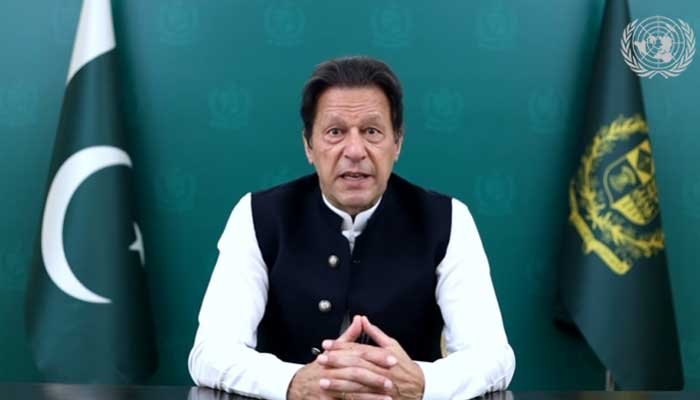
    Prime Minister Imran Khan delivered his address to the 76th session of the United Nations General Assembly (UNGA) earlier today. He said, “There is only one way to go. We must strengthen and stabilise the current government, for the sake of the people of Afghanistan.”

    “Right now the whole international community should think what is the way ahead. There are two paths that we can take. If we neglect Afghanistan right now, according to the UN half the people of Afghanistan are already vulnerable, and by next year almost 90 per cent of the people in Afghanistan will go below the poverty line.”

    “If the world community incentivises them, and encourages them to walk this talk, it will be a win-win situation for everyone. Because these are the four conditions that the US-Taliban dialogue in Doha was all about,” PM Imran Khan said.

    “You cannot waste time. Help is needed there. Humanitarian assistance has to be given there immediately. The Secretary-General of the United Nations has taken bold steps. I urge you to mobilise the international community, and move in this direction,” he said.

    ON ISLAMAPHOBIA

    The premier also discussed Islamophobia and said that the UN Global Counter-Terrorism Strategy has recognised as an emerging threat, as it increases the tendency of right-wing, xenophobic, and violent nationalists, extremists, and terrorist groups to target Muslims.

    “We hope the Secretary-General’s report will focus on these new threats of terrorism posed by Islamophobes and right-wing extremists,” the prime minister said.

    “I call on the Secretary-General to convene a global dialogue on countering the rise of Islamophobia. Our parallel efforts, at the same time, should be to promote interfaith harmony, and they should continue,” he added.

    The prime minister went on to underscore how New Delhi has also embarked “on what it ominously calls the ‘final solution’ for the Jammu and Kashmir dispute”.

    “Indian actions violate the resolutions of the UN Security Council on Jammu and Kashmir. The resolutions clearly prescribe that the ‘final disposition’ of the disputed territory should be decided by its people, through a free and impartial plebiscite held under the UN auspices,” the premier added.

    PM Imran Khan stated for the record that last February, both countries reaffirmed the 2003 ceasefire understanding along the Line of Control.

    “The hope was that it would lead to a rethink of the strategy in New Delhi. Sadly, the BJP government has intensified repression in Kashmir and continues to vitiate the environment by these barbaric acts,” the premier said.

    He said the onus remains on India to create a conducive environment for meaningful and result-oriented engagement with Pakistan.

    ON KASHMIR

    PM Imran Khan highlighted the forcible snatching of the mortal remains of the great Kashmiri leader, Syed Ali Shah Geelani, from his family, denying him a proper Islamic funeral and burial, in accordance with his wishes and Muslim traditions, as the most recent example of Indian barbarity.

    “Devoid of any legal or moral sanction, this action was even against the basic norms of human decency,” he said, adding: “I call on this General Assembly to demand that Syed Geelani’s mortal remains be allowed to be buried in the Cemetery of Martyrs with the appropriate Islamic rites.”

    The prime minister also warned of another conflict between Pakistan in India, which he said is essential to prevent. “India’s military build-up, development of advanced nuclear weapons, and acquisition of destabilising conventional capabilities can erode mutual deterrence between the two countries,” he said.

    ON CLIMATE CHANGE

    Turning his focus to climate change, he termed it one of the “primary existential threats” that the world faces today.

    ON COVID-19

    “The world is facing the triple challenge of Covid-19, the accompanying economic crisis and the threats posed by climate change.”

  • ‘Taliban will legally qualify for recognition once they take over the entire country,’ PM Khan

    ‘Taliban will legally qualify for recognition once they take over the entire country,’ PM Khan

    American Magazine ‘Newsweek’ has published an exclusive interview with Pakistani Prime Minister (PM) Imran Khan, conducted by its Senior Foreign Policy Writer Tom O’Connor.

    PM Khan talked about the troubles occurring in Afghanistan, China–Pakistan Economic Corridor (CPEC), the US emerging close relations with Pakistan’s top rival India and shed some light on Sino-US rivalry.

    In reply to a question by Tom about recognising the new Islamic Emirate of Afghanistan, PM Khan said, “Pakistan is obliged to engage with the de-facto authorities in Afghanistan to prevent an economic and humanitarian collapse.”

    “Once a government in Kabul establishes control over the entire country, it would legally qualify for recognition. However, Pakistan would prefer to reach a decision regarding recognition of the new government together with other neighbors of Afghanistan,” he added.

    He stressed that the authorities in Kabul [Taliban] need to neutralise terrorist groups present in Afghanistan, particularly the Tehreek-i-Taliban Pakistan (TTP) and said, “Pakistan will work with the authorities in Afghanistan to halt TTP and other terrorism from there.”

    While answering the question about the US and China’s influence in South Asia after Washington’s withdrawal from Afghanistan, Khan stated, “The US can work with a new government in Afghanistan to promote common interests and regional stability and can play an important and positive role in Afghanistan by providing humanitarian assistance.”

    “But if China offers economic support to Afghanistan, it’s natural that the Afghans will accept it. The Taliban have welcomed the prospects of being incorporated in the CPEC and establishing close relations with China,” he added.

    Talking about the close ties between the US and India, PM Khan stated, “We understand that the U.S. military support to India is designed to contain China. However India will never confront China, especially not to serve U.S. strategic objectives. India’s purpose in arming itself so massively is to establish its hegemony in South Asia and especially to threaten and coerce Pakistan.”

    “We believe that the current US-China rivalry is unnecessary and contrary to the interests of both these global powers,” he said while hoping that both countries will reach the same conclusion in the near future.

    He concluded by saying that Afghanistan will only be stabilized through help and that the U.S., China and Russia and all other countries must “contribute” to reconstructing the country.

  • ‘World should not repeat the mistake of disengaging with Afghanistan’: Shah Mahmood to Antony Blinken

    ‘World should not repeat the mistake of disengaging with Afghanistan’: Shah Mahmood to Antony Blinken

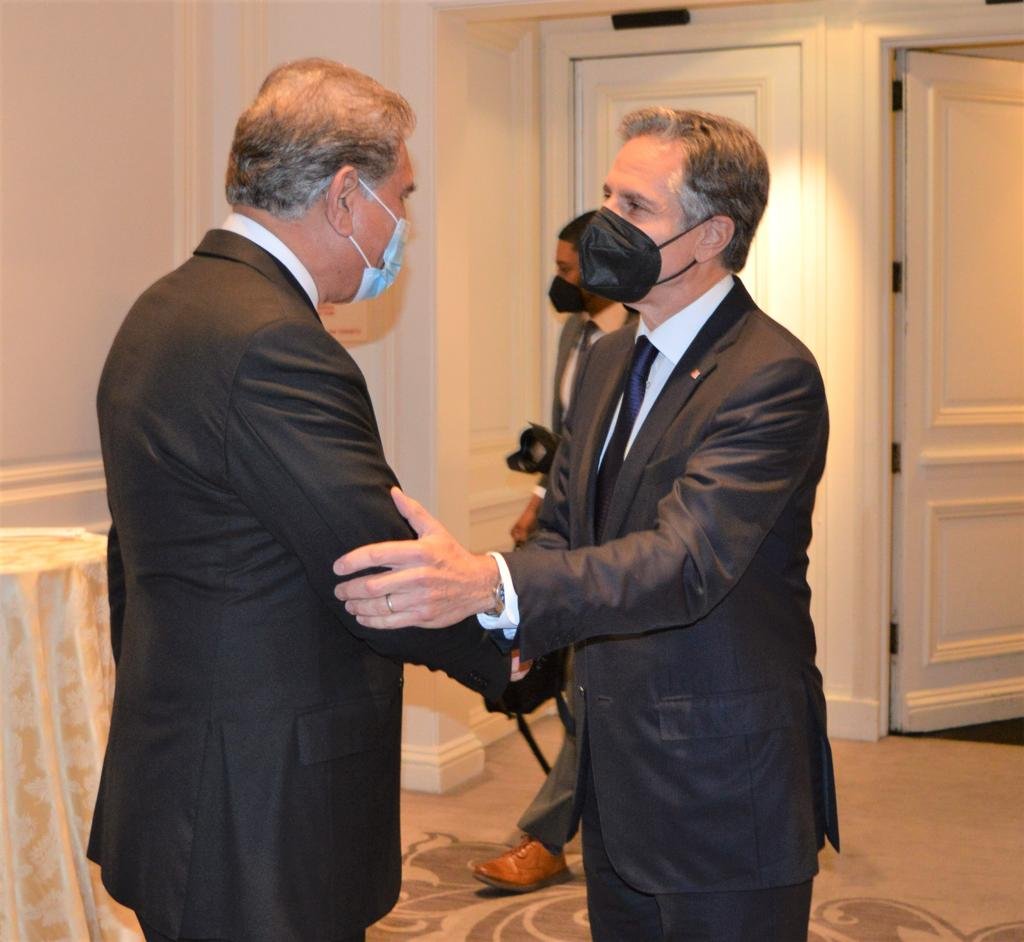
    Foreign Minister Shah Mahmood Qureshi had a meeting with the United States (US) Secretary of State Antony Blinken in New York.

    This is the first meeting between the two top diplomats. Their meeting focused on Afghanistan.

    FM Qureshi said that a new political reality had emerged in Afghanistan, and that “while the Taliban should be held to their commitments, the international community has a moral obligation to help the Afghan people deal with the growing humanitarian crisis in Afghanistan.”

    He hoped that the world would not repeat the mistake of disengaging with Afghanistan as it did in the 1990s.

    Secretary Blinken appreciated Pakistan’s support for the evacuation of US citizens and other nationals from Afghanistan and its continued efforts for peace in the region.

    He added: “Pakistan has long desired high-level contacts with the US leadership, particularly after the collapse of the US-backed government in Kabul.”

  • ‘If Taliban fail to form inclusive govt, Afghanistan could enter into civil war’: PM Khan

    Prime Minister Imran Khan, while giving an interview to BBC, said that it was likely that Afghanistan could descend into a civil war if the Taliban fail to form an inclusive government.

    “If they do not include all the factions, sooner or later they will have a civil war,” said PM Khan. “That would mean an unstable, chaotic Afghanistan and an ideal place for terrorists. That is a worry.”

    Speaking on women and their education, PM Khan stated that the girls of Afghanistan would soon be able to attend schools. He said preventing women from acquiring education in Afghanistan would be un-Islamic.

    “If anyone has any idea of what our religion was, it was a liberation of women, and so whenever the idea that women should not get educated, it’s just not Islamic. It might have been some rural culture in Afghanistan but it has nothing to do with religion,” said PM Khan.

    “The statements they have made since they assumed power, I mean it’s very encouraging,” said the premier. “They have said they will give education to women and allow them to work. They have said they will give amnesty. The soil will not be used for terrorism by anyone.”

    PM Khan reiterated that the statements made by the Taliban were encouraging but where they go from here is unknown to all.

    “What they [Taliban] do from now onwards, we can only hope to persuade them and encourage them, incentivise them in that direction. But you know sitting today, what happens, where they will go, I’m afraid, I don’t know,” says PM Khan.

    “Afghan are strong people, their women are very strong, give them time and they will assert their rights,” said the premier.

  • ‘I welcome PM Khan’s approach on Afghanistan, hope he creates same consensus within Pakistan’: Bilawal Bhutto

    ‘I welcome PM Khan’s approach on Afghanistan, hope he creates same consensus within Pakistan’: Bilawal Bhutto

    Chairman Pakistan People’s Party (PPP) chairman Bilawal Bhutto, while giving an interview to BBC, said that he welcomed Prime Minister Imran Khan’s approach to Afghanistan. He said that recognising the Afghan Taliban government should come after international consensus.

    “While I welcome the approach, I hope he [PM Khan] creates that consensus within Pakistan. The Pakistani parliament, unfortunately, has not met ever since the recent developments in Pakistan, stakeholders within Pakistan have not been consulted.”

    “We continue to encourage the new regime in Afghanistan to live up to international expectations if they want international recognition,” said Bilawal.

    Speaking on women’s rights and providing them safety in Afghanistan, Bilawal said, “There have been complaints from journalists in Afghanistan that women are protesting for their rights and we are concerned that girls are not being allowed to go to schools.”

    Bilawal said that as soon as the situation in Afghanistan developed, the PPP called for the government of Pakistan to hold a session of the parliament.

    “As with various issues in our country, we have been unable to form a national consensus. We require an inclusive foreign policy that is per the will of the parliament, not of any individual,” he said.

    Chairman PPP further said that we are very concerned about the potential blowback of the developments in Afghanistan as well as the links between Tehreek-e-Taliban Afghanistan (TTA) and Tehreek-e-Taliban Pakistan (TTP). He said that we have suffered immensely at the hands of violent extremism.

    “I lost my mother, the former prime minister Shaheed Mohtarma Benazir Bhutto, to Islamic extremism within Pakistan. In order to counter the threat of extremism, we need determination from the government of Pakistan to ensure no space for terrorism or extremism.”

    Journalist Yalda Hakim asked a question about the civilian government having little say in matters, to which Bilawal responded by saying that it was true that the democratic space in Pakistan was ‘shrinking’, especially during Imran Khan’s government.

    “In order for that space to be regained, it is the choice of democratic people of the country to play an active role in the political system, through the parliament and media,” said Bilawal.

    Chairman PPP added, “Everyone seems to be blaming one another, but it is important to work together for a positive outcome for the sake of the region. For the women and youth of Afghanistan who have so much potential, it is worrisome that their potential is in danger.”

    “The people of Pakistan and Afghanistan are both exhausted due to the war, we hope for the best but should also prepare for the worst. We are already seeing an increase in the activities of TTP within Pakistan … we have to tackle this issue through the United Nations to ensure that the vulnerable people, ethnic minorities and women of Afghanistan receive aid,” added Bilawal.

  • Nobody in a ‘rush’ to recognise Taliban govt says Foreign Minister Qureshi

    Nobody in a ‘rush’ to recognise Taliban govt says Foreign Minister Qureshi

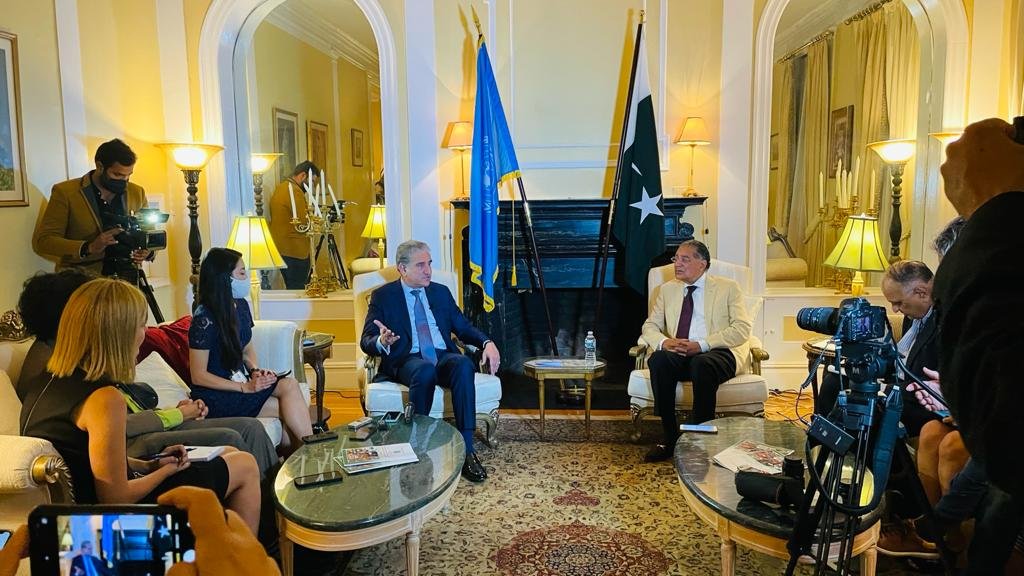
    Foreign Minister Shah Mahmood Qureshi, during a meeting with the United Nations (UN) press representatives, said, “I don’t think anybody is in a rush to recognise the Taliban at this stage and they [Taliban] should keep an eye on that.”

    The minister who is in New York for five days to attend the 76th session of the United Nations General Assembly (UNGA), stated that the world is watching Afghanistan. If they [Taliban] want recognition they have to be more sensitive and more open to international opinion, he added.

    He insisted on stating that Afghanistan should have an inclusive government in order to have stability and peace in the region, and expressed hope that the Afghan Taliban would live up to their promise to allow girls and women in educational institutions.

    Moreover, he urged the United States and other countries that have frozen money from the former Afghan government to release it because “that’s Afghan money that should be spent on Afghan people”.

    “I think freezing the assets is not helping the situation. I would strongly urge the powers that be that they should revisit that policy and think of an unfreeze,” Shah told reporters.

    According to an official statement issued by the Foreign Office, Prime Minister Imran Khan will address the UNGA via a video link on September 24th.