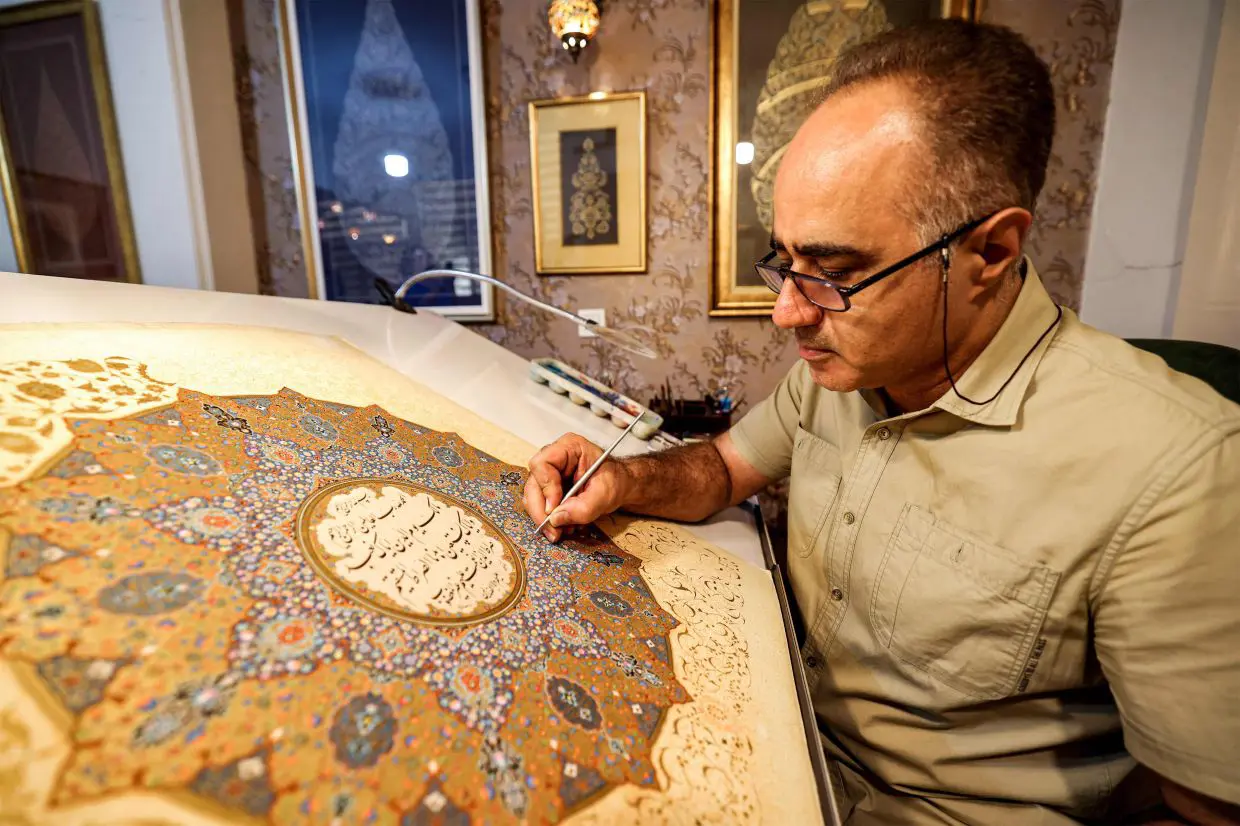
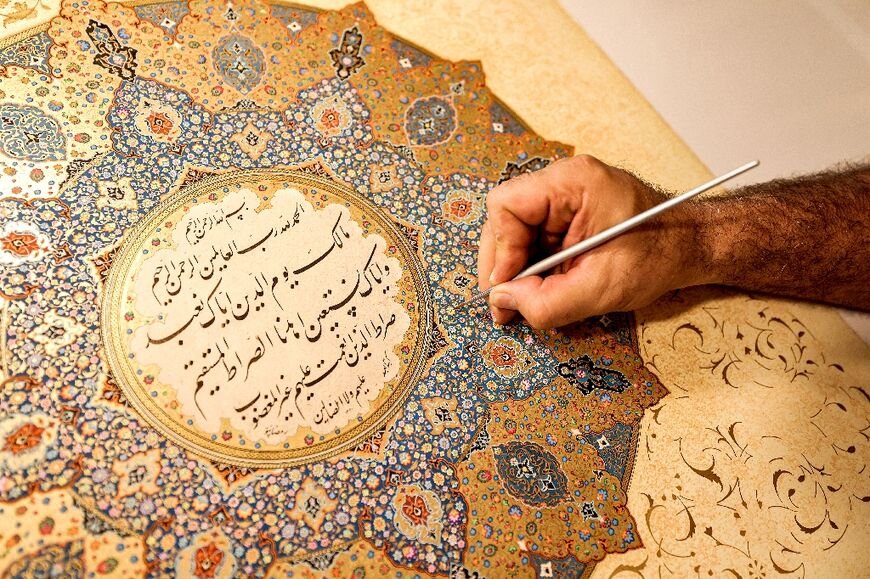
Iranian artist Mohammad Hossein Aghamiri sometimes labours for six months on a single design, very carefully — he knows a single crooked line could ruin his entire artwork.
In the age of AI-assisted graphic design on computer screens, the centuries-old tradition of Persian illumination offers an antidote to rushing the creative process.
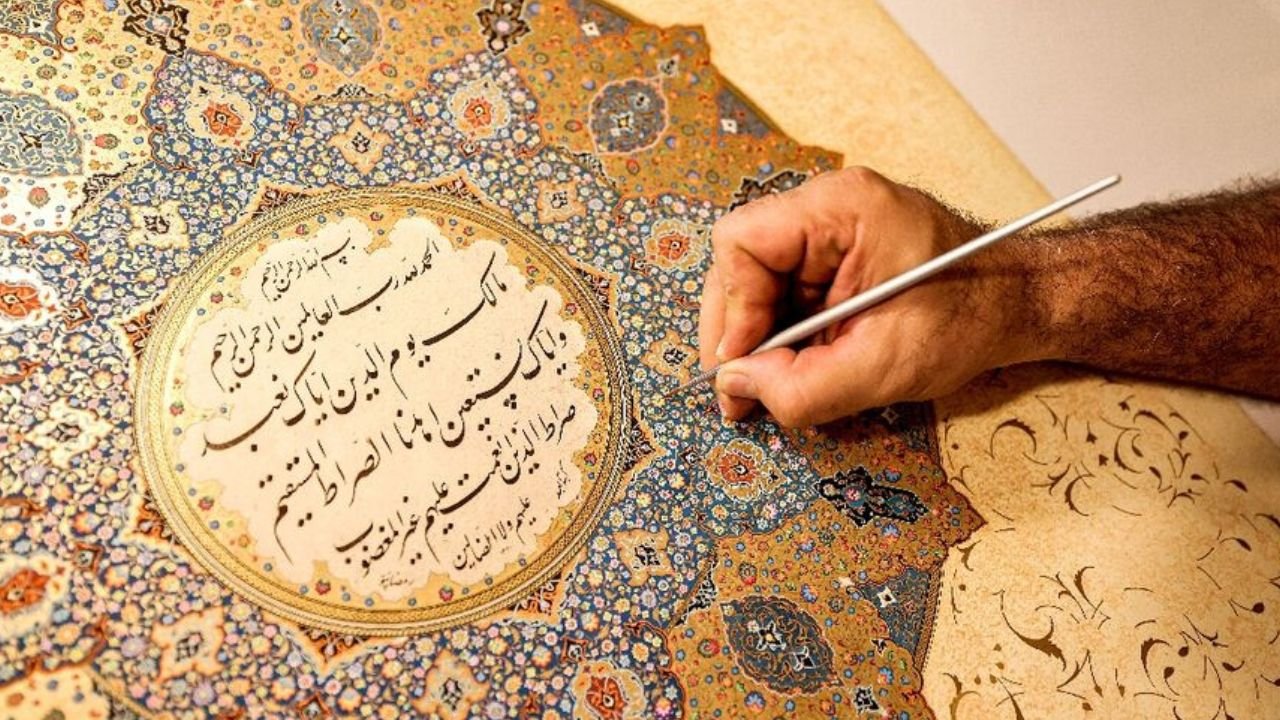
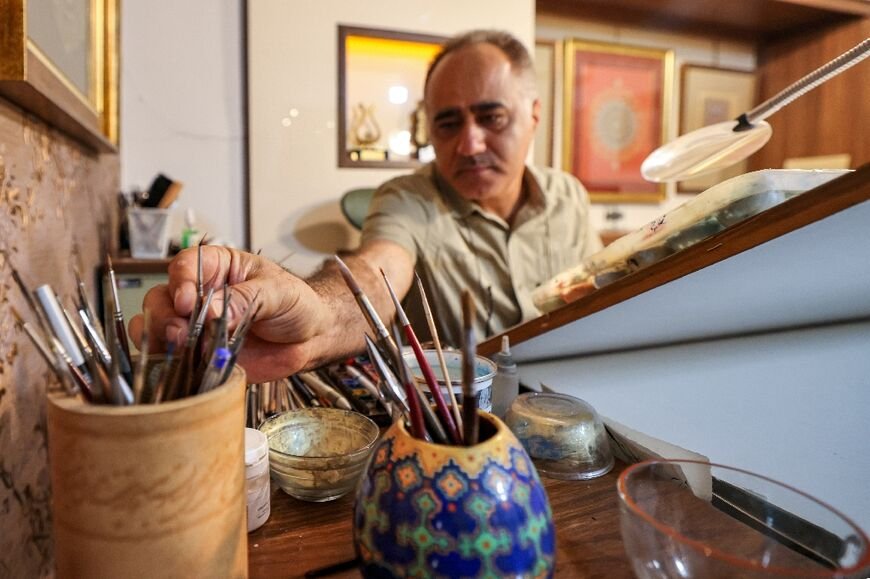
Aghamiri’s fine brush moves natural pigments onto the paper with deliberate precision as he creates intricate floral patterns, religious motifs and elegantly flowing calligraphy.
The exquisite artwork has for centuries embellished literary manuscripts, religious texts and royal edicts as well as many business contracts and marriage certificates.
Aghamiri, 51, is one of Iran’s dozen or so remaining masters of the ancient illumination art of Tazhib, which was inscribed last year on UNESCO’s list of intangible heritage.
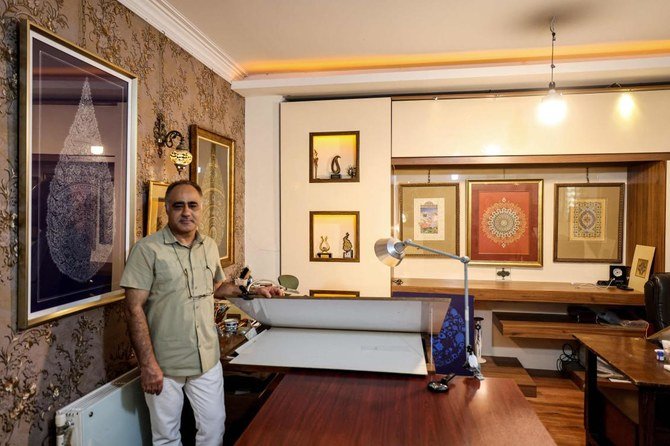
“It is a very unique job that requires a lot of patience and precision,” Aghamiri, a veteran of the craft with over 30 years’ experience, told AFP in his downtown Tehran studio.
“It’s not accessible to everyone.”
Tazhib’s non-figurative and geometric flourishes have traditionally adorned the margins of holy books and epic poems.
The artform dates back to the Sassanid era in pre-Islamic Iran but flourished after the seventh century advent of Islam, which banned human depictions.
Aghamiri says it often takes him months to finish one design and that a single misplaced stroke that disrupts its symmetrical harmony can force him to start over.
– Global workshops online –
When AFP visited, he was working on a so-called shamsa design, a symbolic representation of the sun, about 50 centimetres across with intertwined abstract, geometric and floral patterns.
He said he started the piece over four months ago and aimed to finish it within six weeks, using natural pigments such as lapis lazuli, saffron, gouache and pure gold, from China.
“Gold has a very strong visual appeal,” said Aghamiri. “It’s expensive and it enhances the perceived value of the work.”
Aghamiri hails from a family of artists and artisans with a rich history in Iranian craft traditions including calligraphy, miniature painting and carpet design.
His work has been showcased in museums in Iran and in nearby Arab countries of the Gulf region where interest in Oriental and Islamic art continues to grow.
“Eighty percent of my works are sold in the region, especially in the Emirates and Qatar” as well as in Turkey, he said.
In recent years, Aghamiri garnered interest abroad and even began teaching the ancient art online to students from across the world, notably the United States.
Soon, he also hopes to hold workshops in Britain for his craft, which he says is fundamentally different from European illumination art, which flourished in the Middle Ages.
European designs, he said, are more figurative and can depict human faces, animals and landscapes, and often illustrate biblical scenes.
UNESCO labelled the Persian art of illumination as part of the Intangible Cultural Heritage of Humanity in December 2023, at the request of Iran as well as Turkey, Azerbaijan and Uzbekistan.
“Twenty years ago, I didn’t have much hope” for the future of Persian illumination, said Aghamiri. “But things have changed, and I see that this art is becoming more and more popular.”
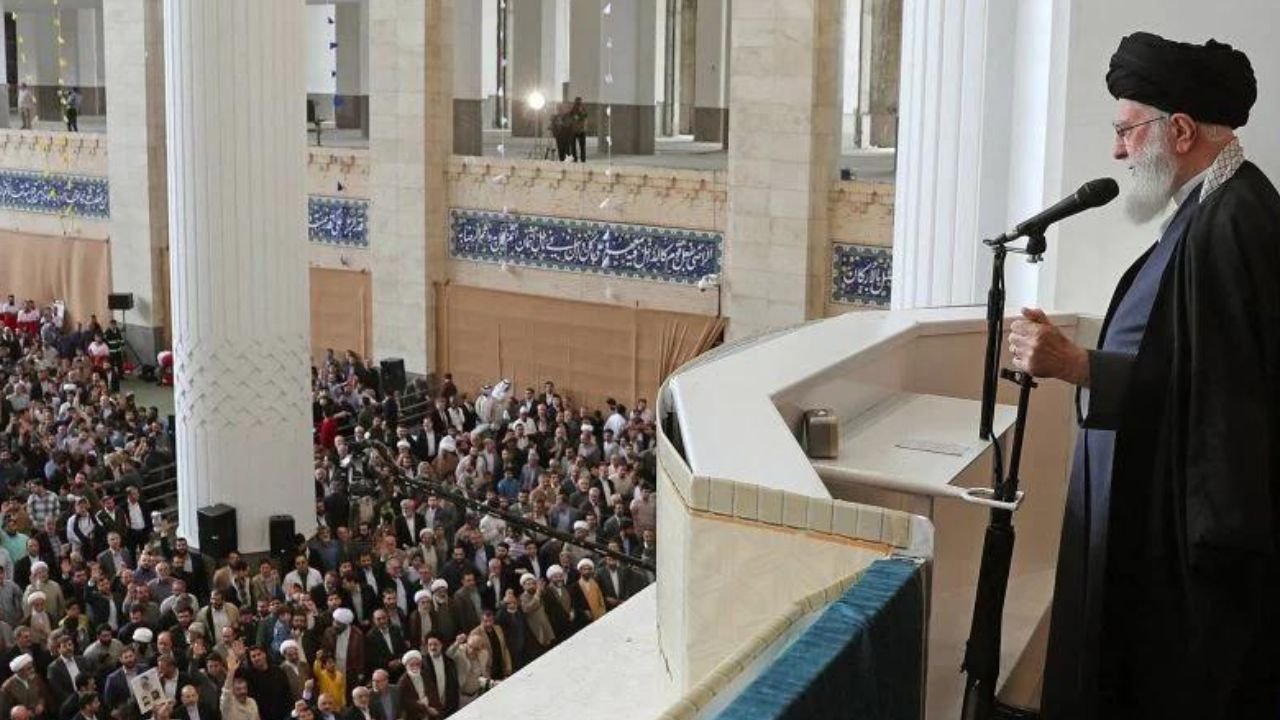
Iran’s supreme leader Ayatollah Ali Khamenei again warned Israel Wednesday that it “will be punished” for a Damascus air strike that killed seven Revolutionary Guards, two of them generals.
“The evil regime made a mistake in this regard. It must be punished and will be punished,” Khamenei said in a televised speech after Eid al-Adha prayers in Tehran.
Israeli Foreign Minister Israel Katz swiftly riposted with a Persian-language statement on social media site X.
“If Iran attacks from its territory, Israel will respond and attack Iran,” he said.
Khamenei said the April 1 strike, which levelled the five-storey Iranian consulate building in the Syrian capital, had run roughshod over international agreements providing for the inviolability of diplomatic premises.
“The consulate and embassy offices in any country are the territory of that country,” he said. “When they attacked our consulate, it means they attacked our territory.”
Khamenei has led Iranian officials in a succession of promises to avenge the strike, which was widely blamed on arch foe Israel.
One of his senior advisers, Yahya Rahim Safavi, warned on Sunday that Israeli embassies were “no longer safe”.
Israel said last week it was strengthening its defences and pausing leave for combat units following Iran’s retaliation threats.
Iran does not recognise Israel, and the two countries have fought a shadow war for years.
Iran charges that Israel was behind a wave of sabotage attacks and assassinations targeting its nuclear programme.
Following Operation Marg Bar Sarmachar, Pakistan and Iran have mutually agreed that ambassadors of both countries will return to their respective posts by January 26, 2024 and the Iranian Foreign Minister is going to visit on January 29, 2024.
In a joint statement issued on Monday, the Foreign Office said that at the invitation of Foreign Minister Jalil Abbas Jilani, his Iranian counterpart Hossein Amir Abdollahian will undertake a visit to Pakistan on January 29.
In a post on X, Pakistan’s Ambassador to Iran Mudassir Tipu said he was “so delighted that leaderships of both Pakistan and Iran so deftly handled a challenging moment astutely- swiftly putting relations back on track”.
I am so delighted that leaderships of both and so deftly handled a challenging moment astutely- swiftly putting relations back on track. We have great potential ahead & both brotherly countries must collectively promote peace & development in region .
Along with that the Foreign Office (FO) said on Monday that Iran’s foreign minister Hossein Amir Abdollahian would visit Pakistan on January 29.
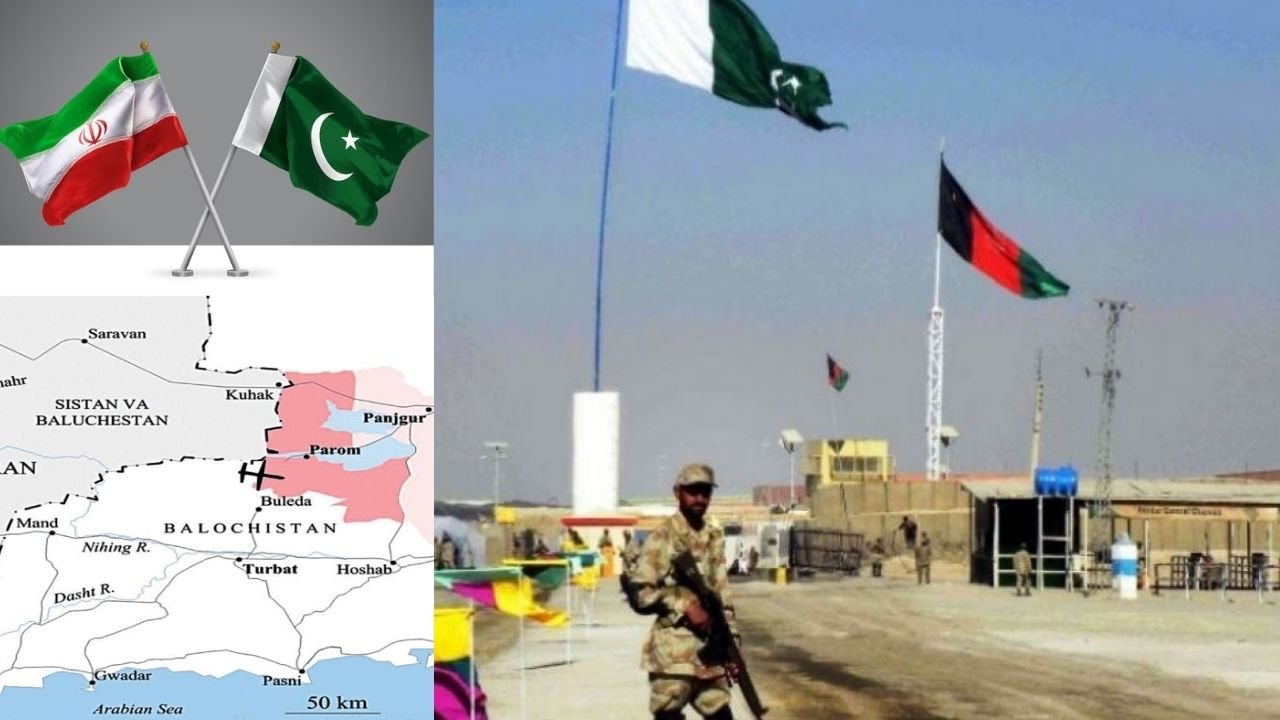
The visit comes days after tensions escalated between the two countries following an Iranian air strike in Pakistan, leading Islamabad to strike terrorist hideouts in the neighbouring country’s Sistan-Baluchestan province.
“Following the telephone conversation between the foreign ministers of Pakistan and the Islamic Republic of Iran, it has been mutually agreed that ambassadors of both countries may return to their respective posts by January 26, 2024,” the FO said in a statement.
The FO said that the Iranian foreign minister would travel to Pakistan on Jan 29 at the invitation of FM Jilani.
: PR NO. 2️⃣3️⃣/2️⃣0️⃣2️⃣4️⃣
Joint Press Statement of the Islamic Republic of Pakistan and the Islamic Republic of Iran
Previously, Pakistan has targeted terrorist hideouts inside Iran in response to the violation of Pakistan’s sovereignty by the Iranian Revolutionary Guard that killed two children and injured three girls.
Hideouts used by terrorist organisations namely Balochistan Liberation Army and Balochistan Liberation Front were successfully struck in an intelligence based operation, code name ‘Marg Bar Sarmachar’, ISPR has stated in a recently released statement.
According to a statement by the Foreign Office (FO), a number of terrorists were killed during the intelligence-based operation codenamed ‘Marg Bar Sarmachar’. Meanwhile, Iran’s IRNA news agency reported that nine people, including seven “non-Iranian nationals”, were killed in the strike targeting a village near the city of Saravan.
The Khorasan Diary reported, that “7 BLF millitants involved in attacks in Pakistan have been killed/injured in Pakistan’s strikes in Iran.”
7 BLF MILITANTS INVOLVED IN ATTACKS IN PAKISTAN HAVE BEEN KILLED/INJURED IN PAKISTANS STRIKES IN IRAN.
A top Pakistani security official told The Khorasan Diary that 7 militants wanted to Pakistan have been killed or injured in the strike in Shamesar, Iran.
In a video posted, it can be seen the damage caused by Pakistani Strikes in approximately 200 kilometres away from PAK-Iran border.
TKD MONITORING: A video uploaded by news outlets of Saravan city at dawn shows at least one site hit by Pakistan early this morning. Multiple bodies are under the debris it states. Saravan city in Sistan wa Balochistan province of Iran is approximately 200 kilometres from… pic.twitter.com/LrLr58iMBO
Publication The Khorasan Diary also claimed that Jaishul Adal, the same militant group, Iran claimed to have targeted has taken the responsibility for the attack on Saravan Corps of Sistan Wa Baluchistan province, Colonel Hossein Ali Javadanfar, adding that the security official was assassinated along with two of his guards.”
ALERT: The deputy commander of the Saravan Corps of Sistan Wa Baluchistan province, Colonel Hossein Ali Javadanfar, was shot dead when he was returning from an administrative mission on the Khash-Zahedan road, Iran. Iranian state media reported. Jaishul Adal, a militant group… pic.twitter.com/LiizDcCVFT
Previously, The Iranian strikes were part of a series of attacks carried out by the country in recent days in Syria and Iraq as a response to recent terrorist attacks on its territory. They have heightened concerns about regional stability, particularly amid ongoing conflicts in the Middle East.
Pakistan undertook a series of highly coordinated and specifically targeted precision military strikes against terrorist hideouts in Siestan-o-Baluchistan province of Iran. A number of terrorists were killed during the Intelligence-based operation – codenamed ‘Marg Bar Sarmachar’, says the official statement released by the Foreign Office of Pakistan.
“Last night’s unprovoked and blatant breach of Pakistan’s sovereignty by Iran is a violation of international law and the purposes and principles of the Charter of the United Nations,” FO Spokesperson Mumtaz Zahra Baloch said in a statement on Wednesday.
A context to the response by the Foreign Office
Foreign Ofiice of Pakistan provided a detailed context to Operation Marg Bar Sarmachar.
“Over the last several years, in our engagements with Iran, Pakistan has consistently shared its serious concerns about the safe havens and sanctuaries enjoyed by Pakistani origin terrorists calling themselves Sarmachars on the ungoverned spaces inside Iran. Pakistan also shared multiple dossiers with concrete evidence of the presence and activities of these terrorists. However, because of lack of action on our serious concerns, these so-called Sarmachars continued to spill the blood of innocent Pakistanis with impunity. This morning’s action was taken in light of credible intelligence of impending large-scale terrorist activities by these so called Sarmachars,” the statement read.
The Foreign Office described the action as a part of its resolve to “defend its national security against all threats.” Moreover it mainatianed that “Pakistan fully respects the sovereignty and territorial integrity of the Islamic Republic of Iran. The sole objective of today’s act was in pursuit of Pakistan’s own security and national interest which is paramount and cannot be compromised.”
Strict monitoring of Air Space
Geo News’ Azaz Syed quotes Civil Aviation Authority that amid the escalation of tensions in Islamabad-Tehran ties, Pakistan has started strict monitoring of all flights from the West including Iran.
Meeting of Foreign Minister with Iranian Counterpart
Caretaker Foreign Minister Jalil Abbas Jilani Wednesday told his Irani counterpart that no country should follow its path of launching an attack on a neighbouring nation’s soil against the menace of terrorism unilaterally.
“No country in the region should tread this perilous path,” Jilani told Iran’s FM Hossein Amir-Abdollahian during a telephone call hours after Tehran claimed it had targeted “terrorists” in Pakistan.
Iranian response
There is a group called Jaishal Adal, which is an Iranian terrorist group that have taken refuge on Pakistan-Iran border. Several times we have talked to Pakistani security officials that this group killed our security personnel and we responded by killing Iranian terrorist on Pakistani soil. I have spoken to my Pakistani counterpart, the Foreign Minister of Pakistan, we do respect the sovereignty of Pakistan but we don’t allow our national security be compromised and be played with. We have no hesitations when it comes to our national interest and those terrorist groups inside Pakistan and those affiliated with Israel” the Iranian Foreign Minister Hossein Amir Abdollahian said while speaking in Davos at The World Economic Forum.
WE RESPECT PAKISTANS SOVEREIGNTY BUT WILL NOT COMPROMISE ON OUR NATIONAL SECURITY SAYS IRANIAN FOREIGN MINISTER
There is a group called Jaishal Adal, which is an Iranian terrorist group that have taken refuse on Pakistan-Iran border. Several times we have talked to Pakistani… pic.twitter.com/NHLrTyCwqn
India India in a statement from the Ministry of External Affairs said, “This is a matter between Iran and Pakistan. Insofar as India is concerned, we have an uncompromising position of zero tolerance towards terrorism. We understand actions that countries take in their self-defence.”
China, close partners of Iran and Pakistan, urged restraint, with foreign ministry spokeswoman Mao Ning saying both should “avoid actions that would lead to an escalation of tension”.
United States of America
The United States, meanwhile, condemned the Iranian strikes in Pakistan, Iraq and Syria, with State Department spokesman Matthew Miller saying Tehran had violated the “sovereign borders of three of its neighbours in just the past couple of days”.
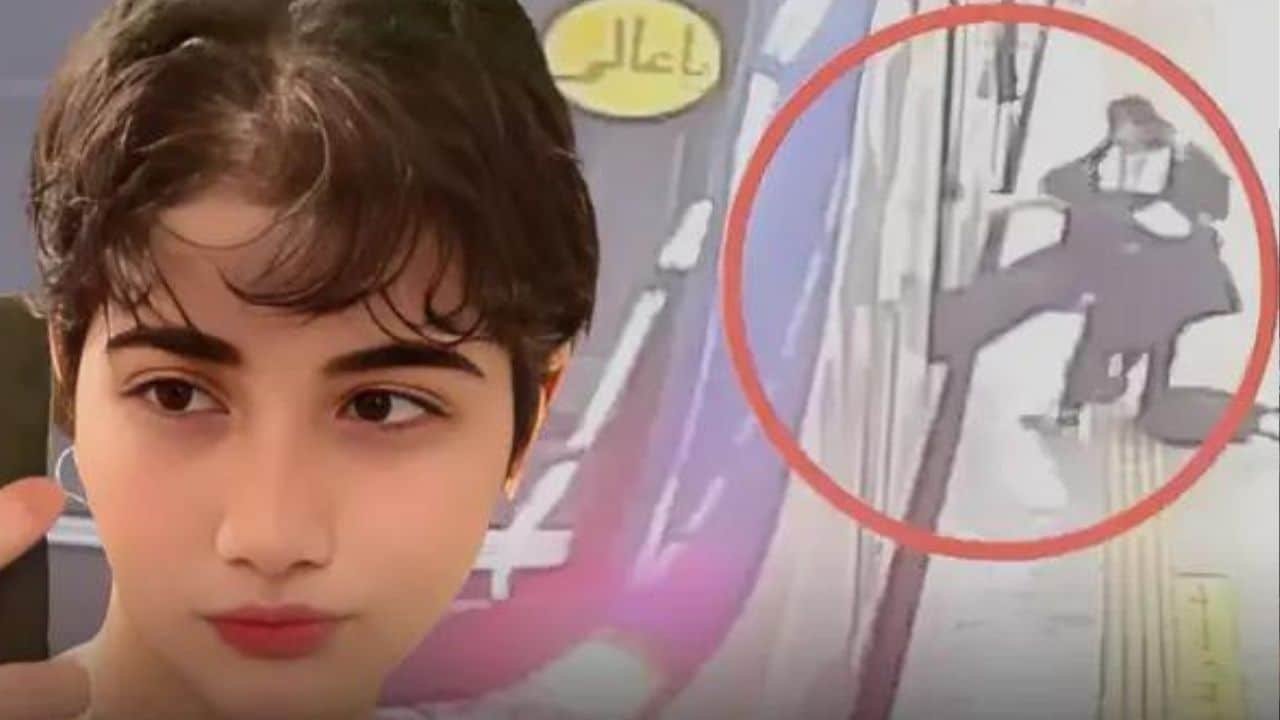
Update : “Armita Garawand, a student in Tehran, died an hour ago after intensive medical treatment and 28 days of hospitalisation in intensive care,” reported the Borna news agency affiliated with the youth ministry.
The 17-year-old ethnic Kurd, who was declared “brain dead” a week ago, had been hospitalised at Fajr Hospital in Tehran since October 1 after she fell unconscious on the metro.
In September, lawmakers voted in favour of toughening the penalties, which include jail sentences of up to 10 years for women who violate the dress code.
The reformist daily Ham Mihan called on the authorities to “allow independent media to investigate” the incident in order to persuade the public.
Previously it was reported that Armita Geravand, a 16 year old in Tehran, is allegedly the latest victim of Iranian morality police. In a controversial incident that took place in a metro station, she is likely to be “brain-dead” as reported by state-media.
Iranian authorities have vehemently denied any such claims of altercation on the Tehran Metro station with the female policers. They say that the girl collapsed due to low blood pressure.
Humanitarians such as Kurdish-Iranian Hengaw groups have claimed otherwise of the reason behind the teenager’s collapse. They made her hospitalisation public, showing her pictures in an unconscious state and alleging that the teen had not undergone any operations owing to her fragile health condition. She was admitted to the hospital on October 1 and since then she has been in a critical condition under a tight security presence. Her mother was also reportedly arrested around the hospital but was released afterwards. Her father has told the Hengaw group that he has been informed by the medical team that “her brain is no longer functioning and there is no hope of recovery.”
As for the footage published by Iranian Media it can be seen that an unconscious body has been dragged out of the train by the female officers. Amnesty International has opined that there is “mounting evidence of a cover-up” because the analysis shows that the footage has been edited with the frame rate increased and over three minutes of footage is missing. They believe that the family and friends affirming state narrative are saying this under duress. They have not been allowed to visit her and even the journalist who went in to report was detained briefly.
The stringent hijab laws in Iran became a point of controversy with the death of 22 year old Mahsa Amini, last year in September 2022. The extremely controversial and unfortunate near-dead condition of this young girl has further raised concerns.
Just a couple of days ago, two Iranian Journalists were sentenced to long periods of imprisonment on charges of covering the protests held all across the country after Amini’s death.
To read more: https://thecurrent.pk/iran-sentences-two-women-journalists-for-covering-mahsa-aminis-protests/
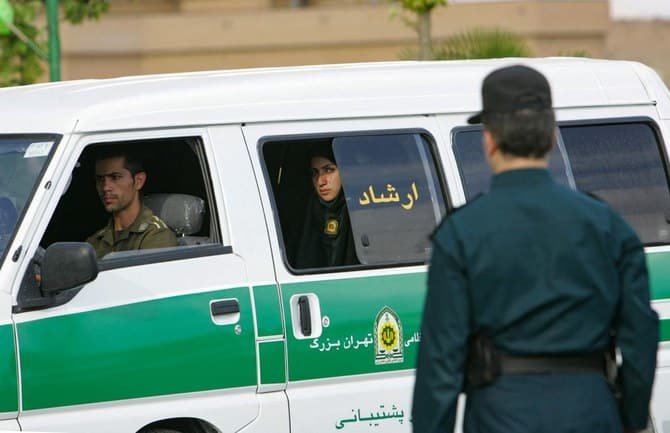
Iran’s notorious morality police have resumed patrolling the streets of the country, after policing efforts had been scaled back following nationwide protests that broke out across the country last year.
Following the death of 22-year-old Kurdish woman Mahsa Amini while she was held in police custody, tens of thousands of Iranians took to the streets to protest, in what some analysts say was the ‘biggest challenge‘ posed against the government since the 1979 Islamic Revolution.
During the mass protests, which lasted for months, the morality police were largely absent from Iranian streets, refraining from highly confrontational methods of enforcing mandatory hijab laws that were imposed shortly after the ‘79 revolution. There were even some reports – later denied – that they had been disbanded.
The protests largely died down earlier this year, after a brutal crackdown in which more than 500 protestors were killed and nearly 20,000 detained by authorities.
Saeid Montazeralmahdi, the spokesperson for the Iranian law enforcement force, confirmed on Sunday that police patrols were now operational on foot and with vehicles to crack down on people whose head covering is not deemed appropriate in the Islamic Republic, according to Al-Jazeera.
The Guardian reported that in Tehran, morality police has been seen patrolling the streets in marked vans.
For the past few months, morality police have also been employing surveillance cameras with face-recognition software to identify hijab violators. The violators are given warnings, fines, or sent to appear in court.
Mahsa Amini was detained last year on September 13th, on accounts of violating the draconian dress code law the Iranian government has in place, which mandates women wearing the hijab. According to authorities, Mahsa Amini was not wearing her hijab ‘properly’.
Witnesses reported that she was beaten by morality police after her arrest in Tehran. The morality police maintain that Mahsa Amini suffered a heart attack and died.
Demonstrators initially gathered outside Kasra hospital in Tehran, where Amini was being treated. Human rights groups reported that security forces deployed pepper spray against protesters and that several were arrested.
This year alone, there have been many high-profile hijab related incidents, including an incident in Mashadd, where a man dumped yoghurt on two women for not wearing the hijab properly. All three parties were arrested by authorities.
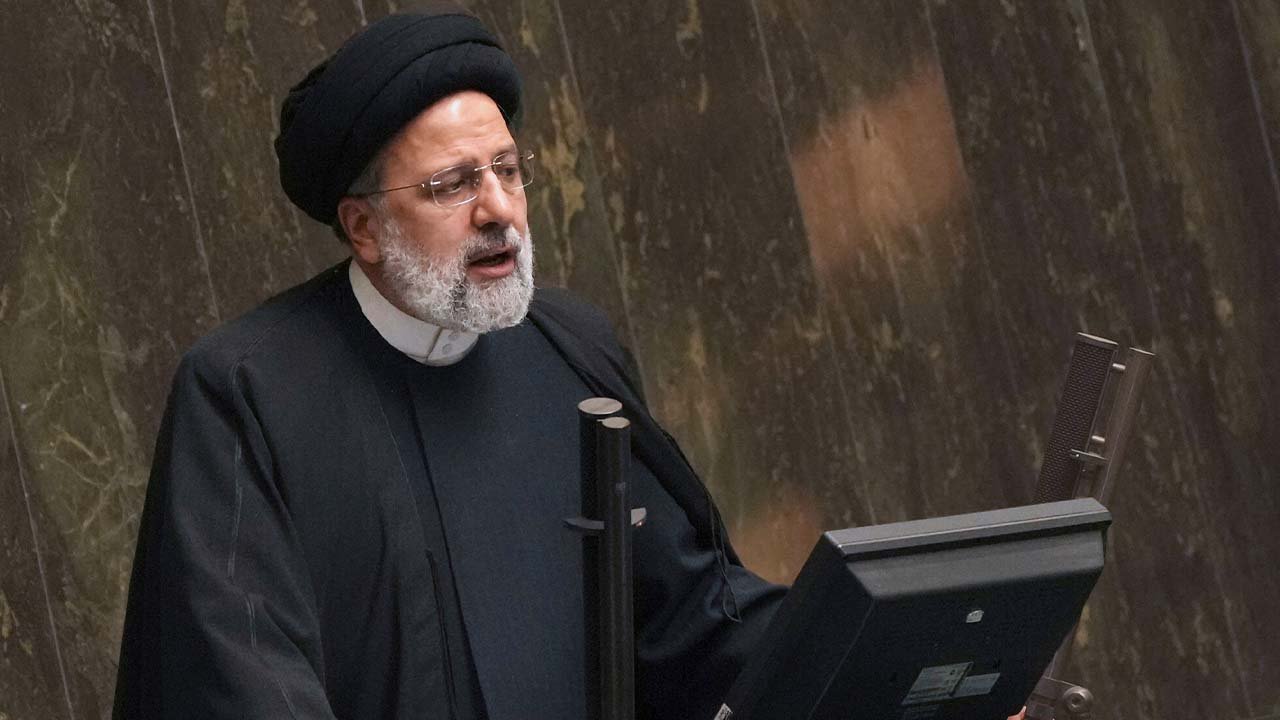
Little over a week after the two nations decided to reestablish diplomatic ties, Iran claims Saudi Arabia has extended an official invitation to Iranian President Ebrahim Raisi to pay a state visit.
The Saudis have not officially confirmed the invitation, which is claimed to have arrived in a letter from King Salman.
The conflict between the two countries has dominated the Middle East’s recent history.
A senior Iranian official, Mohammad Jamshidi, tweeted regarding the invitation to visit Riyadh, saying Mr Raisi had welcomed it and “stressed Iran’s readiness to expand co-operation.”
Furthermore, Hossein Amir-Abdollahian, the foreign minister of Iran, informed reporters that the two nations had agreed to conduct a meeting at the level of the foreign ministers and that three potential venues had been suggested.
He did not specify the locations or the potential dates for the meeting.
According to Bloomberg, the recent thaw in bilateral relations, which came as a surprise after days of negotiations mediated by China, appears to be gaining significant pace.
Both have declared they will reopen their embassies and resume their economic and security relations within two months.
With the failure of earlier attempts at reconciliation, many, including the US and the UN, warily welcomed this progress.
In January 2016 after protesters surrounded its embassy in Tehran, Saudi Arabia broke ties.
That came after Sheikh Nimr al-Nimr, a well-known Shia Muslim cleric who had been found guilty of crimes related to terrorism, was executed by Riyadh.
Since then, there have frequently been high levels of tension between the Sunni- and Shia-led neighbours, with each seeing the other as a dangerous force vying for supremacy in the region.
They have taken opposing sides in a number of local conflicts, including as the civil wars in Yemen and Syria.
Mr. Amir-Abdollahian said that Iran hoped measures would be taken to strengthen ties with Bahrain, a close Saudi ally that cut off diplomatic ties with Tehran in 2016 after Riyadh did the same.
“We hope that some obstacles between Iran and Bahrain will be removed and we will take basic steps to reopen the embassies,” he said.
Bahrain hasn’t reacted to the remarks, but it did earlier applaud the Saudi Arabia-Iran decision to reestablish diplomatic ties.
Moreover, Iran has shown a desire to restart or strengthen ties with other adversaries in the Arab world, such as Jordan and the United Arab Emirates.
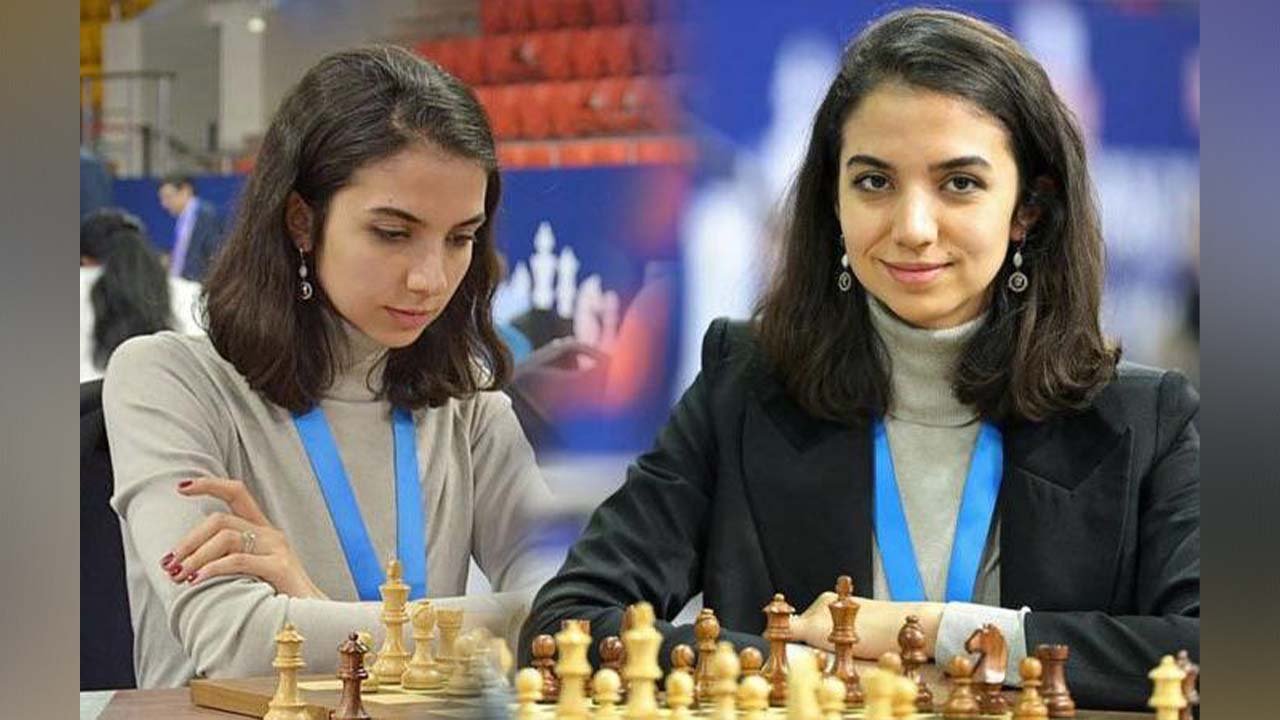
Iranian chess player Sara Khadem has taken part in an international chess tournament without wearing the hijab.
As per Iranian Law, it is compulsory for women to wear hijab or cover their head while competing in international tournaments. Sara Khadem has said that she still hopes she will continue representing her homeland in international competitions.
On September 13 last year in Tehran, Iran, the moral police arrested a 22-years-old woman named Masha Amini from Kurdistan Province for not wearing hijab properly.
Masha Amini went into a coma when the police assaulted her while she was under arrest. Masha died in the hospital on September 16.
Sara Khadem’s action is also being seen as support for the protests which have gripped Iran since Amini’s death. Iranian moral police planned to arrest Sara Khadem upon her arrival in the country but the chess player fled to Spain with her husband and 10-month-old son.
While talking to a Spanish newspaper Sara Khadem said that she is, “not my-self while wearing hijab.” She said that planned to leave Iran after the birth of her son Sam. “I want my son to move freely on roads and play without bothering us. Spain is the only place that pops up in my head and I took refuge here,” she stated.
Khadem also clarified that she will only wear hijab if there are cameras before an international chess match in Kazakhstan.
“But I’m not me when I wear hijab. I don’t feel well. So, I decided to put an end to that situation. Because of this, I have decided not to wear the hijab anymore,” she said.
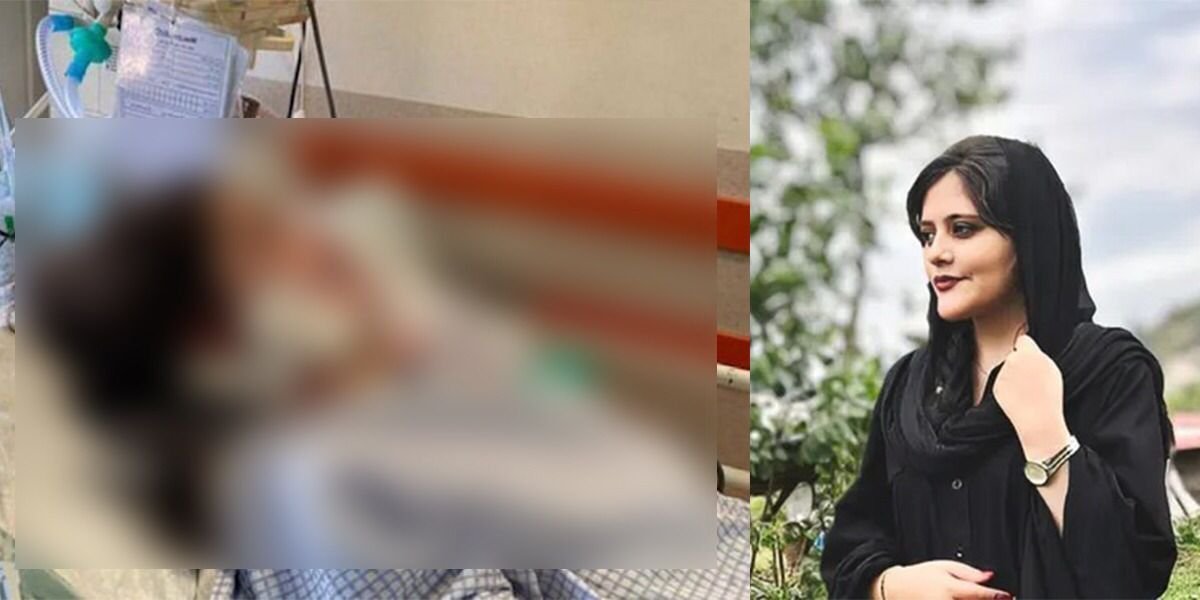
A 22-year-old Iranian woman breathed her last on Friday, days after being arrested by a police unit responsible for forcing Iran’s strict dress code for women. She was arrested for not complying with hijab rules.
According to eyewitnesses, Mahsa Amini was beaten while inside a police van when she was picked up in Tehran on Tuesday. Photographs of the Mahsha lying in a hospital bed have gone viral, showing the young woman in a coma with her head wrapped in bandages and breathing through tubes.
Police Claim:
Police have denied the allegations of beating her to death saying Ms Amini had “suddenly suffered a heart problem”. However her father has denied the claims made by police. “Authorities have said my daughter suffered from chronic medical conditions. I personally deny such claims as my daughter was fit and had no health problems,” Amini’s father told pro-reform Emtedad news website on Sunday.
Protests:
MahsaAmini became one of the top hashtags on Persian-language Twitter on Sunday as Iranians fumed over the death of Amini. The hashtag had gained 1.63 million mentions on Twitter by Sunday afternoon.
As enraged citizens took to the streets to protest, at least 30 persons were injured. People are protesting against strict Iranian hijab laws and against the existence of “guidance patrol.”