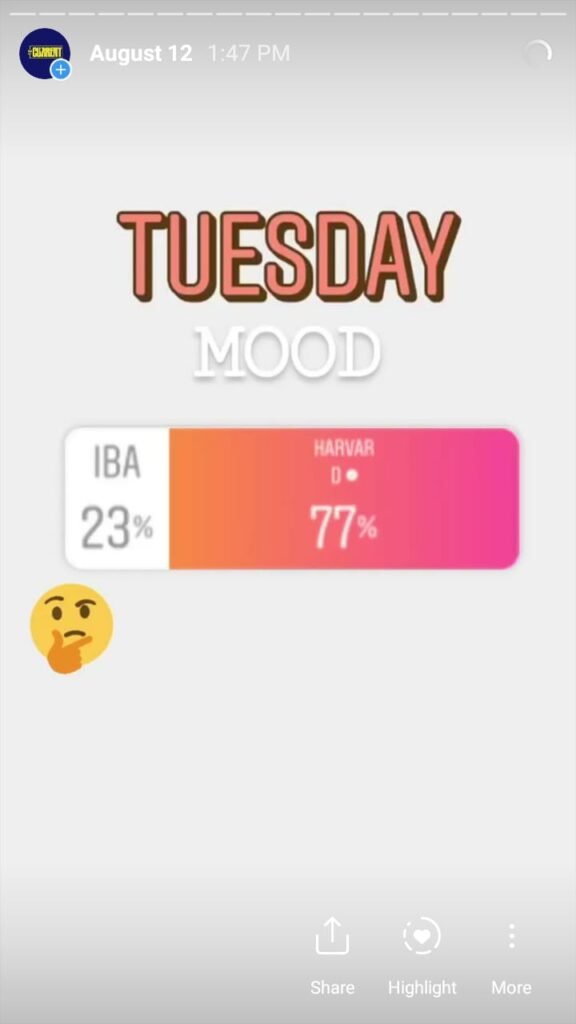
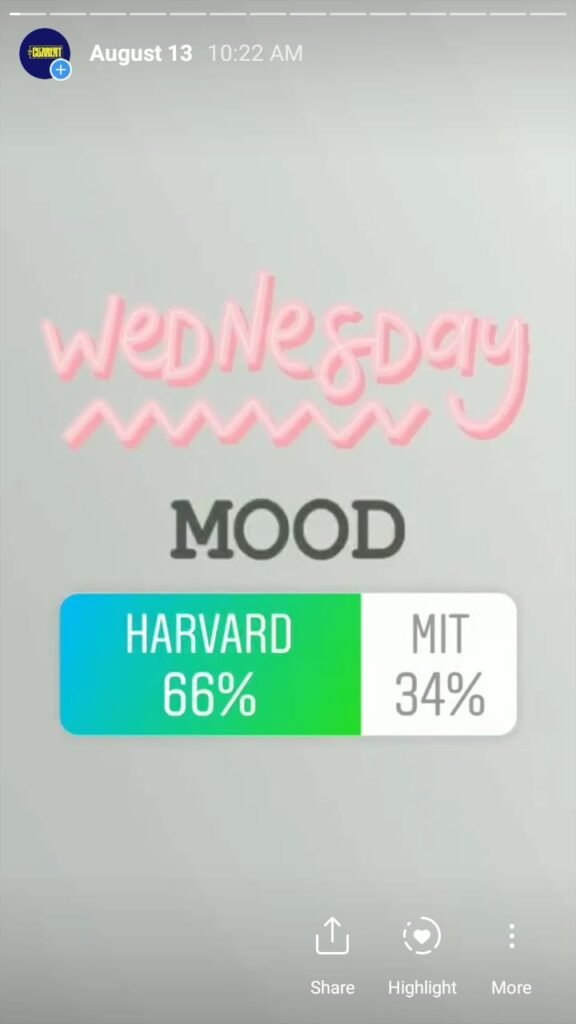
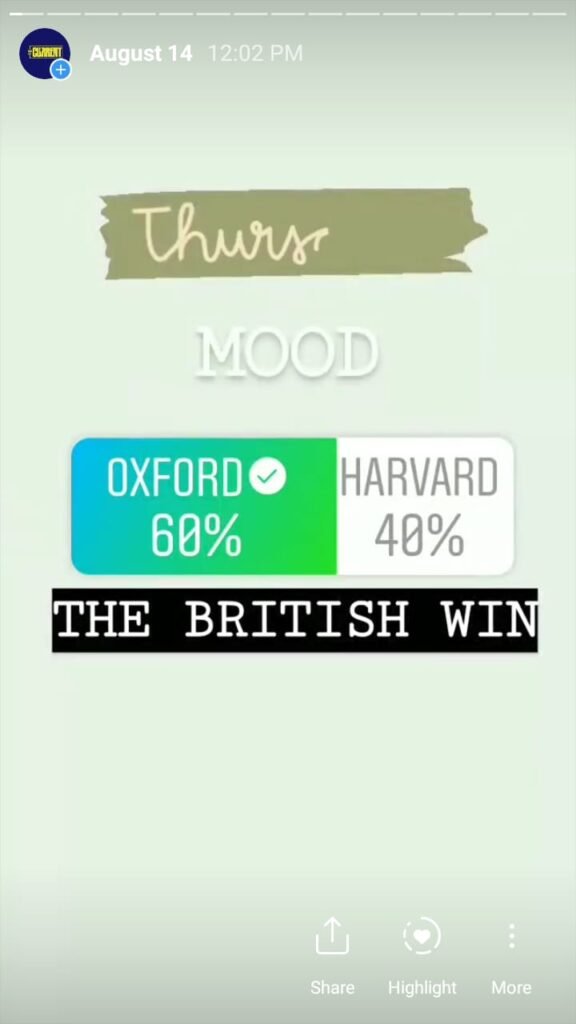
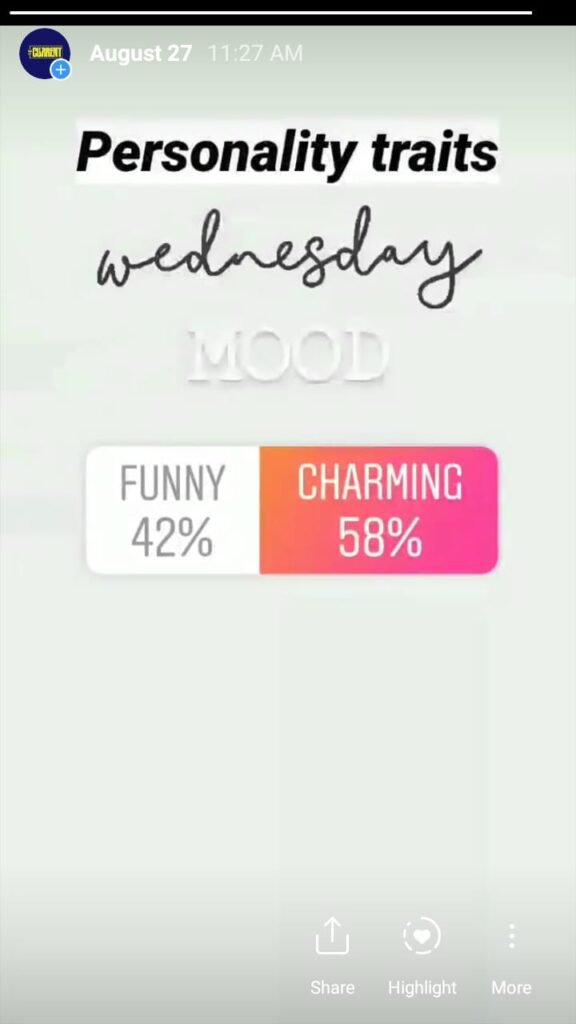
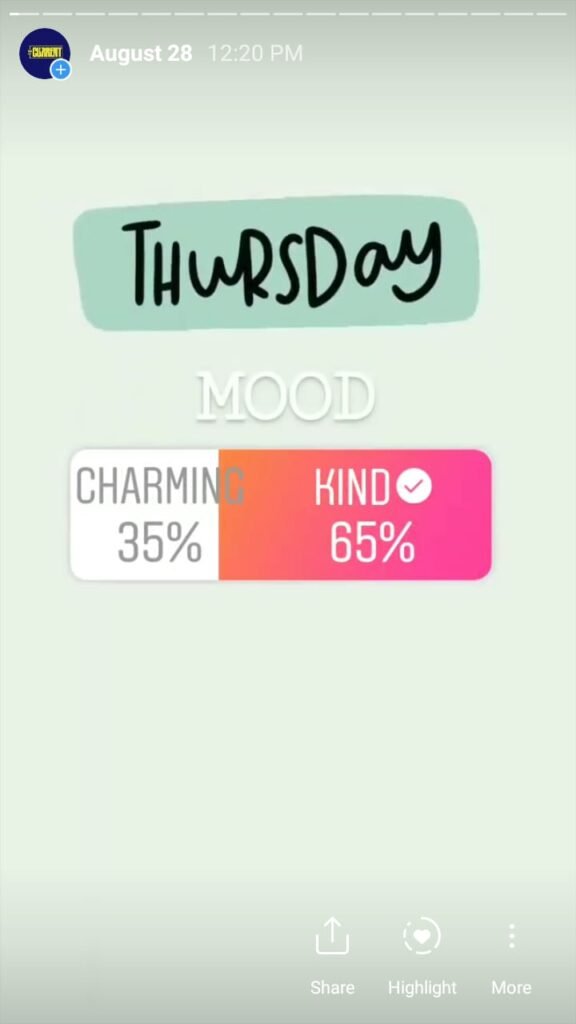
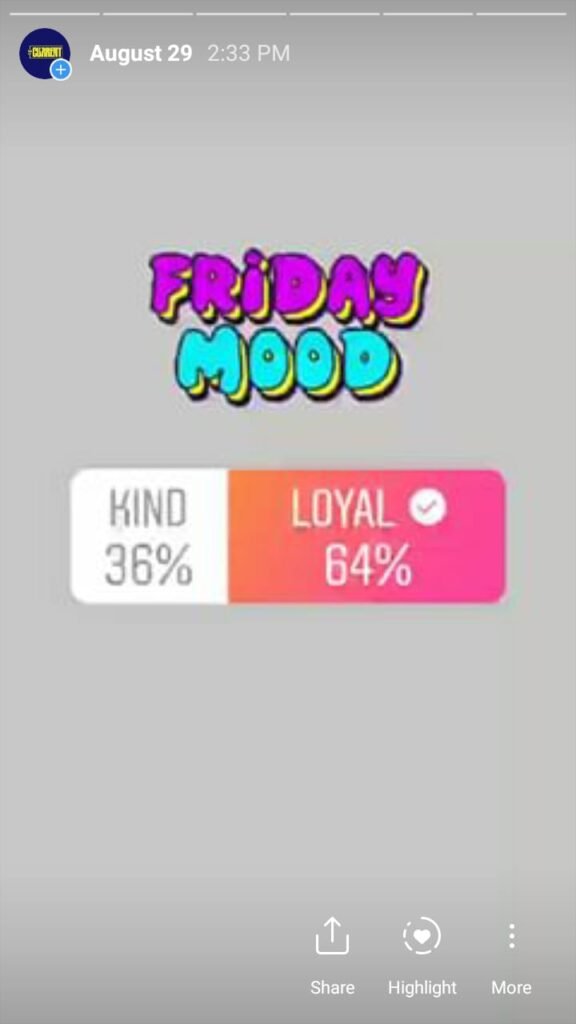
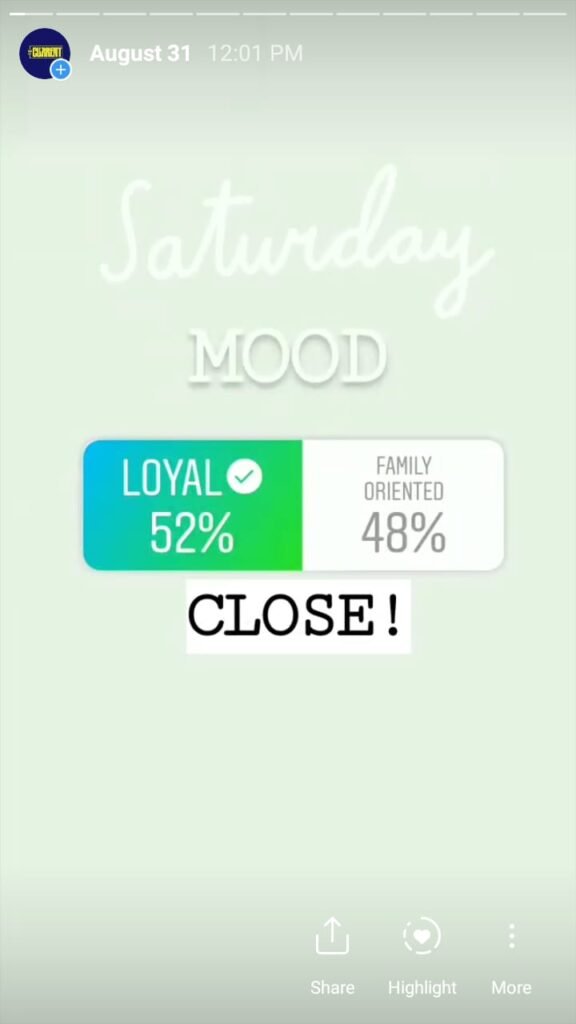
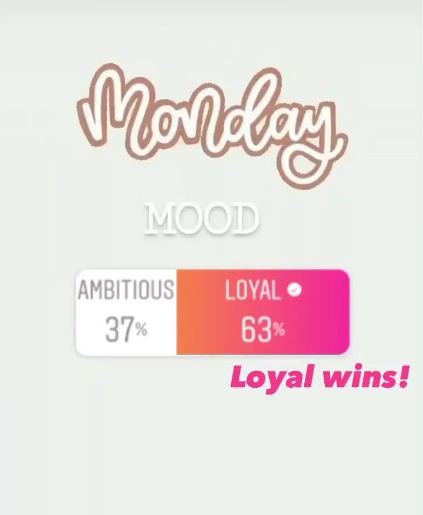
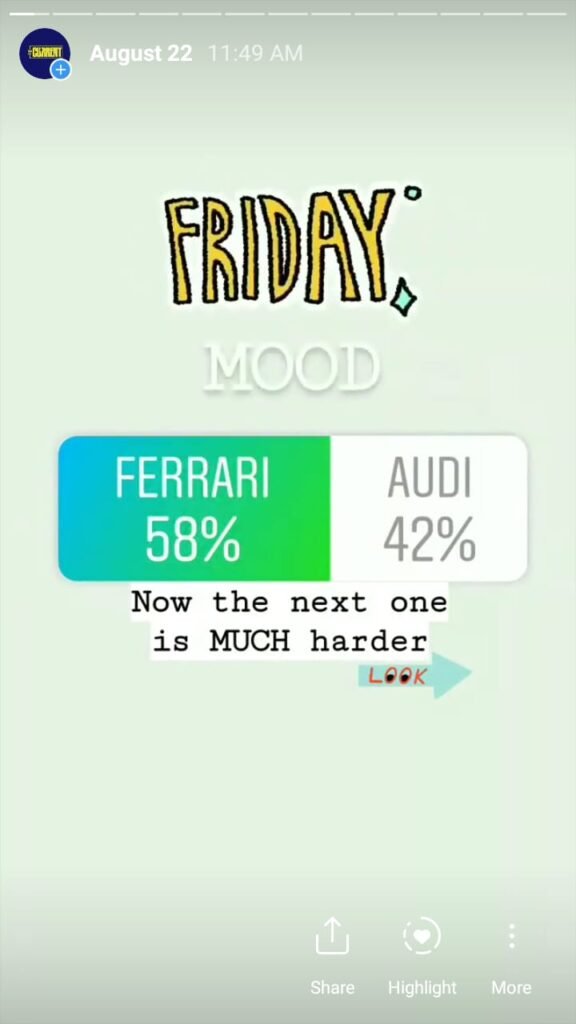
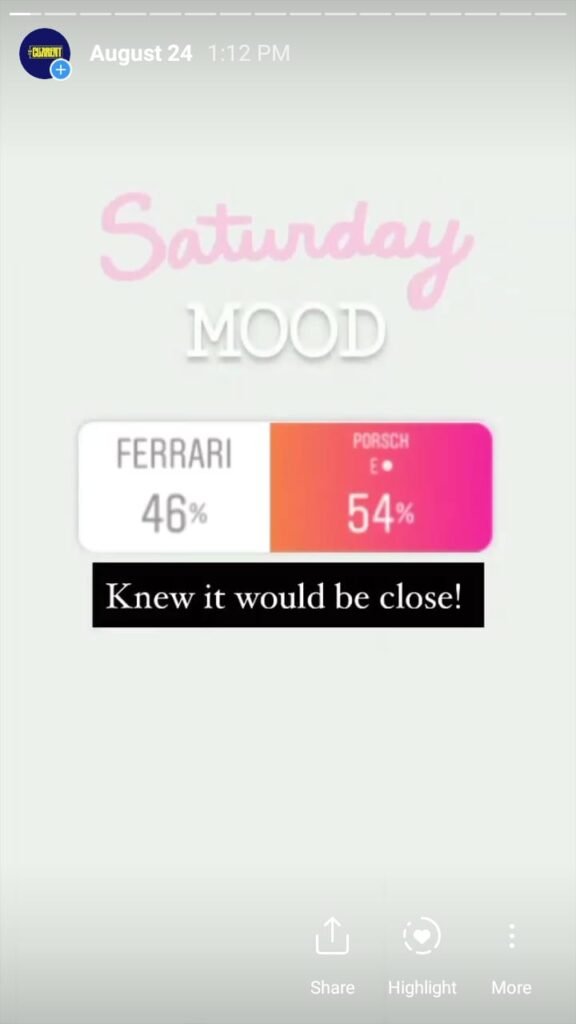
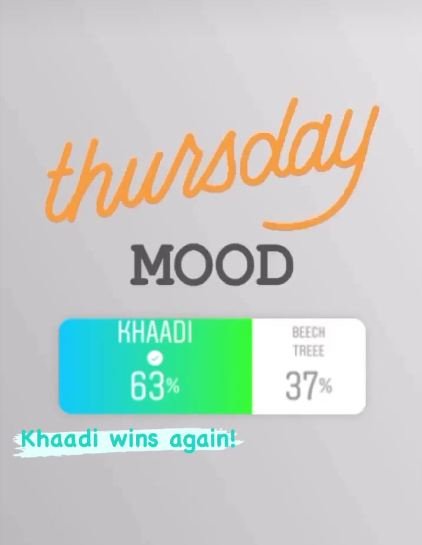
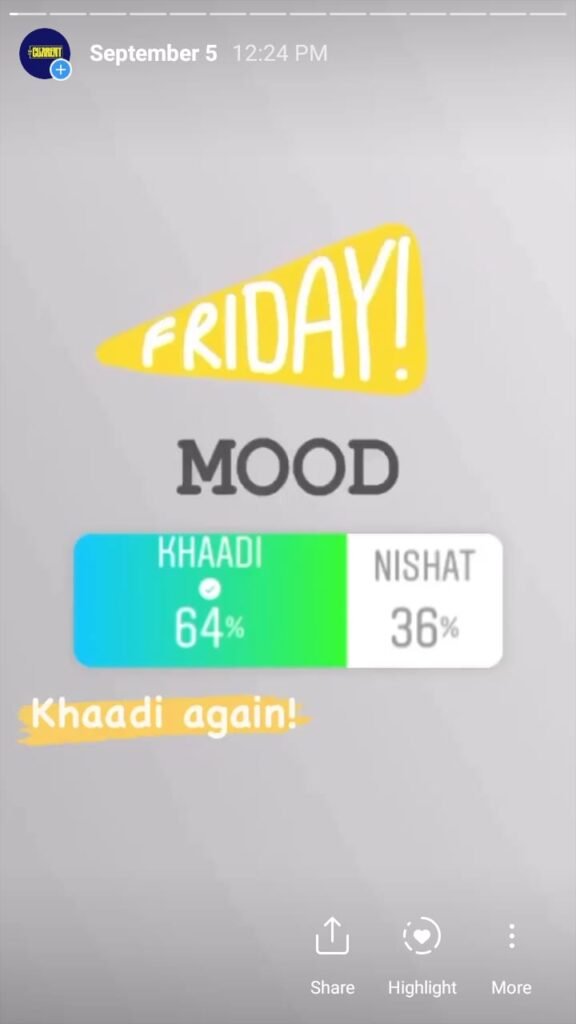
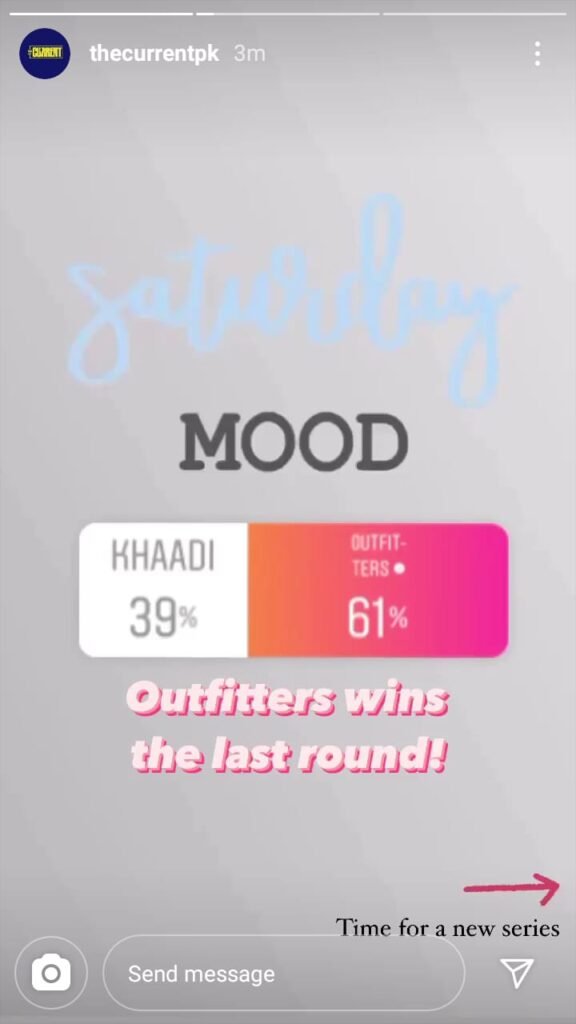
The Current starts its day with a morning mood to engage followers and find out what they are interested in. This is done via a ‘this or that’ poll and the winner had to compete the same category the next day. It is done over a week’s time and we found out a lot about our followers – and Pakistanis – based on what they vote for.
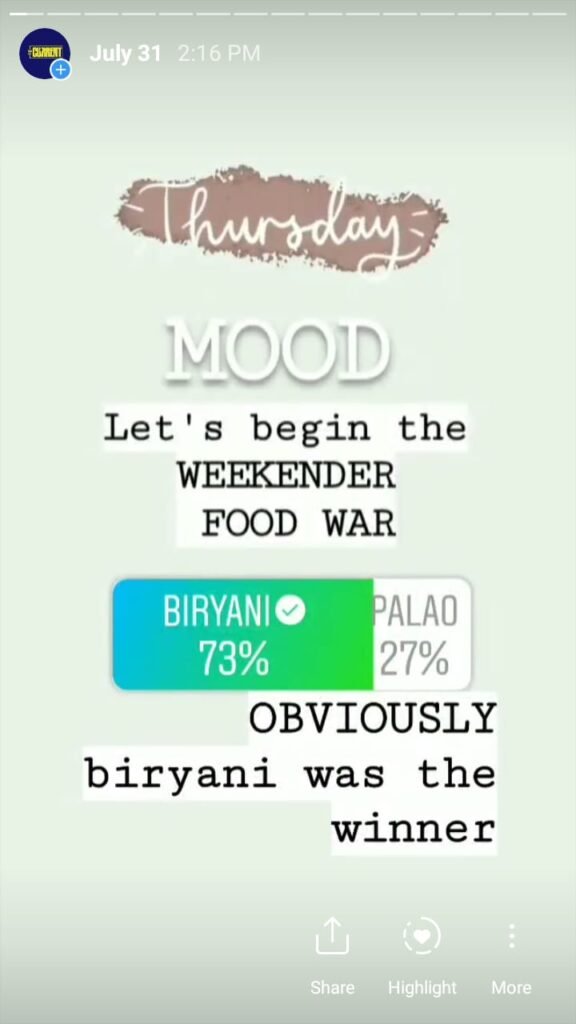
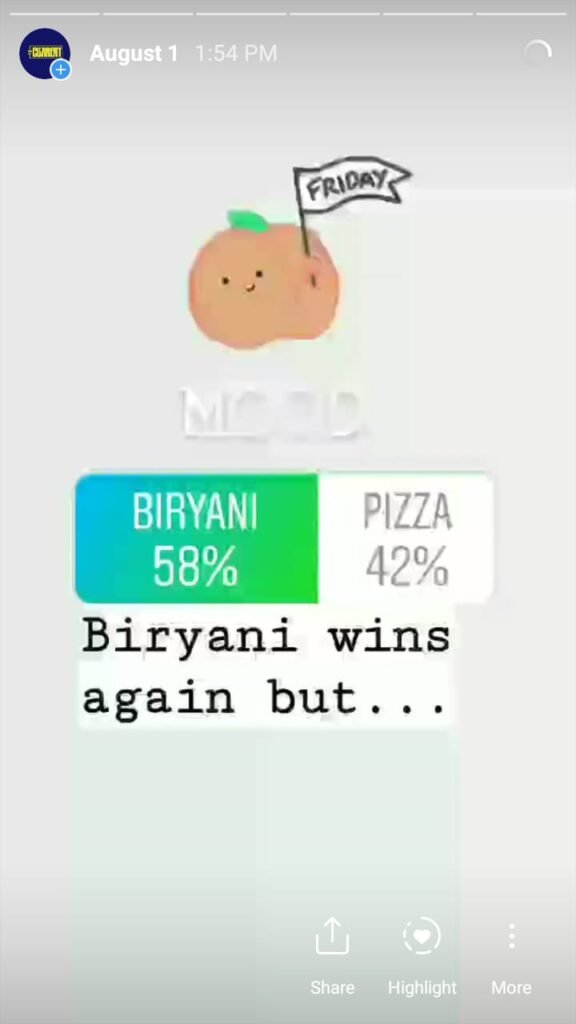
Food Wars
Honestly, this one is no surprise given how much Pakistanis love their biryani. Hence, biryani was the winner.
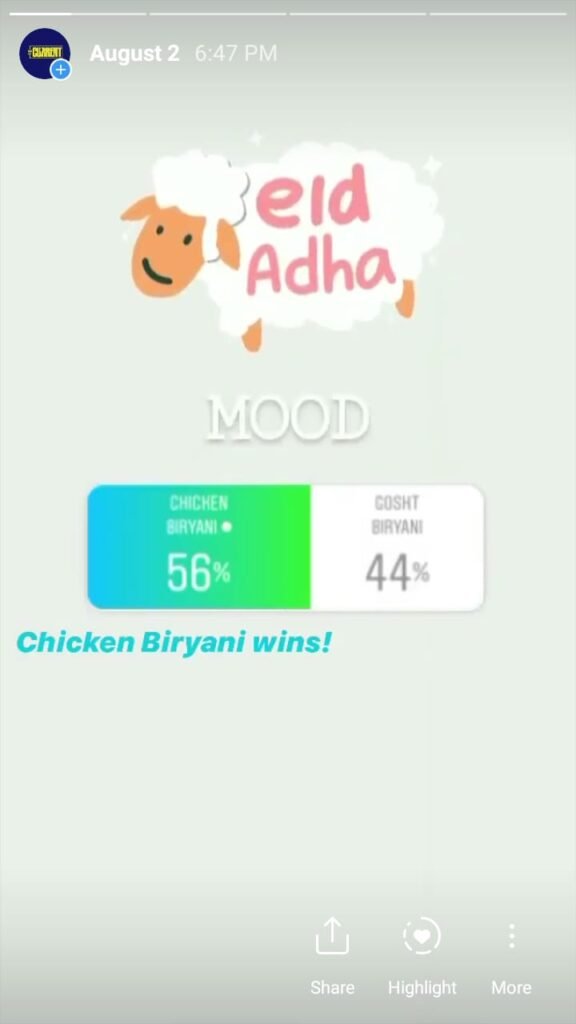
But, we were surprised when chicken biryani won on Eidul Adha.
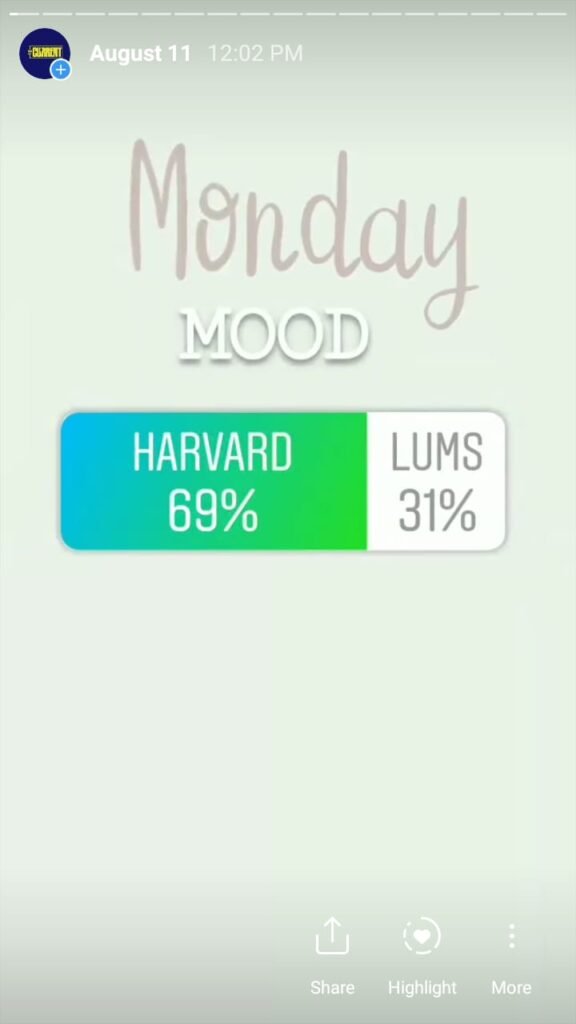
Which university appeals the most to Pakistanis?
We did a poll on different Pakistani and foreign universities and asked you what your dream university is. It’s sad that no Pakistani universities made the cut but here is what did win.
Personality Traits
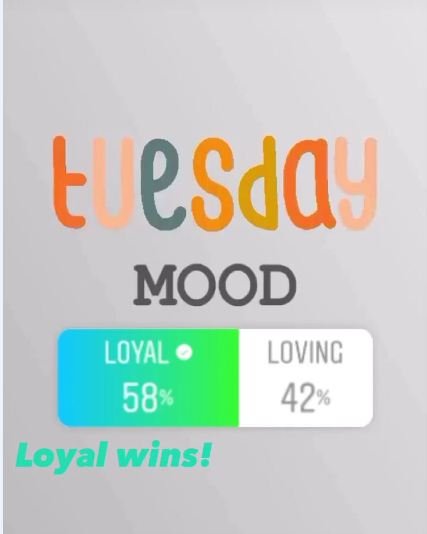
This is the most interesting. What do you all want in your life partner?
Loyal beat everything! Seems like nothing is more important for Pakistanis than a partner who is loyal.
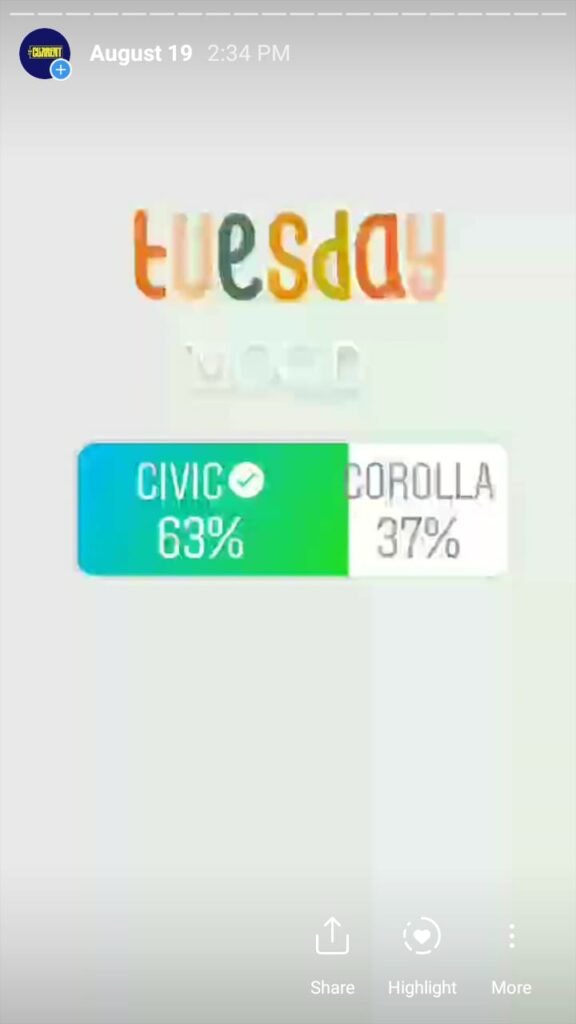
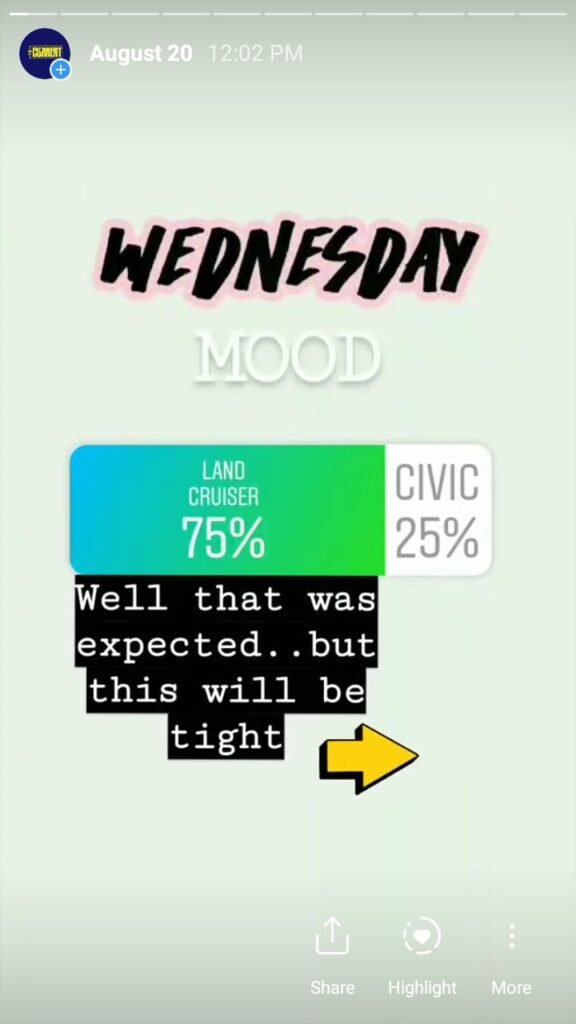
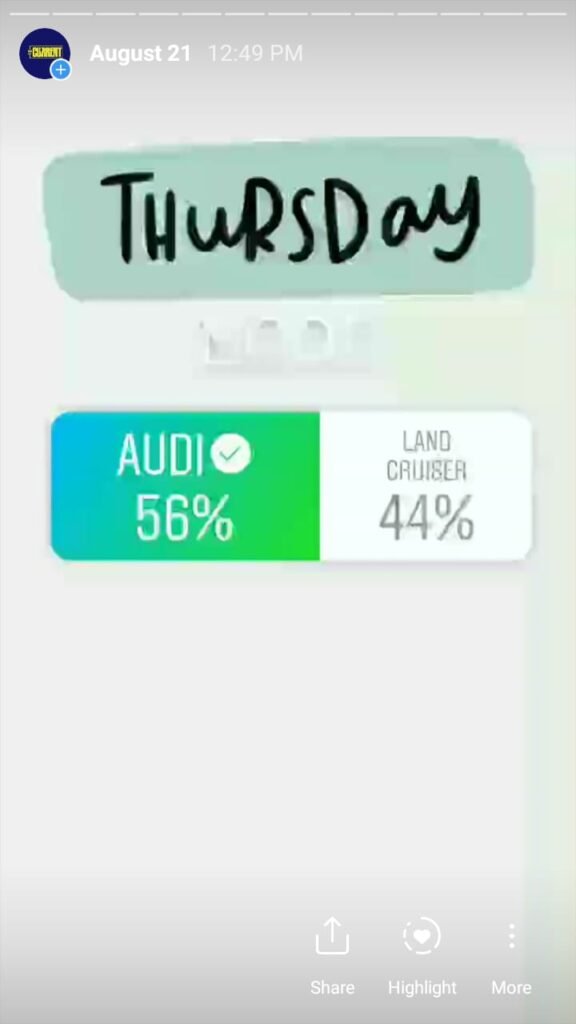
Your dream car?
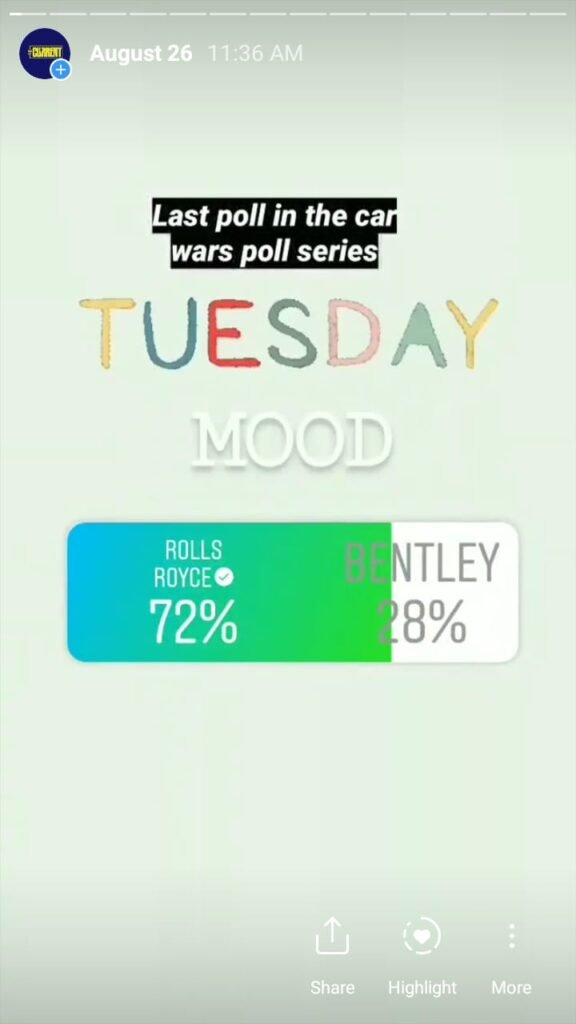
We asked you about your dream car and we got our answer. As per our final poll reults 72% people would go for a Rolls Royce beating Bentley.
Clothing Brands
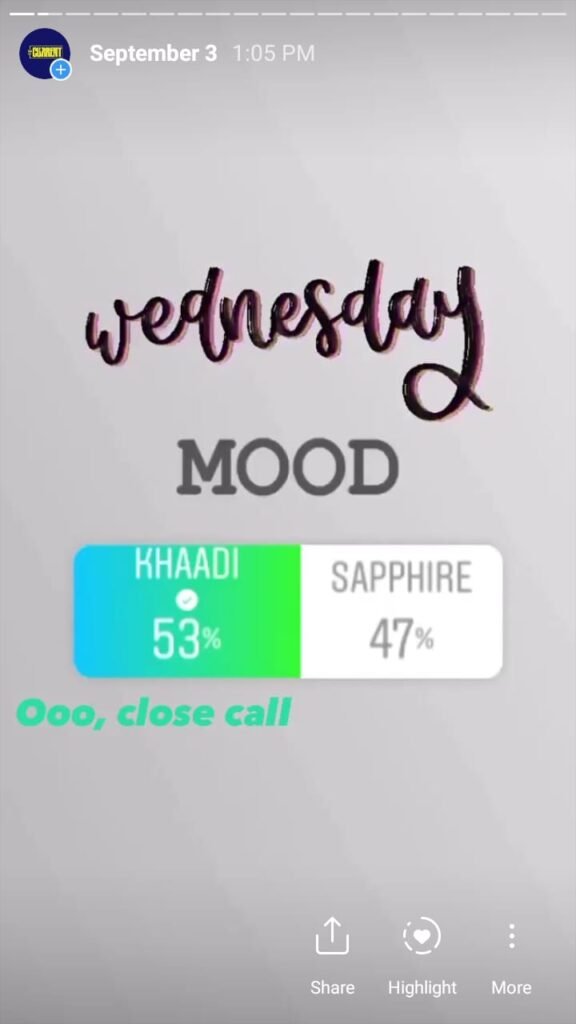
This one was intense and Khaadi was winning but in the final poll that we posted on Saturday, check out who beat Khaadi.
Follow us on Instagram at @thecurrentpk to take part in our polls and message us why you vote the way you do. The latest one is on the most popular fast food chains and that’s not one to miss.
When the COVID-19 pandemic began and I started working from home, I bought into the uproar on social media about having more free time. My first, and perhaps only, resolution for this “extra time” was to read more books, and, in line with everyone’s suggestions about learning new skills and working on one’s own self, I thought I’d try and get two birds with one stone.
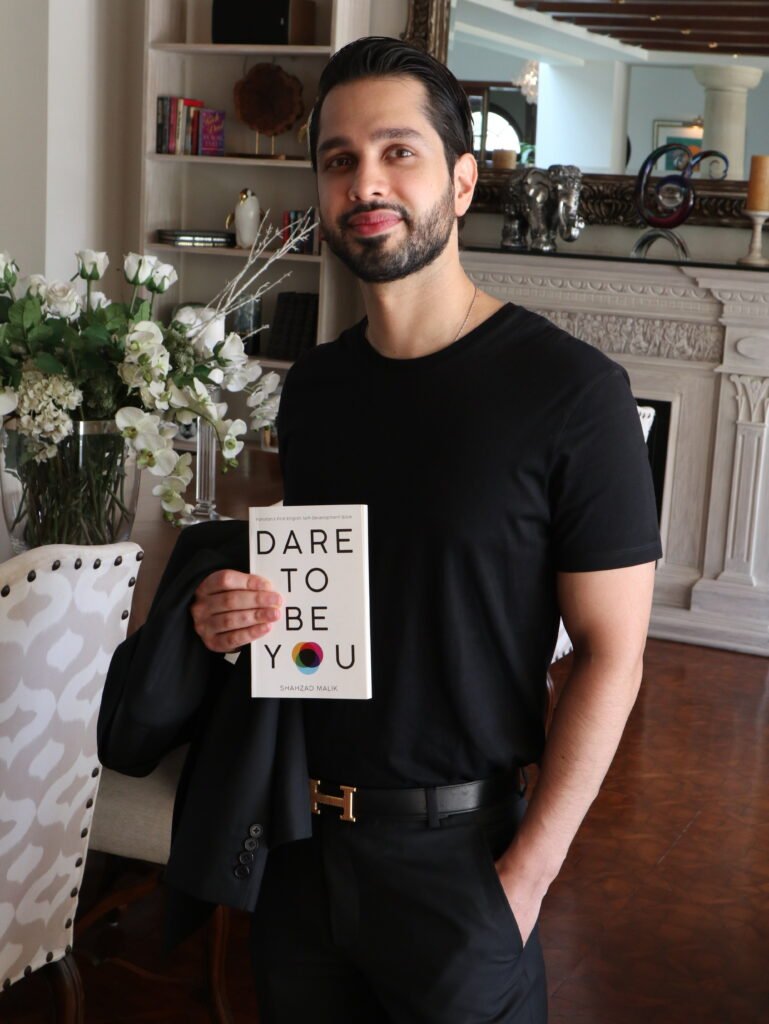
As it so happened, I came across this new book on social media: “Dare to Be You — Pakistan’s First English Self-Development Book” by Shahzad Malik. I was very intrigued and immediately went to the website and ordered it. The book arrived a couple of days later and honestly, I was blown away when I took it out of the packaging. It looked better up close than it did in the pictures. The cover design is beautiful — it’s very minimalistic and, quite like the book itself, it’s not in-your-face. It’s powerful in its subtlety.
It didn’t take me very long to finish the book once I started it. It’s not very long but, more importantly, once I started, I was hooked! I didn’t want to put it down. In fairness, I had not expected this when I bought the book or picked it up. I’m very wary of self-help books generally because they always feel very preachy to me. “You’re living life all wrong, and you must do x, y, and z if you want to be successful.” It almost always leaves a very bittersweet taste in my mouth. But, luckily, “Dare to Be You” isn’t like that at all! It’s very real and very candid. Like the author’s sitting right there talking to you. Like a conversation between friends.
I mean, of course, it isa self-development book, so of course, it’s going to include certain preferred acts and traits. But when I say the book is very real I mean that the author isn’t minimising what you’re going through. He seems to be well-aware of it. And when he talks to you, it feels like he’s talking to you as someone who has been through the things you’re currently going through, has managed to come out on “the other side”, and is now reaching back trying to pull you there too. I’m not one to take everything at face value, so I was a bit skeptical of whether the author actually “made it” and a few Google searches showed me he really had. And after reading the (deeply personal) incidents he’s narrated in the book and how he navigated through them, I really have a new-found respect for him.
“Dare to Be You” is built around one central idea that resonates throughout the book; all of us have the potential to be better and to do better, and we owe it to ourselves to try until we get to where we want to be. In certain places, the book definitely adopts a tough-love attitude, where it actively engages with the excuses we sometimes buy into. But the tough love is fair game, and, honestly? It really helps. Because it really makes you face what you’re running away from, while also guiding you to the support and confidence you need to win (think of the coach in any famous boxing movie pumping up the boxer before the big fight).
The book discusses a number of topics, all the way from overthinking to fear to finding one’s passion. It addresses the idea of mindfulness, of allowing ourselves to listen to our emotions rather than let ourselves be overwhelmed by our thoughts and the discouraging voices in our heads. This idea also flows through the book, and we are reacquainted with it at various points along the way, helping to really ground it in the reader’s mind. And in anxious times such as these, this has been game-changing. The book also lets readers explore how we can change our default way of approaching situations, by allowing for greater awareness of our internal frameworks. For instance, it allows us to explore the fears we carry, that hold us back, and lead to us minimising ourselves. This, in turn, allows us to see them for what they really are and shed them off, taking away their power over us so that we are not perpetually afraid and encumbered.
One of my key take-aways from the book has to be from the chapter on happiness. To quote from the book:
“I had become scared of feeling happy because I thought good things didn’t last. Think about it. It seems so simple when I write it down, but it was such a profound realization for me – that I could be afraid of happiness. That I could be afraid of something beautiful, simply because I was afraid I would lose it.“
The book really invites readers to give themselves a real, honest chance at happiness — both in the small everyday joys and as a mindset — that can become the basis for a more content and resilient life. And once you’re no longer afraid of happiness, the journey to discover your passion becomes a lot clearer (the book helps prevent the associated overwhelm by providing a structure to navigate your journey).
It’s been nearly a fortnight since I finished the book. And over the past two weeks, I’ve found myself thinking back to the book, and even picking it up to re-read certain parts of it. For a relatively light read, I’ve been pleasantly surprised by how it has stayed with me (almost on a subconscious level), allowing me to already start changing some of my habits that have just always been there. I find myself taking down my internal barriers one by one, and actively trying to do away with the voice inside my head that’s always more-than-happy to tell me I’m not good enough.
Granted, I haven’t yet achieved everything I wanted to and I haven’t arrived at the pinnacle of my life’s work. But “Dare to Be You” has certainly allowed me to start walking down the path I’ve been avoiding for a very long time. The path to a self-aware, authentic and meaningful life.
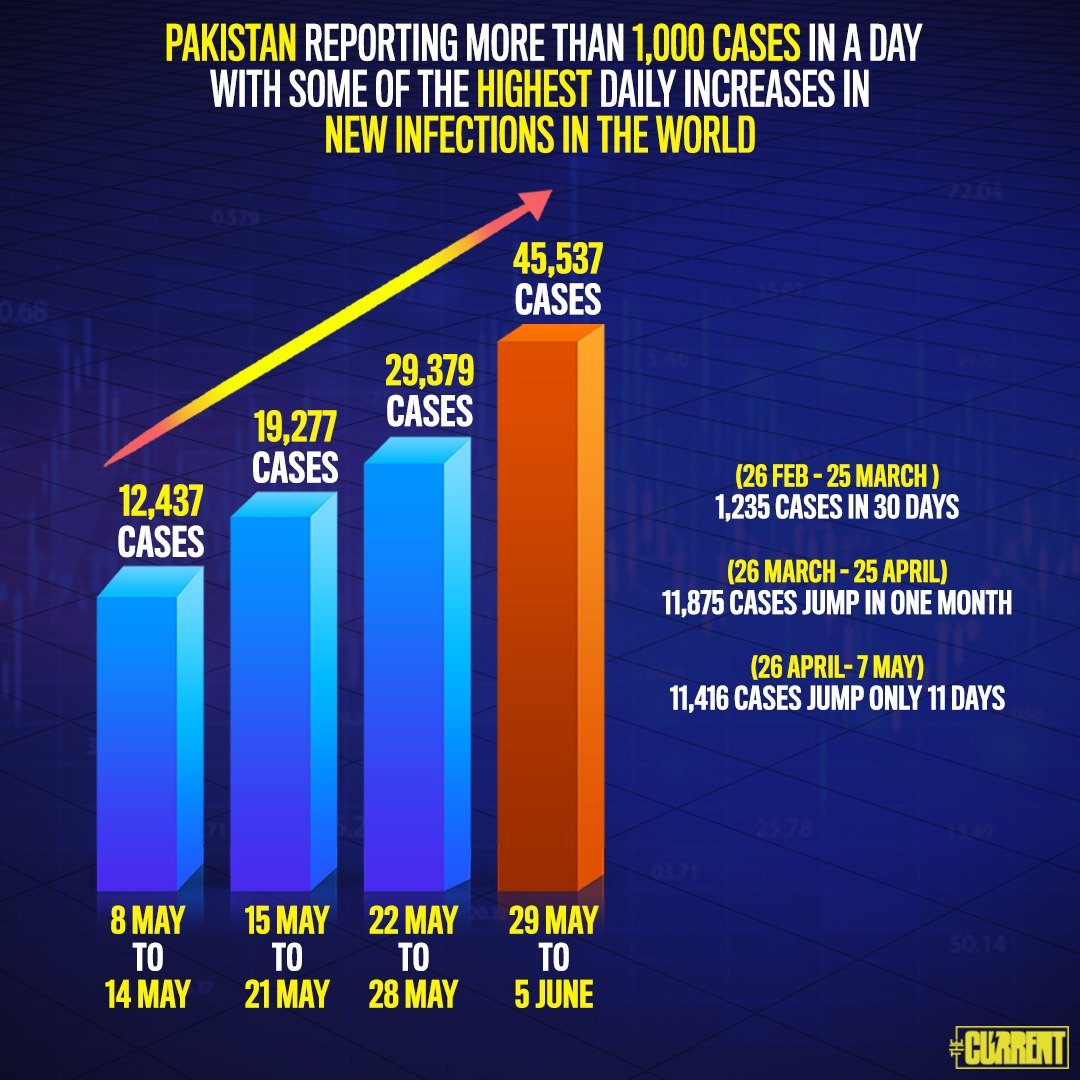
The number of coronavirus cases in Pakistan is likely to rise upwards of 45,000 by the first week of June, suggests the stable trend of rise in infections in the country since its first case of the COVID-19 was reported on February 26.
The tally reached 1,235 on March 25 (in 30 days), which was followed by an increase of 11,875 in a single month (until April 25) — putting the total number of infections past 12,000 — and later a record spike of 11,416 cases in just 11 days from April 26 to May 7.
The World Health Organization (WHO) has already warned that the number of COVID-19 cases in Pakistan can rise to 200,000 by mid-July if “effective interventions” are not taken.
Despite the rising number of cases, countrywide lockdowns have been eased to save the economy while the government is planning to entirely lift the ban on inter-city transportation ahead of Eid holidays.
The number of confirmed cases of coronavirus in Pakistan stood at 42,227 by the time this report was filed. The number of fatalities was 899 with 11,922 recoveries. Sindh had the most number of infections — nearly 18,000 — with Punjab trailing behind at 14,500 cases of COVID-19.
Pakistan’s fastest-growing digital media start-up, The Current, has won the Google News Initiative (GNI) Innovation Challenge, becoming the only media organisation in the country to have secured the coveted spot and that too within just a year of its launch.
Under the challenge, Google received applications from over 255 news organisations and technology companies from across the Asia Pacific, including media giants like Japan’s Nippon Television Network, out of which 18 were selected to receive $2.3 million in funding.
The first round of the challenge focused on diversifying revenue and saw dozens of examples of creative new approaches. The applicants were asked for proposals to increase reader engagement, which ultimately leads to greater loyalty and willingness to pay for content.
The 255 strong submissions revolved around topics like user-generated content, community management, fact-checking and the use of technologies such as machine learning to tackle business challenges.
As part of the project, The Current will develop a membership model that will be the first of its kind in Pakistan — with three levels of membership provided for its most avid followers. The plan is to provide content and training that members want, and also test a viable alternate stream of revenue for digital news startups.
The challenge had been won by Jang Media Group in Pakistan last year. As part of the project, the media organisation developed state-of-the-art Artificial Intelligence (AI) and Augmented Reality (AR) platforms for digitising its historical news archives. The project was similar in scale and ambition to the New York Times collaboration with Google in transforming its archives.
Here’s what you should know about the selected projects from 2020 and the previous years.
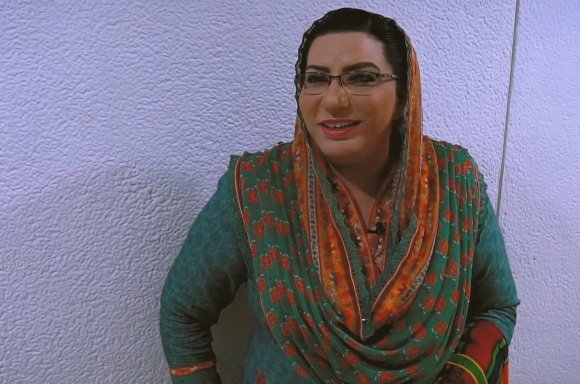
Special Assistant to the Prime Minister (SAPM) on Information and Broadcasting Dr Firdous Ashiq Awan has a tough schedule. Apart from attending various meetings throughout the day with the Prime Minister, Dr Firdous also has to address press conferences to brief the media and public about daily happenings. For all this, Dr Firdous maintains an impeccable appearance and is always on top of her game.
In an exclusive interview with The Current, when asked about her favourite makeup brand, Dr Firdous revealed that it is Clinique.
“Because my skin remains in painting all day, Clinique is good at all this denting-painting,” the SAPM had said.
Apart from that, Dr Firdous also revealed the one thing she admired about her predecessor, former federal minister for information Fawad Chaudhry. She said that she liked his “struggle to always stay in headlines”.
According to the details, with cracks continuing to emerge within the ranks of the ruling Pakistan Tehreek-e-Insaf (PTI) and rumour having it that both Awan and Chaudhry are not the best of friends ever since the latter was sacked and replaced by the former, the SAPM when asked what she liked the most about Chaudhry, she said, “His [Fawad Chaudhry’s] struggle to always stay in headlines.”
To another question, Awan, who is not an elected member of the parliament, said that election defeat under Imran was not a defeat. “It’s a victory for my ideology,” she said.
“Social media is an unguided missile with warheads but no target,” the SAPM said when asked what was that she disliked the most about social media.
Awan also said that she was not a misogynist — her verbal attacks “were for people and not genders” and those who criticised her for not being an elected representative, “lacked sense”.
Special Assistant to the Prime Minister (SAPM) on Information and Broadcasting Dr Firdous Ashiq Awan has admired her predecessor, former federal minister for information Fawad Chaudhry, for his “struggle to always stay in headlines”.
According to the details, with cracks continuing to emerge within the ranks of the ruling Pakistan Tehreek-e-Insaf (PTI) and rumour having it that both Awan and Chaudhry are not the best of friends ever since the latter was sacked and replaced by the former, the SAPM, in an exclusive interview with The Current, was asked what she liked the most about her predecessor.
“His [Fawad Chaudhry’s] struggle to always stay in headlines,” she said.
Chaudhry has time and again been accused of “pulling political gimmicks” as the federal minister for science and technology and an aide of PM Imran Khan, by the general public, leaders of his own party as well as those belonging to the opposition.
To another question, Awan, who is not an elected member of the parliament, said that election defeat under Imran was not a defeat. “It’s a victory for my ideology,” she said.
“Social media is an unguided missile with warheads but no target,” the SAPM said when asked what was that she disliked the most about social media.
Awan also said that she was not a misogynist — her verbal attacks “were for people and not genders” –, shared how she thought that parliamentarians should not get a pay raise, and those who criticised her for not being an elected representative, “lacked sense”.