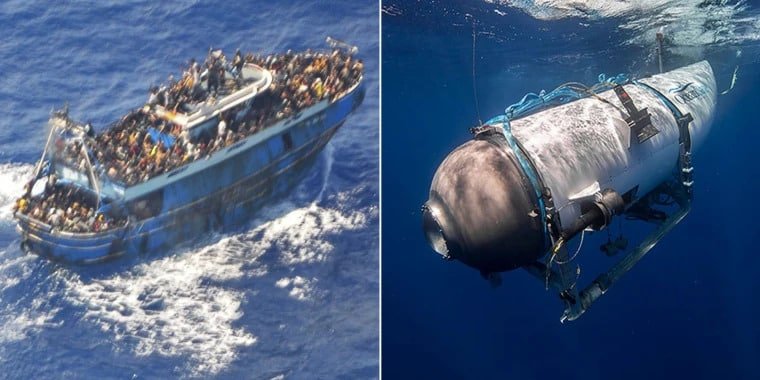
In the last week alone, the world has been witness to two immense tragedies that played out at sea. Tragic as both events were, the public seems to be divided on which party to extend their empathy and/or sympathy toward: the 300+ Pakistani migrants that drowned after a trawler capsized off the south coast of Greece, or the Pakistani billionaire and his 19 year old son that died in an implosion thousands of metres below the surface of the North Atlantic Ocean?
One only need to peruse through the comments under The Current’s reporting on the tragedies to understand what the two sides believe in. On the one hand, individuals are calling out the difference in response to both calamities and suggesting that Shahzada Dawood, Vice-Chairman of Engro Corporation, made a choice to die when he paid $500,000 for him and his son to travel to see the Titanic’s wreckage. Yet, this side maintains, the migrants aboard the trawler had ‘no choice’ but to embark on such a perilous journey to better fortune.
On the other hand, people are shocked by the Pakistani public’s ability to extend and withdraw empathy on the basis of an individual’s wealth – or lack thereof. The Dawoods were renowned philanthropists in the country, donating millions of their wealth to education and healthcare (notwithstanding the argument that, admittedly, it’s probably because they had those millions to spare). Should empathy not be extended to the wealthy that donated vast amounts to projects providing higher-education opportunities to Pakistanis? Should empathy only be extended if the wealthy are charitable?
What is perhaps most interesting – and also practically self-evident – is the anger drawn from the media coverage of both tragedies. The OceanGate submersible was dominating global headlines the second it was announced ‘missing’, up until the moment they realised there was no hope. Meanwhile, the Greek migrant boat tragedy only saw a couple days of reporting – even though there is currently an ongoing investigation concerning the complicity or negligence of both Greek authorities and border authority Frontex on the discrepancies found in communication.
While there is more than plenty to criticise in regards to the stark difference with which both calamities were responded to, it is hugely counterintuitive to compare the loss of lives. It is indeed likely that the migrants were condemned to their deaths by the authorities. In transcripts published by AlarmPhone, and analyses of vessels in the area around the time the trawler sent out an alarm signal, discrepancies in official statements made by the European authorities are enough to merit investigations. Moreover, accusations have abounded regarding the Greek coast guard’s role in the eventual capsize. Pakistani survivors of the wreck reported that the boat only capsized after the Greek coast guard started towing it.
Of course, anger is bound to arise when one compares that scenario to a full-blown military-scale search for the five individuals onboard the missing submersible. However, the people offering no sympathy to Shahzada and his young son Suleman, simply because they paid a lot of money to be in that position, are largely misplacing their anger. The tragic plight of migrants and refugees is not new to us: they were not simply left to their deaths only because they are poor as compared to the Dawoods.
Anti-immigrant sentiment is on the rise in Europe. Far-right parties with anti-immigrant policies have risen in popularity and have become quite verbose on how unwelcome immigrants are. Within such a growing sentiment – while it by no means justifies the tragedy – one simply cannot expect the same level of frantic search. It isn’t because those lives were not worth the search: it’s because those lives, in the clinical eyes of the Europeans, simply meant a burden on their existing economy and resources.
So yes, we should be angry. We should be absolutely livid at such blatant disregard for life. But to redirect that anger to two completely innocent Pakistanis who also encountered a tragic fate, simply because they’re rich, is quite unfounded. It could have made sense if the two incidents were correlated beyond just their occurrence in the sea – say, if the authorities meant to search for the migrants were redirected to the submersible.
At the end of the day, the families of the migrants have seen their entire world shatter, much like the Dawood family. To weigh the worth of lives on such a material basis such as wealth is counterintuitive to the anger felt by the loss of them. And to compare such tragedies distracts us from the larger, more pertinent structural issues that led to the worst migrant boat disaster in recent history.