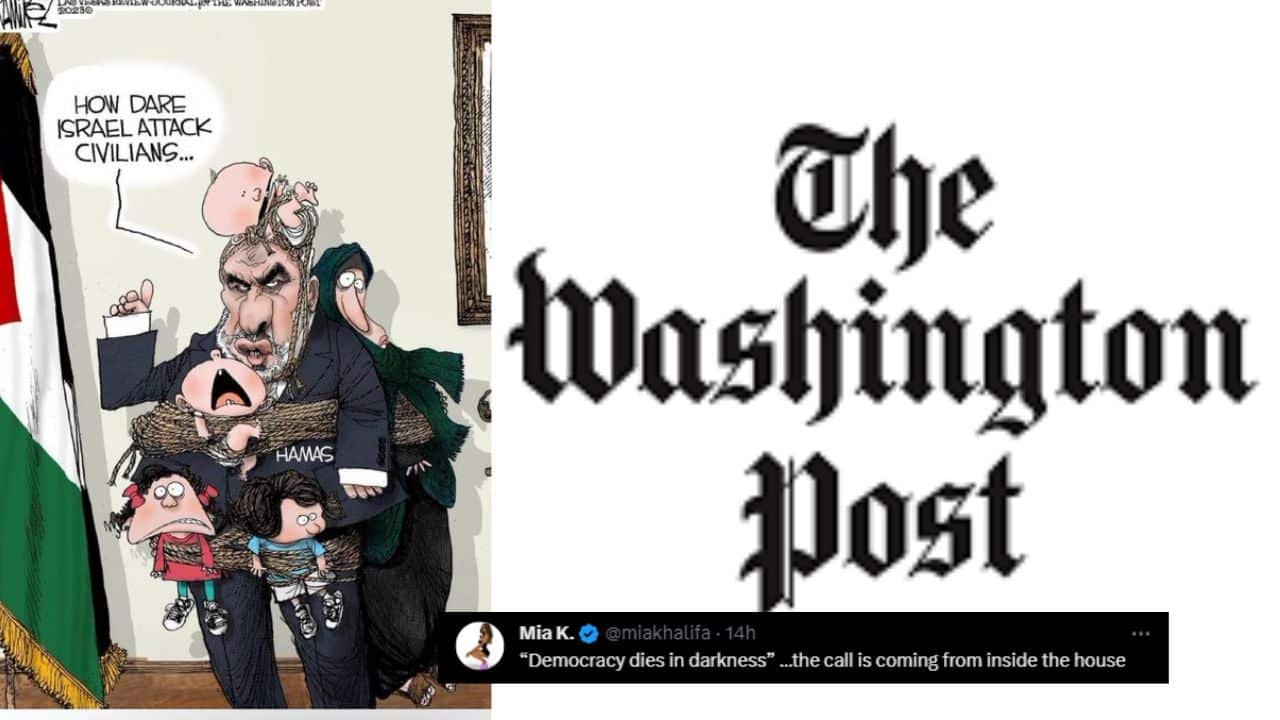
Washington Post was slammed on the internet on Wednesday for a racist cartoon dehumanising the Palestinians. Right now the number of Gazans killed in Israeli airstrikes has reached 10,000. The cartoon has since been deleted, while Post has put out an editorial note.
The offensive drawing shows a crudely drawn Arabic man labeled Hamas with three children and a woman tied around him with ropes.
“This is the kind of anti-Palestinian racism that they think is acceptable for publication,” slammed Palestinian poet Remi Kanazi.
This is the @washingtonpostThis is the kind of anti-Palestinian racism that they think is acceptable for publication pic.twitter.com/nd6FYc4cb0
— Remi Kanazi (@Remroum) November 8, 2023
Palestinian journalist Ahmed Eldin re-shared the post to point out how the racism Palestinians are enduring in the Western media is similar to how the Jews were drawn as evil with physical features that compared them to rats or cockroaches.
“Before the Holocaust, Jews were portrayed as irrational and evil, with physical features that made them appear akin to cockroaches and rats. These images dehumanized Jews to justify their mass extermination. Now, the Western press is doing the same to Palestinians. The source of this obscene and offensive piece of propaganda masquerading as a “political cartoon” by Michael Pramirez is not a lesser-known publication, but rather the widely recognized
@washingtonpost. Regardless of the validity of the claims regarding Hamas using human shields, the notion that thousands of children being killed can be justified or deemed acceptable as collateral damage is absolutely unacceptable. The dehumanization of Palestinians, which serves as a pretext to permit and rationalize their mass killing, is a disturbing trend that seems to have no boundaries within American discussions and debates.”
Before the Holocaust, Jews were portrayed as irrational and evil, with physical features that made them appear akin to cockroaches and rats.
These images dehumanized Jews to justify their mass extermination.
Now, the Western press is doing the same to Palestinians.
The source… pic.twitter.com/fvnxikZ36m
— AHMED | أحمد (@ASE) November 8, 2023
‘What’s more troubling than this racist depiction,” Palestinian-American poet Mohammad El-Kurd wrote. “Is that the Washington Post thinks it’s OK to kill civilians if, hypothetically, ‘terrorists’ hid behind them. Even if the “human-shields” myth was true, only those who kill civilians are responsible for the act of killing.”
What’s more troubling than this racist depiction, is that the Washington Post thinks it’s OK to kill civilians if, hypothetically, “terrorists” hid behind them.
Even if the “human-shields” myth was true, only those who kill civilians are responsible for the act of killing. https://t.co/oa8tueosL9
— Mohammed El-Kurd (@m7mdkurd) November 8, 2023
Columnist and writer Fatima Bhutto tweeted her outrage:
“This cartoon is so anti-Muslim, so racist it boggles the mind that any newspaper could print it. Beyond which, Israel has murdered over 4,000 children- do you have absolutely no shame depicting Palestinian children in this manner? What a disgrace.”
This cartoon is so anti-Muslim, so racist it boggles the mind that any newspaper could print it. Beyond which, Israel has murdered over 4,000 children- do you have absolutely no shame depicting Palestinian children in this manner? What a disgrace @washingtonpost. https://t.co/QVEk08ScdP
— fatima bhutto (@fbhutto) November 8, 2023
The Washington Post opinion editor David Shipley published an apology for the cartoon on their website and took it down:
“A cartoon we published by Michael Ramirez on the war in Gaza, a cartoon whose publication I approved, was seen by many readers as racist. This was not my intent. I saw the drawing as a caricature of a specific individual, the Hamas spokesperson who celebrated the attacks on unarmed civilians in Israel. However, the reaction to the image convinced me that I had missed something profound, and divisive, and I regret that. Our section is aimed at finding commonalities, understanding the bonds that hold us together, even in the darkest times.”