
Tag: tom hanks

  • ‘Amazing’ AI de-ages Tom Hanks in new film ‘Here’

    ‘Amazing’ AI de-ages Tom Hanks in new film ‘Here’

    Tom Hanks has praised the “amazing” use of artificial intelligence to de-age him “in real time” on the set of new movie “Here,” even as he accepted that the technology is causing huge concern in Hollywood.

    “Here,” out in theaters Friday, stars Hanks and Robin Wright as a couple striving to keep their family together through births, marriages, divorces and deaths, across multiple decades and even generations.

    Hanks portrays his character from an idealistic teen, through various stages of youth and middle age, to a frail, elderly man.

    But rather than just relying on makeup, filmmakers teamed up with AI studio Metaphysic on a tool called Metaphysic Live, to rejuvenate and “age up” the actors.

    The technology worked so fast that Hanks was able to immediately watch his “deep-faked” performance after each scene.

    “The thing that is amazing about it is it happened in real time,” said Hanks.

    “We did not have to wait for eight months of post-production. There were two monitors on the set. One was the actual feed from the lens, and the other was just a nanosecond slower, of us ‘deep-faked.’

    “So we could see ourselves in real time, right then and there.”

    The rapidly increasing use of AI in films including “Here” has triggered vast concern in Hollywood, where actors last year went on strike over, among other things, the threat they believe the technology poses to their jobs and industry.

    Hanks acknowledged those fears during a panel discussion with director Robert Zemeckis at last weekend’s AFI Fest in Hollywood, saying a “lot of people” were worried about how it will be used.

    “They took 8 million images of us from the web. They scraped the web for photos of us in every era that we’ve ever been — every event we’ve filmed, every movie still, every family photo that might have existed anywhere,” Hanks explained.

    “And they put that into the box — what is it, ‘deepfake technology,’ whatever you want to call it.”

    – ‘Cinematic’ –

    The use of AI is not the only unusual technological feat in “Here.”

    The film is entirely shot from one static camera, positioned for the most part in the corner of a suburban US home’s living room.

    Viewers occasionally see glimpses of the same geographic space before the house was built, as the action hops back and forth to colonial and pre-colonial times — or even earlier.

    “Here” is based on a graphic novel by Richard McGuire, which uses the same concept.

    “It had to be true to the style of the book, and that’s why it looks the way it does,” Zemeckis told AFP.

    “It worked in levels that I didn’t expect. It’s got a real powerful intimacy to it, and in a wonderful way, it’s very cinematic.”

    But the film’s use of AI has drawn the most attention.

    – ‘Very serious subject’ –

    AI was also at the heart of a very different film at AFI Fest — “Wallace & Gromit: Vengeance Most Fowl,” the latest film for the beloved British stop-motion characters.

    When Wallace constructs a “smart gnome” to take care of chores, his faithful pooch Gromit immediately sniffs danger.

    Once Feathers McGraw — the nefarious penguin introduced to audiences in 1993 short film “The Wrong Trousers” — gets involved, the technology takes a sinister turn.

    AI becomes “the wedge between Wallace and Gromit,” explained co-director Merlin Crossingham.

    “It is a very light touch, although it’s a very serious subject,” he said.

    If “we can trigger some more intellectual conversation from our silly adventure with Wallace and Gromit, then that can’t be a bad thing.”

    The film itself did not use AI.

    “We don’t and we wouldn’t,” said Crossingham, earning hearty applause from the Hollywood crowd.

    “Vengeance Most Fowl” will be broadcast on Christmas Day in the United Kingdom and Ireland, before airing globally on Netflix from January 3.
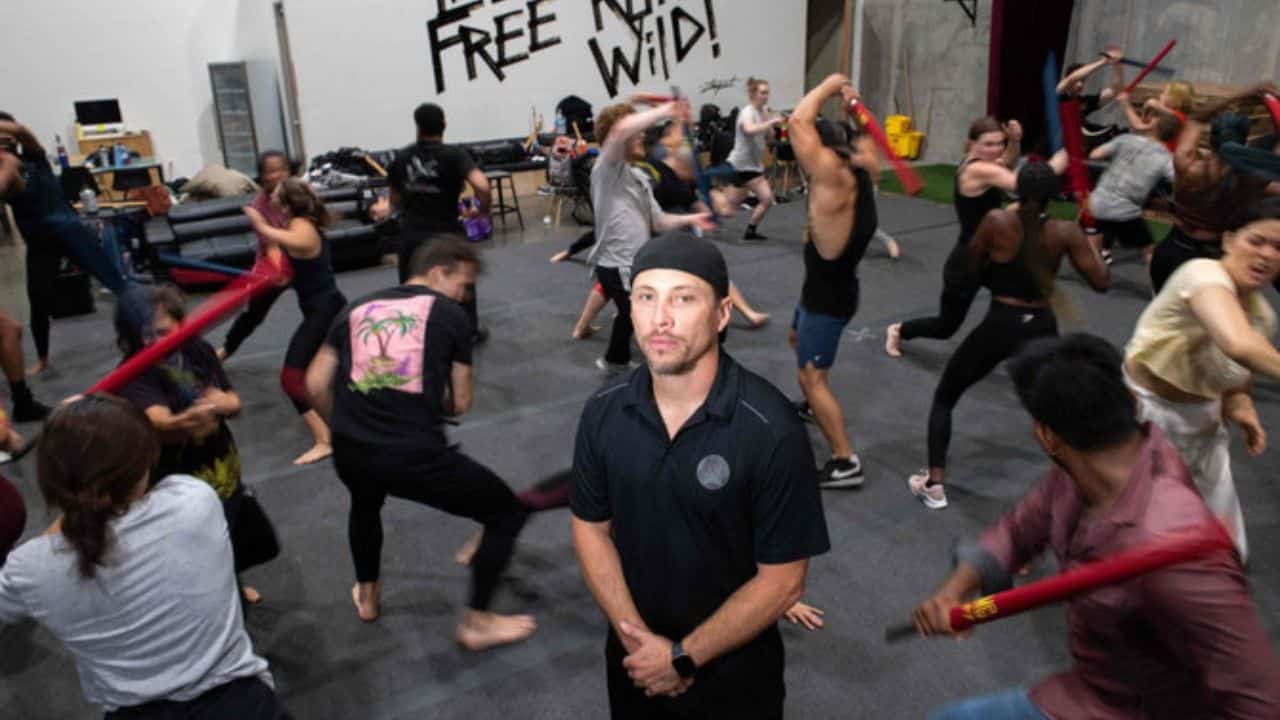
  • Rise of the machines: AI spells danger for Hollywood stunt workers

    Rise of the machines: AI spells danger for Hollywood stunt workers

    By Andrew MARSZAL

    Hollywood’s striking actors fear that artificial intelligence is coming for their jobs — but for many stunt performers, that dystopian danger is already a reality.

    From “Game of Thrones” to the latest Marvel superhero movies, cost-slashing studios have long used computer-generated background figures to reduce the number of actors needed for battle scenes.

    Now, the rise of AI means cheaper and more powerful techniques are being explored to create highly elaborate action sequences such as car chases and shootouts — without those pesky (and expensive) humans.

    Stunt work, a time-honored Hollywood tradition that has spanned from silent epics through to Tom Cruise’s latest “Mission Impossible,” is at risk of rapidly shrinking.

    “The technology is exponentially getting faster and better,” said Freddy Bouciegues, stunt coordinator for movies like “Free Guy” and “Terminator: Dark Fate.”

    “It’s really a scary time right now.”

    Studios are already requiring stunt and background performers to take part in high-tech 3D “body scans” on set, often without explaining how or when the images will be used.

    Advancements in AI mean these likenesses could be used to create detailed, eerily realistic “digital replicas,” which can perform any action or speak any dialogue its creators wish.

    Bouciegues fears producers could use these virtual avatars to replace “nondescript” stunt performers — such as those playing pedestrians leaping out of the way of a car chase.

    “There could be a world where they said, ‘No, we don’t want to bring these 10 guys in… we’ll just add them in later via effects and AI. Now those guys are out of the job.”

    But according to director Neill Blomkamp, whose new film “Gran Turismo” hits theaters August 25, even that scenario only scratches the surface.

    The role AI will soon play in generating images from scratch is “hard to compute,” he told AFP.

    “Gran Turismo” primarily uses stunt performers driving real cars on actual racetracks, with some computer-generated effects added on top for one particularly complex and dangerous scene.

    But Blomkamp predicts that, in as soon as six or 12 months, AI will reach a point where it can generate photo-realistic footage like high-speed crashes based on a director’s instructions alone.

    At that point, “you take all of your CG (computer graphics) and VFX (visual effects) computers and throw them out the window, and you get rid of stunts, and you get rid of cameras, and you don’t go to the racetrack,” he told AFP.

    “It’s that different.”

    – The human element –

    The lack of guarantees over the future use of AI is one of the major factors at stake in the ongoing strike by the Screen Actors Guild (SAG-AFTRA) and Hollywood’s writers, who have been on the picket lines 100 days.

    SAG-AFTRA last month warned that studios intend to create realistic digital replicas of performers, to use “for the rest of eternity, in any project they want” — all for the payment of one day’s work.

    The studios dispute this, and say they have offered rules including informed consent and compensation.

    But as well as the potential implications for thousands of lost jobs, Bouciegues warns that no matter how good the technology has become, “the audience can still tell” when the wool is being pulled over their eyes by computer-generated VFX.

    Even if AI can perfectly replicate a battle, explosion or crash, it cannot supplant the human element that is vital to any successful action film, he said, pointing to Cruise’s recent “Top Gun” and “Mission Impossible” sequels.

    “He uses real stunt people, and he does real stunts, and you can see it on the screen. For me, I feel like it subconsciously affects the viewer,” said Bouciegues.

    Current AI technology still gives “slightly unpredictable results,” agreed Blomkamp, who began his career in VFX, and directed Oscar-nominated “District 9.”

    “But it’s coming… It’s going to fundamentally change society, let alone Hollywood. The world is going to be different.”

    For stunt workers like Bouciegues, the best outcome now is to blend the use of human performers with VFX and AI to pull off sequences that would be too dangerous with old-fashioned techniques alone.

    “I don’t think this job will ever just cease to be,” said Bouciegues, of stunt work. “It just definitely is going to get smaller and more precise.”

    But even that is a sobering reality for stunt performers who are currently standing on picket lines outside Hollywood studios.

    “Every stunt guy is the alpha male type, and everybody wants to say, ‘Oh, we’re good,’” said Bouciegues.

    “But I personally have spoken to a lot of people that are freaked out and nervous.”