Tag: trade

  • Pakistani rupee gains Rs2 to close at Rs221.94

    Pakistani rupee gains Rs2 to close at Rs221.94

    On Thursday, the Pakistani rupee (PKR) strengthened by Rs2 or 0.90 per cent against the dollar to close at Rs221.94.

    According to the Forex Association of Pakistan (FPA), the local currency was trading at Rs221.75 per $1 at 9:46 am, up 0.98 per cent from yesterday’s close of Rs223.94.

    The rupee has been strengthening since September 22, when it nearly hit an all-time low of Rs239.71. In the last nine sessions, it has increased by Rs15.77 or 6.58 per cent.

    The State Bank of Pakistan’s (SBP) and finance ministry’s joint investigation into banks making obscene profits from their dollar sales, according to Mettis Global Director Saad bin Naseer, has calmed the interbank market.

    SBP On Tuesday, Governor Jameel Ahmad told a National Assembly committee that eight banks were under investigation for the initial round of currency rate manipulation. In the following stage, the other banks would be looked into.

    He said that a smaller trade deficit in September and the Asian Development Bank’s (ADB) pledge of approximately $2.3–2.5 billion in aid were the key reasons for the rupee’s recovery on the open market.

    FAP Chairman Malik Bostan listed the ADB announcement and hopes of a sustained drop in imports as the factors that contributed to the rupee’s rise.

  • PKR continues losing ground against dollar amid fears of widening trade deficit

    PKR continues losing ground against dollar amid fears of widening trade deficit

    In the interbank market during the first hours of trading on Monday, the Pakistani rupee was trading between Rs229 and Rs230 versus the US dollar.

    When intra-day trading began at 11:00 AM, the rupee was quoted at Rs229.88, depreciating by 0.31 per cent against the US dollar.

    The rupee had a terrible prior week, falling against the US dollar in the inter-bank market to close at Rs228.18 after losing value in each of the five sessions for a total loss of almost 4 per cent.

    In the interbank market during the first hours of trading on Monday, the Pakistani rupee was trading between Rs229 and Rs230 versus the US dollar.

    When intra-day trading began at 11:00 AM, the rupee was quoted at Rs229.88, depreciating by Re0.70 or 0.31 per cent against the US dollar.

    The rupee had a terrible prior week, falling against the US dollar in the inter-bank market to close at Rs228.18 after losing value in each of the five sessions for a total loss of almost 4 per cent.

    The dollar index, which compares the value of the dollar to six important rival currencies, held steady at Rs108.82, retreating from a two-decade high achieved on Wednesday. In the previous session, it fell to Rs108.35, its lowest level since August 30.

    Investors remain cautious ahead of Tuesday’s release of the US CPI data, despite the fact that Fed officials continued to use hawkish language on Friday, the last day before a period of silence prior to the Federal Open Market Committee’s meetings.

    A significant factor in currency parity, oil prices fell on Monday as the outlook for global fuel demand was overshadowed by COVID-19 limitations in China and the possibility of future interest rate increases in the US and Europe.

  • Rupee gets stronger by Rs2.11 to close at Rs224.04 against US dollar

    Rupee gets stronger by Rs2.11 to close at Rs224.04 against US dollar

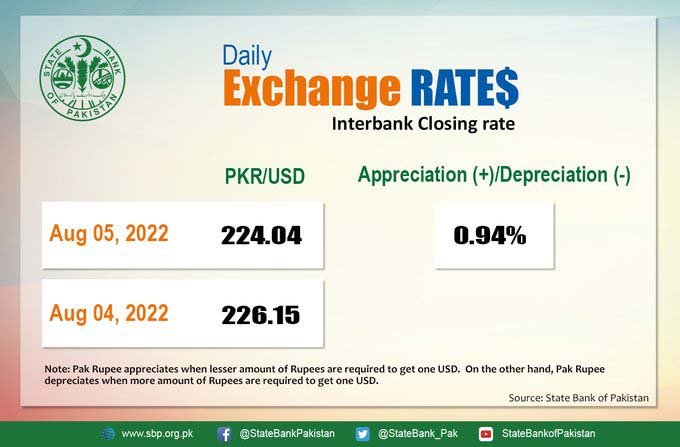
    During intraday trade on Friday in the interbank market, the Pakistani rupee (PKR) climbed by Rs2.11 against the US dollar for the sixth session in a row.

    In the course of the day’s trading, the local currency gained Rs2.11 or 0.94 per cent versus the dollar and closed at Rs224.04, down from Thursday’s closing of Rs226.15.

    Dollar to PKR rate – Friday 8 August 2022

    At yesterday’s closing, the rupee marginally increased by Rs2.65 or 1.17 per cent.

    Following the government’s austerity measures, which caused a sharp rise in inflation but also prevented the nation’s economy from collapsing, the rupee has been on the upswing.

    On Wednesday, PKR increased by Rs9.58 against the US dollar, the local currency saw a significant gain. The biggest one-day rise since 1999, it grew by 4 per cent.

    In his speech at an event at the Pakistan Stock Exchange (PSX), Finance Minister Miftah Ismail said that if the nation can manage imports, exports may be increased through a number of strategies.

    After the coalition partners made unpopular decisions, Miftah stated Pakistan was “on the right track” and that the pressure on the rupee will continue to lessen in the days ahead as it strengthened against the dollar.

  • Government will soon lift the import ban on certain items

    Government will soon lift the import ban on certain items

    The government will lift the import ban on some items in the upcoming weeks, according to Finance Minister Miftah Ismail, but restrictions for cellphones, cars, and home appliances will remain in place.

    He stated that the Commerce Ministry has sent a summary to the federal cabinet for removing restrictions on the import of non-essential and luxury items while speaking at a seminar about the performance of state-owned enterprises (SOEs) here in the federal capital.

    According to the finance minister, the decision was made in light of a lower import bill as a result of restrictions placed on the import of new machinery and raw materials, as well as lower oil prices on the global market. “In the upcoming months, we anticipate a decrease in petroleum product imports. Lower imports will enable Pakistan to conserve its foreign currency, he continued.

    He continued by saying he was hopeful for higher dollar inflows compared to outflows starting in the upcoming month, which would ease pressure on the local currency.

    “Imports in Pakistan as of July 25 were $3.758 billion and our total imports are likely to be $4.824 billion. This number will be less than our exports plus remittance”, he had written on Twitter a day earlier.

    The ban on 30 categories and 83 Customs headings was reportedly requested to be lifted by the finance minister on Tuesday to Prime Minister Shehbaz Sharif.

    He did, however, suggest that the Commerce Ministry keep the ban on completely built units (CBUs), cars, and home appliances in place.

    Speaking with Profit, sources said that between May 19 and July 19, 2021, Pakistan imported CBU automobiles, mobile phones, and home appliances worth Rs399 million. However, after the ban was imposed on May 19, 2022, the trend of importing these items decreased.

    Pakistan imported goods worth Rs123 million between May 19 and July 19, 2022, a difference of Rs276 million compared to the corresponding months of the previous fiscal year.

    It is important to note that the government has outright banned the import of cars, mobile phones, home appliances, dry fruits (aside from those from Afghanistan), crockery, shoes, chandeliers, lights (except energy savers), headphones, and loudspeakers.

    Some items on the list included condiments, doors and window frames, travel bags and suitcases, sanitary ware, fish and frozen fish, preserved fruits, tissue paper, furniture, shampoos, confectionery, luxury mattresses, and sleeping bags, jams and jellies, cornflakes, toiletries, heaters, blowers, sunglasses, kitchenware, aerated water, frozen meat, juices, pasta, ice cream, cigarettes, shaving supplies, luxury leather apparel, and musical instruments.

  • Gold prices hit an all-time high of Rs152,000 per tola

    Gold prices hit an all-time high of Rs152,000 per tola

    On Wednesday, the price of gold in Pakistan rose to an all-time high, reaching Rs152,000 per tola, primarily as a result of increased demand and the weakening of Pakistani rupee (PKR).

    Just on Wednesday, gold prices increased by Rs2,500. The price per tola has climbed by a total of Rs10,900 since July 1 with the most recent hike.

    Pakistan often follows the trajectory of the global market for bullion and other precious metals. A declining rupee, however, has altered the situation.

    According to Akhtar Tesori, chairman of the Pakistan Gems Jewellery Traders and Exporters Association (PGJTEA), demand for gold jewelry was significantly decreased in the country during the past several months.

    In the interbank market on Wednesday, the rupee finished at Rs236.02. This is a new record low for the rupee versus the US dollar.

    The cost of silver in the domestic market remained steady at Rs1,600 for a tola and Rs1,371.74 for a gramme.

  • Pakistan and Afghanistan to launch luxury bus service in August

    Pakistan and Afghanistan to launch luxury bus service in August

    Pakistan and Afghanistan will launch a luxury bus service between Peshawar and Jalalabad, as well as Quetta and Kandahar, by the end of August.

    During the visit of Pakistan’s official delegation to Kabul, the two nations have also agreed to boost bilateral trade by allowing unrestricted travel for trucks and other goods-carrying vehicles. Meetings were held between the delegation and other top Afghan officials, including the temporary ministers of foreign and commerce.

    In a joint statement released at the conclusion of three days of talks between Pakistani and Afghan officials (July 18–20), both sides committed to continuing their efforts to remove obstacles through mutual cooperation and coordination.

    The delegation from Pakistan was led by Commerce Secretary Muhammad Sualeh Ahmad Faruqui and included businessmen as well as senior members of various ministries. The delegation from Afghanistan was led by Nooruddin Azizi, the minister of trade and industry, and Amir Khan Muttaqi, the acting foreign minister.

    In order to ensure prompt clearance of trade and transit traffic and to address bottlenecks and obstacles on a priority basis, the official also agreed to make border crossing points more efficient.

    In an effort to further boost trade between the two nations, the two sides approved the implementation of the Temporary Admission Document (TAD), which permits free movement of vehicles engaged in bilateral trade but prohibits the loading and unloading of cargo at border crossing points.

    Additionally, all crossing points, particularly Torkham, Kharlachi, Ghulam Khan, and Chaman-Spin Boldak, will have longer operating hours, according to the authorities.

    The bilateral discussions were still centred on trade. Both parties concentrated on enhancing bilateral trade, transit, and accessibility as well as taking the necessary actions to facilitate trade and address issues faced by importers, exporters, traders, and business owners in Pakistan and Afghanistan.

    In parallel, a delegation from the Afghan business community headed by Khan Jan Alokozai, co-chairman of the Pak-Afghan Joint Chamber of Commerce and Industry (PAJJCCI), arrived in Pakistan on Thursday to take part in a roundtable of Pak-Afghan trade stakeholders. Members of the PAJCCI as well as senior business figures from the Kunar and Nangarhar Chambers of Commerce and Industry make up the delegation.

    Zubair Motiwala, chairman of the PAJCCI, lauded the efforts of the commerce chamber in setting up visits to Chaman, Torkham, and Swat for joint discussions on bilateral and transit trade, exploring new trade avenues, removing trade barriers, and aiding governments in formulating policy.

  • One Euro is equal to one US dollar for the first time in 20 years

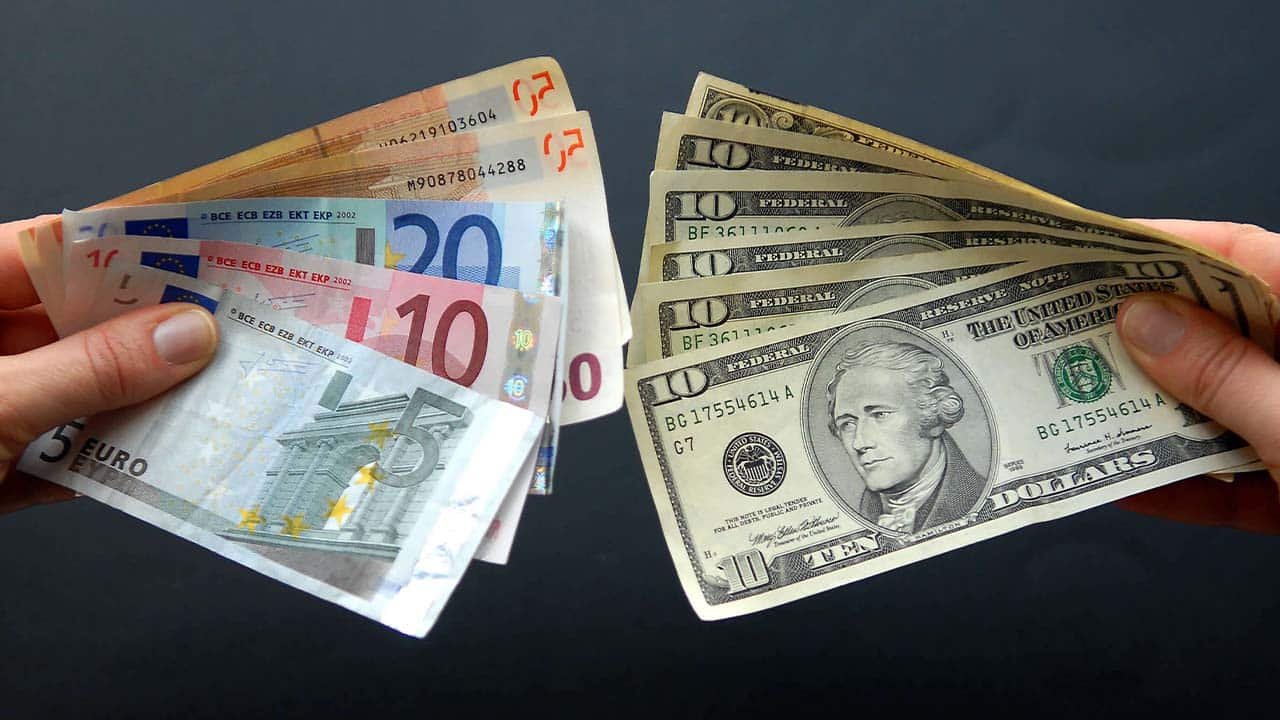
    One Euro is equal to one US dollar for the first time in 20 years

    The euro reached its lowest level in more than 20 years by 10:00 GMT on Tuesday, falling to $1.

    The stock markets declined as a result of the euro’s parity with the dollar and the possibility of additional central bank tightening as well as concerns over the global economy’s stability.

    Recent weeks have seen the US dollar soar to two-decade highs against a variety of other currencies, strengthening its position as the preferred currency for investors concerned about the economic outlook.

    A continuing rise in natural gas prices’ impact on the local economy as well as the conflict in Ukraine have made the euro particularly vulnerable. The European Central Bank has lagged behind competitors in increasing interest rates.

    The move towards parity, according to Mizuho analysts, is taking place as “the downturn in the eurozone is priced in,” and the overall environment does not appear to be improving risk sentiment.

    For the European Union, this is a “catastrophe,” according to SG Futures, as energy imports may become more expensive.

    “Energy supply is already unaffordable and as we head into winter it’ll likely get even worse,” it added on a tweet.

    The dollar index has been moving higher as a result of the euro’s weakness, as well as concerns about global economic growth as China, in particular, enforces strict zero-COVID policies to control new outbreaks.

    The presumption that the Federal Reserve will raise rates faster and further than peers is, however, arguably the main reason for the dollar’s increase.

  • Gold surges to Rs147,250 per tola in local market

    Gold surges to Rs147,250 per tola in local market

    On Monday, gold prices in the local market rose by Rs1,450 per tola to a new all-time high, pushed up by the Pakistani currency’s continued depreciation against the US dollar.

    Despite no change in gold rates in the international market, gold rates in the local market increased to Rs147,250 per tola, according to data released by the All Sindh Saraf Jewelers Association. Similarly, the price of a gramme of gold increased by Rs1,243 to Rs126,243.

    However, gold prices on the international market remained unchanged at $1,840 per ounce.

    The price of silver per tola remained unchanged at Rs1,560. The price of a gramme of silver also remained unchanged at Rs1,337.44. When compared to rates in the Dubai gold market, local jewellers said prices in the local market remained below Rs3,000 per tola.

    Pakistani rupee dips to new lows

    Experts predict that the Pakistan rupee will continue to fall against the US dollar and other major currencies owing to concerns regarding the IMF’s $6 billion program’s restoration, the country’s expanding current account deficit, and dwindling foreign exchange reserves.

    The PKR which lost 32.5 per cent of its value in the current financial year 2021-22 is forecasted to remain under stress as the dollar is in high demand in the market due to economic crises.

    The central bank appears helpless to stem the rupee’s speculative fall, as demand for the US dollar continues to rise due to quarter-end payment strain.

  • DG Khan Cement to export 50,000 tonnes of cement to the United States

    DG Khan Cement to export 50,000 tonnes of cement to the United States

    Following long and complex certification processes, D.G. Khan Cement Company Limited (DGKCL), one of Pakistan’s largest cement producers, is set to export 50,000 tonnes of the building material to the sophisticated US market.

    This is a positive development for Pakistan, which is struggling to boost exports in the face of a burgeoning trade deficit that has steered the rupee to historic depths. The process took almost ten months for the renowned industrial group to complete the necessary certifications for delivering cement to US markets after winning the contract. TXDOT, LDOT, NCDOT, and SCDOT are among the certifications available.

    According to Brecorder, the company’s CFO, Inayat Ullah Niazi, stated that a ship was currently loading cement at a port in Karachi for delivery to Houston.

    It was not easy for the company to meet the contract for a monthly supply of 100,000 tonnes of cement to Texas. In August of last year, DG Khan Cement signed a contract with a US company for the year 2021.

    Since the United States lacks cement production, it imports it from Mexico, Canada, and Turkey.

    Finally. a Pakistani cement supplier has entered the US market for the first time, as demand for the construction material has risen dramatically, with buyers looking for other options in the wake of President Joe Biden’s $6 trillion infrastructure package.

    All of the mega infrastructure in the United States, including roads, bridges, and other structures, would be rebuilt as they were nearly a century ago under the announced package.

    Pakistan exported 4.971 million tonnes cement in the first 11 months of the current fiscal year (July-May), a negative growth of 43.32 per cent, according to export data. Cement exports to Afghanistan were only 813,493 tonnes during this time, a negative 65.04 per cent increase.

    With only 1.478 million tonnes exported, exports to other countries experienced negative growth of 27.2 per cent.

    As per industry insiders, after DG Khan Cement began discovering the US market for cement exports, other larger players began the certification process for their goods.

    According to the latest figures released by the Pakistan Bureau of Statistics (PBS), the country’s exports declined by 10.22 per cent on a monthly basis in May 2022, falling to $2.6 billion from $2.897 billion in April 2022.

    D.G. Khan Cement, one of Pakistan’s largest cement producers, earned Rs4.1 billion in the nine-month period ending March 31, 2022, a 26 per cent increase in profit. In the same period of 2020-21, the company made Rs3.25 billion in profits.

    It is worth noting that the business also received orders for cement export to the Philippines back in 2020.

    With a nearly 50 per cent (Rs300 per bag) increase in the last 12 months, more price increases would be required to offset the coal cost impact.