Tag: transphobia

  • Protest after Peru classifies transsexuality as mental disorder

    Protest after Peru classifies transsexuality as mental disorder

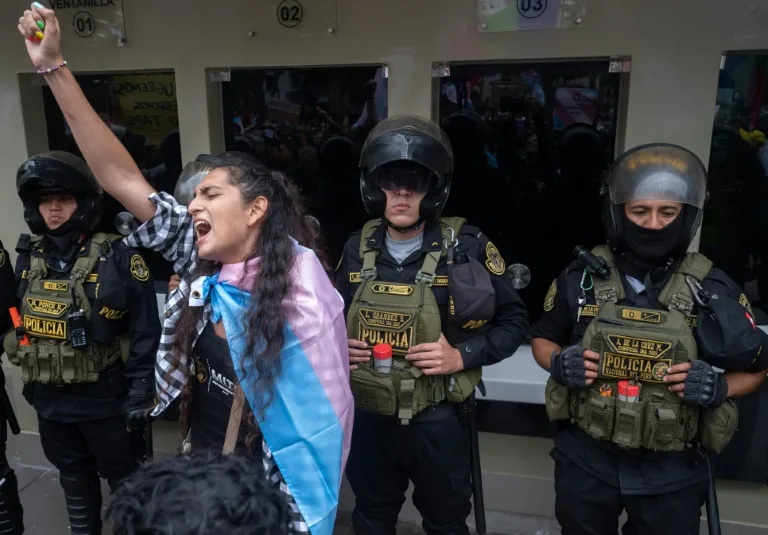
    LGBTQ groups protested Friday outside Peru’s health ministry after the government issued a decree listing transsexualism as a mental disorder.

    “It is a decree that takes us back three decades,” said Jorge Apolaya, spokesman of the Collective Pride March, a Lima-based rights group.

    “We cannot live in a country where we are considered sick,” he said.

    Transgender people are those who reject the sex they were assigned at birth. Some opt for surgical or medical intervention.

    The government on May 10 updated its list of insurable health conditions — which since 2021 has offered benefits for mental health treatment — to include services for transgender people.

    In the decree, the health ministry describes the condition as a “mental disorder” — an obsolete term long officially abandoned by the World Health Organization.

    More than 200 activists gathered outside the health ministry to demand the revocation of the decree on Friday — the International Day Against Homophobia, Biphobia and Transphobia.

    Police guard the entrance of Peru’s Ministry of Health during a protest staged by LGBTQ groups against a new government decree listing transsexualism as a “mental disorder” (Cris BOURONCLE)

    “It is a regulation that violates us … they are positioning us as sick people, as if we have a problem,” said 25-year-old Afrika Nakamura.

    With slogans like “It’s not a  disease, it’s diversity!” and “We are trans and we are not sick,” the protesters blocked the busy avenue in front of the ministry for a few hours.

    No clashes with police were reported.

    “We demand the repeal of this transphobic and violent decree, which goes against our trans identities in Peru,” activist Gianna Camacho of the Coordinacion Nacional LGTBIQ+ told AFP.

    “We are not mentally ill and we do not suffer from any mental disorder,” she added.

    The government said it would not scrap the decree.

    Health ministry official Carlos Alvadrado told AFP that doing so would “remove the right to care.”

    The ministry has previously insisted it does not consider gender diversity as an illness, and in a statement expressed “our respect for gender identities and our rejection of the stigmatization of sexual diversity.”

    It said the decree was meant merely to extend mental health coverage “for the full exercise of the right to health and well-being” of those who want or need it.

    An article on the website of Human Rights Watch describes the decree as “profoundly regressive” in a country that does not allow same-sex marriage nor for transgender people to change their identity documents.

    For Percy Mayta, a medical doctor and activist, “pathologizing” transgender people “opens the door to… conversion therapy” — which UN bodies have equated to torture and is not illegal in Peru.

    In its press statement, Peru’s health ministry underlined that “the sexual orientation and gender identity of a person does not in itself constitute a physical or mental health disorder and therefore should not be subjected to medical treatment or care or so-called reconversion therapies.”

  • What was the backlash on Aurat March’s ‘people with uterus’ post all about? An organizer explains

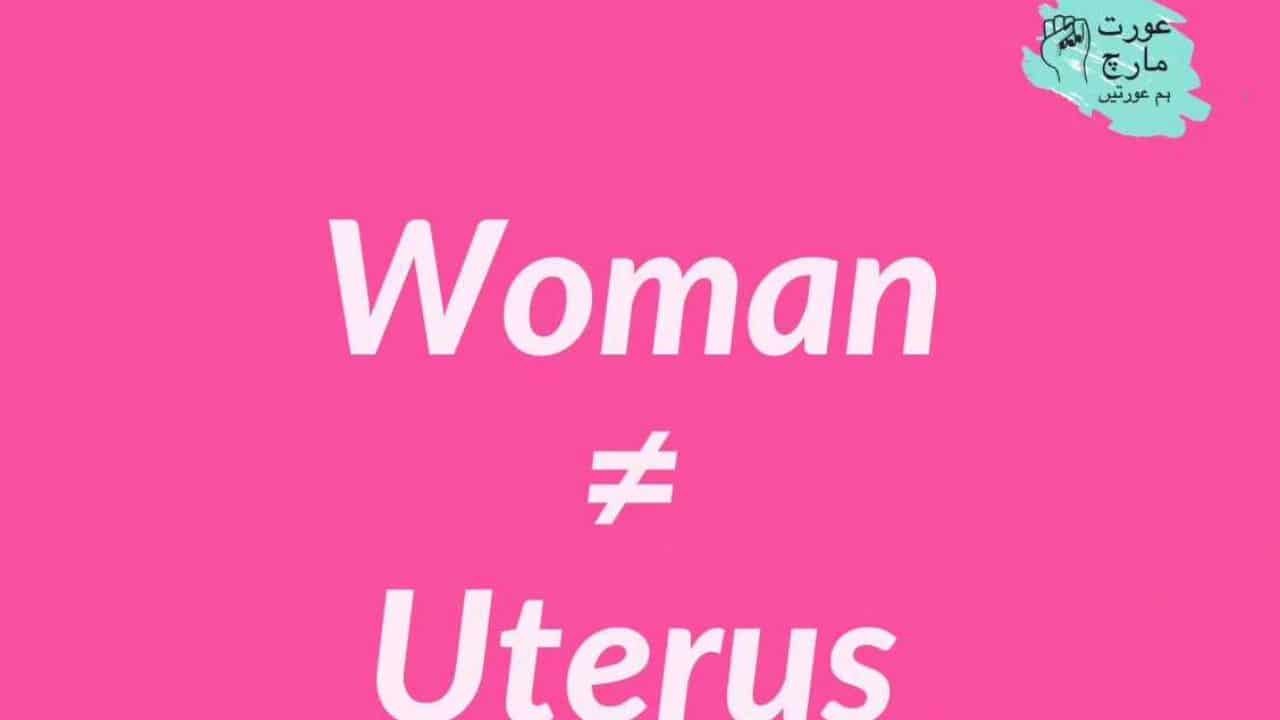
    What was the backlash on Aurat March’s ‘people with uterus’ post all about? An organizer explains

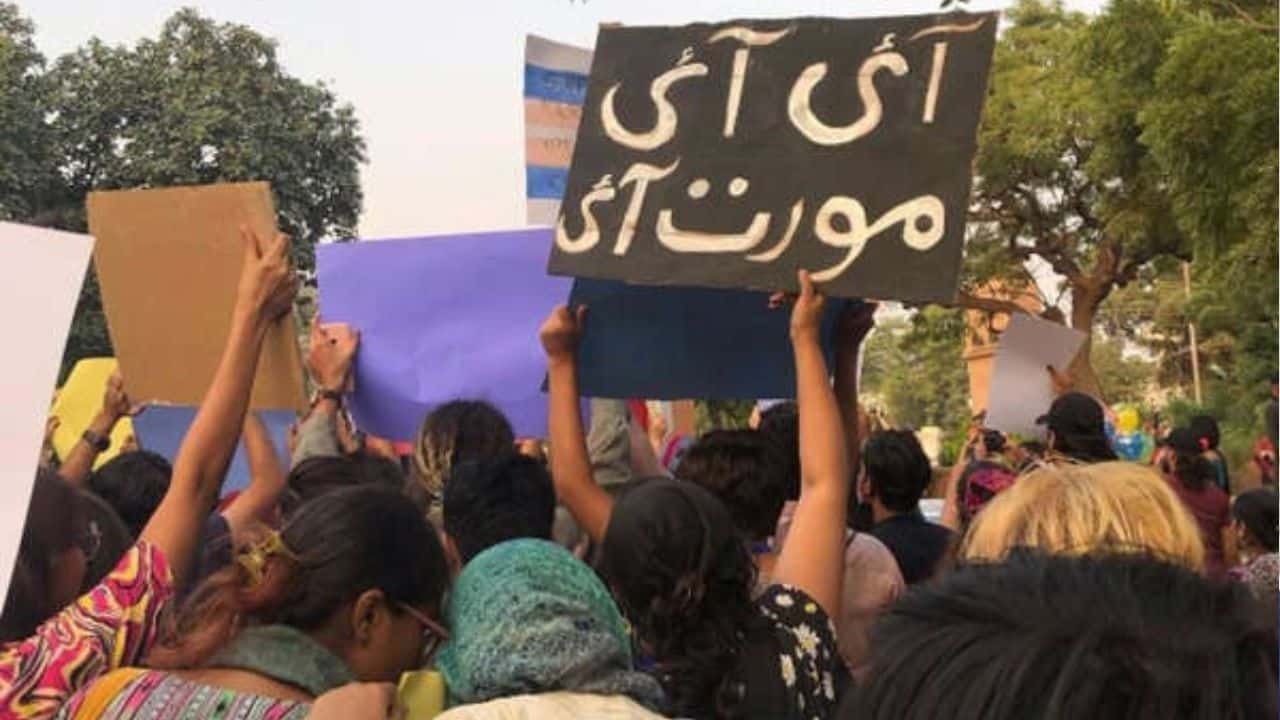
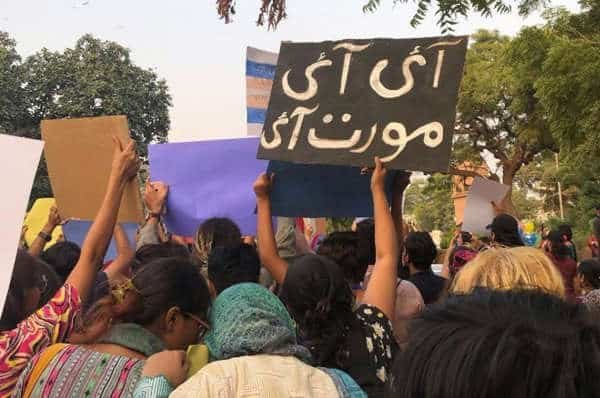
    Three days ago, the women rights movement Aurat March’s Karachi page uploaded a detailed statement on their Twitter account addressing the backlash surrounding the term ‘people with uteruses’. The term was used in a statement announcing a feminist baithak a few days ago, where women and people of other genders were invited to discuss the topic “Mensturation and Misogyny”.

    In their statement, Aurat March explained why mensturation has less to do with gender, because it’s a biological process since the uterus, or the womb is the main organ involved in it.

    “Mensturation is a biological process, with the uterus or the womb being the main organ involved in it. Needless to say, it has to do with the sex a person is assigned at birth rather than their gender. It only makes sense, then, to call anyone who mensurates a ‘person with uterus’ or ‘mensturator’.”

    “This form of criticism revolves around the deeply ingrained, patriarchal belief that a woman’s identity is inherently tied to her uterus, other reproductive organs, and ability to conceive and bear children. It is deeply misogynist, especially in our context, where many CIS women are considered baby making machines and girls are married off at a young age (often even in their teenage) with the belief that they would bear more children, often at the cost of the girl’s health or even life.”

    In their next post, Aurat March detailed on the misogynist attitude towards periods- and how it affects every person, woman or not.

    “Given that the majority of uteruses bleed almost every month for four decades, it is crucial to realize that the misogynist attitudes towards periods affect every person who mensurates- whether woman or not. We use the word misogyny here because the patriarchy views mensuration as inherently feminine thing (and hence, as cause of inferiority); therefore, this misogyny extends also to non-binary and trans-masculine mensurators.”

    “The bottom line is that the uteruses of many women, transgender men and non-binary persons (who were assigned female at birth) have been bleeding for centuries and will continue to do so.”

    The statement was slammed by several Twitter users as misogynist towards women, with Youtubers like Muzamil stepping in to label the movement elitist. To get to the bottom of the controversy and how can we craft more spaces for women, and people from the transgender community, to talk openly about their mensuration without facing backlash, we spoke with Aurat March organiser *Rosa.

    Q. What inspired you to write this statement, and did you anticipate that there would be such backlash?

    Truth be told, we did not expect the response to be this big. Aurat March regularly hosts baithaks where we discuss our politics with the poeple but also amongst ourselves. The use of inclusive and misogyny-aware language is something we’ve been consistently using over the years. Our movement is feminist and takes pride in the fact that we stand for all genders that are suppressed under patriarchy. We think the fact the tweet started with the word “people with uteruses” is what had people read it and have it make rounds.

    Q. Given the criticism the post has received, do you feel Aurat March could have worded the statement differently or toned it down?

    No. The criticism for a feminist voice in the political space has been there since day one. People criticize us mindlessly for anything that we do. They place an unfair burden of championing every single feminist issue in the country while those same men might not have gotten off their horses of privilege to raise a single finger for the feminist cause. The criticism is bandwagon-ish, misogynistic and transphobic, and it shows how much work we have to do in terms of the discourse around menstruation, the people it impacts, and the trauma of internalized misogyny that women in Pakistan carry. The hate isn’t even necessarily centered around the statement; it’s centered around Aurat March and what it represents.

    Q. Several users, including the YouTuber Muzzamil, criticised the post saying its proof that Aurat March is an elitist movement, that doesn’t address the ongoing issues faced by women in Pakistan. Do you feel this perspective is justified? 

    We think its funny that out of all the people, Muzzamil came out to call the Aurat March an elitist movement while he sits and tweets this from Dubai. There are several tiers of responses as to how the perspective isn’t justified. 

    The burden to prove whether AM is an elitist movement is not just unfair in the first place, it’s impossible to prove as well. Our marches regularly pulls in more than half of its audience from the working class communities we work with. We go and visit these hidden, impoverished and disenfranchised communities all year round: Zia Colony, Mauripur, Orangi Town, Kausar Niazi, Mehran Town, Race Course, Shikarpur, Surjani, Ibrahim Hyderi, Lyari are only some of the names. We then arrange their transport from their communities to the march as well. 

    But not just that, all that one has to do see where our priorities lie as a movement is go through our Instagram. For the last month or so, we’ve been working with effectees from Jaranwala, raising voices and protesting for the rehabilitation, protesting at Teen Talwar for recovery of Hindu missing persons while a delegation from our team has been facing harassment and abuse from the police at Jaranwala as we speak. 

    But of course, men like Muzzamil wouldn’t see the groundwork that Aurat March has done because he’s never visited these places himself, or maybe he doesn’t have binoculars big enough that can help him see all the way from Dubai. The truth is, our politics doesn’t revolve around just creating a feminist discourse or space on twitter, but a lot of people see it that way. They like to think that politics that does not exist beyond this digital space, and we couldn’t care less about these keyboard warriors. The work that we do, impacts the people we work with and it makes a difference in their lives, and that is all that the feminist cause is at the end of the day.

    Q. The ongoing backlash surrounding menstruation can have some implications on the mental health of Pakistani women because they don’t feel its safe for them to express their concerns out loud, even on social media. How can we continue to create spaces to openly speak about the issues Pakistani women want to talk about.

    We think it’s important to clarify our politics and position in this context. We believe it’s important to see a woman beyond her uterus. In many instances, this “bachadani” holds more value than her life. Her worth is gauged up on her ability to reproduce, her identity is centered around her motherhood, and her final goal is set out to become a mother. So many women lose their lives in forced pregnancies, so many battle uterine cancer and so many see their childhoods end the moment their uteruses start bleeding, married off to a man twice or thrice her age. So of course, when AM tries to separate the woman’s identity from her uterus, people lose their minds.

    It’s funny people think ‘people with uterus’ is dehumanizing language when so many people see only a uterus when they look at a woman. To think about how this experience might not be inherent to their existence would then, of course, be thought of as radical. At that same time, it’s important to remember that many women don’t necessarily have a uterus either. Alot of them have their removed due to complications, while many are simply born without one; the language is inclusive of their womanhood and identity, too. All the while, we also acknowledge all the people that menstruate or have uteruses but might not necessarily identify as women either, such transmen or non binary folks. The movement is just as much as for them and by them as it is for any gender.

    And understandably so, it becomes difficult for a woman to voice out her concerns regarding her body on social media. When our comments section becomes places of spewing hate or become dominated by men who think they’re invited to share their opinions about women’s bodies, they drown out any chances of having an open engagement and discussion on these topics. 

  • Transgender activist Zaakraa’s story takes sinister turn, wipes all previous posts

    Transgender activist Zaakraa’s story takes sinister turn, wipes all previous posts

    TRIGGER WARNING: discussion of abuse, torture, homophobia

    Zaakraa has wiped out all of her social media posts, and posted a video saying she didn’t mean what she said previously, and had said it because she had anxiety.

    “I had uploaded my last video on the recommendation of someone, and at that point I was panicking and severely depressed. I am sorry for everything, and for insulting anyone.”

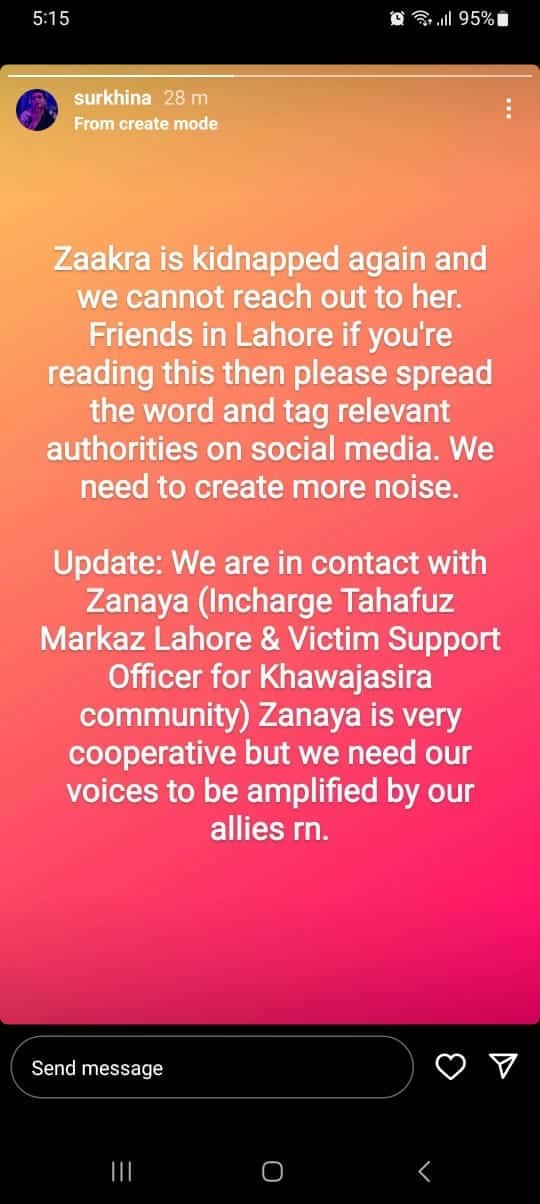
    Meanwhile, transgender activists Hina Baloch and Mehrub Moiz Awan have alleged that Zaakraa has been ‘kidnapped’ by the facility after she made public allegations of suffering abuse, torture and beatings while she stayed there.

    Mehrub Moiz revealed she was on the phone with Zaakraa for eight seconds when she heard screaming and a voice saying: “Dr Imran is here.”

    Hina Baloch requested friends from Lahore to spread the word so she may be found.

    Soon after Zaakraa took to Instagram, deleting her previous videos.

    A transgender activist who goes by the name Zaakraa has appeared back online after disappearing from social media for six months.

    She has posted videos on her Twitter and Instagram page, stating that her parents forced her to take conversion therapy at the Focus Life Rehabilitation Centre, detailing the torture and abuse she was subjected to at the hands of the doctors.

    In the video, Zaakraa says that for three months, she was stripped naked, beaten, and slapped by staff when she refused to eat because of her eating disorder. She also revealed that Dr Samina, who was present at the clinic, would question why Zaakraa was so invested in Aurat March, and other issues related to women. Another psychiatrist, Dr Imran, was informed by Zaakraa’s sister about his bisexuality. He berated the activist for his support for Aurat March and Moorat March.

    https://twitter.com/BubblesKhanum2/status/1688117427241095168?s=20

    The Current reached out to Zaakraa for a statement. She responded as follows:

    “I want Focus Life Rehab to be held accountable.”

    Zaakraa also shared pictures on her social media account of the doctors who she says were responsible for the torture and abuse during the time she was there.

    https://twitter.com/zaakraaaa/status/1688171062243315712?s=20

    We have reached out to Focus Life for a statement, and will update the article with their response.

    Prominent transgender activists like Mehrub Moiz Awan have expressed outrage on social media and called for the organisation to be shut down.

  • Pakistani transgender comedian and activist barred from using Emirates

    Pakistani transgender comedian and activist barred from using Emirates

    Pakistani transgender activist and stand up comedian Anaya Rahimi took to Twitter to share that she was preventing from boarding an Emirates flight to Tunisia because of the X gender on her card, which signifies that she is a trans woman.

    Describing the experience in an Instagram post, Rahimi said that the Emirates staff misbehaved with her, prohibiting her from travelling as trans people are not allowed to board their planes, despite her efforts to communicate with them.

    “When I went to emirates check in Lahore @lahoreairport the @emirates staff there stopped me and insulted me first because of my gender they along with there manager used transphobic slurs and then told me that you cant travel as @emirates does not allow trangender people to travel. I tried my best to argue and make my case presented the email approval by emirates and told that I confirmed from headoffice too but they shut me down and asked guards to escort me out didn’t let me use my phone as well.”

    Since the post went viral on Twitter, transgender activists like Shahzadi Rai, who was previously prevented from using FlyDubai because of her gender identity, condemned the airline and called for authorities to take action against the organisation.

    https://twitter.com/Bubbleskhanum/status/1675907955055636493?s=20
  • ‘Don’t label things as agenda without knowing the complete context’: Muneeb Butt responds to Maria B’s criticism of Sar-e-Rah

    ‘Don’t label things as agenda without knowing the complete context’: Muneeb Butt responds to Maria B’s criticism of Sar-e-Rah

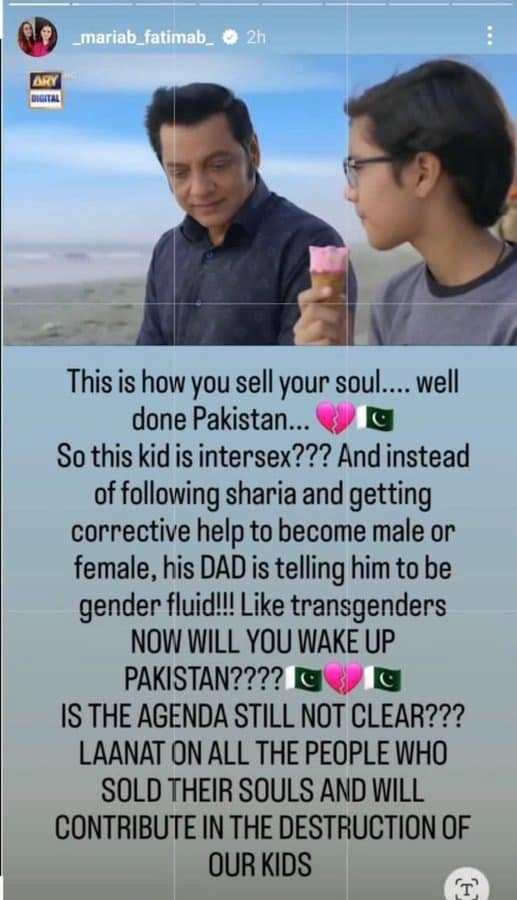
    When Sar-e-Rah aired its fourth episode, the story shifted to the struggles of an intersex boy who struggled to get love and acceptance from his family, and was determined to work hard and make his father proud. A significant moment in this episode which had caused social media users to declare it as the best television series of the decade, was an interaction between father and son when he explained to his child that it was okay to embrace gender fluidity.

    However, fashion designer Maria B had criticized the episode for encouraging acceptance of the transgender community, and called the actors who had taken part in the show ‘sell outs’ who were contributing to the destruction of Pakistan.

    In an interview with Maliha Rehman, actor Muneeb Butt addressed the criticism of the episode being ‘anti-Islamic’ by calling it wrong and entirely taken out of context.

    “I was disappointed to listen to her accusation because we are not anti-Islamic, we are Muslim, as well as the writers who wrote this script. We have a problem that we are quick to label other people as having agendas, or we distribute certificates that they’re anti- Muslim or taking an anti-Islamic stance. We think that we’re right, and the other people around them are wrong…When I read this drama, I was analyzing that there is nothing insensitive being spoken, clashing with my Islamic beliefs, and I didn’t think it was contradicting any Islamic value.”

    Butt addressed the scene which was slammed by B and other right wing critics as promoting ‘vulgarity’, by explaining that these critics had not taken into account the back story of these characters to understand the scene properly:

    “You should listen to the context behind this clip. If you watch a clip and judge an entire drama from this, then you’re completely wrong. No one can predict an entire drama from just a clip, because you don’t remember what happened before it. Before this, the father had seen his son dancing like a woman and wearing makeup, and his mother was forcing him to do this. The dad simply asked him did he want to do all of this in the bathroom, to which the son responded yes he does. The father is silent for a minute, then again asks ‘Beta, if you like doing this then tell me. I won’t feel bad at all.’ Then the son says ‘Baba, I don’t want to do this.’ It’s after that the father gently explains to him that right now his son is young but when he grows up that’s when you will learn to understand the feelings inside your body. He wasn’t saying that it’s your choice if you want to become a girl or a boy. The father was trying to make his son understand that the feelings your body is trying to tell you, whether you’re a male or female, that is something you will decide on your own. Right now it’s not necessary for you to figure out these things, you have to focus on your studies. This is the entire context, and it was beautiful how the father was encouraging his son to keep moving forward and study hard.”

    Given the entire context, Butt slammed critics for labeling him and the rest of the ‘Sar-e-Rah’ crew, saying it could have placed his life in danger.

    While social media overflowed with different takes on Sarang’s character, Butt had chosen to remain silent and did not address the allegations on social media. Butt explained that he had planned to write a note as soon as episode 6 came out, when Sarang gives a speech at a convocation.

    Butt revealed that the wife of a prominent actor had reached out to him when this episode had aired, and had sent him an audio note which said some things that proved she wasn’t happy with the drama.

    “It was her right to say all of these things because we make shows for the public. It’s their right to tell us about their opinions about our dramas, but for that you need to watch the complete episode to understand the context rather than judging it from a small video clip.”

    Listen to the complete interview here:

  • Two transgender activists barred from Fly Dubai plane because of X gender

    Two transgender activists barred from Fly Dubai plane because of X gender

    Transgender activist Shahzadi Rai has said on Friday that Fly Dubai had barred her and another transgender activist from travelling on their flight.
    Rai took to Twitter to share her experience with Fly Dubai stating that she and her Project Manager Zarish were barred from travelling from Karachi to Dubai because of her X gender.
    The activist who works with the Gender Interactive Alliance narrated the incident in a video clip.

    “We had a flight to attend our annual meeting, me and my project manager, Zarish. But they cancelled our ticket because we had written X in our gender category. This is extremely transphobic.”

    In the next tweet, Rai shared a screenshot of her flight ticket and wrote that although transgender people are a part of mainstream community in other countries, it was shocking to witness Fly Dubai indulge in transphobic behavior.
    “Transgender persons are part of the main stream in other countries but Fly Dubai doesn’t allow x-gender cards to travel, Transphobic behaviour by Fly Dubai, if they don’t allow us to travel on their plane, why did they issue a ticket.”

    Since this post was uploaded yesterday, many transgender activists and otter public figures have criticized the airline. Transgender activists like Mehrub Moiz Awan and Hina Baloch slammed Fly Dubai on their twitter accounts, and have called for Pakistan’s Foreign Office to address the matter.

    Fly Dubai has yet to issue a statement regarding the matter.