Tag: trust

  • Listen to your body, trust your instincts: ZaraNoor Abbas has advice for new moms

    Listen to your body, trust your instincts: ZaraNoor Abbas has advice for new moms

    Zara Noor Abbas just had a baby girl named Noor-e-Jahan with her husband Asad Siddiqui. Usually, people talk a lot about the happiness of having a new baby, but Zara wanted to talk about something else too. She went on Instagram to discuss the postpartum period.

    Zara posted pictures with her daughter and photos of cute things like white booties, a pink cake, and toys. There was even a poster saying ‘Welcome home, baby Noor-e-Jahan and Mommy.’ Zara also said thank you to everyone who has been supporting her, like her fans, friends, and family. She talked about how becoming a mom changed her life, making her feel like she had everything she needed.

    “First and foremost- Thank you to all my friends and family and my amazing fans for all the pyaar and duayein (love and prayers). I read all your comments and messages,” Abbas penned in the caption. “It’s just Insane. The journey from nothingness to everything. This rush of joy and power. The feeling that I can conquer anything now. The nourishment of empowerment and love.”

    She continued, “The tears, the all-nighters, the difficulties in understanding what the baby wants. Which cry will signal me of a particular task/action. How to position the head – how to lengthen the body, how to massage the fragile bones that you can hear sounds of.”

    Zara openly talked about the challenges of understanding her newborn’s needs, learning how to take care of a baby, and the confusing feelings that come with the time after giving birth. She stressed how important it is for new moms to accept help, take care of themselves, and be proud of what they’ve achieved without feeling like they have to be perfect.
    She added, “The questions that will only be answered by spending alone time with the baby. The pressure to know it all in these 40 days. It’s superior! It’s a lot! And I feel like we don’t talk much about the journey after the birth. Postpartum. It’s real. It’s as real as pregnancy.”

    Zara highlighted the strength that comes with being a mom, encouraging other new moms to recognize their own strength and ask for help when they need it. She wanted to make it normal to talk about the challenges after giving birth, hoping to reassure other moms that they’re not alone in their journey.

    The Jhoom actor had a message for new moms: take control of your post-baby journey. “To all the new moms, don’t feel like you have to be a superhero. You already became one by giving birth with God’s help. Now, take a break. Let others help you. Rest. Eat. Sleep. Nap. You can tell people to leave you alone. Don’t follow advice you don’t like. Swaddle the baby how you want. Feed the baby however you want. Do what feels right for you,” she commented.

    Abbas ended with an important reminder: “Listen to your body and your motherly instincts.” She emphasized the need to be patient, saying, ‘It will take time to recover, but you’ll be okay, I promise. You know why? Because you’re a mom. And moms, wow, we know how strong they are, don’t we?’”

  • TikTok is the fastest growing platform among social media apps: report

    TikTok is the fastest growing platform among social media apps: report

    Data from the Reuters Digital Media Report 2022 shows that among users of social media platforms, TikTok took over Snapchat and Telegram in 2021 and 2022 respectively, across the world. It is the fastest growing platform among all social media channels. In 2021, only five per cent of the global audience was using TikTok and this number has grown to 16 per cent in 2022. Snapchat audience decreased by one per cent to 12 per cent while Telegram has seen an increase of five per cent with new global audience of 12 per cent.

    The table shows change in audiences using Snapchat and TikTok

      2020 2022 Change
    TikTok 5 per cent 16 per cent 11 per cent
    Snapchat 13 per cent 12 per cent -1 per cent

    Social media usage has also increased throughout the world.

    Trust in BBC falls by 20%

    Data mentioned in the report also shows that the average level of trust in news networks globally has reduced by eight points from 50 per cent to 42 per cent in a year. Moreover, in the UK, the proportion of people not trusting BBC has increased from 11 per cent to 26 per cent while the proportion trusting BBC has fallen by 20 per cent.

    The attached graph shows how the UK audience’s trust in the BBC has dwindled over time.

    Another important thing to notice is that TikTok is not just being used for fun videos. It is also emerging as a new player in the news ecosystem. More and more people are turning to TikTok for their news. It has also taken over Snapchat for news as well.

      2020 2022 Change
    TikTok 1 per cent 7 per cent 6 per cent
    Snapchat 3 per cent 2 per cent -1 per cent
    Audience is less interested in news

    Globally, the interest of people in news is falling. The proportion that says they are extremely interested in the news has fallen sharply over time. On average, in 2015, 67 per cent of global audiences was interested in the news while this number declined to 47 per cent in 2022 with a change of -20 per cent.

    Country 2017 2022 Change
    Argentina 77 per cent 48 per cent -29 per cent
    Brazil 82 per cent 57 per cent -25 per cent
    Spain 82 per cent 55 per cent -27 per cent
    UK 65 per cent 43 per cent -22 per cent
    USA 68 percent 47 per cent -21 per cent
    Consumers are avoiding the news

    The report also says that 38 per cent of the audience actively avoided news in 2022. The audience becoming least interested in the news has been increasing from 2017 to 2022 in every country except for Italy. The attached graph shows the percentage of people staying away from news in different countries.

    The most common reason for avoiding news is politics and Covid-19. Data shows that 43 per cent of users avoid the news because of excessive news regarding Covid-19 and politics. Moreover, 36 per cent of the audience thinks that the news has a negative impact on their mood.

    People under the age of 35 struggle to understand news

    People under 35 are also finding it hard to understand the news and it is causing them to avoid the news.

    Younger audiences want journalists to express personal opinions

    Data from the report shows that 46 per cent of the population between the ages of 18-24 do not want news channels to just report news on social media but want them to express their personal opinions alongside reporting news, while the opposite is true for people of age 55+. 57 per cent of older people want news channels to stick to reporting the news. The older the consumer, the more the proportion of them want journalists to stick to just posting news on social media.

    Majority uses smart phones to access morning news

    In most countries, the majority use mobile phones to access news in the morning with the highest percentage being 43 per cent in Norway. In most countries, the least used medium for news is print media. The 2021 report shows that the lockdown during Covid-19 proved to be a nail in the coffin for print media.

    Younger audiences prefer watching the news rather than reading it

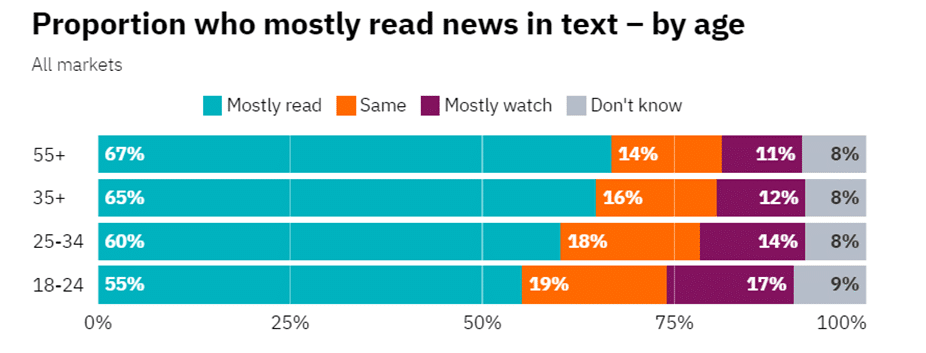
    Although the significant majority still prefers reading news irrespective of age, data reveals that people aged 18-24 prefer watching the news (17 per cent) which is more when compared to older people (11 per cent for age above 55). The younger you are, the more you prefer watching the news rather than reading about it.

    Key findings in Digital Media Report 2021

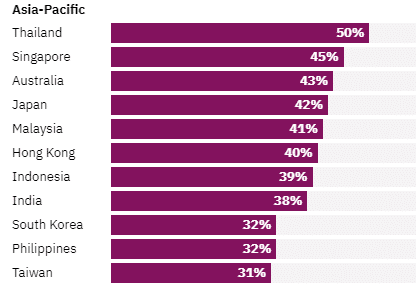
    Data from the digital media report last year (2021) showed that the trust level for news reports in Asia-Pacific is no more than 50 per cent with the most being in Thailand. It is important to notice that the USA is reported to have a trust level of 29 per cent in the news, which is the lowest of all 46 countries selected for the report. The report says it is the aftermath of deep division over the US ‘stolen election reports’ and the killing of George Floyd.

    To measure the trust level, people were asked to indicate if they trusted the news posted on social media,

    Other key findings of last year’s report showed that Facebook, which was known for Covid-19 misinformation, was still used by 32 per cent for news and the most successful social media platform was YouTube.